 Скачать презентацию CH 8 BIRTH AND RISE OF ISLAM AND
fae8b93b2f8c8829d2db6f29d65e9735.ppt
- Количество слайдов: 23



CH 8 BIRTH AND RISE OF ISLAM AND ISLAMIC EMPIRES
We move now to the Arabian peninsula to speak about a people called the ARAB BEDOINS (400’S-600’S CE) Animistic –Polytheistic desert and sea merchants of the Arabian Peninsula, northern Africa, and the Middle East They committed plenty infanticide on girl newborn because of the need of young male workers and less food and resources to distribute among girls who could not be as “profitable” as the boys (or men). The Arabs were in constant competition and betrayal, until a little boy felt there was something wrong about his people, and one day he would grow up to be a man and according to sacred scriptures, he would receive a message from an angel. The angel told him that there was only one God and that he must spread this news to all people and encourage them to submit to one God. The man’s name was MUHAMMAD (570 -632 CE) In 600’s CE, Muhammad received a message from an angel that there was only one God known as ALLAH The name of God in Arabic, who is considered the same God of the Jews and Christians, but now Muhammad is his last and most significant prophet ISLAM Means “submission to one God” and all those who believe Muhammad is Allah’s prophet are known as MUSLIMS The followers of Islam KORAN (QURAN) The sacred teachings of Muhammad were written by his disciples during his life. According to Muhammad, there were 5 pillars that all people must follow 5 PILLARS OF ISLAM According to the Koran, Muhammad taught that all Muslims must do 5 mandates during their lives 1 - To recognize that there is only one God, known as Allah and Muhammad is his prophet 2 - Pray 5 times daily facing Mecca: The most holy city of Islam 3 - To fast during the Muslim calendar month called the “Ramadan” 4 - Protect and serve the poor 5 - make a pilgrimage to the holy city of Mecca When Mohhamed died, religious successors emerged known as the CALIPH Theocratic leaders who were known as the “successors of the prophet” But even before Muhammad died, Arabia had already and rapidly converted to Islam. But they believed that it was their ultimate goal to spread Islam through missionaries or conquest known as
ARAB BEDOUINS (400’S-600’S CE) Animistic –Polytheistic desert and sea merchants of the Arabian Peninsula, northern Africa, and the Middle East
MUHAMMAD (570 -632 CE) In 600’s CE, Muhammad received a message from an angel that there was only one God known as ALLAH The name of God in Arabic, who is considered the same God of the Jews and Christians, but now Muhammad is his last and most significant prophet
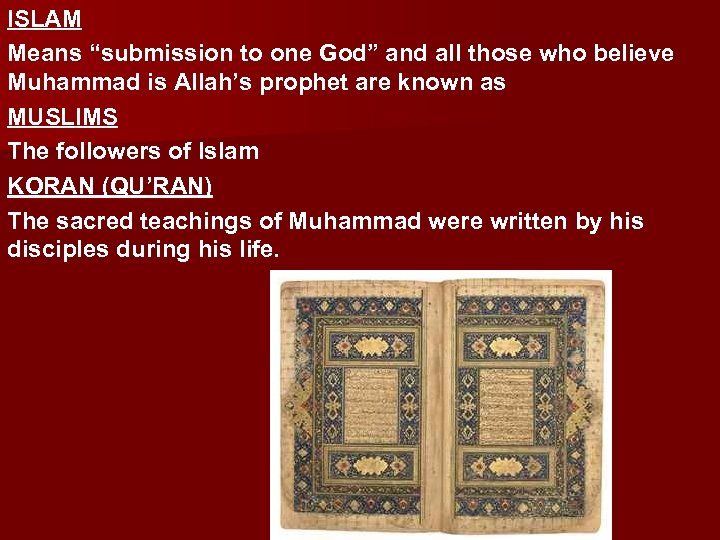
ISLAM Means “submission to one God” and all those who believe Muhammad is Allah’s prophet are known as MUSLIMS The followers of Islam KORAN (QU’RAN) The sacred teachings of Muhammad were written by his disciples during his life.
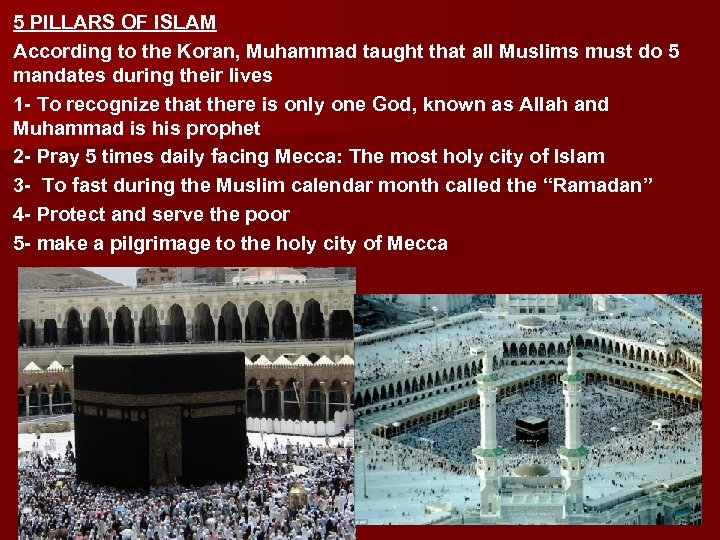
5 PILLARS OF ISLAM According to the Koran, Muhammad taught that all Muslims must do 5 mandates during their lives 1 - To recognize that there is only one God, known as Allah and Muhammad is his prophet 2 - Pray 5 times daily facing Mecca: The most holy city of Islam 3 - To fast during the Muslim calendar month called the “Ramadan” 4 - Protect and serve the poor 5 - make a pilgrimage to the holy city of Mecca
CALIPH Theocratic leaders who were known as the “successors of the prophet”
DAR AL ISLAM Ideology that the world must submit to Islam’ religious and political beliefs thus commiting JIHAD (HOLY WAR) The idea that if the world does not submit to Islam, then ultimately it is a “house war” until dar-al Islam is achieved With that Muslim kingdoms would rise out of Arabia and declare war or missionary work to spread the doctrine of Islam. Note: many Muslims today that are moderate believe that dar al Islam is the ideology of Muslims freely to worship where they want. But radicals believe that it must be spread by any means necessary. ISLAMIC EXPANSION (600’S-1200’S) Through conquest and missionary-traders, Islam expanded into Iraq, Persia, Syria, Palestine, Egypt, and North Africa, Spain, Italy, Eastern Europe, and northern India UMAYYAD CALIPHATE (661 -750 CE) One of two Caliph empire that chose their Muslim leaders through a council of Islamic leadership But there would be a rival that claimed that the caliph was not meant for councils of Islamic leadership to rule but rather descendants of Mohammad. They were known as the ABBASID CALIPHATE (750 -1258) Challenged the Umayyad claiming that the successor of Muhammad (the caliph) MUST be a descendant or family of Muhammad SUNNI MUSLIMS Supporters of the Umayyad who make up the vast majority of Muslims (80%) SHIITE MUSLIMS Supporters of the Abbasids who believed that the caliph must come from a direct family member of Mohammed and are convinced that the Koran was tampered by the Sunnis. Ali, the son in law who was killed in war, is the so-called descendant of Mohammad. As the Muslims expanded into India, many poor indians of the outcast system became exceeding attracted to Islam, a religious concept that all are equal under God’s eyes and therefore converted. Many, however, preserved Hindu enlightenment and mystic beliefs so syncretism emwerged with Islam's Hindu Indians creating a new religious docrine branched out of Isslam called SUFISM (700’s) Syncretic faith of Hindu enlightenment and mystic beliefs with Islamic doctrine in northern India (pd Pakistan) * we will cover more details on India and Islam in Ch 10 PEOPLE OF THE BOOK Islamic empires recognized Moses and Jesus as significant prophets and therefore treated Jews and Christians with compassion Nevertheless, Islam did impose higher taxation on Jews and Christians who refused to convert to Islam. However, Hindus, due to their polytheistic beliefs, were butchered and their idols destroyed as we will later learn. But because of extensive taxations, at times the people of the Islamic empire rebelled. Nevertheless, Islam reached a culural glden age of greatness. While Europe was plunged in to a dark age, Islam became a cultural bedrest. ABBASID CALIPHATE AND ISLAM’S GOLDEN AGE ERA(750 -1258) For 5 centuries, Islam would endure a classical age of culture, literature, and centralization BAGHDAD The capital of the Abbasid Empire where stability and economic growth emerged HAROUN AL-RASHID (R. 786 -809) The most famous Abbasid Caliph who became the legacy of Islam’s golden age HOUSE OF WISDOM (Bayt al-Hikma) Haroun Al-Rashid’s magnificent library of learning and research that symbolized the militarily, cultural, and political advancement of tha Abbasid Caliphate They took one of Muhammad’s sayings indicating that the ink of the scholar is more holy than the blood of the martyr. A legacy of this golden era. Gradually, however, with constant foreign attacks, diverse groups under rule, and the split of sunni shoite the abbassid caliph’s golden age came to a hault.
DAR AL ISLAM Ideology that the world must submit to Islam’s religious and political beliefs thus committing JIHAD (HOLY WAR) The idea that if the world does not submit to Islam, then ultimately it is a “house war” until dar-al Islam is achieved
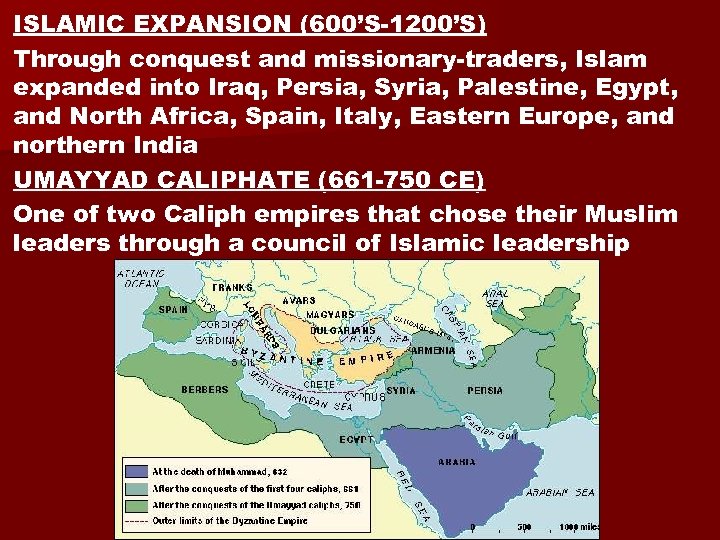
ISLAMIC EXPANSION (600’S-1200’S) Through conquest and missionary-traders, Islam expanded into Iraq, Persia, Syria, Palestine, Egypt, and North Africa, Spain, Italy, Eastern Europe, and northern India UMAYYAD CALIPHATE (661 -750 CE) One of two Caliph empires that chose their Muslim leaders through a council of Islamic leadership
ABBASID CALIPHATE (750 -1258) Challenged the Umayyad claiming that the successor of Muhammad (the caliph) MUST be a descendant or family of Muhammad SUNNI MUSLIMS Supporters of the Umayyad who make up the vast majority of Muslims (80%)
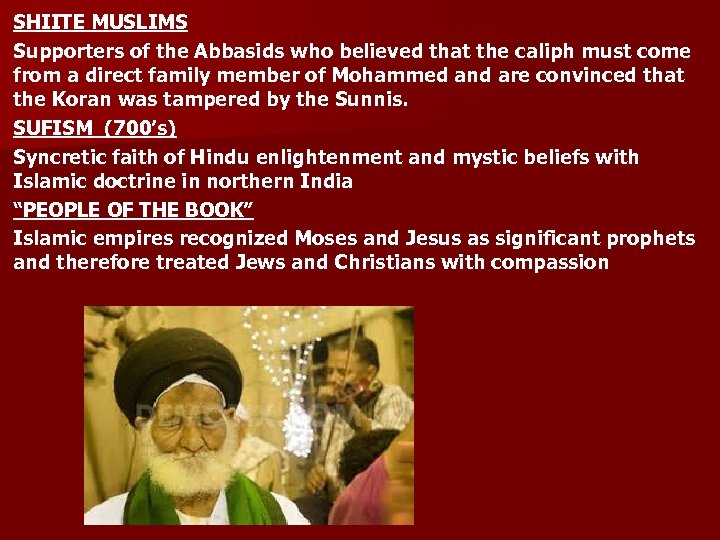
SHIITE MUSLIMS Supporters of the Abbasids who believed that the caliph must come from a direct family member of Mohammed and are convinced that the Koran was tampered by the Sunnis. SUFISM (700’s) Syncretic faith of Hindu enlightenment and mystic beliefs with Islamic doctrine in northern India “PEOPLE OF THE BOOK” Islamic empires recognized Moses and Jesus as significant prophets and therefore treated Jews and Christians with compassion
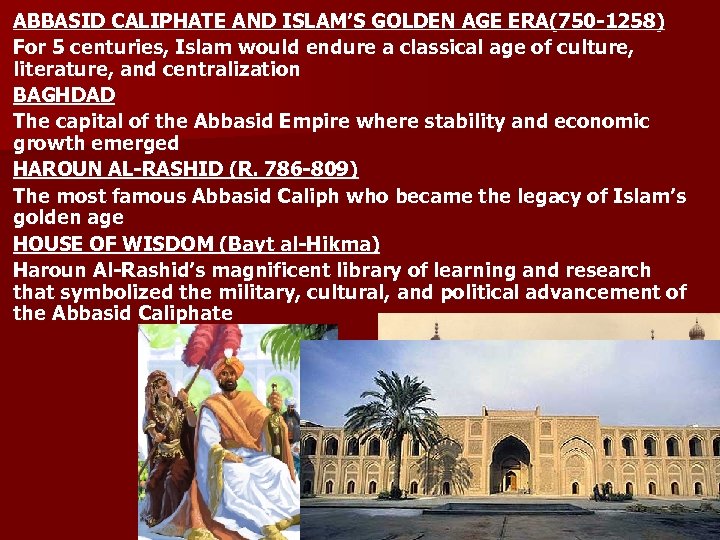
ABBASID CALIPHATE AND ISLAM’S GOLDEN AGE ERA(750 -1258) For 5 centuries, Islam would endure a classical age of culture, literature, and centralization BAGHDAD The capital of the Abbasid Empire where stability and economic growth emerged HAROUN AL-RASHID (R. 786 -809) The most famous Abbasid Caliph who became the legacy of Islam’s golden age HOUSE OF WISDOM (Bayt al-Hikma) Haroun Al-Rashid’s magnificent library of learning and research that symbolized the military, cultural, and political advancement of the Abbasid Caliphate
MONGOL SIEGE ON BAGHDAD (1258) Many factors caused the gradual fall of the Abbasid caliph, but the final storm came in 1258 with Mongol’s brutal assault. They took down Baghdad and mutilated the last caliph, CAUSED ATROCITIES, DESTROYED THE HOUSE OF WISDOM AND THE GOLDEN AGE OF Islam comes to a sudden halt NORTHERN (SAHARA) AND SUB-SAHARA AFRICA Unlike most of Middle East and Europe, Islam mostly (not entirely) grew due to Arab traders AFRICAN RESOURCES Caravans from the north brought metals, potteries, glass, cloth while caravans from the south brought slaves, salt, ivory, and animal salt, skin BERBERS (BERBER STATES) The most powerful group of Arab-African Muslims dominating northern Africa (Sahara) MALI (1260 -1460) The most powerful western Muslim empire of sub-Saharan Africa that became Muslim through Arab traders SUNDIATA KEITA (SON-JARA) 1200’s Founder of Mali empire of sub-sahara Africa providing rich resources to Arab traders especially salt and slaves TIMBUKTU Mali’s vital metropolis for trading and a learning center where caravan traders fused MANSA MUSA (1312 -1337) Mali Emperor who converted to Islam and established wealth, prosperity, and Islamic influence in Sub-Saharan One thing to note is that Mongols conquered brutally, but then traded extensively. Once Mongols occupied an area they traded extensively. Understanding that Arab Mulsims loved slaves, the Mongols not only brought slaves in to the Middle East to trade with Arabs but also had taught their slaves and others to be expert horsemen. As a tresult, a group of Mongol subjects would one day learn and migrate in to Eastern Euriope and the Middle East known as the Turks. MAMLUK TURKS Many of them were brought by the mongols as slaves to tarde with the Arab world, but through generations the Mamluks migrated to Egypt and gradually became SLAVE DYNASTY OF EGYPT Mamluks eventually moved up in political positions in Egypt due to their horse riding abilities (learned from the Mongols) MAMLUK VS. MONGOLS (Battle of Ain Jalut, Syria, 1260) Mongols attempted to overthrow Egypt but the Mamluks stopped them at Syria, which is why Africa was never conquered by the brutal Mongols SELJUK TURKS Also learned Mongol horseback riding techniques from the Mongols and occupied Anatolia SELJUK VS. MONGOLS (1241 -1243) Ironically, Seljuks stopped the Mongols from conquering anatolia which prevented Mongol exopansion in to Eastern Europe SELJUKS VS. BYZANTINE (1200’s-1300’s) But the Seljuks crippled many of the defensive posts of the Byzantine empire which caused the beginning of the end of Byzantium
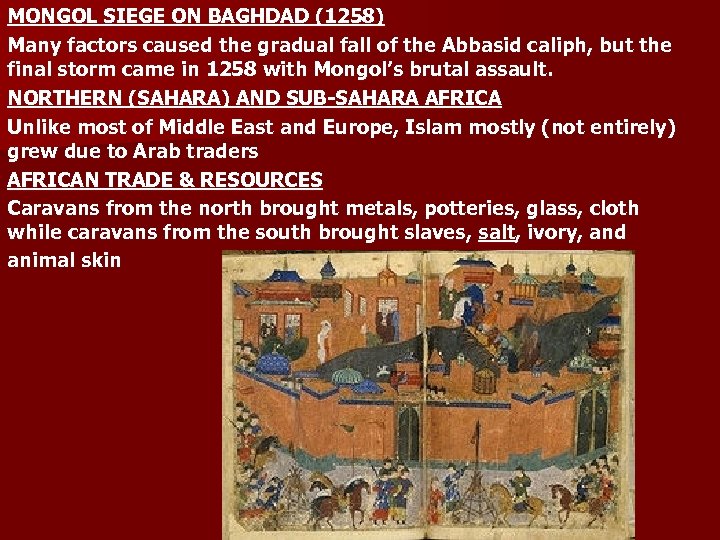
MONGOL SIEGE ON BAGHDAD (1258) Many factors caused the gradual fall of the Abbasid caliph, but the final storm came in 1258 with Mongol’s brutal assault. NORTHERN (SAHARA) AND SUB-SAHARA AFRICA Unlike most of Middle East and Europe, Islam mostly (not entirely) grew due to Arab traders AFRICAN TRADE & RESOURCES Caravans from the north brought metals, potteries, glass, cloth while caravans from the south brought slaves, salt, ivory, and animal skin
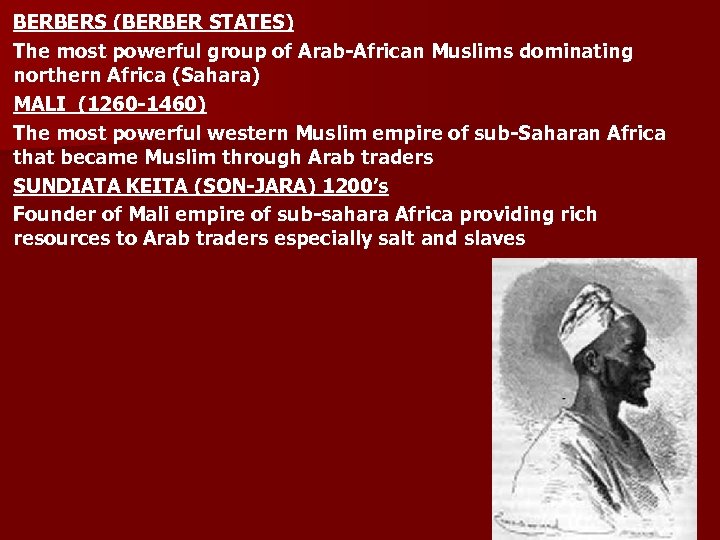
BERBERS (BERBER STATES) The most powerful group of Arab-African Muslims dominating northern Africa (Sahara) MALI (1260 -1460) The most powerful western Muslim empire of sub-Saharan Africa that became Muslim through Arab traders SUNDIATA KEITA (SON-JARA) 1200’s Founder of Mali empire of sub-sahara Africa providing rich resources to Arab traders especially salt and slaves
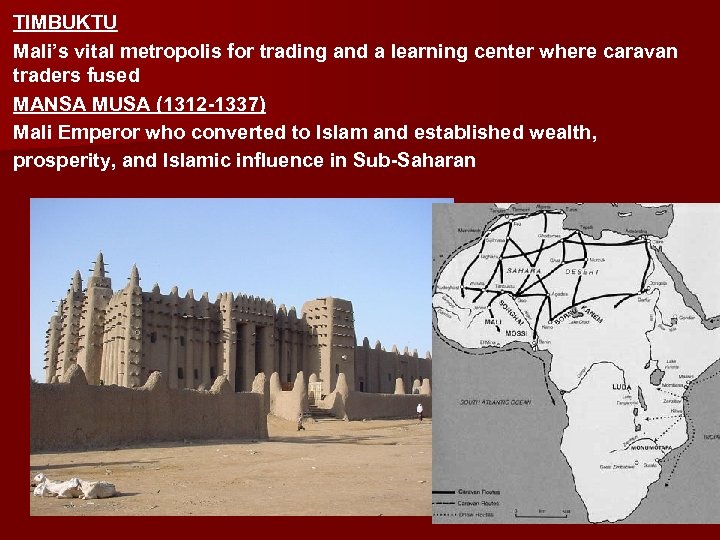
TIMBUKTU Mali’s vital metropolis for trading and a learning center where caravan traders fused MANSA MUSA (1312 -1337) Mali Emperor who converted to Islam and established wealth, prosperity, and Islamic influence in Sub-Saharan
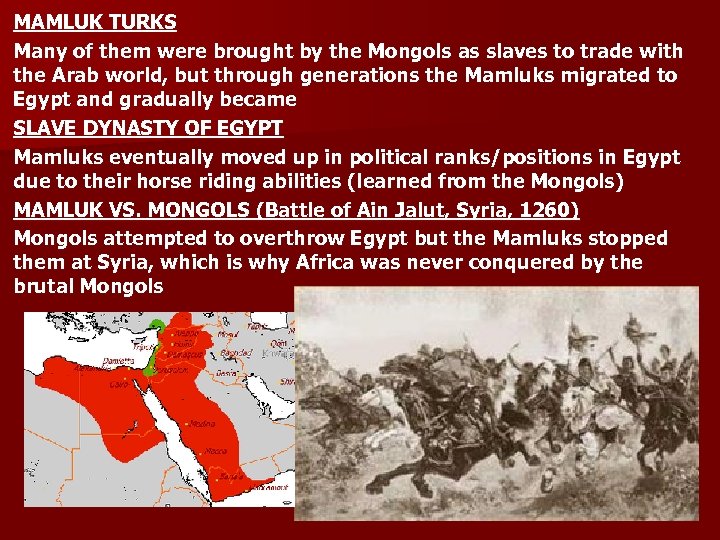
MAMLUK TURKS Many of them were brought by the Mongols as slaves to trade with the Arab world, but through generations the Mamluks migrated to Egypt and gradually became SLAVE DYNASTY OF EGYPT Mamluks eventually moved up in political ranks/positions in Egypt due to their horse riding abilities (learned from the Mongols) MAMLUK VS. MONGOLS (Battle of Ain Jalut, Syria, 1260) Mongols attempted to overthrow Egypt but the Mamluks stopped them at Syria, which is why Africa was never conquered by the brutal Mongols
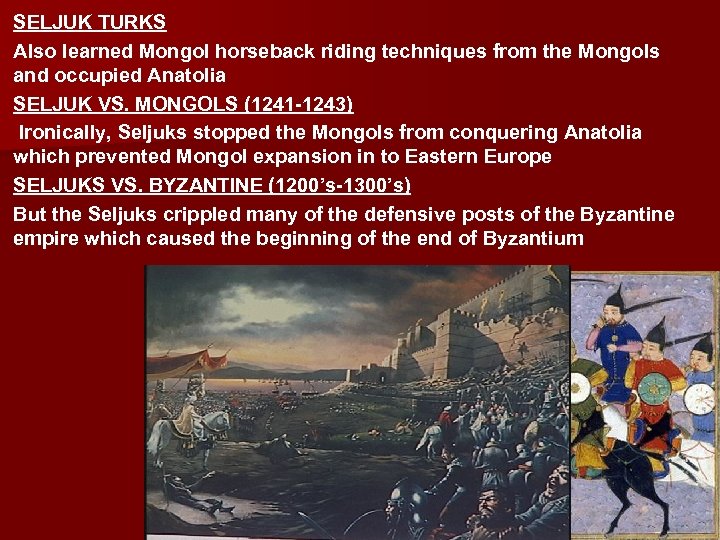
SELJUK TURKS Also learned Mongol horseback riding techniques from the Mongols and occupied Anatolia SELJUK VS. MONGOLS (1241 -1243) Ironically, Seljuks stopped the Mongols from conquering Anatolia which prevented Mongol expansion in to Eastern Europe SELJUKS VS. BYZANTINE (1200’s-1300’s) But the Seljuks crippled many of the defensive posts of the Byzantine empire which caused the beginning of the end of Byzantium
OTTOMAN VS. SELJUKS Led by Osman I (1299) the Seljuks were eventually subdued MEHMET II (1253) Sultan Turk of the Ottomans who was first to ever use sed gun powder artillery in history and finally crushed the Byzantine Empire OTTOMAN EMPIRE (1299 -1922) Would overthrow Byzantine and become a dominating force of Sunni Muslims stretching from Middle East, to Eastern Europe and Africa The Ottomans, being Turks, would never endure the internal peace and stability of the Abbasid golden age. But the Ottoman did become successful under Suleiman the magnificent With Islam at a rise during the Middle Ages, great achievements took place. While Europe was plunged in a dark age, and was slowly coming in to the renaissance, Islamic empires and caliphates were in a prosperous era ISLAMIC ACHIEVEMENTS Medicene, literature, philospohy, religios doctrine and law (sharia), architectural elaborate designs and buildings and more demonstrate Islam’s long lasting legacy compared to Europe’s backlash of the Middle Ages ARABIAN NIGHTS (1, 001 NIGHTS) A collection of stories told by many Islamic writers throughout the Muslim world where a fictional girl narrates the many stories such as Aladin, Sinbad, and Ali Baba and the 40 thieves
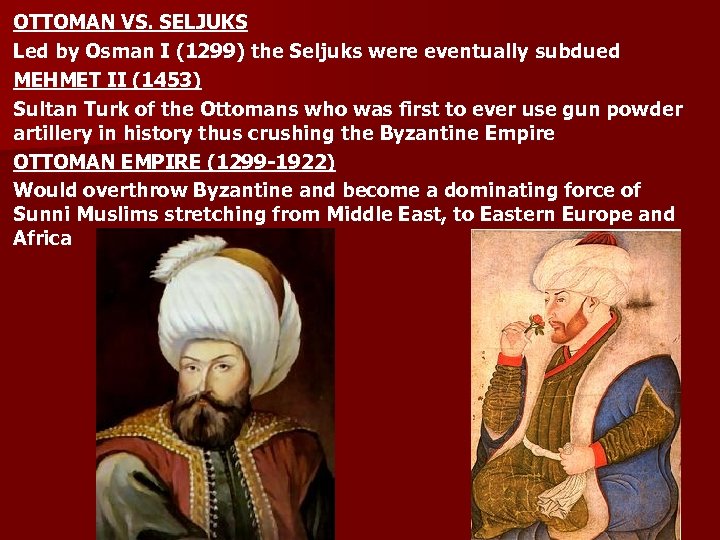
OTTOMAN VS. SELJUKS Led by Osman I (1299) the Seljuks were eventually subdued MEHMET II (1453) Sultan Turk of the Ottomans who was first to ever use gun powder artillery in history thus crushing the Byzantine Empire OTTOMAN EMPIRE (1299 -1922) Would overthrow Byzantine and become a dominating force of Sunni Muslims stretching from Middle East, to Eastern Europe and Africa
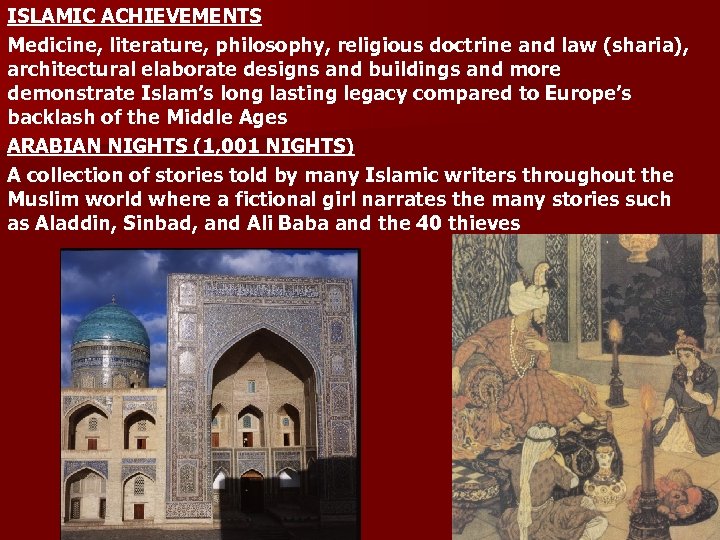
ISLAMIC ACHIEVEMENTS Medicine, literature, philosophy, religious doctrine and law (sharia), architectural elaborate designs and buildings and more demonstrate Islam’s long lasting legacy compared to Europe’s backlash of the Middle Ages ARABIAN NIGHTS (1, 001 NIGHTS) A collection of stories told by many Islamic writers throughout the Muslim world where a fictional girl narrates the many stories such as Aladdin, Sinbad, and Ali Baba and the 40 thieves
 Скачать презентацию CH 8 BIRTH AND RISE OF ISLAM AND
fae8b93b2f8c8829d2db6f29d65e9735.ppt