


 Скачать презентацию ch 6_2 STRATEGIES FOR SME INTERNATIONALISATION l l
9d8e52eb809b2cbf0311097a7a229709.ppt
- Количество слайдов: 23
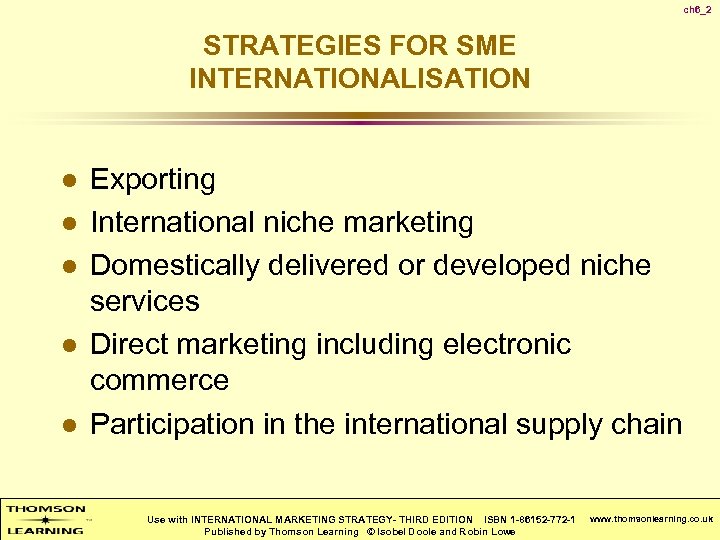 ch 6_2 STRATEGIES FOR SME INTERNATIONALISATION l l l Exporting International niche marketing Domestically delivered or developed niche services Direct marketing including electronic commerce Participation in the international supply chain Use with INTERNATIONAL MARKETING STRATEGY- THIRD EDITION ISBN 1 -86152 -772 -1 Published by Thomson Learning © Isobel Doole and Robin Lowe www. thomsonlearning. co. uk
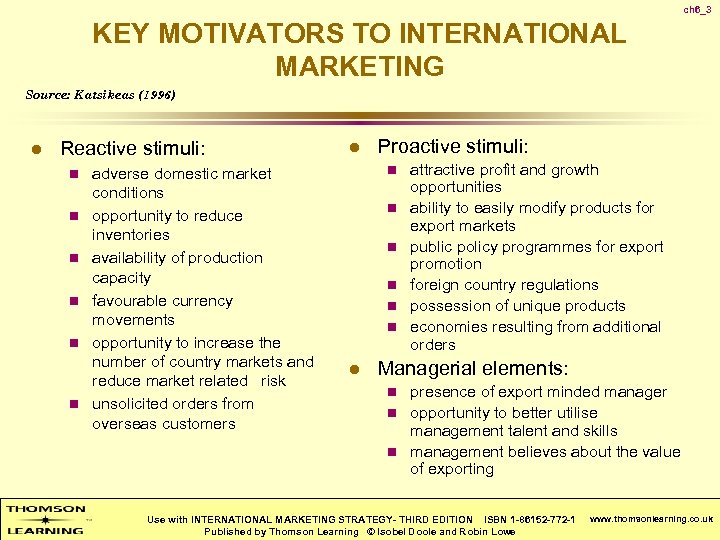 ch 6_3 KEY MOTIVATORS TO INTERNATIONAL MARKETING Source: Katsikeas (1996) l Reactive stimuli: n n n adverse domestic market conditions opportunity to reduce inventories availability of production capacity favourable currency movements opportunity to increase the number of country markets and reduce market related risk unsolicited orders from overseas customers l Proactive stimuli: n n n l attractive profit and growth opportunities ability to easily modify products for export markets public policy programmes for export promotion foreign country regulations possession of unique products economies resulting from additional orders Managerial elements: presence of export minded manager n opportunity to better utilise management talent and skills n management believes about the value of exporting n Use with INTERNATIONAL MARKETING STRATEGY- THIRD EDITION ISBN 1 -86152 -772 -1 Published by Thomson Learning © Isobel Doole and Robin Lowe www. thomsonlearning. co. uk
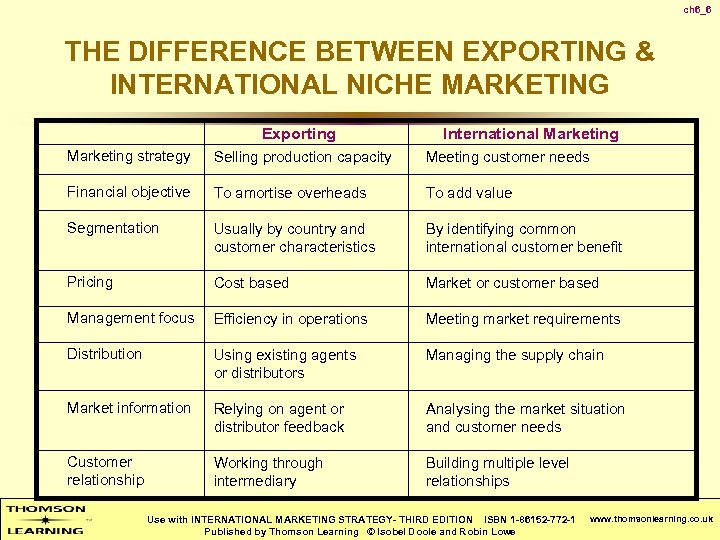 ch 6_6 THE DIFFERENCE BETWEEN EXPORTING & INTERNATIONAL NICHE MARKETING Exporting International Marketing strategy Selling production capacity Meeting customer needs Financial objective To amortise overheads To add value Segmentation Usually by country and customer characteristics By identifying common international customer benefit Pricing Cost based Market or customer based Management focus Efficiency in operations Meeting market requirements Distribution Using existing agents or distributors Managing the supply chain Market information Relying on agent or distributor feedback Analysing the market situation and customer needs Customer relationship Working through intermediary Building multiple level relationships Use with INTERNATIONAL MARKETING STRATEGY- THIRD EDITION ISBN 1 -86152 -772 -1 Published by Thomson Learning © Isobel Doole and Robin Lowe www. thomsonlearning. co. uk
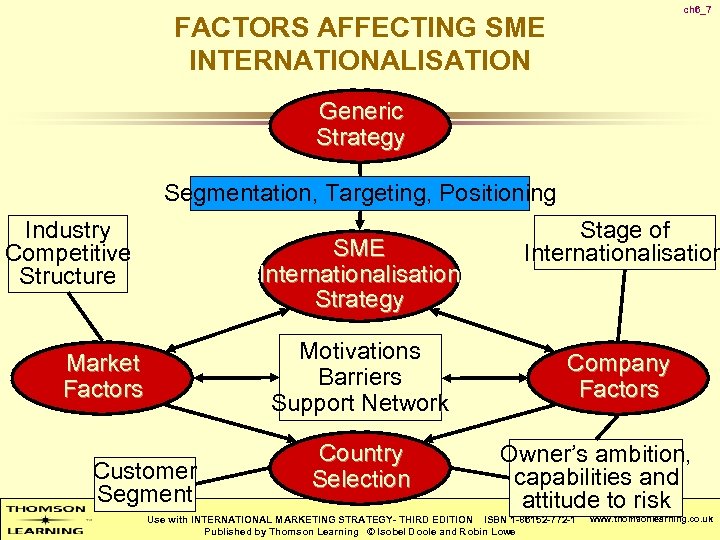 ch 6_7 FACTORS AFFECTING SME INTERNATIONALISATION Generic Strategy Segmentation, Targeting, Positioning Industry Competitive Structure SME Internationalisation Strategy Motivations Barriers Support Network Market Factors Customer Segment Country Selection Stage of Internationalisation Company Factors Owner’s ambition, capabilities and attitude to risk Use with INTERNATIONAL MARKETING STRATEGY- THIRD EDITION ISBN 1 -86152 -772 -1 Published by Thomson Learning © Isobel Doole and Robin Lowe www. thomsonlearning. co. uk
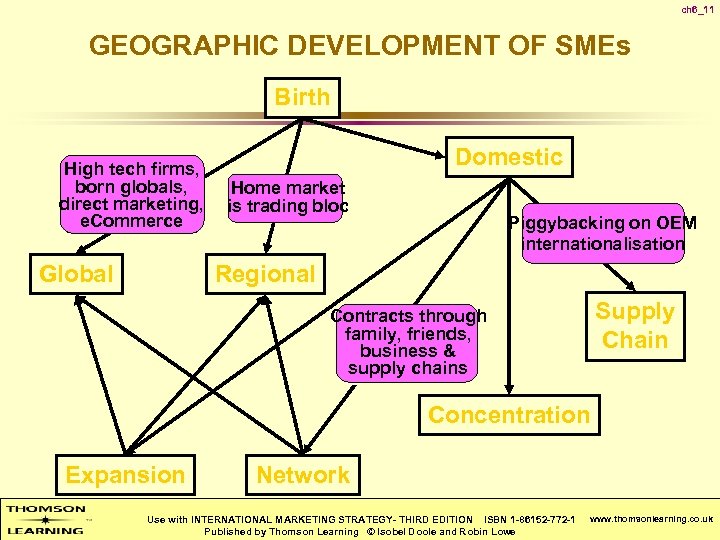 ch 6_11 GEOGRAPHIC DEVELOPMENT OF SMEs Birth High tech firms, born globals, direct marketing, e. Commerce Global Domestic Home market is trading bloc Piggybacking on OEM internationalisation Regional Contracts through family, friends, business & supply chains Supply Chain Concentration Expansion Network Use with INTERNATIONAL MARKETING STRATEGY- THIRD EDITION ISBN 1 -86152 -772 -1 Published by Thomson Learning © Isobel Doole and Robin Lowe www. thomsonlearning. co. uk
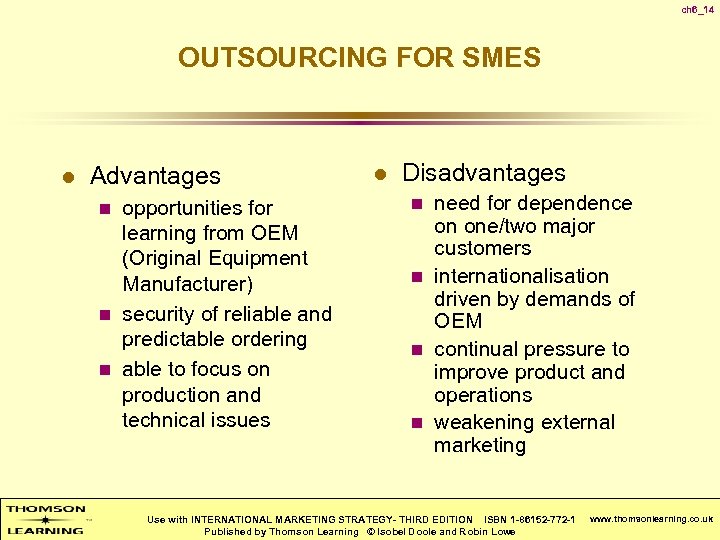 ch 6_14 OUTSOURCING FOR SMES l Advantages opportunities for learning from OEM (Original Equipment Manufacturer) n security of reliable and predictable ordering n able to focus on production and technical issues n l Disadvantages need for dependence on one/two major customers n internationalisation driven by demands of OEM n continual pressure to improve product and operations n weakening external marketing n Use with INTERNATIONAL MARKETING STRATEGY- THIRD EDITION ISBN 1 -86152 -772 -1 Published by Thomson Learning © Isobel Doole and Robin Lowe www. thomsonlearning. co. uk
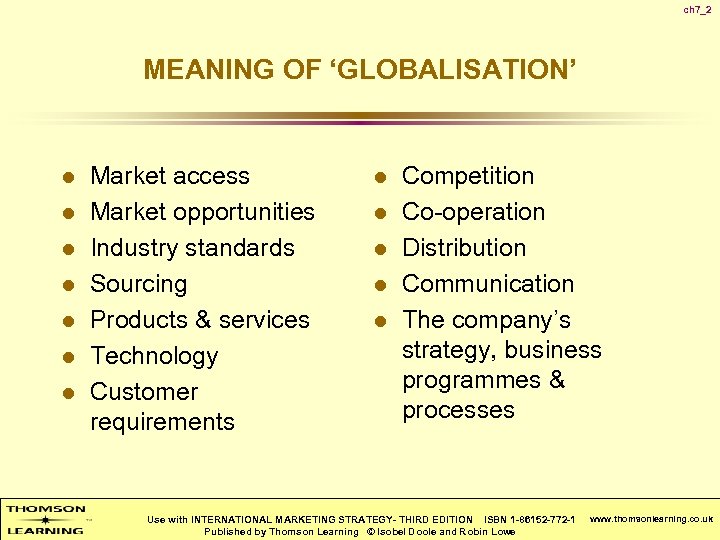 ch 7_2 MEANING OF ‘GLOBALISATION’ l l l l Market access Market opportunities Industry standards Sourcing Products & services Technology Customer requirements l l l Competition Co-operation Distribution Communication The company’s strategy, business programmes & processes Use with INTERNATIONAL MARKETING STRATEGY- THIRD EDITION ISBN 1 -86152 -772 -1 Published by Thomson Learning © Isobel Doole and Robin Lowe www. thomsonlearning. co. uk
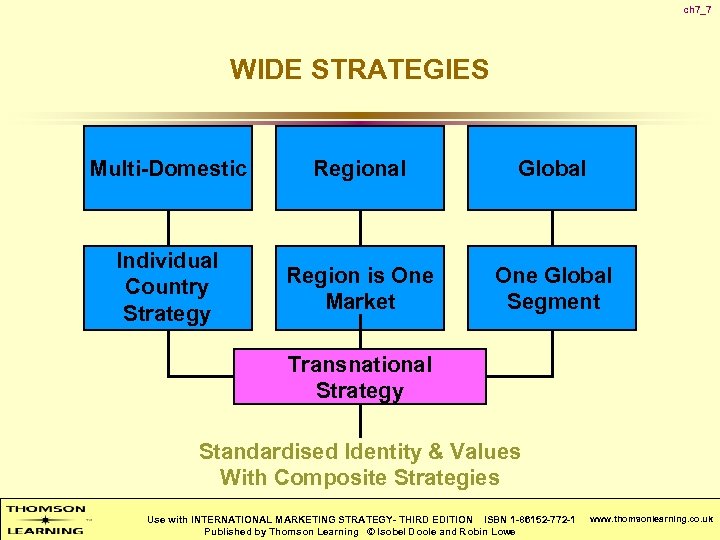 ch 7_7 WIDE STRATEGIES Multi-Domestic Regional Global Individual Country Strategy Region is One Market One Global Segment Transnational Strategy Standardised Identity & Values With Composite Strategies Use with INTERNATIONAL MARKETING STRATEGY- THIRD EDITION ISBN 1 -86152 -772 -1 Published by Thomson Learning © Isobel Doole and Robin Lowe www. thomsonlearning. co. uk
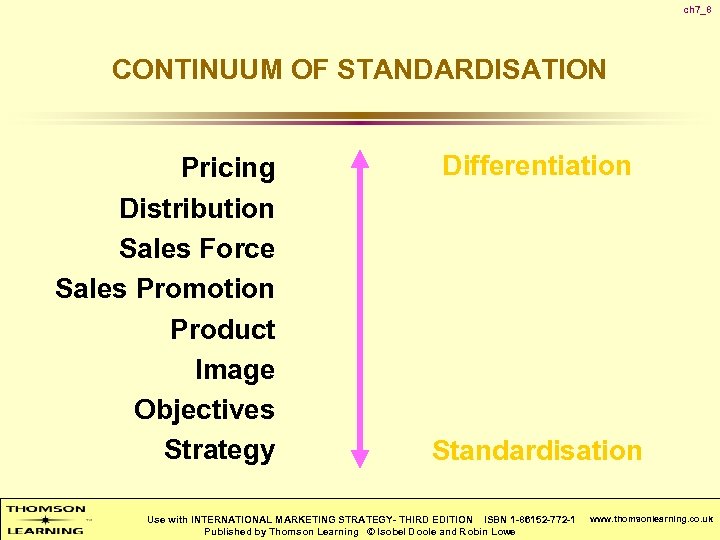 ch 7_8 CONTINUUM OF STANDARDISATION Pricing Distribution Sales Force Sales Promotion Product Image Objectives Strategy Differentiation Standardisation Use with INTERNATIONAL MARKETING STRATEGY- THIRD EDITION ISBN 1 -86152 -772 -1 Published by Thomson Learning © Isobel Doole and Robin Lowe www. thomsonlearning. co. uk
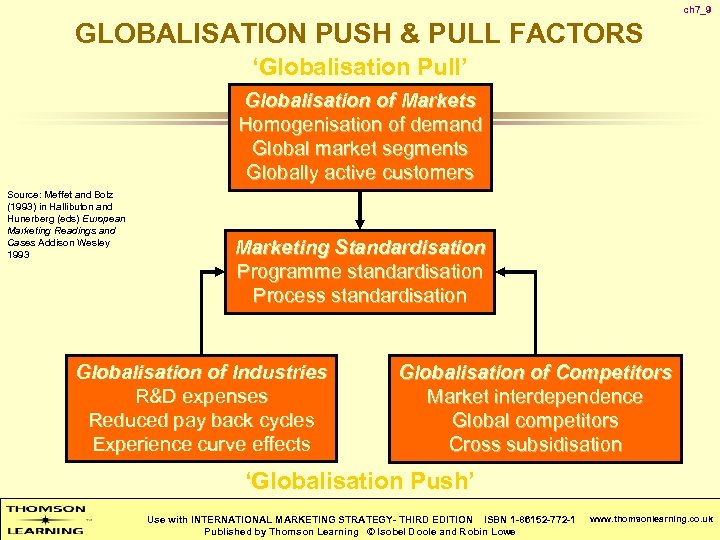 ch 7_9 GLOBALISATION PUSH & PULL FACTORS ‘Globalisation Pull’ Globalisation of Markets Homogenisation of demand Global market segments Globally active customers Source: Meffet and Bolz (1993) in Hallibuton and Hunerberg (eds) European Marketing Readings and Cases Addison Wesley 1993 Marketing Standardisation Programme standardisation Process standardisation Globalisation of Industries R&D expenses Reduced pay back cycles Experience curve effects Globalisation of Competitors Market interdependence Global competitors Cross subsidisation ‘Globalisation Push’ Use with INTERNATIONAL MARKETING STRATEGY- THIRD EDITION ISBN 1 -86152 -772 -1 Published by Thomson Learning © Isobel Doole and Robin Lowe www. thomsonlearning. co. uk
 ch 7_10 FORCES DRIVING A MULTI-DOMESTIC APPROACH l l l Industry standards remain diverse Customers continue to demand locally Being an insider remains critically important Global organisations are difficult to manage Management myopia Use with INTERNATIONAL MARKETING STRATEGY- THIRD EDITION ISBN 1 -86152 -772 -1 Published by Thomson Learning © Isobel Doole and Robin Lowe www. thomsonlearning. co. uk
 ch 7_13 DEMAND FOR CUSTOMISED SOLUTIONS l l l l customers cannot be classified into simple, stable segments the customer in not monodimensional desires guide consumption functional and techonolgoical attributes of products or services are balanced by its aesthetics and cultural attributes quality is now more subjective a wide permanent variety of products is required the quest for authenticity orientates consumption Source: Halliburton (1994) Use with INTERNATIONAL MARKETING STRATEGY- THIRD EDITION ISBN 1 -86152 -772 -1 Published by Thomson Learning © Isobel Doole and Robin Lowe www. thomsonlearning. co. uk
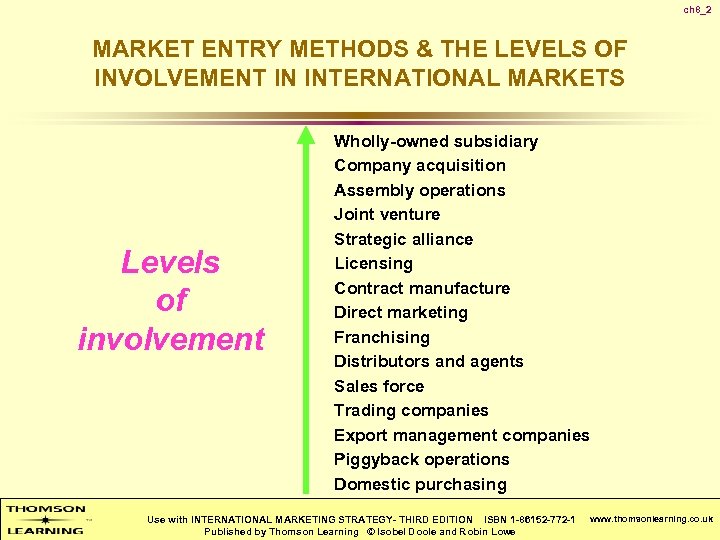 ch 8_2 MARKET ENTRY METHODS & THE LEVELS OF INVOLVEMENT IN INTERNATIONAL MARKETS Levels of involvement Wholly-owned subsidiary Company acquisition Assembly operations Joint venture Strategic alliance Licensing Contract manufacture Direct marketing Franchising Distributors and agents Sales force Trading companies Export management companies Piggyback operations Domestic purchasing Use with INTERNATIONAL MARKETING STRATEGY- THIRD EDITION ISBN 1 -86152 -772 -1 Published by Thomson Learning © Isobel Doole and Robin Lowe www. thomsonlearning. co. uk
 ch 8_3 SUCCESSFUL MARKET ENTRY #1 l Criteria for Selecting Appropriate Market Entry Method n n n The company objectives and expectations relating to the size and value of anticipated business The size and financial resources of the company Existing foreign market involvement The skills, abilities and attitudes of the company management towards international marketing The nature and power of the competition with the market Use with INTERNATIONAL MARKETING STRATEGY- THIRD EDITION ISBN 1 -86152 -772 -1 Published by Thomson Learning © Isobel Doole and Robin Lowe www. thomsonlearning. co. uk
 ch 8_4 SUCCESSFUL MARKET ENTRY #2 l Criteria for Selecting Appropriate Market Entry Method The nature of existing and anticipated tariff and non-tariff barriers n The nature of the product itself, particularly any areas of competitive advantage, such as trademark or patent protection n The timing of the move in relation to the market and competitive situation n Use with INTERNATIONAL MARKETING STRATEGY- THIRD EDITION ISBN 1 -86152 -772 -1 Published by Thomson Learning © Isobel Doole and Robin Lowe www. thomsonlearning. co. uk
 ch 8_6 INDIRECT EXPORTING #1 l Domestic Purchasing Foreign organisation purchases the product for export to another country n Gives access to and limited knowledge of the international market n Little control over choice of markets entered n For longer term, need a more proactive approach n l Export Management Companies (EMCs) Specialist companies act as the export department for a range of companies n Help SMEs to initiate/develop/maintain international sales n Deal with documentation, government regulation n Use with INTERNATIONAL MARKETING STRATEGY- THIRD EDITION ISBN 1 -86152 -772 -1 Published by Thomson Learning © Isobel Doole and Robin Lowe www. thomsonlearning. co. uk
 ch 8_7 INDIRECT EXPORTING #2 l Trading Houses Their extensive operations and controls enable operation in more difficult trading areas n Manage countertrade activities n l Piggy Backing An established international distribution network of one manufacturer used to carry products of a second n Particularly good for firms from developing countries n Often poorly considered terms and conditions n Use with INTERNATIONAL MARKETING STRATEGY- THIRD EDITION ISBN 1 -86152 -772 -1 Published by Thomson Learning © Isobel Doole and Robin Lowe www. thomsonlearning. co. uk
 ch 8_10 IMPORTANT FACTORS FOR SUCCESSFUL EXPORTING l l l commitment of the firm’s management exporting approach reliant on strong skills base good marketing and information communication system production capacity & capability, product superiority, competitive pricing effective market research effective national export policy Source: Katsikeas et al (1996) Use with INTERNATIONAL MARKETING STRATEGY- THIRD EDITION ISBN 1 -86152 -772 -1 Published by Thomson Learning © Isobel Doole and Robin Lowe www. thomsonlearning. co. uk
 ch 8_11 AGENTS #1 l Selection Criteria for Finding a Suitable Agent n Financial strength of the agent n Their contacts with potential customers n The nature and extent of their responsibilities to other organisations n Their premises, equipment and resources (including sales representatives) Use with INTERNATIONAL MARKETING STRATEGY- THIRD EDITION ISBN 1 -86152 -772 -1 Published by Thomson Learning © Isobel Doole and Robin Lowe www. thomsonlearning. co. uk
 ch 8_12 AGENTS # 2 l Achieving Satisfactory Manufacturer-agent Relationship n n n Allocate time and resources to find a suitable agent Ensure that both understand what each expects of the other Ensure that the agent is motivated to improve performance Provide adequate support on a continuing basis Ensure that there is sufficient advice and information transfer in both directions Use with INTERNATIONAL MARKETING STRATEGY- THIRD EDITION ISBN 1 -86152 -772 -1 Published by Thomson Learning © Isobel Doole and Robin Lowe www. thomsonlearning. co. uk
 ch 8_13 REASONS FOR SETTING UP OVERSEAS MANUFACTURE l l l l l Nature of product e. g. perishable Costs of transporting and warehousing Barriers to trade e. g. tariffs and quotas Government regulations e. g. local investment Local manufacture viewed favourable by market Contributions to local economy Market information feedback International culture in firm Faster response and just-in-time delivery Lower labour cost Use with INTERNATIONAL MARKETING STRATEGY- THIRD EDITION ISBN 1 -86152 -772 -1 Published by Thomson Learning © Isobel Doole and Robin Lowe www. thomsonlearning. co. uk
 ch 8_16 FOREIGN MANUFACTURING STRATEGIES WITH DIRECT INVESTMENT l Reasons for investment in local operations n n n To gain new business: local production demonstrates strong commitment To defend existing business To move with an established customer To save costs: e. g. labour, raw materials and transport To avoid government restrictions Use with INTERNATIONAL MARKETING STRATEGY- THIRD EDITION ISBN 1 -86152 -772 -1 Published by Thomson Learning © Isobel Doole and Robin Lowe www. thomsonlearning. co. uk
 ch 8_18 DRIVING FORCES FOR THE FORMATION & OPERATION OF STRATEGIC ALLIANCES l l l l Insufficient resources Pace of innovation and market diffusion High research and development costs Concentration of firms in mature industries Government co-operation Self protection Market access Use with INTERNATIONAL MARKETING STRATEGY- THIRD EDITION ISBN 1 -86152 -772 -1 Published by Thomson Learning © Isobel Doole and Robin Lowe www. thomsonlearning. co. uk