 Скачать презентацию Ch 4 Periodic Table Unit 2 That s a
ea88f227c54ebb395b2ea127b295f008.ppt
- Количество слайдов: 47



Ch#4 Periodic Table Unit 2 • "That's a pro-phosphorous idea!" (read as preposterous) • "I can't be arsenic-ed!" (read as arsed) • "This is so boron!" (read as boring) • "Pick it up off the fluor-ine!" (read as floor) • "Lith-ium alone!" (read as leave him) • "This is a-bismuth!" (read as abysmal) • "I've got a bad gold" (read as cold) • "Is she Indium? " (read as Indian) • "Did he have a car-bon? " (read as car bomb)
I. Development of Periodic Table A. @ 70 elements had been discovered by mid 1800’s but no common feature that would relate them had been created. B. Dmitri Mendeleev, a Russian chemist began to list elements in vertical col. In order of increasing atomic mass. C. He then began to notice a reg. (periodic) recurrence of their phys. & chem. Properties. Key
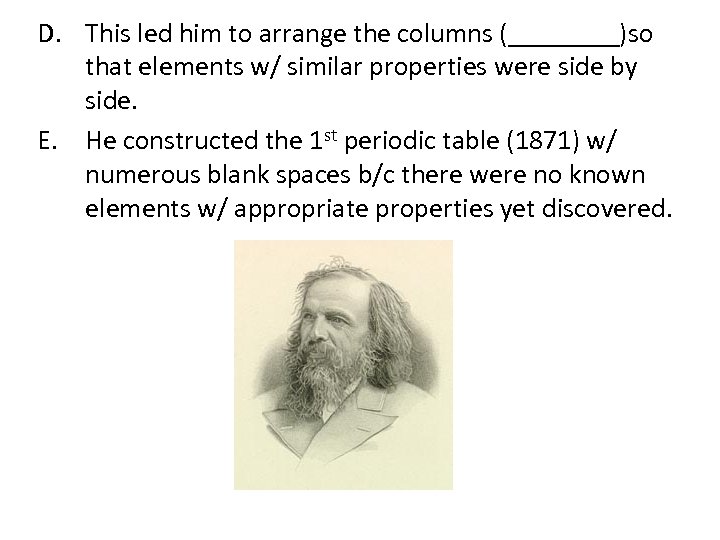
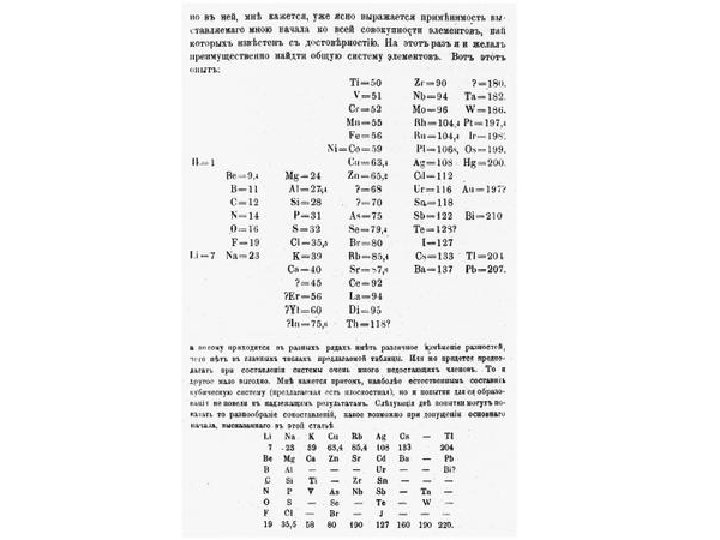
D. This led him to arrange the columns (____)so that elements w/ similar properties were side by side. E. He constructed the 1 st periodic table (1871) w/ numerous blank spaces b/c there were no known elements w/ appropriate properties yet discovered.
II. Modern Periodic Table A. In 1913, Henry Moseley (1887 -1915), a young British physicist, determined nuclear charge aka atomic number of elements. B. Moseley worked proved that elements should be rearranged using atomic #’s C. Moseley was killed in WWI at the age of 28, British no longer assign scientist to combat duty.
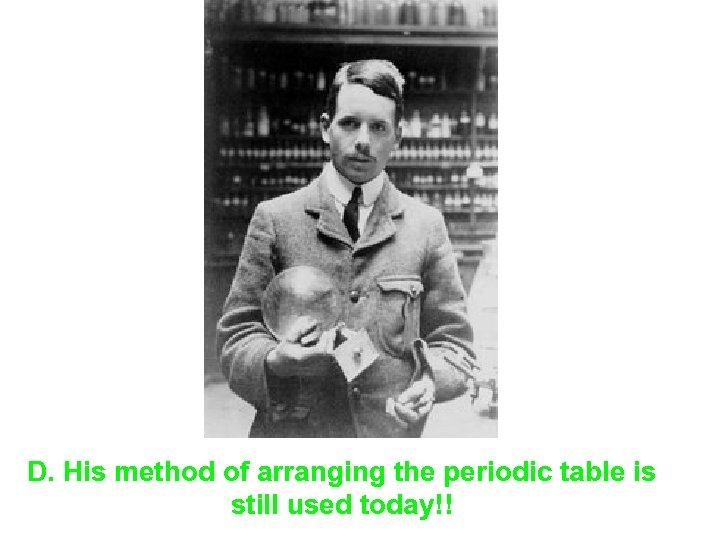
D. His method of arranging the periodic table is still used today!!
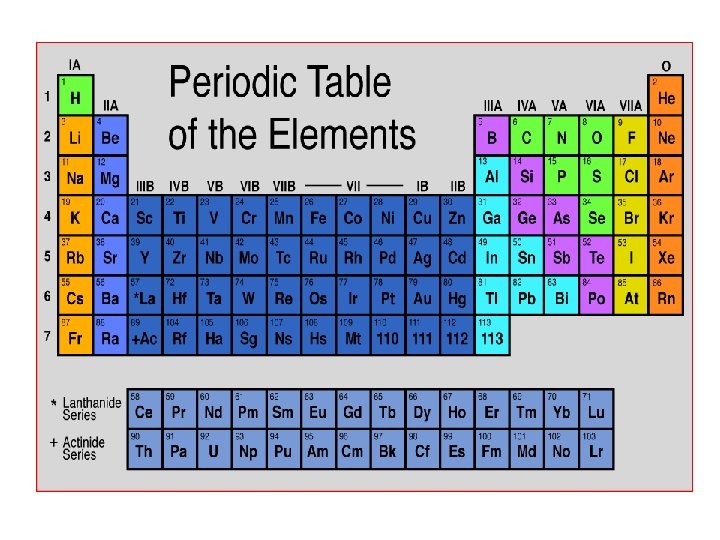
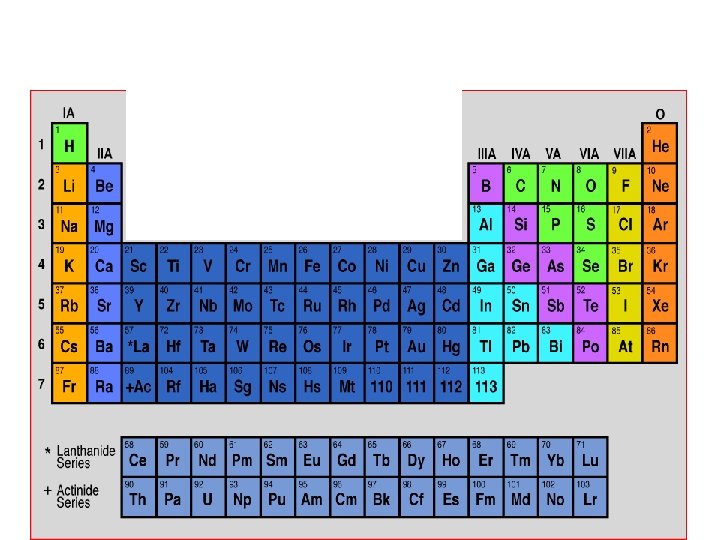
E. The horizontal rows of periodic table are called Periods that represent the orbital or energy level #. F. The vertical columns are called Groups or Families. 1. Each group is identified by a roman numeral (IVIII) and a letter (A or B). 2. Groups 1 A – 8 A are the representative elements. They exhibit a wide variety of phys. and chem. Properties 3. Each Group have similar phys. and chem. properties and these properties change from group to group.
G. Sequence of change (in properties) is the same in all periods thus we have the Periodic Law: When elements are arranged in order of increasing atomic number, there is a periodic pattern in their physical and chemical properties.
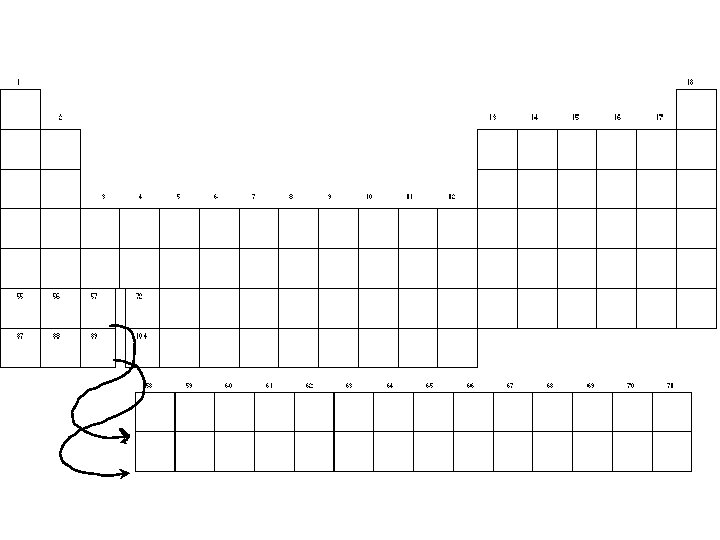

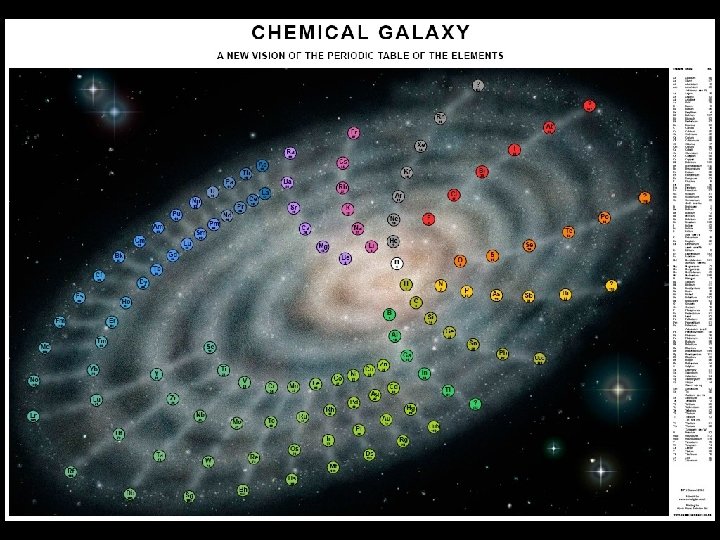
Alkali metals Alkali earth metals Transition metals Metalloids/Semimetals Nonmetals. Periodic Table 1 A 1 Halogens H Noble gases 8 A He 3 A 4 A 5 A 6 A 7 A B C N O F 1 7 Mg 12 K Ca 20 21 22 Rb Sr Y Zr Nb Mo Tc Ru Rh Pd Ag Cd In 38 39 40 41 42 49 50 51 Cs Ba Hf Ta W 55 6 Na 37 5 4 19 4 Be 11 3 Li 3 2 2 A 56 72 73 74 Fr Ra 87 88 5 23 24 25 26 43 27 44 29 30 9 10 P S Cl Ar 15 16 17 18 As Se Br Kr Ga Ge 31 48 8 33 32 Ir Pt Au Hg Tl Pb Bi 81 82 83 36 I Xe 53 54 At Rn 85 86 Po 78 35 52 46 34 Te Sn Sb 77 76 47 7 14 13 6 45 Re Os 75 28 84 79 80 Rf Db Sg Bh Hs Mt 104 105 106 107 108 109 Lanthanoid Series 6 La Ce Pr Nd Pm Sm Eu Gd Tb Dy Ho Er Tm Yb Lu 57 58 59 60 61 62 63 64 65 66 67 68 69 70 71 Actinoid Series 7 Ac Th Pa 89 90 91 U 92 Np Pu Am Cm Bk Cf 93 94 95 96 97 98 Ne Si Al 3 B 4 B 5 B 6 B 7 B 1 B 2 B Sc Ti V Cr Mn Fe Co Ni Cu Zn 2 Es Fm Md No Lr 99 100 101 102 103
III. Noble Gases A. Group 0 or VIIIA has a full octet, thus stable. B. Noble Gases are also known as “Inert” or “rare” gases b/c they rarely combine with other elements. C. Octet rule: Atoms react by changing the # of e- to acquire the stable e- config. of a noble gas. D. Despite unreactivity they have many uses: He used in weather balloons instead of H (explosive); He & Ne used in artificial atmospheres; Ne, Ar, Kr, & Xe used to produce atmospheres for flashbulbs/welding.
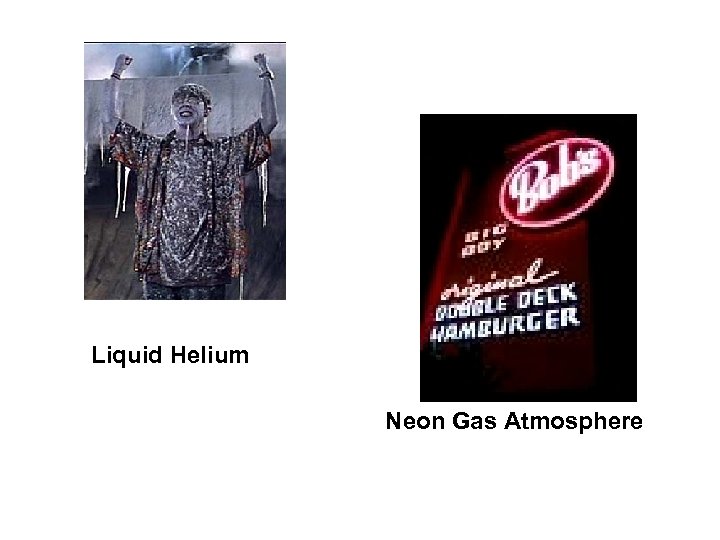
Liquid Helium Neon Gas Atmosphere
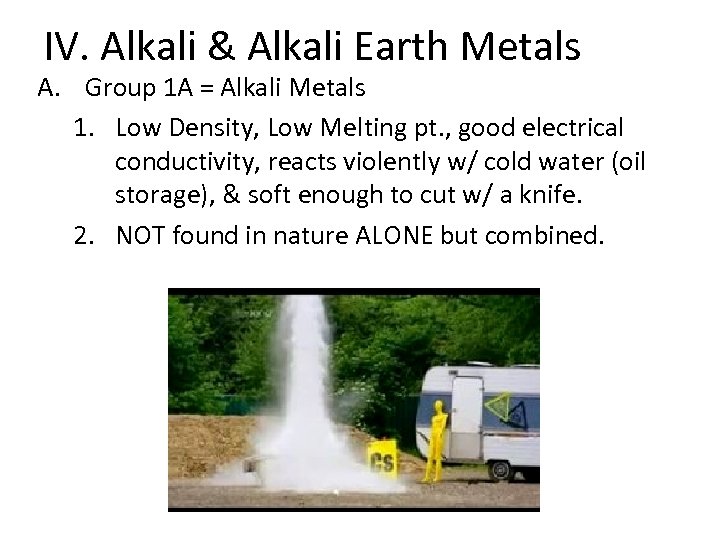
IV. Alkali & Alkali Earth Metals A. Group 1 A = Alkali Metals 1. Low Density, Low Melting pt. , good electrical conductivity, reacts violently w/ cold water (oil storage), & soft enough to cut w/ a knife. 2. NOT found in nature ALONE but combined.
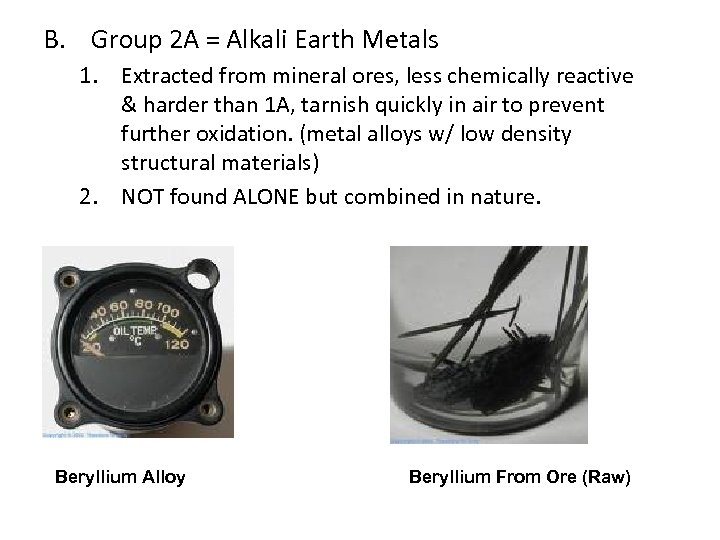
B. Group 2 A = Alkali Earth Metals 1. Extracted from mineral ores, less chemically reactive & harder than 1 A, tarnish quickly in air to prevent further oxidation. (metal alloys w/ low density structural materials) 2. NOT found ALONE but combined in nature. Beryllium Alloy Beryllium From Ore (Raw)
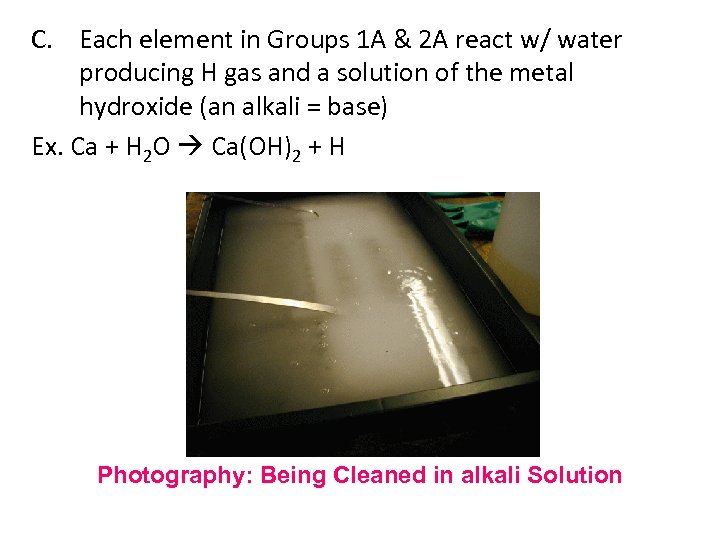
C. Each element in Groups 1 A & 2 A react w/ water producing H gas and a solution of the metal hydroxide (an alkali = base) Ex. Ca + H 2 O Ca(OH)2 + H Photography: Being Cleaned in alkali Solution
V. Carbon Group (IVA) A. C is a nonmetal, Si & Ge are metalloids (metallic & nonmetallic properties), and Sn & Pb are both metals. B. Carbon containing cmpds (4 million) are all called organic cmpds which constitute the bulk of living things. 1) Diamond- behaves like a typical nonmetal or nonconductor of electricity 2) Graphite- has some properties of a metal and is a good conductor of electricity 3) Coke- is the pure form of carbon aka Carbon Black
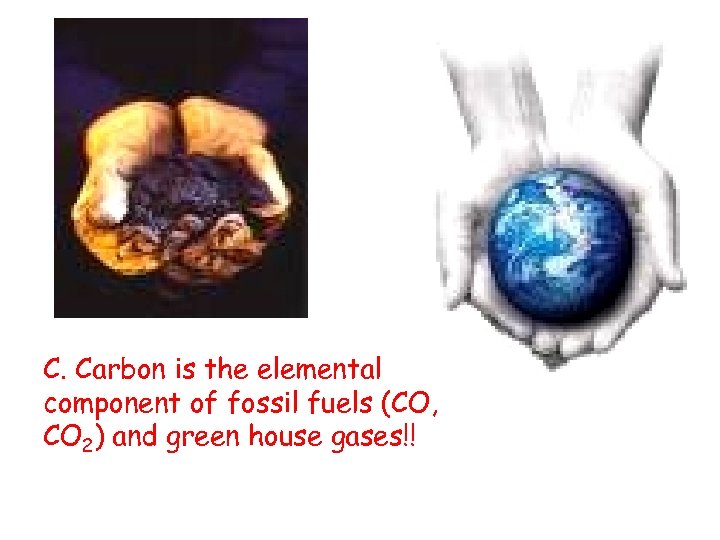
C. Carbon is the elemental component of fossil fuels (CO, CO 2) and green house gases!!
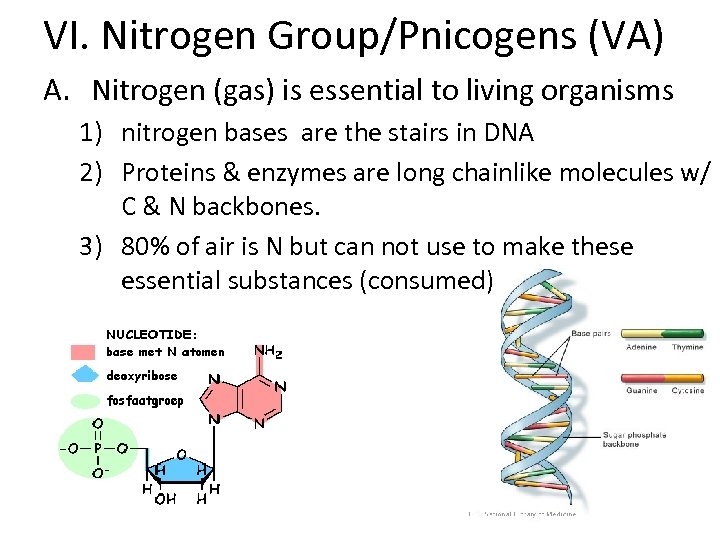
VI. Nitrogen Group/Pnicogens (VA) A. Nitrogen (gas) is essential to living organisms 1) nitrogen bases are the stairs in DNA 2) Proteins & enzymes are long chainlike molecules w/ C & N backbones. 3) 80% of air is N but can not use to make these essential substances (consumed)
Metalloids: B, Si, Ge, As, Sb, Te, Po (7) -Greek- metallon = "metal" and eidos = "sort” -aka semimetals -The metalloid line is known as the “Amphoteric” line -reacts with both acids and bases -They are all semiconductors
VII. Oxygen Group/Chalcogens (VIA) A. Oxygen (a gas) is the most abundant element 1) 20% by vol. of air we breath 2) 60% by mass of human body 3) 50% by mass of earth’s crust (silicate rocks of earth’s crust) 4) Produced by plants in photosynthesis: 5) O is used in medicine, manufacturing of steel (to remove impurities), & along w/ acetylene in welding.
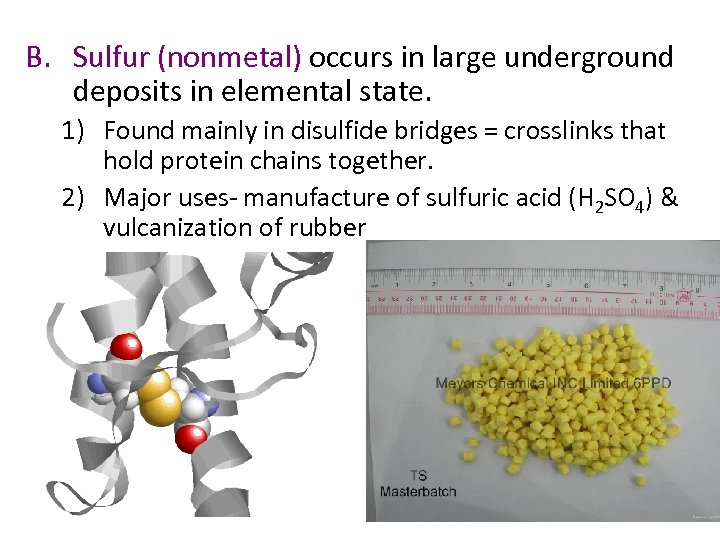
B. Sulfur (nonmetal) occurs in large underground deposits in elemental state. 1) Found mainly in disulfide bridges = crosslinks that hold protein chains together. 2) Major uses- manufacture of sulfuric acid (H 2 SO 4) & vulcanization of rubber
VIII. The Halogens & H (VIIA) A. Family of very reactive nonmetals that are usually found as salts w/ group IA & IIA metals (halos=salt, gen=born) i. e: Na. Br, Na. Cl, & Na. I are found in seawater & salt beds. A. F & Cl are yellowish-green gases at room temp. & are essential to our well being. 1) Fluoride ion is good for teeth but F (element) also used in production of Teflon (F 4 acid= causes birth defects) 2) Chloride ion is a component of blood & other body fluids but Cl (element) is the primary component of bleach (Cl gas is deadly)
C. Iodine (a purple solid) is used in soln form as an antiseptic but iodide ion is necessary to prevent goiter, thyroid enlargement. D. Bromine (dark red liquid) is safe but Br gas is extremely deadly, Na. Br(Sodium bromide) is a natural seasalt used as an exfoliator. E. Astatine - exceedingly rare radioactive solid that has not been well investigated.
F. Hydrogen is a group by itself b/c it is unique! 1) Reactive gas that reacts violently with most elements and explosively with oxygen. 2) Appears at top of IA b/c reacts w/ halogens and has one outer electron like Alkali metals. 3) Can also appear at top of VIIA b/c reacts w/ alkali metals and has one less electron than He, the noble gas it precedes.
IX. Inner & Transition Metals A. Transition metals are the Group B elements, & the inner transition metals are (6 th pd) lanthanides and (7 th pd) actinides. B. All are typical metals with: – – – High luster ( ) and electrical conductivity Ductile – drawn into wires Malleable-beaten into thin sheets. C. Vary greatly in their chemical reactivity & most of the cmpds they form have multiple formula combinations (Fe 2 O 3; Fe. O: Fe. O 2) and are colored.
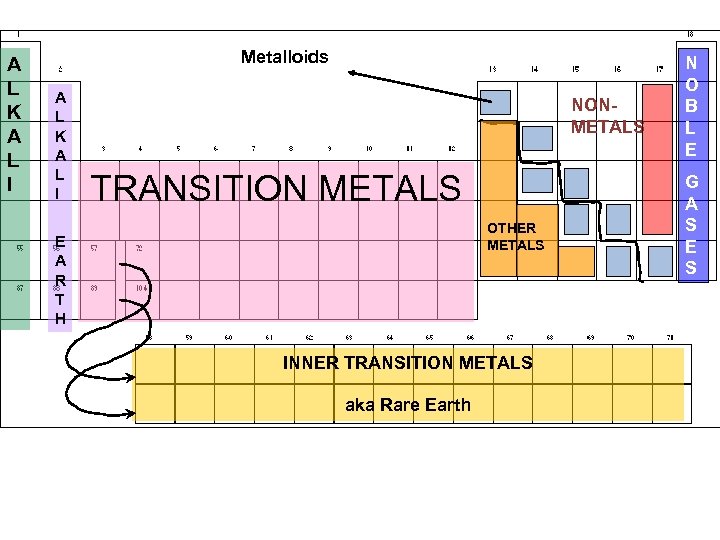
A L K A L I Metalloids A L K A L I NONMETALS TRANSITION METALS OTHER METALS E A R T H INNER TRANSITION METALS aka Rare Earth N O B L E G A S E S
X. Ions A. Column or group # designates # of valence e- or e- involved in chemical reactions (aka outermost electrons as well!!) B. Cation- when an element loses a valence e- to achieve noble gas octet (E is absorbed) 1) Groups 1 A, 2 A, B, Al, Zn, Ag are specific where as transition metals will be 1+ to 7+ C. Anion-when an element gains a valence e- to achieve noble gas octet (E is released) 1) ALL Non-metals will be anions
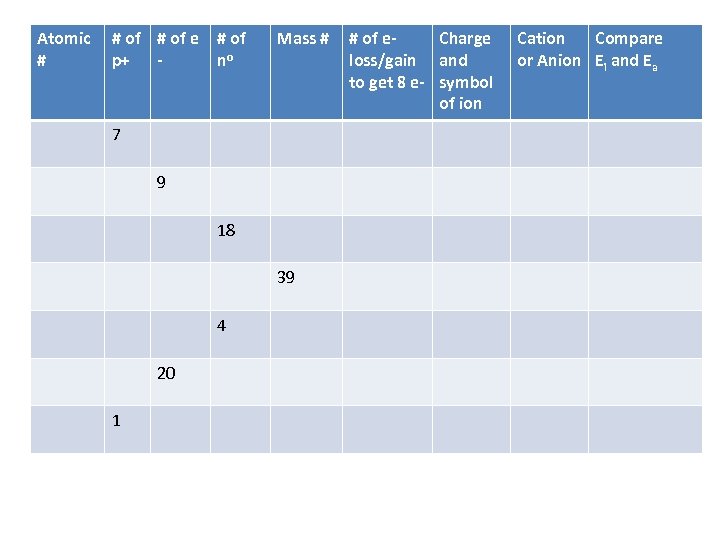
Atomic # # of e p+ - # of no Mass # 7 9 18 39 4 20 1 # of e. Charge loss/gain and to get 8 e- symbol of ion Cation Compare or Anion Ei and Ea
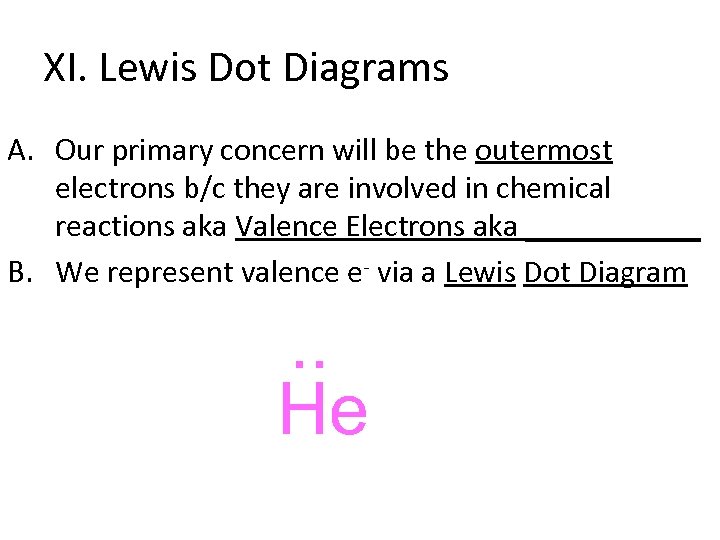
XI. Lewis Dot Diagrams A. Our primary concern will be the outermost electrons b/c they are involved in chemical reactions aka Valence Electrons aka ______ B. We represent valence e- via a Lewis Dot Diagram . . He
C. Steps for Dot Diagrams: 1. Symbol represents nucleus and all e- except valence e-. 2. Use Column # to figure out how many valence e 3. Arrange dots around symbol, keeping e- paired 4. Arrange symmetrically whenever possible 5. The maximum # of e- is ____ aka an octet. Examples:
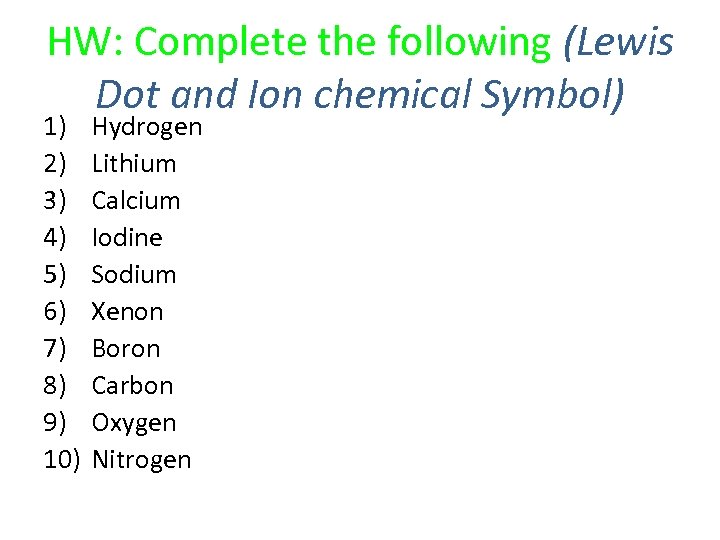
HW: Complete the following (Lewis Dot and Ion chemical Symbol) 1) 2) 3) 4) 5) 6) 7) 8) 9) 10) Hydrogen Lithium Calcium Iodine Sodium Xenon Boron Carbon Oxygen Nitrogen
How Ions Come to Achieve Stability • Ionic Cmpd: Metal + Nonmetal = Zero Charge (octet) Examples:
Covalent Cmpd: Examples Octet Rule CO 2 H 3 P C 3 H 8
7 Diatomics: F, Cl, Br, I, O, N, H Lewis Dot Diagrams:
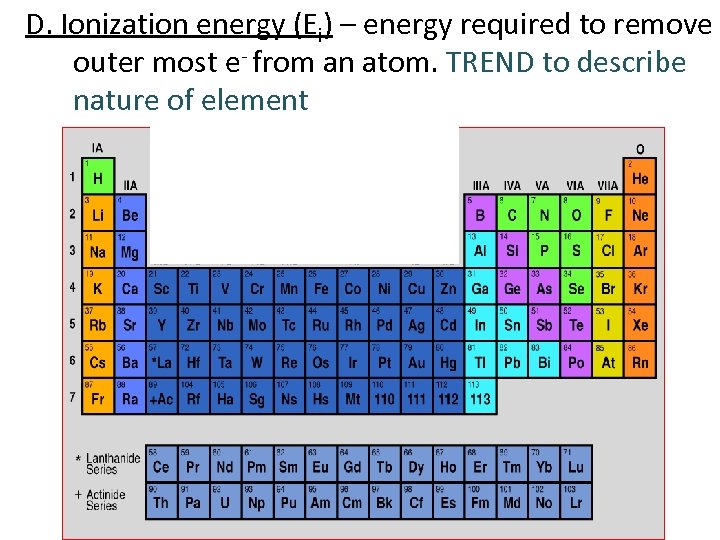
D. Ionization energy (Ei) – energy required to remove outer most e- from an atom. TREND to describe nature of element
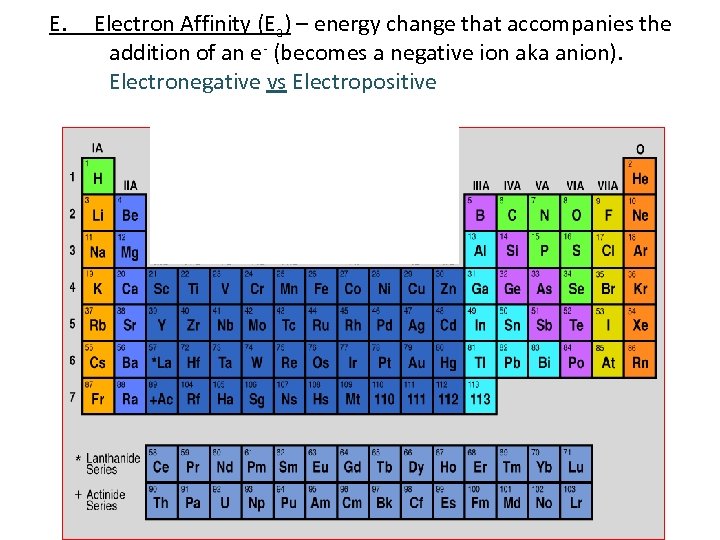
E. Electron Affinity (Ea) – energy change that accompanies the addition of an e- (becomes a negative ion aka anion). Electronegative vs Electropositive
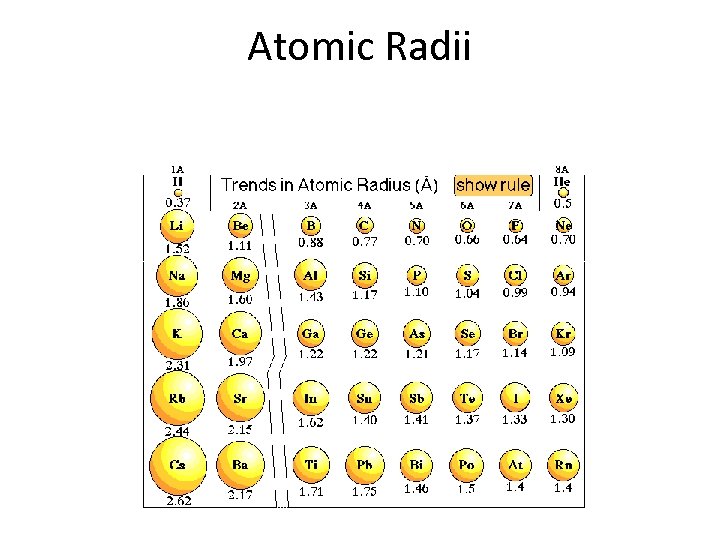
Atomic Radii
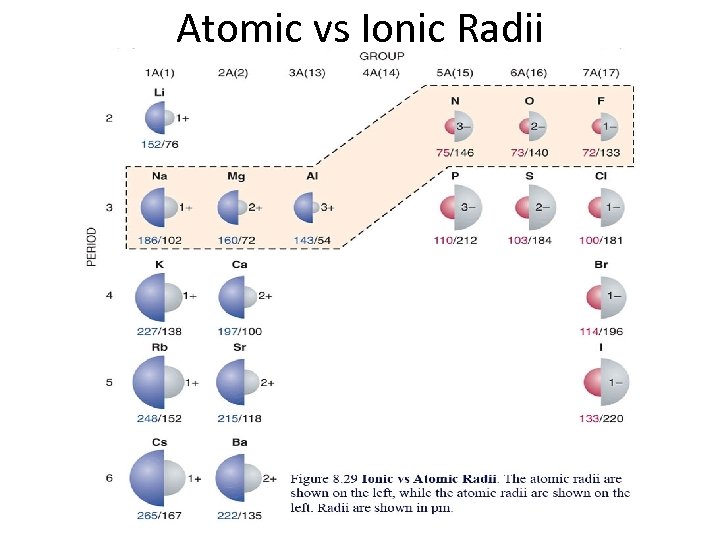
Atomic vs Ionic Radii
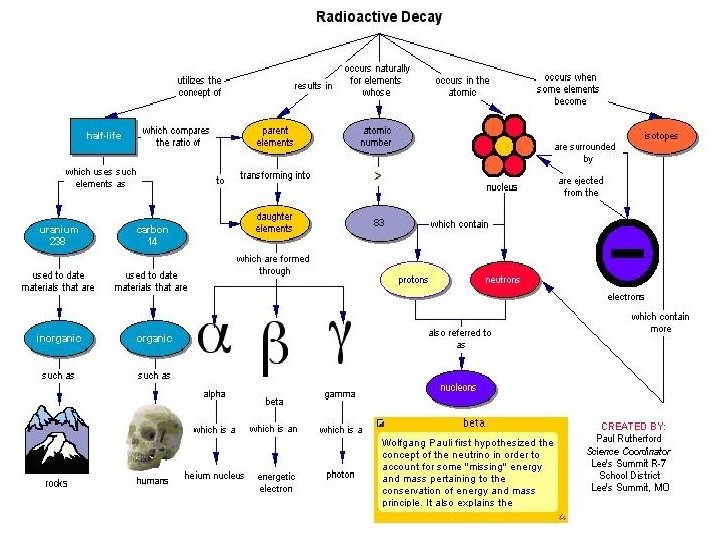
VIII. What keeps an Atom together? A. Electrostatic attraction between the electrically charged particles aka Coloumb’s law: _______________ B. However an atom can lose parts of its nucleus simply because it is too large aka radioactive decay
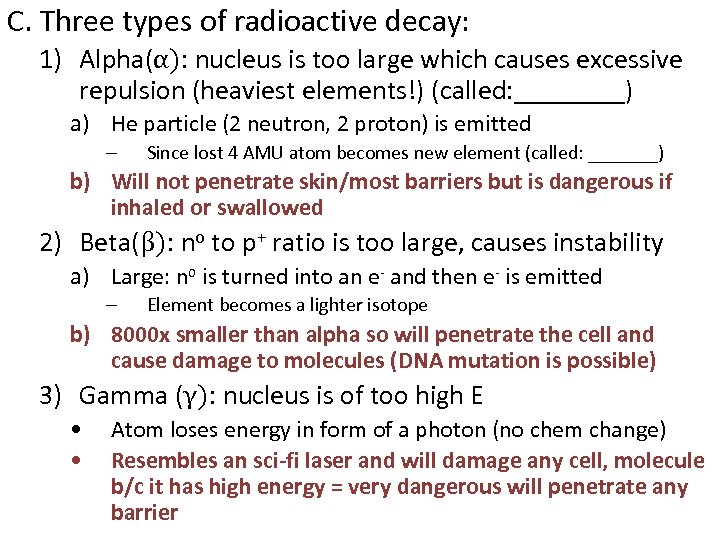
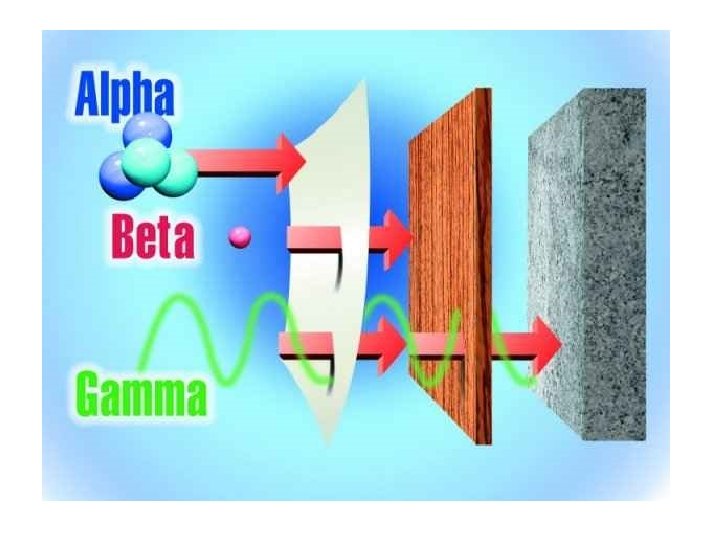
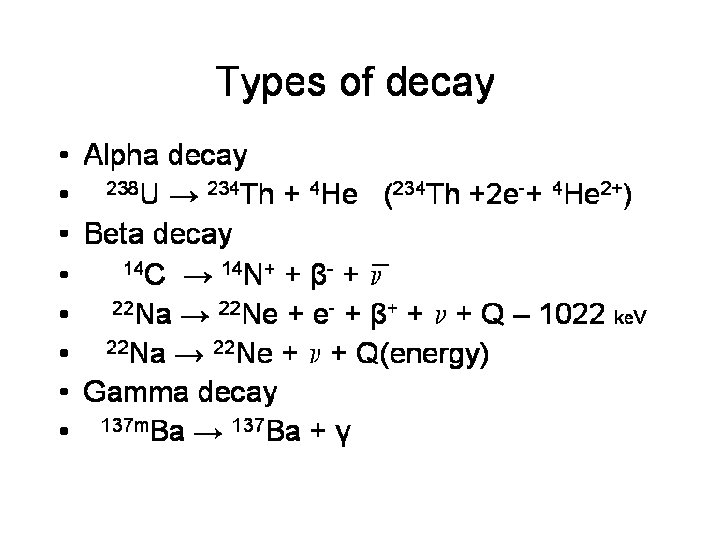
C. Three types of radioactive decay: 1) Alpha(α): nucleus is too large which causes excessive repulsion (heaviest elements!) (called: ____) a) He particle (2 neutron, 2 proton) is emitted – Since lost 4 AMU atom becomes new element (called: _______) b) Will not penetrate skin/most barriers but is dangerous if inhaled or swallowed 2) Beta(β): no to p+ ratio is too large, causes instability a) Large: no is turned into an e- and then e- is emitted – Element becomes a lighter isotope b) 8000 x smaller than alpha so will penetrate the cell and cause damage to molecules (DNA mutation is possible) 3) Gamma (γ): nucleus is of too high E • • Atom loses energy in form of a photon (no chem change) Resembles an sci-fi laser and will damage any cell, molecule b/c it has high energy = very dangerous will penetrate any barrier
 Скачать презентацию Ch 4 Periodic Table Unit 2 That s a
ea88f227c54ebb395b2ea127b295f008.ppt