


 Скачать презентацию Ch 4 Money and Inflation Mankiw Macro Ch
e1a204b5e7c039a8fca3da125eeff825.ppt
- Количество слайдов: 77
 Ch 4 Money and Inflation Mankiw: Macro Ch 4 Mankiw: Econ Ch 24, Ch 29, Ch 30 1
 Outline p The classical theory of inflation n causes n effects n social costs p Classical: assumes prices are flexible and markets clear p Applies to the long run 2
 The connection between money and prices p Inflation rate = the percentage increase in the average level of prices. p Price = amount of money required to buy a good. Prices are defined in terms of money. p Value of money =1/price 3
 Definition of Money Barter economy (以物易物): to require Double Coincidence of Wants (慾望的雙重巧合) Money is the stock of assets that can be readily used to make transactions. 4
 Three Functions of Money 1. Store of Value 價值儲存 a transfers purchasing power from the present to the future eg, money, bond, stock, house 2. Unit of Account 計價單位 the common unit by which everyone measures prices and values 3. Medium of Exchange 交易媒介 we use it to buy stuff eg, money, check 5
 The Functions of Money p Liquidity 流動性: the ease with which an asset can be converted into the economy’s medium of exchange. The most liquid asset is currency and check. Other asset is less liquid because it takes time to convert itself to a medium of exchange. 6
 The Kinds of Money p Commodity money 商品貨幣 takes the form of a commodity with intrinsic value. n p eg, gold, silver, cigarettes, wine. Fiat money 法幣 is used as money because of government decree. n n It does not have intrinsic value. eg, coins, currency, check deposits. 7
 Money supply and monetary policy: definitions p Money supply: the quantity of money available in the economy. p Monetary policy: the control over the money supply. 8
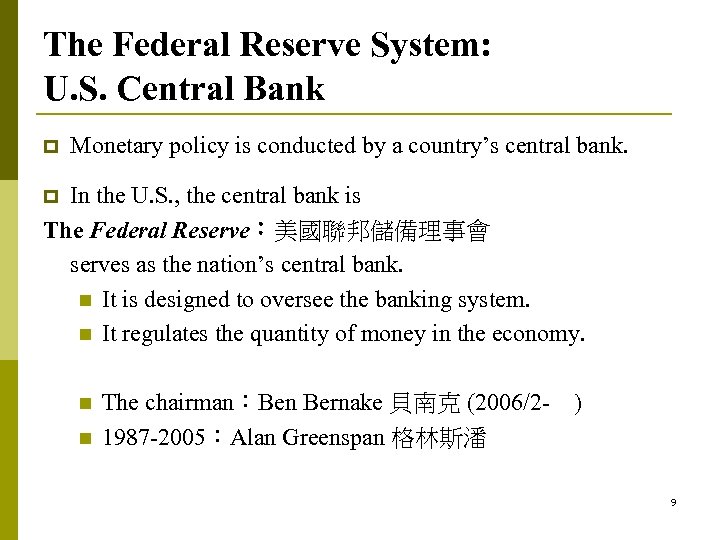 The Federal Reserve System: U. S. Central Bank p Monetary policy is conducted by a country’s central bank. In the U. S. , the central bank is The Federal Reserve:美國聯邦儲備理事會 serves as the nation’s central bank. n It is designed to oversee the banking system. n It regulates the quantity of money in the economy. p n n The chairman:Ben Bernake 貝南克 (2006/21987 -2005:Alan Greenspan 格林斯潘 ) 9
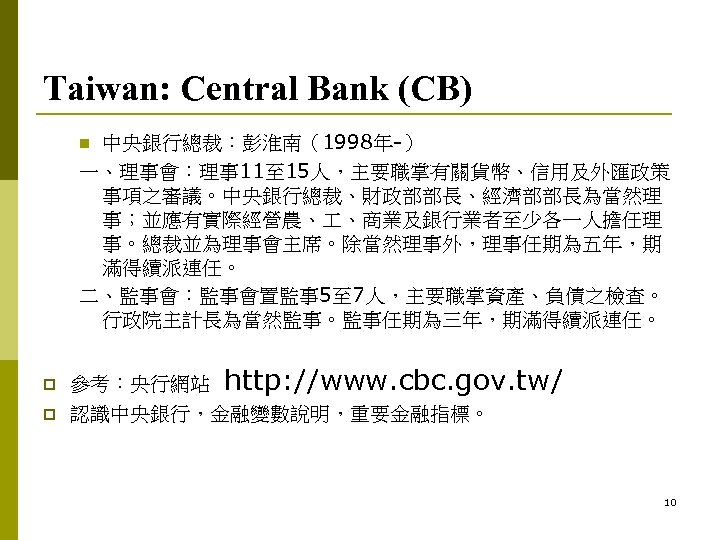 Taiwan: Central Bank (CB) 中央銀行總裁:彭淮南(1998年-) 一、理事會:理事11至 15人,主要職掌有關貨幣、信用及外匯政策 事項之審議。中央銀行總裁、財政部部長、經濟部部長為當然理 事;並應有實際經營農、 、商業及銀行業者至少各一人擔任理 事。總裁並為理事會主席。除當然理事外,理事任期為五年,期 滿得續派連任。 二、監事會:監事會置監事5至 7人,主要職掌資產、負債之檢查。 行政院主計長為當然監事。監事任期為三年,期滿得續派連任。 n p p 參考:央行網站 http: //www. cbc. gov. tw/ 認識中央銀行,金融變數說明,重要金融指標。 10
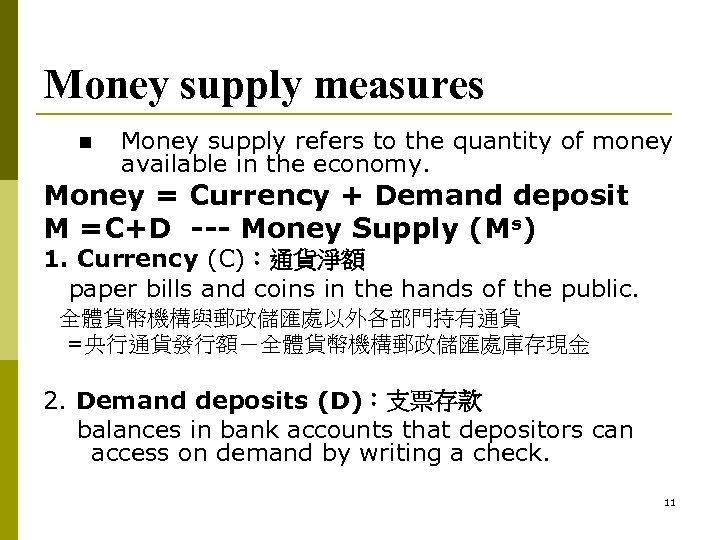 Money supply measures n Money supply refers to the quantity of money available in the economy. Money = Currency + Demand deposit M =C+D --- Money Supply (Ms) 1. Currency (C):通貨淨額 paper bills and coins in the hands of the public. 全體貨幣機構與郵政儲匯處以外各部門持有通貨 =央行通貨發行額-全體貨幣機構郵政儲匯處庫存現金 2. Demand deposits (D):支票存款 balances in bank accounts that depositors can access on demand by writing a check. 11
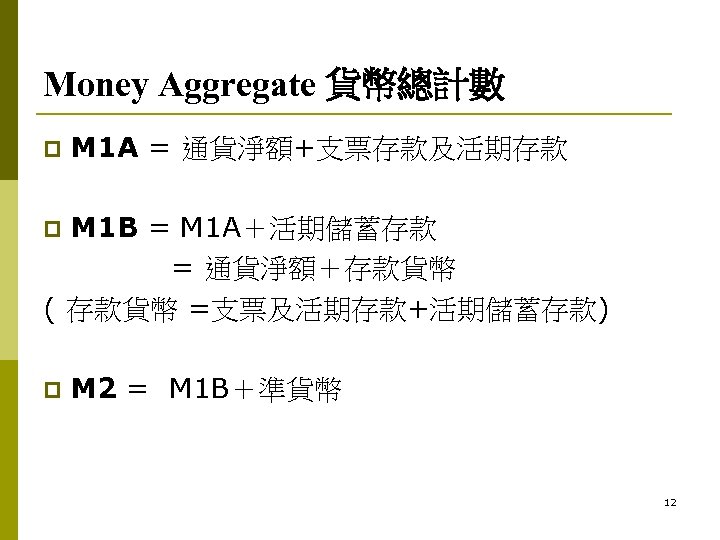 Money Aggregate 貨幣總計數 p M 1 A = 通貨淨額+支票存款及活期存款 M 1 B = M 1 A+活期儲蓄存款 = 通貨淨額+存款貨幣 ( 存款貨幣 =支票及活期存款+活期儲蓄存款) p p M 2 = M 1 B+準貨幣 12
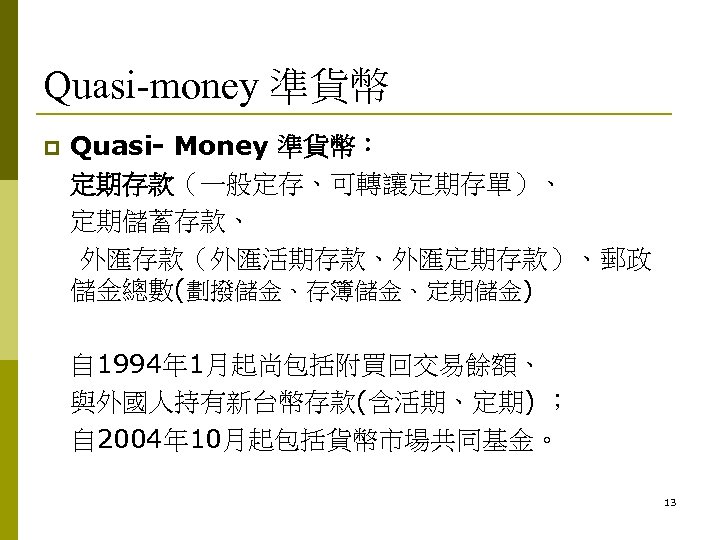 Quasi-money 準貨幣 p Quasi- Money 準貨幣: 定期存款(一般定存、可轉讓定期存單)、 定期儲蓄存款、 外匯存款(外匯活期存款、外匯定期存款)、郵政 儲金總數(劃撥儲金、存簿儲金、定期儲金) 自 1994年 1月起尚包括附買回交易餘額、 與外國人持有新台幣存款(含活期、定期) ; 自 2004年 10月起包括貨幣市場共同基金。 13
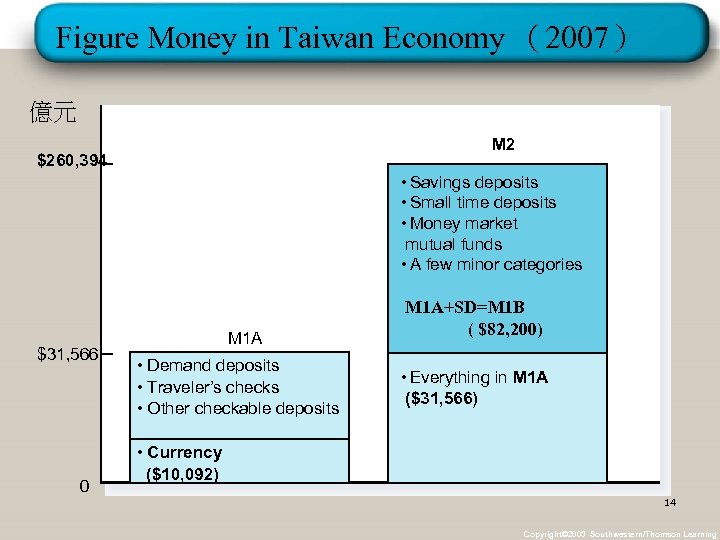 Figure Money in Taiwan Economy (2007) 億元 M 2 $260, 394 • Savings deposits • Small time deposits • Money market mutual funds • A few minor categories $31, 566 0 M 1 A • Demand deposits • Traveler’s checks • Other checkable deposits M 1 A+SD=M 1 B ( $82, 200) • Everything in M 1 A ($31, 566) • Currency ($10, 092) 14 Copyright© 2003 Southwestern/Thomson Learning
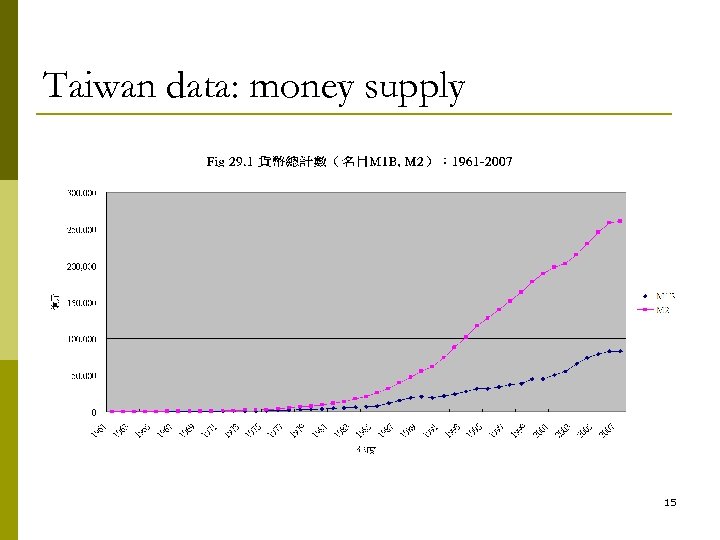 Taiwan data: money supply 15
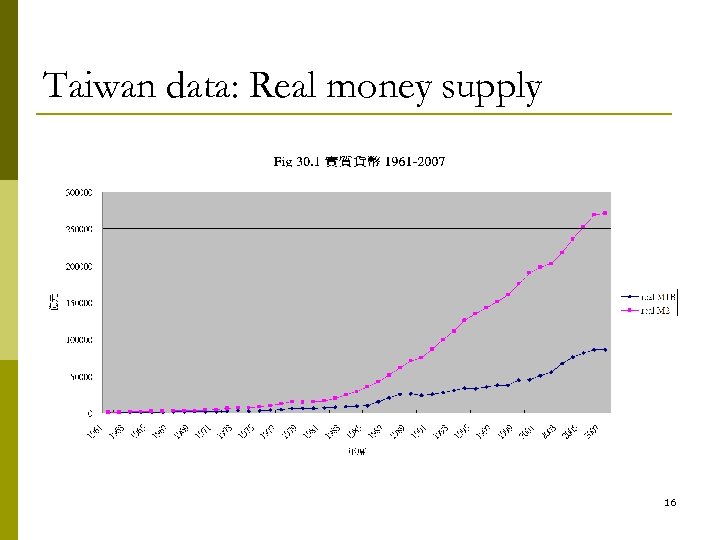 Taiwan data: Real money supply 16
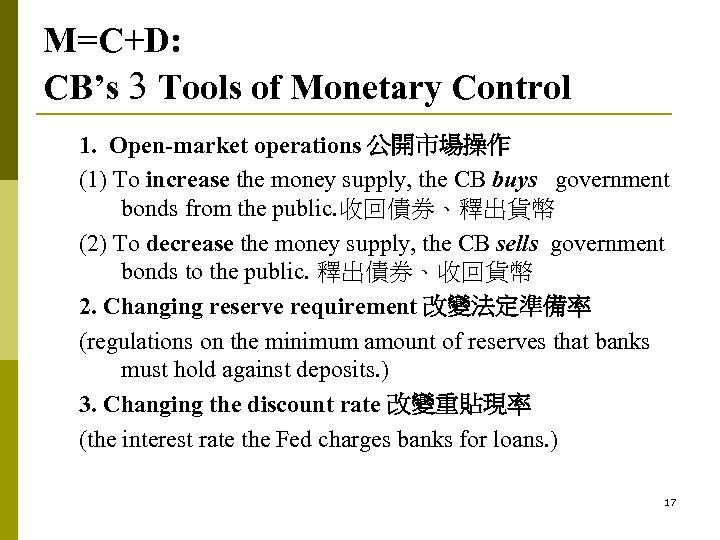 M=C+D: CB’s 3 Tools of Monetary Control 1. Open-market operations 公開市場操作 (1) To increase the money supply, the CB buys government bonds from the public. 收回債券、釋出貨幣 (2) To decrease the money supply, the CB sells government bonds to the public. 釋出債券、收回貨幣 2. Changing reserve requirement 改變法定準備率 (regulations on the minimum amount of reserves that banks must hold against deposits. ) 3. Changing the discount rate 改變重貼現率 (the interest rate the Fed charges banks for loans. ) 17
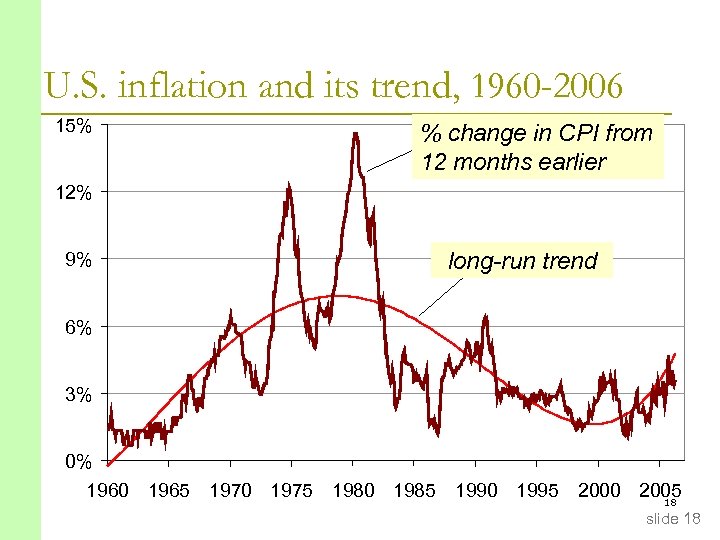 U. S. inflation and its trend, 1960 -2006 15% % change in CPI from 12 months earlier 12% long-run trend 9% 6% 3% 0% 1960 1965 1970 1975 1980 1985 1990 1995 2000 2005 18 slide 18
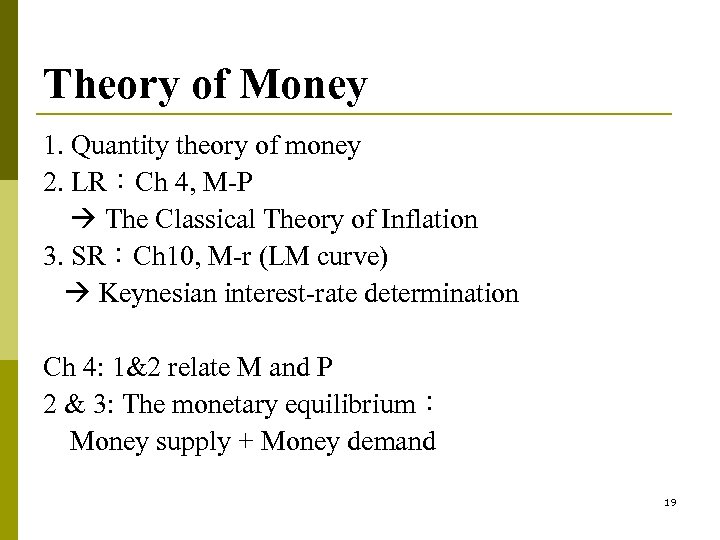 Theory of Money 1. Quantity theory of money 2. LR:Ch 4, M-P The Classical Theory of Inflation 3. SR:Ch 10, M-r (LM curve) Keynesian interest-rate determination Ch 4: 1&2 relate M and P 2 & 3: The monetary equilibrium: Money supply + Money demand 19
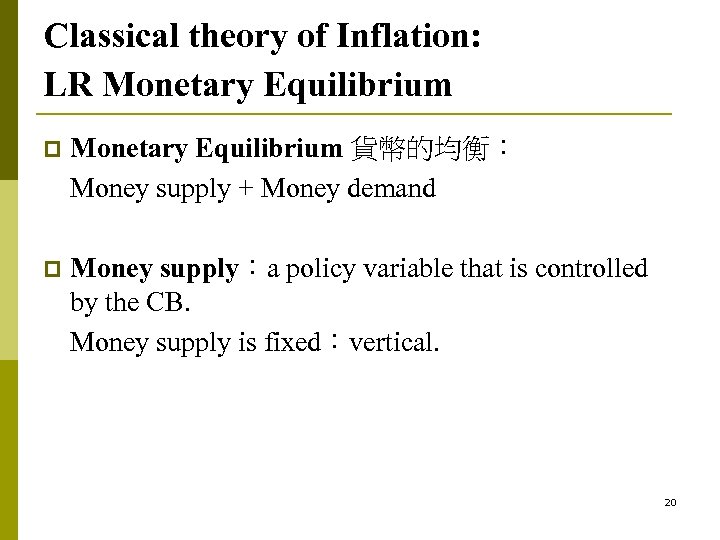 Classical theory of Inflation: LR Monetary Equilibrium p Monetary Equilibrium 貨幣的均衡: Money supply + Money demand p Money supply:a policy variable that is controlled by the CB. Money supply is fixed:vertical. 20
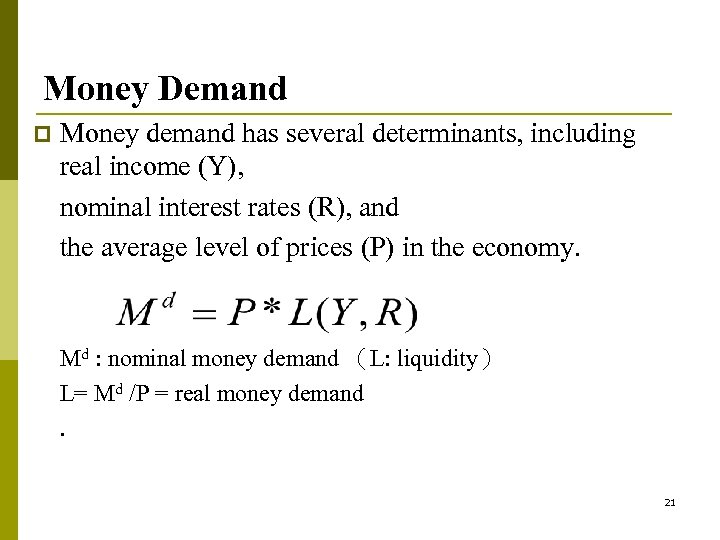 Money Demand p Money demand has several determinants, including real income (Y), nominal interest rates (R), and the average level of prices (P) in the economy. Md : nominal money demand (L: liquidity) L= Md /P = real money demand. 21
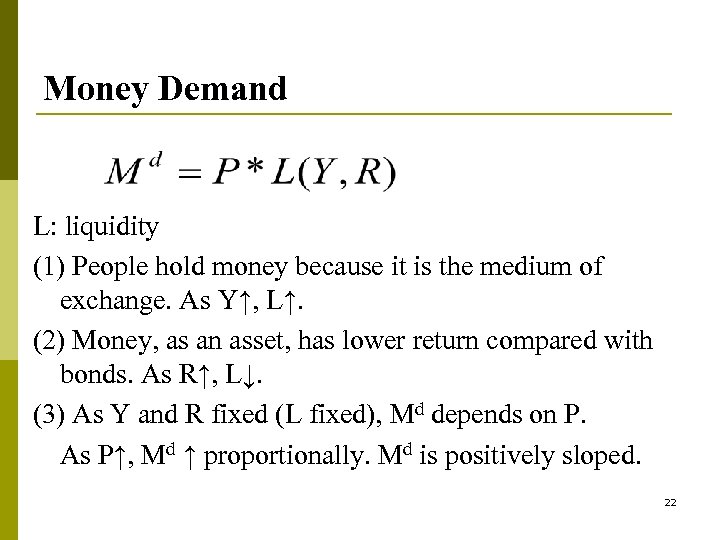 Money Demand L: liquidity (1) People hold money because it is the medium of exchange. As Y↑, L↑. (2) Money, as an asset, has lower return compared with bonds. As R↑, L↓. (3) As Y and R fixed (L fixed), Md depends on P. As P↑, Md ↑ proportionally. Md is positively sloped. 22
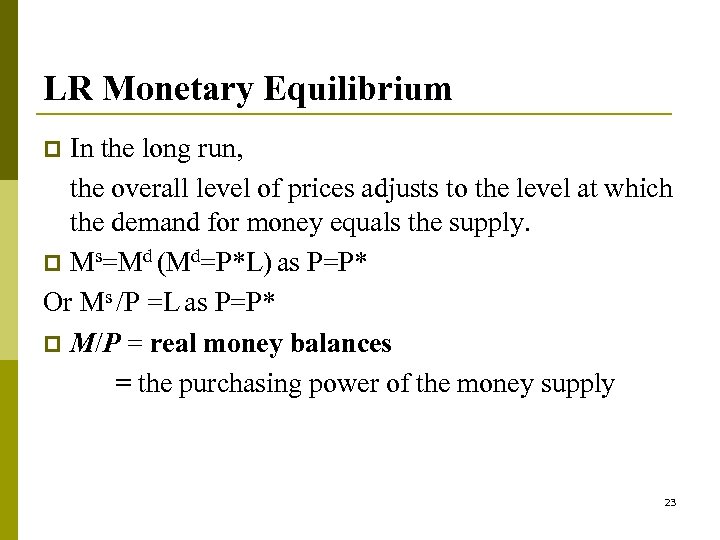 LR Monetary Equilibrium In the long run, the overall level of prices adjusts to the level at which the demand for money equals the supply. p Ms=Md (Md=P*L) as P=P* Or Ms /P =L as P=P* p M/P = real money balances = the purchasing power of the money supply p 23
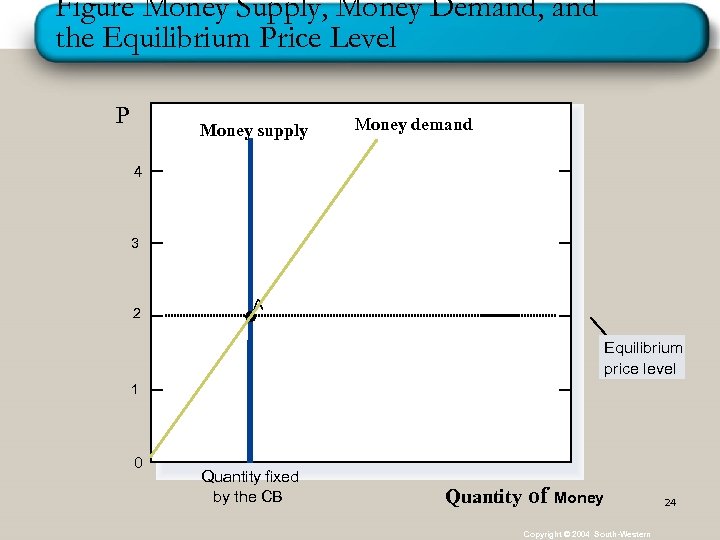 Figure Money Supply, Money Demand, and the Equilibrium Price Level P Money supply Money demand 4 3 2 A Equilibrium price level 1 0 Quantity fixed by the CB Quantity of Money Copyright © 2004 South-Western 24
 Comparative Static 1: △Ms The Effects of a Monetary Injection Helicopter Money 直昇機貨幣 (Money Rain) The CB increases money supply. Ms curve shifts to the right. Price level rises, with same proportion as Ms. p eg, If the money supply doubles (Ms 2=2 Ms 1), and the price level doubles, (P*=2 4) 25
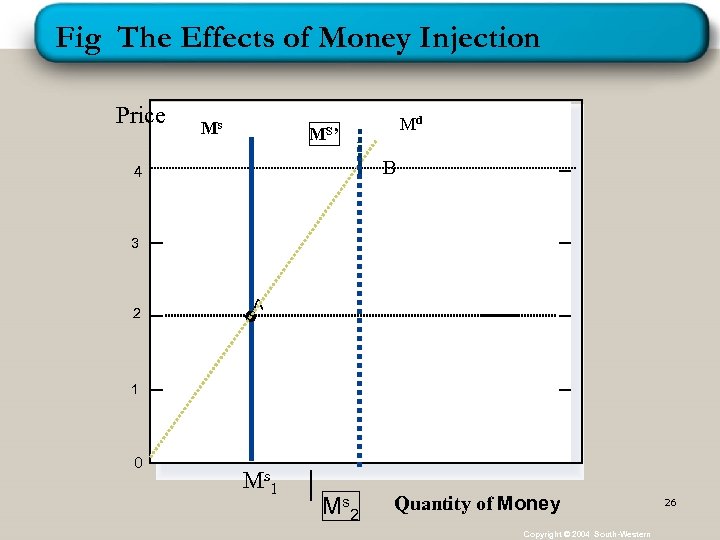 Fig The Effects of Money Injection Price Ms Md MS’ B 4 3 2 A 1 0 M s 1 M s 2 Quantity of Money Copyright © 2004 South-Western 26
 The increase in Money supply Reasoning: An increase in Money supply, given the same output At the original price, there exists ESM: Too much money is chasing the same amounts of goods. The price level rises. When reaching new equilibrium, P ↑ with the same proportion as Ms. 太多的貨幣追逐太少的貨物,造成物價上漲。 物價上漲幅度與貨幣增加幅度相同。 p △Ms △P: LR phenomenon 27
 The increase in Money supply Reasoning: (2) When the overall price level rises, the value of money falls. The value of money =1/P eg, P doubles, (P*=2 4) and the value of money becomes one half of the initial value. (1/2 1/4) To purchase the same amount of goods, the households have to hold more money: to double their money demand. (movement along Md curve) p Inflation is an economy-wide phenomenon that concerns value of the economy’s medium of exchange. 28
 Real and Nominal Interest Rates Interest represents a payment in the future for a transfer of money in the past. p Nominal interest rate (R,名目利率): the interest rate usually reported. p n p It is the interest rate that a bank pays. Real interest rate (r,實質利率): nominal interest rate corrected for the effects of inflation. 29
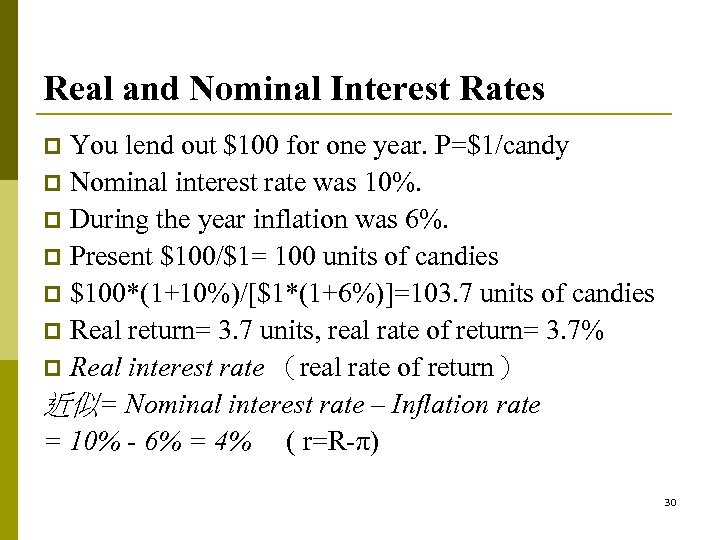 Real and Nominal Interest Rates You lend out $100 for one year. P=$1/candy p Nominal interest rate was 10%. p During the year inflation was 6%. p Present $100/$1= 100 units of candies p $100*(1+10%)/[$1*(1+6%)]=103. 7 units of candies p Real return= 3. 7 units, real rate of return= 3. 7% p Real interest rate (real rate of return) 近似= Nominal interest rate – Inflation rate = 10% - 6% = 4% ( r=R-π) p 30
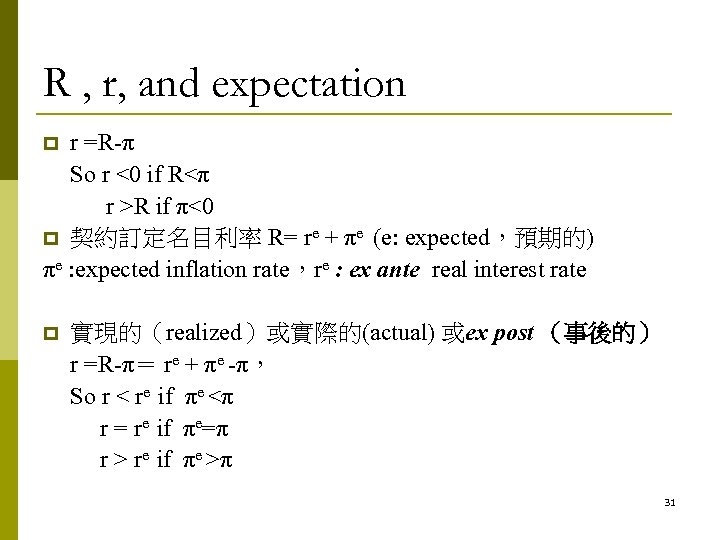 R , r, and expectation r =R-π So r <0 if R<π r >R if π<0 p 契約訂定名目利率 R= re + πe (e: expected,預期的) πe : expected inflation rate,re : ex ante real interest rate p p 實現的(realized)或實際的(actual) 或ex post (事後的) r =R-π= re + πe -π, So r < re if πe <π r = re if πe=π r > re if πe >π 31
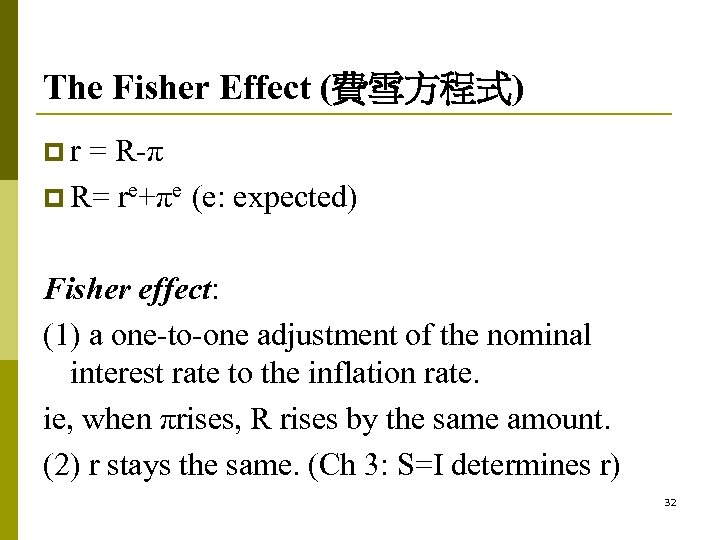 The Fisher Effect (費雪方程式) pr = R-π p R= re+πe (e: expected) Fisher effect: (1) a one-to-one adjustment of the nominal interest rate to the inflation rate. ie, when πrises, R rises by the same amount. (2) r stays the same. (Ch 3: S=I determines r) 32
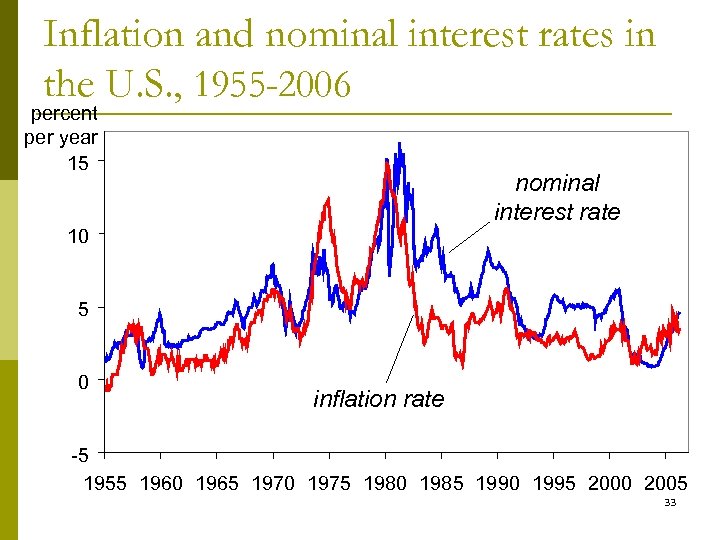 Inflation and nominal interest rates in the U. S. , 1955 -2006 percent per year 15 nominal interest rate 10 5 0 inflation rate -5 1955 1960 1965 1970 1975 1980 1985 1990 1995 2000 2005 33
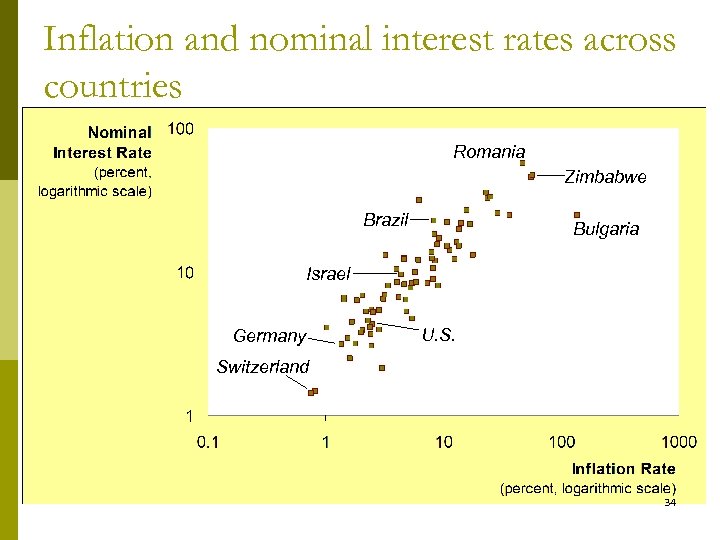 Inflation and nominal interest rates across countries Romania Zimbabwe Brazil Bulgaria Israel Germany U. S. Switzerland 34
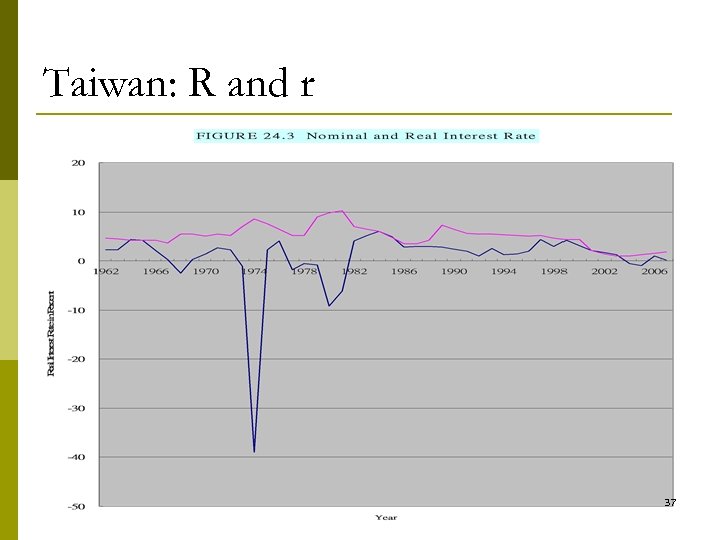
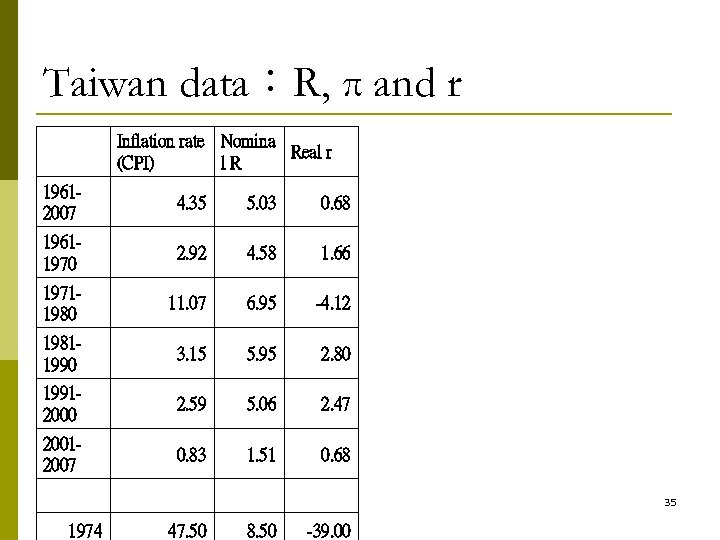 Taiwan data:R, π and r Inflation rate Nomina Real r (CPI) l. R 19612007 4. 35 5. 03 0. 68 19611970 2. 92 4. 58 1. 66 19711980 11. 07 6. 95 -4. 12 19811990 3. 15 5. 95 2. 80 19912000 2. 59 5. 06 2. 47 20012007 0. 83 1. 51 0. 68 1974 47. 50 8. 50 -39. 00 35
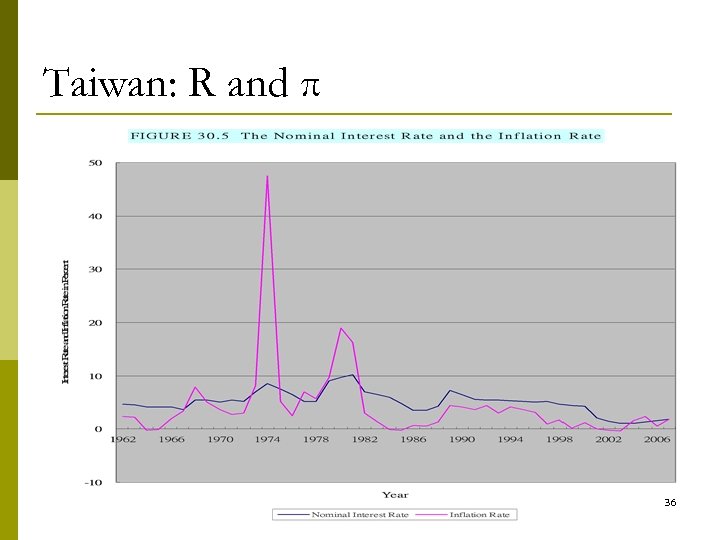 Taiwan: R and π 36
 Taiwan: R and r 37
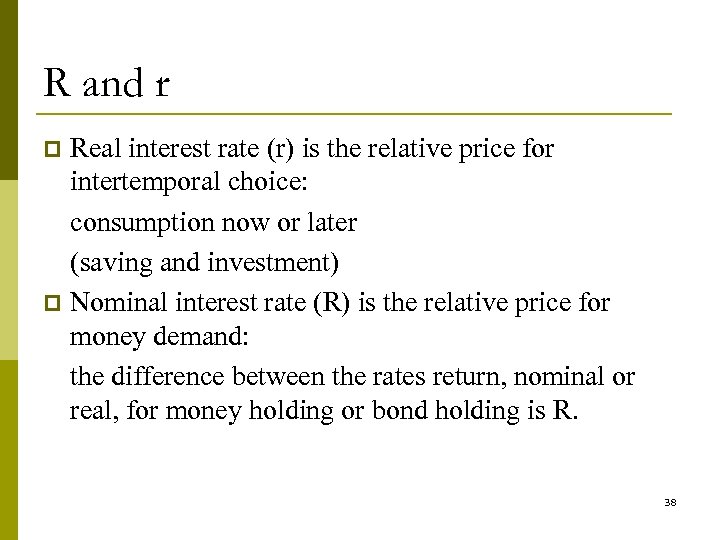 R and r Real interest rate (r) is the relative price for intertemporal choice: consumption now or later (saving and investment) p Nominal interest rate (R) is the relative price for money demand: the difference between the rates return, nominal or real, for money holding or bond holding is R. p 38
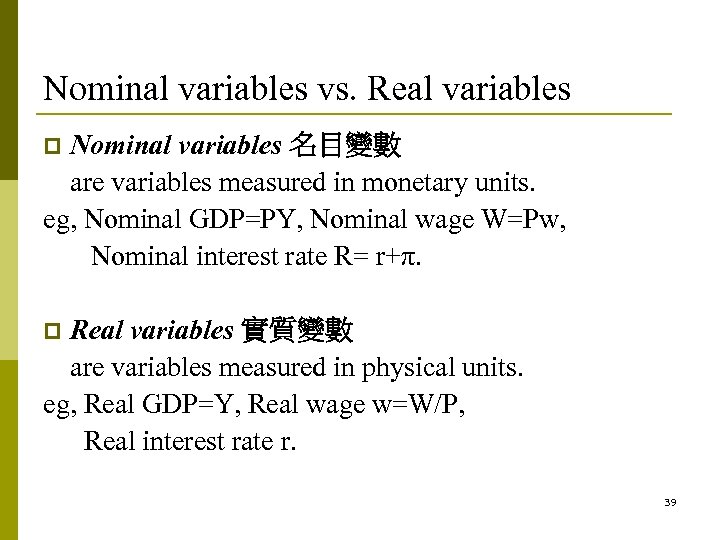 Nominal variables vs. Real variables Nominal variables 名目變數 are variables measured in monetary units. eg, Nominal GDP=PY, Nominal wage W=Pw, Nominal interest rate R= r+π. p Real variables 實質變數 are variables measured in physical units. eg, Real GDP=Y, Real wage w=W/P, Real interest rate r. p 39
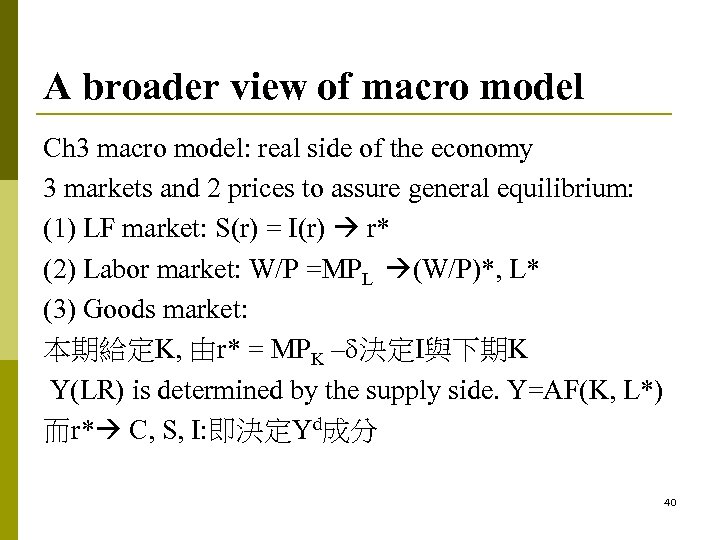 A broader view of macro model Ch 3 macro model: real side of the economy 3 markets and 2 prices to assure general equilibrium: (1) LF market: S(r) = I(r) r* (2) Labor market: W/P =MPL (W/P)*, L* (3) Goods market: 本期給定K, 由r* = MPK –δ決定I與下期K Y(LR) is determined by the supply side. Y=AF(K, L*) 而r* C, S, I: 即決定Yd成分 40
 The Classical Dichotomy and Monetary Neutrality Ch 4: 4 markets and 3 prices Here, add one more market (money market) and this market determine price (P) independently. Classical dichotomy 古典二分法: different forces influence real and nominal variables. p Changes in the money supply only affect P (and π) and only affect nominal variables (PY, W, R). But do not affect the real side of the economy( Y, r, (W/P), C, I, K, L). The irrelevance of monetary changes for real variables: monetary neutrality. (貨幣中立性) p 41
 Comparative Static 2: △πe In LR, people don’t consistently over- or underforecast inflation, so e = on average. p In SR, e may change when people get new information. eg: CB announces it will increase M next year. People will expect next year’s P to be higher, so e rises. This affects P now, even though M hasn’t changed yet…. p 42
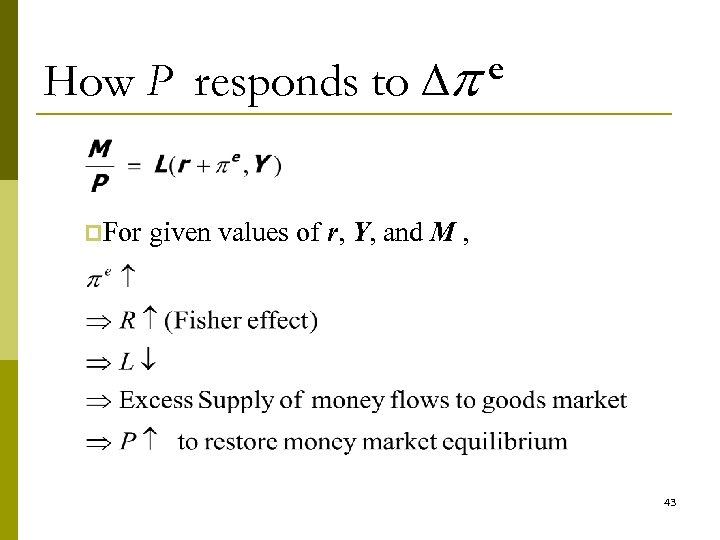 How P responds to p. For e given values of r, Y, and M , 43
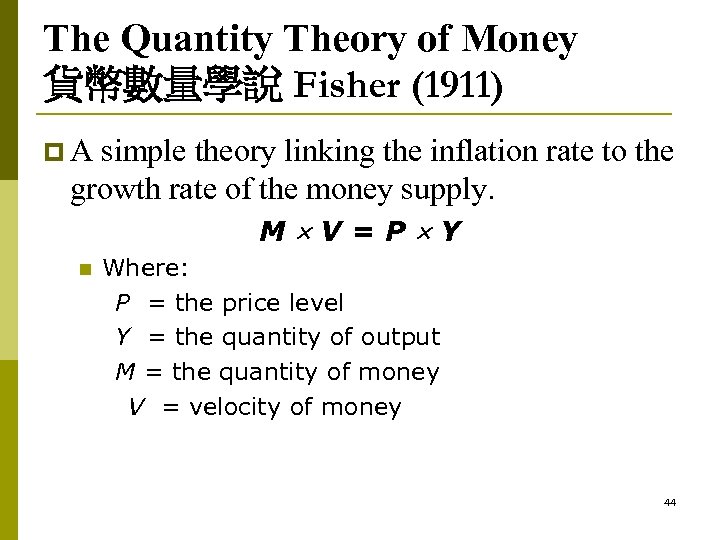 The Quantity Theory of Money 貨幣數量學說 Fisher (1911) p. A simple theory linking the inflation rate to the growth rate of the money supply. M V=P Y n Where: P = the price level Y = the quantity of output M = the quantity of money V = velocity of money 44
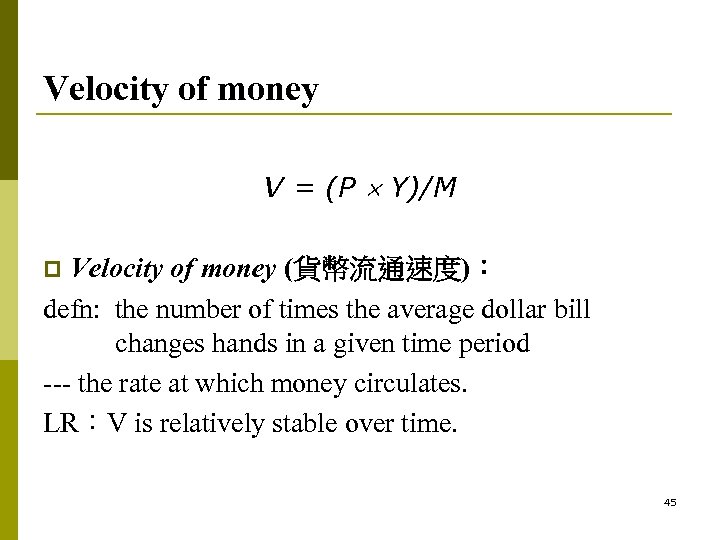 Velocity of money V = (P Y)/M Velocity of money (貨幣流通速度): defn: the number of times the average dollar bill changes hands in a given time period --- the rate at which money circulates. LR:V is relatively stable over time. p 45
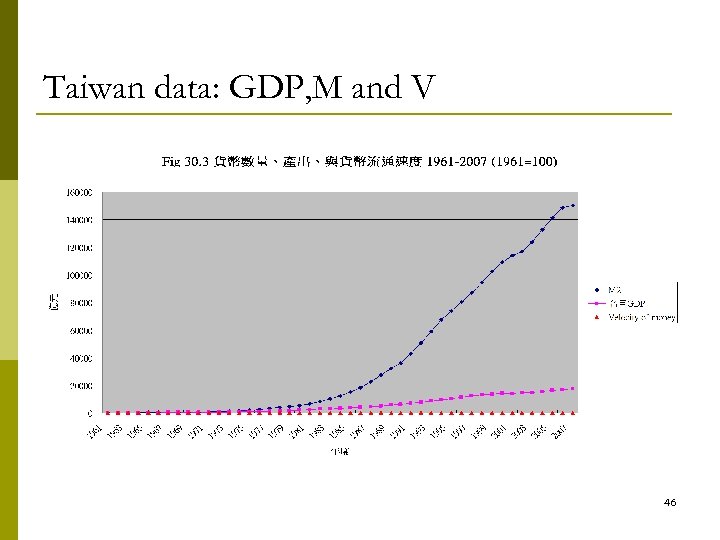 Taiwan data: GDP, M and V 46
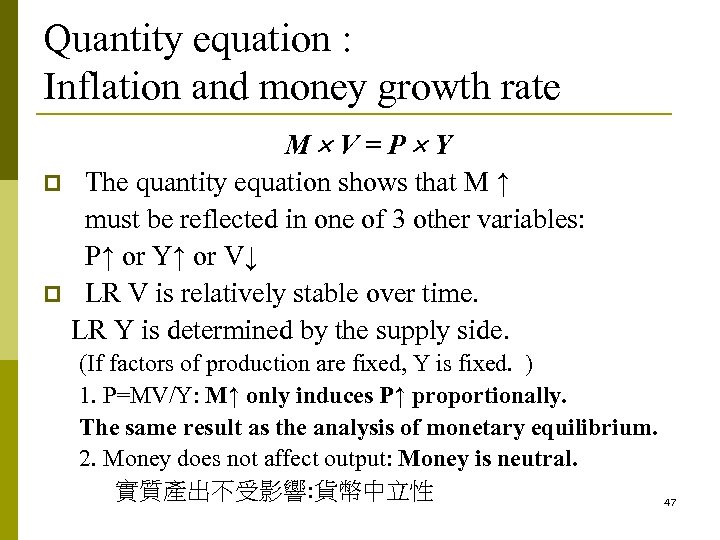 Quantity equation : Inflation and money growth rate p p M V=P Y The quantity equation shows that M ↑ must be reflected in one of 3 other variables: P↑ or Y↑ or V↓ LR V is relatively stable over time. LR Y is determined by the supply side. (If factors of production are fixed, Y is fixed. ) 1. P=MV/Y: M↑ only induces P↑ proportionally. The same result as the analysis of monetary equilibrium. 2. Money does not affect output: Money is neutral. 實質產出不受影響: 貨幣中立性 47
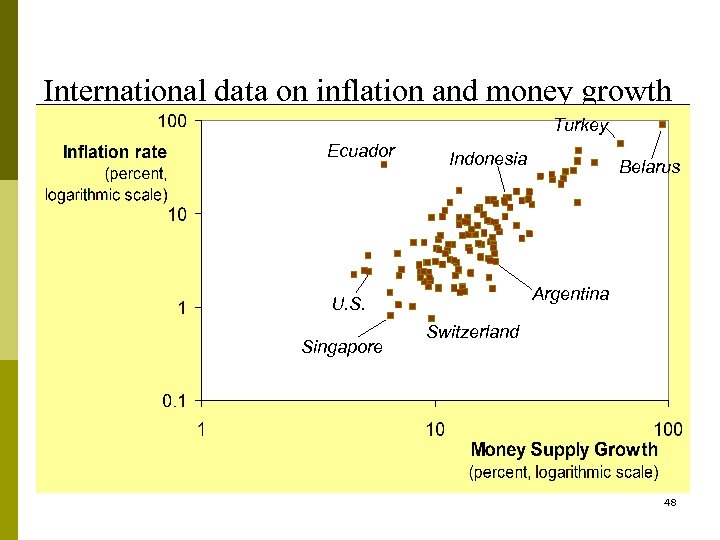 International data on inflation and money growth Turkey Ecuador Indonesia Argentina U. S. Singapore Belarus Switzerland 48
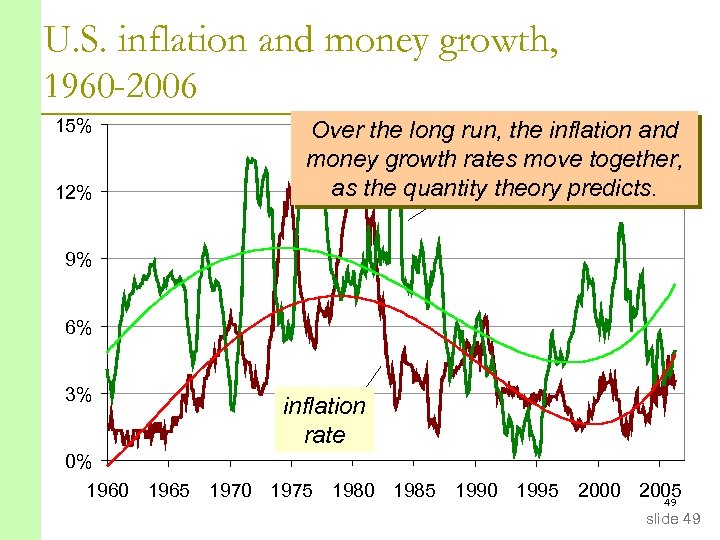 U. S. inflation and money growth, 1960 -2006 15% 12% Over the long run, the inflation and money growth rates move together, M 2 theory predicts. as the quantitygrowth rate 9% 6% 3% 0% 1960 1965 inflation rate 1970 1975 1980 1985 1990 1995 2000 2005 49 slide 49
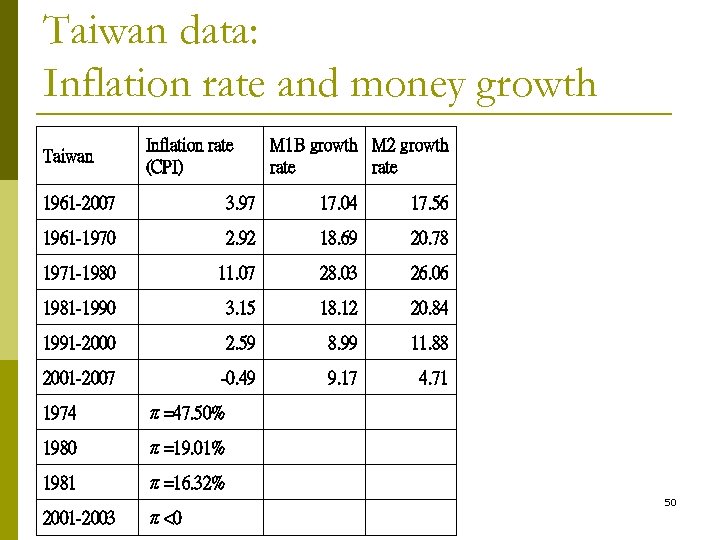 Taiwan data: Inflation rate and money growth Taiwan Inflation rate (CPI) M 1 B growth M 2 growth rate 1961 -2007 3. 97 17. 04 17. 56 1961 -1970 2. 92 18. 69 20. 78 1971 -1980 11. 07 28. 03 26. 06 1981 -1990 3. 15 18. 12 20. 84 1991 -2000 2. 59 8. 99 11. 88 2001 -2007 -0. 49 9. 17 4. 71 1974 π=47. 50% 1980 π=19. 01% 1981 π=16. 32% 50 2001 -2003 π<0
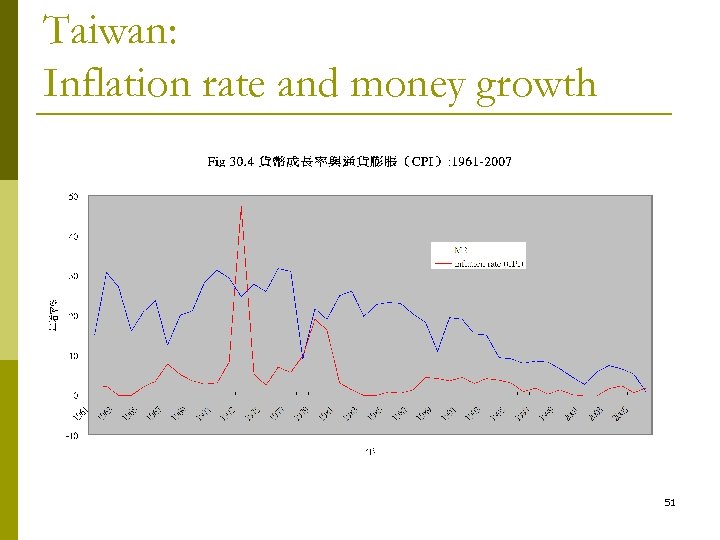 Taiwan: Inflation rate and money growth 51
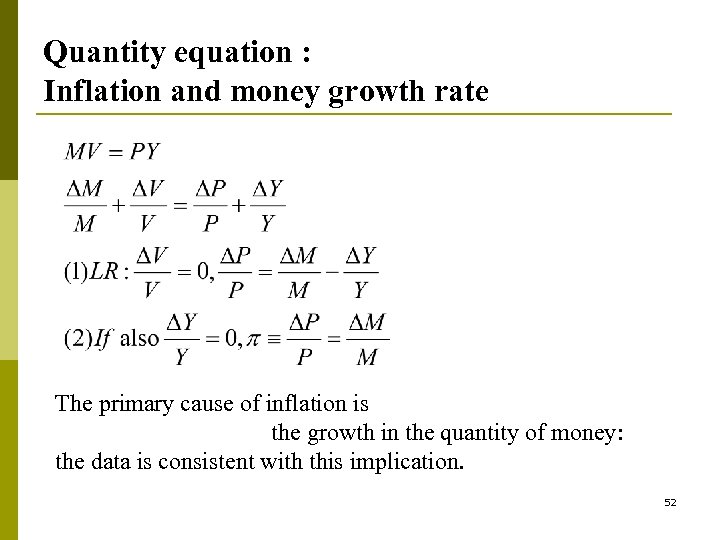 Quantity equation : Inflation and money growth rate The primary cause of inflation is the growth in the quantity of money: the data is consistent with this implication. 52
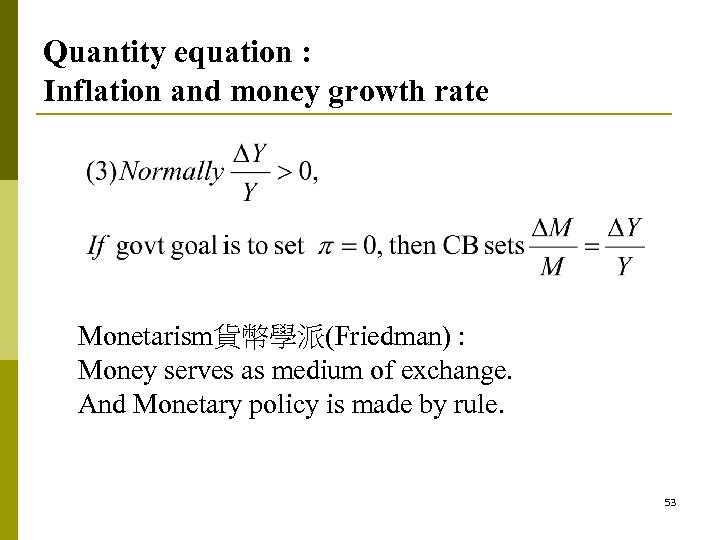 Quantity equation : Inflation and money growth rate Monetarism貨幣學派(Friedman) : Money serves as medium of exchange. And Monetary policy is made by rule. 53
 Money demand the quantity equation p In the quantity theory of money, the demand for real money balances depends only on real income Y. p A simple money demand function: M d/P = k Y k = how much money people wish to hold for each dollar of income. (k is exogenous) 54
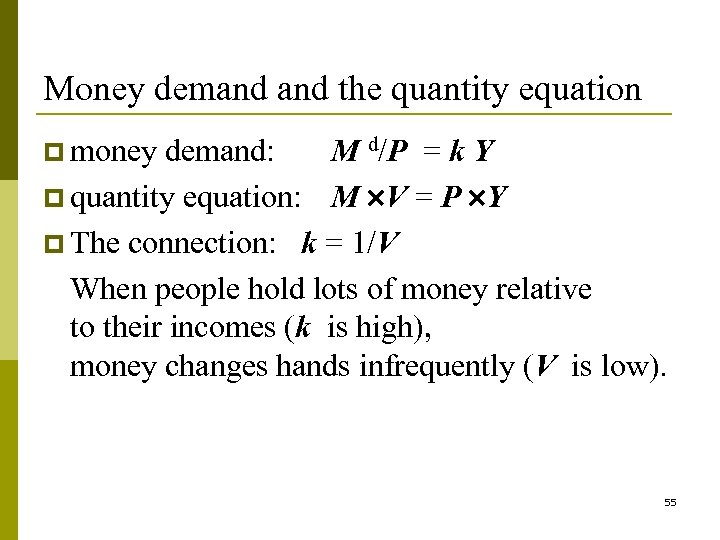 Money demand the quantity equation p money demand: M d/P = k Y p quantity equation: M V = P Y p The connection: k = 1/V When people hold lots of money relative to their incomes (k is high), money changes hands infrequently (V is low). 55
 The Social Costs of Inflation Common misperception: inflation reduces real wages and reduce purchasing power. p True only in the short run, when nominal wages are fixed by contracts. p Ch 3: In LR, real wage is determined by labor supply and the marginal product of labor, not the price level or inflation rate. p 56
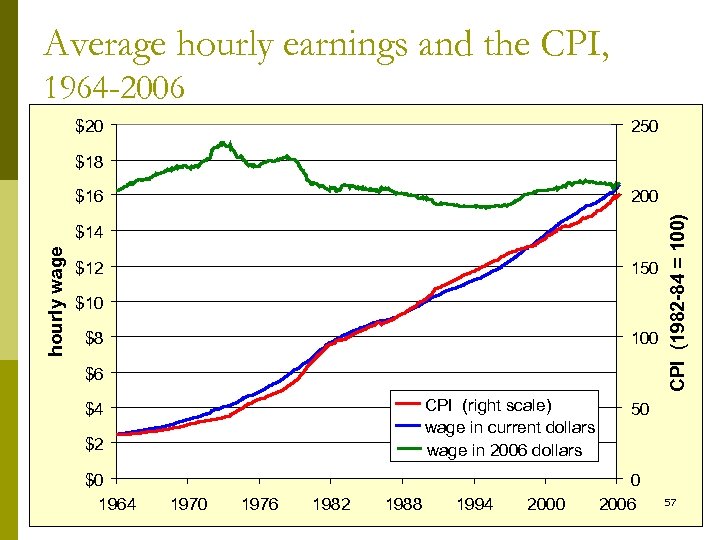 Average hourly earnings and the CPI, 1964 -2006 $20 250 $18 200 hourly wage $14 $12 150 $10 $8 100 $6 CPI (right scale) wage in current dollars wage in 2006 dollars $4 $2 $0 1964 1970 1976 1982 1988 1994 2000 CPI (1982 -84 = 100) $16 50 0 2006 57
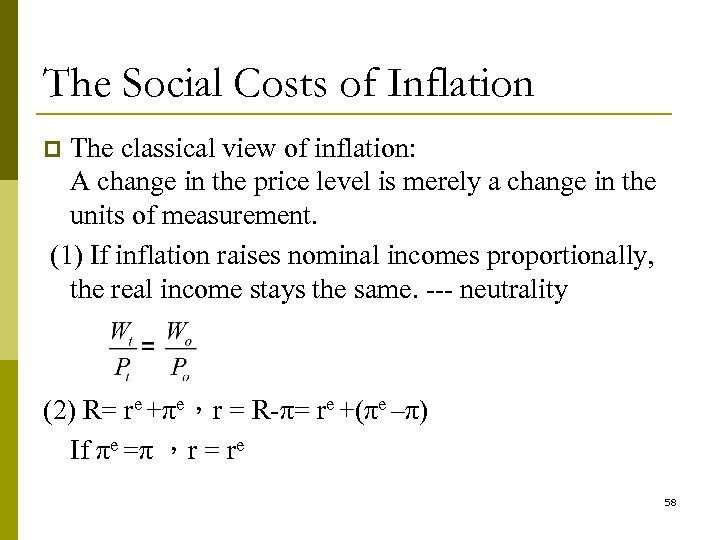 The Social Costs of Inflation The classical view of inflation: A change in the price level is merely a change in the units of measurement. (1) If inflation raises nominal incomes proportionally, the real income stays the same. --- neutrality p (2) R= re +πe,r = R-π= re +(πe –π) If πe =π ,r = re 58
 The Social Costs of Inflation p p p Inflation does not in itself reduce people’s real purchasing power. Costs of expected Inflation: Shoeleather costs Menu costs Relative price distortions Unfair tax treatment and tax distortion Confusion and inconvenience Costs of Unexpected Inflation: Arbitrary Redistribution of Wealth 59
 1. Shoeleather Costs (鞋帶成本) p In LR, inflation does not affect real income or real spending. But π↑ R↑ L↓ p So, same monthly spending but lower average money holdings means more frequent trips to the bank to withdraw smaller amounts of cash. p Shoeleather costs : It take s time and inconvenience for people to make the extra trips to the bank. take time away from productive activities. p 60
 2. Menu Costs (菜單成本) Menu costs : the costs of adjusting prices. p During inflationary times, it is necessary to update price lists and other posted prices. a resource-consuming process that takes away from other productive activities. p 61
 3. Relative-Price distortions Inflation distorts relative prices. p Consumer decisions are distorted, and markets are less able to allocate resources to their best use. Microeconomic inefficiencies due to misallocation of Resources p 62
 4. Unfair tax treatment and Tax Distortion Inflation exaggerates the size of capital gains and increases the tax burden on this type of income. (1) The income tax treats the nominal interest earned on savings as income, even though part of the nominal interest rate merely compensates for inflation. (2) The after-tax real interest rate falls making saving less attractive. p 63
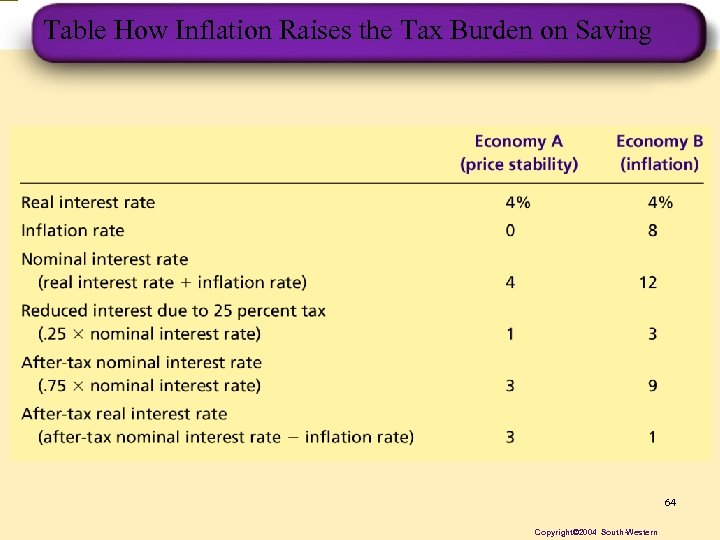 Table How Inflation Raises the Tax Burden on Saving 64 Copyright© 2004 South-Western
 5. Confusion and Inconvenience When the CB increases the money supply and creates inflation, it causes dollars at different times to have different real values. It is more difficult to compare real revenues, costs, and profits over time: It erodes the real value of the unit of account. p 65
 6. A Cost of Unexpected Inflation: Arbitrary Redistribution of Wealth (1) Principal:Debt/P = real debt↓ as P↑ (2) Returns: R= re +πe,r = R-π= re +(πe –π) If πe <π ,r < re Lower rate of return for lenders, and lower cost of borrowing for borrowers. Unexpected inflation redistributes wealth among the population from the lenders to the borrowers. 66
 One benefit of inflation Nominal wages are rarely reduced, even when the equilibrium real wage falls. This hinders labor market clearing. p Inflation allows the real wages to reach equilibrium levels without nominal wage cuts. Therefore, moderate inflation improves the functioning of labor markets. p 67
 CASE STUDY: Money and Prices during Four Hyperinflations p p p Hyperinflation is inflation that exceeds 50 percent per month. Hyperinflation occurs in some countries because the government prints too much money to pay for its spending. If it prints money rapidly enough, the result is hyperinflation. Money ceases to function as a store of value, and may not serve its other functions (unit of account, medium of exchange). People may conduct transactions with barter or a stable foreign currency. In theory, the solution to hyperinflation is simple: stop printing money. 68
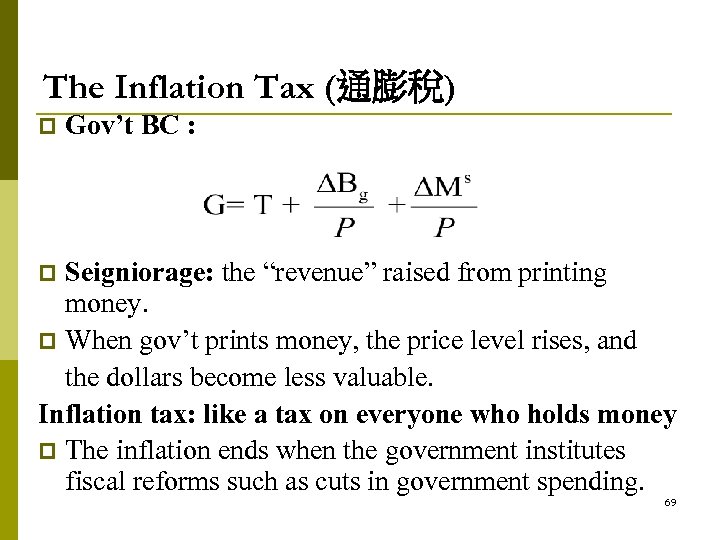 The Inflation Tax (通膨稅) p Gov’t BC : Seigniorage: the “revenue” raised from printing money. p When gov’t prints money, the price level rises, and the dollars become less valuable. Inflation tax: like a tax on everyone who holds money p The inflation ends when the government institutes fiscal reforms such as cuts in government spending. p 69
 惡性通貨膨脹 p 很多國家曾發生過嚴重的通貨膨脹,受害慘重。 尤其是在近代兩次世界大戰之後,許多國家因為 生產遭到嚴重破壞,以及龐大的軍費支出,造成 財政鉅額赤字,迫使政府大量印發鈔票,而陷入 惡性通貨膨脹,經濟體制幾乎瓦解。(央行) 70
 惡性通貨膨脹:台灣 四萬舊台幣=一元新台幣 (資料來源:央行) 台灣在光復之初曾遭遇惡性通貨膨脹。民國3438年之間,台灣的物價幾乎是一日數變,每年的 物價漲幅都在 500%至 1200%之間。 p 民國38年 6月15日,台灣實施幣制改革,每四萬 舊台幣兌換新台幣一元。 p 71
 惡性通貨膨脹:美國 US: over the past 60 years, prices have risen on average about 5 % per year. n Deflation (π<0,通貨緊縮): decreasing average prices, occurred in the U. S. in the nineteenth century. (Taiwan: 2001 -2003) n In the 1970 s prices rose by 7 % per year. n During the 1990 s, prices rose at an average rate of 2 % per year. n 72
 惡性通貨膨脹:德國 德國通貨膨脹經驗慘痛: p 第一次世界大戰後的1923年,德國陷入惡性通貨 膨脹,物價較戰前上漲一萬四千億倍,一份報紙 售價二千億馬克。 p 第二次世界大戰結束後,德國再度出現惡性通貨 膨脹,1947年間,德國大半交易被迫改用以物易 物的方式進行。 世界上最大的通貨膨脹是二次戰後的匈牙利,自 1945/7 -1946/8的13個月間,物價上升3*1025。 73
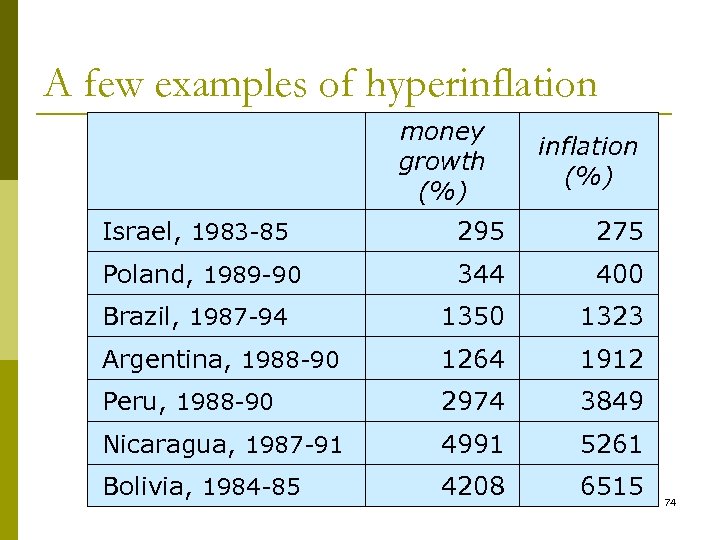 A few examples of hyperinflation money growth (%) inflation (%) Israel, 1983 -85 295 275 Poland, 1989 -90 344 400 Brazil, 1987 -94 1350 1323 Argentina, 1988 -90 1264 1912 Peru, 1988 -90 2974 3849 Nicaragua, 1987 -91 4991 5261 Bolivia, 1984 -85 4208 6515 74
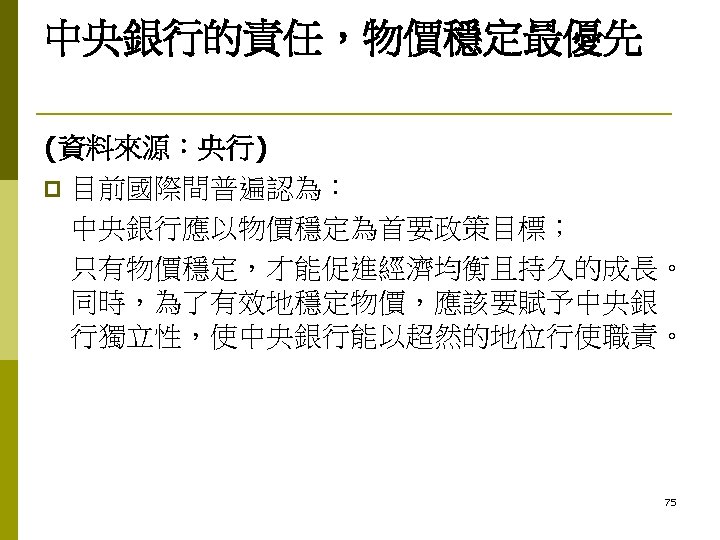 中央銀行的責任,物價穩定最優先 (資料來源:央行) p 目前國際間普遍認為: 中央銀行應以物價穩定為首要政策目標; 只有物價穩定,才能促進經濟均衡且持久的成長。 同時,為了有效地穩定物價,應該要賦予中央銀 行獨立性,使中央銀行能以超然的地位行使職責。 75
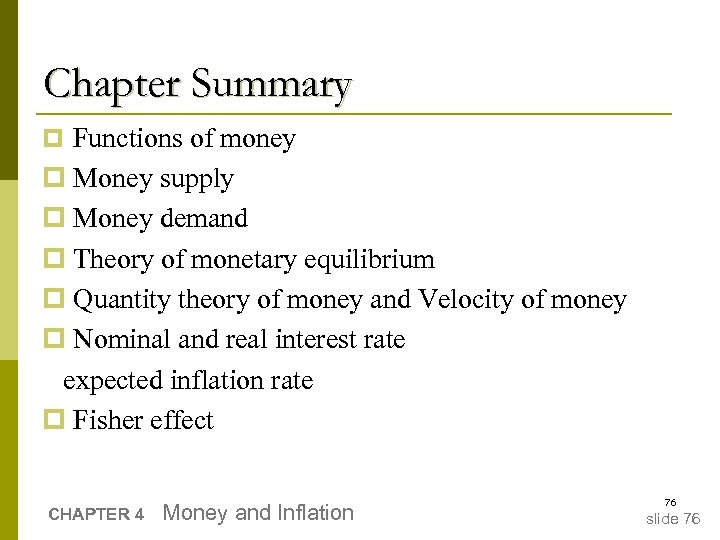 Chapter Summary p Functions of money p Money supply p Money demand p Theory of monetary equilibrium p Quantity theory of money and Velocity of money p Nominal and real interest rate expected inflation rate p Fisher effect CHAPTER 4 Money and Inflation 76 slide 76
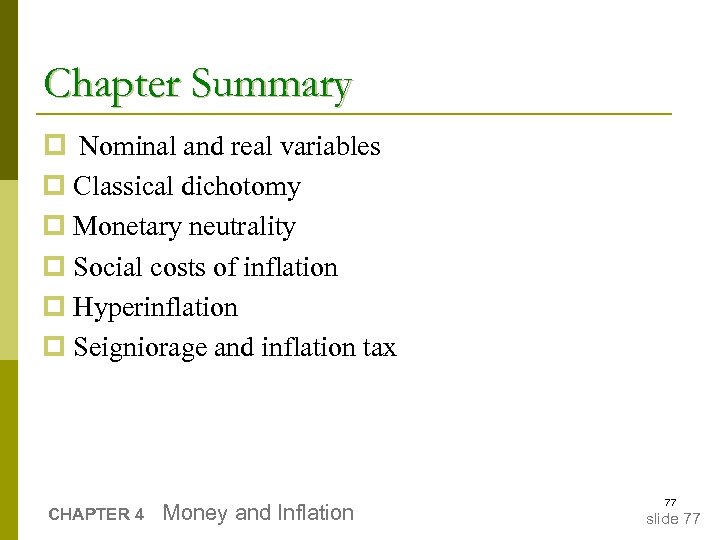 Chapter Summary p Nominal and real variables p Classical dichotomy p Monetary neutrality p Social costs of inflation p Hyperinflation p Seigniorage and inflation tax CHAPTER 4 Money and Inflation 77 slide 77