 Скачать презентацию Ch 3 Loans Conventional By Dr D Grogan
e309e97ab27004d5605977343ac1f814.ppt
- Количество слайдов: 52



Ch 3: Loans: Conventional By Dr. D. Grogan M. C. “Buzz” Chambers © 2011 Cengage Learning
PREVIEW The purpose of this unit is to acquaint the learner with the various types of non-government loans available in the conventional lending arena. These loans usually follow FNMA, GNMA or FHLMC guidelines. New loans become available on a regular basis to meet new consumer demands. Some traditional loan programs do not always have funding available by investors for particular types of loans. The market is ever changing and the mortgage loan broker must be flexible. Other loans are SBA, reverse mortgages, refinance loans, junior liens, equity loans and less than “A” paper loans. Defaults are also discussed. © 2011 Cengage Learning
Contents n PART 2 Loans n 3. 2 Conventional loan features q n Ch 3: Loans Conventional n 3. 1 How a mortgage broker selects a loan q q q q Loan amounts Eligibility requirements for high-balance loans Loan to value ratio Loan to value payment Fixed rate loan Bi-Weekly fixed rate loans The 10 - or 15 -year mortgage Adjustable rate mortgages Index Treasury bill rate LIBOR The two step mortgage Price level-adjusted mortgage Reverse annuity mortgage © 2011 Cengage Learning
Contents q n 3. 2 Conventional loan features (cont. ) q q FNMA & FHLMC loan programs Condominium loans q q q n 3. 3 Mortgage insurance q q q n 3. 4 California loan programs q q California housing finance agency Southern California Home Financing Authority Hope for Ownership of Single Family Homes Home Investment and Affordable Housing n 3. 4 California loan programs (cont. ) Public Employees Retirement System State Teacher Retirement System Home Ownership Program My Community mortgage loan Energy Efficient Mortgage Other loan programs 3. 5 Refinance, Equity and Junior or Sub -Prime loans q q q n © 2011 Cengage Learning Refinance loan Junior liens Home equity line of credit Loans: Sub-Prime borrowers Defaults
Student Learning Outcomes: 1. 2. 3. 4. 5. 6. 7. 8. 9. Compare and contrast the primary considerations used to select one conventional lender over another. Differentiate among the various conventional loans for FNMA, GNMA, and FHLMC. Describe conventional loans features used to determine which loan best suits a particular borrower. List and explain the components of various types of indexes for which a loan rate would be tied. Describe conventional loan insurance programs, when such is required and the coverage. Identify the loan criteria that serve as a match with buyer qualification. Explain the nature of the various conventional programs. Describe the elements of junior lien types. Discuss subprime or B-paper loans. © 2011 Cengage Learning
3. 1 How a Loan Broker selects a loan n n n What is the lender’s ability to lock in an interest rate? What date or event will the loan rate tie to: application date, funding date, advertised rate? What loan points, fees, and costs go with which kind of loan? Will the lender give you references of other loan brokers who use this lender? What is the average time to close the loan once a processed loan is submitted? What loan terms and programs are available to the loan broker? What are underwriting guidelines that the lender prefers for the loan package? © 2011 Cengage Learning
3. 2 Conventional loan features n n NOT a government loan & NOT insured by state or federal agency Conforming loan guidelines for secondary market: q q n Maximum loan amount Minimum qualification for borrower & property Secondary money market loans must meet the guideline standards set by FNMA or FHLMC © 2011 Cengage Learning
CONVENTIONAL LOAN FEATURES n n n Prefer single-family, owner-occupied homes or condos. Prefer working with only certain loan programs. No one conventional lender dominates the market. Different conventional lenders have different stacking orders. Processing time varies from conventional lender to lender. Typical down payment required on many of these loans ranges from five to ten percent. © 2011 Cengage Learning
CONVENTIONAL LOAN FEATURES (cont) n n Loan-to-Value (LTV) ratios q Up to 95% of the appraised property value q Interest rates and loan fees will vary q Each lender sets own guidelines for LTV Amortized loan payment q Some principal and interest payment. q Impound account may be required for taxes and insurance. © 2011 Cengage Learning
Conventional Loans n Loans made by institutional lenders: q Life insurance companies prefer larger loans. q Commercial banks prefer loans on construction, refinance & home equity line. q Savings prefer owner occupied home loans. © 2011 Cengage Learning
Conventional Loans n Loans made by non-institutional lenders: q q q n Mortgage Companies prefer saleable loans Loan correspondent represents one company, usually for income property loans Funded by a mortgage banker Private investors include sellers who carry back junior loans on property they sell q q Soft money loan is when a seller is the lender Hard money loan is funded by an outside source © 2011 Cengage Learning
Conventional Loan Amounts n OTS sets upper limits on loan-to-value (LTV) (for S&Ls only, not for all mortgage lenders) q q q High-cost areas maximum loan amounts changed Jan 2, 2009 Land up to 65% Land development up to 75% Multifamily & commercial property up to 80% 1 -4 family properties up to 95%-100% © 2011 Cengage Learning
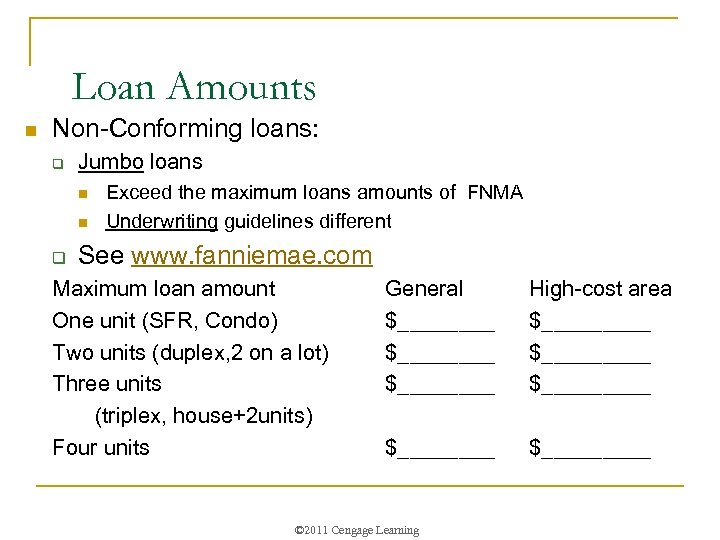
Loan Amounts n Non-Conforming loans: q Jumbo loans n n q Exceed the maximum loans amounts of FNMA Underwriting guidelines different See www. fanniemae. com Maximum loan amount One unit (SFR, Condo) Two units (duplex, 2 on a lot) Three units (triplex, house+2 units) Four units General $________ $____ High-cost area $_________ $_________ © 2011 Cengage Learning
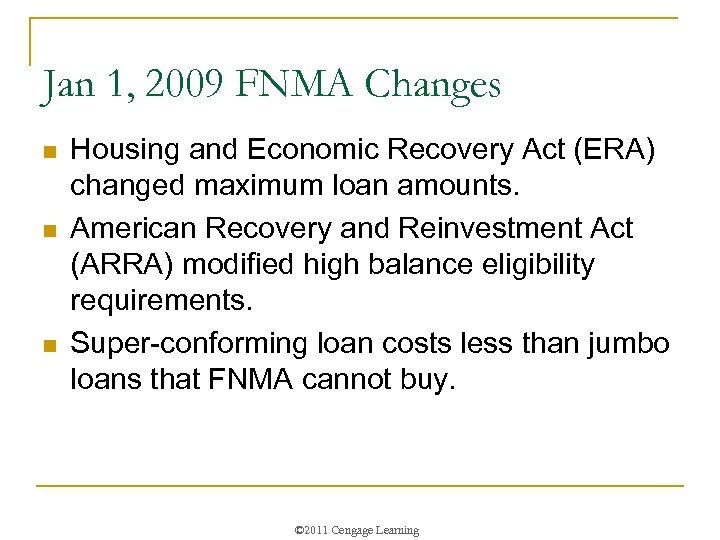
Jan 1, 2009 FNMA Changes n n n Housing and Economic Recovery Act (ERA) changed maximum loan amounts. American Recovery and Reinvestment Act (ARRA) modified high balance eligibility requirements. Super-conforming loan costs less than jumbo loans that FNMA cannot buy. © 2011 Cengage Learning
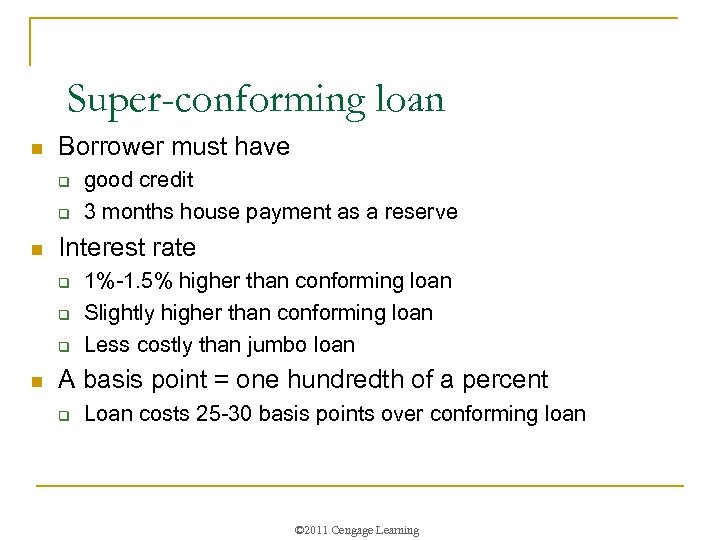
Super-conforming loan n Borrower must have q q n Interest rate q q q n good credit 3 months house payment as a reserve 1%-1. 5% higher than conforming loan Slightly higher than conforming loan Less costly than jumbo loan A basis point = one hundredth of a percent q Loan costs 25 -30 basis points over conforming loan © 2011 Cengage Learning
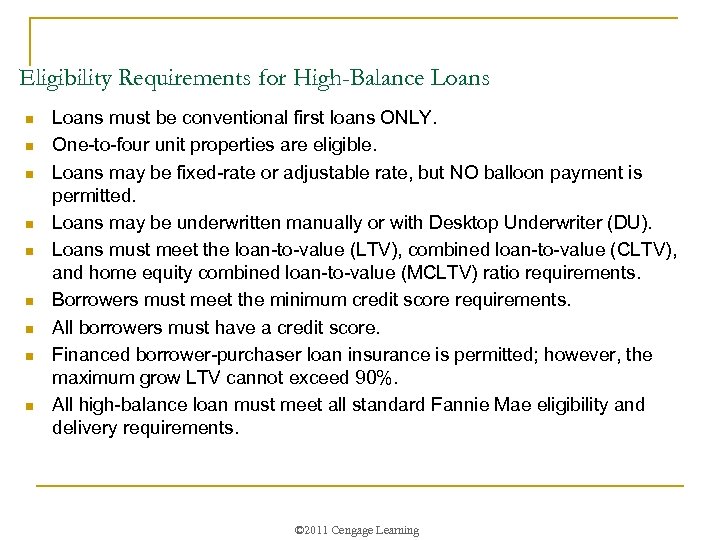
Eligibility Requirements for High-Balance Loans n n n n n Loans must be conventional first loans ONLY. One-to-four unit properties are eligible. Loans may be fixed-rate or adjustable rate, but NO balloon payment is permitted. Loans may be underwritten manually or with Desktop Underwriter (DU). Loans must meet the loan-to-value (LTV), combined loan-to-value (CLTV), and home equity combined loan-to-value (MCLTV) ratio requirements. Borrowers must meet the minimum credit score requirements. All borrowers must have a credit score. Financed borrower-purchaser loan insurance is permitted; however, the maximum grow LTV cannot exceed 90%. All high-balance loan must meet all standard Fannie Mae eligibility and delivery requirements. © 2011 Cengage Learning
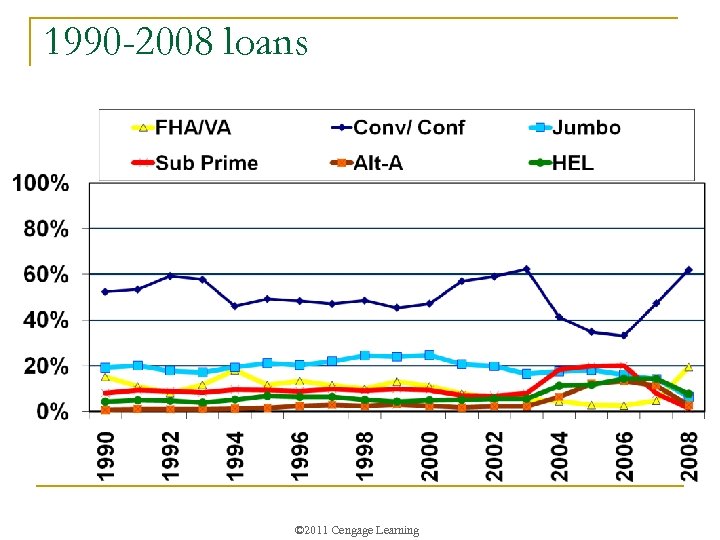
1990 -2008 loans © 2011 Cengage Learning
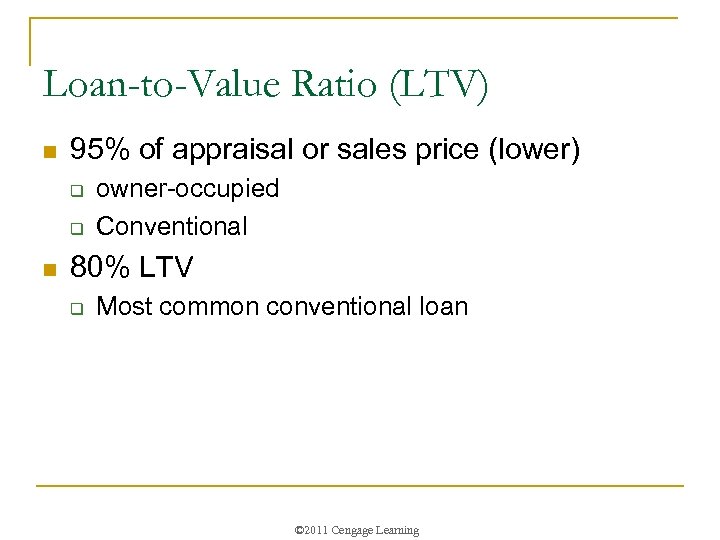
Loan-to-Value Ratio (LTV) n 95% of appraisal or sales price (lower) q q n owner-occupied Conventional 80% LTV q Most common conventional loan © 2011 Cengage Learning
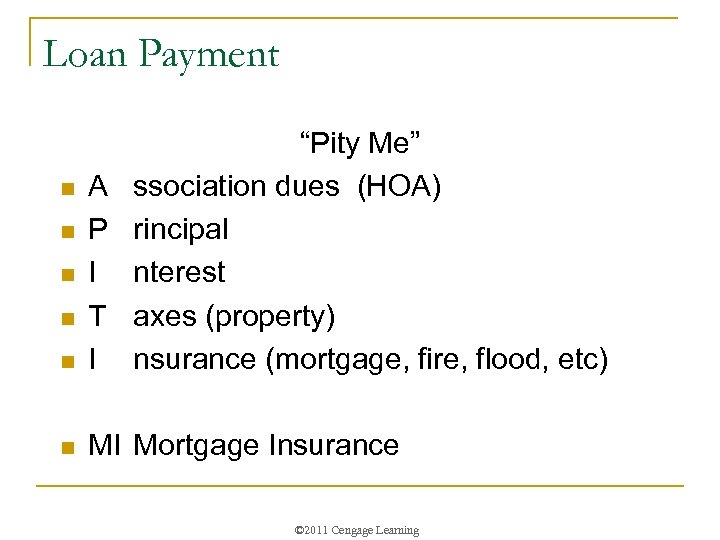
Loan Payment n “Pity Me” A ssociation dues (HOA) P rincipal I nterest T axes (property) I nsurance (mortgage, fire, flood, etc) n MI Mortgage Insurance n n © 2011 Cengage Learning
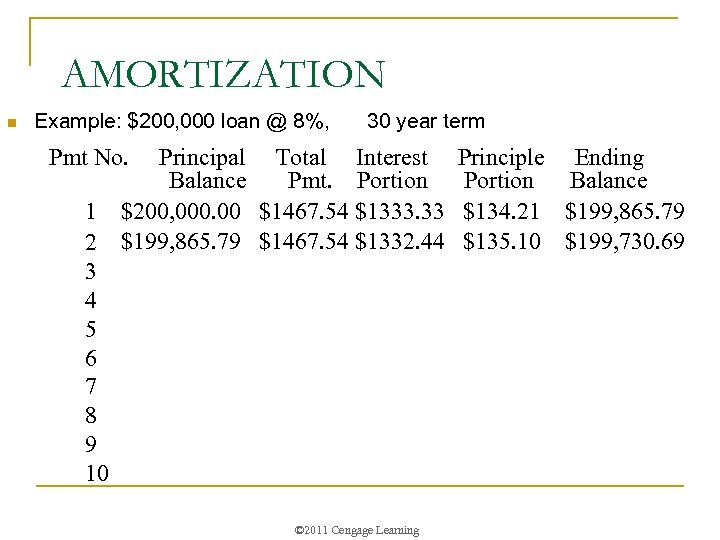
AMORTIZATION n Example: $200, 000 loan @ 8%, 30 year term Pmt No. 1 2 3 4 5 6 7 8 9 10 Principal Total Interest Balance Pmt. Portion $200, 000. 00 $1467. 54 $1333. 33 $199, 865. 79 $1467. 54 $1332. 44 © 2011 Cengage Learning Principle Ending Portion Balance $134. 21 $199, 865. 79 $135. 10 $199, 730. 69
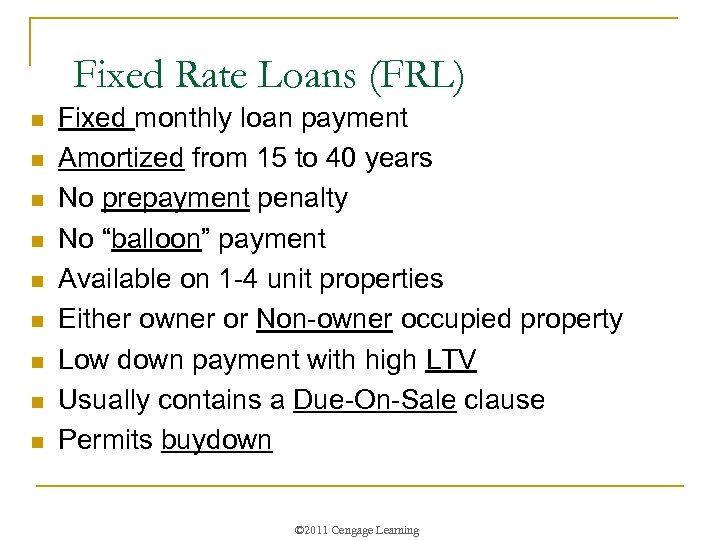
Fixed Rate Loans (FRL) n n n n n Fixed monthly loan payment Amortized from 15 to 40 years No prepayment penalty No “balloon” payment Available on 1 -4 unit properties Either owner or Non-owner occupied property Low down payment with high LTV Usually contains a Due-On-Sale clause Permits buydown © 2011 Cengage Learning
Bi-Weekly Fixed Rate Loan n Shortens the life of the loan The borrower makes 26 payments a year – one every two weeks Reduces the total interest paid © 2011 Cengage Learning
10 - or 15 - year loan n n Lower interest rate Shorter duration Pays off a 30 year about 9 years early To convert a 30 year loan to 15 year payoff, pay 4. 5% more each year. © 2011 Cengage Learning
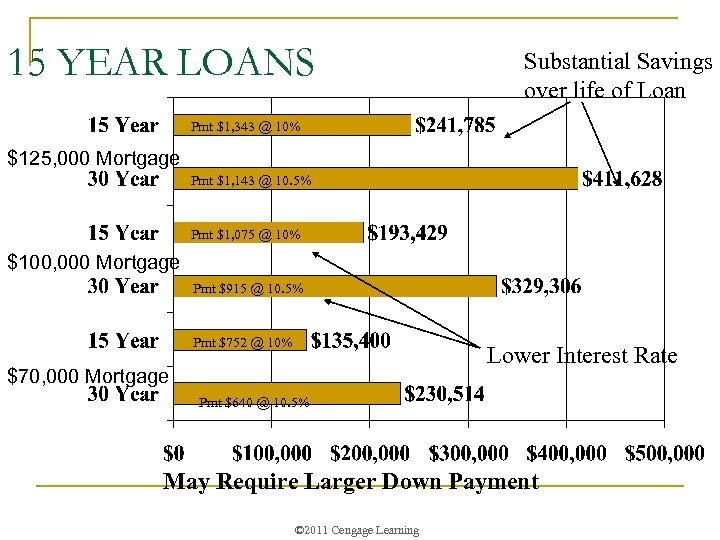
15 YEAR LOANS Substantial Savings over life of Loan Pmt $1, 343 @ 10% $125, 000 Mortgage Pmt $1, 143 @ 10. 5% Pmt $1, 075 @ 10% $100, 000 Mortgage Pmt $915 @ 10. 5% Pmt $752 @ 10% Lower Interest Rate $70, 000 Mortgage Pmt $640 @ 10. 5% May Require Larger Down Payment © 2011 Cengage Learning
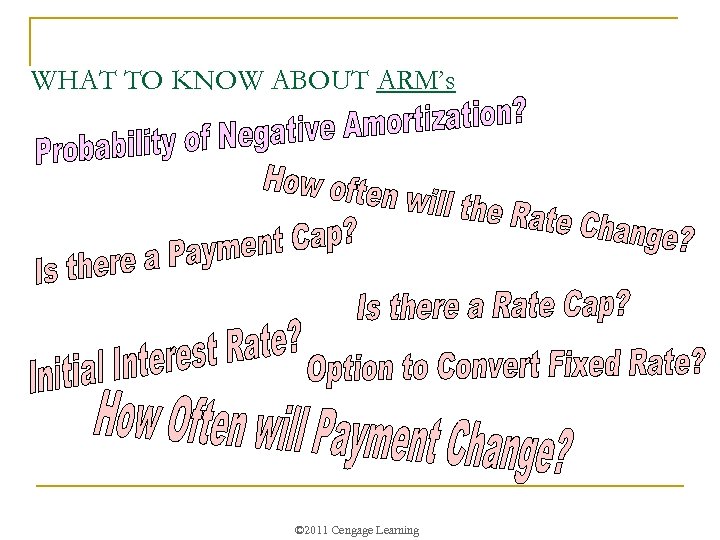
WHAT TO KNOW ABOUT ARM’s © 2011 Cengage Learning
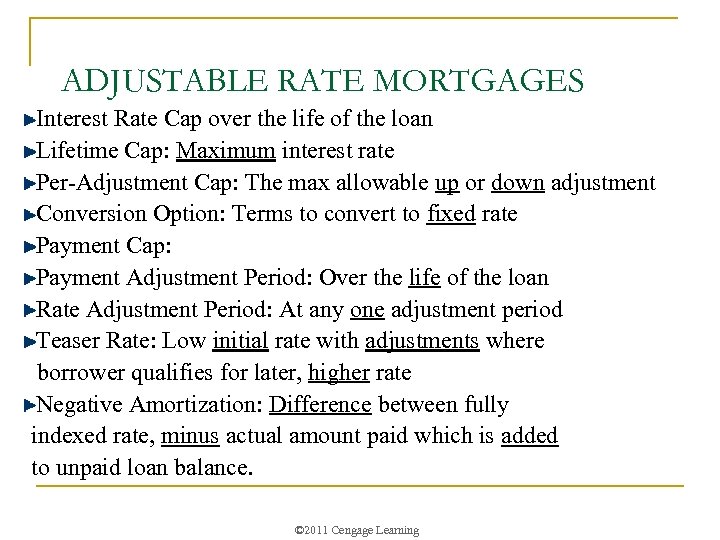
ADJUSTABLE RATE MORTGAGES Interest Rate Cap over the life of the loan Lifetime Cap: Maximum interest rate Per-Adjustment Cap: The max allowable up or down adjustment Conversion Option: Terms to convert to fixed rate Payment Cap: Payment Adjustment Period: Over the life of the loan Rate Adjustment Period: At any one adjustment period Teaser Rate: Low initial rate with adjustments where borrower qualifies for later, higher rate Negative Amortization: Difference between fully indexed rate, minus actual amount paid which is added to unpaid loan balance. © 2011 Cengage Learning
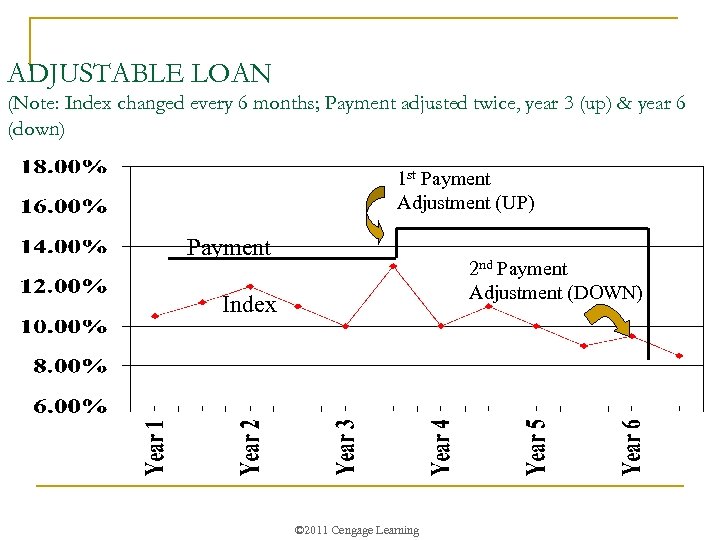
ADJUSTABLE LOAN (Note: Index changed every 6 months; Payment adjusted twice, year 3 (up) & year 6 (down) 1 st Payment Adjustment (UP) Payment 2 nd Payment Adjustment (DOWN) Index © 2011 Cengage Learning
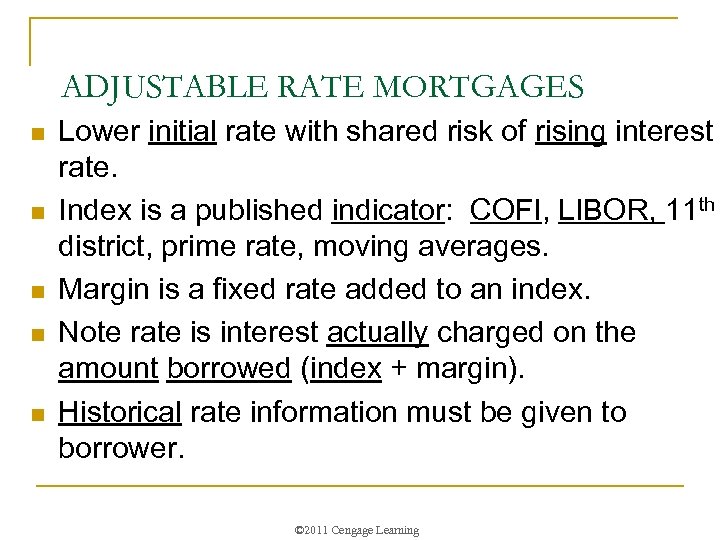
ADJUSTABLE RATE MORTGAGES n n n Lower initial rate with shared risk of rising interest rate. Index is a published indicator: COFI, LIBOR, 11 th district, prime rate, moving averages. Margin is a fixed rate added to an index. Note rate is interest actually charged on the amount borrowed (index + margin). Historical rate information must be given to borrower. © 2011 Cengage Learning
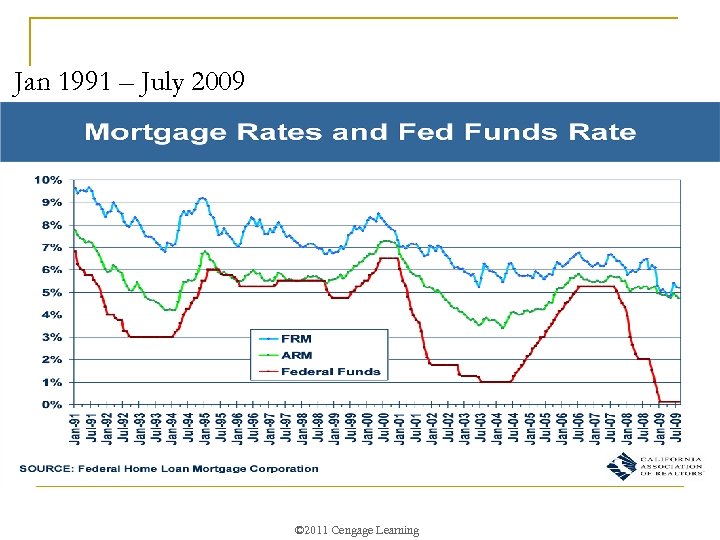
Jan 1991 – July 2009 © 2011 Cengage Learning
Other conventional loans n Two-Step q q n Interest rate adjusted only once Rate usually adjusted at year five or seven Price Level-Adjusted Mortgage (PLAM) q q The rate is the same as the Consumer Price Index Adjustment in monthly payment and outstanding principal annually. © 2011 Cengage Learning
Reverse Annuity Mortgage (RAM) n n Borrower must be age 62 or older q Borrower equity rich, but cash poor q Loan may be a lump sum or a line of credit q Must occupy the property as their principal residence Single-purpose reverse mortgage that may be used for only one specified purpose (to pay property taxes or make a home repair). Federally insured reverse mortgage that may be used for any purpose and is available throughout the United States, providing the largest advances that are convention, insured loans. Proprietary reverse mortgages may be used for any purpose and are designed for advances where the property value is substantially more than the median home value in the country, called high-cost areas. http: //www. aarp. org/revmort © 2011 Cengage Learning
RAM loan options ARM payment option-Borrower: n Receives monthly payment for fixed period they select. n Receive monthly payment until they no longer occupy the property as their principal residence. n May draw the principal in equal monthly payments. n May draw cash at times & amounts of their choosing. n May change from one option to another for a fee with HUD authorization. Fixed-rate Single payment option n Borrower may draw entire line of credit at closing. n Future draws or access are allowed only for repairs or servicing fees. n FNMA will only fund closed-end, fully drawn, fixed-rate HECMs that comply w/HUD regulations. © 2011 Cengage Learning
Step to obtain a RAM n n n Awareness: Go online to learn about reverse mortgage for general information. Action: Contact a reverse mortgage lender or NRMLA. Counseling: Obtain counseling from a HUD approved counseling agency or AARP-trained counselor. Counseling is mandatory, regardless of which program chosen. Application: The homeowner completes an application and selects the payment option: fixed monthly payments, lump sum amount, line of credit or combination. Processing: Loan broker orders title and lien payoffs. Financial institution orders appraisal to determine the property value and physical condition of the property. Underwriting: Loan broker finalizes loan parameters with the homeowner and submits the loan package to an underwriter for final loan approval. © 2011 Cengage Learning
Step to obtain a RAM (cont. ) n n n Closing: After the loan is approved and the closing date is scheduled for the signing of the final loan documents, the loan closes escrow. The initial and expected interest rates are then calculated and the final figures are prepared. Once completed, the homeowner signs the new loan papers. Funding: The homeowner has three business days to cancel the loan. After the three days, the loan funds are disbursed. Payments: The homeowner does not make any monthly loan payment to the lender during the life of the loan. The loan is due upon death or sale. © 2011 Cengage Learning
FNMA & FHLMC Loans n FNMA- Fannie Mae -Federal National Mortgage Association q n FHLMC - Freddie Mac - Federal Home Loan Mortgage Corp. q n http: //www. fanniemae. com http: //www. freddiemac. com GNMA - Ginnie Mae – Government National Mortgage Corp. q http: //www. ginniemae © 2011 Cengage Learning
Mortgage Credit Certificate (MCC) n 15% of the interest paid on the loan is a direct credit on federal taxes n Allows some borrowers to qualify for a loan that they might otherwise not be able to obtain. © 2011 Cengage Learning
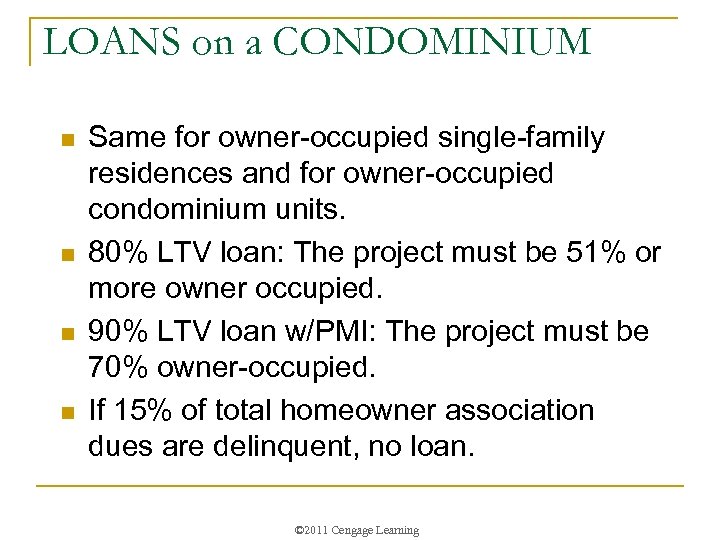
LOANS on a CONDOMINIUM n n Same for owner-occupied single-family residences and for owner-occupied condominium units. 80% LTV loan: The project must be 51% or more owner occupied. 90% LTV loan w/PMI: The project must be 70% owner-occupied. If 15% of total homeowner association dues are delinquent, no loan. © 2011 Cengage Learning
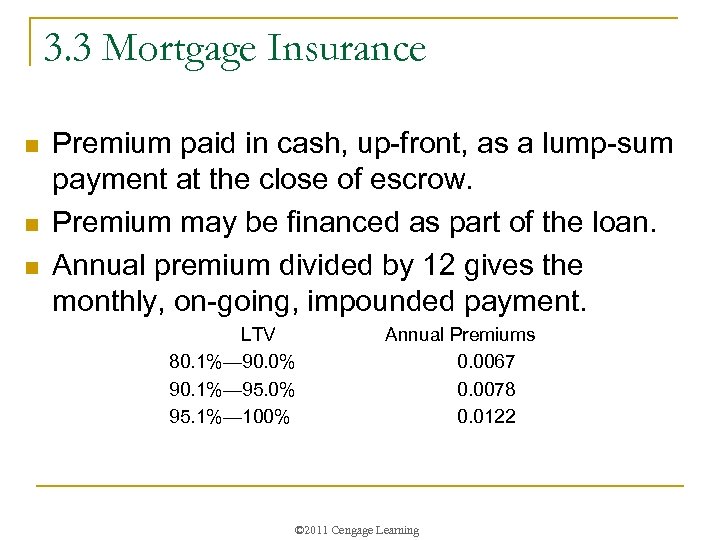
3. 3 Mortgage Insurance n n n Premium paid in cash, up-front, as a lump-sum payment at the close of escrow. Premium may be financed as part of the loan. Annual premium divided by 12 gives the monthly, on-going, impounded payment. LTV 80. 1%— 90. 0% 90. 1%— 95. 0% 95. 1%— 100% Annual Premiums 0. 0067 0. 0078 0. 0122 © 2011 Cengage Learning
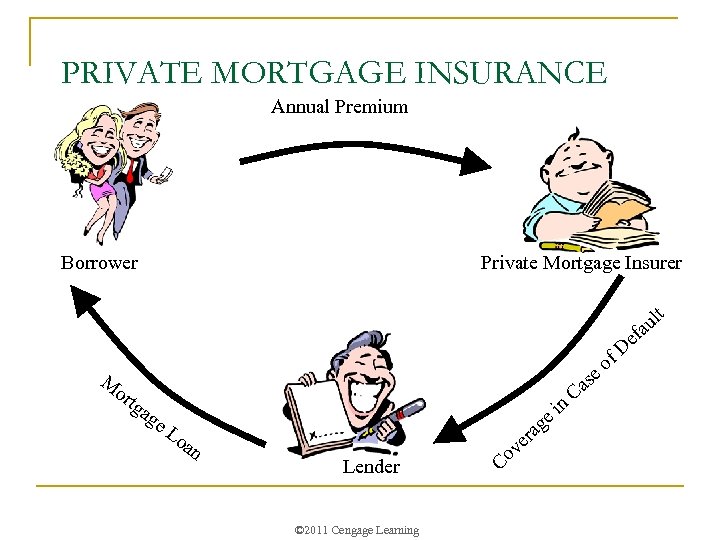
PRIVATE MORTGAGE INSURANCE Annual Premium Borrower Private Mortgage Insurer t l au M or of e tga ge g Lo an in e a er Lender © 2011 Cengage Learning ov C as C ef D
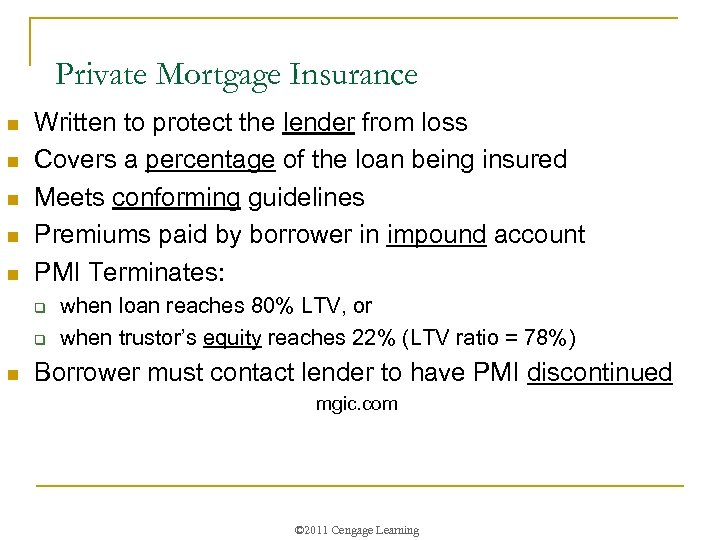
Private Mortgage Insurance n n n Written to protect the lender from loss Covers a percentage of the loan being insured Meets conforming guidelines Premiums paid by borrower in impound account PMI Terminates: q q n when loan reaches 80% LTV, or when trustor’s equity reaches 22% (LTV ratio = 78%) Borrower must contact lender to have PMI discontinued mgic. com © 2011 Cengage Learning
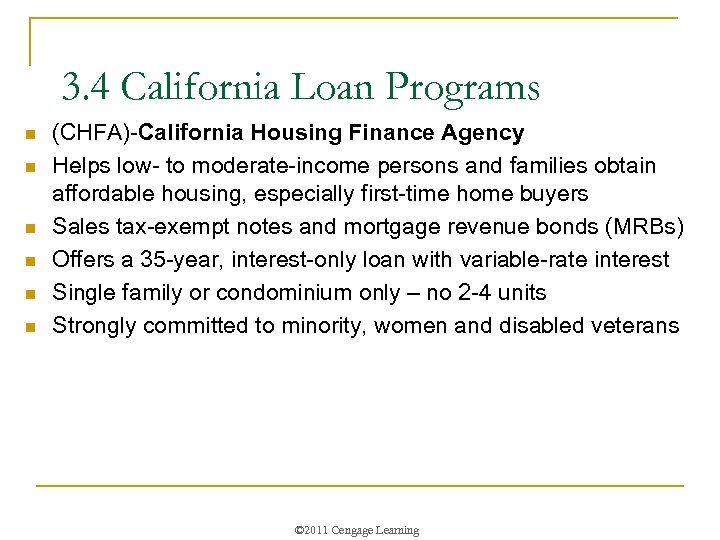
3. 4 California Loan Programs n n n (CHFA)-California Housing Finance Agency Helps low- to moderate-income persons and families obtain affordable housing, especially first-time home buyers Sales tax-exempt notes and mortgage revenue bonds (MRBs) Offers a 35 -year, interest-only loan with variable-rate interest Single family or condominium only – no 2 -4 units Strongly committed to minority, women and disabled veterans © 2011 Cengage Learning
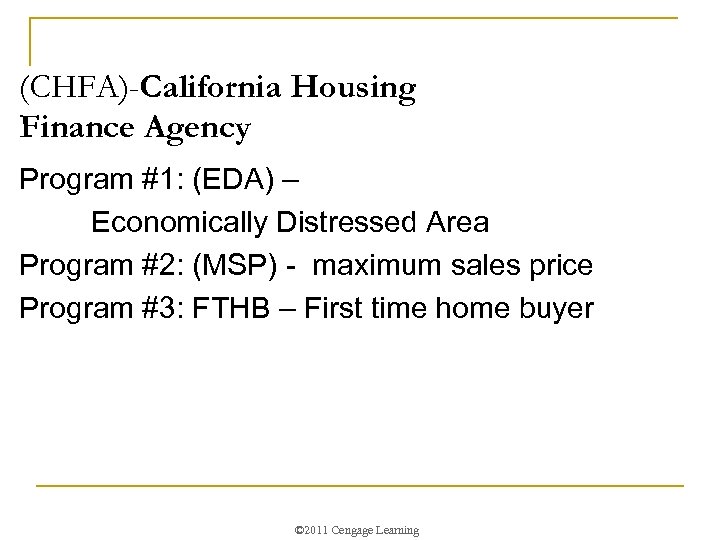
(CHFA)-California Housing Finance Agency Program #1: (EDA) – Economically Distressed Area Program #2: (MSP) - maximum sales price Program #3: FTHB – First time home buyer © 2011 Cengage Learning
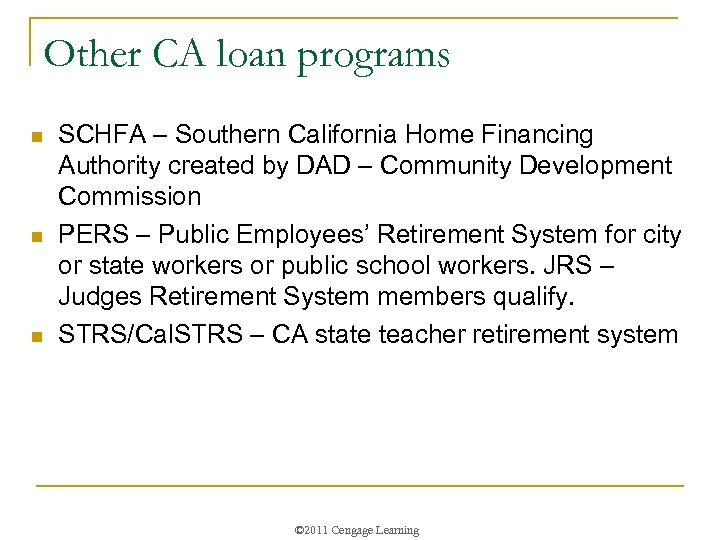
Other CA loan programs n n n SCHFA – Southern California Home Financing Authority created by DAD – Community Development Commission PERS – Public Employees’ Retirement System for city or state workers or public school workers. JRS – Judges Retirement System members qualify. STRS/Cal. STRS – CA state teacher retirement system © 2011 Cengage Learning
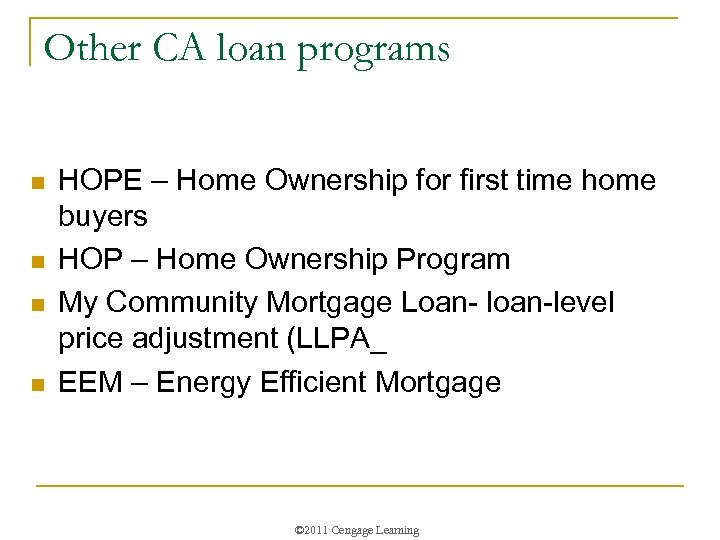
Other CA loan programs n n HOPE – Home Ownership for first time home buyers HOP – Home Ownership Program My Community Mortgage Loan- loan-level price adjustment (LLPA_ EEM – Energy Efficient Mortgage © 2011 Cengage Learning
Rate lock n n A rate commitment where the lender’s holds a certain interest rate and a points for a specific period of time. The lock is to hold until the close of escrow. Rate float is a delay of the decision to fix the interest rate. Float-down option is the ability to lock a rate today and take advantage of any future drop in interest rate until the loan closes. © 2011 Cengage Learning
Refinance Loan (Refi) n Borrower objectives q q q Do it if new interest rate is 2% lower than existing. To cut out-of-pocket loan costs and benefit the shortest pay back time to cover these costs. Pay off an existing loan that has poor terms, such as rate increase or short-term due date. © 2011 Cengage Learning
Junior liens n n Any loan on a property above the existing loans (1 st, 2 nd, 3 rd, etc. ) Seller carry-back loans Home equity loans Used when borrower cannot obtain desired amount finance with one loan due to q q Poor credit Lack of equity – low appraisal © 2011 Cengage Learning
Home Equity Line of Credit (HELOC) n n A form of revolving credit. Property serves as collateral. Borrower may obtain multiple advances up the maximum approved loan amount. After a certain time the loan locks at whatever is then unpaid balance with no future advances allowed. © 2011 Cengage Learning
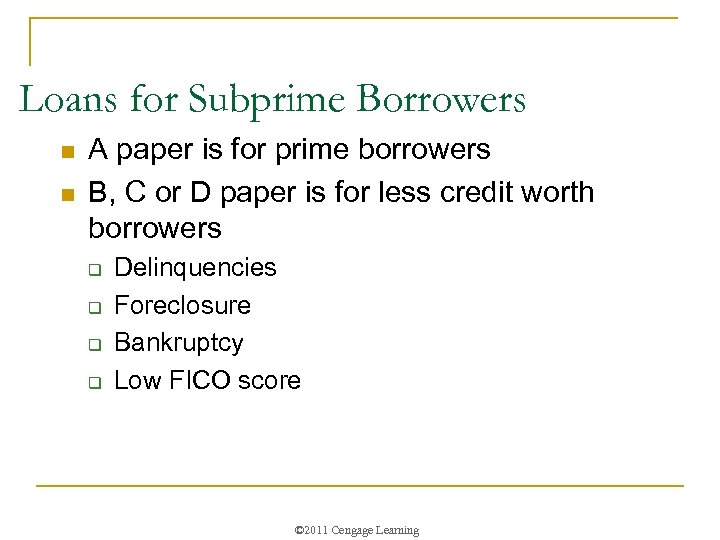
Loans for Subprime Borrowers n n A paper is for prime borrowers B, C or D paper is for less credit worth borrowers q q Delinquencies Foreclosure Bankruptcy Low FICO score © 2011 Cengage Learning
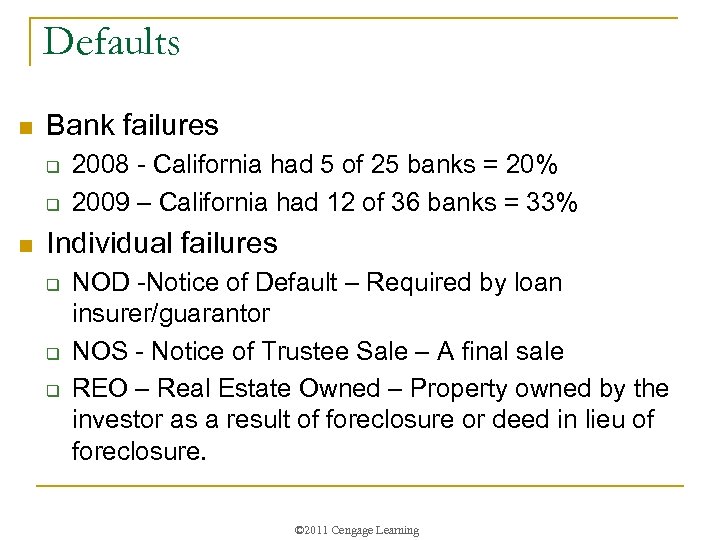
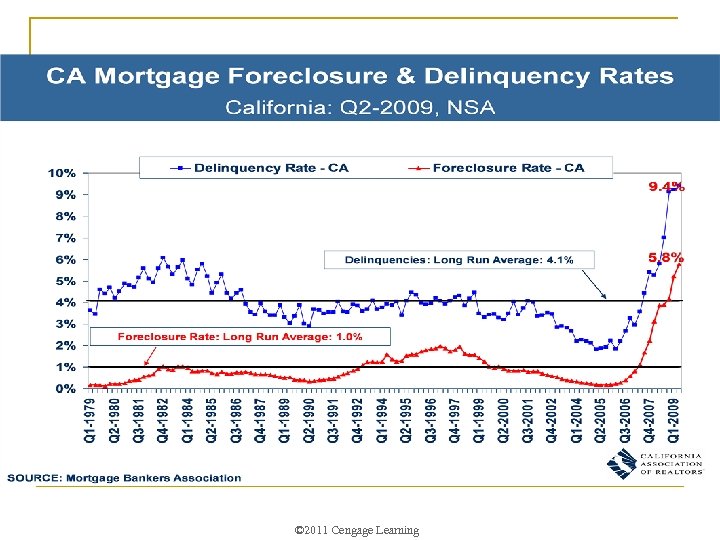
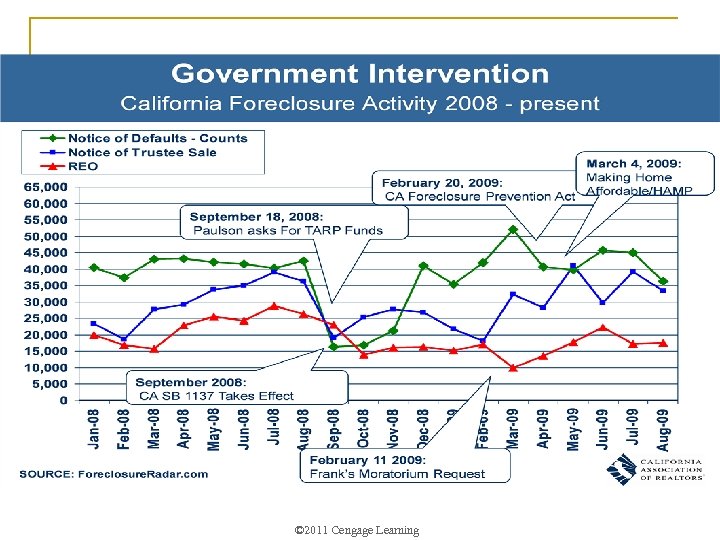
Defaults n Bank failures q q n 2008 - California had 5 of 25 banks = 20% 2009 – California had 12 of 36 banks = 33% Individual failures q q q NOD -Notice of Default – Required by loan insurer/guarantor NOS - Notice of Trustee Sale – A final sale REO – Real Estate Owned – Property owned by the investor as a result of foreclosure or deed in lieu of foreclosure. © 2011 Cengage Learning
© 2011 Cengage Learning
© 2011 Cengage Learning
Скачать презентацию Ch 3 Loans Conventional By Dr D Grogan
e309e97ab27004d5605977343ac1f814.ppt