 Скачать презентацию Ch 28 Gov t and Market Failure Public
f02313bba9841bb1e2b1ccb643b2115c.ppt
- Количество слайдов: 14



Ch 28. Gov’t and Market Failure
Public Goods n n Nonrivalry – Once a producer has produced a public good, everyone can obtain the benefit. Nonexcludability – One persons consumption of the good does not preclude consumption of the same good by others. -- Because of these, private firms cannot profitably produce a public good.
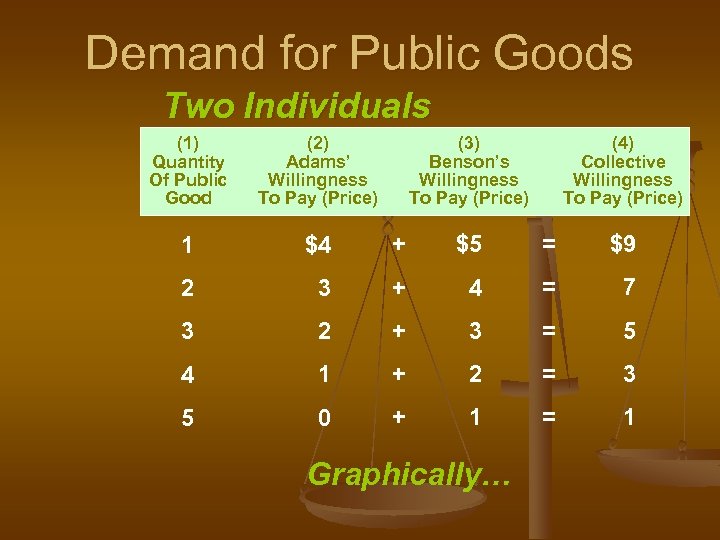
Demand for Public Goods Two Individuals (1) Quantity Of Public Good (2) Adams’ Willingness To Pay (Price) (3) Benson’s Willingness To Pay (Price) 1 $4 + $5 = $9 2 3 + 4 = 7 3 2 + 3 = 5 4 1 + 2 = 3 5 0 + 1 = 1 Graphically… (4) Collective Willingness To Pay (Price)
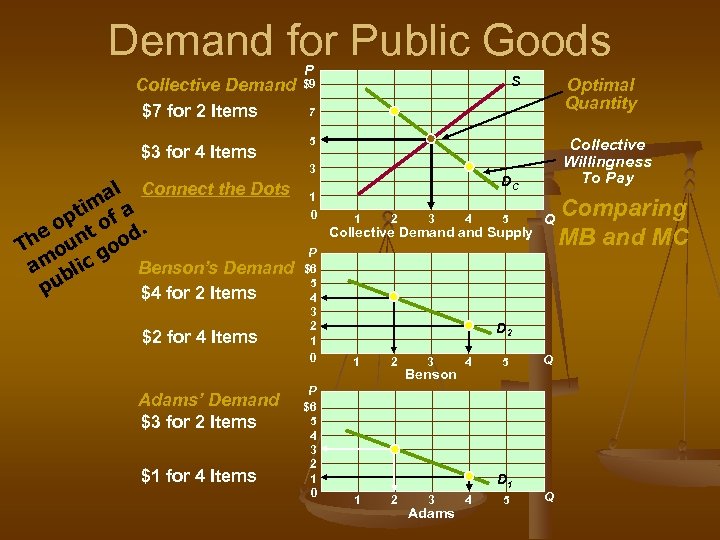
Demand for Public Goods Collective Demand $7 for 2 Items $3 for 4 Items al Connect the Dots tim f a op t o. e d Th oun goo Benson’s Demand am blic pu $4 for 2 Items $2 for 4 Items Adams’ Demand $3 for 2 Items $1 for 4 Items P S $9 Optimal Quantity 7 5 3 DC 1 0 1 2 3 4 5 Collective Demand Supply P $6 5 4 3 2 1 0 Collective Willingness To Pay Q D 2 1 2 3 Benson 4 5 Q D 1 1 2 3 Adams 4 5 Q Comparing MB and MC
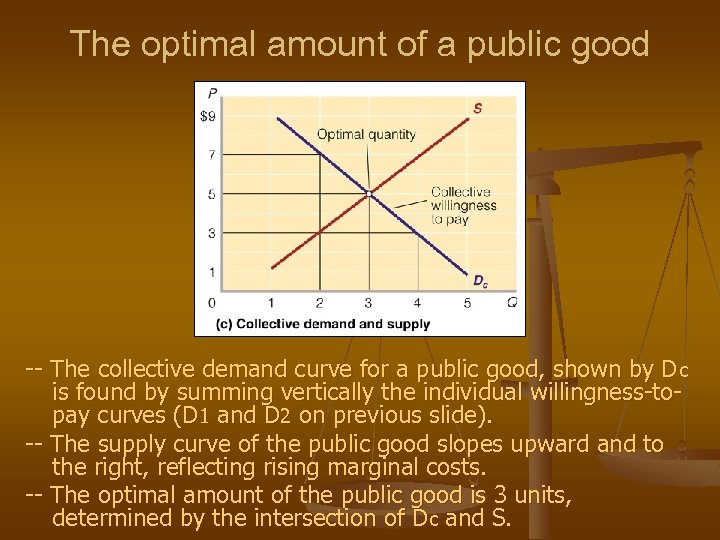
The optimal amount of a public good -- The collective demand curve for a public good, shown by D c is found by summing vertically the individual willingness-topay curves (D 1 and D 2 on previous slide). -- The supply curve of the public good slopes upward and to the right, reflecting rising marginal costs. -- The optimal amount of the public good is 3 units, determined by the intersection of Dc and S.
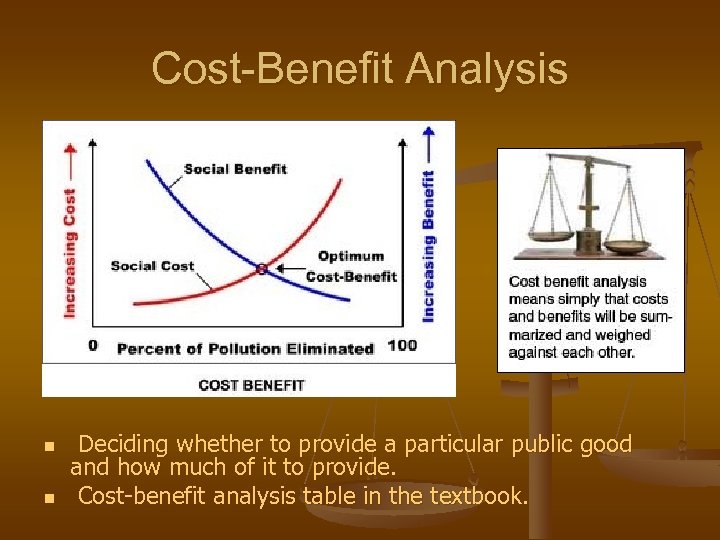
Cost-Benefit Analysis n n Deciding whether to provide a particular public good and how much of it to provide. Cost-benefit analysis table in the textbook.
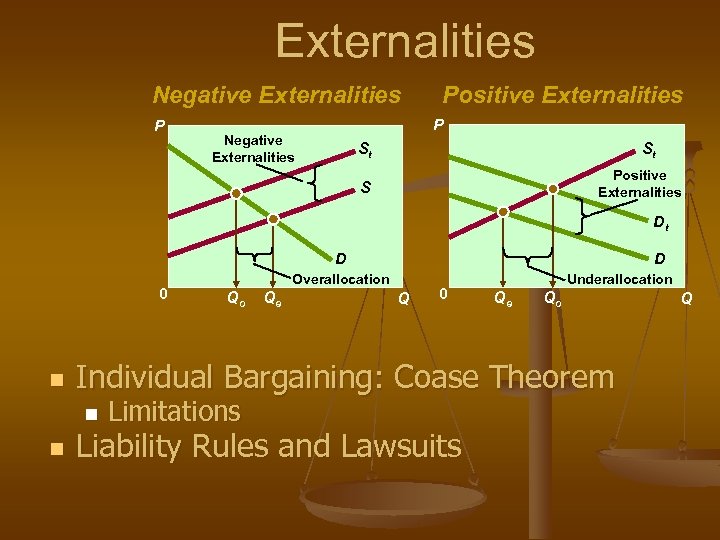
Externalities Negative Externalities P Positive Externalities P Negative Externalities St St Positive Externalities S Dt D D 0 n Qo Qe Q 0 Underallocation Qe Qo Individual Bargaining: Coase Theorem n n Overallocation Limitations Liability Rules and Lawsuits Q
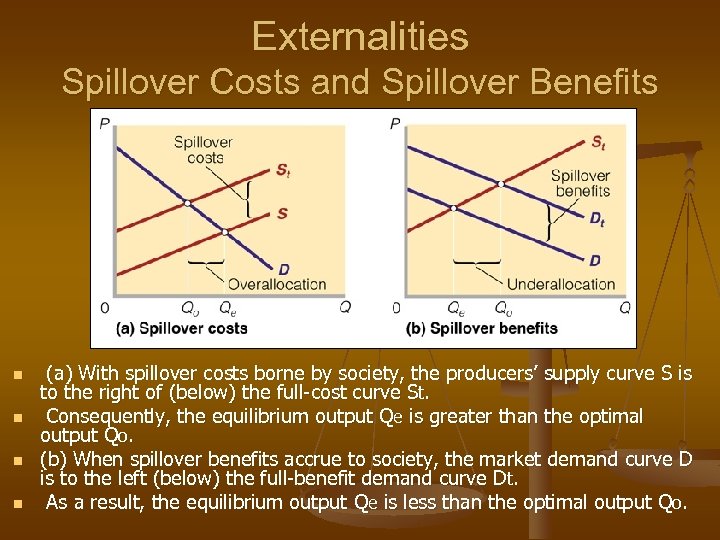
Externalities Spillover Costs and Spillover Benefits n n (a) With spillover costs borne by society, the producers’ supply curve S is to the right of (below) the full-cost curve St. Consequently, the equilibrium output Qe is greater than the optimal output Qo. (b) When spillover benefits accrue to society, the market demand curve D is to the left (below) the full-benefit demand curve Dt. As a result, the equilibrium output Qe is less than the optimal output Qo.
Coase Theorem n n In law and economics, the Coase theorem, attributed to Ronald Coase, describes the economic efficiency of an economic allocation or outcome in the presence of externalities. The theorem states that when trade in an externality is possible and there are no transaction costs, bargaining will lead to an efficient outcome regardless of the initial allocation of property rights. In practice, obstacles to bargaining or poorly defined property rights can prevent Coasian bargaining. This theorem, along with his 1937 paper on the nature of the firm (which also emphasizes the role of transaction costs), earned Coase the 1991 Nobel Prize in Economics. The Coase theorem is an important basis for most modern economic analyses of government regulation, especially in the case of externalities. George Stigler summarized the resolution of the externality problem in the absence of transaction costs in a 1966 economics textbook in terms of private and social cost, and for the first time called it a "theorem. " Since the 1960 s, a voluminous literature on the Coase theorem and its various interpretations, proofs, and criticism has developed and continues to grow.
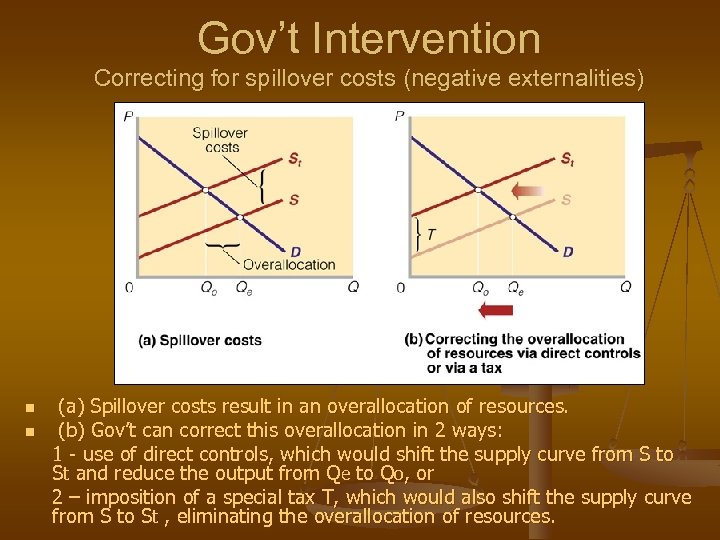
Gov’t Intervention Correcting for spillover costs (negative externalities) n n (a) Spillover costs result in an overallocation of resources. (b) Gov’t can correct this overallocation in 2 ways: 1 - use of direct controls, which would shift the supply curve from S to St and reduce the output from Qe to Qo, or 2 – imposition of a special tax T, which would also shift the supply curve from S to St , eliminating the overallocation of resources.
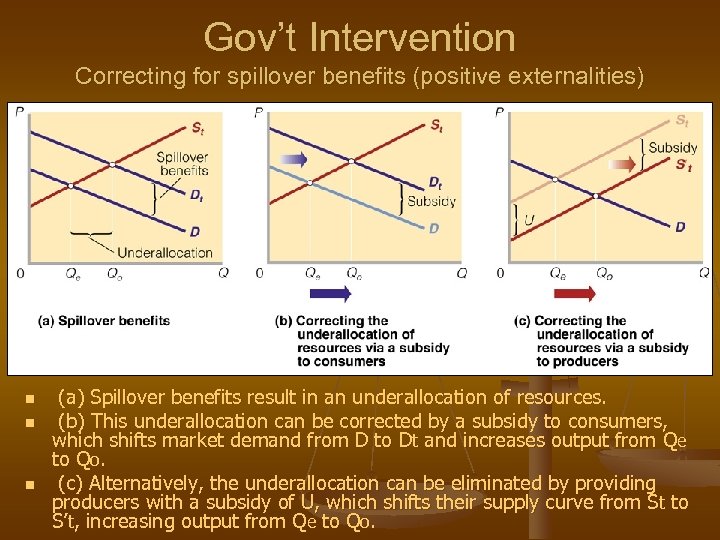
Gov’t Intervention Correcting for spillover benefits (positive externalities) n n n (a) Spillover benefits result in an underallocation of resources. (b) This underallocation can be corrected by a subsidy to consumers, which shifts market demand from D to Dt and increases output from Qe to Qo. (c) Alternatively, the underallocation can be eliminated by providing producers with a subsidy of U, which shifts their supply curve from S t to S’t, increasing output from Qe to Qo.
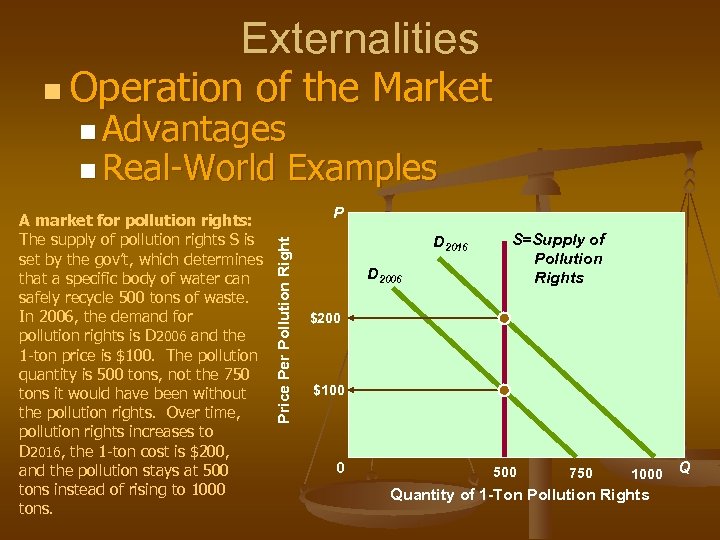
Externalities n Operation of the Market n Advantages n Real-World P Price Per Pollution Right A market for pollution rights: The supply of pollution rights S is set by the gov’t, which determines that a specific body of water can safely recycle 500 tons of waste. In 2006, the demand for pollution rights is D 2006 and the 1 -ton price is $100. The pollution quantity is 500 tons, not the 750 tons it would have been without the pollution rights. Over time, pollution rights increases to D 2016, the 1 -ton cost is $200, and the pollution stays at 500 tons instead of rising to 1000 tons. Examples D 2016 D 2006 S=Supply of Pollution Rights $200 $100 0 500 750 1000 Quantity of 1 -Ton Pollution Rights Q
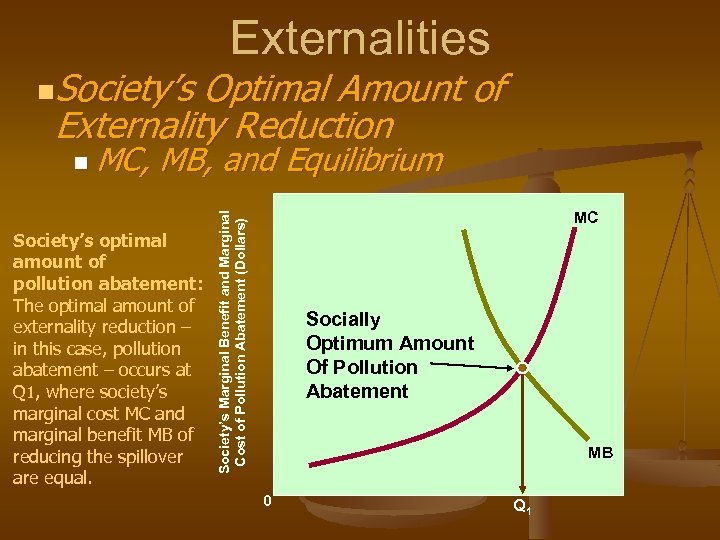
n. Society’s Externalities Optimal Amount of Externality Reduction MB, and Equilibrium Society’s optimal amount of pollution abatement: The optimal amount of externality reduction – in this case, pollution abatement – occurs at Q 1, where society’s marginal cost MC and marginal benefit MB of reducing the spillover are equal. MC Society’s Marginal Benefit and Marginal Cost of Pollution Abatement (Dollars) n MC, Socially Optimum Amount Of Pollution Abatement MB 0 Q 1
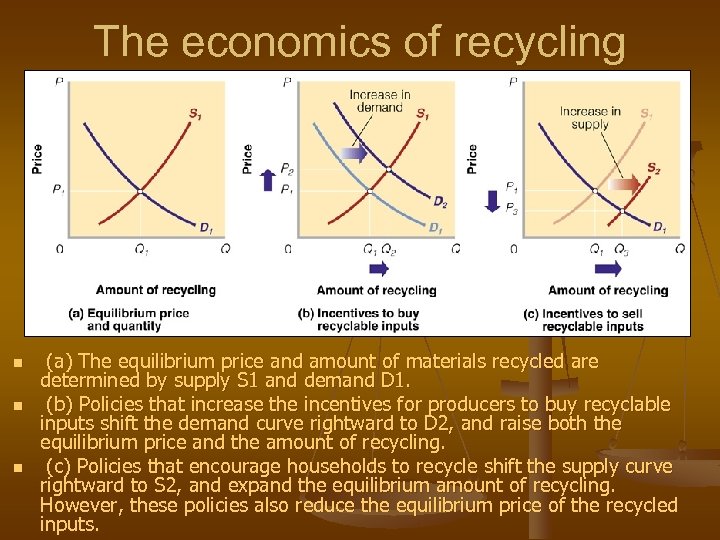
The economics of recycling n n n (a) The equilibrium price and amount of materials recycled are determined by supply S 1 and demand D 1. (b) Policies that increase the incentives for producers to buy recyclable inputs shift the demand curve rightward to D 2, and raise both the equilibrium price and the amount of recycling. (c) Policies that encourage households to recycle shift the supply curve rightward to S 2, and expand the equilibrium amount of recycling. However, these policies also reduce the equilibrium price of the recycled inputs.
Скачать презентацию Ch 28 Gov t and Market Failure Public
f02313bba9841bb1e2b1ccb643b2115c.ppt