


 Скачать презентацию Ch 27 Life in Two City-States Athens and
65fa624fa7e348c1ba5141925cfa2ec1.ppt
- Количество слайдов: 74
 Ch. 27 Life in Two City-States: Athens and Sparta
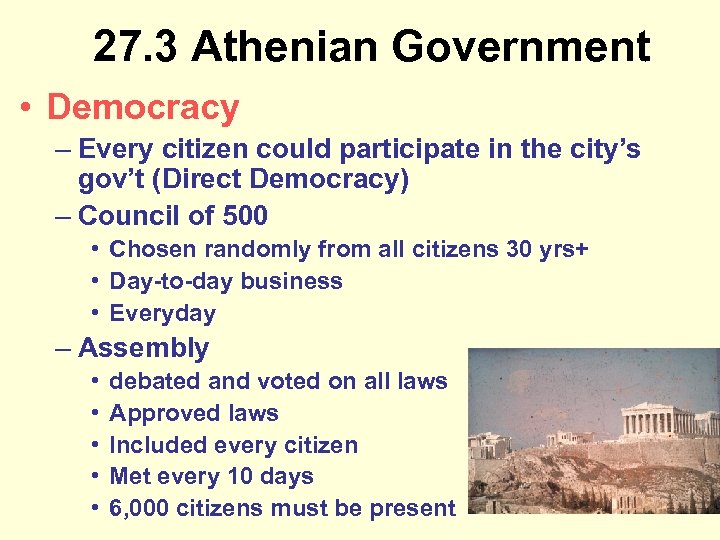 27. 3 Athenian Government • Democracy – Every citizen could participate in the city’s gov’t (Direct Democracy) – Council of 500 • Chosen randomly from all citizens 30 yrs+ • Day-to-day business • Everyday – Assembly • • • debated and voted on all laws Approved laws Included every citizen Met every 10 days 6, 000 citizens must be present
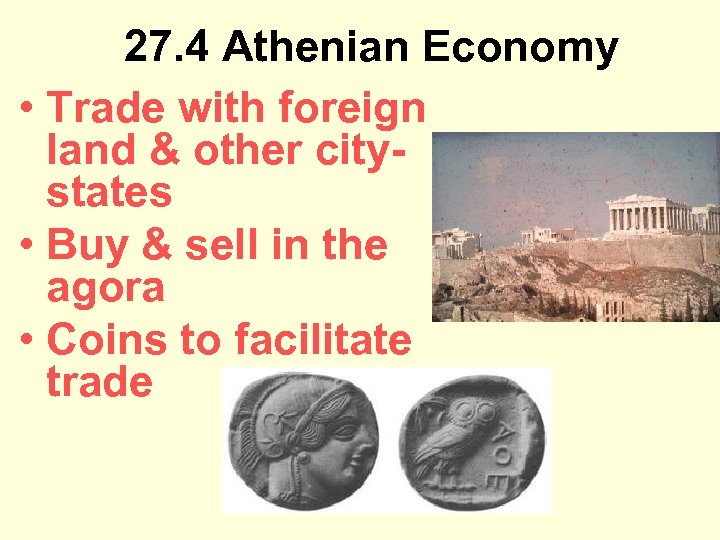 27. 4 Athenian Economy • Trade with foreign land & other citystates • Buy & sell in the agora • Coins to facilitate trade
 27. 5 Education in Athens • Boys taught at home by mother until 6 or 7 • School 6 – 14 –Reading, writing, arithmetic, literature, sports, music • Military training at 18 • Private tutor for wealthy • Purpose – to make good citizens
 27. 6 Women & slaves in Athens Women • Not citizens • Couldn’t choose husband • Couldn’t own property • Some priestesses • Managed household • Didn’t go out alone
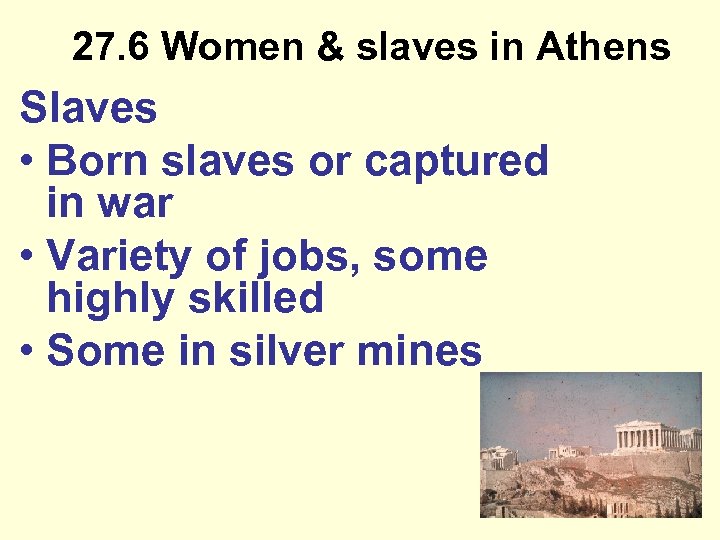 27. 6 Women & slaves in Athens Slaves • Born slaves or captured in war • Variety of jobs, some highly skilled • Some in silver mines
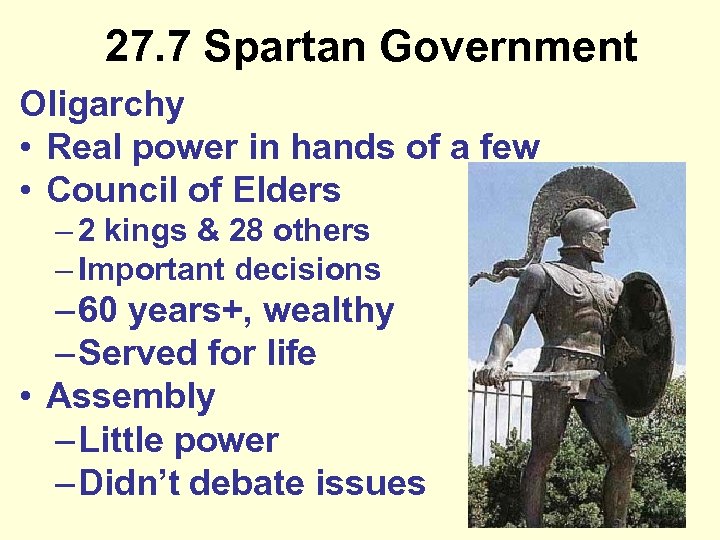 27. 7 Spartan Government Oligarchy • Real power in hands of a few • Council of Elders – 2 kings & 28 others – Important decisions – 60 years+, wealthy – Served for life • Assembly – Little power – Didn’t debate issues
 27. 8 Spartan Economy • Limited trading • Farming • Slaves (helots) & noncitizens produced goods • Conquered other people • Iron bars used for money
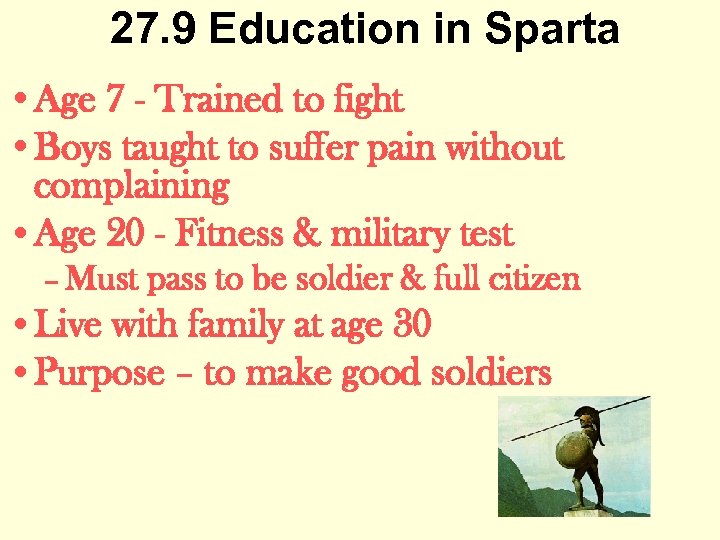 27. 9 Education in Sparta • Age 7 - Trained to fight • Boys taught to suffer pain without complaining • Age 20 - Fitness & military test – Must pass to be soldier & full citizen • Live with family at age 30 • Purpose – to make good soldiers
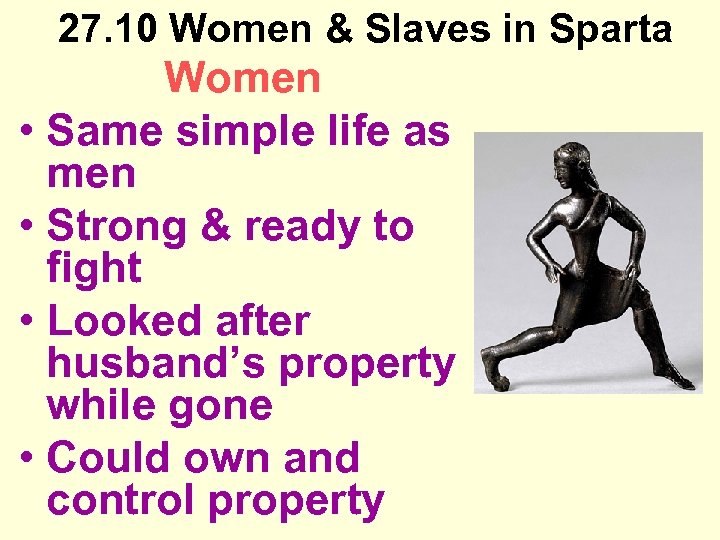 27. 10 Women & Slaves in Sparta Women • Same simple life as men • Strong & ready to fight • Looked after husband’s property while gone • Could own and control property
 27. 10 Women & Slaves in Sparta Slaves • Treated very harshly • Killed if thought to rebel • Could marry freely • Sell extra crops • Buy freedom
 In this form of gov’t, power is in the hands of one person who inherited power. 1. 2. 3. 4. Monarchy Oligarchy Tyranny Democracy
 In this form of gov’t, ruling power is shared by all citizens. 1. 2. 3. 4. Monarchy Oligarchy Tyranny Democracy
 In this form of gov’t, a person seizes power illegally, usually by force. 1. 2. 3. 4. Monarchy Oligarchy Tyranny Democracy
 In this form of gov’t, ruling power is in the hands of a few people. 1. 2. 3. 4. Monarchy Oligarchy Tyranny Democracy
 When the oligarchs ruled, what happened to the rich? 1. They got richer 2. They demanded a democracy 3. They moved to Sparta 4. They gave all their money to the poor
 Who makes the laws in a monarchy? 1. 2. 3. 4. Citizens Assembly Tyrant King
 In this type of democracy, every citizen can vote on every issue. (Athens) 1. Direct democracy 2. Representative democracy
 In the United States, citizens vote for representatives who decide issues on their behalf. This is called…. 1. Direct democracy 2. Representative democracy
 In Athens, the group of citizens who voted on the laws was called the… 1. 2. 3. 4. VIPs Assembly Aristocrats Senators
 Who could speak and vote in the Assembly? 1. Spartan soldiers 2. Athenian slaves 3. Any man who lived in Greece 4. Free Athenianborn men
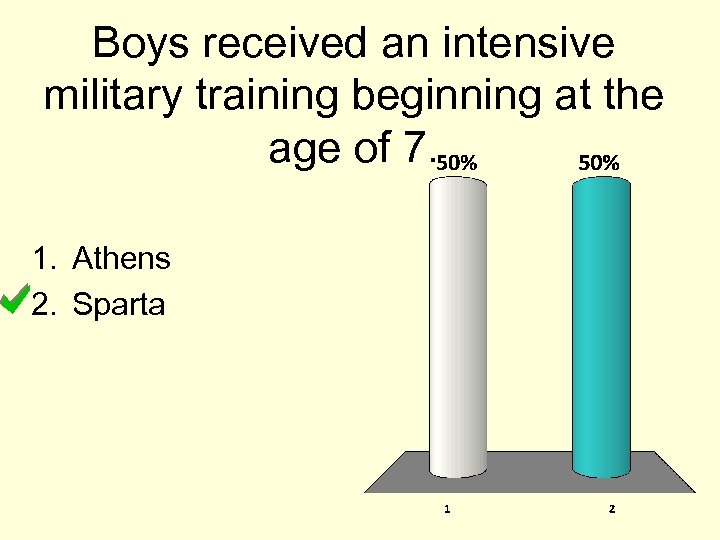 Boys received an intensive military training beginning at the age of 7. 1. Athens 2. Sparta
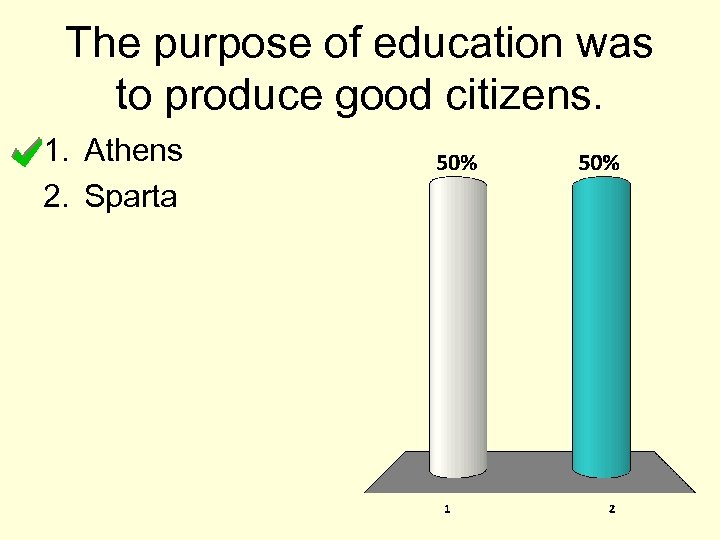 The purpose of education was to produce good citizens. 1. Athens 2. Sparta
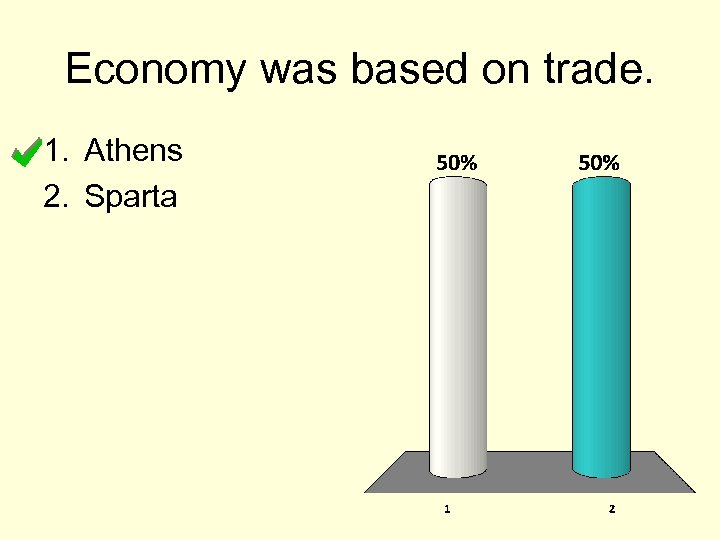 Economy was based on trade. 1. Athens 2. Sparta
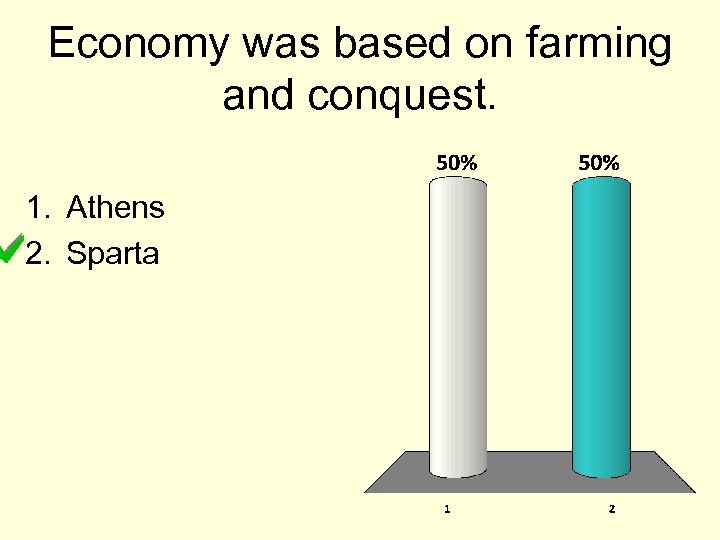 Economy was based on farming and conquest. 1. Athens 2. Sparta
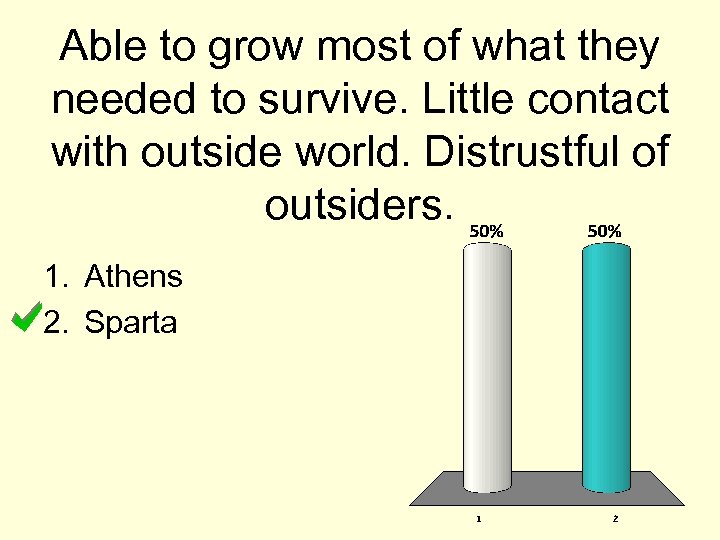 Able to grow most of what they needed to survive. Little contact with outside world. Distrustful of outsiders. 1. Athens 2. Sparta
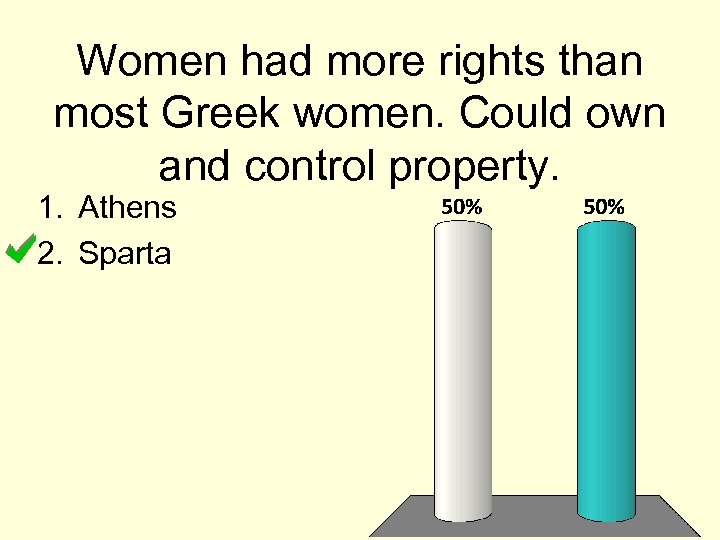 Women had more rights than most Greek women. Could own and control property. 1. Athens 2. Sparta
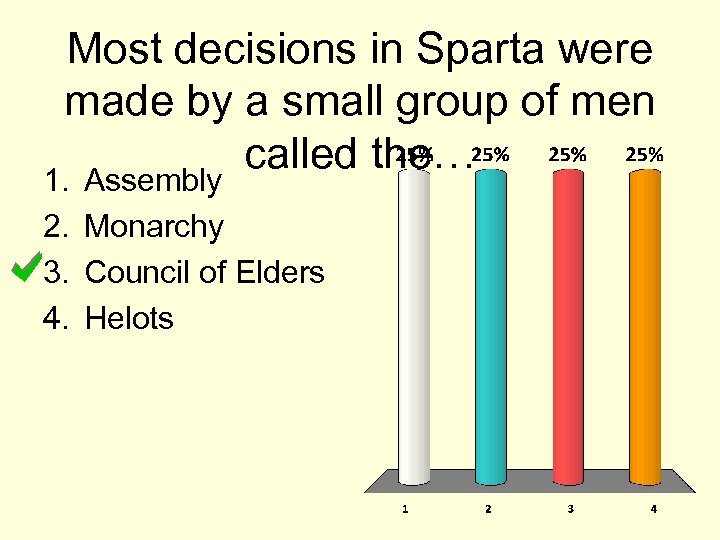 Most decisions in Sparta were made by a small group of men called the… 1. 2. 3. 4. Assembly Monarchy Council of Elders Helots
 • Put the Athens/Sparta Double Bubble in a pile at the front of your table • Write your homework in the binder reminder Do it for Sparta!!!!!.
 Texting? Spartans don’t text!!!!! We fight! Text: Lol brb ttyl g 2 g omg asap Rofl ftw 4 u idk y Tmi 2 idc afk jk thx Tgif ily skol skewl cul 8 r XD kewl <3 =) nvm T. T Nm ur ru >=( 2 day fyi =P btw ttfn . _.
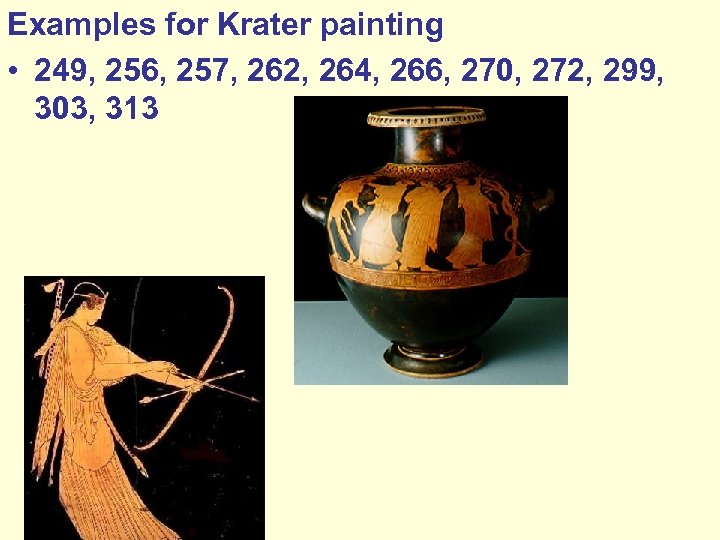 Examples for Krater painting • 249, 256, 257, 262, 264, 266, 270, 272, 299, 303, 313
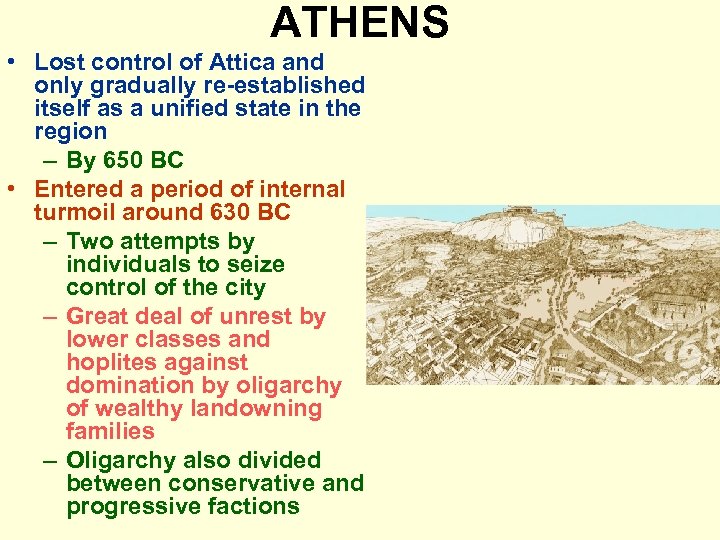 ATHENS • Lost control of Attica and only gradually re-established itself as a unified state in the region – By 650 BC • Entered a period of internal turmoil around 630 BC – Two attempts by individuals to seize control of the city – Great deal of unrest by lower classes and hoplites against domination by oligarchy of wealthy landowning families – Oligarchy also divided between conservative and progressive factions
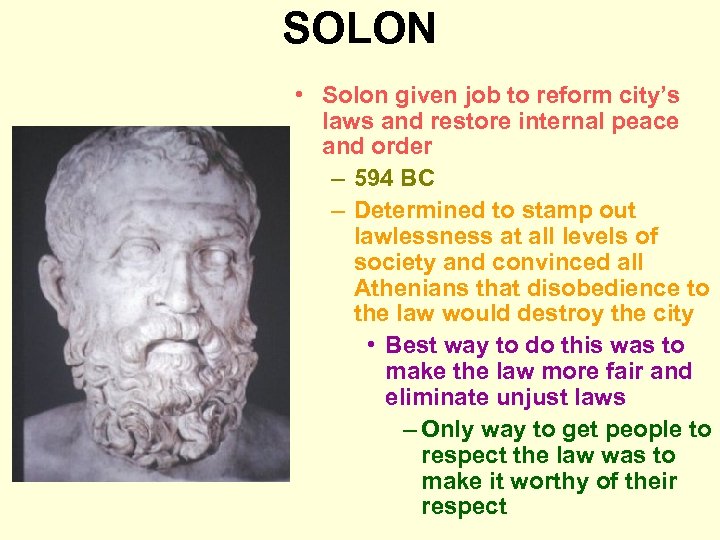 SOLON • Solon given job to reform city’s laws and restore internal peace and order – 594 BC – Determined to stamp out lawlessness at all levels of society and convinced all Athenians that disobedience to the law would destroy the city • Best way to do this was to make the law more fair and eliminate unjust laws – Only way to get people to respect the law was to make it worthy of their respect
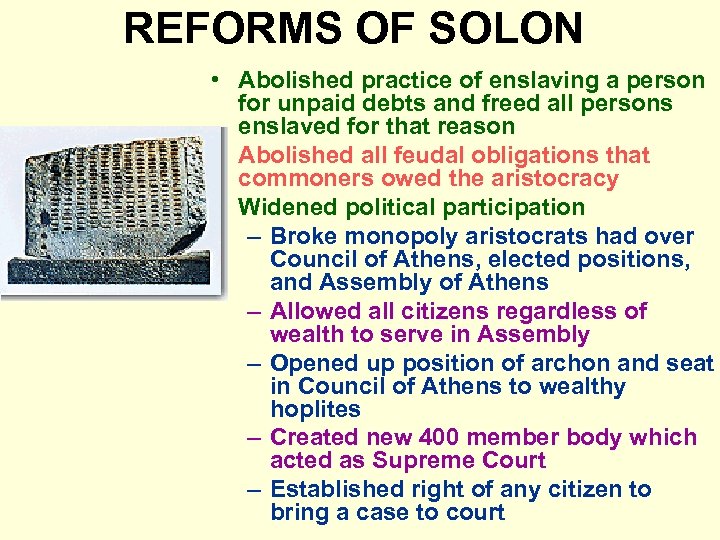 REFORMS OF SOLON • Abolished practice of enslaving a person for unpaid debts and freed all persons enslaved for that reason • Abolished all feudal obligations that commoners owed the aristocracy • Widened political participation – Broke monopoly aristocrats had over Council of Athens, elected positions, and Assembly of Athens – Allowed all citizens regardless of wealth to serve in Assembly – Opened up position of archon and seat in Council of Athens to wealthy hoplites – Created new 400 member body which acted as Supreme Court – Established right of any citizen to bring a case to court
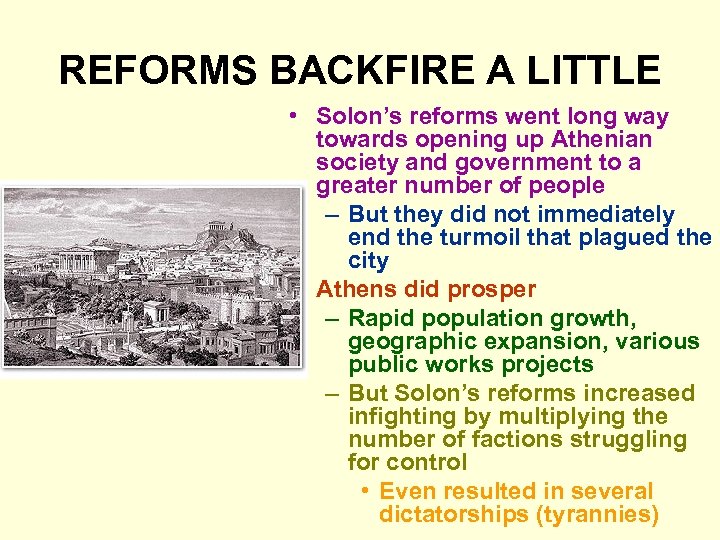 REFORMS BACKFIRE A LITTLE • Solon’s reforms went long way towards opening up Athenian society and government to a greater number of people – But they did not immediately end the turmoil that plagued the city • Athens did prosper – Rapid population growth, geographic expansion, various public works projects – But Solon’s reforms increased infighting by multiplying the number of factions struggling for control • Even resulted in several dictatorships (tyrannies)
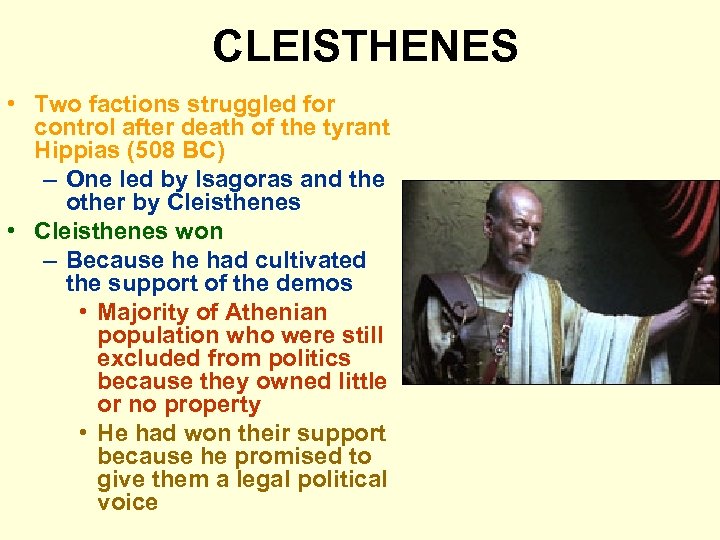 CLEISTHENES • Two factions struggled for control after death of the tyrant Hippias (508 BC) – One led by Isagoras and the other by Cleisthenes • Cleisthenes won – Because he had cultivated the support of the demos • Majority of Athenian population who were still excluded from politics because they owned little or no property • He had won their support because he promised to give them a legal political voice
 REFORMS OF CLEISTHENES • Cleisthenes kept promise to demos – Population of city and region divided into ten tribes – Each included people from all walks of life – Each elected representatives to the Council, elected generals and public officials, and jurors to Supreme Court • Cleisthenes permanently broke power of old aristocracy and established the foundation for democracy
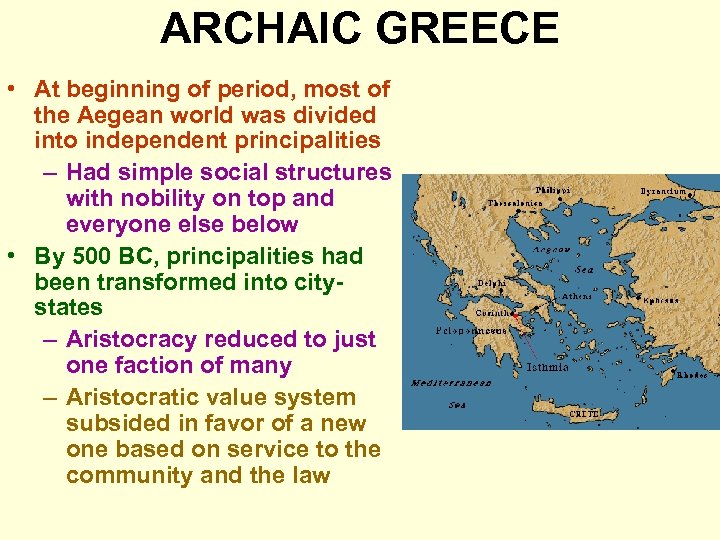 ARCHAIC GREECE • At beginning of period, most of the Aegean world was divided into independent principalities – Had simple social structures with nobility on top and everyone else below • By 500 BC, principalities had been transformed into citystates – Aristocracy reduced to just one faction of many – Aristocratic value system subsided in favor of a new one based on service to the community and the law
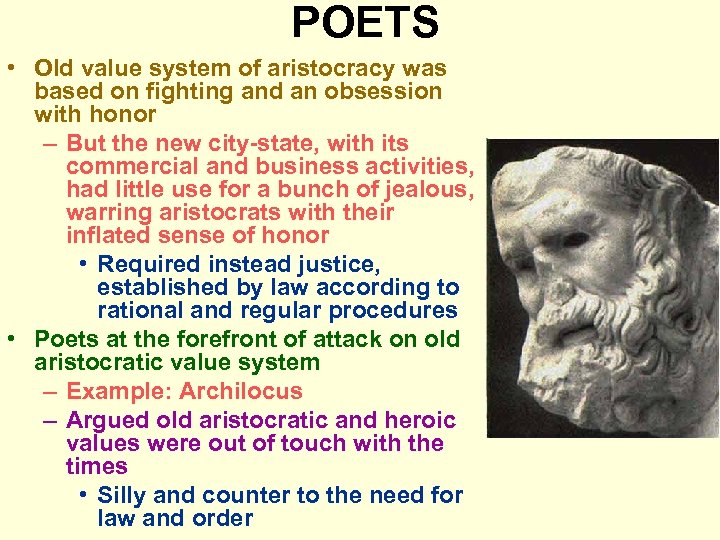 POETS • Old value system of aristocracy was based on fighting and an obsession with honor – But the new city-state, with its commercial and business activities, had little use for a bunch of jealous, warring aristocrats with their inflated sense of honor • Required instead justice, established by law according to rational and regular procedures • Poets at the forefront of attack on old aristocratic value system – Example: Archilocus – Argued old aristocratic and heroic values were out of touch with the times • Silly and counter to the need for law and order
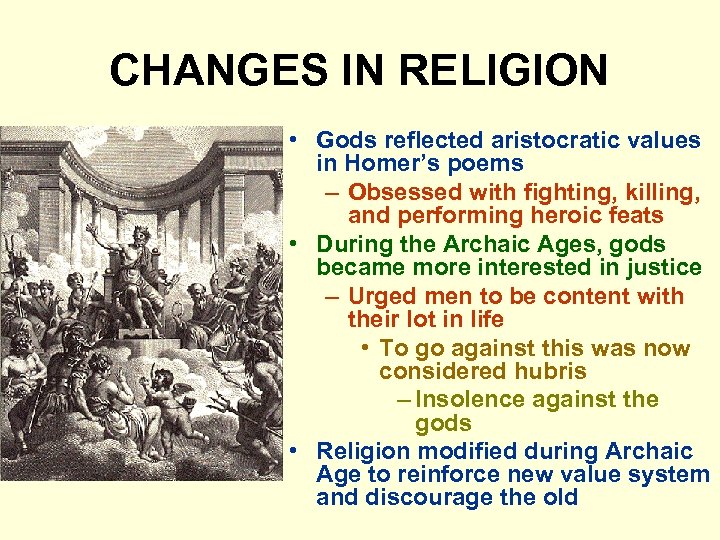 CHANGES IN RELIGION • Gods reflected aristocratic values in Homer’s poems – Obsessed with fighting, killing, and performing heroic feats • During the Archaic Ages, gods became more interested in justice – Urged men to be content with their lot in life • To go against this was now considered hubris – Insolence against the gods • Religion modified during Archaic Age to reinforce new value system and discourage the old
 SUMMARY • Mutually-reinforcing cycle – Growth of business and trade undermined the aristocratic monopoly over society • Decline of aristocracy was accompanied by a parallel decline in their value system – Helped by propaganda attacks by poets and a gradual shift in religious emphasis – Decline of aristocratic value system was paralleled by the rise of a new value system based on law, order, and stability • Encouraged further business growth and prosperity – Sped up the decline of the aristocracy – Provided good environment for development of literature and beginning of philosophic and scientific speculation
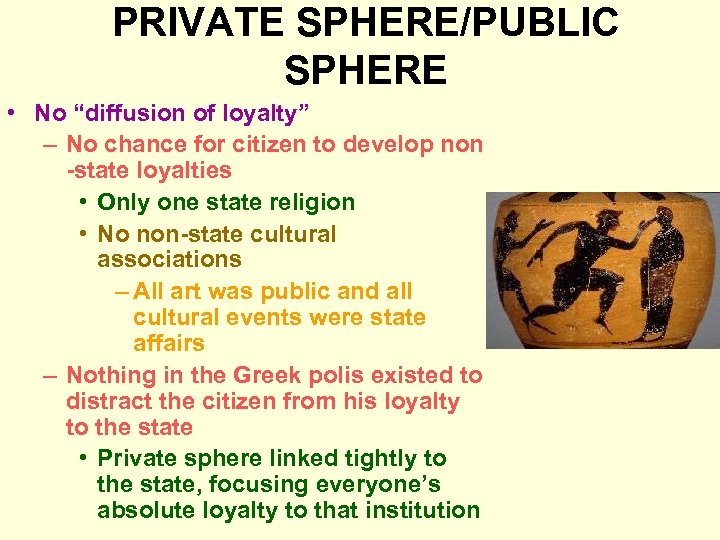 PRIVATE SPHERE/PUBLIC SPHERE • No “diffusion of loyalty” – No chance for citizen to develop non -state loyalties • Only one state religion • No non-state cultural associations – All art was public and all cultural events were state affairs – Nothing in the Greek polis existed to distract the citizen from his loyalty to the state • Private sphere linked tightly to the state, focusing everyone’s absolute loyalty to that institution
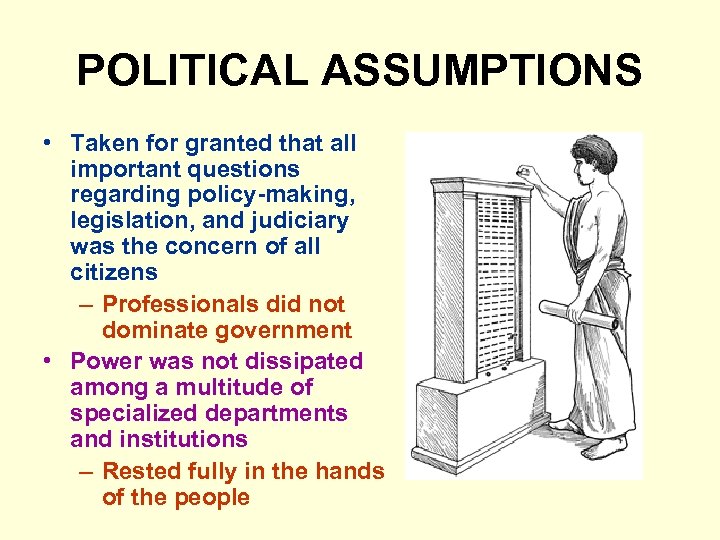 POLITICAL ASSUMPTIONS • Taken for granted that all important questions regarding policy-making, legislation, and judiciary was the concern of all citizens – Professionals did not dominate government • Power was not dissipated among a multitude of specialized departments and institutions – Rested fully in the hands of the people
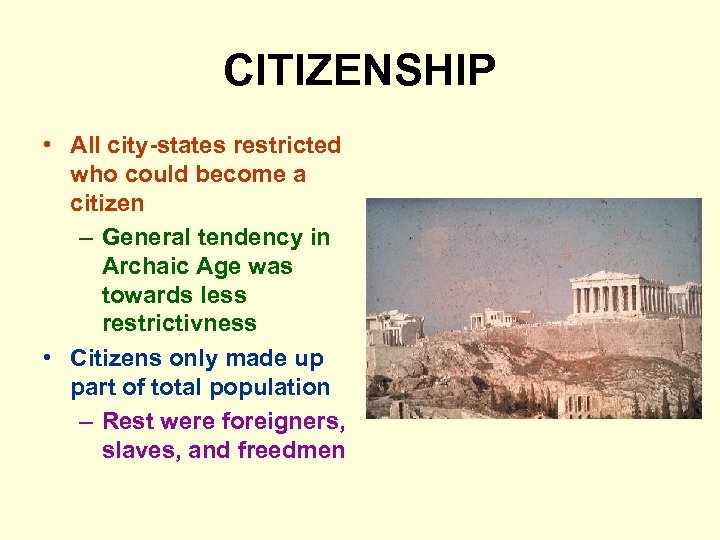 CITIZENSHIP • All city-states restricted who could become a citizen – General tendency in Archaic Age was towards less restrictivness • Citizens only made up part of total population – Rest were foreigners, slaves, and freedmen
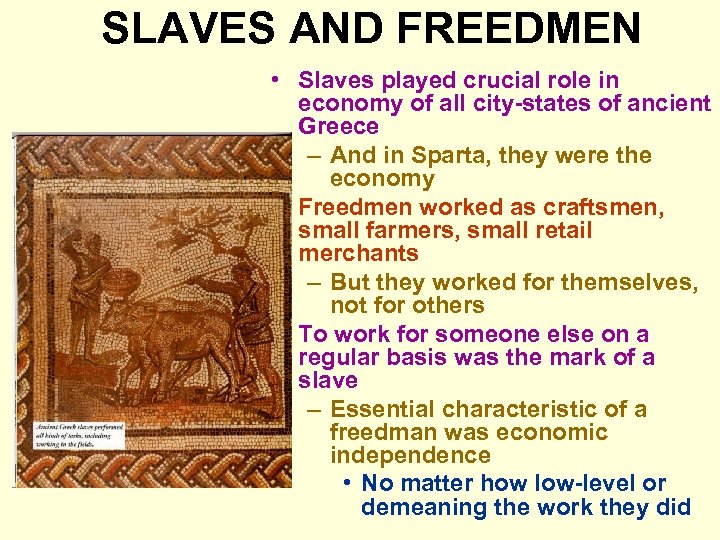 SLAVES AND FREEDMEN • Slaves played crucial role in economy of all city-states of ancient Greece – And in Sparta, they were the economy • Freedmen worked as craftsmen, small farmers, small retail merchants – But they worked for themselves, not for others • To work for someone else on a regular basis was the mark of a slave – Essential characteristic of a freedman was economic independence • No matter how low-level or demeaning the work they did
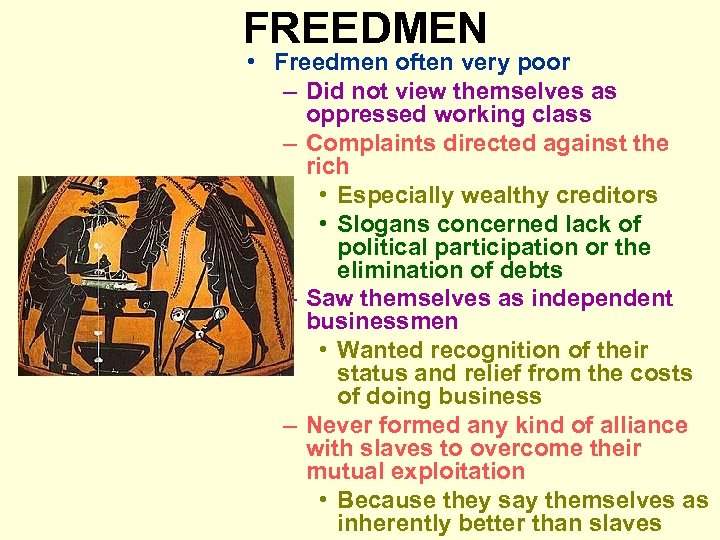 FREEDMEN • Freedmen often very poor – Did not view themselves as oppressed working class – Complaints directed against the rich • Especially wealthy creditors • Slogans concerned lack of political participation or the elimination of debts – Saw themselves as independent businessmen • Wanted recognition of their status and relief from the costs of doing business – Never formed any kind of alliance with slaves to overcome their mutual exploitation • Because they say themselves as inherently better than slaves
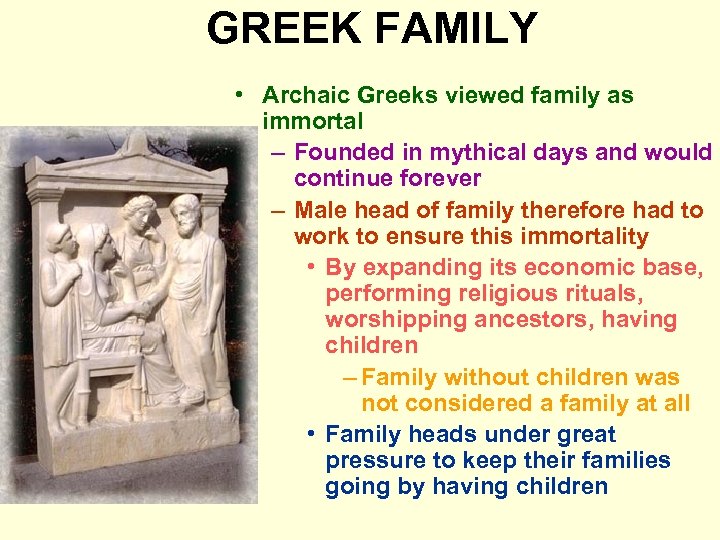 GREEK FAMILY • Archaic Greeks viewed family as immortal – Founded in mythical days and would continue forever – Male head of family therefore had to work to ensure this immortality • By expanding its economic base, performing religious rituals, worshipping ancestors, having children – Family without children was not considered a family at all • Family heads under great pressure to keep their families going by having children
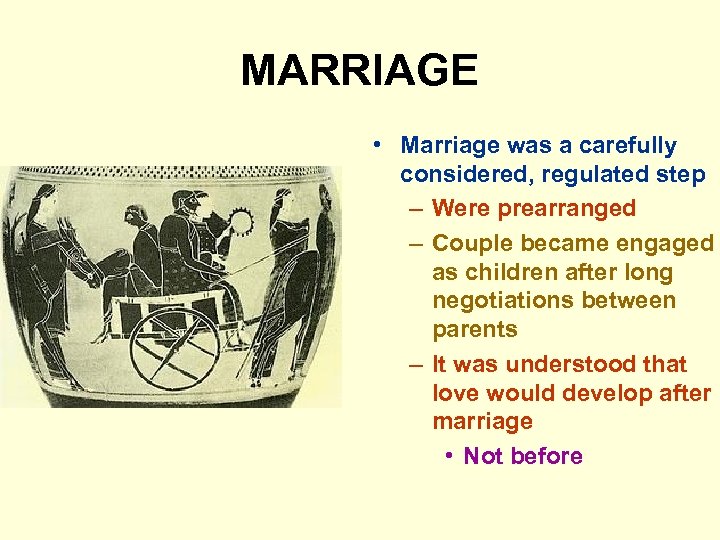 MARRIAGE • Marriage was a carefully considered, regulated step – Were prearranged – Couple became engaged as children after long negotiations between parents – It was understood that love would develop after marriage • Not before
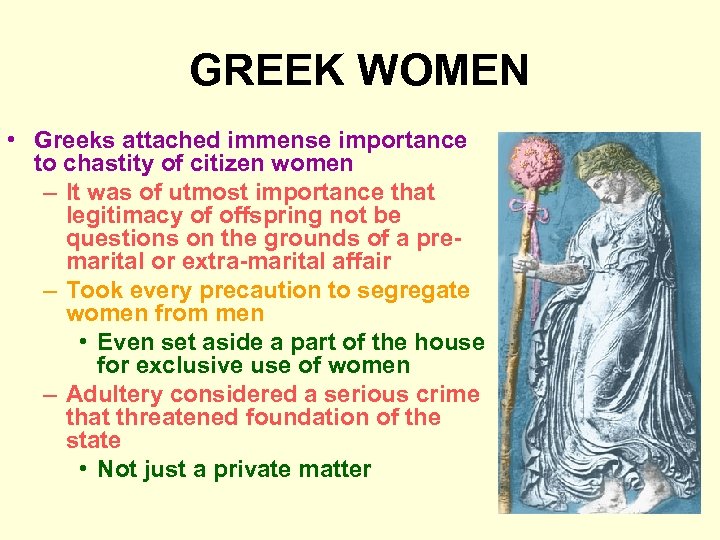 GREEK WOMEN • Greeks attached immense importance to chastity of citizen women – It was of utmost importance that legitimacy of offspring not be questions on the grounds of a premarital or extra-marital affair – Took every precaution to segregate women from men • Even set aside a part of the house for exclusive use of women – Adultery considered a serious crime that threatened foundation of the state • Not just a private matter
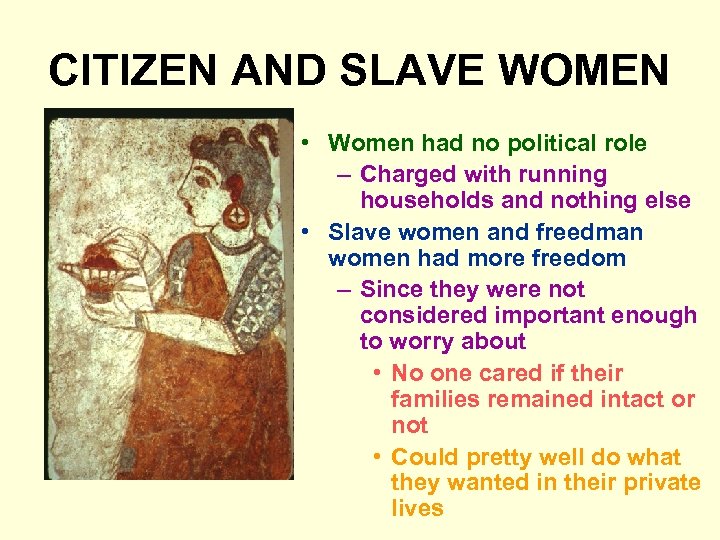 CITIZEN AND SLAVE WOMEN • Women had no political role – Charged with running households and nothing else • Slave women and freedman women had more freedom – Since they were not considered important enough to worry about • No one cared if their families remained intact or not • Could pretty well do what they wanted in their private lives
 FINAL POINT • Neither male nor female citizens enjoyed a high degree of freedom (in the modern sense of the term) – Greek ideas of freedom implied conformity to community standards of behavior • Community needs defined the roles of men and women and restricted the freedom of both • Male family heads had little choice over who and when he should marry, whether to have children, etc. – Law and custom demanded that he subordinate his own needs and desires to those of his family and the community at large – In exchange, men and women enjoyed a strong and stimulating community life » A trade off between liberty and security, with security receiving the most emphasis
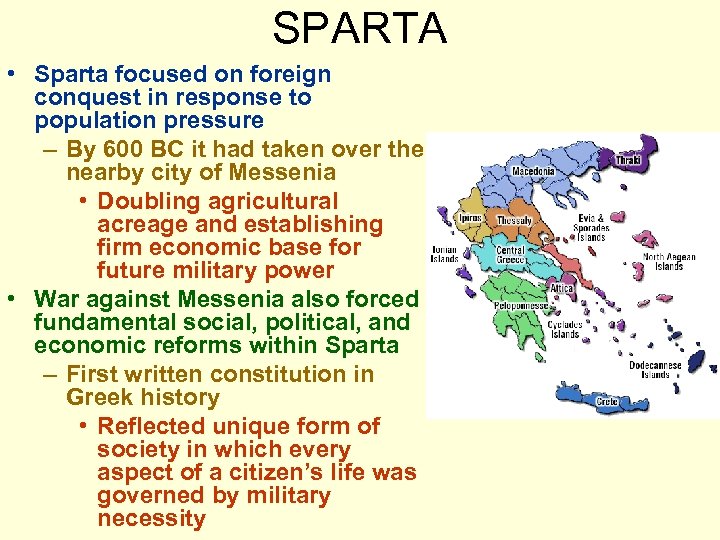 SPARTA • Sparta focused on foreign conquest in response to population pressure – By 600 BC it had taken over the nearby city of Messenia • Doubling agricultural acreage and establishing firm economic base for future military power • War against Messenia also forced fundamental social, political, and economic reforms within Sparta – First written constitution in Greek history • Reflected unique form of society in which every aspect of a citizen’s life was governed by military necessity
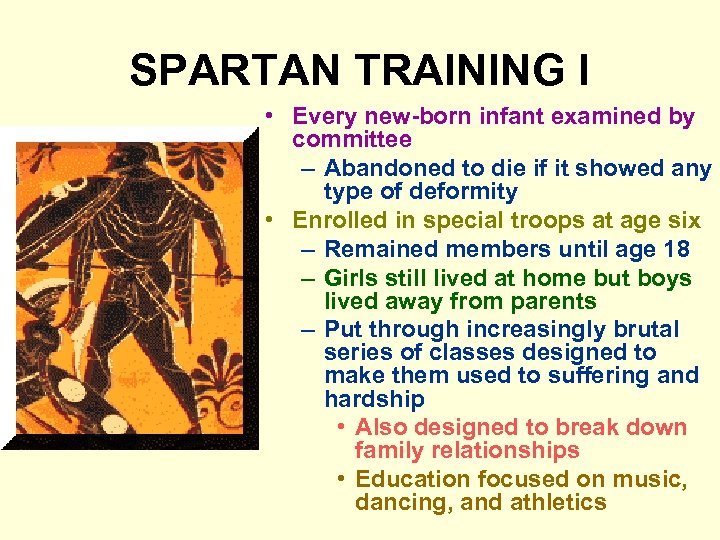 SPARTAN TRAINING I • Every new-born infant examined by committee – Abandoned to die if it showed any type of deformity • Enrolled in special troops at age six – Remained members until age 18 – Girls still lived at home but boys lived away from parents – Put through increasingly brutal series of classes designed to make them used to suffering and hardship • Also designed to break down family relationships • Education focused on music, dancing, and athletics
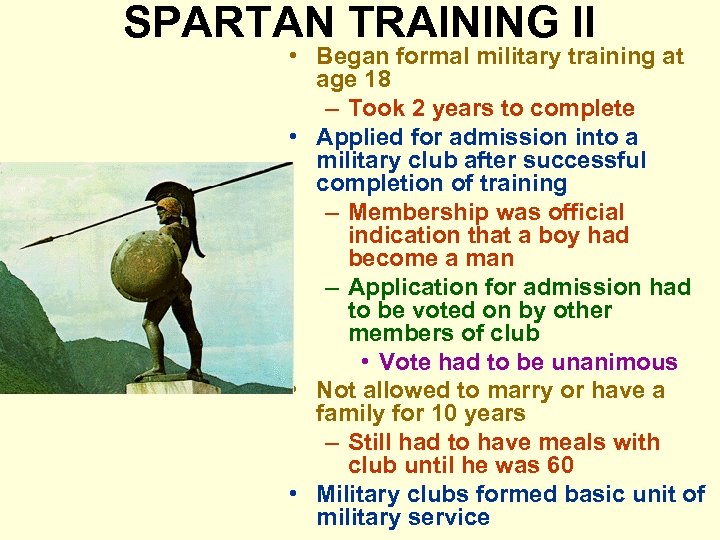 SPARTAN TRAINING II • Began formal military training at age 18 – Took 2 years to complete • Applied for admission into a military club after successful completion of training – Membership was official indication that a boy had become a man – Application for admission had to be voted on by other members of club • Vote had to be unanimous • Not allowed to marry or have a family for 10 years – Still had to have meals with club until he was 60 • Military clubs formed basic unit of military service
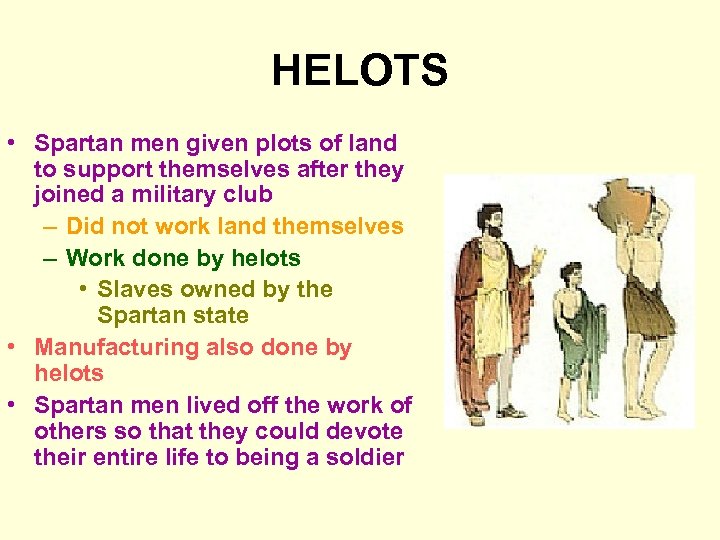 HELOTS • Spartan men given plots of land to support themselves after they joined a military club – Did not work land themselves – Work done by helots • Slaves owned by the Spartan state • Manufacturing also done by helots • Spartan men lived off the work of others so that they could devote their entire life to being a soldier
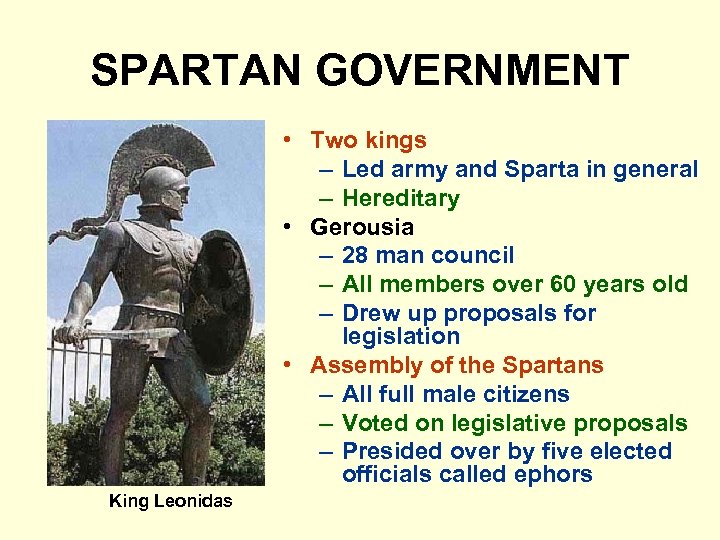 SPARTAN GOVERNMENT • Two kings – Led army and Sparta in general – Hereditary • Gerousia – 28 man council – All members over 60 years old – Drew up proposals for legislation • Assembly of the Spartans – All full male citizens – Voted on legislative proposals – Presided over by five elected officials called ephors King Leonidas
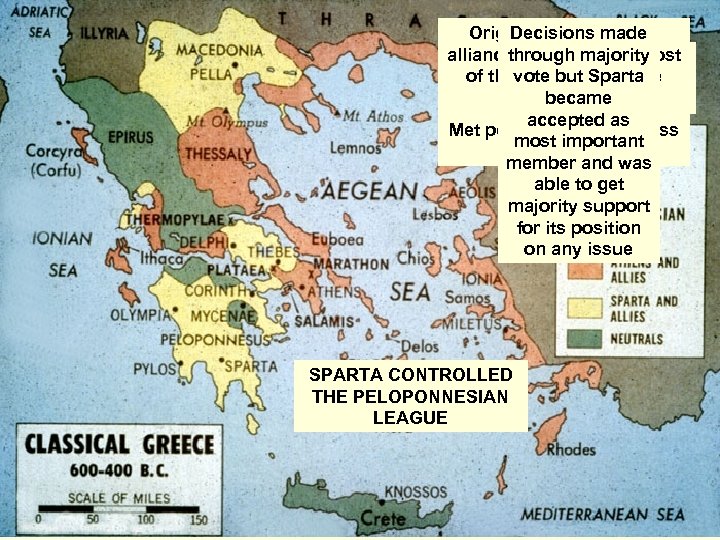 Originally a protective Decisions made alliance with included most through majority Sparta exercised power of thevote Peloponnesian through city-states in the but Sparta Peloponnese became League accepted as Met periodically to discuss most important issues member and was able to get majority support for its position on any issue SPARTA CONTROLLED THE PELOPONNESIAN LEAGUE
 BRIDGES HOLLAND 7 th Grade Social Studies Chapter 10 GREEK CITY-STATES
 BRIDGES HOLLAND 7 th Grade Social Studies Chapter 10 GREEK CITY-STATES
 CHAPTER 10 THE CITY-STATES SECTION 1—THE POLIS SECTION 2—SPARTA SECTION 3—ATHENS SECTION 4—DECLINE OF CITY-STATES
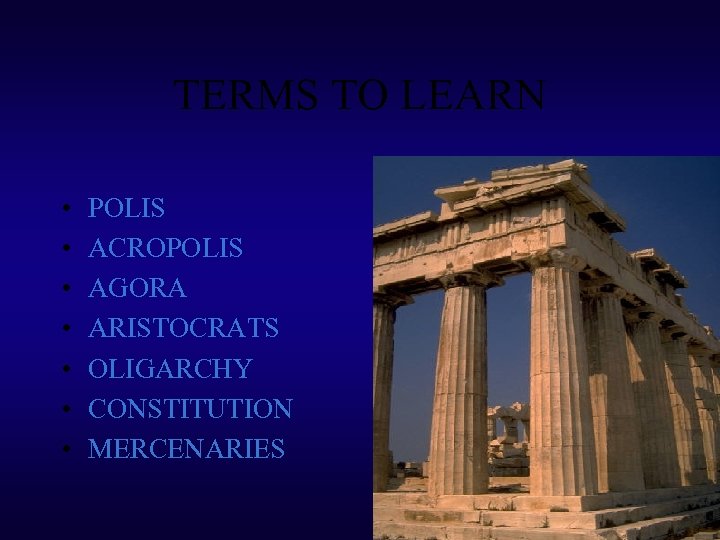 TERMS TO LEARN • • POLIS ACROPOLIS AGORA ARISTOCRATS OLIGARCHY CONSTITUTION MERCENARIES
 SECTION 1 --THE POLIS • • Polis- center of Greek life (City-State) Acropolis- fortified hill temple to gods Agora- open marketplace area Polis- gave sense of belonging, good of the polis was top priority • If Born outside Greece—No citizenship • Citizens could Vote, fight in Army, hold office, speak for themselves in court. • Greatest City-States -- (Athens, Sparta
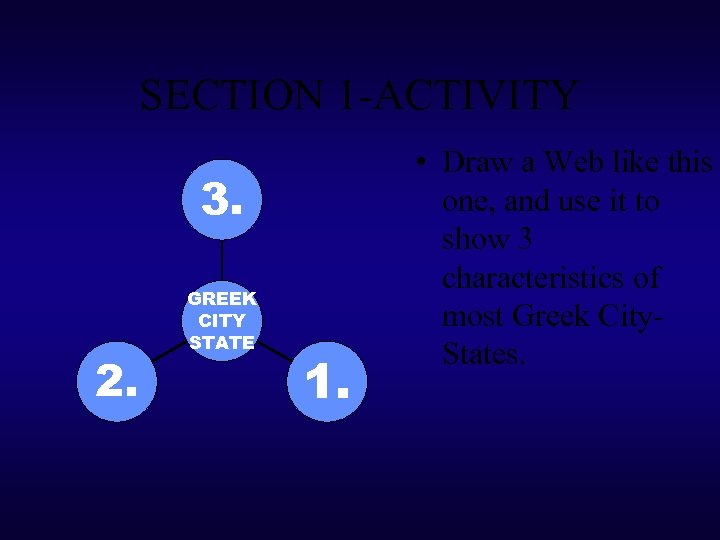 SECTION 1 -ACTIVITY 3. 2. GREEK CITY STATE 1. • Draw a Web like this one, and use it to show 3 characteristics of most Greek City. States.
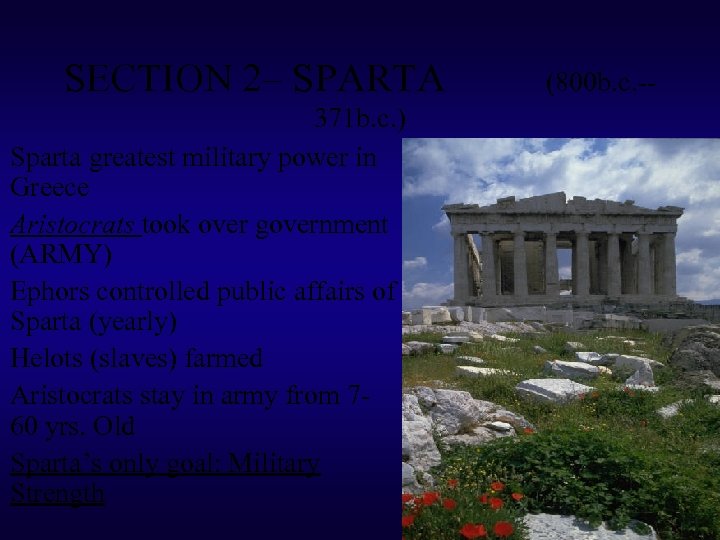 SECTION 2– SPARTA 371 b. c. ) Sparta greatest military power in Greece Aristocrats took over government (ARMY) Ephors controlled public affairs of Sparta (yearly) Helots (slaves) farmed Aristocrats stay in army from 760 yrs. Old Sparta’s only goal: Military Strength (800 b. c. --
 SECTION 2 --ACTIVITY PROS CONS After reading Section 2—SPARTA, list 3 pros and 3 cons of living in Sparta.
 SECTION 3 --ATHENS • • • Athens was ruled by an Oligarchy-few people have ruling powe Solon set up first Athenian Constitution Citizenship was offered to everyone 508 b. c. first democratic government setup (favoring the people Became citizens at age 18 490 b. c. the word “Nike” was first used (Greek goddess of victory upon defeat of the Persians. • Delian League was formed (city-states joined) (like the United Nations)
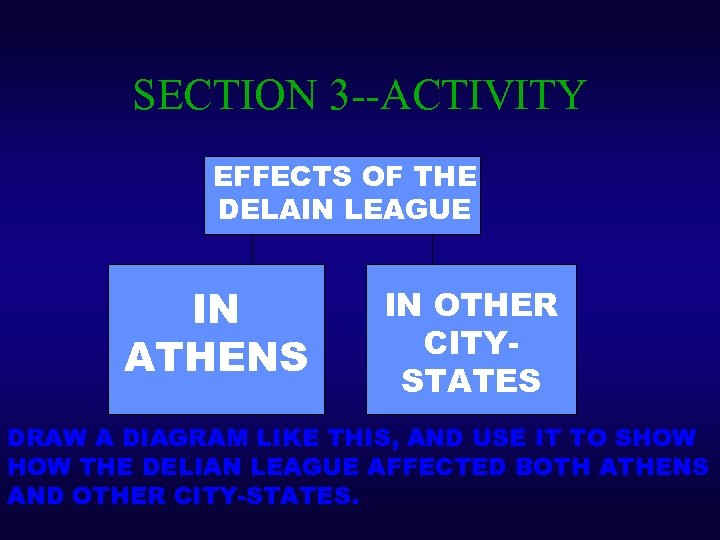 SECTION 3 --ACTIVITY EFFECTS OF THE DELAIN LEAGUE IN ATHENS IN OTHER CITYSTATES DRAW A DIAGRAM LIKE THIS, AND USE IT TO SHOW THE DELIAN LEAGUE AFFECTED BOTH ATHENS AND OTHER CITY-STATES.
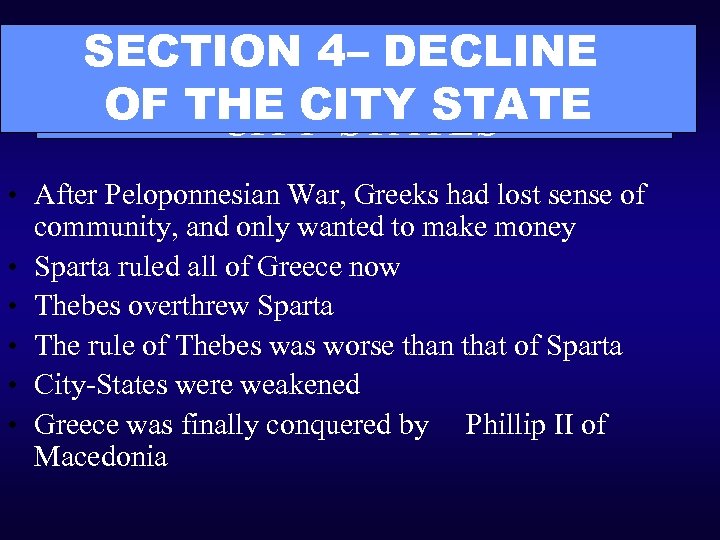 SECTION 4– DECLINE SECTION 4 --DECLINE OF THE CITY STATE CITY-STATES • After Peloponnesian War, Greeks had lost sense of community, and only wanted to make money • Sparta ruled all of Greece now • Thebes overthrew Sparta • The rule of Thebes was worse than that of Sparta • City-States were weakened • Greece was finally conquered by Phillip II of Macedonia
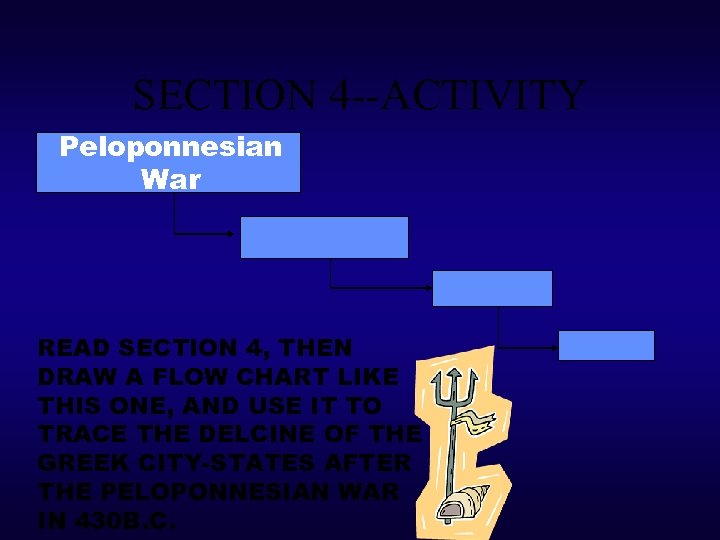 SECTION 4 --ACTIVITY Peloponnesian War READ SECTION 4, THEN DRAW A FLOW CHART LIKE THIS ONE, AND USE IT TO TRACE THE DELCINE OF THE GREEK CITY-STATES AFTER THE PELOPONNESIAN WAR IN 430 B. C.
 1. 2. 3. 4. REVIEW What did the citizens of a polis consider most important? Why did Sparta remain a poor farming society? What was Sparta’s main goal? In what City-State did the first democratic style of govt. begin? 5. What was the purpose of the Delian League, and what does it compare to today? 6. Which City-State did not join the Delian League? 7. Who conquered Greece?
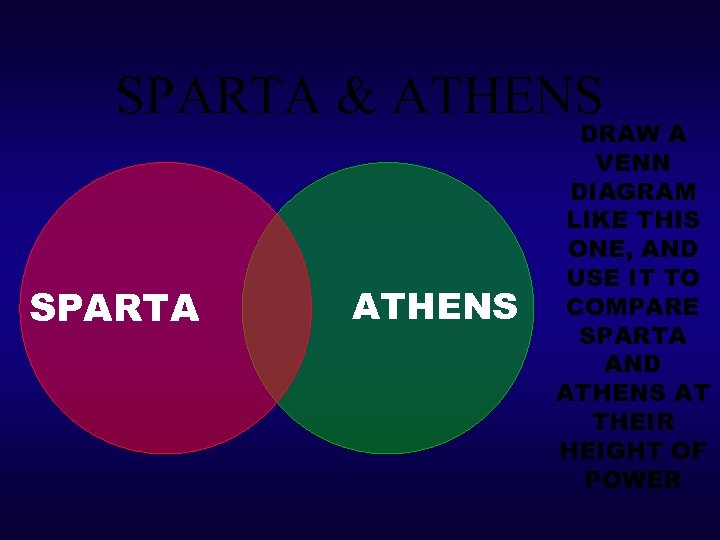 SPARTA & ATHENS SPARTA ATHENS DRAW A VENN DIAGRAM LIKE THIS ONE, AND USE IT TO COMPARE SPARTA AND ATHENS AT THEIR HEIGHT OF POWER
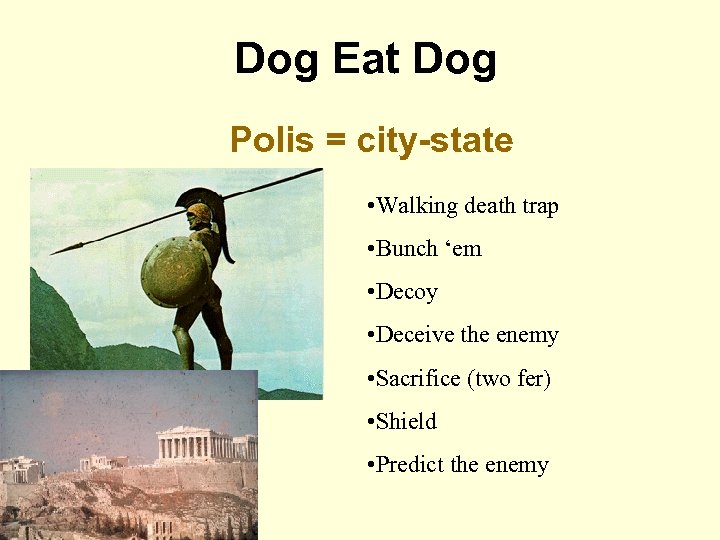 Dog Eat Dog Polis = city-state • Walking death trap • Bunch ‘em • Decoy • Deceive the enemy • Sacrifice (two fer) • Shield • Predict the enemy
 Biopoem Greek name Title Relative of ____ Lover of ____ (things or people) Who feels ____ (1 -3 things) Who needs ____ (1 -3 things) Who fears _____ (1 -3 things) Who gives _____ (1 -3 things) Who would like to see ___ (1 -3 things) Resident of _______ Roman name
 Homework • Greek God Commercial Planning Sheet & Storyboard due Tuesday • Commercial filming Tuesday • Getty Villa E. C. due May 14