 Скачать презентацию Ch 2 6 Objective To use the distributive
6dc51fbe421a8aaa8148f9ece9f759b5.ppt
- Количество слайдов: 12



Ch 2. 6 Objective: To use the distributive property to simplify variable expressions.
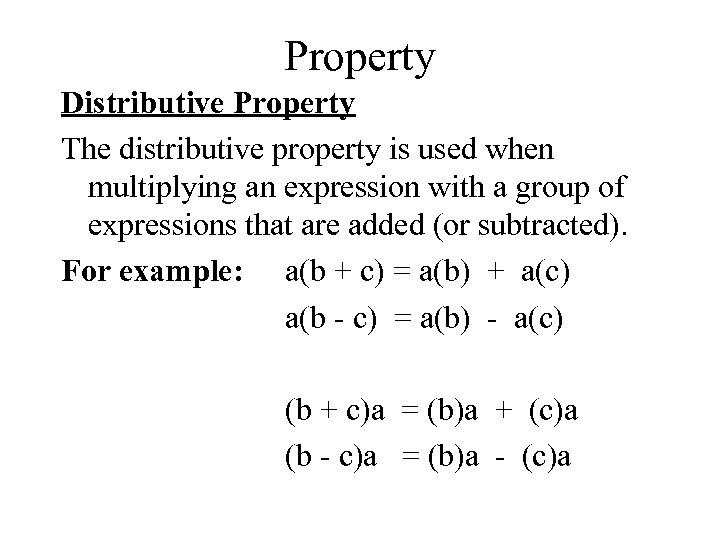
Property Distributive Property The distributive property is used when multiplying an expression with a group of expressions that are added (or subtracted). For example: a(b + c) = a(b) + a(c) a(b - c) = a(b) - a(c) (b + c)a = (b)a + (c)a (b - c)a = (b)a - (c)a
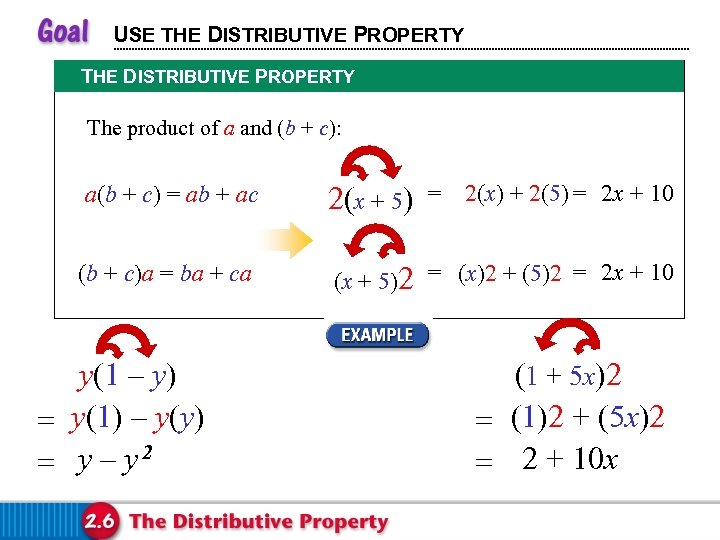
USE THE DISTRIBUTIVE PROPERTY The product of a and (b + c): = 2(x) + 2(5) = 2 x + 10 a(b + c) = ab + ac 2(x + 5) (b + c)a = ba + ca (x + 5)2 = (x)2 + (5)2 = 2 x + 10 y(1 – y) = y(1) – y(y) y – y 2 = (1 + 5 x)2 = (1)2 + (5 x)2 = 2 + 10 x
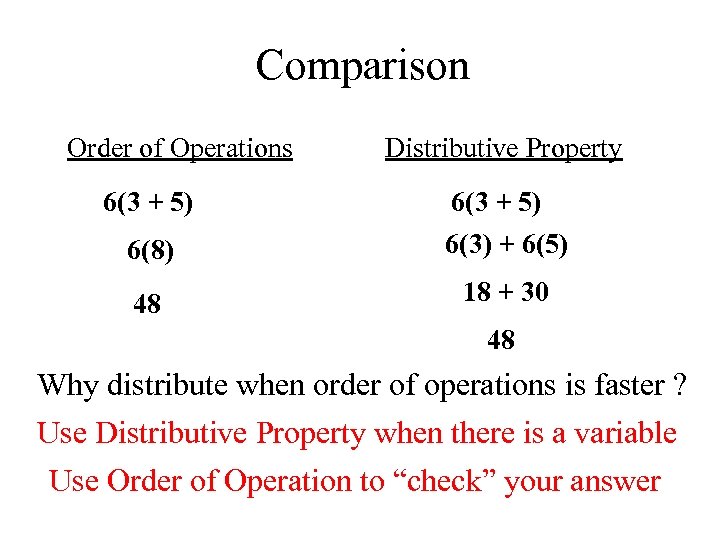
Comparison Order of Operations 6(3 + 5) Distributive Property 6(8) 6(3 + 5) 6(3) + 6(5) 48 18 + 30 48 Why distribute when order of operations is faster ? Use Distributive Property when there is a variable Use Order of Operation to “check” your answer
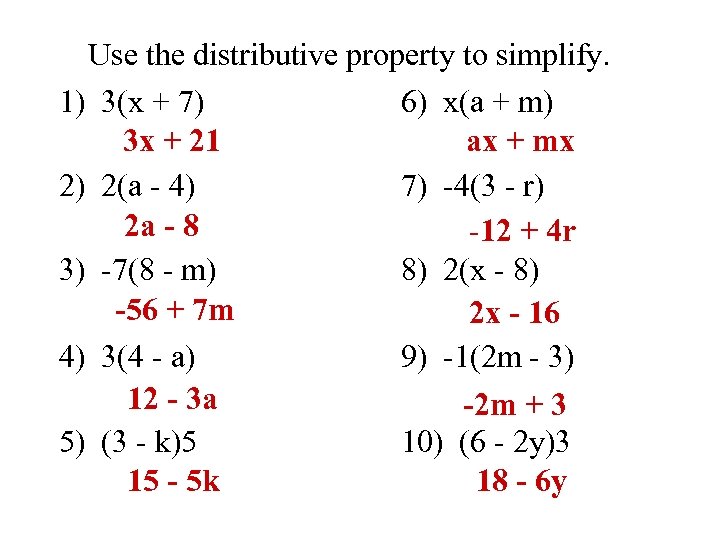
Use the distributive property to simplify. 1) 3(x + 7) 6) x(a + m) 3 x + 21 ax + mx 2) 2(a - 4) 7) -4(3 - r) 2 a - 8 -12 + 4 r 3) -7(8 - m) 8) 2(x - 8) -56 + 7 m 2 x - 16 4) 3(4 - a) 9) -1(2 m - 3) 12 - 3 a -2 m + 3 5) (3 - k)5 10) (6 - 2 y)3 15 - 5 k 18 - 6 y
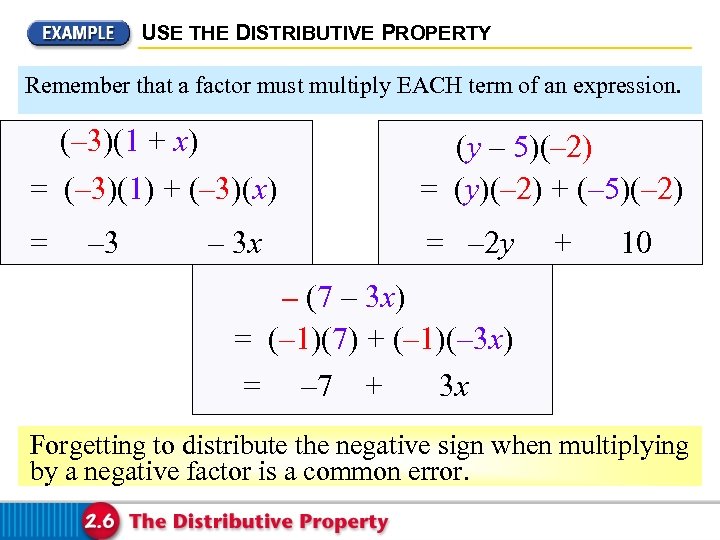
USE THE DISTRIBUTIVE PROPERTY Remember that a factor must multiply EACH term of an expression. (– 3)(1 + x) = (– 3)(1) + (– 3)(x) (y – 5)(– 2) = (y)(– 2) + (– 5)(– 2) = – 3 x = – 2 y + 10 – (7 – 3 x) = (– 1)(7) + (– 1)(– 3 x) = – 7 + 3 x Forgetting to distribute the negative sign when multiplying by a negative factor is a common error.
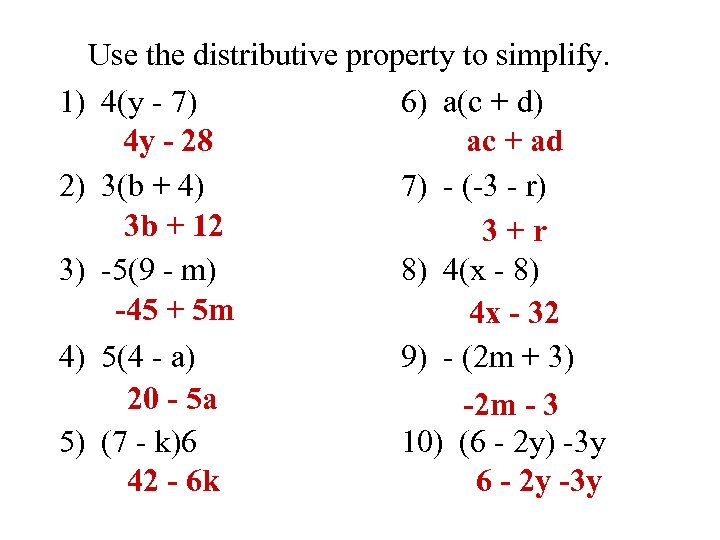
Use the distributive property to simplify. 1) 4(y - 7) 6) a(c + d) 4 y - 28 ac + ad 2) 3(b + 4) 7) - (-3 - r) 3 b + 12 3+r 3) -5(9 - m) 8) 4(x - 8) -45 + 5 m 4 x - 32 4) 5(4 - a) 9) - (2 m + 3) 20 - 5 a -2 m - 3 5) (7 - k)6 10) (6 - 2 y) -3 y 42 - 6 k 6 - 2 y -3 y
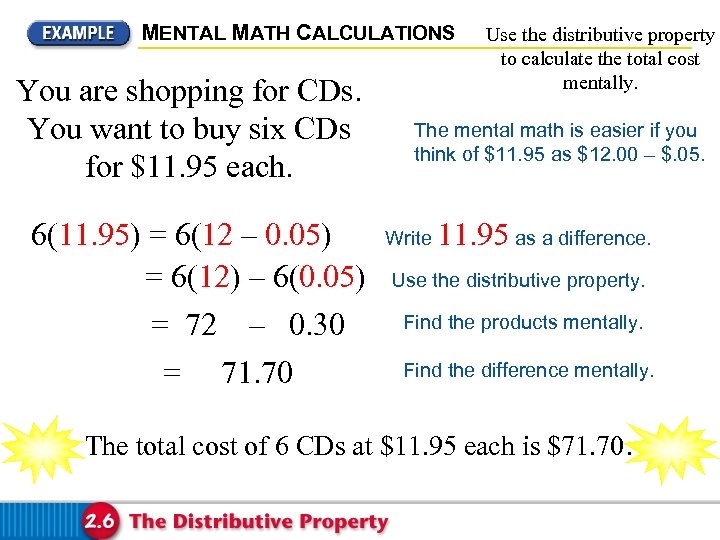
MENTAL MATH CALCULATIONS You are shopping for CDs. You want to buy six CDs for $11. 95 each. 6(11. 95) = 6(12 – 0. 05) = 6(12) – 6(0. 05) = 72 – 0. 30 = 71. 70 Use the distributive property to calculate the total cost mentally. The mental math is easier if you think of $11. 95 as $12. 00 – $. 05. Write 11. 95 as a difference. Use the distributive property. Find the products mentally. Find the difference mentally. The total cost of 6 CDs at $11. 95 each is $71. 70.
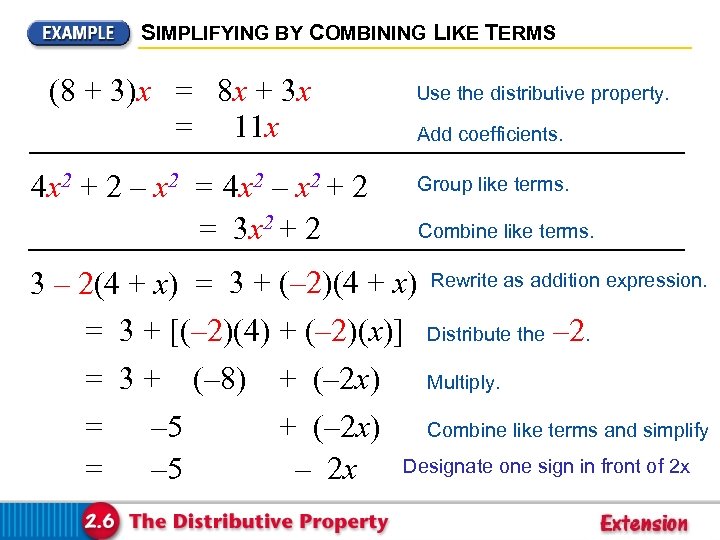
SIMPLIFYING BY COMBINING LIKE TERMS (8 + 3)x = 8 x + 3 x = 11 x 4 x 2 + 2 – x 2 = 4 x 2 – x 2 + 2 = 3 x 2 + 2 Use the distributive property. Add coefficients. Group like terms. Combine like terms. 3 – 2(4 + x) = 3 + (– 2)(4 + x) Rewrite as addition expression. = 3 + [(– 2)(4) + (– 2)(x)] Distribute the – 2. = 3 + (– 8) + (– 2 x) Multiply. = – 5 + (– 2 x) Combine like terms and simplify = – 5 – 2 x Designate one sign in front of 2 x
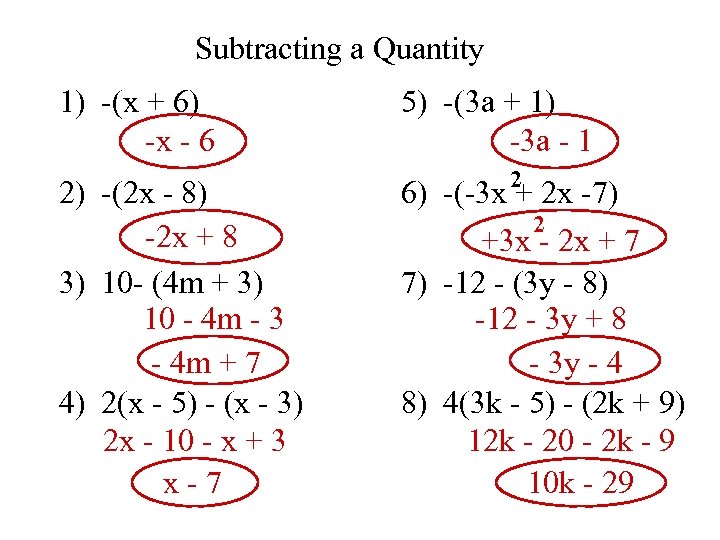
Subtracting a Quantity 1) -(x + 6) -x - 6 2) -(2 x - 8) -2 x + 8 3) 10 - (4 m + 3) 10 - 4 m - 3 - 4 m + 7 4) 2(x - 5) - (x - 3) 2 x - 10 - x + 3 x - 7 5) -(3 a + 1) -3 a - 1 2 6) -(-3 x + 2 x -7) 2 +3 x - 2 x + 7 7) -12 - (3 y - 8) -12 - 3 y + 8 - 3 y - 4 8) 4(3 k - 5) - (2 k + 9) 12 k - 20 - 2 k - 9 10 k - 29
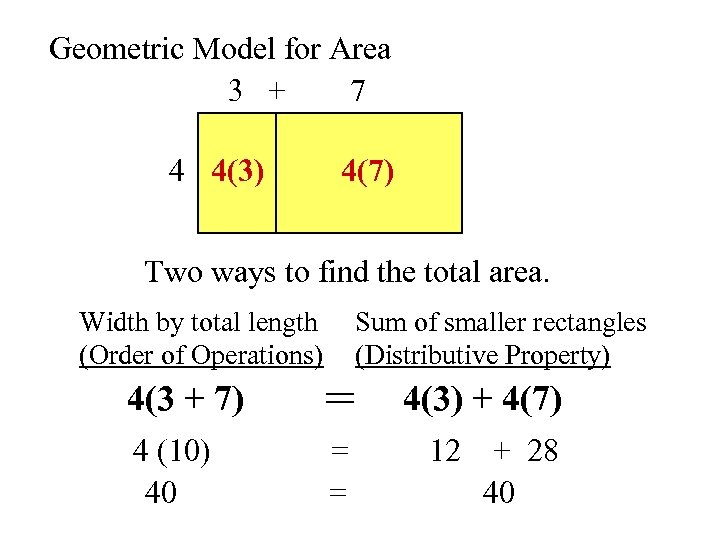
Geometric Model for Area 3 + 7 4 4(3) 4(7) Two ways to find the total area. Width by total length (Order of Operations) 4(3 + 7) Sum of smaller rectangles (Distributive Property) = 4(3) + 4(7) 4 (10) = 12 + 28 40 = 40
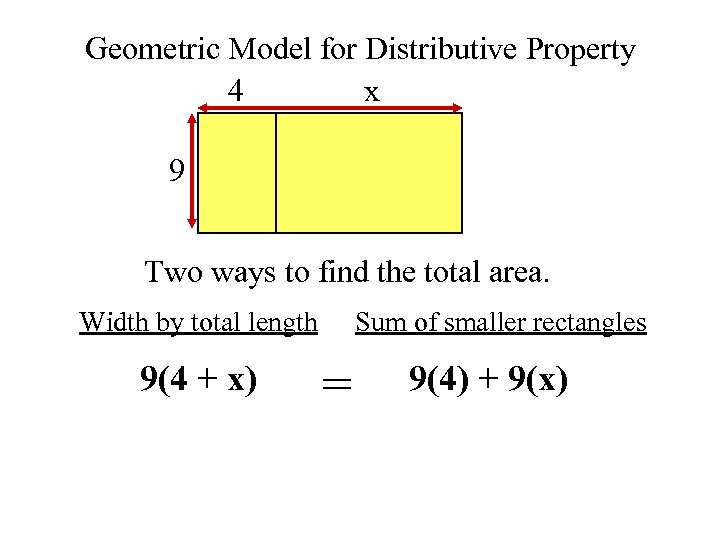
Geometric Model for Distributive Property 4 x 9 Two ways to find the total area. Width by total length 9(4 + x) Sum of smaller rectangles = 9(4) + 9(x)
Скачать презентацию Ch 2 6 Objective To use the distributive
6dc51fbe421a8aaa8148f9ece9f759b5.ppt