


 Скачать презентацию Ch 17 Reaction Rates We define a
bc0d06856a504050961a48cbb8053e1b.ppt
- Количество слайдов: 9
 Ch 17: Reaction Rates • We define a rate as a change in a quantity divided by the change in time: rate = ∆quantity ∆time Examples of types of rates: 1. 2. 3. 4. Speed of a car Points scored in a game Hot dogs eaten in 5 minutes Pages printed by a printer in 1 minute
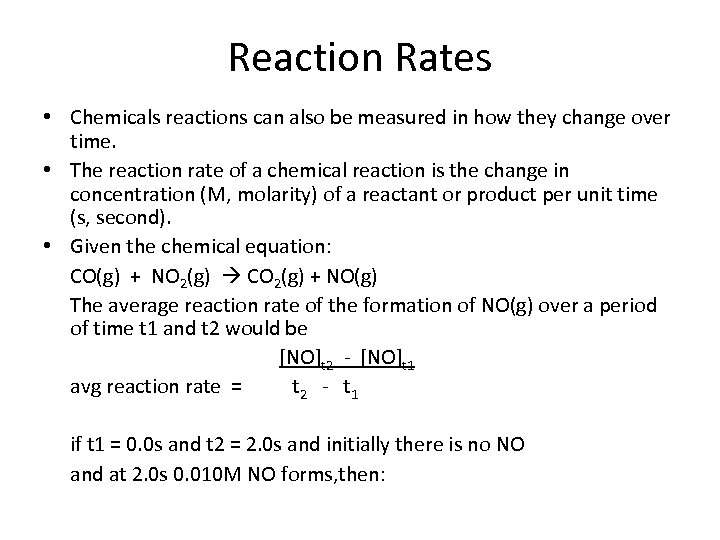 Reaction Rates • Chemicals reactions can also be measured in how they change over time. • The reaction rate of a chemical reaction is the change in concentration (M, molarity) of a reactant or product per unit time (s, second). • Given the chemical equation: CO(g) + NO 2(g) CO 2(g) + NO(g) The average reaction rate of the formation of NO(g) over a period of time t 1 and t 2 would be [NO]t 2 - [NO]t 1 avg reaction rate = t 2 - t 1 if t 1 = 0. 0 s and t 2 = 2. 0 s and initially there is no NO and at 2. 0 s 0. 010 M NO forms, then:
 Collision Theory • Reactions occur when molecules collide together • The collision theory says that: 1. atoms, ions, and molecules must collide in order to react. 2. Reacting substances must collide with the correct orientation 3. Reacting substances must collide with sufficient energy to form the activated complex • The activated complex (or transition state) is a temporary, unstable arrangement of atoms that may form products or may break apart to reform the reactants.
 Activation Energy • In order for a reaction to occur, the reacting atoms, ions, and molecules must have sufficient energy when they collide in the right orientation. • The minimum amount of energy required for the activated complex to form and for the reaction to take places is called the activation energy (Ea). • Although important in determining if a reaction will occur, this tells us little about the actual speed/rate of reaction.
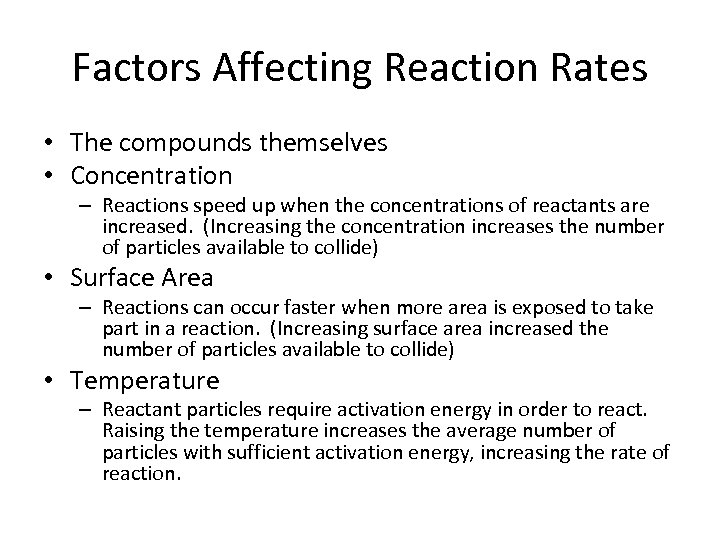 Factors Affecting Reaction Rates • The compounds themselves • Concentration – Reactions speed up when the concentrations of reactants are increased. (Increasing the concentration increases the number of particles available to collide) • Surface Area – Reactions can occur faster when more area is exposed to take part in a reaction. (Increasing surface area increased the number of particles available to collide) • Temperature – Reactant particles require activation energy in order to react. Raising the temperature increases the average number of particles with sufficient activation energy, increasing the rate of reaction.
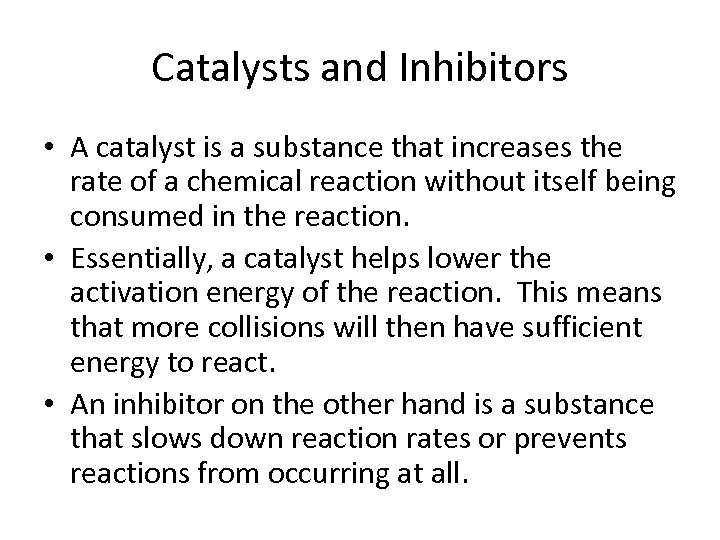 Catalysts and Inhibitors • A catalyst is a substance that increases the rate of a chemical reaction without itself being consumed in the reaction. • Essentially, a catalyst helps lower the activation energy of the reaction. This means that more collisions will then have sufficient energy to react. • An inhibitor on the other hand is a substance that slows down reaction rates or prevents reactions from occurring at all.
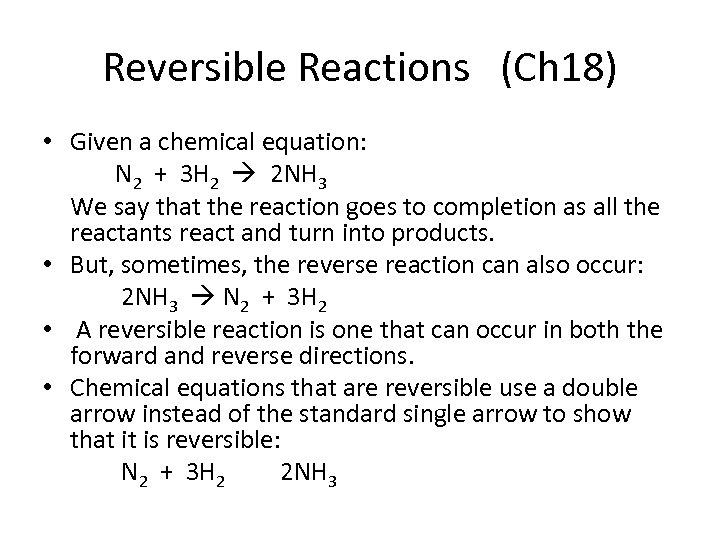 Reversible Reactions (Ch 18) • Given a chemical equation: N 2 + 3 H 2 2 NH 3 We say that the reaction goes to completion as all the reactants react and turn into products. • But, sometimes, the reverse reaction can also occur: 2 NH 3 N 2 + 3 H 2 • A reversible reaction is one that can occur in both the forward and reverse directions. • Chemical equations that are reversible use a double arrow instead of the standard single arrow to show that it is reversible: N 2 + 3 H 2 2 NH 3
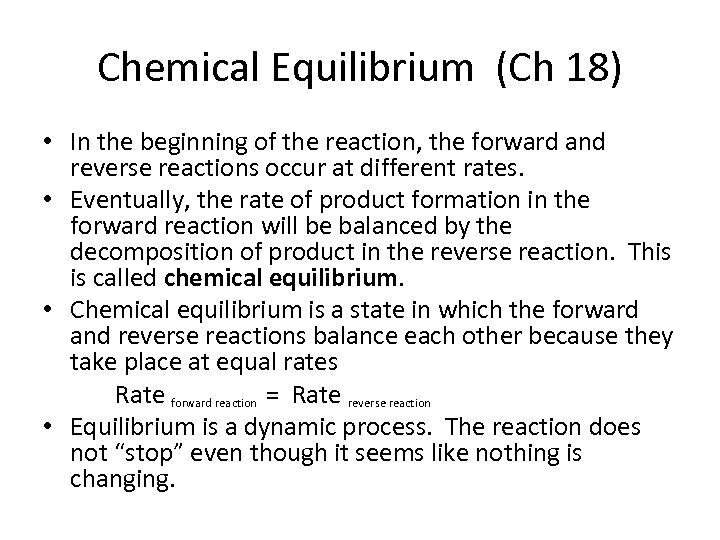 Chemical Equilibrium (Ch 18) • In the beginning of the reaction, the forward and reverse reactions occur at different rates. • Eventually, the rate of product formation in the forward reaction will be balanced by the decomposition of product in the reverse reaction. This is called chemical equilibrium. • Chemical equilibrium is a state in which the forward and reverse reactions balance each other because they take place at equal rates Rate forward reaction = Rate reverse reaction • Equilibrium is a dynamic process. The reaction does not “stop” even though it seems like nothing is changing.
 Changes in Equilibrium (Ch 18) • Equilibrium of chemical reactions can “shift” in one direction or another. • Le Châtelier’s Principle states that if a stress is applied to a system at equilibrium, the system shifts in the direction that relieves the stress. – Increase reactants – forward reaction favored, making more product. The reaction “shifts to the right” – Increase products – reverse reaction favored, making more reactants. The reaction “shifts to the left” – Decrease reactants – reverse reaction favored, making more reactants. The reaction “shifts to the left” – Decrease producs – forward reaction favored, making more products. The reaction “shifts to the right” – Increase temperature – Endothermic reaction is favored. Reaction shifts towards the endothermic process – Add catalyst – no effect