


 Скачать презентацию Ch 10 Consumption Savings Gr 11 Economics
2c28084fb06cb6fb14116eaf8e8bb9a7.ppt
- Количество слайдов: 16
 Ch. 10: Consumption & Savings Gr. 11 Economics (CIE 3 M 1 -01) M. Nicholson
 Consumption • Consumption is that part of an individual’s income that is spent on goods & services rather than saved. • Consumer demand determines what goods & services are produced
 Consumption • Factors influencing consumer choice üIncome levels üFashion üCustom üAdvertising
 Consumption • Consumer protection Goods and services much more complex than in the past, therefore vulnerable consumers need to be protected by: üGovernment üBetter Business Groups üConsumer Protection Groups
 Consumption • Consumer credit üThe ability to buy now and pay later üOther sources of credit include bills we receive and pay well after we have used the product (e. g. hydro, telephone) üCredit cards such as Visa and Master. Card are very popular, but unpaid balances have punitive interest payments of 18. 5 %
 Consumption • Consumer credit üCharge accounts like a Sears card are growing less popular as they become credit cards (e. g. Canadian Tire) üConditional sales contracts are installment payments that if not paid allow the seller to repossess the product sold
 Consumption • Spending patterns of Canadians üincomes ↑ expenditures ↑ < savings ↑ üexpenditures as a percentage of income decrease as income rises üe. g. spend $12, 000 of a $12, 000 income which is 100% whereas spend $40, 000 of a $60, 000 income which is 66%
 Consumption • Personal finances üGood idea to develop a budget or financial plan showing expected income & expenditures üit helps control your consumption to avoid debt caused by poor purchasing decisions
 Savings • Savings are that part of current income that is not spent • Loans üBanks, trust companies, and credit unions borrow money from individual Canadians (e. g. personal chequing account, chequing / savings account, guaranteed investment certificates)
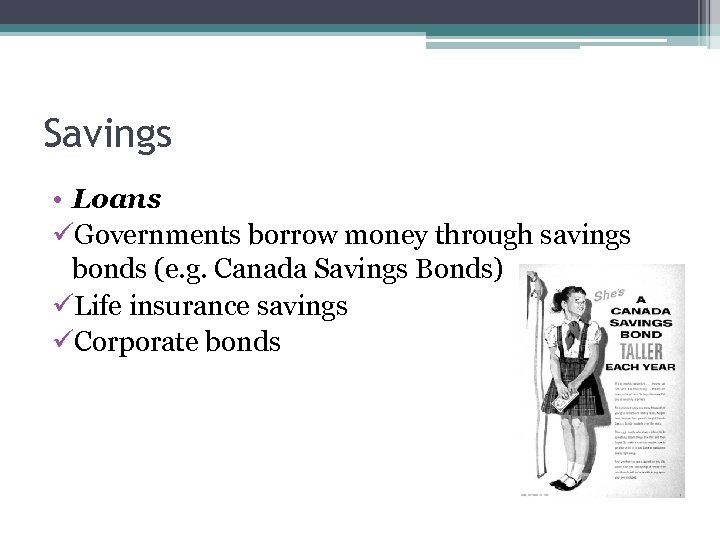 Savings • Loans üGovernments borrow money through savings bonds (e. g. Canada Savings Bonds) üLife insurance savings üCorporate bonds
 Savings • Equities üStocks or ownership in a corporation offer a high return, but risk of losing investment can be high üReal estate offers homeowner’s equity, the difference between the value of the house and outstanding loans plus there is no capital gains tax on the increased price a home seller may receive
 Savings • Mutual / Investment Funds üSafer investment because of diversification and professional management üE. g. equity funds, bond funds, mortgage funds, money market funds, balanced funds
 Savings • Life Insurance üA contract in which one party (the insurer) agrees to pay another (the insured) a sum of money in the event of a specific loss (e. g. death) üTerm insurance, Straight-life / Whole-life insurance, Limited-pay life insurance
 Savings • Share ownership among Canadians üimage of Canadians being very conservative and adverse to risk üownership of stocks ↑ 16% to 21 % of the population between 1989 -93 ü 25 % own equity funds
 Savings • Registered Retirement Savings Plans üMethod of reducing taxable income and saving for retirement • You and your investments üDecide on reasonable financial objectives (e. g. 3 bedroom house, minivan, Florida vacation) ügreater risk = greater potential returns ü less risk = less potential returns
 Savings • You and your investments ü Income large enough? ü Future income? ü Age? ü Time, interest, knowledge in investments? ü Tax situation? ü Risk tolerance?