 Скачать презентацию Ch 10 Agriculture Biotechnology and the Future of
f6cdf8e9d501542a9e9f9517711a60fc.ppt
- Количество слайдов: 50



Ch 10 Agriculture, Biotechnology, and the Future of Food Part 2: Environmental Issues and the Search for Solutions Power. Point® Slides prepared by Jay Withgott and Heidi Marcum Copyright © 2006 Pearson Education, Inc. , publishing as Benjamin Cummings Copyright © 2008 Pearson Education, Inc. , publishing as Pearson Benjamin Cummings
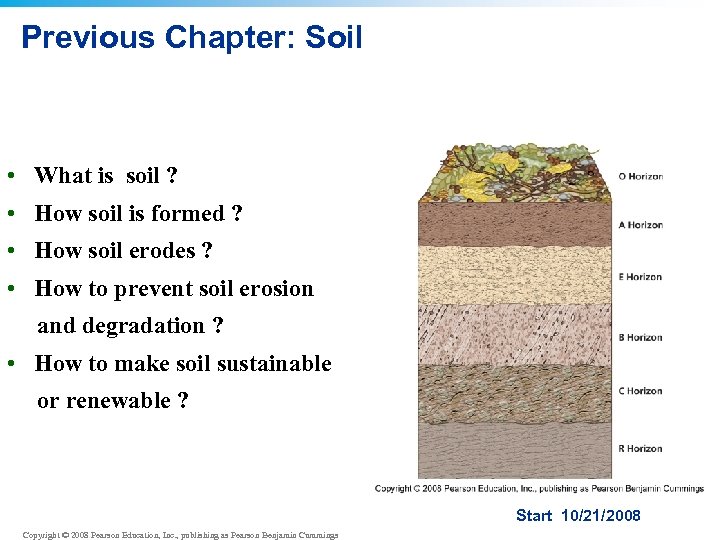
Previous Chapter: Soil • What is soil ? • How soil is formed ? • How soil erodes ? • How to prevent soil erosion and degradation ? • How to make soil sustainable or renewable ? Start 10/21/2008 Copyright © 2008 Pearson Education, Inc. , publishing as Pearson Benjamin Cummings
This lecture will help you understand: • The challenge of feeding a growing human population • The green revolution • Strategies of pest control • Pollination • Genetically modified (GM) food • How to conserve crop diversity • Assess Feedlot (Factory Farm) • Aquaculture • Sustainable agriculture Copyright © 2008 Pearson Education, Inc. , publishing as Pearson Benjamin Cummings
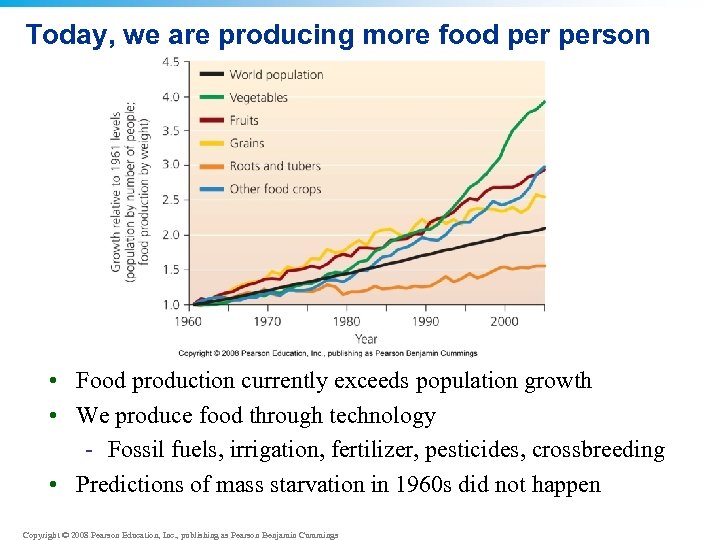
Today, we are producing more food person • Food production currently exceeds population growth • We produce food through technology - Fossil fuels, irrigation, fertilizer, pesticides, crossbreeding • Predictions of mass starvation in 1960 s did not happen Copyright © 2008 Pearson Education, Inc. , publishing as Pearson Benjamin Cummings
We face both too little and too much food 2, 500 Cal/day (for an average person) = 29 cal/sec ~ 121 Watts 2, 500 Cal/day x (1 g of food/Cal) =2, 500 g/day =5. 5 lbs/day (requirement) • Undernourishment: people receive less than 90% of their daily caloric needs - Mainly from economic reasons in developing countries - 31 million Americans are food insecure • Overnutrition = receiving too many calories - In the U. S. , 25% of adults are obese - Worldwide, more than 300 million people are obese • Malnutrition = a shortage of nutrients the body needs - The diet lacks adequate vitamins and minerals Energy Expenditure Copyright © 2008 Pearson Education, Inc. , publishing as Pearson Benjamin Cummings
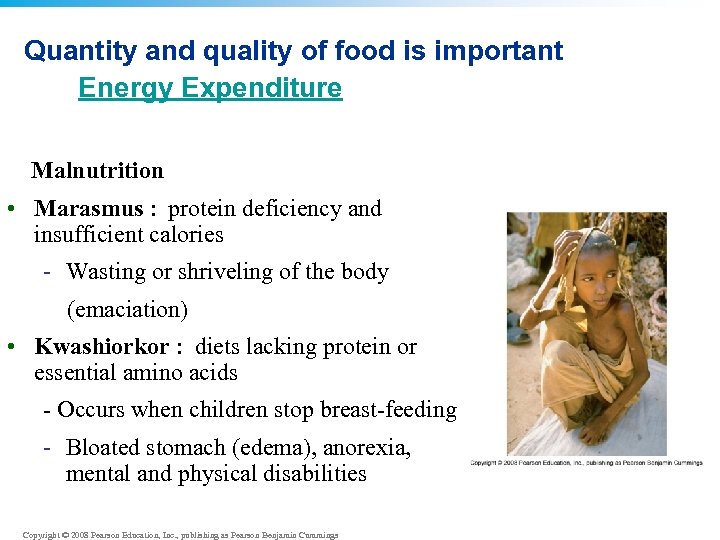
Quantity and quality of food is important Energy Expenditure Malnutrition • Marasmus : protein deficiency and insufficient calories - Wasting or shriveling of the body (emaciation) • Kwashiorkor : diets lacking protein or essential amino acids - Occurs when children stop breast-feeding - Bloated stomach (edema), anorexia, mental and physical disabilities Copyright © 2008 Pearson Education, Inc. , publishing as Pearson Benjamin Cummings
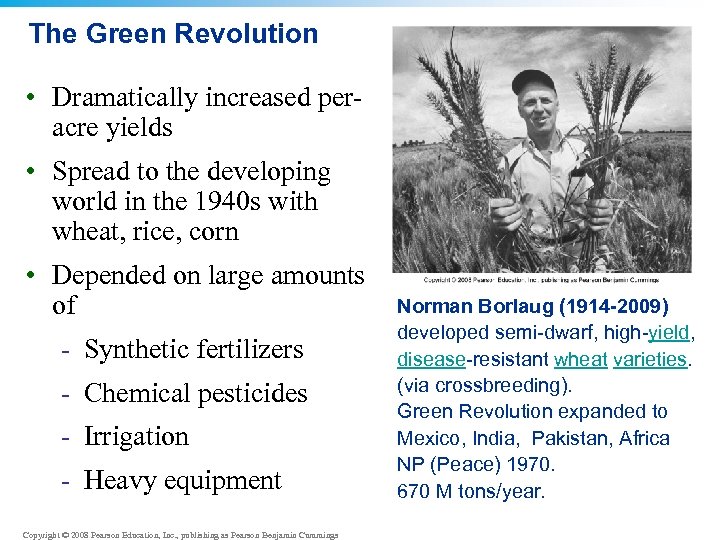
The Green Revolution • Dramatically increased peracre yields • Spread to the developing world in the 1940 s with wheat, rice, corn • Depended on large amounts of - Synthetic fertilizers - Chemical pesticides - Irrigation - Heavy equipment Copyright © 2008 Pearson Education, Inc. , publishing as Pearson Benjamin Cummings Norman Borlaug (1914 -2009) developed semi-dwarf, high-yield, disease-resistant wheat varieties. (via crossbreeding). Green Revolution expanded to Mexico, India, Pakistan, Africa NP (Peace) 1970. 670 M tons/year.
The green revolution brought benefits and harm • From 1900 to 2000, cultivated area increased 33%, while energy inputs increased 80 times! • Positive effects on natural resources - Prevented some deforestation - Preserved biodiversity • Negative effects on natural resources - Pollution - Erosion - Salinization - Desertification Copyright © 2008 Pearson Education, Inc. , publishing as Pearson Benjamin Cummings
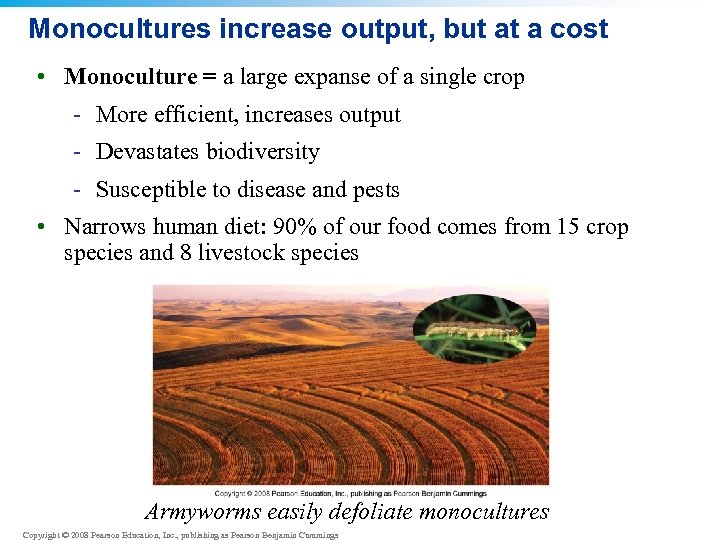
Monocultures increase output, but at a cost • Monoculture = a large expanse of a single crop - More efficient, increases output - Devastates biodiversity - Susceptible to disease and pests • Narrows human diet: 90% of our food comes from 15 crop species and 8 livestock species Armyworms easily defoliate monocultures Copyright © 2008 Pearson Education, Inc. , publishing as Pearson Benjamin Cummings
Pests and pollinators • Pest: any organism that damages valuable crops • Weed: any plant that competes with crops • Pesticides: poisons that target pest organisms - Insecticides: target insects - Herbicides : target plants - Fungicides : target fungi • 400 million kg (900 million lbs. ) of pesticides are applied in the U. S. each year - 75% of this is applied to agricultural land - Usage is increasing in developing countries Copyright © 2008 Pearson Education, Inc. , publishing as Pearson Benjamin Cummings
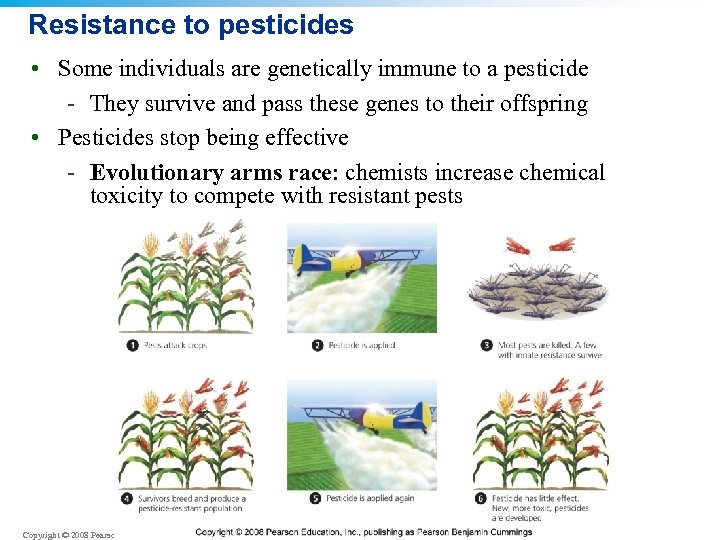
Resistance to pesticides • Some individuals are genetically immune to a pesticide - They survive and pass these genes to their offspring • Pesticides stop being effective - Evolutionary arms race: chemists increase chemical toxicity to compete with resistant pests Copyright © 2008 Pearson Education, Inc. , publishing as Pearson Benjamin Cummings
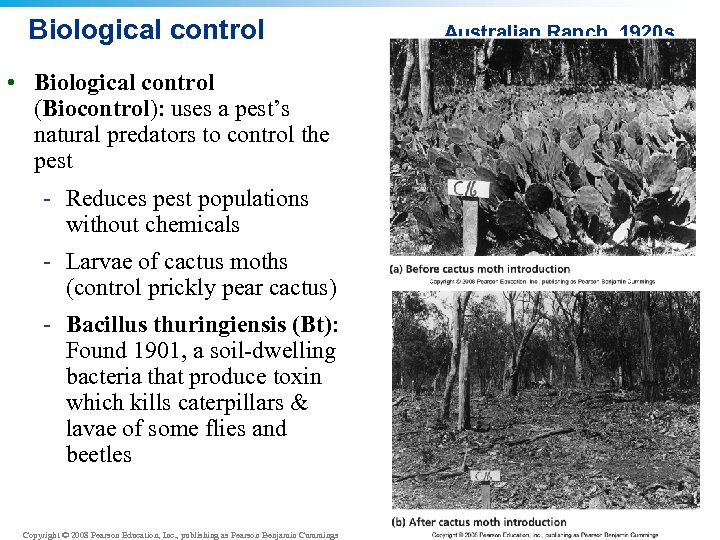
Biological control • Biological control (Biocontrol): uses a pest’s natural predators to control the pest - Reduces pest populations without chemicals - Larvae of cactus moths (control prickly pear cactus) - Bacillus thuringiensis (Bt): Found 1901, a soil-dwelling bacteria that produce toxin which kills caterpillars & lavae of some flies and beetles Copyright © 2008 Pearson Education, Inc. , publishing as Pearson Benjamin Cummings Australian Ranch, 1920 s
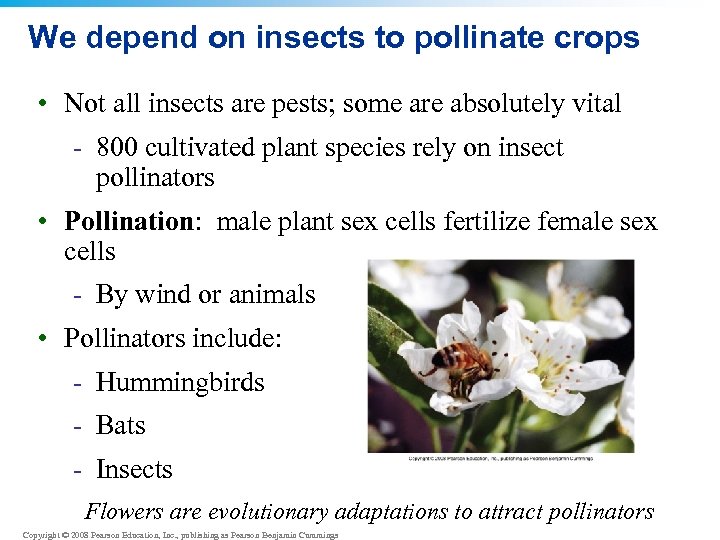
We depend on insects to pollinate crops • Not all insects are pests; some are absolutely vital - 800 cultivated plant species rely on insect pollinators • Pollination: male plant sex cells fertilize female sex cells - By wind or animals • Pollinators include: - Hummingbirds - Bats - Insects Flowers are evolutionary adaptations to attract pollinators Copyright © 2008 Pearson Education, Inc. , publishing as Pearson Benjamin Cummings
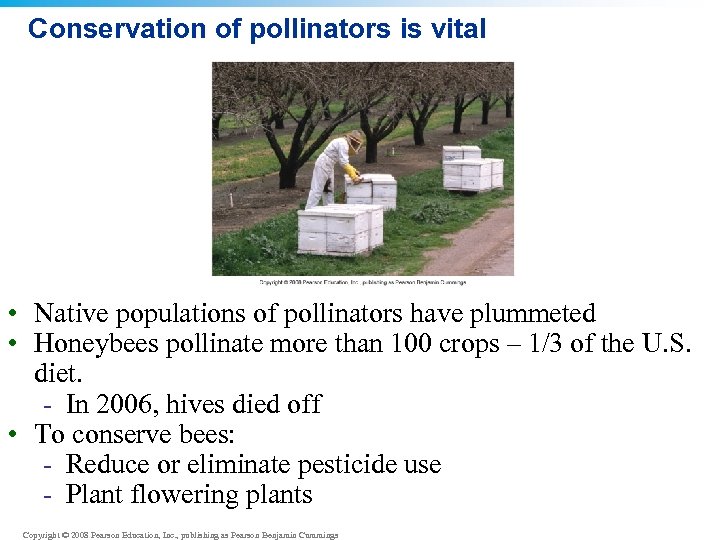
Conservation of pollinators is vital • Native populations of pollinators have plummeted • Honeybees pollinate more than 100 crops – 1/3 of the U. S. diet. - In 2006, hives died off • To conserve bees: - Reduce or eliminate pesticide use - Plant flowering plants Copyright © 2008 Pearson Education, Inc. , publishing as Pearson Benjamin Cummings
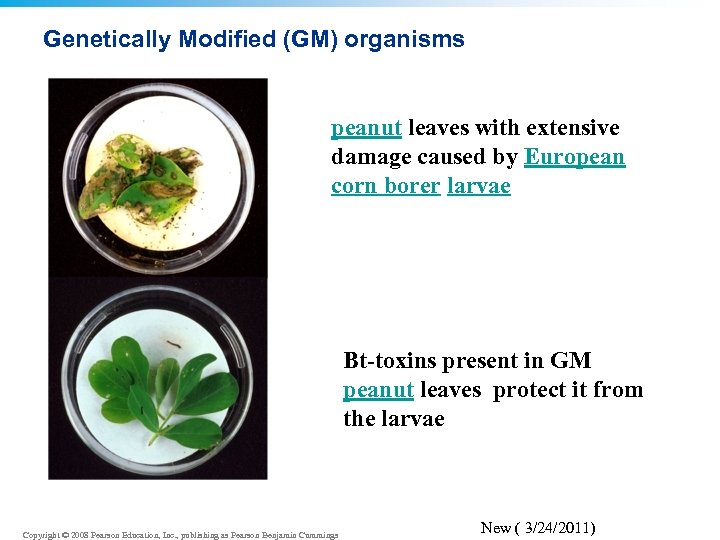
Genetically Modified (GM) organisms peanut leaves with extensive damage caused by European corn borer larvae Bt-toxins present in GM peanut leaves protect it from the larvae Copyright © 2008 Pearson Education, Inc. , publishing as Pearson Benjamin Cummings New ( 3/24/2011)
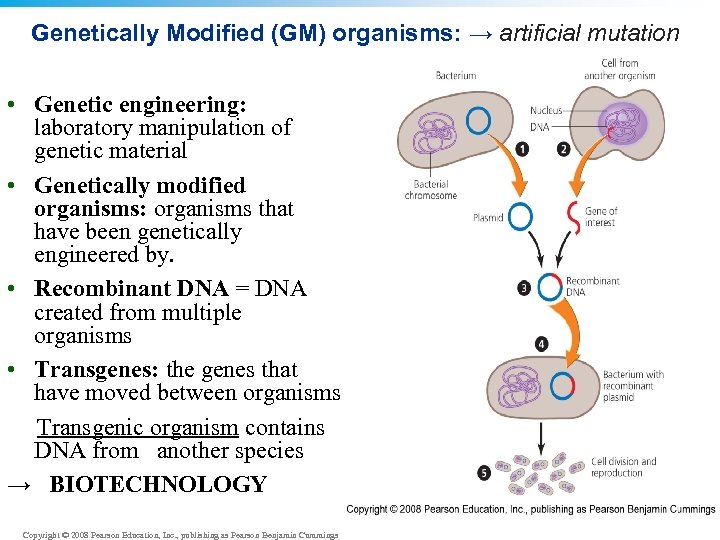
Genetically Modified (GM) organisms: → artificial mutation • Genetic engineering: laboratory manipulation of genetic material • Genetically modified organisms: organisms that have been genetically engineered by. • Recombinant DNA = DNA created from multiple organisms • Transgenes: the genes that have moved between organisms Transgenic organism contains DNA from another species → BIOTECHNOLOGY Copyright © 2008 Pearson Education, Inc. , publishing as Pearson Benjamin Cummings
Genetic engineering has both benefits and risks • Benefits of genetic engineering: - Increased nutritional content - Increased agricultural efficiency - Rapid growth - Disease and pest resistance • Negatives of genetic engineering: - Risks are not yet defined or well understood - Protests from environmental activists, small farmers, and consumer advocates Copyright © 2008 Pearson Education, Inc. , publishing as Pearson Benjamin Cummings
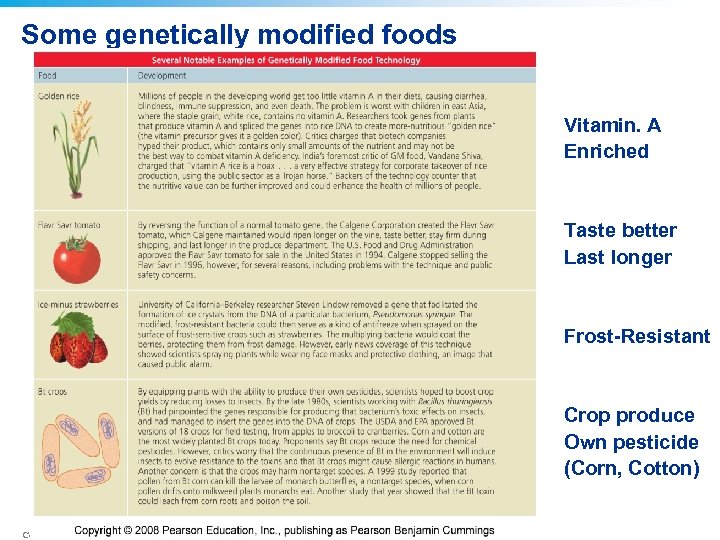
Some genetically modified foods Vitamin. A Enriched Taste better Last longer Frost-Resistant Crop produce Own pesticide (Corn, Cotton) Copyright © 2008 Pearson Education, Inc. , publishing as Pearson Benjamin Cummings
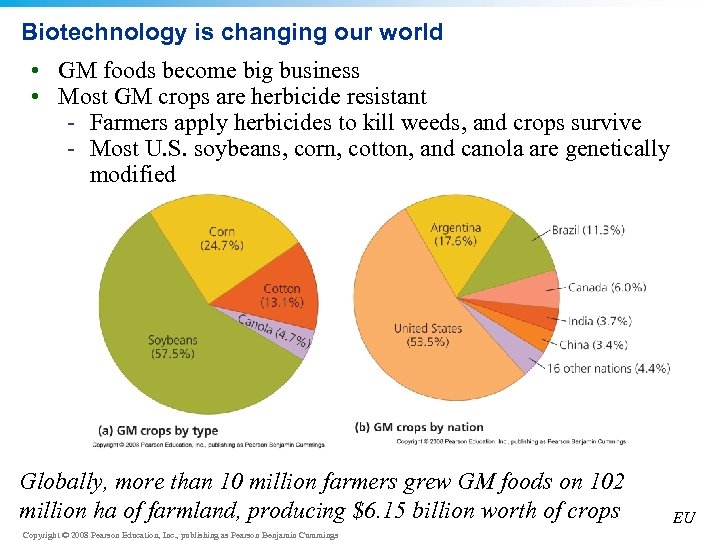
Biotechnology is changing our world • GM foods become big business • Most GM crops are herbicide resistant - Farmers apply herbicides to kill weeds, and crops survive - Most U. S. soybeans, corn, cotton, and canola are genetically modified Globally, more than 10 million farmers grew GM foods on 102 million ha of farmland, producing $6. 15 billion worth of crops Copyright © 2008 Pearson Education, Inc. , publishing as Pearson Benjamin Cummings EU
Supporters maintain that GM crops are safe • Supporters make the following points: - GM crops pose no ill health effects (short term only) - They benefit the environment by using less herbicides - Herbicide-resistant crops encourage no-till farming - GM crops reduce carbon emissions by needing fewer fuel-burning tractors and sequestering carbon in the soil by no-till farming • Critics argue that we should adopt the precautionary principle: don’t do any new action until it’s understood Copyright © 2008 Pearson Education, Inc. , publishing as Pearson Benjamin Cummings
Nations differ in their acceptance of GM foods • Europe opposed GM foods - The U. S. sued the European Union before the World Trade Organization, charging that the European Union was hindering free trade - Brazil, India, and China approve GM crops - Zambia refused U. S. food aid, even though people were starving, because some seeds were genetically modified Copyright © 2008 Pearson Education, Inc. , publishing as Pearson Benjamin Cummings
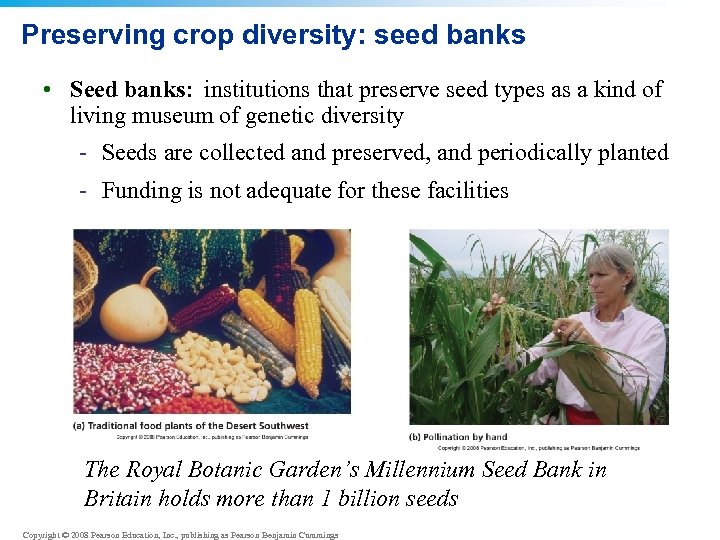
Preserving crop diversity: seed banks • Seed banks: institutions that preserve seed types as a kind of living museum of genetic diversity - Seeds are collected and preserved, and periodically planted - Funding is not adequate for these facilities The Royal Botanic Garden’s Millennium Seed Bank in Britain holds more than 1 billion seeds Copyright © 2008 Pearson Education, Inc. , publishing as Pearson Benjamin Cummings
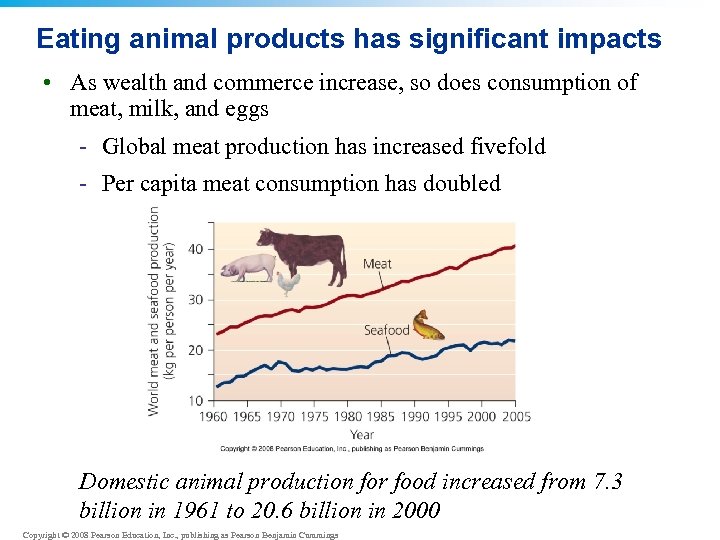
Eating animal products has significant impacts • As wealth and commerce increase, so does consumption of meat, milk, and eggs - Global meat production has increased fivefold - Per capita meat consumption has doubled Domestic animal production for food increased from 7. 3 billion in 1961 to 20. 6 billion in 2000 Copyright © 2008 Pearson Education, Inc. , publishing as Pearson Benjamin Cummings
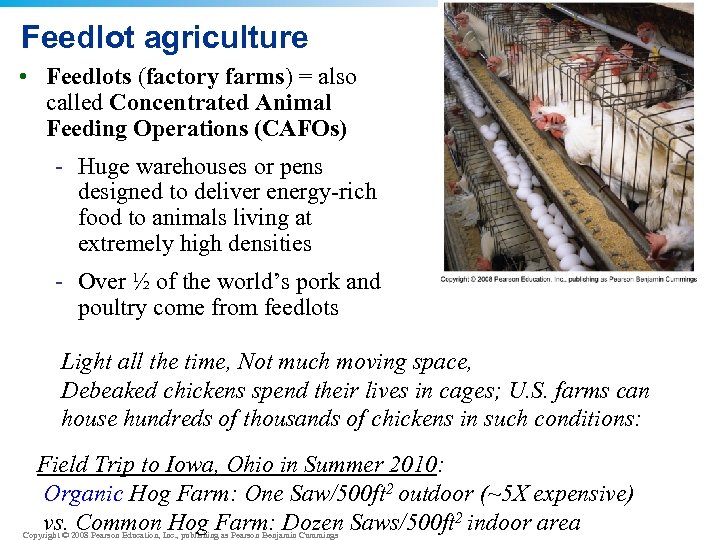
Feedlot agriculture • Feedlots (factory farms) = also called Concentrated Animal Feeding Operations (CAFOs) - Huge warehouses or pens designed to deliver energy-rich food to animals living at extremely high densities - Over ½ of the world’s pork and poultry come from feedlots Light all the time, Not much moving space, Debeaked chickens spend their lives in cages; U. S. farms can house hundreds of thousands of chickens in such conditions: Field Trip to Iowa, Ohio in Summer 2010: Organic Hog Farm: One Saw/500 ft 2 outdoor (~5 X expensive) vs. Common Hog Farm: Dozen Saws/500 ft 2 indoor area Copyright © 2008 Pearson Education, Inc. , publishing as Pearson Benjamin Cummings
The benefits and drawbacks of feedlots • The benefits of feedlots include: - Greater production of food - Unavoidable in countries with high levels of meat consumption, like the U. S. - They take livestock off the land reduces the impact that they would have on it • Drawbacks of feedlots include: - Contributions to water and air pollution - Poor waste containment causes outbreaks in disease - Heavy uses of antibiotics to control disease Copyright © 2008 Pearson Education, Inc. , publishing as Pearson Benjamin Cummings
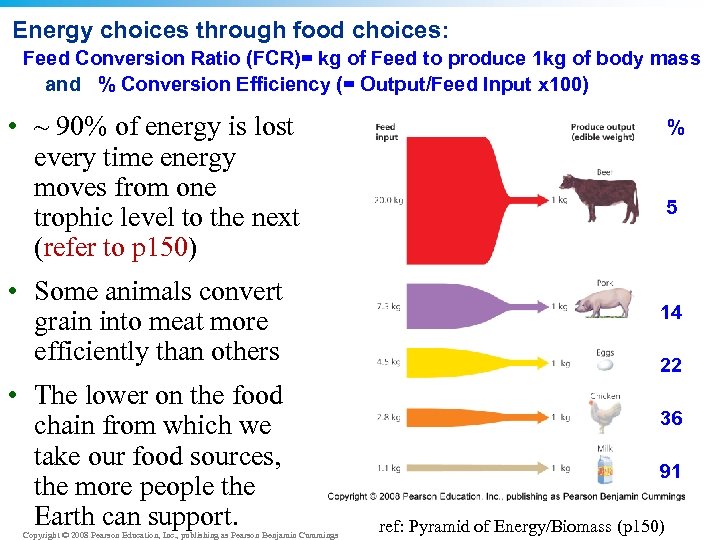
Energy choices through food choices: Feed Conversion Ratio (FCR)= kg of Feed to produce 1 kg of body mass and % Conversion Efficiency (= Output/Feed Input x 100) • ~ 90% of energy is lost every time energy moves from one trophic level to the next (refer to p 150) • Some animals convert grain into meat more efficiently than others • The lower on the food chain from which we take our food sources, the more people the Earth can support. Copyright © 2008 Pearson Education, Inc. , publishing as Pearson Benjamin Cummings % 5 14 22 36 91 ref: Pyramid of Energy/Biomass (p 150)
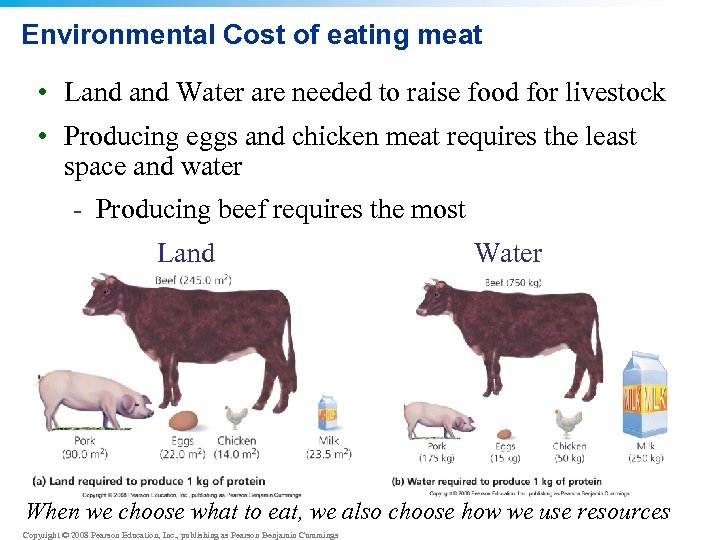
Environmental Cost of eating meat • Land Water are needed to raise food for livestock • Producing eggs and chicken meat requires the least space and water - Producing beef requires the most Land Water When we choose what to eat, we also choose how we use resources Copyright © 2008 Pearson Education, Inc. , publishing as Pearson Benjamin Cummings
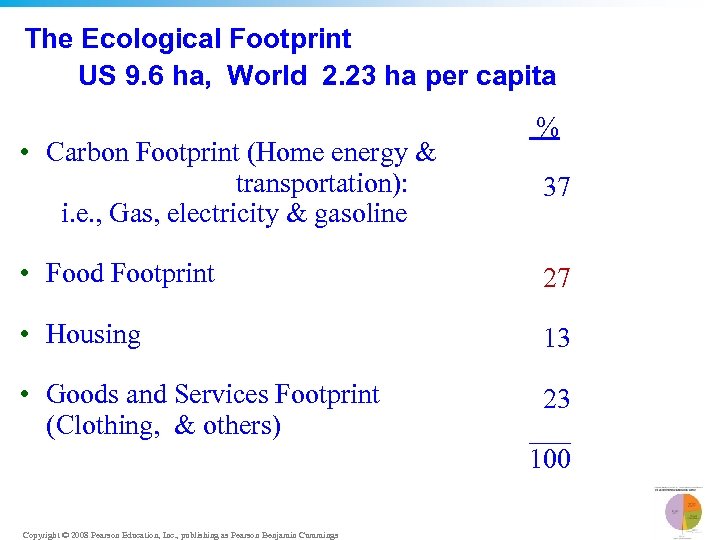
The Ecological Footprint US 9. 6 ha, World 2. 23 ha per capita • Carbon Footprint (Home energy & transportation): i. e. , Gas, electricity & gasoline % 37 • Food Footprint 27 • Housing 13 • Goods and Services Footprint (Clothing, & others) Copyright © 2008 Pearson Education, Inc. , publishing as Pearson Benjamin Cummings 23 ___ 100
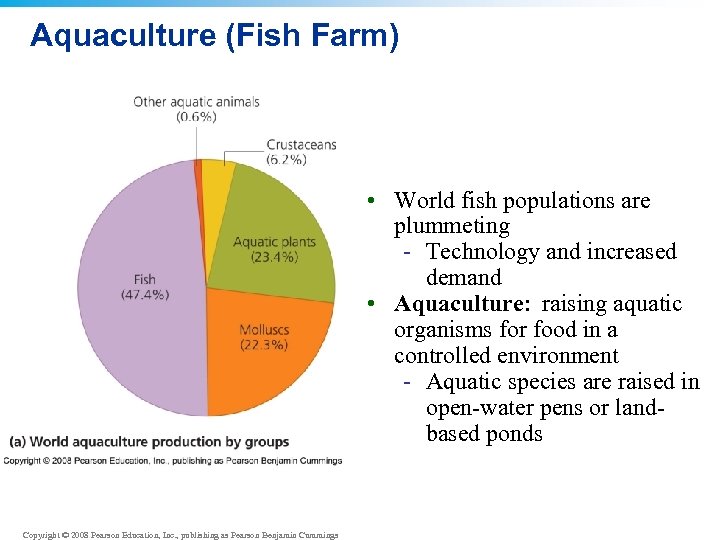
Aquaculture (Fish Farm) • World fish populations are plummeting - Technology and increased demand • Aquaculture: raising aquatic organisms for food in a controlled environment - Aquatic species are raised in open-water pens or landbased ponds Copyright © 2008 Pearson Education, Inc. , publishing as Pearson Benjamin Cummings
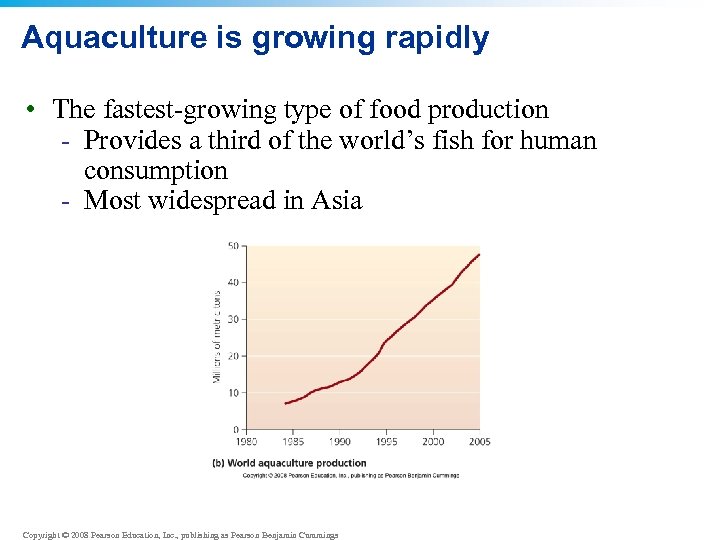
Aquaculture is growing rapidly • The fastest-growing type of food production - Provides a third of the world’s fish for human consumption - Most widespread in Asia Copyright © 2008 Pearson Education, Inc. , publishing as Pearson Benjamin Cummings
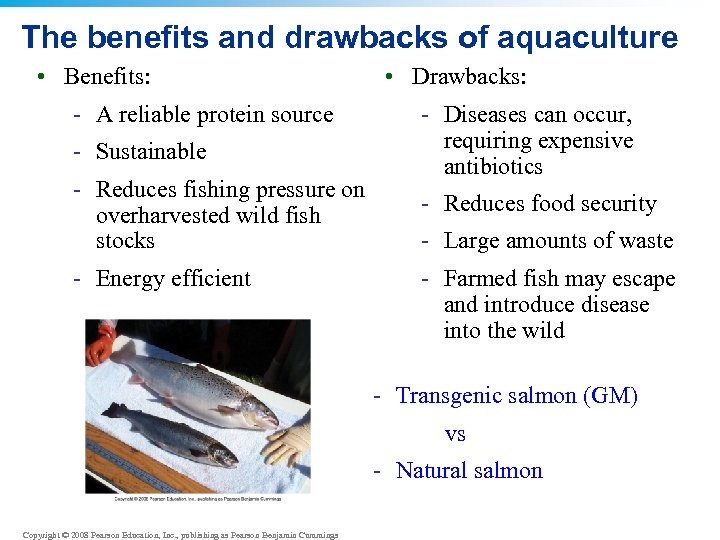
The benefits and drawbacks of aquaculture • Benefits: - A reliable protein source - Sustainable - Reduces fishing pressure on overharvested wild fish stocks - Energy efficient • Drawbacks: - Diseases can occur, requiring expensive antibiotics - Reduces food security - Large amounts of waste - Farmed fish may escape and introduce disease into the wild - Transgenic salmon (GM) vs - Natural salmon Copyright © 2008 Pearson Education, Inc. , publishing as Pearson Benjamin Cummings
Sustainable Agriculture • Industrial agriculture may seem necessary, but less-intensive agricultural methods may be better in the long run • Sustainable agriculture = does not deplete soil, pollute water, or decrease genetic diversity • Low-input agriculture = uses smaller amounts of pesticide, fertilizers, growth hormones, water, and fossil fuel energy than industrial agriculture • Organic agriculture = Uses no synthetic fertilizers, insecticides, fungicides, or herbicides - Relies on biological approaches (composting and biocontrol) Copyright © 2008 Pearson Education, Inc. , publishing as Pearson Benjamin Cummings
A standardized meaning for “organic” • People debate the meaning of the word “organic” - Organic Food Production Act (1990) establishes national standards for organic products - The USDA issued criteria in 2000 by which food could be labeled organic see Table 10. 3 (p 286) - Some states pass even stricter guidelines for labeling Copyright © 2008 Pearson Education, Inc. , publishing as Pearson Benjamin Cummings
USDA Criteria for Certifying Crops/Livestock as “organic” • Land free from prohibited substance for at least 3 yrs • Must not be genetically engineered • Without ionizing radiation: UV, gamma rays : Co-60 (5. 3 yrs), Cs-137 (30 yrs) • No synthetic fertilizers& most of pesticides etc. • Mammals must be raised under organic management • Must feed livestock with 100% organic feed (but, Vitamins, Mineral supplements: allowed) • No antibiotics, hormones (but, vaccines permitted), • Animals must have access to the outdoors. Copyright © 2008 Pearson Education, Inc. , publishing as Pearson Benjamin Cummings see Table 10. 3 (p 286)
The benefits of organic farming • For farmers: - Lower input costs, enhanced income from higher-value products, reduced chemical costs and pollution - Obstacles include the risks and costs of switching to new farming methods and less market infrastructure • For consumers: - Concern about pesticide’s health risks - A desire to improve environmental quality - Obstacles include the added expense and less aesthetically appealing appearance of the product Copyright © 2008 Pearson Education, Inc. , publishing as Pearson Benjamin Cummings
The U. S. doesn’t financially support organic farmers • In 1993, the European Union adopted a policy to support farmers financially during conversion to organic farming • The U. S. offers no such support - Organic production lags in the U. S. - Farmers can’t switch, because they can’t afford the temporary loss of income - In the long run, organic farming is more profitable Grassroot organic farmers are growing: End, 10/21/2008 Copyright © 2008 Pearson Education, Inc. , publishing as Pearson Benjamin Cummings
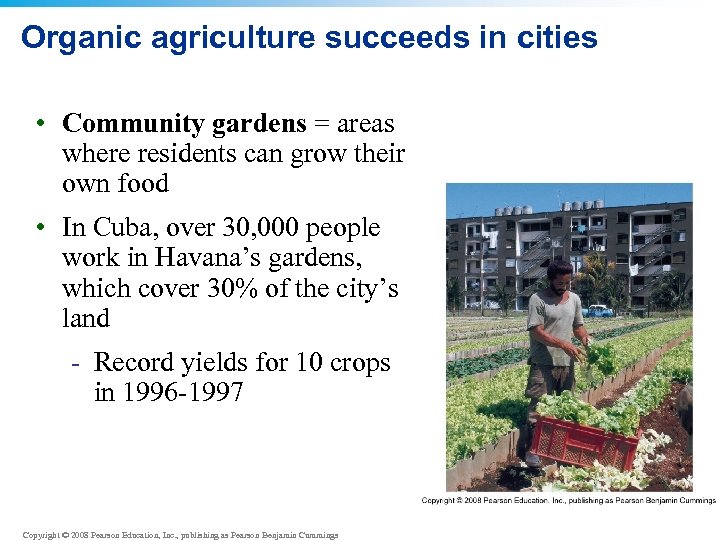
Organic agriculture succeeds in cities • Community gardens = areas where residents can grow their own food • In Cuba, over 30, 000 people work in Havana’s gardens, which cover 30% of the city’s land - Record yields for 10 crops in 1996 -1997 Copyright © 2008 Pearson Education, Inc. , publishing as Pearson Benjamin Cummings
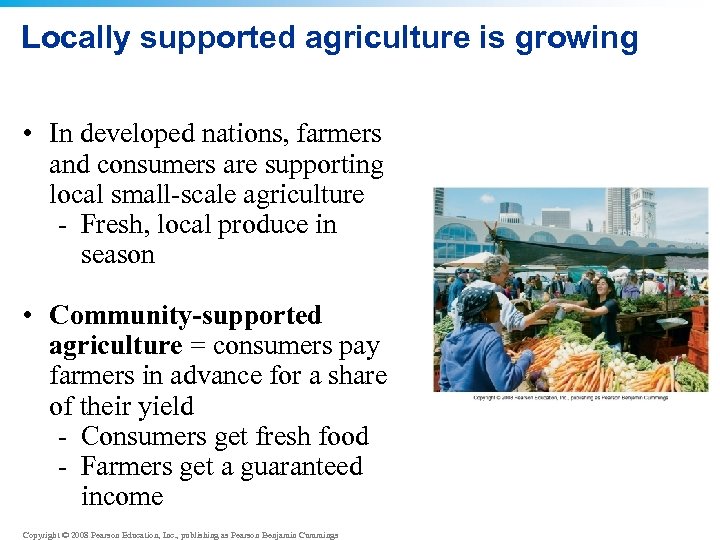
Locally supported agriculture is growing • In developed nations, farmers and consumers are supporting local small-scale agriculture - Fresh, local produce in season • Community-supported agriculture = consumers pay farmers in advance for a share of their yield - Consumers get fresh food - Farmers get a guaranteed income Copyright © 2008 Pearson Education, Inc. , publishing as Pearson Benjamin Cummings
Conclusion • Intensive commercial agriculture has substantial negative environmental impacts - Industrialized agriculture has relieved pressures on the land - But, the environmental consequences are severe • If our planet will be able to support 9 billion humans, we must shift to sustainable agriculture - Biological pest control; organic agriculture; pollinator protection; preservation of native crop diversity; aquaculture; and careful, responsible genetic modification of food Copyright © 2008 Pearson Education, Inc. , publishing as Pearson Benjamin Cummings
QUESTION: Review Why has our production of food increased, despite the growing population? a) We have become more sustainable in food production b) We have converted much more land to agricultural production c) Technology in the form of fossil fuels, pesticides, and fertilizers have increased production d) We have not produced more food in the past several decades Copyright © 2008 Pearson Education, Inc. , publishing as Pearson Benjamin Cummings
QUESTION: Review Which term means “a shortage of nutrients the body needs”? a) b) c) d) Undernourishment Overnutrition Food security Malnutrition Copyright © 2008 Pearson Education, Inc. , publishing as Pearson Benjamin Cummings
QUESTION: Review Which of the following is NOT correct about monocultures? a) b) c) d) They are an efficient way to produce food They increase biodiversity They make crops more susceptible to diseases They narrow human diets Copyright © 2008 Pearson Education, Inc. , publishing as Pearson Benjamin Cummings
QUESTION: Review Which of the following is not a part of Integrated Pest Management (IPM)? a) b) c) d) No-till farming Biocontrol Some chemical use All are part of IPM Copyright © 2008 Pearson Education, Inc. , publishing as Pearson Benjamin Cummings
QUESTION: Review How does GM food production differ from traditional, selective breeding? a) b) c) d) It does not differ It uses genes from different species It involves more fieldwork It works better in developing countries Copyright © 2008 Pearson Education, Inc. , publishing as Pearson Benjamin Cummings
QUESTION: Review What is a “seed bank”? a) An institution that preserves seed types for their genetic diversity b) A form of banking in developing countries, where people can put their excess seeds up as collateral for a loan c) A form of genetically modified organism d) An area where livestock are fed high-quality grains Copyright © 2008 Pearson Education, Inc. , publishing as Pearson Benjamin Cummings
QUESTION: Review Which of the following is the fastest growing type of agriculture? a) b) c) d) Concentrated animal feeding operations Sustainable agriculture Aquaculture Monocultures Copyright © 2008 Pearson Education, Inc. , publishing as Pearson Benjamin Cummings
QUESTION: Weighing the Issues Given that the green revolution has increased crop yields, but only by using increased fertilizers, pesticides, irrigation, and hybrid seed, do you consider it a success? a) b) c) d) Yes, because more people were fed, regardless of the price Yes, because industrialized countries can help through education and technology No, we will have to eventually pay the environmental costs of producing food in this way It does not matter; I can buy food whenever I want Copyright © 2008 Pearson Education, Inc. , publishing as Pearson Benjamin Cummings
QUESTION: Weighing the Issues Factory farming allows us to have high consumption of meat products. However, many people are troubled by the conditions that animals are kept in. Should the quality of the animals’ lives be considered when we decide how to raise food? a) b) c) d) Yes, the quality of an animal’s life is important, too Yes, but only if it does not interfere with access to meat No, animals have no right to a quality of life I don’t care; I’m not particularly fond of cows or chickens Copyright © 2008 Pearson Education, Inc. , publishing as Pearson Benjamin Cummings
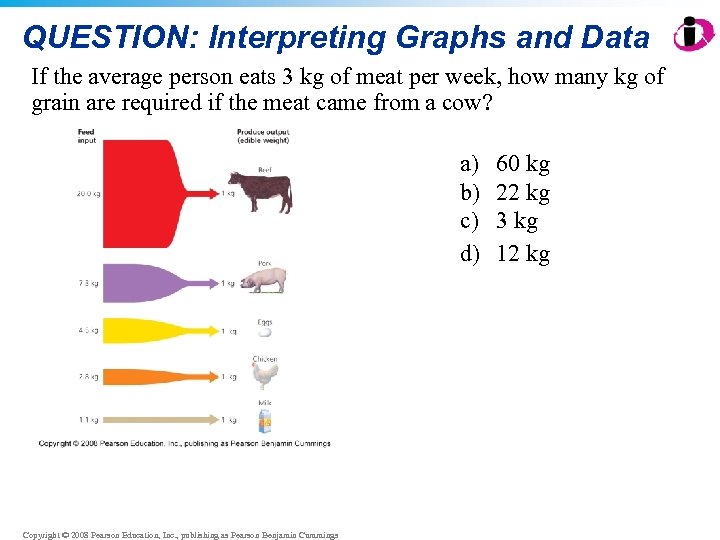
QUESTION: Interpreting Graphs and Data If the average person eats 3 kg of meat per week, how many kg of grain are required if the meat came from a cow? a) b) c) d) Copyright © 2008 Pearson Education, Inc. , publishing as Pearson Benjamin Cummings 60 kg 22 kg 3 kg 12 kg
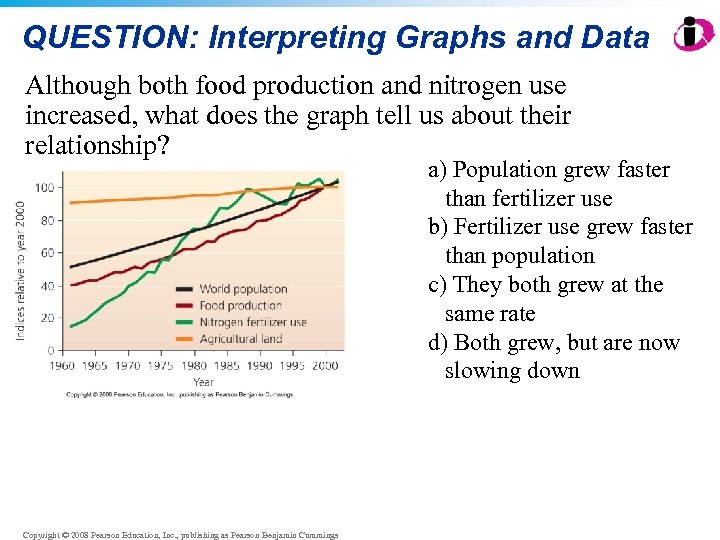
QUESTION: Interpreting Graphs and Data Although both food production and nitrogen use increased, what does the graph tell us about their relationship? a) Population grew faster than fertilizer use b) Fertilizer use grew faster than population c) They both grew at the same rate d) Both grew, but are now slowing down Copyright © 2008 Pearson Education, Inc. , publishing as Pearson Benjamin Cummings
Скачать презентацию Ch 10 Agriculture Biotechnology and the Future of
f6cdf8e9d501542a9e9f9517711a60fc.ppt