


 Скачать презентацию Ch 1 Introduction Outline Intelligent Transportation
2f1e801a5c0c703b89a2181dd89fa6af.ppt
- Количество слайдов: 44
 Ch 1 Introduction
 Outline • Intelligent Transportation Systems • ITS Applications – Telematics = Telecommunication + Infomatics • ITS Standard Organization • Vehicular communication • Telecom Service Integration
 Outline • Intelligent Transportation Systems • ITS Applications – Telematics = Telecommunication + Infomatics • ITS Standard Organization • Vehicular communication • Telecom Service Integration
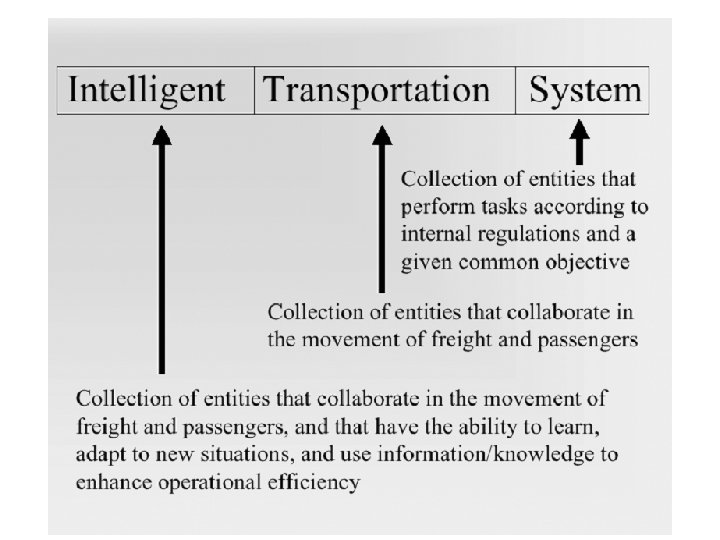
 Intelligent Transportation System • The term intelligent transportation system (ITS) refers to efforts to add information and communications technology to transport infrastructure and vehicles, in order to improve safety and reduce vehicle wear, transportation times, and fuel consumption.
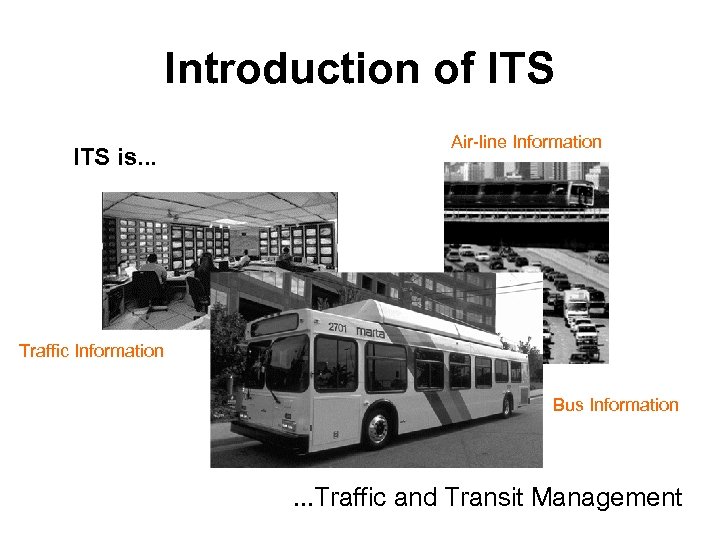 Introduction of ITS is. . . Air-line Information Traffic Information Bus Information . . . Traffic and Transit Management
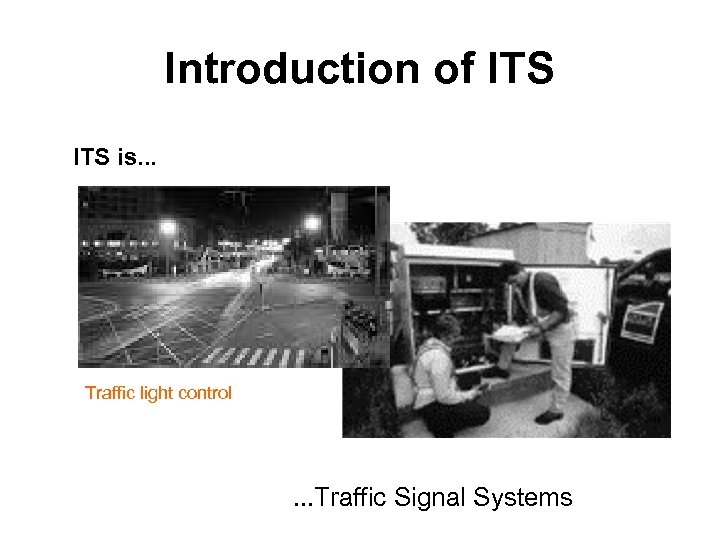 Introduction of ITS is. . . Traffic light control . . . Traffic Signal Systems
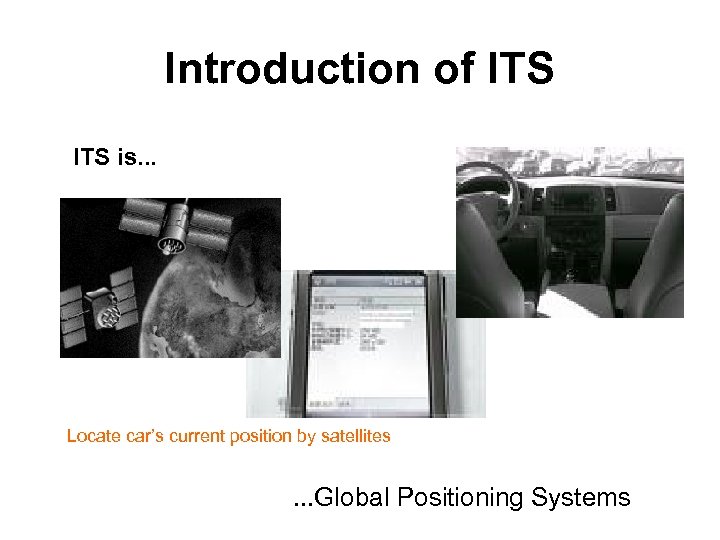 Introduction of ITS is. . . Locate car’s current position by satellites . . . Global Positioning Systems
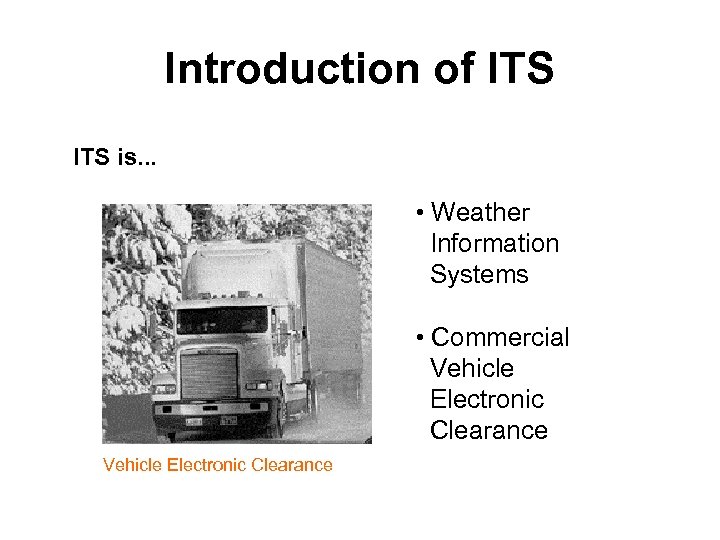 Introduction of ITS is. . . • Weather Information Systems • Commercial Vehicle Electronic Clearance Vehicle Electronic Clearance
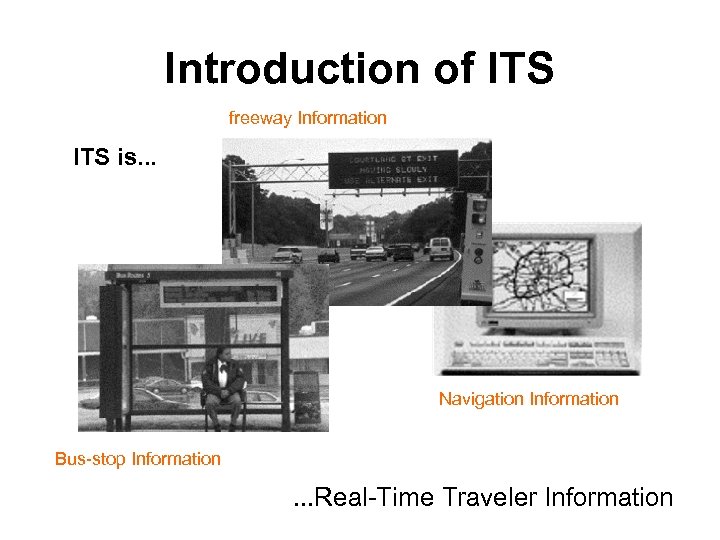 Introduction of ITS freeway Information ITS is. . . Navigation Information Bus-stop Information . . . Real-Time Traveler Information
 Why is ITS Important? • Offers the next major leap forward in improving safety, convenience, and productivity of our personal and commercial travel. • Critical as population and congestion increase, and land funding for new roads decrease.
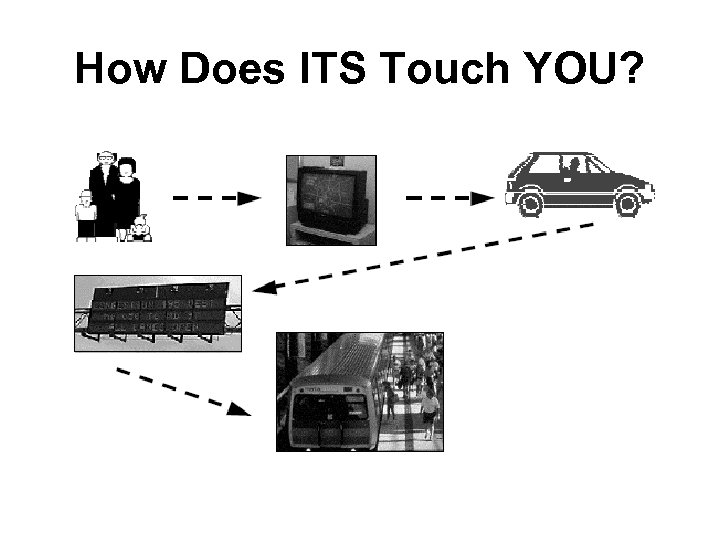 How Does ITS Touch YOU?
 Identified Benefits • • • Time Savings Improved Throughput Reduced Crashes and Fatalities Cost Avoidance Increased Customer Satisfaction Energy and Environmental Benefits
 Outline • Intelligent Transportation Systems • ITS Applications – Telematics = Telecommunication + Infomatics • ITS Standard Organization • Vehicular communication • Telecom Service Integration
 Applications Overview • • • Global Positioning Systems Weather information systems Bus Information System Traffic and transit management Real-time information Parking Incident management Emergency management Electronic toll collection Commercial vehicle operations
 Global Positioning Systems • The Global Positioning System (GPS) is a satellite-based navigation system made up of a network of 24 satellites placed into orbit by the U. S. Department of Defense. GPS was originally intended for military applications, but in the 1980 s, the government made the system available for civilian use. GPS works in any weather conditions, anywhere in the world, 24 hours a day.
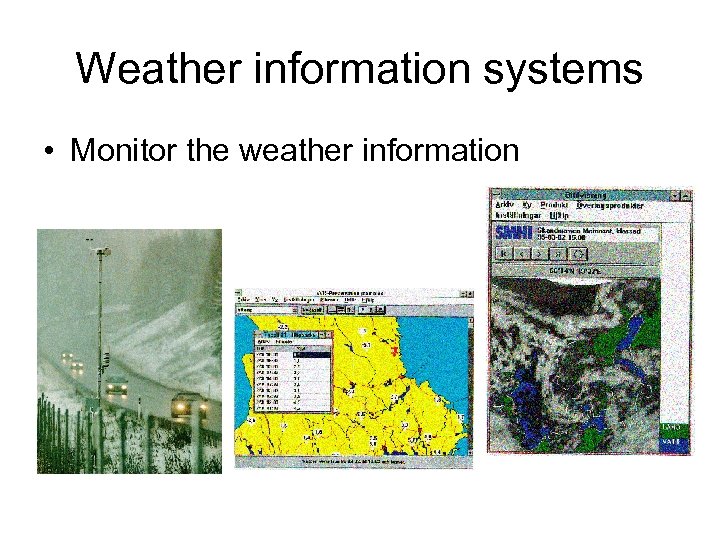 Weather information systems • Monitor the weather information
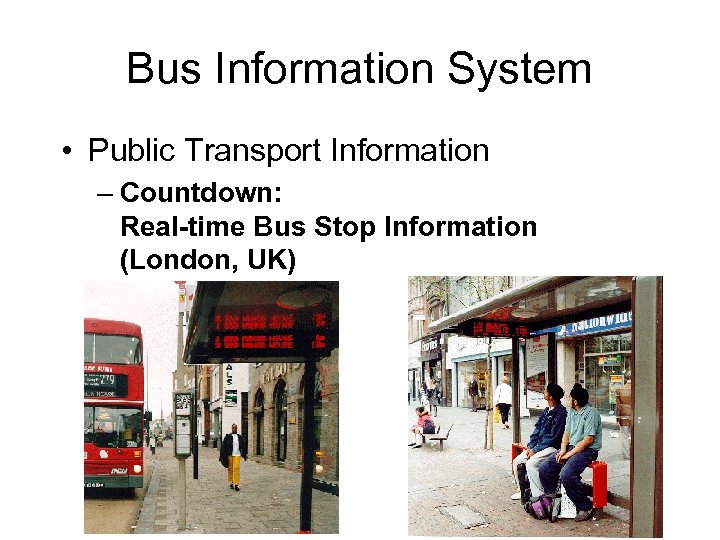 Bus Information System • Public Transport Information – Countdown: Real-time Bus Stop Information (London, UK)
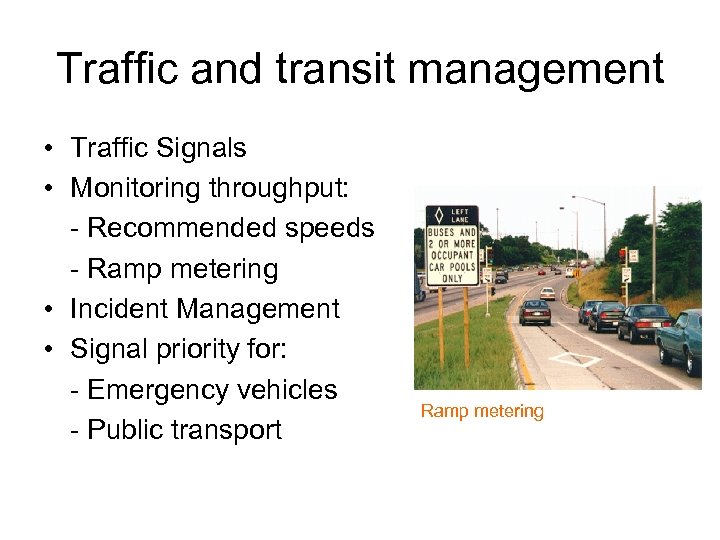 Traffic and transit management • Traffic Signals • Monitoring throughput: - Recommended speeds - Ramp metering • Incident Management • Signal priority for: - Emergency vehicles - Public transport Ramp metering
 Real-time information • • • Automobile traffic Public transport Parking Airport arrivals/departures News, banking, stocks…
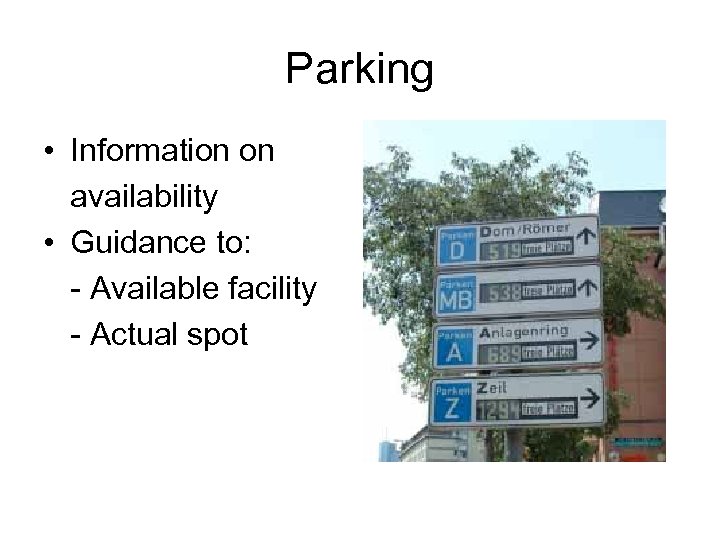 Parking • Information on availability • Guidance to: - Available facility - Actual spot
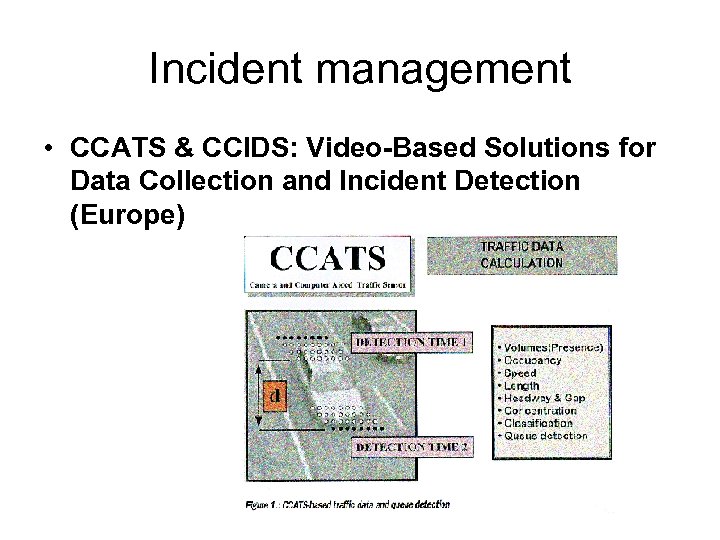 Incident management • CCATS & CCIDS: Video-Based Solutions for Data Collection and Incident Detection (Europe)
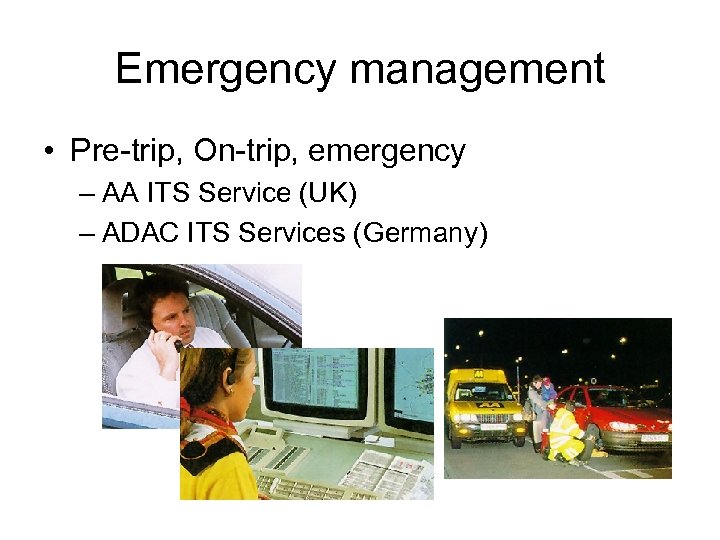 Emergency management • Pre-trip, On-trip, emergency – AA ITS Service (UK) – ADAC ITS Services (Germany)
 Electronic toll collection • Electronic toll collection (ETC) makes it possible for vehicles to drive through toll gates at traffic speed, reducing congestion at toll plazas and automating toll collection. Originally ETC systems were used to automate toll collection, but more recent innovations have used ETC to enforce congestion pricing through cordon zones in city centers and ETC lanes.
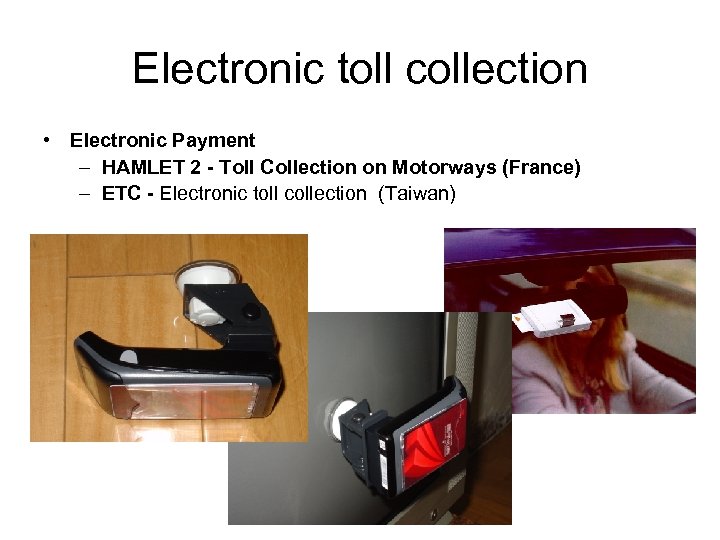 Electronic toll collection • Electronic Payment – HAMLET 2 - Toll Collection on Motorways (France) – ETC - Electronic toll collection (Taiwan)
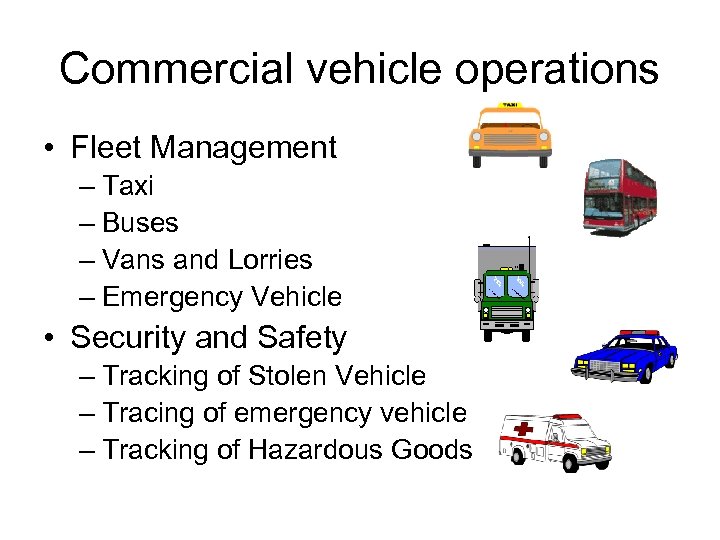 Commercial vehicle operations • Fleet Management – Taxi – Buses – Vans and Lorries – Emergency Vehicle • Security and Safety – Tracking of Stolen Vehicle – Tracing of emergency vehicle – Tracking of Hazardous Goods
 Outline • Intelligent Transportation Systems • ITS Applications – Telematics = Telecommunication + Infomatics • ITS Standard Organization • Vehicular communication • Telecom Service Integration
 National ITS Architecture (US) • The National ITS Architecture provides a common framework for planning, defining, and integrating intelligent transportation systems. It is a mature product that reflects the contributions of a broad crosssection of the ITS community (transportation practitioners, systems engineers, system developers, technology specialists, consultants, etc. )
 National ITS architecture defines … • The functions (e. g. , gather traffic information or request a route) that are required for ITS • The physical entities or subsystems where these functions reside (e. g. , the field or the vehicle) • The information flows and data flows that connect these functions and physical subsystems together into an integrated system
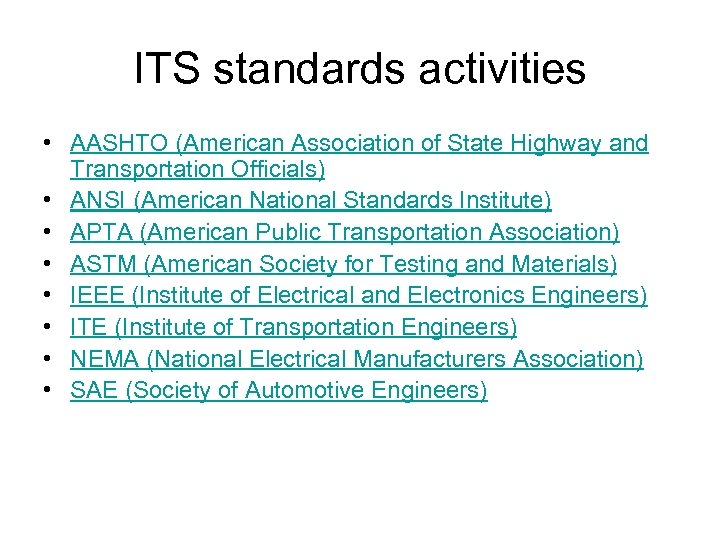 ITS standards activities • AASHTO (American Association of State Highway and Transportation Officials) • ANSI (American National Standards Institute) • APTA (American Public Transportation Association) • ASTM (American Society for Testing and Materials) • IEEE (Institute of Electrical and Electronics Engineers) • ITE (Institute of Transportation Engineers) • NEMA (National Electrical Manufacturers Association) • SAE (Society of Automotive Engineers)
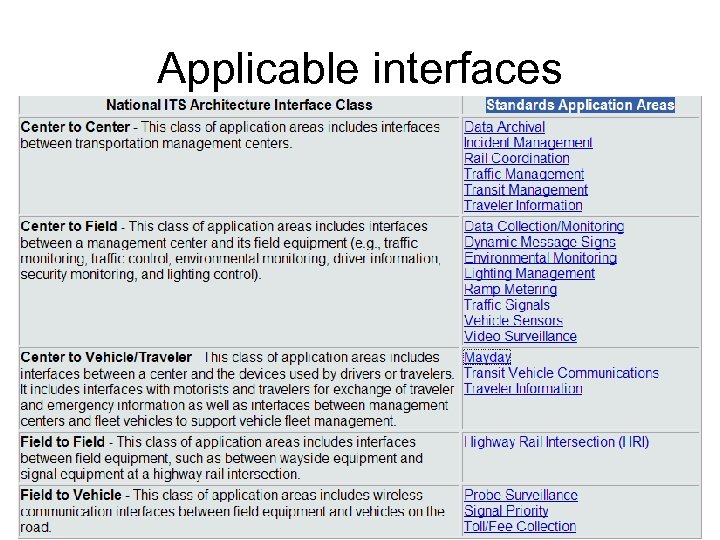 Applicable interfaces
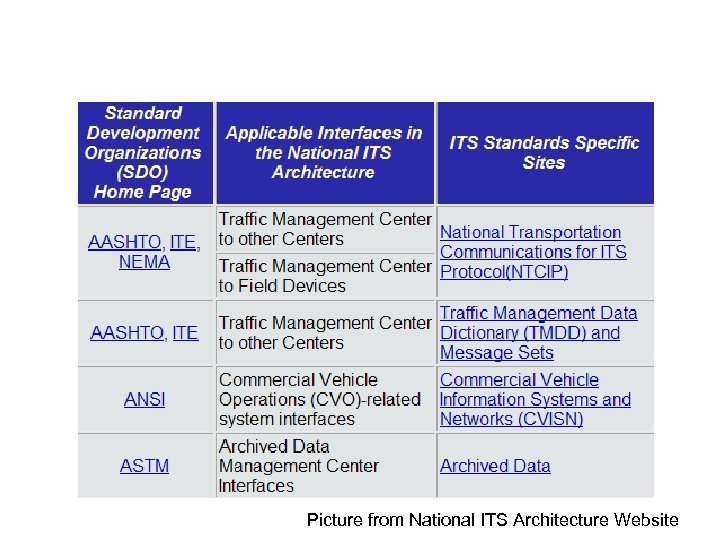 Picture from National ITS Architecture Website
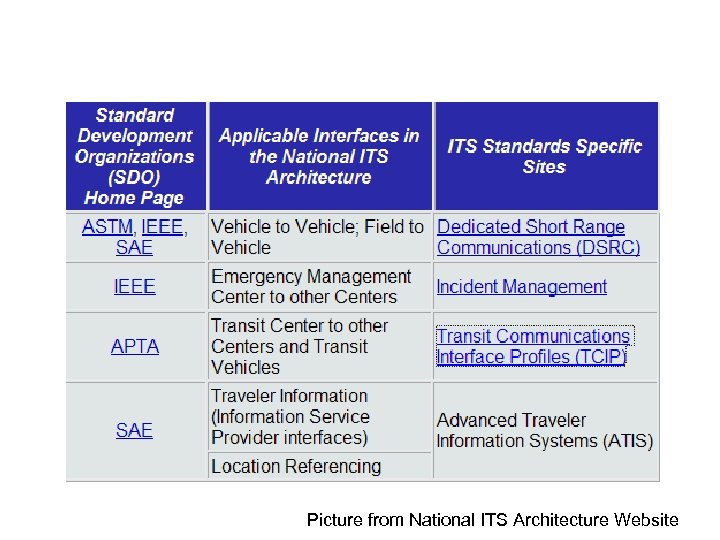 Picture from National ITS Architecture Website
 Outline • Intelligent Transportation Systems • ITS Applications – Telematics = Telecommunication + Infomatics • ITS Standard Organization • Vehicular communication • Telecom Service Integration
 Motivation for Vehicular Communication (VC) • The main goal of VC is convenient and safe. • Vehicles have… (differs from personal comm. ) – Enough power – Large space – Predictable and high-speed mobility • Use communication for new services – – Collision warning Up-to-date traffic information Active navigation services Weather information
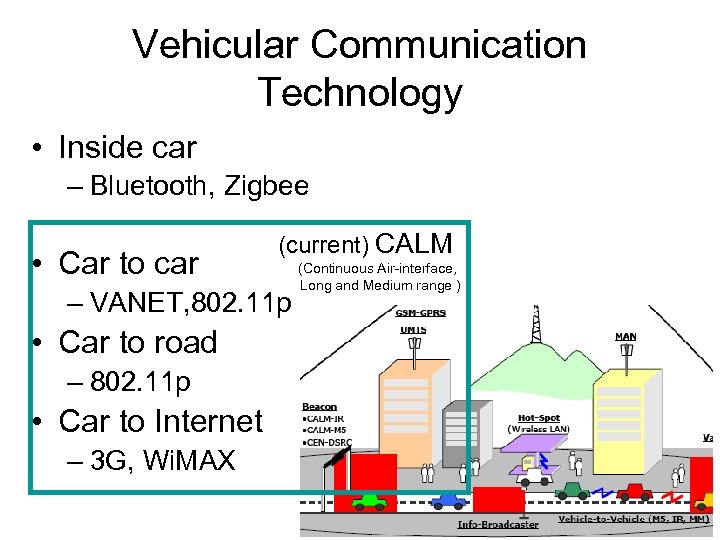 Vehicular Communication Technology • Inside car – Bluetooth, Zigbee • Car to car (current) CALM – VANET, 802. 11 p • Car to road – 802. 11 p • Car to Internet – 3 G, Wi. MAX (Continuous Air-interface, Long and Medium range )
 VANET • Vehicular ad hoc networks (VANETs), a subclass of mobile Ad Hoc networks (MANETs), is a promising approach for future intelligent transportation system (ITS). • The direct communication between vehicles using an Ad Hoc network, referred to as – inter-vehicle communication (IVC) – Car-to-car communication(C 2 CC) – vehicle ad hoc networks (VANETs)
 IEEE 802. 11 p • IEEE 802. 11 p is a draft amendment to the IEEE 802. 11 standard to add wireless access in the vehicular environment (WAVE). It defines enhancements to 802. 11 required to support Intelligent Transportation Systems (ITS) applications. This includes data exchange between high-speed vehicles and between the vehicles and the roadside infrastructure in the licensed ITS band of 5. 9 GHz (5. 85 -5. 925 GHz). IEEE 1609 is a higher layer standard on which IEEE 802. 11 p is based. http: //en. wikipedia. org/wiki/IEEE_802. 11 p
 3 G/UMTS • Universal Mobile Telecommunications System (UMTS) is one of the emerging mobile phone technologies known as thirdgeneration, or 3 G. Third-generation systems are designed to include such traditional phone tasks as calls, voice mail, and paging, but also new technology tasks such as Internet access, video, and SMS, or text messaging. http: //en. wikipedia. org/wiki/Universal_Mobile_Telecommunications_System
 Wi. MAX • Wi. MAX, the Worldwide Interoperability for Microwave Access, is a telecommunications technology that provides for the wireless transmission of data in a variety of ways, ranging from point-to-point links to full mobile cellulartype access. The technology provides broadband speed without the requirement of cables. The technology is based on the IEEE 802. 16 standard (also called Wireless. MAN) http: //en. wikipedia. org/wiki/Wimax
 Outline • Intelligent Transportation Systems • ITS Applications – Telematics = Telecommunication + Infomatics • ITS Standard Organization • Vehicular communication • Telecom Service Integration
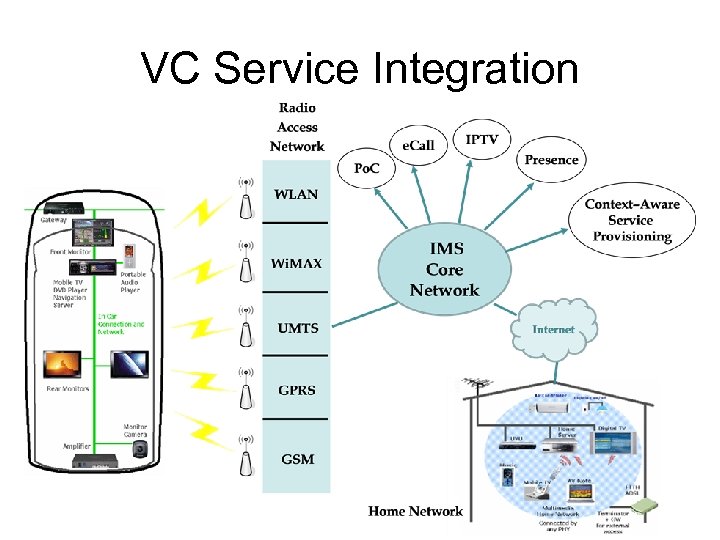 VC Service Integration
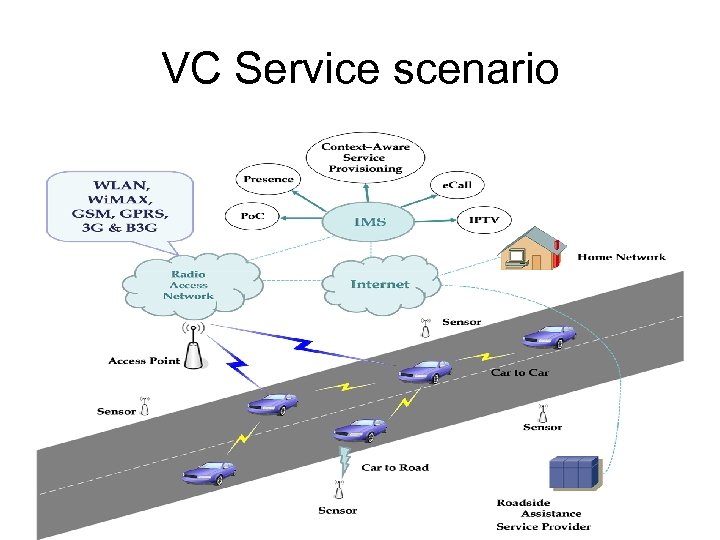 VC Service scenario
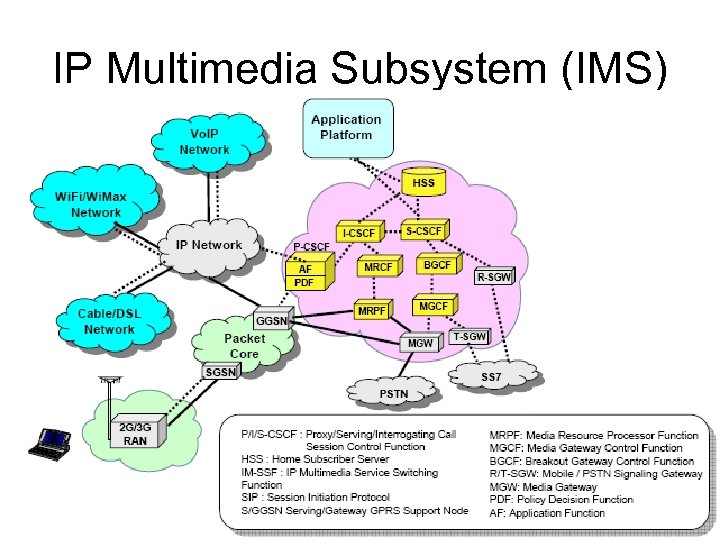 IP Multimedia Subsystem (IMS)