


 Скачать презентацию CESD SAGES Scottish Alliance for Geoscience Environment
02a9443f4747737ffed83fe72e4a6d91.ppt
- Количество слайдов: 63
 CESD SAGES Scottish Alliance for Geoscience, Environment & Society Climate Change: Observing and Simulating the Past; Predicting the Future Simon Tett, Chair of Earth System Dynamics & Modelling With thanks to Gabi Hegerl, Ben Santer, Phil Jones, Keith Briffa, Peter Thorne, Philip Brohan, Nick Rayner, John Kennedy, Peter Stott, Myles Allen, Gareth Jones, John Mitchell, Geoff Jenkins, Chris Folland, David Parker, Jonathan Gregory, Bob Harwood, Richard Kenway and Claire Jones 1
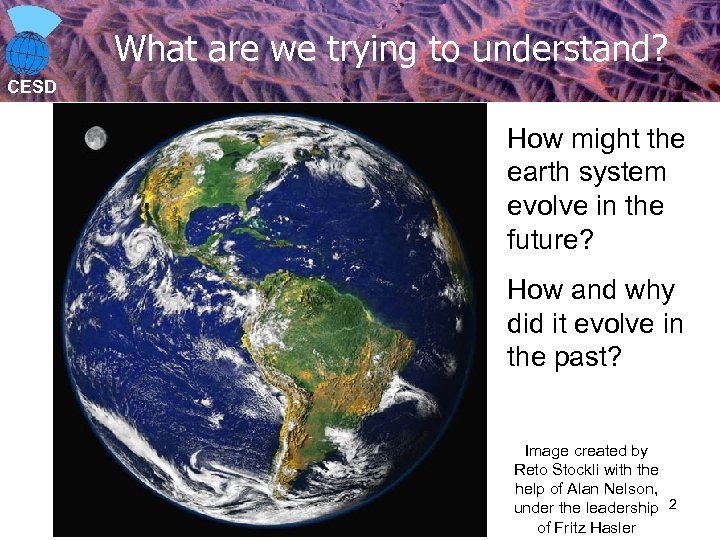 What are we trying to understand? CESD How might the earth system evolve in the future? How and why did it evolve in the past? Image created by Reto Stockli with the help of Alan Nelson, under the leadership 2 of Fritz Hasler
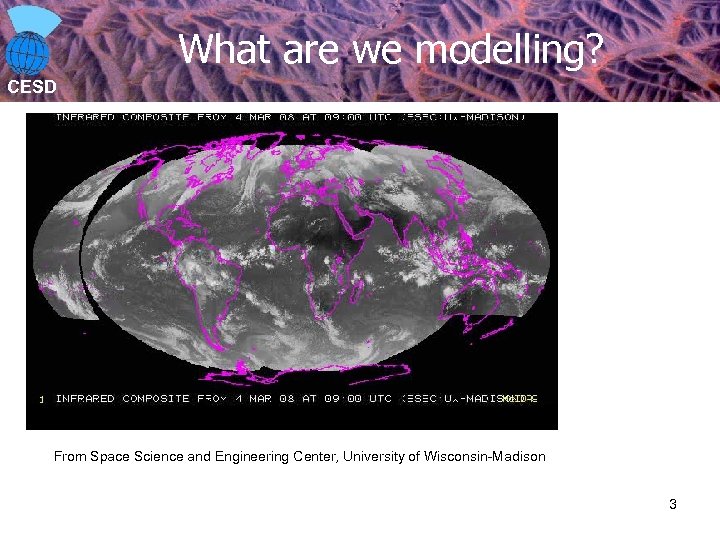 What are we modelling? CESD From Space Science and Engineering Center, University of Wisconsin-Madison 3
 Overview CESD • • Basic physics Modelling the climate system Observations of climate change Using climate models – – Understanding 20 th century climate change Role of natural drivers in natural variability Predictions of future change Importance of external drivers • Concluding thoughts 4
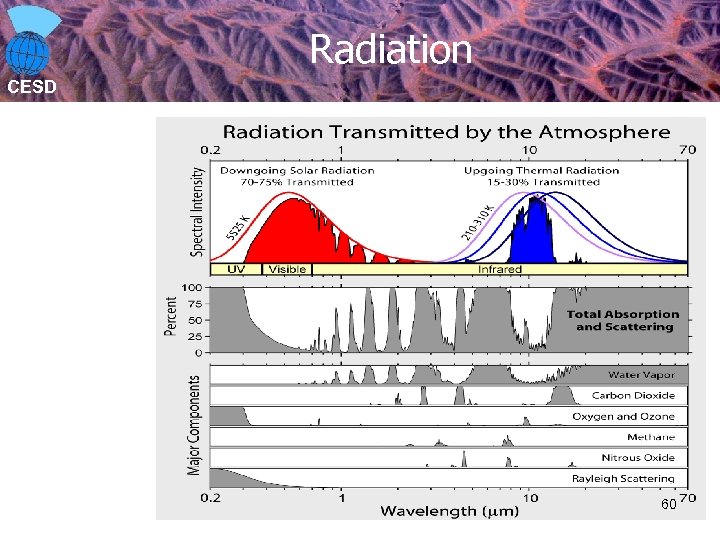
 CESD Radiation – the driver of the climate system • Key ideas – Lots of incoming shortwave radiation (“Visible”) from sun – Same total energy going out from Earth but peaks in Infra-red. (“Heat”) – Surface is warmer than you’d expect from simple radiation budget. • The bit of the climate system that radiates energy to space is high up (where it is cooler). • Atmosphere cools with height • So surface is warmer the “greenhouse” effect • Changing the height of the atmosphere where energy gets to space will then affect the surface temperature 5
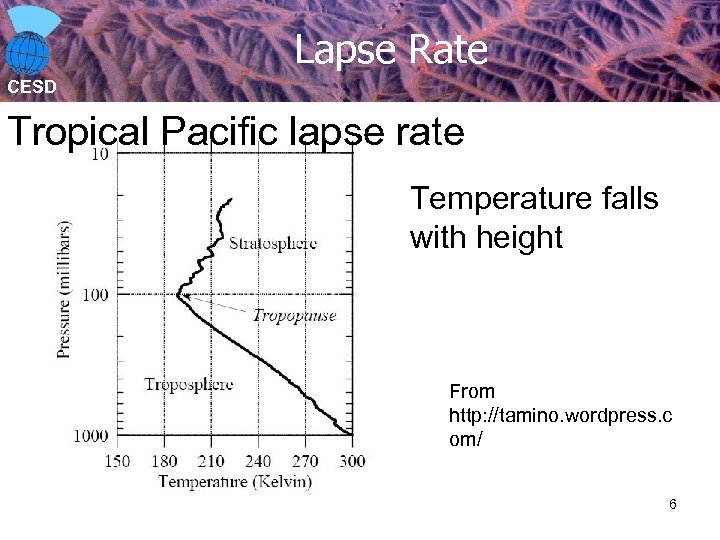 Lapse Rate CESD Tropical Pacific lapse rate Temperature falls with height From http: //tamino. wordpress. c om/ 6
 Feedbacks CESD • Act to amplify (or decrease) warming from changes in CO 2, other greenhouse gases and other climate drivers. – Blackbody – warmer planet emits more radiation and so cools. (Negative feedback) – Water vapour – warmer atmosphere can store more water vapour. Water vapour absorbs “heat” radiation so is a Greenhouse gas. • Most important in the upper troposphere • Warmer world will have more moisture in the atmosphere and so will trap more heat. Positive feedback. – Clouds • Positive feedback – “trap” “heat” radiation. Particularly true for high clouds • Negative feedback – reflect back solar radiation. Particularly true for low clouds – Ice/Albedo feedback. • Ice is white and reflects lots of solar energy back to space. • Melt ice and more solar radiation absorbed which in turn warms the climate. . 7
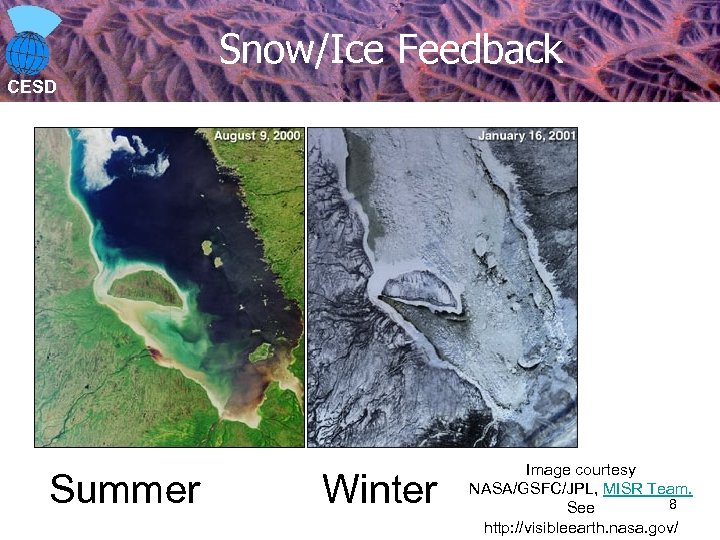 Snow/Ice Feedback CESD Summer Winter Image courtesy NASA/GSFC/JPL, MISR Team. 8 See http: //visibleearth. nasa. gov/
 Climate Modelling CESD • Atmospheric modelling has long history – first attempts, using computers, made in 1950’s. • General Circulation Models (GCM’s) developed from numerical weather prediction models – Take physical laws and apply them to atmospheric and oceanic motions. – Key is that GCM’s are built bottom up. – Interested in “Emergent Phenomenon”, such as statistics of data, rather than detailed evolution. • Other approaches but not covered in this lecture. 9
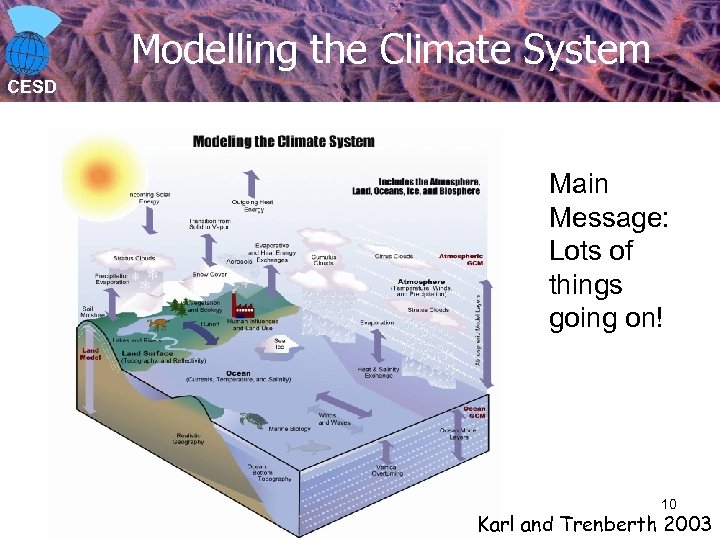 Modelling the Climate System CESD Main Message: Lots of things going on! 10 Karl and Trenberth 2003
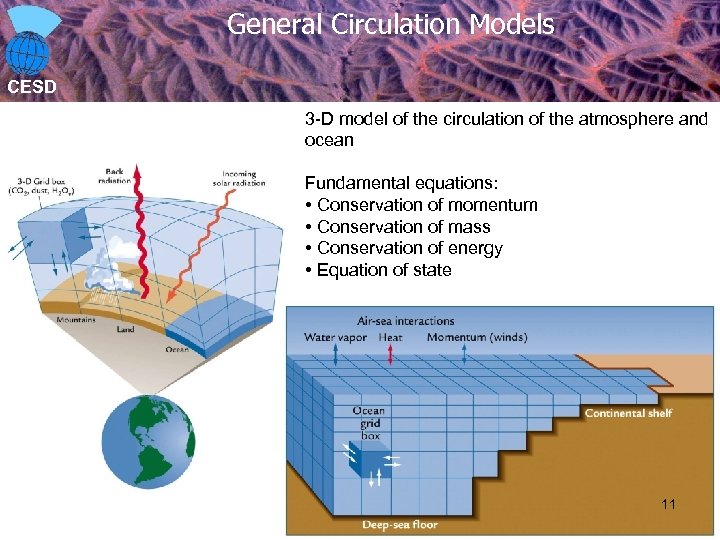 General Circulation Models CESD 3 -D model of the circulation of the atmosphere and ocean Fundamental equations: • Conservation of momentum • Conservation of mass • Conservation of energy • Equation of state 11
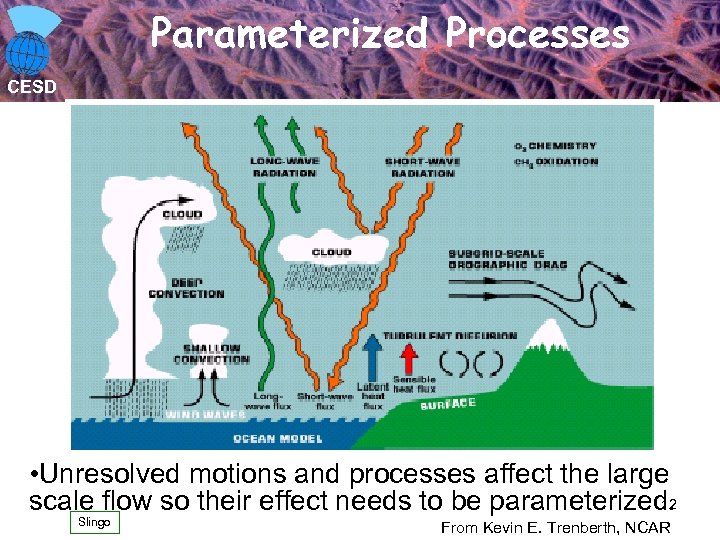 Parameterized Processes CESD • Unresolved motions and processes affect the large 12 scale flow so their effect needs to be parameterized. Slingo From Kevin E. Trenberth, NCAR
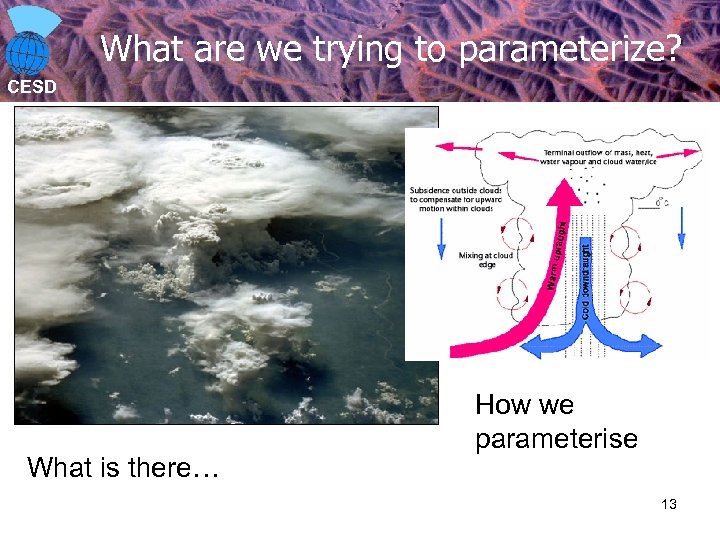 What are we trying to parameterize? CESD What is there… How we parameterise 13
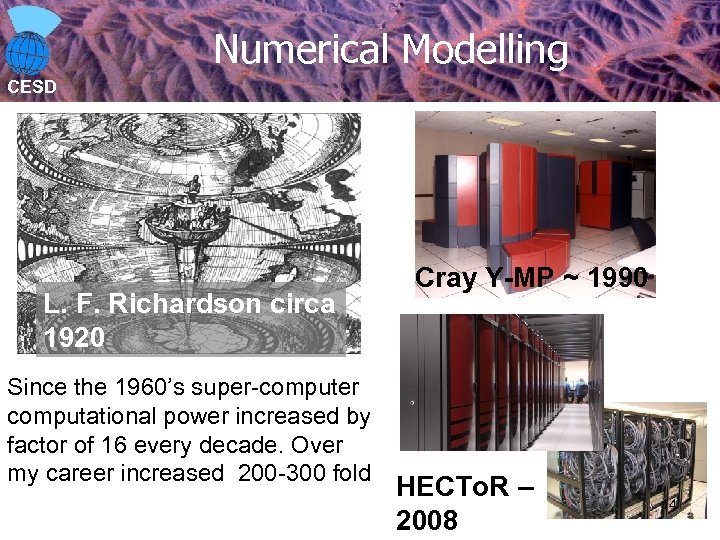 Numerical Modelling CESD L. F. Richardson circa 1920 Since the 1960’s super-computer computational power increased by factor of 16 every decade. Over my career increased 200 -300 fold Cray Y-MP ~ 1990 HECTo. R – 2008 14
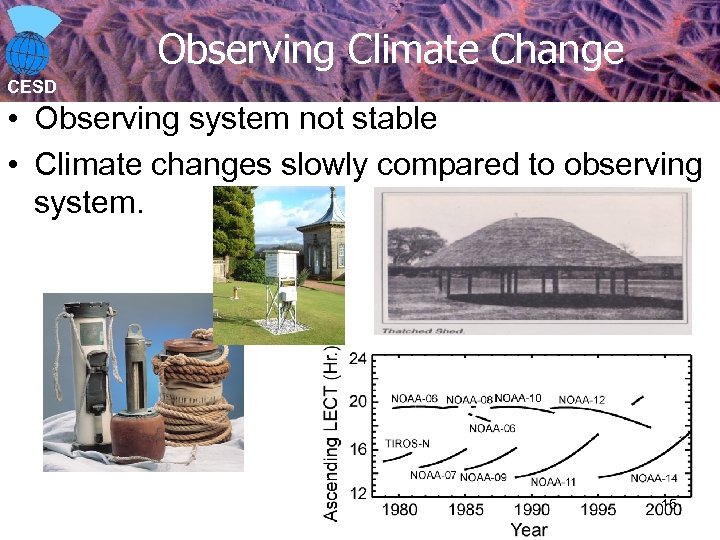 Observing Climate Change CESD • Observing system not stable • Climate changes slowly compared to observing system. 15
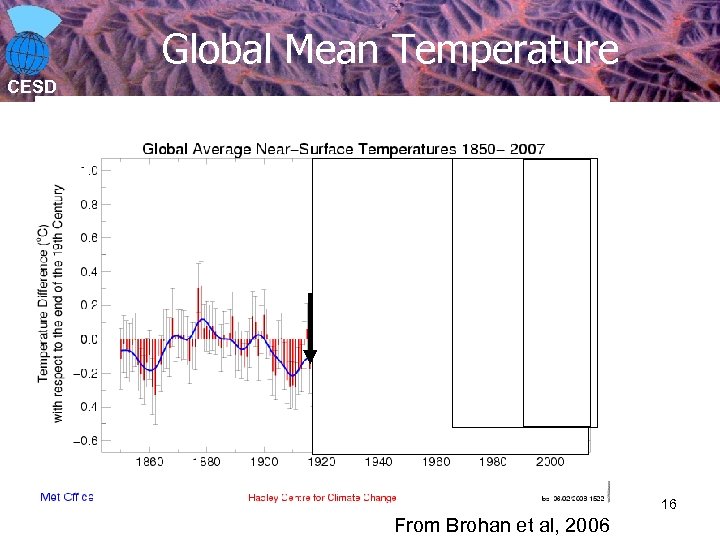 Global Mean Temperature CESD 16 From Brohan et al, 2006
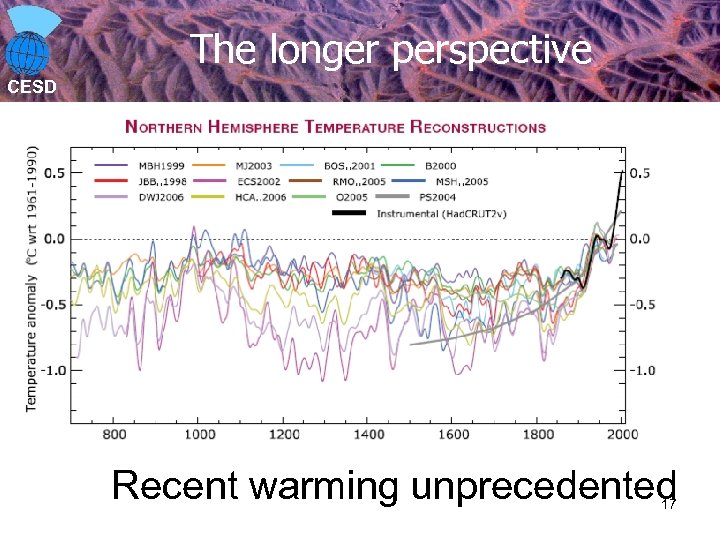 The longer perspective CESD Recent warming unprecedented 17
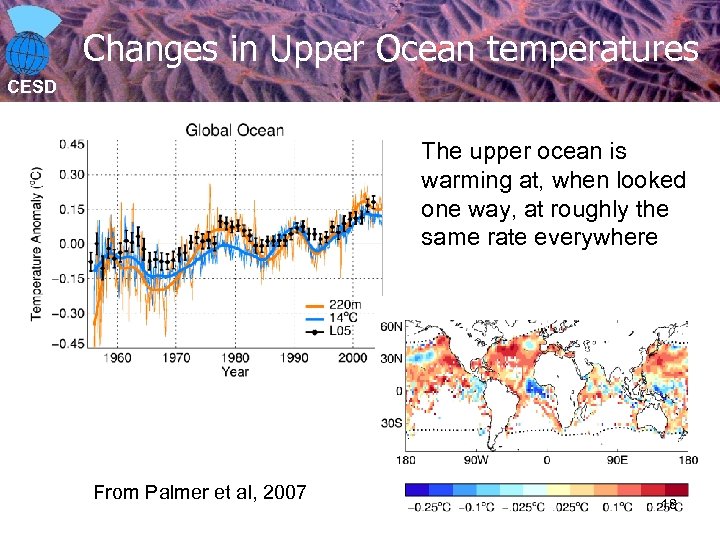 Changes in Upper Ocean temperatures CESD The upper ocean is warming at, when looked one way, at roughly the same rate everywhere From Palmer et al, 2007 18
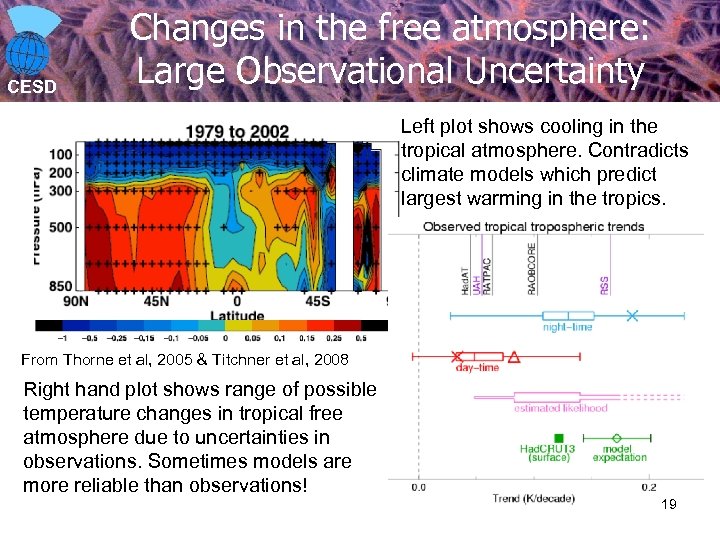 CESD Changes in the free atmosphere: Large Observational Uncertainty Left plot shows cooling in the tropical atmosphere. Contradicts climate models which predict largest warming in the tropics. From Thorne et al, 2005 & Titchner et al, 2008 Right hand plot shows range of possible temperature changes in tropical free atmosphere due to uncertainties in observations. Sometimes models are more reliable than observations! 19
 Model Applications CESD • Understanding 20 th century climate change • The role of natural and human drivers in climate variability • Future scenarios • Summary: external drivers important in explaining observed climate variability and future climate change 20
 What might cause observed change? CESD 21
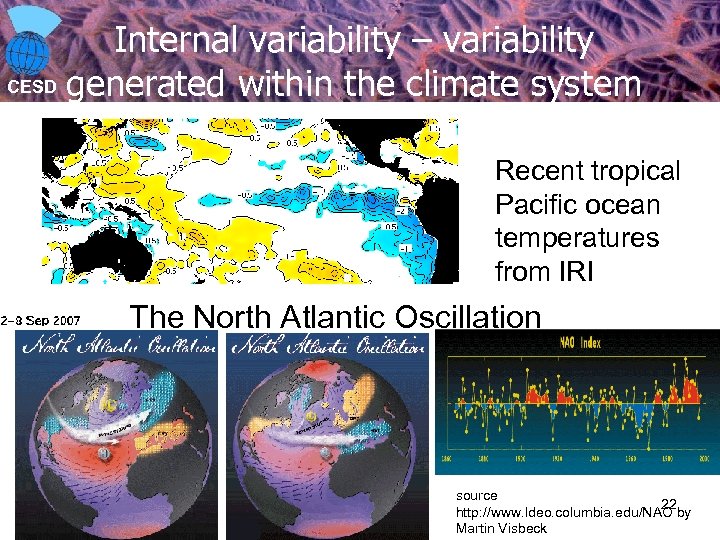 Internal variability – variability CESD generated within the climate system Recent tropical Pacific ocean temperatures from IRI The North Atlantic Oscillation source 22 http: //www. ldeo. columbia. edu/NAO by Martin Visbeck
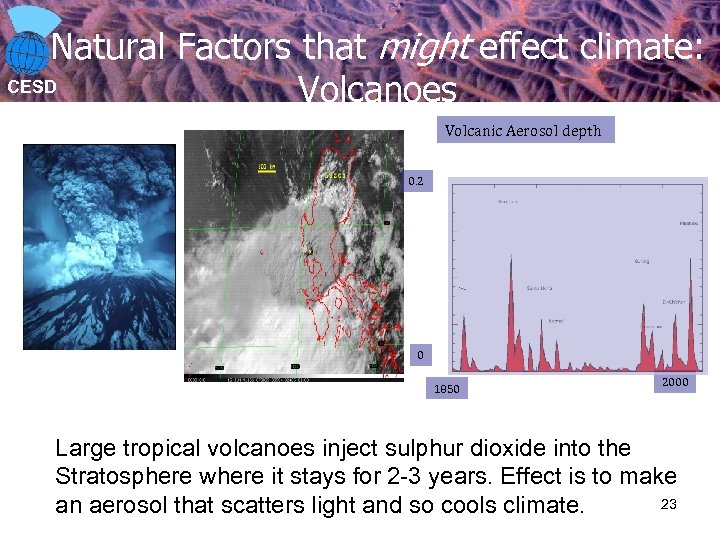 Natural Factors that might effect climate: CESD Volcanoes Volcanic Aerosol depth 0. 2 0 1850 2000 Large tropical volcanoes inject sulphur dioxide into the Stratosphere where it stays for 2 -3 years. Effect is to make 23 an aerosol that scatters light and so cools climate.
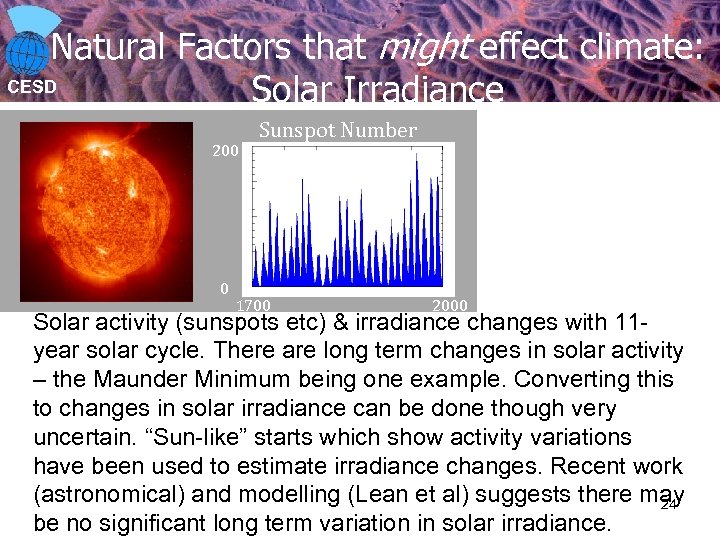 Natural Factors that might effect climate: CESD Solar Irradiance 200 0 Sunspot Number 1700 2000 Solar activity (sunspots etc) & irradiance changes with 11 year solar cycle. There are long term changes in solar activity – the Maunder Minimum being one example. Converting this to changes in solar irradiance can be done though very uncertain. “Sun-like” starts which show activity variations have been used to estimate irradiance changes. Recent work (astronomical) and modelling (Lean et al) suggests there may 24 be no significant long term variation in solar irradiance.
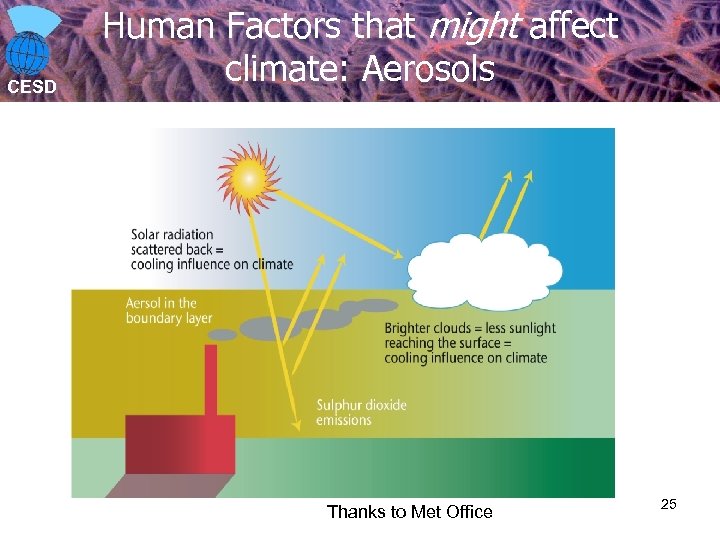 CESD Human Factors that might affect climate: Aerosols Thanks to Met Office 25
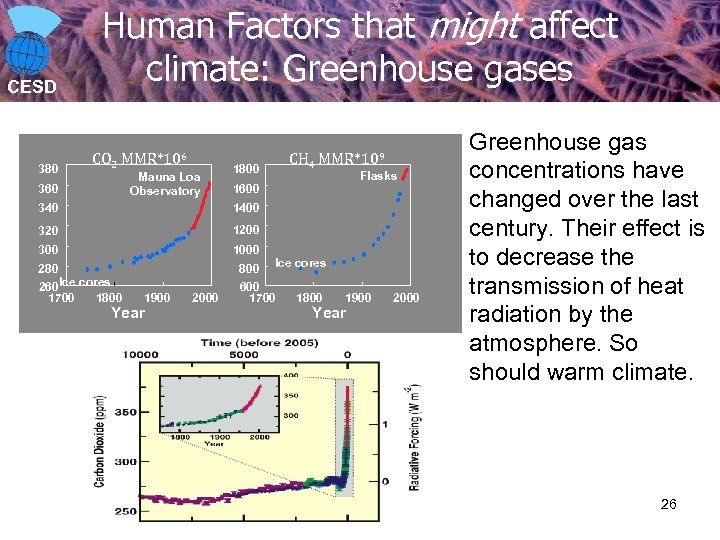 CESD 380 Human Factors that might affect climate: Greenhouse gases CO 2 MMR*106 360 Mauna Loa Observatory 1800 CH 4 MMR*109 Flasks 1600 340 1400 320 1200 300 1000 280 260 Ice cores 1700 1800 1900 Year 2000 Ice cores 800 600 1700 1800 1900 Year 2000 Greenhouse gas concentrations have changed over the last century. Their effect is to decrease the transmission of heat radiation by the atmosphere. So should warm climate. 26
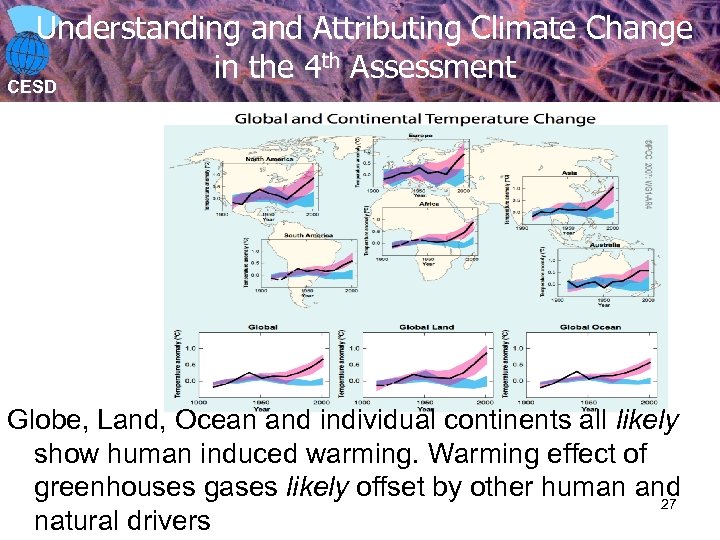 Understanding and Attributing Climate Change in the 4 th Assessment CESD Globe, Land, Ocean and individual continents all likely show human induced warming. Warming effect of greenhouses gases likely offset by other human and 27 natural drivers
 Modelling the last 500 years CESD • How important are external drivers compared to internal climate variability? • Simulation with fixed drivers – “internal” variability alone. • Simulation with only natural drivers – Sun & Volcanic eruptions • Simulation with human and natural drivers – Natural + changes in greenhouse gases, aerosols, and land-surface properties 28
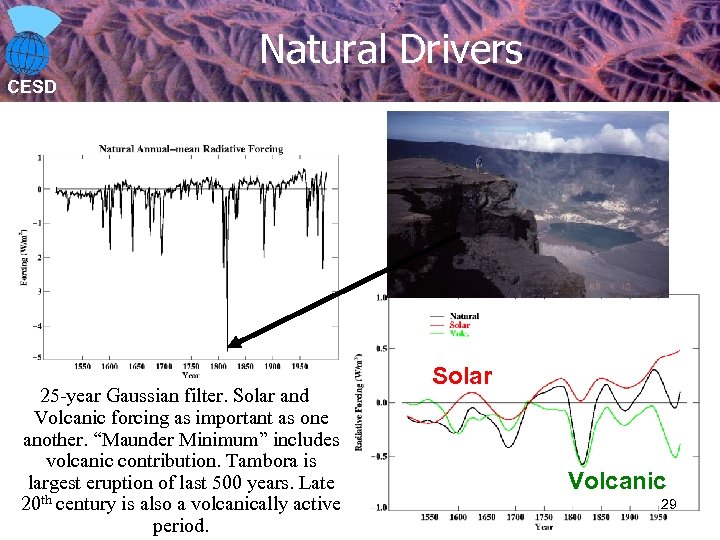 Natural Drivers CESD Annual: Slow changes with large negative forcings (from volcanoes) 25 -year Gaussian filter. Solar and Volcanic forcing as important as one another. “Maunder Minimum” includes volcanic contribution. Tambora is largest eruption of last 500 years. Late 20 th century is also a volcanically active period. Solar Volcanic 29
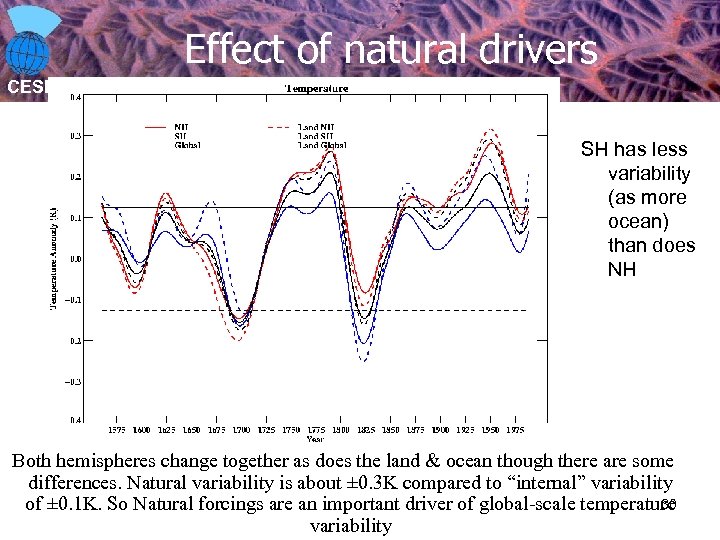 Effect of natural drivers CESD SH has less variability (as more ocean) than does NH Both hemispheres change together as does the land & ocean though there are some differences. Natural variability is about ± 0. 3 K compared to “internal” variability 30 of ± 0. 1 K. So Natural forcings are an important driver of global-scale temperature variability
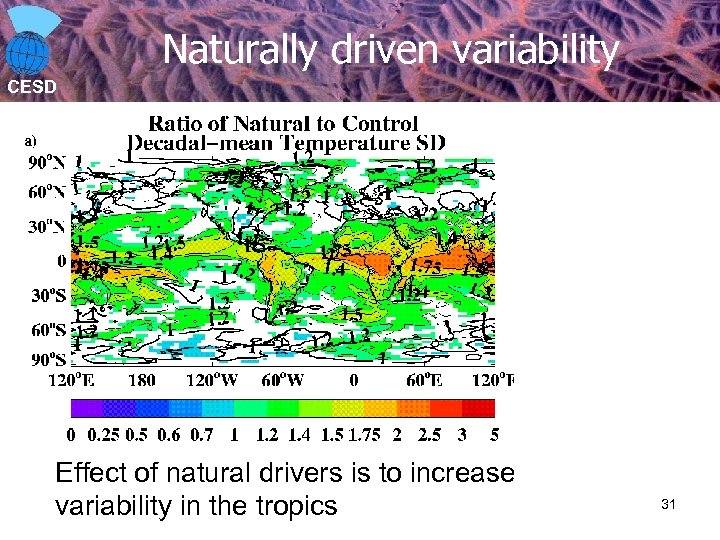 Naturally driven variability CESD Effect of natural drivers is to increase variability in the tropics 31
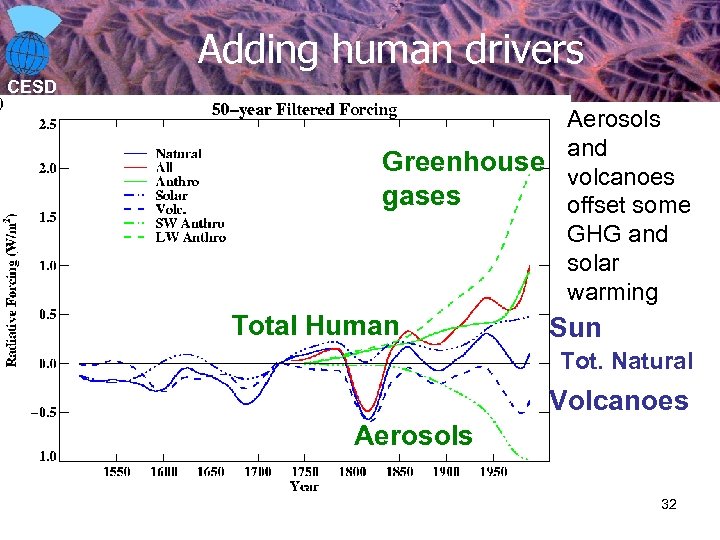 Adding human drivers CESD Aerosols and Greenhouse volcanoes gases offset some GHG and solar warming Total Human Sun Tot. Natural Volcanoes Aerosols 32
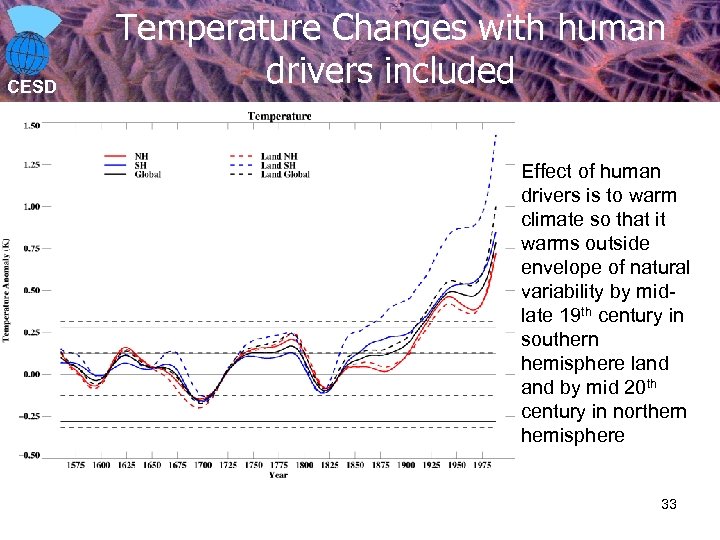 CESD Temperature Changes with human drivers included Effect of human drivers is to warm climate so that it warms outside envelope of natural variability by midlate 19 th century in southern hemisphere land by mid 20 th century in northern hemisphere 33
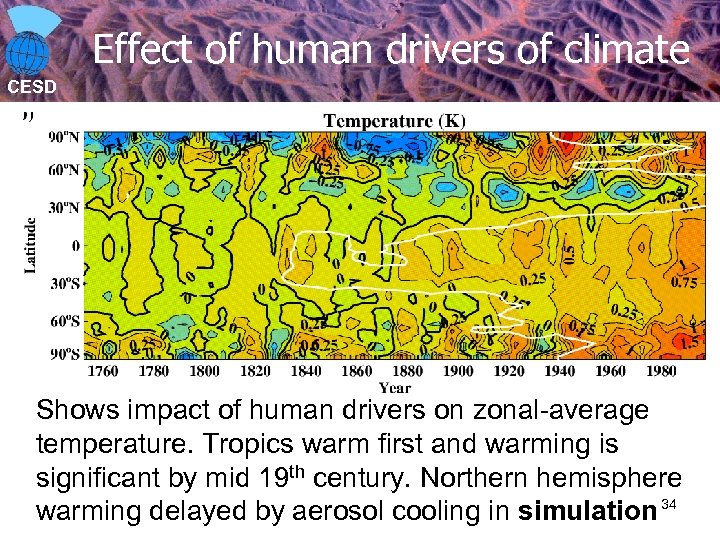 Effect of human drivers of climate CESD Shows impact of human drivers on zonal-average temperature. Tropics warm first and warming is significant by mid 19 th century. Northern hemisphere warming delayed by aerosol cooling in simulation 34
 Predicting the Future CESD Material in this section from IPCC 4 th assessment report. Results based on multi-model archive. Typically show average across all model simulations with uncertainties from range Scenarios used to drive models. Selfconsistent atmospheric concentrations of CO 2 and other greenhouse gases. Based on different human development paths 35
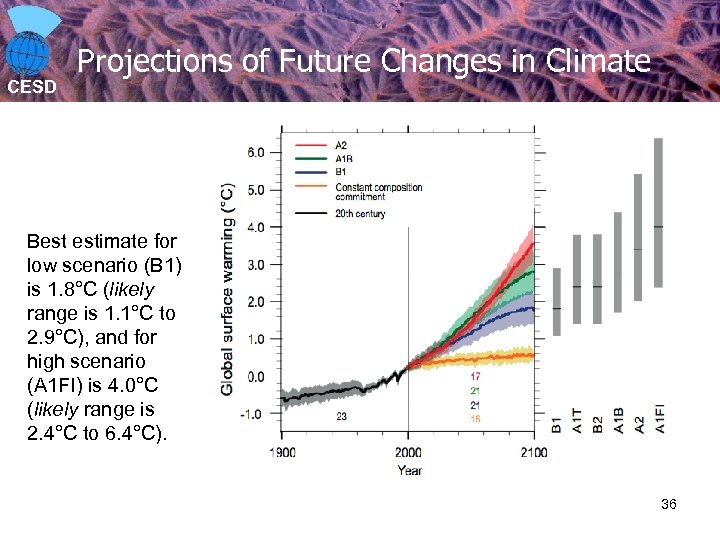 CESD Projections of Future Changes in Climate Best estimate for low scenario (B 1) is 1. 8°C (likely range is 1. 1°C to 2. 9°C), and for high scenario (A 1 FI) is 4. 0°C (likely range is 2. 4°C to 6. 4°C). 36
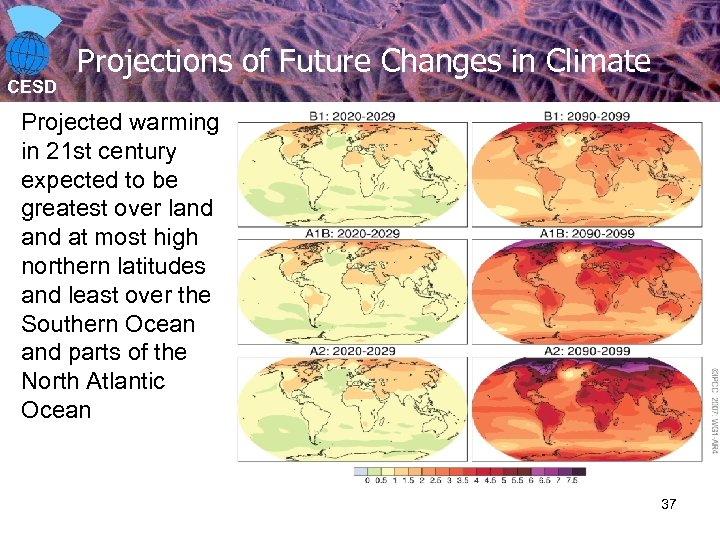 CESD Projections of Future Changes in Climate Projected warming in 21 st century expected to be greatest over land at most high northern latitudes and least over the Southern Ocean and parts of the North Atlantic Ocean 37
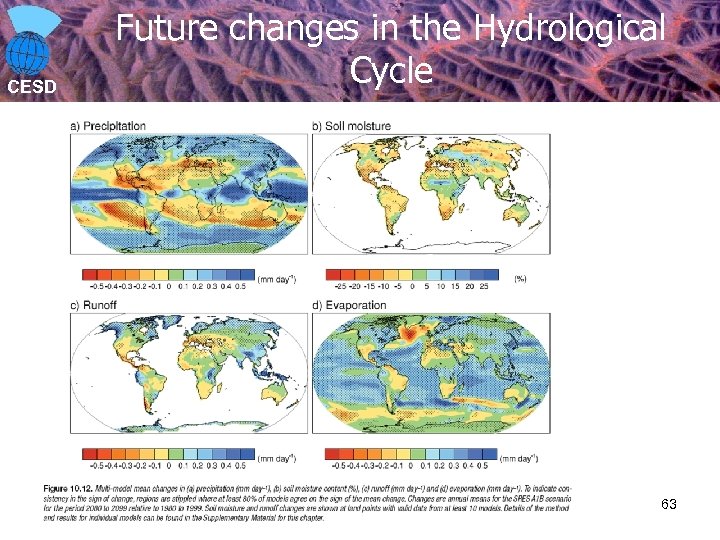
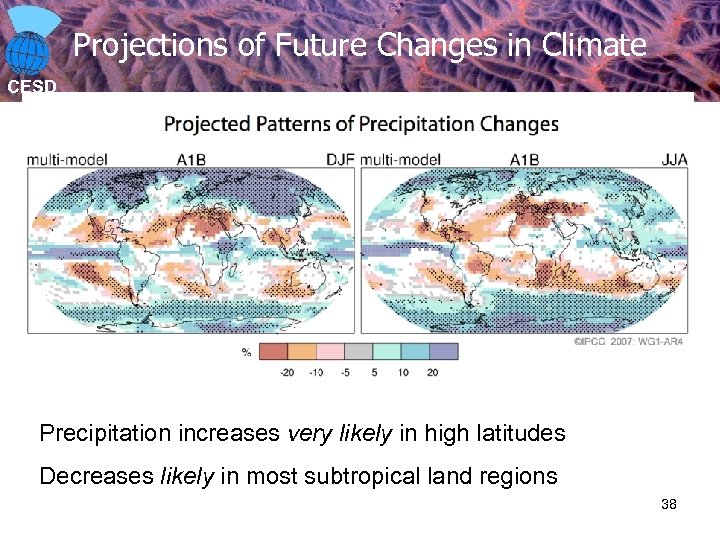 Projections of Future Changes in Climate CESD Precipitation increases very likely in high latitudes Decreases likely in most subtropical land regions 38
 CESD Is climate changing faster than we thought it would? • Lot of argument has been about reality of climate change – Are observations good? – Is the sun responsible for warming? – Feedbacks are weak so that future warming not likely to be a great threat? • General consensus (see 4 th Assessment report) is that climate is changing, likely due to human influences and agreement between different models as to likely warming. • But could models be underestimating future climate change? 39
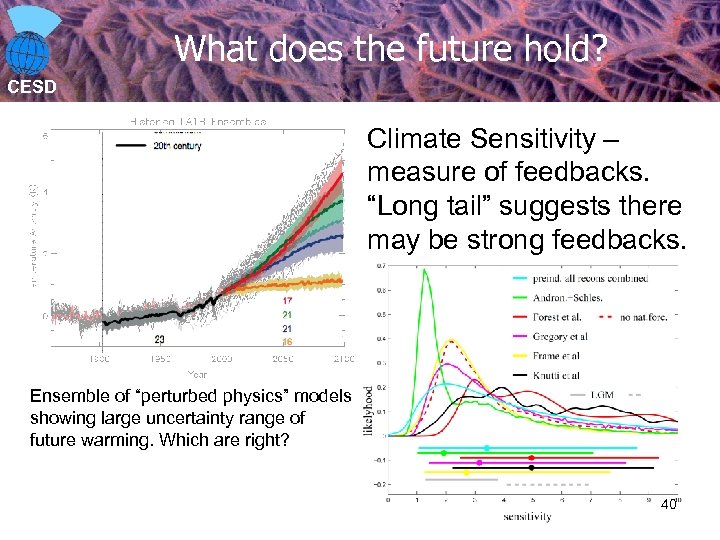 What does the future hold? CESD Climate Sensitivity – measure of feedbacks. “Long tail” suggests there may be strong feedbacks. Ensemble of “perturbed physics” models showing large uncertainty range of future warming. Which are right? 40
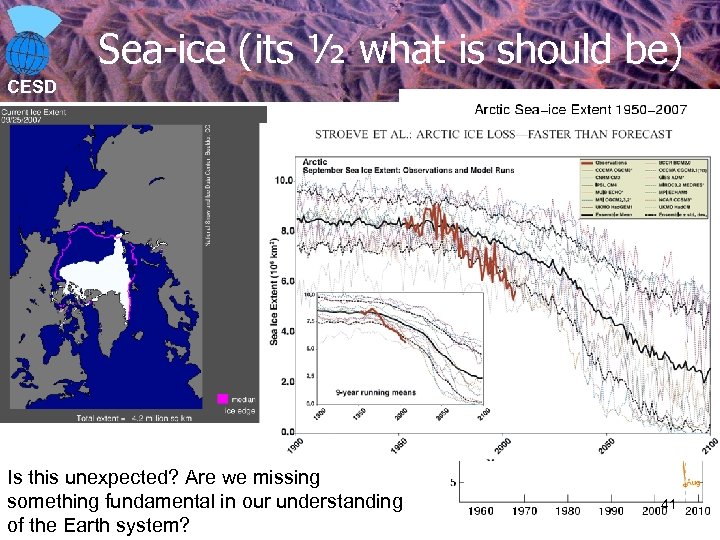 Sea-ice (its ½ what is should be) CESD Is this unexpected? Are we missing something fundamental in our understanding of the Earth system? 41
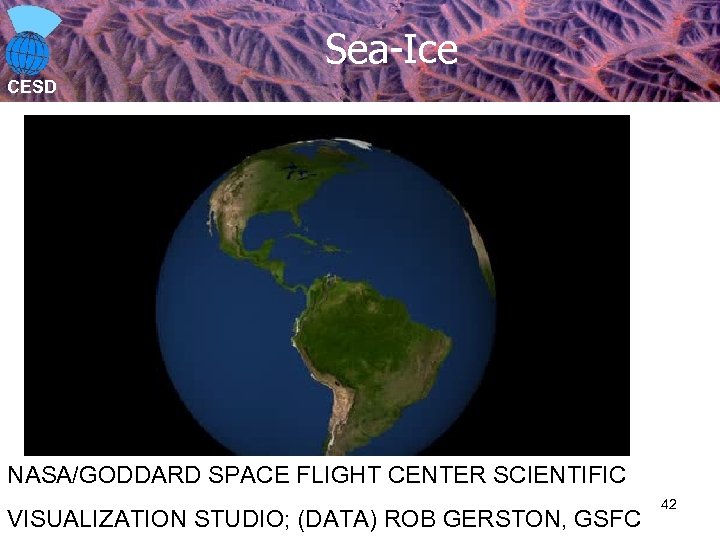 Sea-Ice CESD NASA/GODDARD SPACE FLIGHT CENTER SCIENTIFIC VISUALIZATION STUDIO; (DATA) ROB GERSTON, GSFC 42
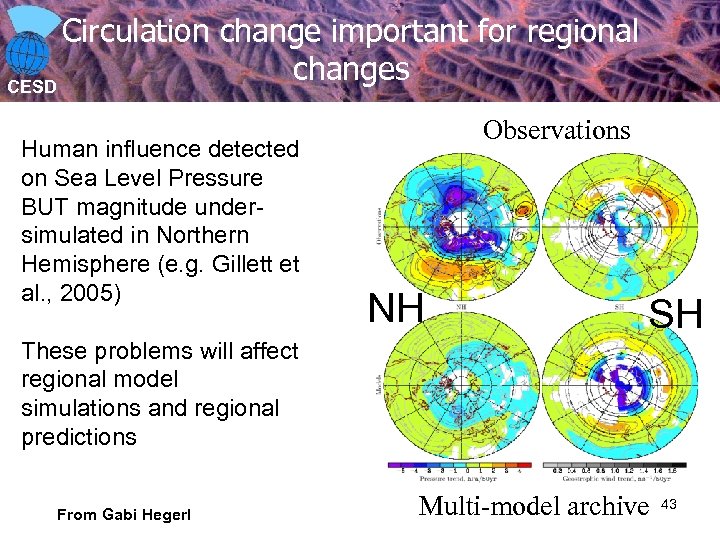 Circulation change important for regional changes CESD Human influence detected on Sea Level Pressure BUT magnitude undersimulated in Northern Hemisphere (e. g. Gillett et al. , 2005) Observations Model mean NH SH These problems will affect regional model simulations and regional predictions From Gabi Hegerl Multi-model archive 43
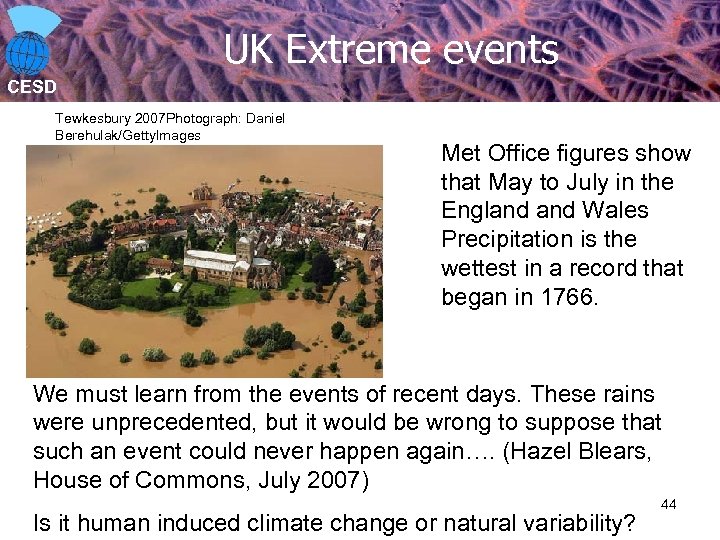 UK Extreme events CESD Tewkesbury 2007 Photograph: Daniel Berehulak/Getty. Images Met Office figures show that May to July in the England Wales Precipitation is the wettest in a record that began in 1766. We must learn from the events of recent days. These rains were unprecedented, but it would be wrong to suppose that such an event could never happen again…. (Hazel Blears, House of Commons, July 2007) Is it human induced climate change or natural variability? 44
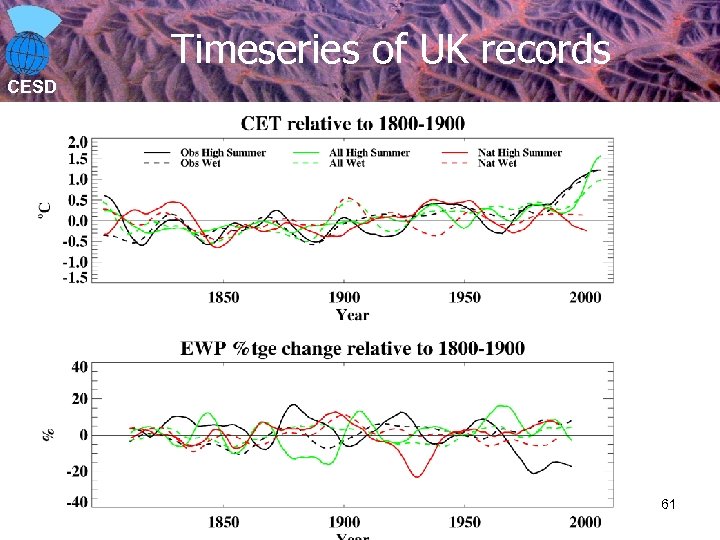
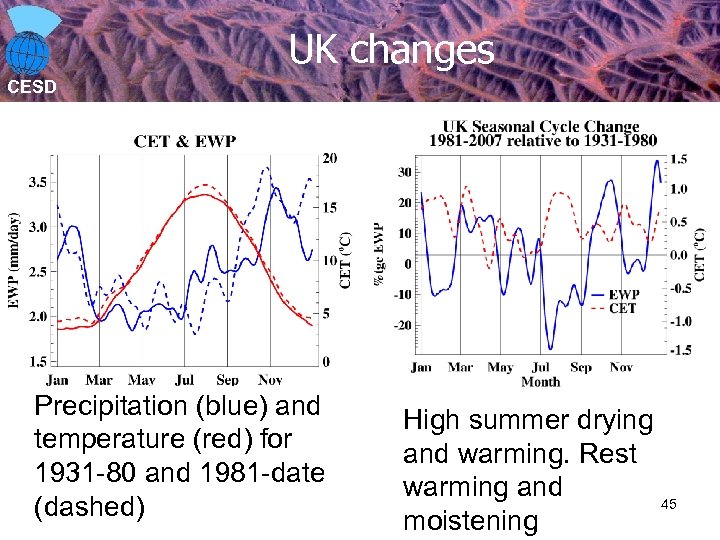 UK changes CESD Precipitation (blue) and temperature (red) for 1931 -80 and 1981 -date (dashed) High summer drying and warming. Rest warming and 45 moistening
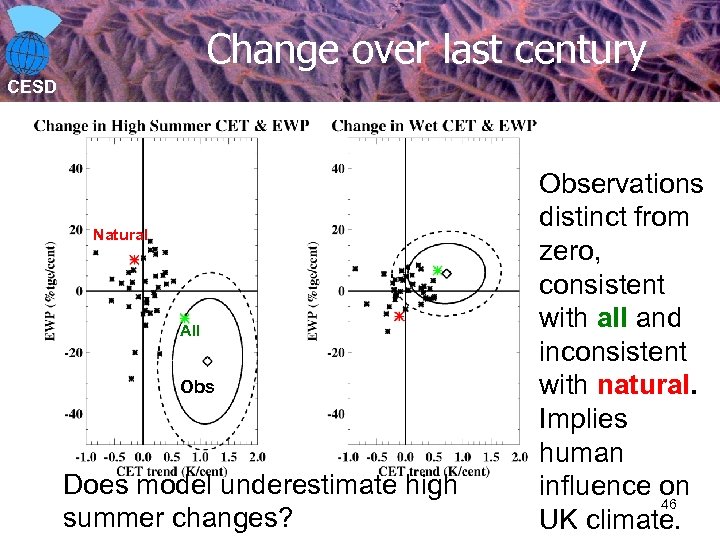 Change over last century CESD Natural All Obs Does model underestimate high summer changes? Observations distinct from zero, consistent with all and inconsistent with natural. Implies human influence on 46 UK climate.
 Summary & Conclusions CESD • Basic understanding of the climate system explains greenhouse effect and why would expect warming in response to changing atmospheric composition • Details of response come from feedbacks • Climate models are built “bottom up” not top down. Uncertainties arise from need to parameterize unresolved phenomenon • Interested in the emergent behaviour which is not easily predictable from basic physics in model. • Instrumental observations of surface temperature back to mid 19 th century • This, and other observations, show clear evidence of warming and climate change. 47
 Summary & Conclusions CESD • Using models and observations to establish that: – 20 th century climate change is likely to be human driven with greenhouse gas warming being offset by natural and other human drivers – That external drivers are an important driver of natural climate variability – That humans might have affected 19 th century tropical climate. – Climate change has already happened and will continue to happen regardless of what we do. – But will be large if emissions are not reduced. • Models may be underestimating changes to come particularly those related to changes in atmospheric circulation. – This has important consequences for regional (i. e. UK) climate change. 48
 CESD The End! Thanks for listening Any Questions? 49
 Extra Material CESD 50
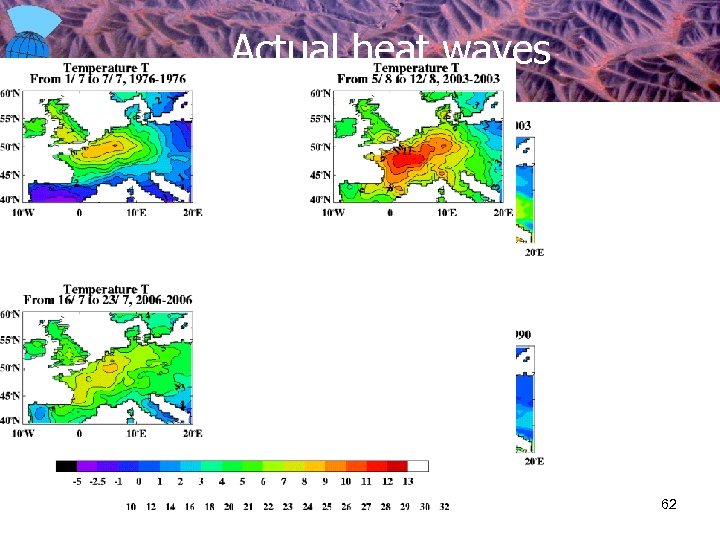
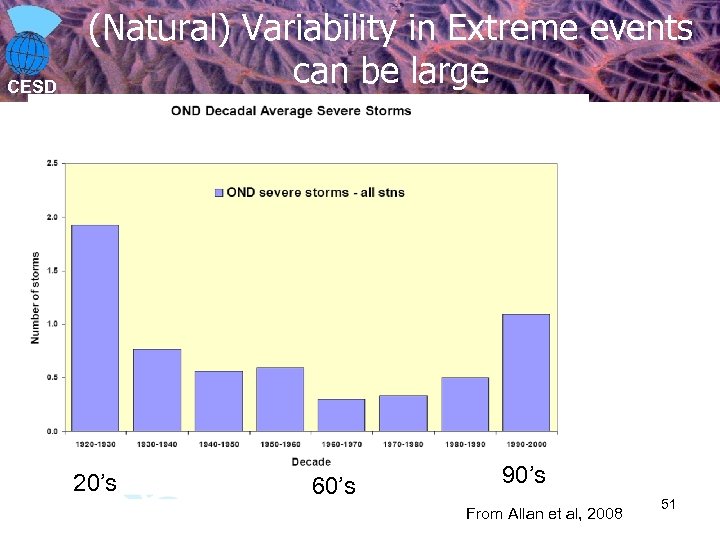 CESD (Natural) Variability in Extreme events can be large 20’s 60’s 90’s From Allan et al, 2008 51
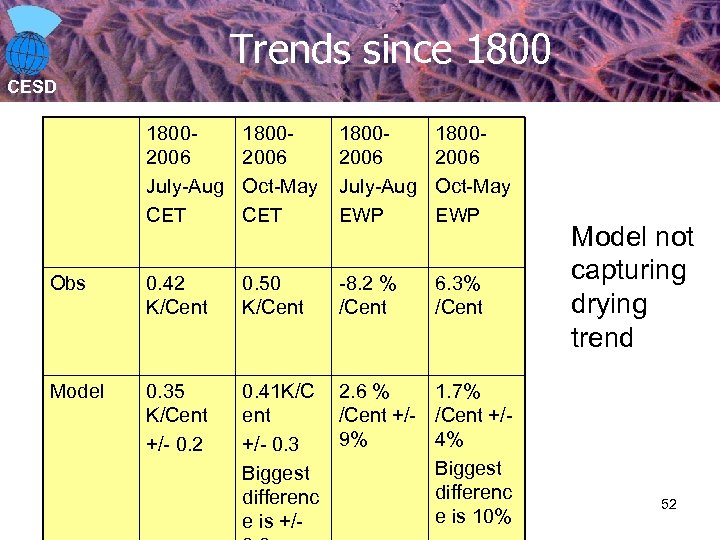 Trends since 1800 CESD 18002006 July-Aug CET 18002006 Oct-May CET 18002006 July-Aug EWP 18002006 Oct-May EWP Obs 0. 42 K/Cent 0. 50 K/Cent -8. 2 % /Cent 6. 3% /Cent Model 0. 35 K/Cent +/- 0. 2 0. 41 K/C 2. 6 % ent /Cent +/9% +/- 0. 3 Biggest differenc e is +/- 1. 7% /Cent +/4% Biggest differenc e is 10% Model not capturing drying trend 52
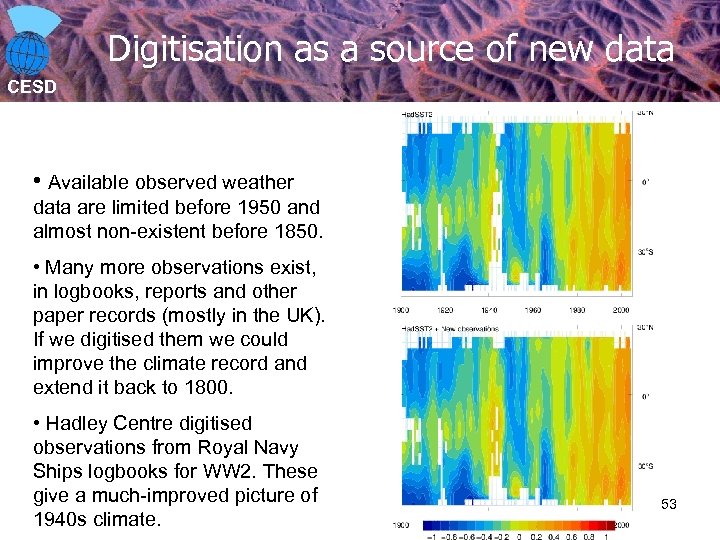 Digitisation as a source of new data CESD • Available observed weather data are limited before 1950 and almost non-existent before 1850. • Many more observations exist, in logbooks, reports and other paper records (mostly in the UK). If we digitised them we could improve the climate record and extend it back to 1800. • Hadley Centre digitised observations from Royal Navy Ships logbooks for WW 2. These give a much-improved picture of 1940 s climate. 53
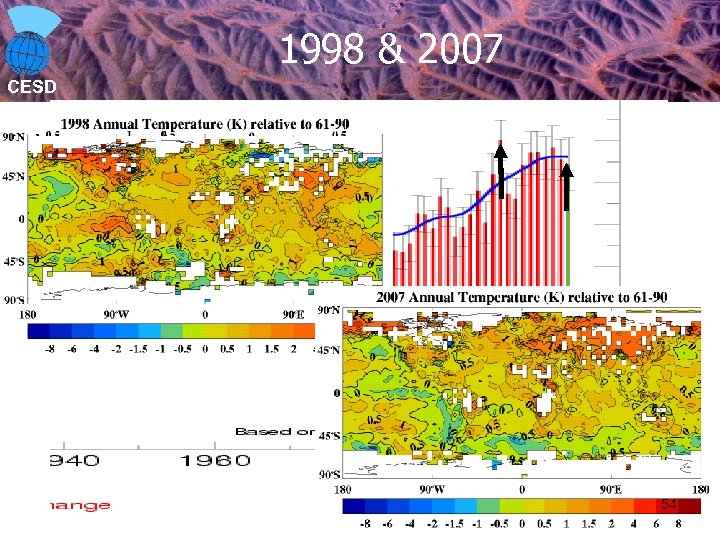 1998 & 2007 CESD 54
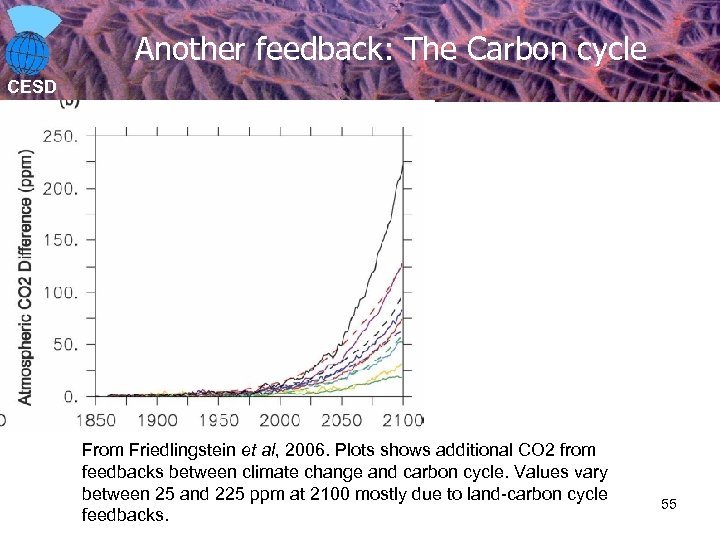 Another feedback: The Carbon cycle CESD From Friedlingstein et al, 2006. Plots shows additional CO 2 from feedbacks between climate change and carbon cycle. Values vary between 25 and 225 ppm at 2100 mostly due to land-carbon cycle feedbacks. 55
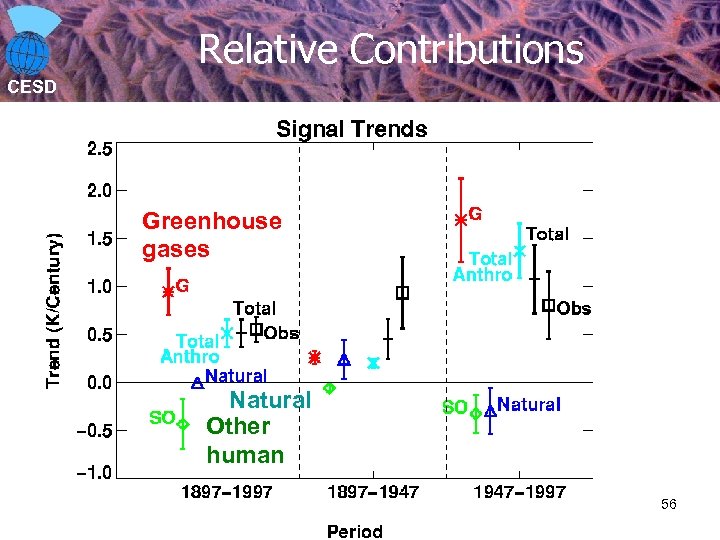 Relative Contributions CESD Greenhouse gases Natural Other human 56
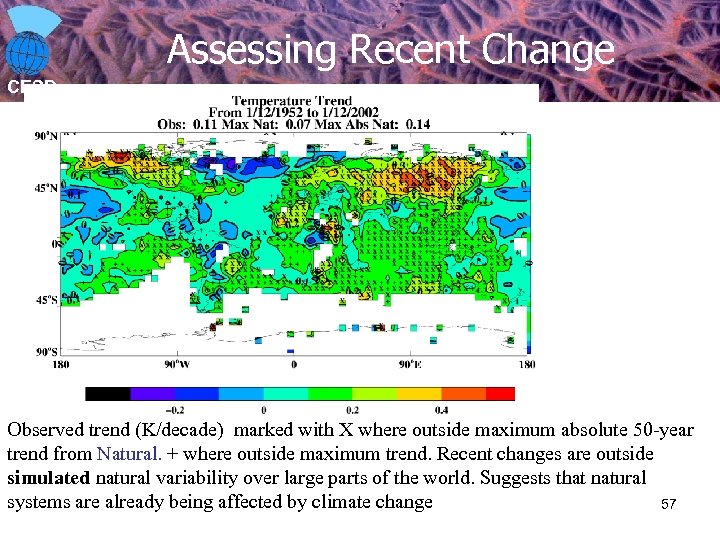 Assessing Recent Change CESD Observed trend (K/decade) marked with X where outside maximum absolute 50 -year trend from Natural. + where outside maximum trend. Recent changes are outside simulated natural variability over large parts of the world. Suggests that natural systems are already being affected by climate change 57
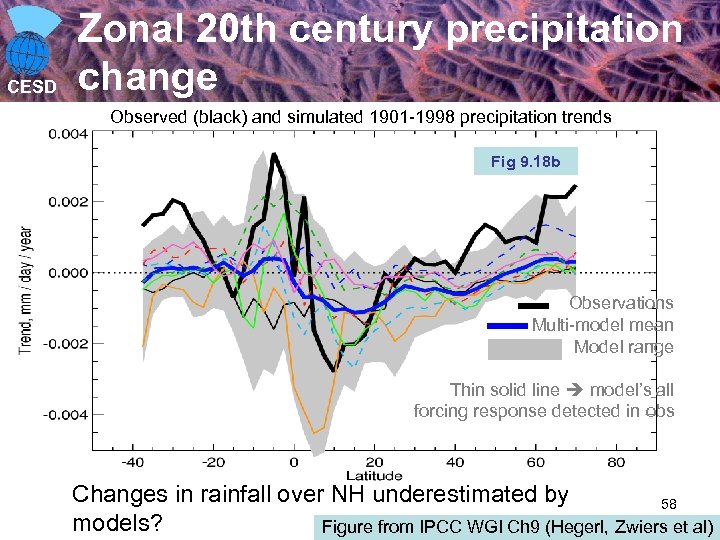 CESD Zonal 20 th century precipitation change Observed (black) and simulated 1901 -1998 precipitation trends Fig 9. 18 b Observations Multi-model mean Model range Thin solid line model’s all forcing response detected in obs Changes in rainfall over NH underestimated by 58 models? Figure from IPCC WGI Ch 9 (Hegerl, Zwiers et al)
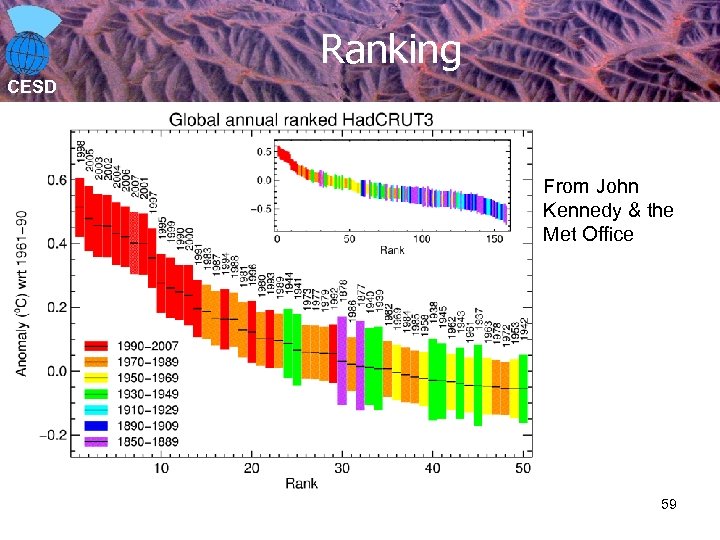 Ranking CESD From John Kennedy & the Met Office 59
 Radiation CESD 60
 Timeseries of UK records CESD 61
 Actual heat waves CESD 62
 CESD Future changes in the Hydrological Cycle 63