 Скачать презентацию Cesarean Delivery on Maternal Request Presented by Barbara
7e81b0bf7c880dcc9b5d0c84cda2f4da.ppt
- Количество слайдов: 41



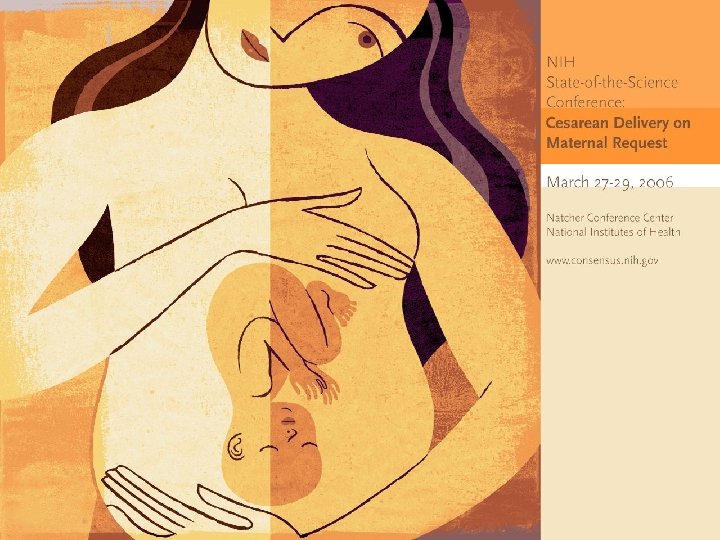
Cesarean Delivery on Maternal Request Presented by: Barbara Hughes, CNM, MS, MBA, FACNM Colorado Perinatal Care Council July 31, 2009
Background and Process Increasing Rate of Cesarean Delivery NIH Role CDMR: What is it? Identifying the Key Questions What did the evidence say? What were the recommendations? What’s YOUR Opinion?
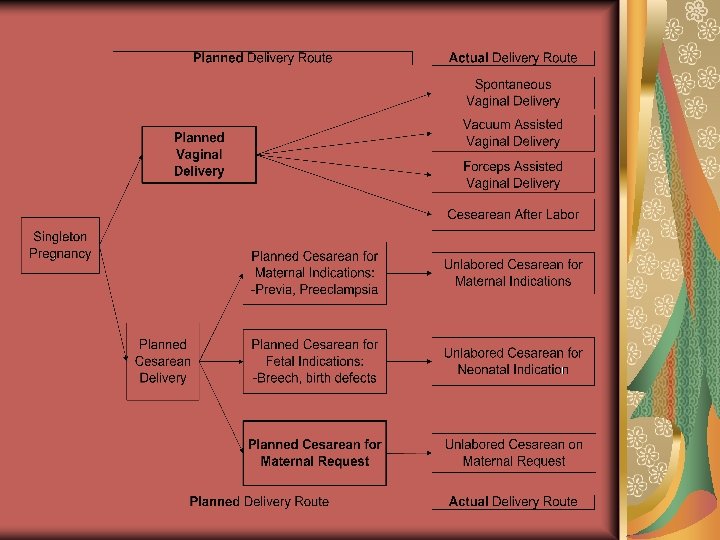
Definition of Cesarean Delivery on Maternal Request (CDMR) Primary cesarean delivery Singleton pregnancy At term On maternal request No maternal or neonatal indications
Conference Sponsors National Institute of Child Health and Human Development, NIH (NICHD) Office of Medical Applications of Research, NIH (OMAR) Co-Sponsors National Institute of Diabetes and Digestive and Kidney Diseases, NIH National Institute of Nursing Research, NIH Office of Research on Women’s Health Also supported by: The Agency for Healthcare Research and Quality (AHRQ)

State-of-the-Science Conference NIH consensus and state-of-the-science statements are prepared by independent panels of health professionals and public representatives on the basis of (1) the results of a systematic literature review prepared under contract with the Agency for Healthcare Research and Quality (AHRQ), (2) presentations by investigators working in areas relevant to the conference questions during a 2 day public session, (3) questions and statements from conference attendees during open discussion periods that are part of the public session, and (4) closed deliberations by the panel during the remainder of the second day and morning of the third. This statement is an independent report of the panel and is not a policy statement of the NIH or the Federal Government.

Who was on the Panel? ? ? OB/GYN Physicians MFM Urogynecologist Urologist Anesthesiologist Epidemiologist Bio-statistician Neonatologist Psychiatrist Dean of Law School Nurse-Midwife Patient Representative

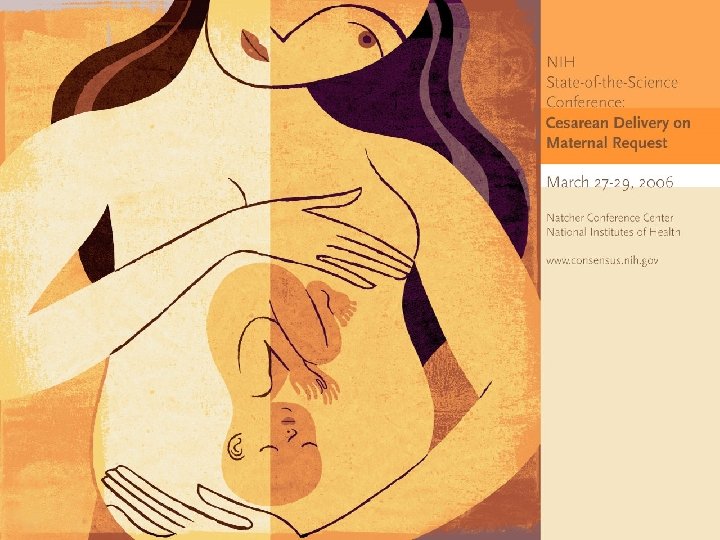
The Assignment. . . National Institute of Child Health and Human Development (NICHD) and the Office of Medical Applications of Research (OMAR) of the National Institutes of Health (NIH) convened a State-of-the-Science Conference from March 27 to 29, 2006, to assess the available scientific evidence relevant to four key questions:
What are the Key Questions (KQs)? KQ 1: What is the trend and incidence of cesarean delivery over time in the US and in other developed countries? KQ 2: What is the effect of approach to delivery (i. e. cesarean delivery on maternal request compared to planned vaginal delivery), on maternal and infant short-term and long-term outcomes? KQ 3: What are the factors affecting the magnitude of the benefits and harms in KQ 2? KQ 4: What future research directions need to be considered to get evidence for making appropriate decisions regarding CDMR versus planned vaginal delivery?
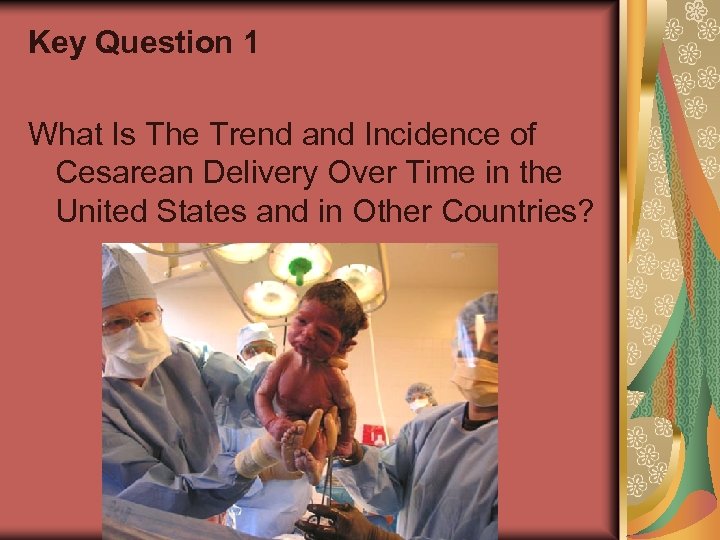
Key Question 1 What Is The Trend and Incidence of Cesarean Delivery Over Time in the United States and in Other Countries?
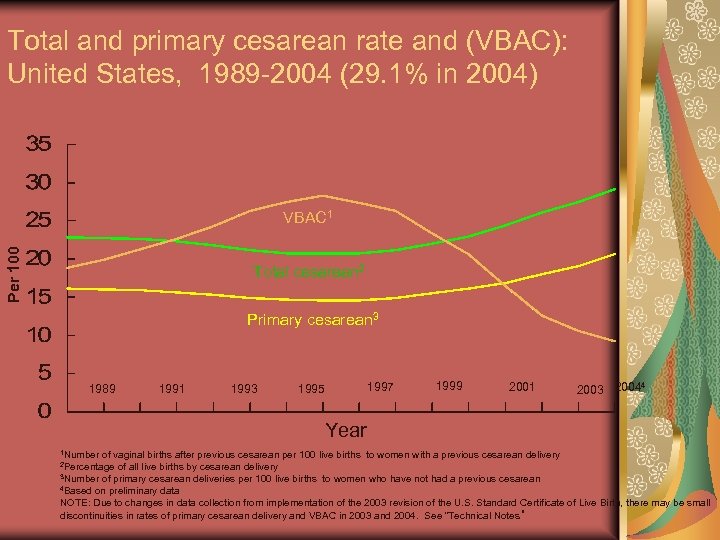
Total and primary cesarean rate and (VBAC): United States, 1989 -2004 (29. 1% in 2004) Per 100 VBAC 1 Total cesarean 2 Primary cesarean 3 1989 1991 1993 1997 1995 1999 2001 2003 20044 Year 1 Number of vaginal births after previous cesarean per 100 live births to women with a previous cesarean delivery 2 Percentage of all live births by cesarean delivery 3 Number of primary cesarean deliveries per 100 live births to women who have not had a previous cesarean 4 Based on preliminary data NOTE: Due to changes in data collection from implementation of the 2003 revision of the U. S. Standard Certificate of Live Birth, there may be small discontinuities in rates of primary cesarean delivery and VBAC in 2003 and 2004. See “Technical Notes. ”
What is the IDEAL Rate of CD? Healthy People 2010 = 15% Upon what basis was this rate determined? Does the cesarean section rate influence maternal and child health?
The Evidence-based Practice Center (EPC) Report: RTI International—University of North Carolina at Chapel Hill Evidence-based Practice Center (RTI-UNC EPC) NUMEROUS additional articles Speakers Audience Participants

? ? Planned Vaginal Delivery Planned Cesarean Delivery
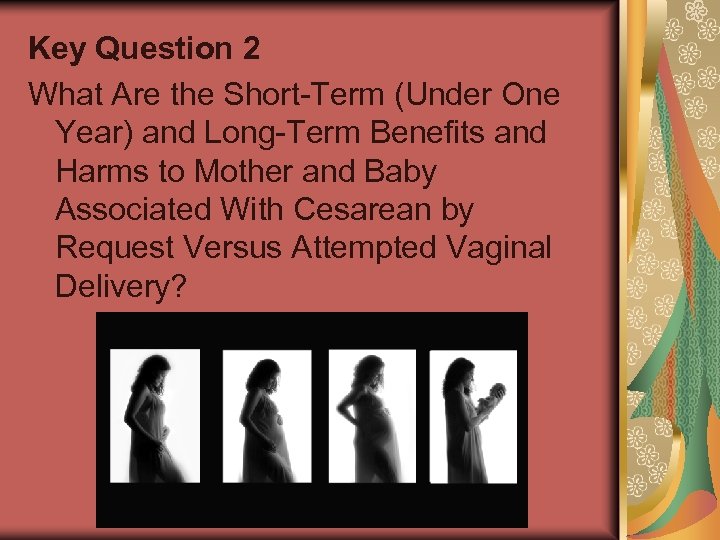
Key Question 2 What Are the Short-Term (Under One Year) and Long-Term Benefits and Harms to Mother and Baby Associated With Cesarean by Request Versus Attempted Vaginal Delivery?

Quality and Relevance of the Evidence For the evidence obtained from the EPC report, the panel utilized an evidence quality grading scale provided within the document: Level I—strong, Level II—moderate, Level III—weak Level IV—absent
What did we have to work with? No Level I evidence was found! 3 outcomes had Level II evidence (Mom) Hemorrhage, LOS (Baby) Respiratory morbidity The remaining outcomes were Level III or IV Interpretation of many outcome variables was confounded by a lack of appropriate comparison groups, a lack of consistency in outcome definitions, and the frequent use of composite outcomes & proxies.
Maternal Outcomes With Moderate-Quality Evidence (2) Hemorrhage. The frequency of postpartum hemorrhage associated with planned CD is less than that reported with the combination of PVD and unplanned CD. Maternal length of hospital stay is higher for CD, planned or otherwise, than for vaginal delivery. But. . .
Benefits & Harms: Summary With the exception of 3 outcome variables with moderate-quality evidence (maternal hemorrhage, maternal length of stay, and neonatal respiratory morbidity). . . all of the remaining outcome assessments considered by the panel were based on weak evidence. This significantly limits the reliability of judgments regarding whether an outcome measure favors either CDMR or PVD.
Key Question 3 What Factors Influence Benefits and Harms?
What factors influence benefits & harms? Patient specific factors Age Childbearing plans/family size Obesity Accuracy of gestational age assessment Psychological factors

What factors influence benefits & harms? Cultural & Societal Issues Cultural beliefs and practices Personal philosophy of birth Increasing societal acceptance Media
What factors influence benefits & harms? Provider Type and Professional Resources Obstetrical providers. . . OB/GYN Physicians MFM Physicians Family Medicine Physicians Certified Nurse-Midwives
What factors influence benefits & harms? Provider Type and Professional Resources Provider’s View of CDMR. . . Training Practice environment Experience Personal philosophy Medicolegal issues
What factors influence benefits & harms? Provider Type and Professional Resources Geographical location Level of perinatal services Availability of anesthesia Hospital resources (OR & Staff) Unpredictability of timing Complex issues Potential for biased recommendations
What factors influence benefits & harms? Ethical Issues Provider/Patient relationship Ethical principles Autonomy Beneficence First, DO NO HARM “If a woman requests information. . . ” Shared decision making process When a provider cannot support a request for CDMR, “. . . it is appropriate to refer the woman to another provider. ”
Summary of factors that influence benefits and harms. . . Birth is an inherently normal process The majority of women would like to achieve a spontaneous vaginal delivery and should supported in their efforts to achieve that goal The available evidence and data comparing risks and benefits of PVD and CDMR are sparse and provide few clear conclusions
Key Question 4 What future research directions need to be considered to get evidence for making appropriate decisions regarding cesarean delivery on request or attempted vaginal delivery?
Future research directions Surveys of women, providers, insurers and healthcare facilities regarding CDMR Create mechanisms to identify CDMR CPT Code Birth Certificate Increase research devoted to strategies to predict and influence the likelihood of successful vaginal birth, especially in the first pregnancy
Future research directions Study of large, prospective cohorts, including long-term follow-up of mothers and children Study of critical outcomes Case-control studies Randomized Trials?
Future research directions Future studies should determine whethere are modifiable factors in the management of labor that can decrease maternal and neonatal complications. Furthermore, an attempt should be made to identify subgroups of women at higher risk for complications that would benefit most from planned CDMR.
Studies comparing CDMR & PVD should consider the following key outcomes. . . Maternal death Placental abnormalities including previa & acreta Pelvic floor disorders Psychological factors
Studies comparing CDMR & PVD should consider the following key outcomes. . . Neonatal death Neonatal encephalopathy CP Brachial plexus injury Respiratory outcomes Neurodevelopmental outcomes Other birth injuries
Studies comparing CDMR & PVD should consider the following key outcomes. . . Cost analysis of CDMR
Conclusions. . . The incidence of CD without medical/obstetrical indications is rising in the United States, and a component of this is due to CDMR. Given the tools available, the magnitude of the CDMR component is difficult to quantify. There is insufficient evidence to evaluate fully the benefits and risks of CDMR as compared to PVD, and more research is needed.
Conclusions. . . Until quality evidence becomes available, any decision to perform a CDMR should be carefully individualized and consistent with ethical principles. Given that the risks of placenta previa and acreta rise with each CD, CDMR is not recommended for women desiring several children.
Conclusions. . . CDMR should not be performed prior to 39 weeks or without verification of lung maturity, because of the significant danger of neonatal respiratory complications. Request for CDMR should not be motivated by unavailability of effective pain management. Efforts must be made to assure availability of pain management services for all women.

Conclusions. . . NIH or another appropriate Federal agency should establish and maintain a Web site to provide up-to-date information on the benefits and risks of all modes of delivery.

What is YOUR opinion? ? ?
 Скачать презентацию Cesarean Delivery on Maternal Request Presented by Barbara
7e81b0bf7c880dcc9b5d0c84cda2f4da.ppt