 Скачать презентацию Cesaer seminar 2009 Aalborg The modernisation agenda of
668e3becae307bf93a56fa0c84f763d0.ppt
- Количество слайдов: 21



Cesaer seminar 2009, Aalborg: The modernisation agenda of the universities Mobility Rector Matti Pursula Helsinki University of Technology, Finland Date 30. 10. 2009 Page 1
Outline of the presentation §Background §Global facts and trends of mobility §Statistics about Finland TKK §How to increase mobility §Conclusions Page 1 Enter your footer here
Background: The Global Challenge § The rise of knowledge and innovation (research) to central factors of competitiveness - Global companies meet the cutting edge of engineering and business skills every day in the market and can, and have, to buy the best knowledge wherever they find it - The global economy is changing radically structures of industry and services, especially in Europe and USA § The change of education towards a commercial university brand products with international suppliers and ranking lists - International competition of the best graduates and best faculty is real today - International competition about research funding, from companies and EU - Competition of talented students is changing from national to international § The EU response - EHEA, ERA, The Lisbon declaration Enter your footer here
Background: The reform of universities § The EU Lisbon strategy sets the goal - Europe must become the most competitive economy of the world § Universities as places for education and research are important elements in reaching this goal - A university reform is undergoing in Europe and globally - Economic and administrative autonomy and internationalisation are in the core of the reform Enter your footer here
Mobility, a central tool for internationalisation § Internationalisation can be measured by - The rate of foreign degree students and faculty - The rate of student and faculty exchange - The participation in international research § From the European point of view - the mobility between EU countries is an important part of common market and cohesion - The mobility between EU and other parts of the world is the real test of our competitiveness in the long run Page 1 Enter your footer here
International mobility statistiscs from Global Education Digest (UN) Page 1 Enter your footer here
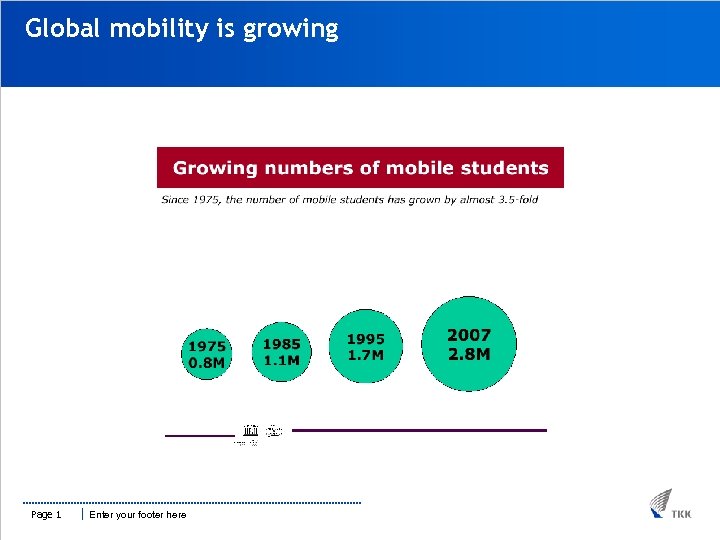
Global mobility is growing Page 1 Enter your footer here
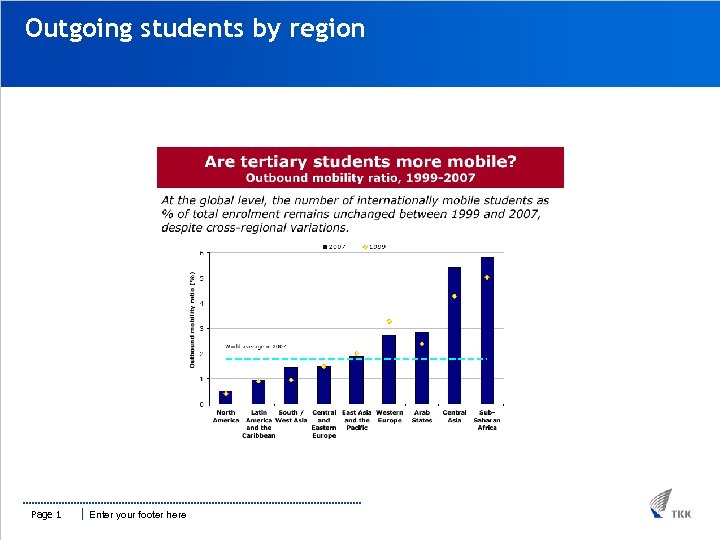
Outgoing students by region Page 1 Enter your footer here
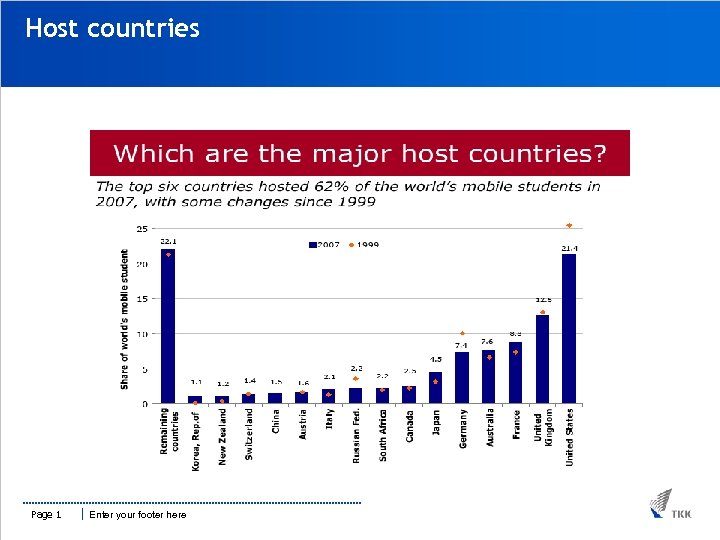
Host countries Page 1 Enter your footer here
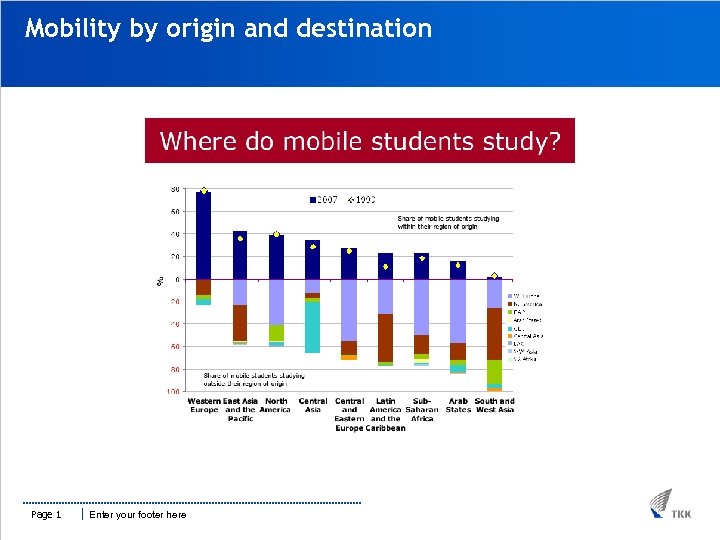
Mobility by origin and destination Page 1 Enter your footer here
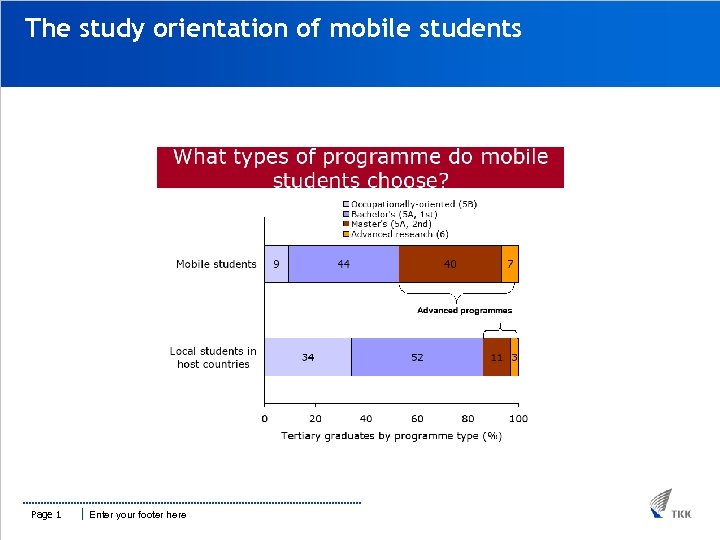
The study orientation of mobile students Page 1 Enter your footer here
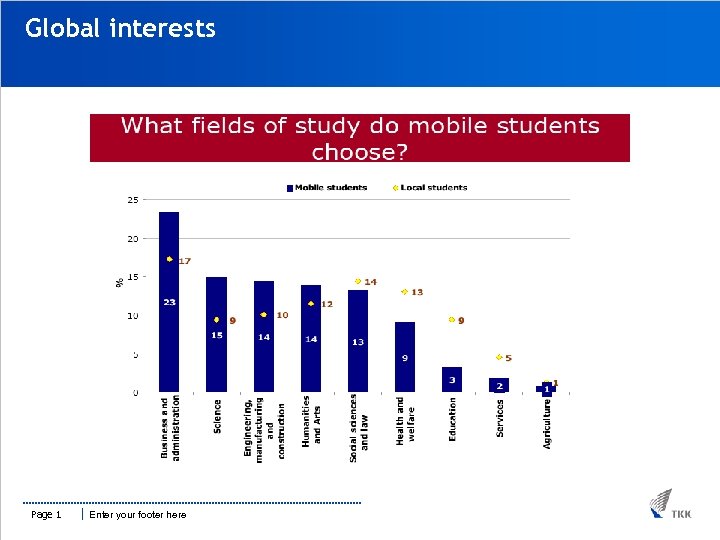
Global interests Page 1 Enter your footer here
Sources Page 1 Enter your footer here
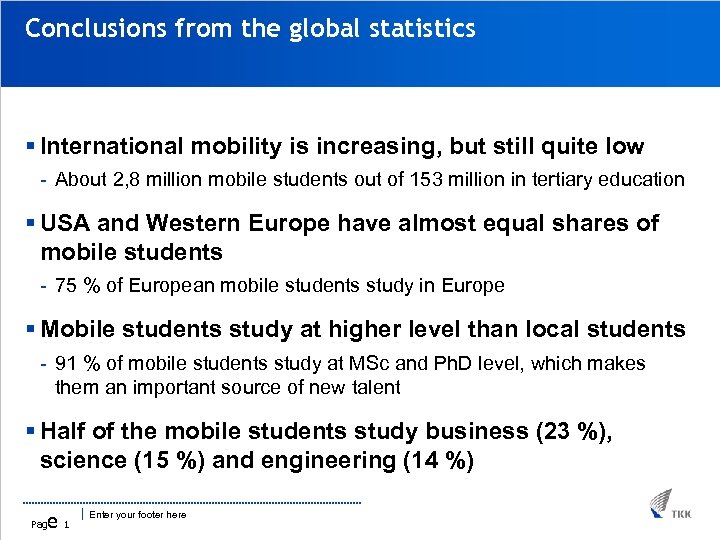
Conclusions from the global statistics § International mobility is increasing, but still quite low - About 2, 8 million mobile students out of 153 million in tertiary education § USA and Western Europe have almost equal shares of mobile students - 75 % of European mobile students study in Europe § Mobile students study at higher level than local students - 91 % of mobile students study at MSc and Ph. D level, which makes them an important source of new talent § Half of the mobile students study business (23 %), science (15 %) and engineering (14 %) e Pag 1 Enter your footer here
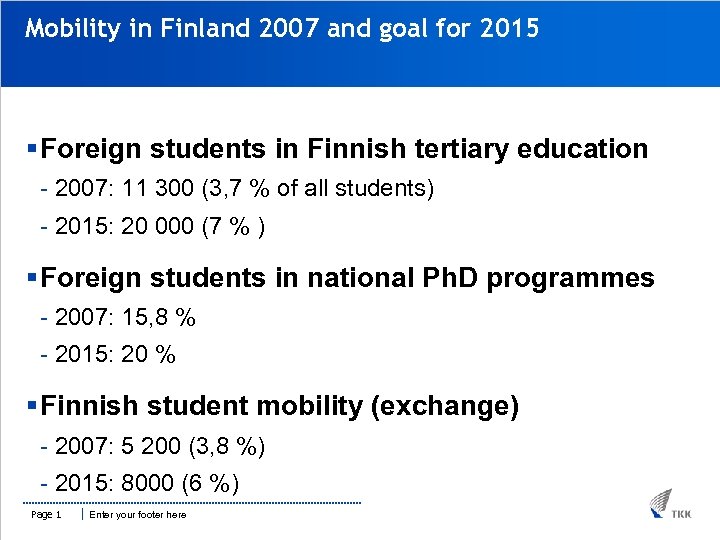
Mobility in Finland 2007 and goal for 2015 § Foreign students in Finnish tertiary education - 2007: 11 300 (3, 7 % of all students) - 2015: 20 000 (7 % ) § Foreign students in national Ph. D programmes - 2007: 15, 8 % - 2015: 20 % § Finnish student mobility (exchange) - 2007: 5 200 (3, 8 %) - 2015: 8000 (6 %) Page 1 Enter your footer here
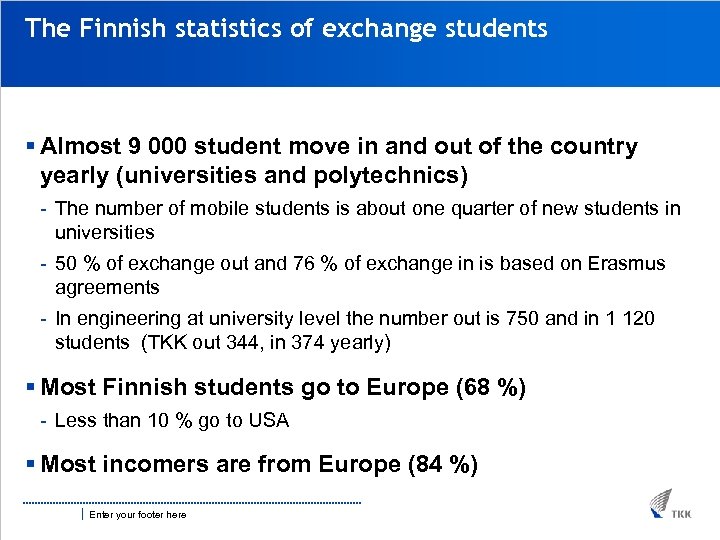
The Finnish statistics of exchange students § Almost 9 000 student move in and out of the country yearly (universities and polytechnics) - The number of mobile students is about one quarter of new students in universities - 50 % of exchange out and 76 % of exchange in is based on Erasmus agreements - In engineering at university level the number out is 750 and in 1 120 students (TKK out 344, in 374 yearly) § Most Finnish students go to Europe (68 %) - Less than 10 % go to USA § Most incomers are from Europe (84 %) Enter your footer here
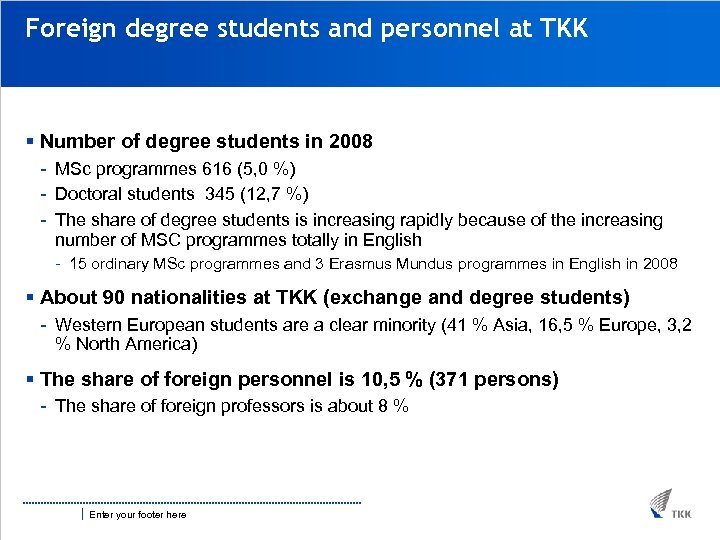
Foreign degree students and personnel at TKK § Number of degree students in 2008 - MSc programmes 616 (5, 0 %) - Doctoral students 345 (12, 7 %) - The share of degree students is increasing rapidly because of the increasing number of MSC programmes totally in English - 15 ordinary MSc programmes and 3 Erasmus Mundus programmes in English in 2008 § About 90 nationalities at TKK (exchange and degree students) - Western European students are a clear minority (41 % Asia, 16, 5 % Europe, 3, 2 % North America) § The share of foreign personnel is 10, 5 % (371 persons) - The share of foreign professors is about 8 % Enter your footer here
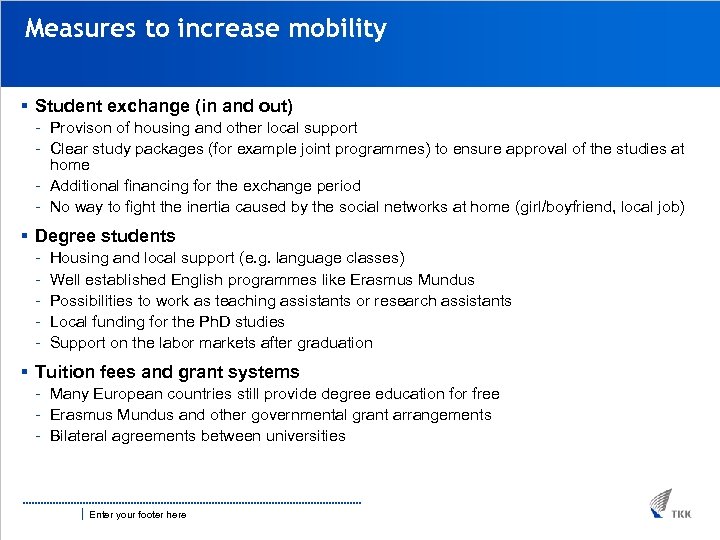
Measures to increase mobility § Student exchange (in and out) - Provison of housing and other local support - Clear study packages (for example joint programmes) to ensure approval of the studies at home - Additional financing for the exchange period - No way to fight the inertia caused by the social networks at home (girl/boyfriend, local job) § Degree students - Housing and local support (e. g. language classes) Well established English programmes like Erasmus Mundus Possibilities to work as teaching assistants or research assistants Local funding for the Ph. D studies Support on the labor markets after graduation § Tuition fees and grant systems - Many European countries still provide degree education for free - Erasmus Mundus and other governmental grant arrangements - Bilateral agreements between universities Enter your footer here
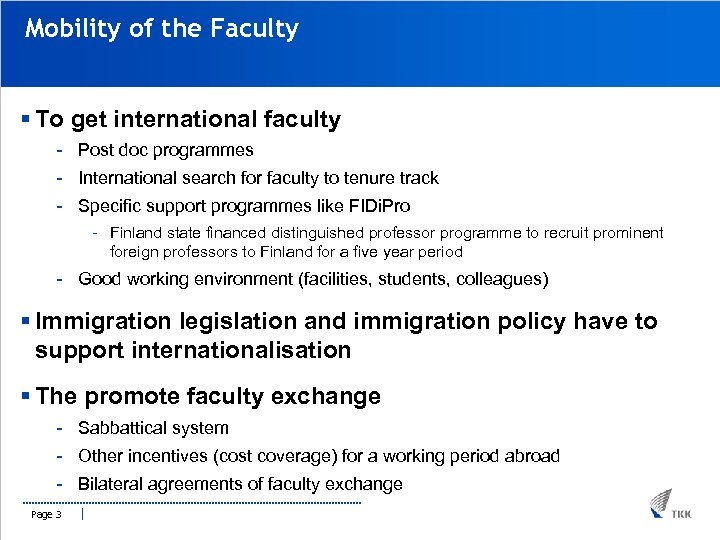
Mobility of the Faculty § To get international faculty - Post doc programmes - International search for faculty to tenure track - Specific support programmes like FIDi. Pro - Finland state financed distinguished professor programme to recruit prominent foreign professors to Finland for a five year period - Good working environment (facilities, students, colleagues) § Immigration legislation and immigration policy have to support internationalisation § The promote faculty exchange - Sabbattical system - Other incentives (cost coverage) for a working period abroad - Bilateral agreements of faculty exchange Page 3 Enter your footer here
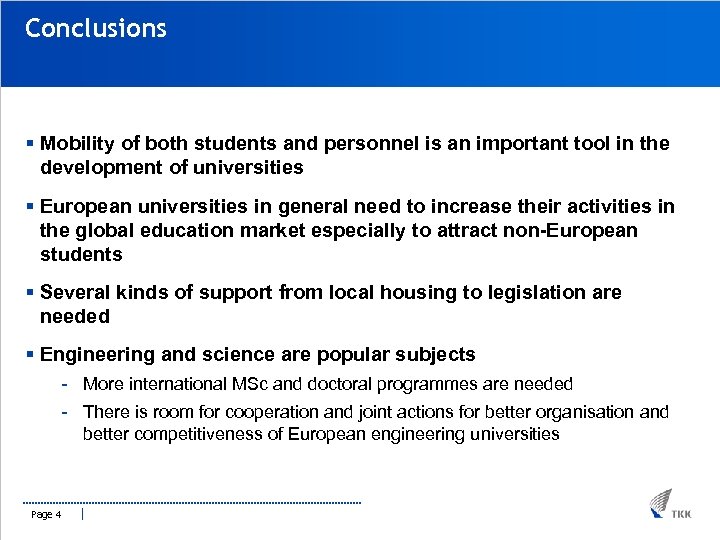
Conclusions § Mobility of both students and personnel is an important tool in the development of universities § European universities in general need to increase their activities in the global education market especially to attract non-European students § Several kinds of support from local housing to legislation are needed § Engineering and science are popular subjects - More international MSc and doctoral programmes are needed - There is room for cooperation and joint actions for better organisation and better competitiveness of European engineering universities Page 4 Enter your footer here
Thank you for your attention! Enter your footer here
Скачать презентацию Cesaer seminar 2009 Aalborg The modernisation agenda of
668e3becae307bf93a56fa0c84f763d0.ppt