 Скачать презентацию Cervical Cancer Detection Using SVM Based Feature Screening
f3fc739e7d66dc34739e30e8ae46afed.ppt
- Количество слайдов: 1



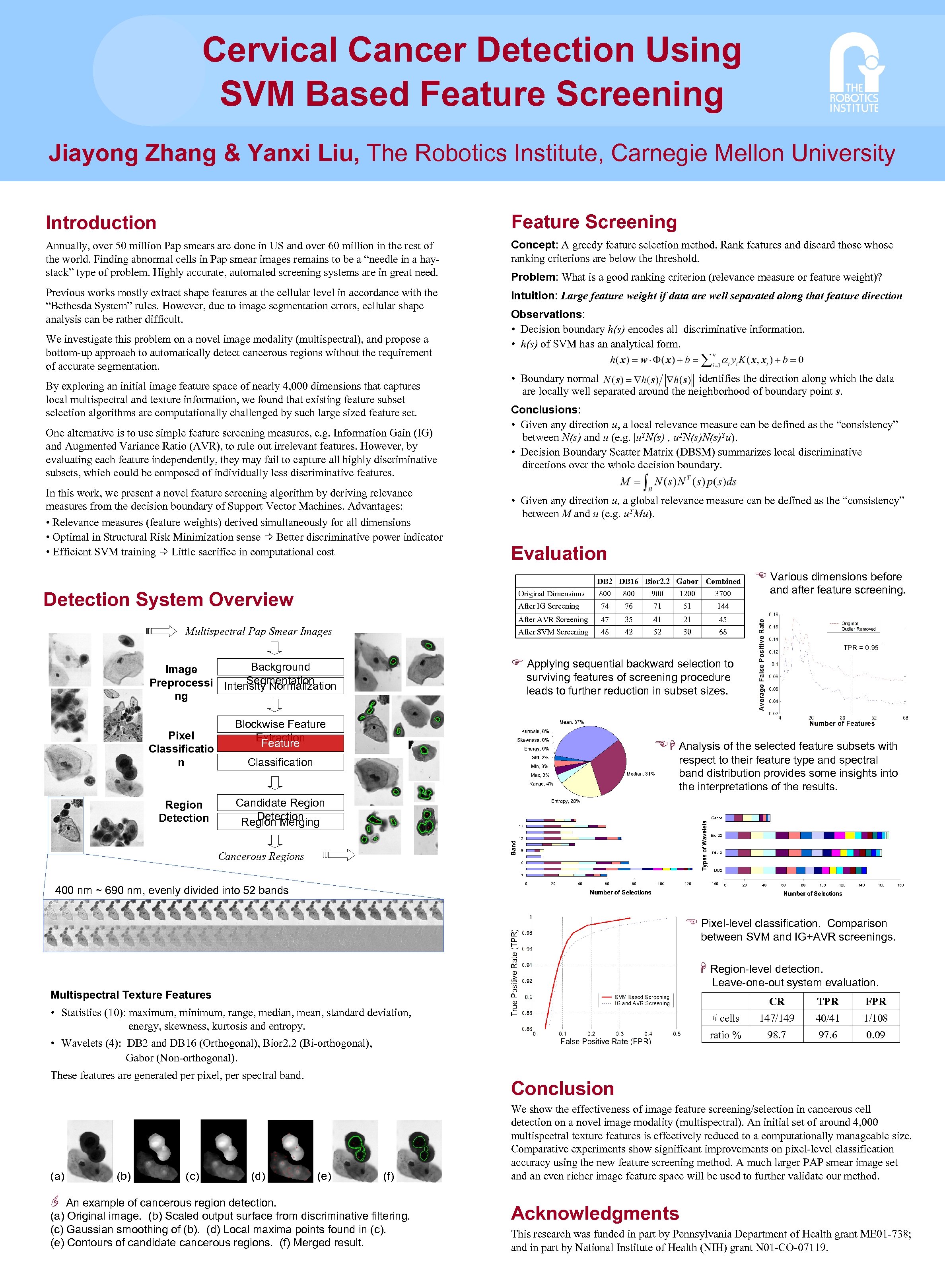
Cervical Cancer Detection Using SVM Based Feature Screening Jiayong Zhang & Yanxi Liu, The Robotics Institute, Carnegie Mellon University Introduction Feature Screening Annually, over 50 million Pap smears are done in US and over 60 million in the rest of the world. Finding abnormal cells in Pap smear images remains to be a “needle in a haystack” type of problem. Highly accurate, automated screening systems are in great need. Concept: A greedy feature selection method. Rank features and discard those whose ranking criterions are below the threshold. Previous works mostly extract shape features at the cellular level in accordance with the “Bethesda System” rules. However, due to image segmentation errors, cellular shape analysis can be rather difficult. Intuition: Large feature weight if data are well separated along that feature direction We investigate this problem on a novel image modality (multispectral), and propose a bottom-up approach to automatically detect cancerous regions without the requirement of accurate segmentation. By exploring an initial image feature space of nearly 4, 000 dimensions that captures local multispectral and texture information, we found that existing feature subset selection algorithms are computationally challenged by such large sized feature set. One alternative is to use simple feature screening measures, e. g. Information Gain (IG) and Augmented Variance Ratio (AVR), to rule out irrelevant features. However, by evaluating each feature independently, they may fail to capture all highly discriminative subsets, which could be composed of individually less discriminative features. In this work, we present a novel feature screening algorithm by deriving relevance measures from the decision boundary of Support Vector Machines. Advantages: • Relevance measures (feature weights) derived simultaneously for all dimensions • Optimal in Structural Risk Minimization sense Better discriminative power indicator • Efficient SVM training Little sacrifice in computational cost Problem: What is a good ranking criterion (relevance measure or feature weight)? Observations: • Decision boundary h(s) encodes all discriminative information. • h(s) of SVM has an analytical form. • Boundary normal identifies the direction along which the data are locally well separated around the neighborhood of boundary point s. Conclusions: • Given any direction u, a local relevance measure can be defined as the “consistency” between N(s) and u (e. g. |u. TN(s)|, u. TN(s)Tu). • Decision Boundary Scatter Matrix (DBSM) summarizes local discriminative directions over the whole decision boundary. • Given any direction u, a global relevance measure can be defined as the “consistency” between M and u (e. g. u. TMu). Evaluation DB 2 DB 16 Bior 2. 2 Gabor Combined Detection System Overview Original Dimensions 1200 3700 74 76 71 51 47 35 41 21 45 48 42 52 30 and after feature screening. 144 After SVM Screening 68 Applying sequential backward selection to Background Image Segmentation Preprocessi Intensity Normalization ng surviving features of screening procedure leads to further reduction in subset sizes. Blockwise Feature Extraction Feature Screening/Selection Classification Region Detection 900 After AVR Screening Pixel Classificatio n 800 After IG Screening Multispectral Pap Smear Images 800 E Various dimensions before Candidate Region Detection Region Merging E Analysis of the selected feature subsets with respect to their feature type and spectral band distribution provides some insights into the interpretations of the results. Cancerous Regions 400 nm ~ 690 nm, evenly divided into 52 bands E Pixel-level classification. Comparison between SVM and IG+AVR screenings. Region-level detection. Leave-one-out system evaluation. Multispectral Texture Features CR These features are generated per pixel, per spectral band. (a) (b) (c) (d) 40/41 1/108 98. 7 97. 6 0. 09 Conclusion (e) (f) An example of cancerous region detection. (a) Original image. (b) Scaled output surface from discriminative filtering. (c) Gaussian smoothing of (b). (d) Local maxima points found in (c). (e) Contours of candidate cancerous regions. (f) Merged result. 147/149 ratio % • Wavelets (4): DB 2 and DB 16 (Orthogonal), Bior 2. 2 (Bi-orthogonal), Gabor (Non-orthogonal). FPR # cells • Statistics (10): maximum, minimum, range, median, mean, standard deviation, energy, skewness, kurtosis and entropy. TPR We show the effectiveness of image feature screening/selection in cancerous cell detection on a novel image modality (multispectral). An initial set of around 4, 000 multispectral texture features is effectively reduced to a computationally manageable size. Comparative experiments show significant improvements on pixel-level classification accuracy using the new feature screening method. A much larger PAP smear image set and an even richer image feature space will be used to further validate our method. Acknowledgments This research was funded in part by Pennsylvania Department of Health grant ME 01 -738; and in part by National Institute of Health (NIH) grant N 01 -CO-07119.
Скачать презентацию Cervical Cancer Detection Using SVM Based Feature Screening
f3fc739e7d66dc34739e30e8ae46afed.ppt