


 Скачать презентацию Certified Wireless Network Administrator CWNA PW 0 -105
c2f0527466073974d83f7780ac5ddda5.ppt
- Количество слайдов: 30
 Certified Wireless Network Administrator (CWNA) PW 0 -105 Chapter 1 Overview of Wireless Standards, Organizations, and Fundamentals
 Chapter 1 Overview • • History of WLAN Standards Organizations Core, Distribution, and Access Communications Fundamentals Certified Wireless Network Administrator: CWNA – PW 0 -105 2
 History of WLAN • 19 th century research on electrical magnetic radio frequency (RF) • First used by United Stated during WWII • Spread spectrum patented in 1942 but not implemented until 1962 • University of Hawaii developed ALOHAnet in 1970 to communicate between the islands Certified Wireless Network Administrator: CWNA – PW 0 -105 3
 History of WLAN (continued) • 900 MHz low speed commercial networks were developed in the 1990’s • IEEE began discussing WLAN standardization in 1991 • IEEE 802. 11 was ratified in 1997 • Initially deployed in warehousing and manufacturing environments Certified Wireless Network Administrator: CWNA – PW 0 -105 4
 History of WLAN (continued) • IEEE 802. 11 b was ratified in 1999 • Introduced 11 Mbps transmission speed • Faster data rate and price decreases ignited sales in home and small office environments • More than 350 million Wi-Fi chipsets shipped in 2010 Certified Wireless Network Administrator: CWNA – PW 0 -105 5
 Standards Organizations • Regulatory Domain Authorities, such as the Federal Communications Commission (FCC) • International Telecommunications Union Radiocommunication Sector (ITU-R) • Institute of Electrical and Electronics Engineers (IEEE) • Internet Engineering Task Force (IETF) • Wi-Fi Alliance • International Organization for Standardization (ISO) Certified Wireless Network Administrator: CWNA – PW 0 -105 6
 Regulatory Domain Authorities • Regulates communications within the country of jurisdiction • Typically regulates – Licensed spectrum – Unlicensed spectrum Certified Wireless Network Administrator: CWNA – PW 0 -105 7
 Regulatory Domain Authorities (continued) • Five areas of RF typically regulated – – Frequency Bandwidth Maximum power of the intentional radiator (IR) Maximum equivalent isotropically radiated power (EIRP) – Use (indoor and/or outdoor) Certified Wireless Network Administrator: CWNA – PW 0 -105 8
 Regulatory Domain Authorities (continued) • FCC rules are published in the Code of Federal Regulations (CFR) • Divided into 50 titles • Title 47, Telecommunications – Relevant to wireless • Titles are divided into parts • Part 15, “Radio Frequency Devices” – Contains rules and regulations regarding 802. 11 Certified Wireless Network Administrator: CWNA – PW 0 -105 9
 International Telecommunication Union Radiocommunication Sector (ITU-R) • Global hierarchy for management of the RF spectrum worldwide • Tasked by the United Nations • Maintains database of worldwide frequency assignments • Coordinates spectrum management through five administrative regions Certified Wireless Network Administrator: CWNA – PW 0 -105 10
 Institute of Electrical and Electronics Engineers (IEEE) • Mission is to “foster technological innovation and excellence for the benefit of humanity” • Global professional society • More than 400, 000 members worldwide • Best known for its LAN standards – IEEE 802 project Certified Wireless Network Administrator: CWNA – PW 0 -105 11
 Institute of Electrical and Electronics Engineers (IEEE) (continued) • Subdivided into working groups • Groups develop standards that address specific problems or needs • Group numbers assigned sequentially; eg. 802. 1, 802. 2, … • Revisions or amendments are assigned sequential letters – eg. 802. 11 a, b, c, …ac, ad, ae… Certified Wireless Network Administrator: CWNA – PW 0 -105 12
 Internet Engineering Task Force (IETF) • • • Goal to make the Internet work better No membership fees Open to anyone Part of the Internet Society (ISOC) Made up of many working groups A working group creates a documents known as a Request for Comments (RFC) Certified Wireless Network Administrator: CWNA – PW 0 -105 13
 Wi-Fi Alliance • • Global, nonprofit industry association More than 350 member companies Devoted to promoting the growth of WLANs Main task is to provide hardware certification testing • Founded in 1999 as the Wireless Ethernet Compatibility Alliance (WECA) • Changed its name in 2002 Certified Wireless Network Administrator: CWNA – PW 0 -105 14
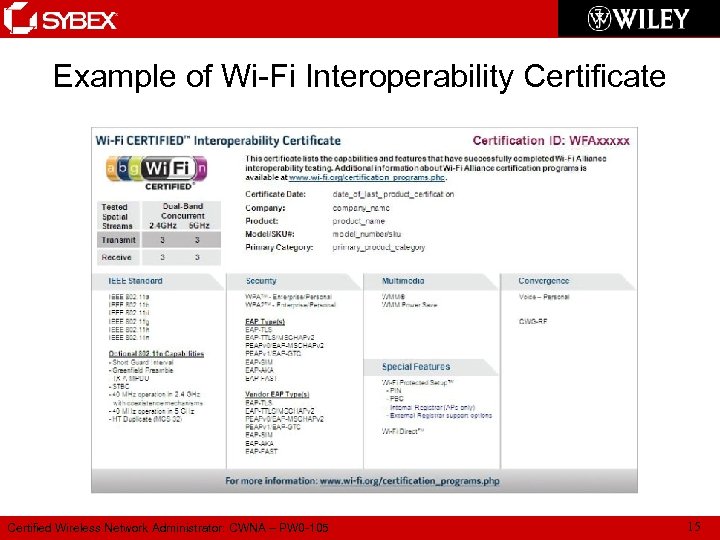 Example of Wi-Fi Interoperability Certificate Certified Wireless Network Administrator: CWNA – PW 0 -105 15
 Wi-Fi CERTIFIED Programs • • Core Technology & Security Wi-Fi Multimedia (WMM) WMM Power Save (WMM-PS) Wi-Fi Protected Setup - Security Wi-Fi Direct CWG-RF – Multimedia Voice Personal - Application Certified Wireless Network Administrator: CWNA – PW 0 -105 16
 International Organization for Standardization (ISO) • Global, nongovernmental organization • Responsible for Open Systems Interconnection (OSI) model • OSI model developed in the late 1970 s Certified Wireless Network Administrator: CWNA – PW 0 -105 17
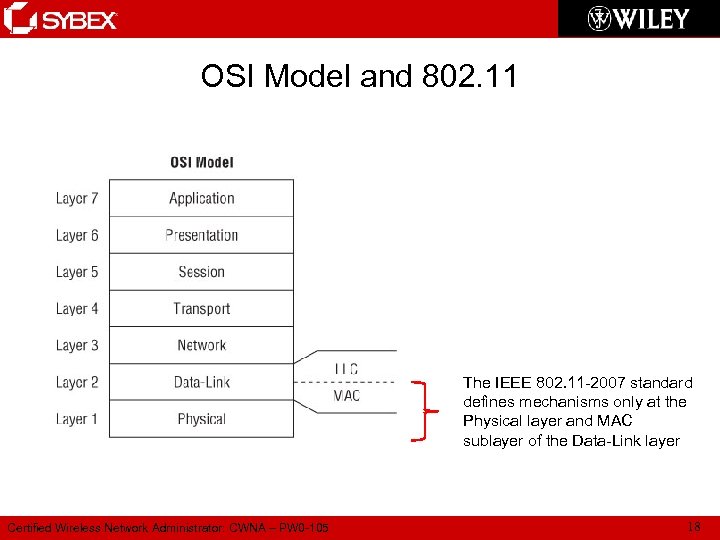 OSI Model and 802. 11 The IEEE 802. 11 -2007 standard defines mechanisms only at the Physical layer and MAC sublayer of the Data-Link layer Certified Wireless Network Administrator: CWNA – PW 0 -105 18
 Core, Distribution, and Access • Core – High-speed backbone – Performs high-speed switching • Distribution – Routes traffic between VLANs and subnets – Wireless bridging between buildings • Access – Delivery of traffic to end user – Typically where 802. 11 operates Certified Wireless Network Administrator: CWNA – PW 0 -105 19
 Communications Fundamentals • • • Amplitude Wavelength Frequency Phase Carrier Signals Keying Methods – Amplitude Shift Keying (ASK) – Frequency Shift Keying (FSK) – Phase Shift Keying (PSK) Certified Wireless Network Administrator: CWNA – PW 0 -105 20
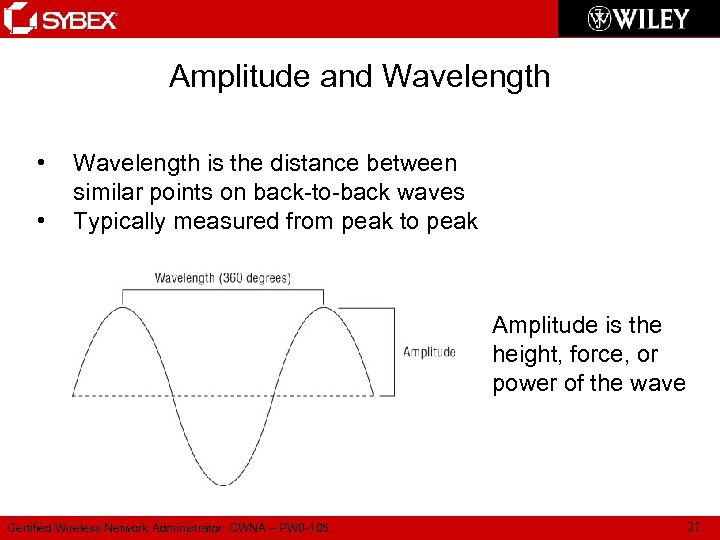 Amplitude and Wavelength • • Wavelength is the distance between similar points on back-to-back waves Typically measured from peak to peak Amplitude is the height, force, or power of the wave Certified Wireless Network Administrator: CWNA – PW 0 -105 21
 Frequency • • • Number of waves generated per second One wave = one oscillation Measured in hertz (Hz) Hertz = one oscillation per second 2. 4 GHz = 2. 4 billion oscillations per second Certified Wireless Network Administrator: CWNA – PW 0 -105 22
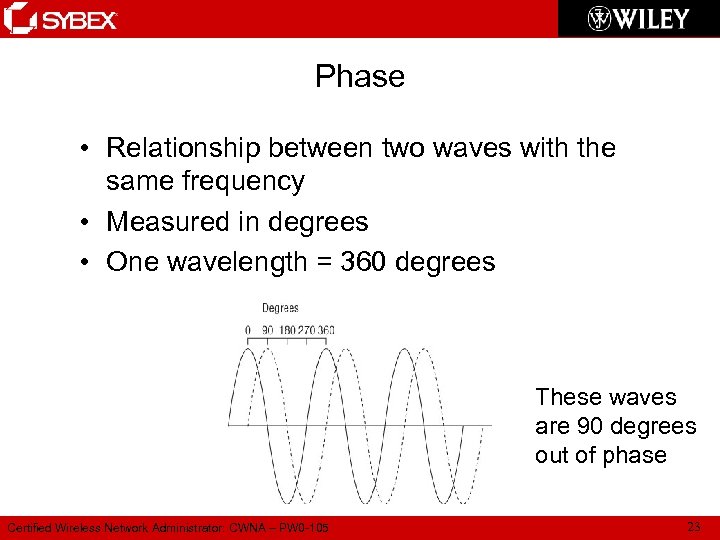 Phase • Relationship between two waves with the same frequency • Measured in degrees • One wavelength = 360 degrees These waves are 90 degrees out of phase Certified Wireless Network Administrator: CWNA – PW 0 -105 23
 Carrier Signal • Data consists of 0 and 1 bits • AC or DC signal needs to represent data • RF signal can represent data by fluctuating or altering its RF properties • Properties that can be altered – Amplitude – Frequency – Phase Certified Wireless Network Administrator: CWNA – PW 0 -105 24
 Keying Methods • Method of manipulating a signal to represent multiple pieces of data • Three types of keying methods – Amplitude-shift keying (ASK) – Frequency-shift keying (FSK) – Phase-shift keying (PSK) • Two techniques used to represent data – Current state – State transition Certified Wireless Network Administrator: CWNA – PW 0 -105 25
 Keying Techniques • Current State – Current value of the signal is used to distinguish between 0 s and 1 s – Current value or level at a specific time • State Transition – A change or transition of the signal is used to distinguish between 0 s and 1 s – Presence of a change or lack of presence of a change determines 0 or 1 Certified Wireless Network Administrator: CWNA – PW 0 -105 26
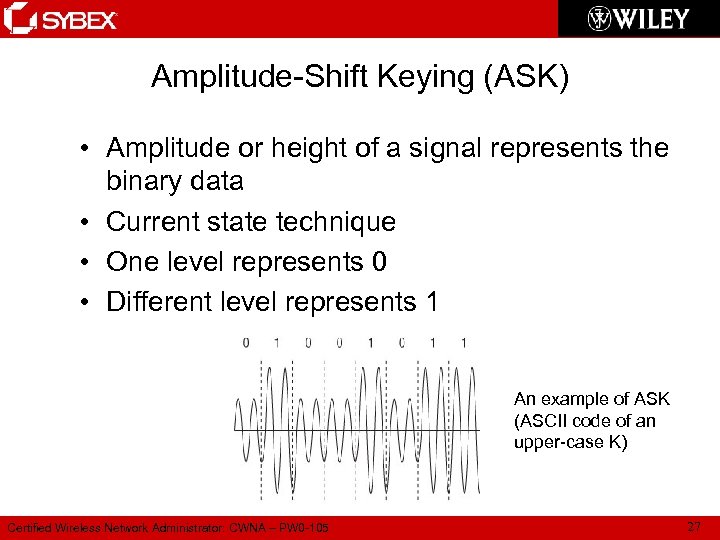 Amplitude-Shift Keying (ASK) • Amplitude or height of a signal represents the binary data • Current state technique • One level represents 0 • Different level represents 1 An example of ASK (ASCII code of an upper-case K) Certified Wireless Network Administrator: CWNA – PW 0 -105 27
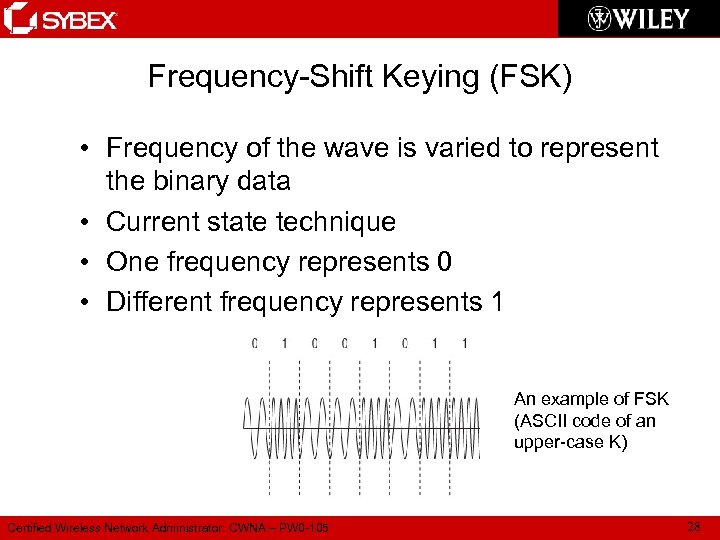 Frequency-Shift Keying (FSK) • Frequency of the wave is varied to represent the binary data • Current state technique • One frequency represents 0 • Different frequency represents 1 An example of FSK (ASCII code of an upper-case K) Certified Wireless Network Administrator: CWNA – PW 0 -105 28
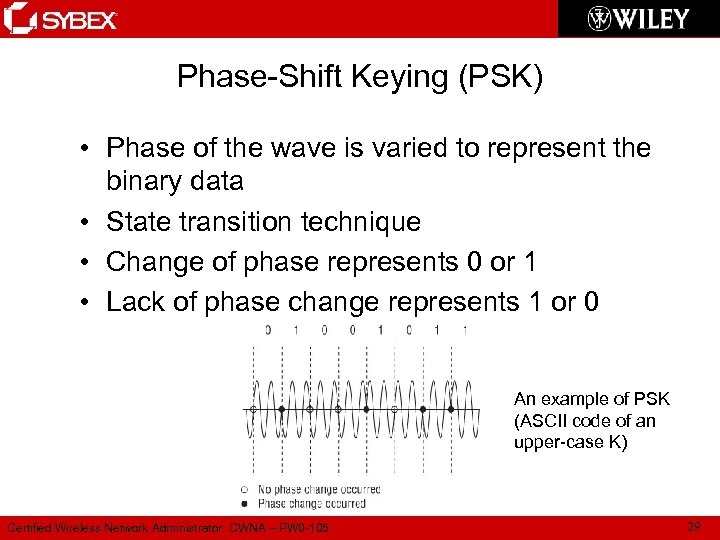 Phase-Shift Keying (PSK) • Phase of the wave is varied to represent the binary data • State transition technique • Change of phase represents 0 or 1 • Lack of phase change represents 1 or 0 An example of PSK (ASCII code of an upper-case K) Certified Wireless Network Administrator: CWNA – PW 0 -105 29
 Chapter 1 Summary • History of WLANs • Roles of standards organizations • Relationship between 802. 11 and Core, Distribution, and Access • Communications Fundamentals – – – Amplitude Wavelength Frequency Phase Carrier signals & keying methods Certified Wireless Network Administrator: CWNA – PW 0 -105 30