 Скачать презентацию Certificates for developing renewables and efficient use of
ef01491a28089e9829c909a83f0d347a.ppt
- Количество слайдов: 16



Certificates for developing renewables and efficient use of energy By Senior research specialist Poul Erik Morthorst Systems Analyses Department Risø National Laboratory Denmark Systems Analysis
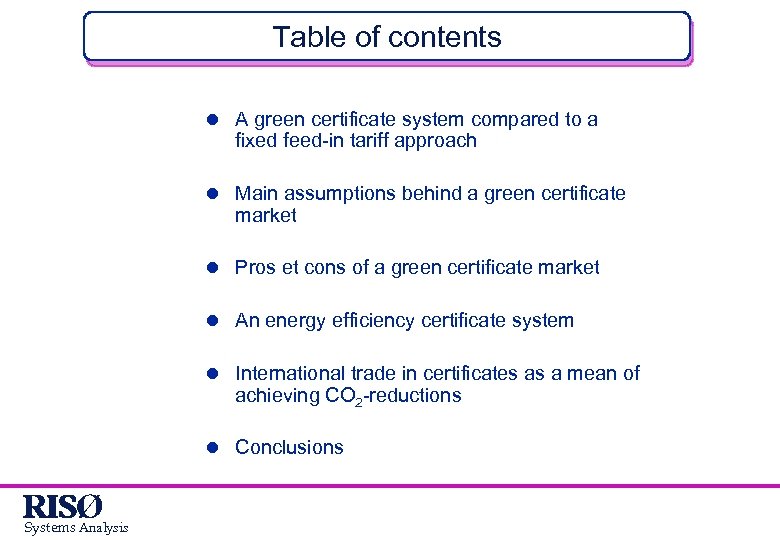
Table of contents l A green certificate system compared to a fixed feed-in tariff approach l Main assumptions behind a green certificate market l Pros et cons of a green certificate market l An energy efficiency certificate system l International trade in certificates as a mean of achieving CO 2 -reductions l Conclusions Systems Analysis
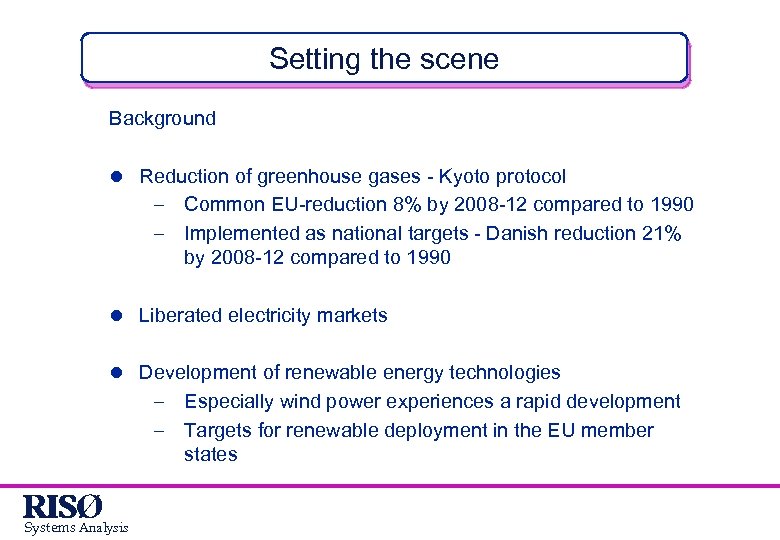
Setting the scene Background l Reduction of greenhouse gases - Kyoto protocol - Common EU-reduction 8% by 2008 -12 compared to 1990 - Implemented as national targets - Danish reduction 21% by 2008 -12 compared to 1990 l Liberated electricity markets l Development of renewable energy technologies - Especially wind power experiences a rapid development - Targets for renewable deployment in the EU member states Systems Analysis
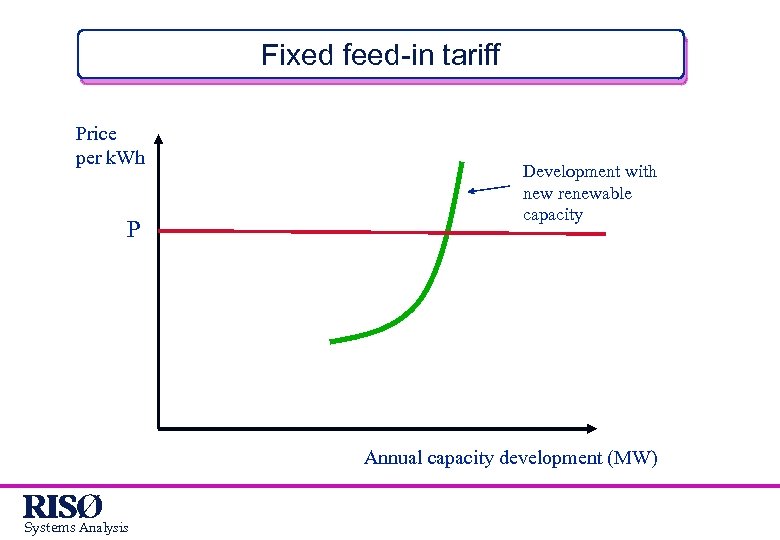
Fixed feed-in tariff Price per k. Wh P Development with new renewable capacity Annual capacity development (MW) Systems Analysis
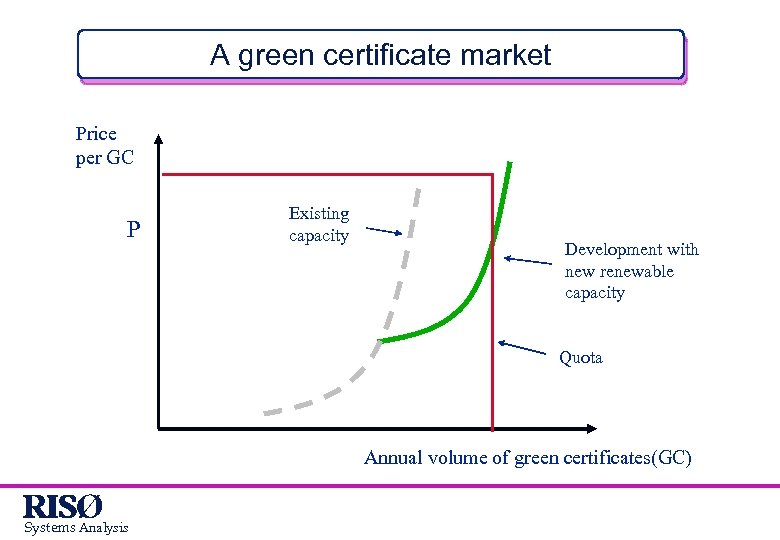
A green certificate market Price per GC P Existing capacity Development with new renewable capacity Quota Annual volume of green certificates(GC) Systems Analysis
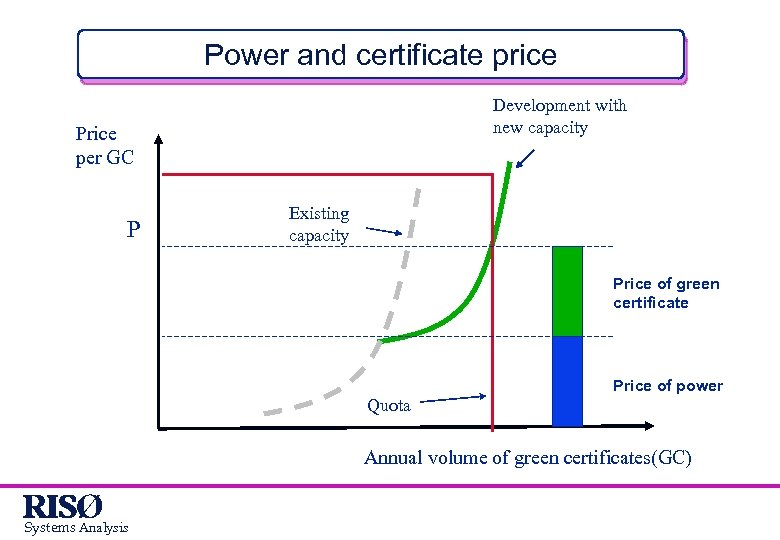
Power and certificate price Development with new capacity Price per GC P Existing capacity Price of green certificate Price of power Quota Annual volume of green certificates(GC) Systems Analysis
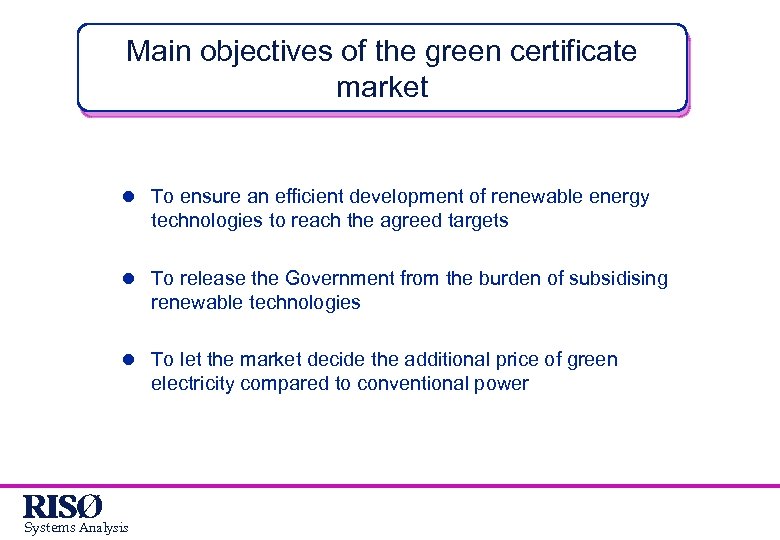
Main objectives of the green certificate market l To ensure an efficient development of renewable energy technologies to reach the agreed targets l To release the Government from the burden of subsidising renewable technologies l To let the market decide the additional price of green electricity compared to conventional power Systems Analysis
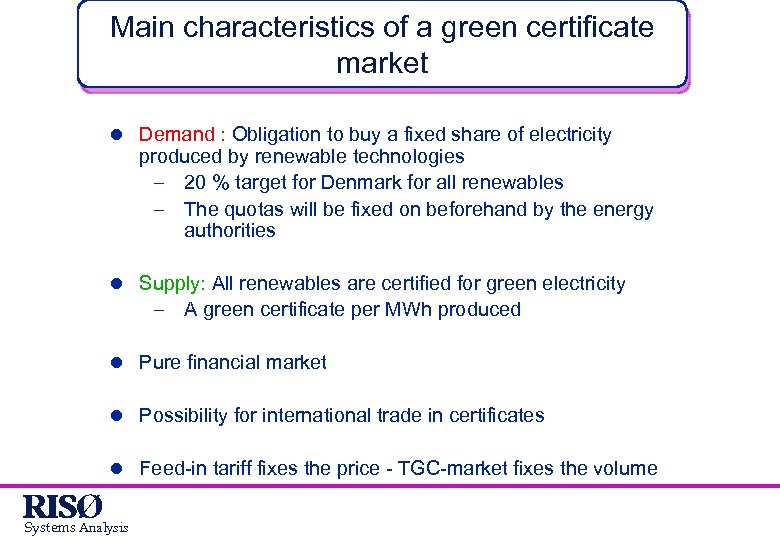
Main characteristics of a green certificate market l Demand : Obligation to buy a fixed share of electricity produced by renewable technologies - 20 % target for Denmark for all renewables - The quotas will be fixed on beforehand by the energy authorities l Supply: All renewables are certified for green electricity - A green certificate per MWh produced l Pure financial market l Possibility for international trade in certificates l Feed-in tariff fixes the price - TGC-market fixes the volume Systems Analysis
Pro et cons Advantages l Efficiency improvements show up in GC-prices directly l Strong regulation of capacity development l No governmental subsidisation - the consumers are going to pay l International trade with green certificates is possible Disadvantages l Only the most competitive renewable technology is promoted l The national market should have a minimum volume l Higher investment risk: The GC market comprises both market risk and reliability of politicians l How will green certificates interplay with other greenhouse gas reduction instruments? Systems Analysis
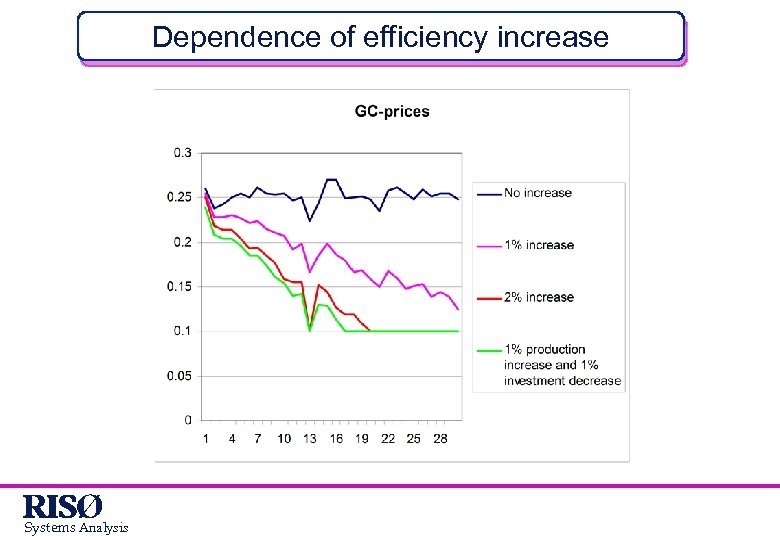
Dependence of efficiency increase Systems Analysis
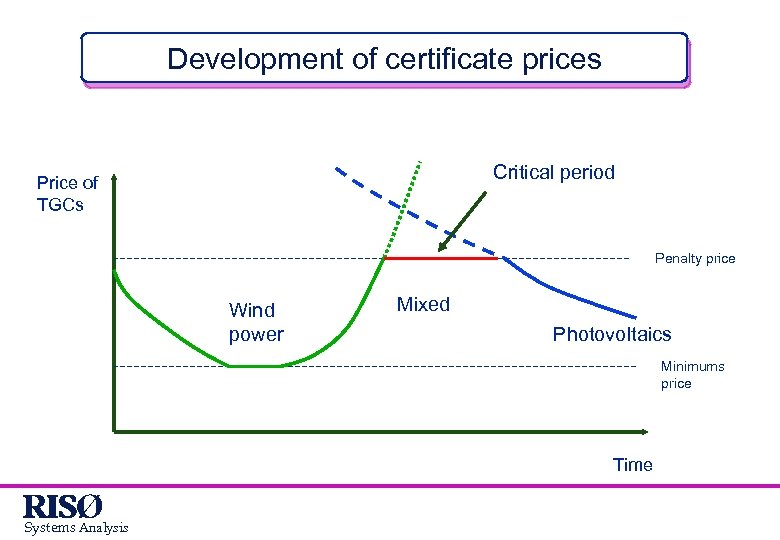
Development of certificate prices Critical period Price of TGCs Penalty price Wind power Mixed Photovoltaics Minimums price Time Systems Analysis
Characteristics for an energy efficiency certificate market In principle the same as for a renewable certificate market l Demand : Obligation to buy a fixed amount of certificates from energy efficiency projects l Supply: Energy efficiency projects certified for supplying certificates l Pure financial market l Can be combined with the green market for renewables l Monitoring and certification becomes more important than for the renewable system Systems Analysis
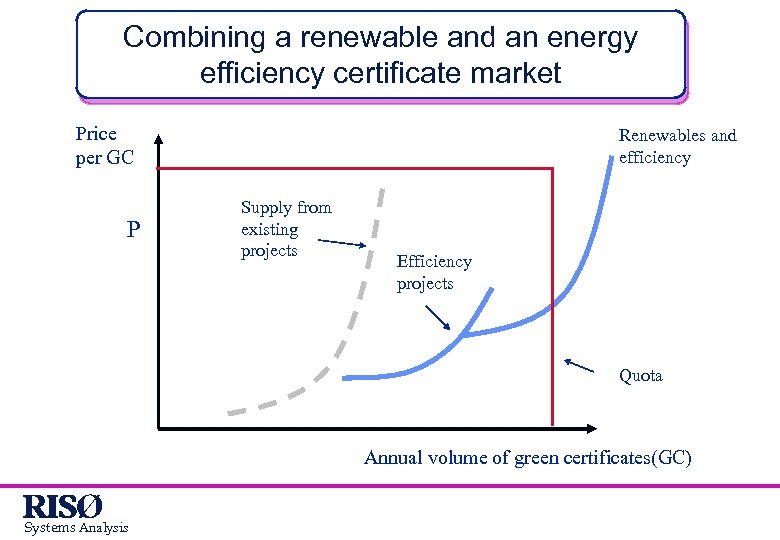
Combining a renewable and an energy efficiency certificate market Price per GC P Renewables and efficiency Supply from existing projects Efficiency projects Quota Annual volume of green certificates(GC) Systems Analysis
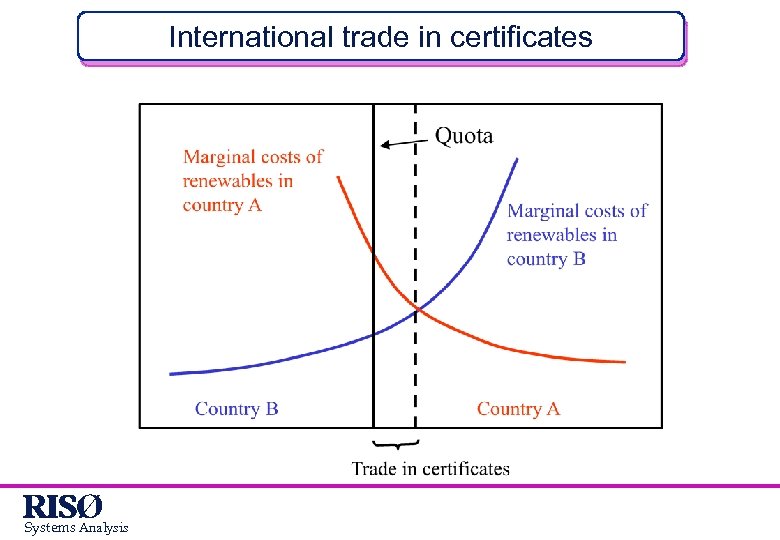
International trade in certificates Systems Analysis
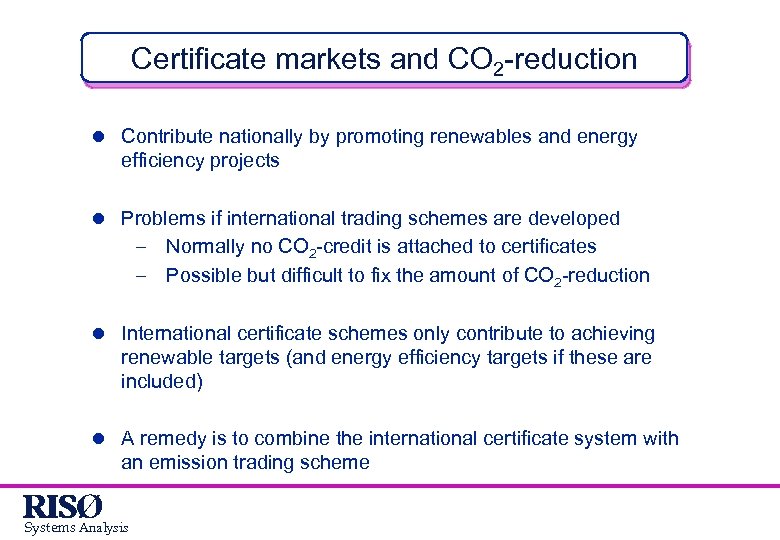
Certificate markets and CO 2 -reduction l Contribute nationally by promoting renewables and energy efficiency projects l Problems if international trading schemes are developed - Normally no CO 2 -credit is attached to certificates - Possible but difficult to fix the amount of CO 2 -reduction l International certificate schemes only contribute to achieving renewable targets (and energy efficiency targets if these are included) l A remedy is to combine the international certificate system with an emission trading scheme Systems Analysis
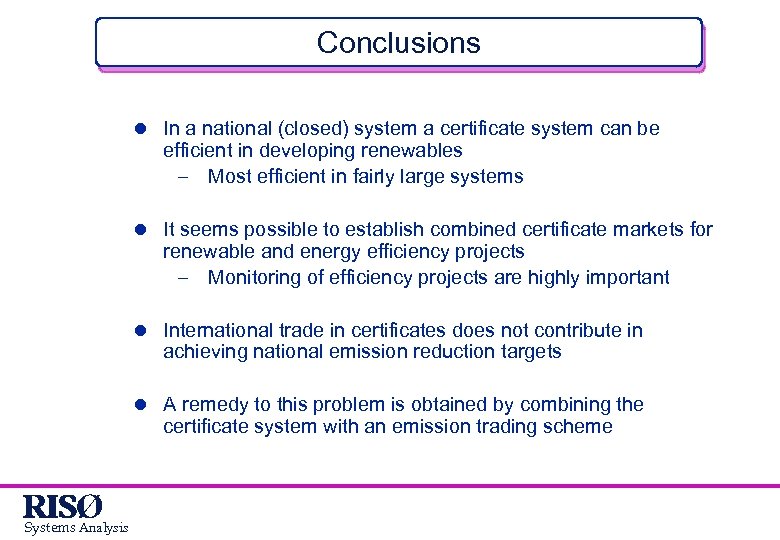
Conclusions l In a national (closed) system a certificate system can be efficient in developing renewables - Most efficient in fairly large systems l It seems possible to establish combined certificate markets for renewable and energy efficiency projects - Monitoring of efficiency projects are highly important l International trade in certificates does not contribute in achieving national emission reduction targets l A remedy to this problem is obtained by combining the certificate system with an emission trading scheme Systems Analysis
Скачать презентацию Certificates for developing renewables and efficient use of
ef01491a28089e9829c909a83f0d347a.ppt