


 Скачать презентацию Certificate of Completion Program Reviews Management Human
d38ab5389b230ac0299dd2fbd0cdf2a4.ppt
- Количество слайдов: 45
 Certificate of Completion Program Reviews Management / Human Resources and Management / Small Business 2007 -2011
 Business Programs Overview Recommendations from Previous Program Reviews Assessment of Program Quality Assessment of Program Need Assessment of Program Cost
 Business Programs Overview http: //www. lc. edu/business
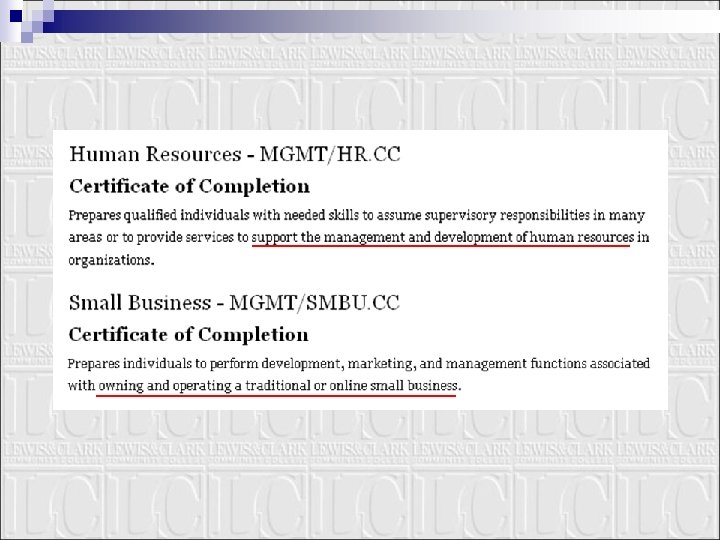
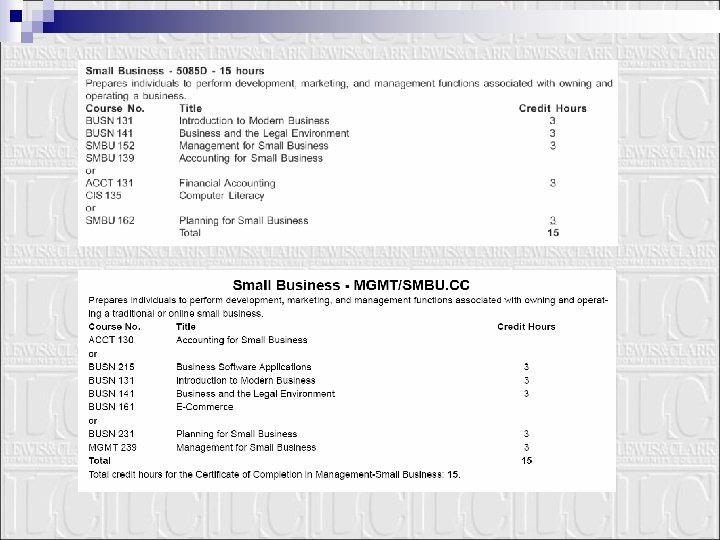
 L&C Catalog Content on Certificates of Completion within Management
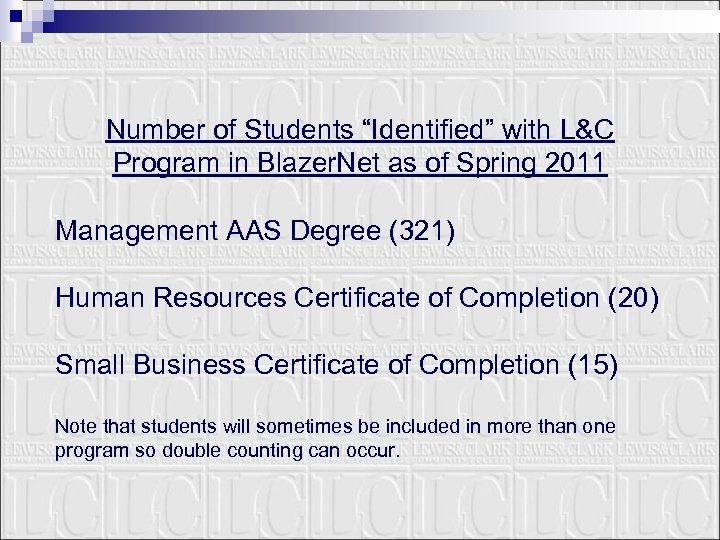 Number of Students “Identified” with L&C Program in Blazer. Net as of Spring 2011 Management AAS Degree (321) Human Resources Certificate of Completion (20) Small Business Certificate of Completion (15) Note that students will sometimes be included in more than one program so double counting can occur.
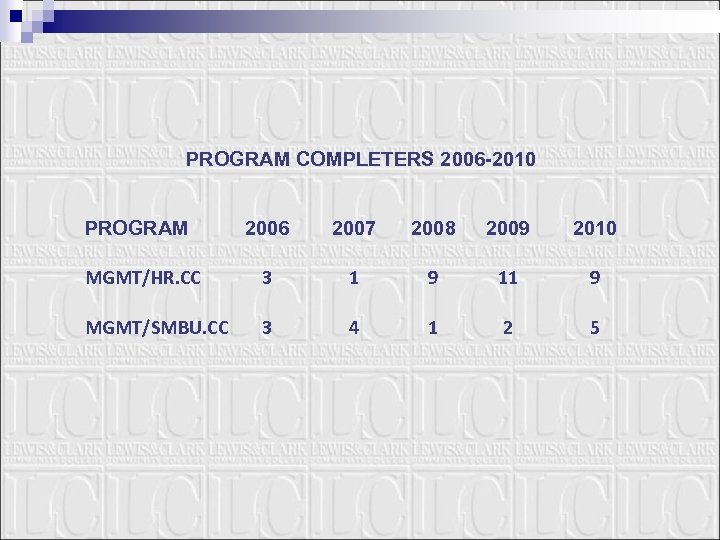 PROGRAM COMPLETERS 2006 -2010 PROGRAM 2006 2007 2008 2009 2010 MGMT/HR. CC 3 1 9 11 9 MGMT/SMBU. CC 3 4 1 2 5
 Recommendations from Previous Program Reviews
 Specific Recommendations 1. Establish certificate program learning objectives. 2. Increase efforts to promote the certificate programs. 3. Modify small business certificate course options to enhance coverage of the business use of the web and to reduce scheduling hurdles to certificate completion.
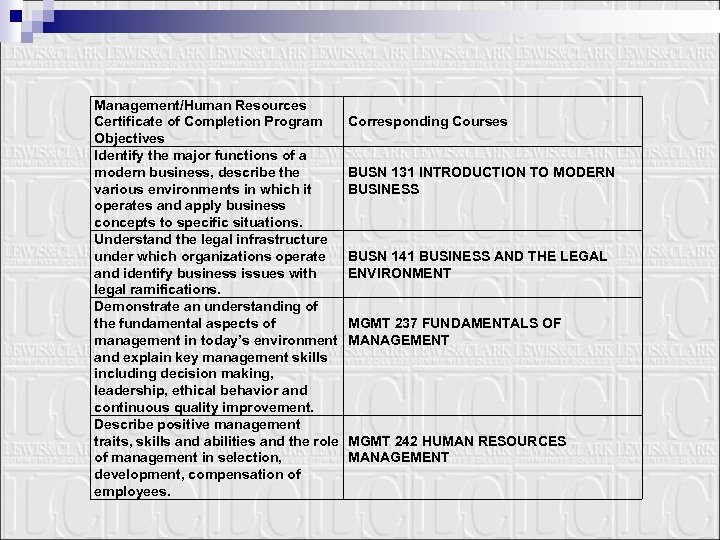 Management/Human Resources Certificate of Completion Program Objectives Identify the major functions of a modern business, describe the various environments in which it operates and apply business concepts to specific situations. Understand the legal infrastructure under which organizations operate and identify business issues with legal ramifications. Demonstrate an understanding of the fundamental aspects of management in today’s environment and explain key management skills including decision making, leadership, ethical behavior and continuous quality improvement. Describe positive management traits, skills and abilities and the role of management in selection, development, compensation of employees. Corresponding Courses BUSN 131 INTRODUCTION TO MODERN BUSINESS BUSN 141 BUSINESS AND THE LEGAL ENVIRONMENT MGMT 237 FUNDAMENTALS OF MANAGEMENT MGMT 242 HUMAN RESOURCES MANAGEMENT
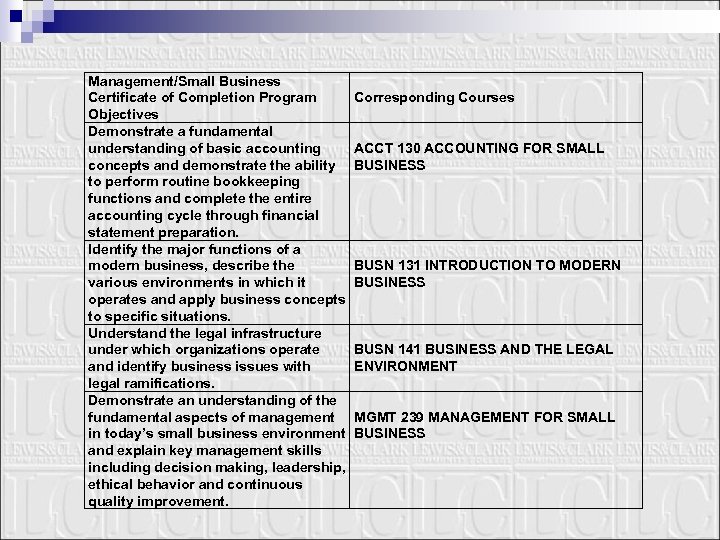 Management/Small Business Certificate of Completion Program Objectives Demonstrate a fundamental understanding of basic accounting concepts and demonstrate the ability to perform routine bookkeeping functions and complete the entire accounting cycle through financial statement preparation. Identify the major functions of a modern business, describe the various environments in which it operates and apply business concepts to specific situations. Understand the legal infrastructure under which organizations operate and identify business issues with legal ramifications. Demonstrate an understanding of the fundamental aspects of management in today’s small business environment and explain key management skills including decision making, leadership, ethical behavior and continuous quality improvement. Corresponding Courses ACCT 130 ACCOUNTING FOR SMALL BUSINESS BUSN 131 INTRODUCTION TO MODERN BUSINESS BUSN 141 BUSINESS AND THE LEGAL ENVIRONMENT MGMT 239 MANAGEMENT FOR SMALL BUSINESS
 Specific Recommendations 1. Establish certificate program learning objectives. 2. Increase efforts to promote the certificate programs. 3. Modify small business certificate course options to enhance coverage of the business use of the web and to reduce scheduling hurdles to certificate completion.
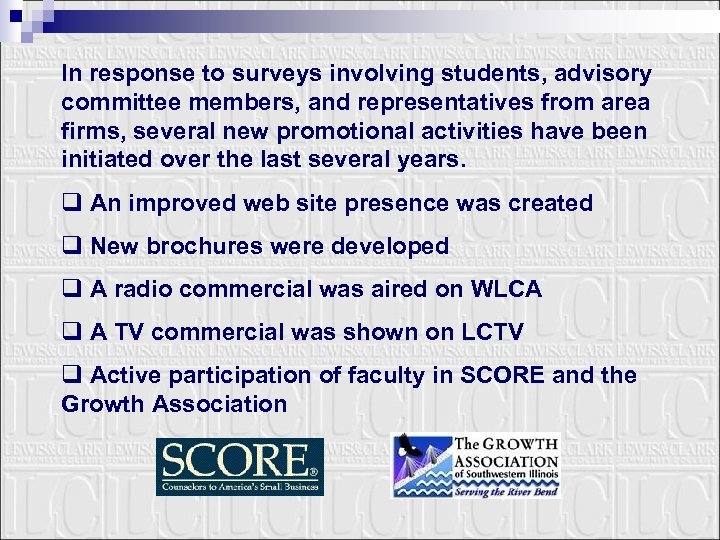 In response to surveys involving students, advisory committee members, and representatives from area firms, several new promotional activities have been initiated over the last several years. q An improved web site presence was created q New brochures were developed q A radio commercial was aired on WLCA q A TV commercial was shown on LCTV q Active participation of faculty in SCORE and the Growth Association
 Specific Recommendations 1. Establish certificate program learning objectives. 2. Increase efforts to promote the certificate programs. 3. Modify small business certificate course options to enhance coverage of the business use of the web and to reduce scheduling hurdles to certificate completion.
 Assessment of Program Quality
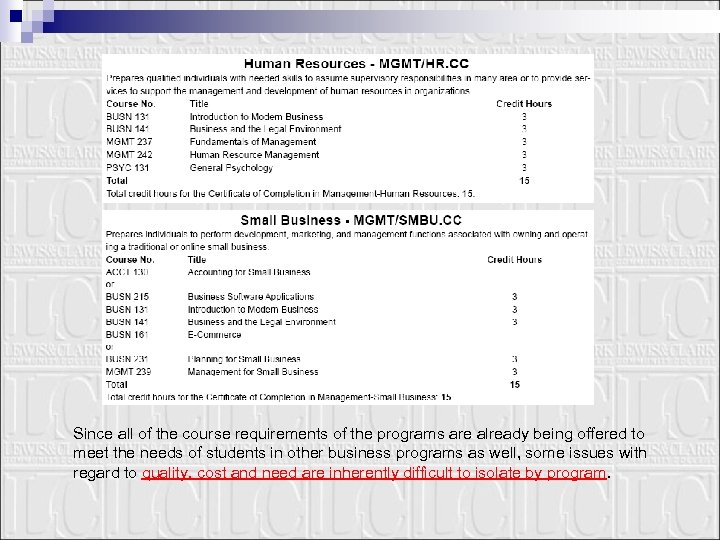 Since all of the course requirements of the programs are already being offered to meet the needs of students in other business programs as well, some issues with regard to quality, cost and need are inherently difficult to isolate by program.
 Comments on Methodology • It should be noted that the business programs at L&C overlap in many ways. Students sometimes start with a short-term certificates and subsequently continue with their studies to complete degrees. • Also, most of the courses are common to many programs. Therefore, it is often difficult to separate factors unique to a particular program. • As a result, a lot of the information provided in this presentation will include Business Department data from departmental transfer courses and other business career program courses as well.
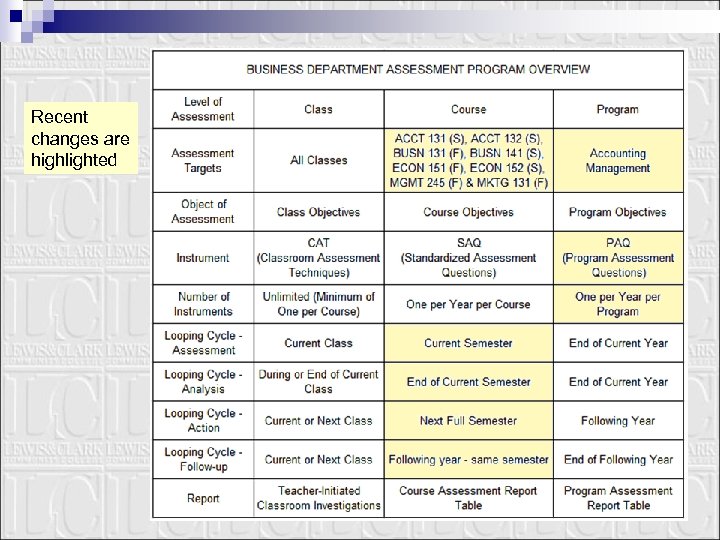 Recent changes are highlighted
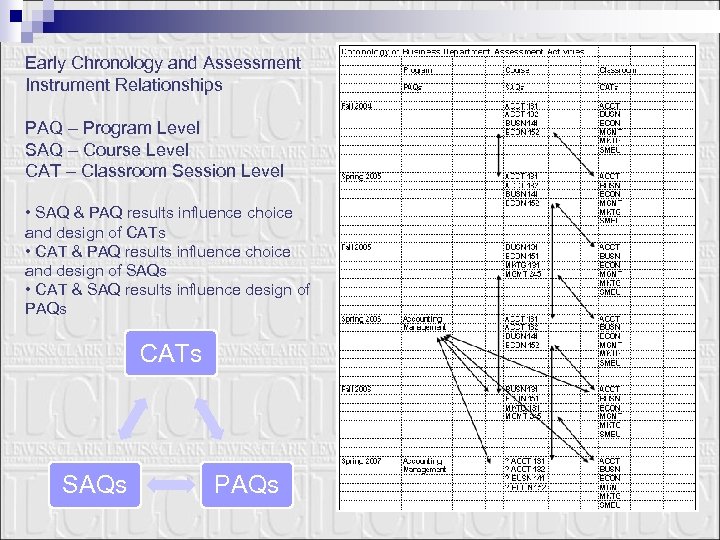 Early Chronology and Assessment Instrument Relationships PAQ – Program Level SAQ – Course Level CAT – Classroom Session Level • SAQ & PAQ results influence choice and design of CATs • CAT & PAQ results influence choice and design of SAQs • CAT & SAQ results influence design of PAQs CATs SAQs PAQs
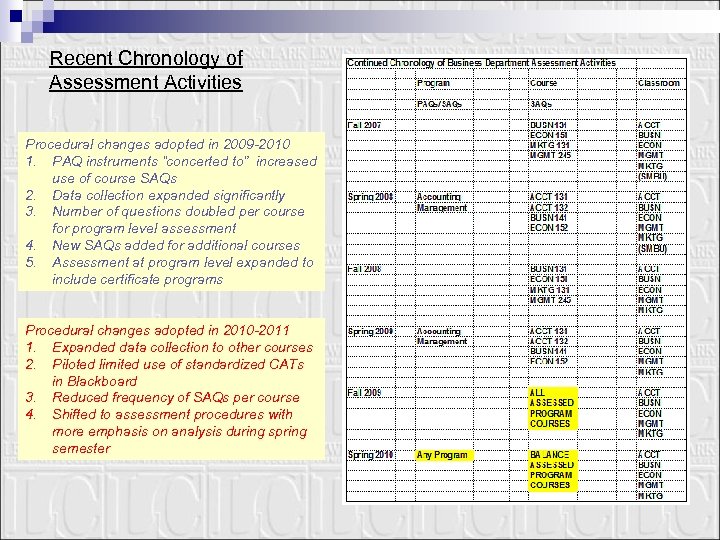 Recent Chronology of Assessment Activities Procedural changes adopted in 2009 -2010 1. PAQ instruments “concerted to” increased use of course SAQs 2. Data collection expanded significantly 3. Number of questions doubled per course for program level assessment 4. New SAQs added for additional courses 5. Assessment at program level expanded to include certificate programs Procedural changes adopted in 2010 -2011 1. Expanded data collection to other courses 2. Piloted limited use of standardized CATs in Blackboard 3. Reduced frequency of SAQs per course 4. Shifted to assessment procedures with more emphasis on analysis during spring semester
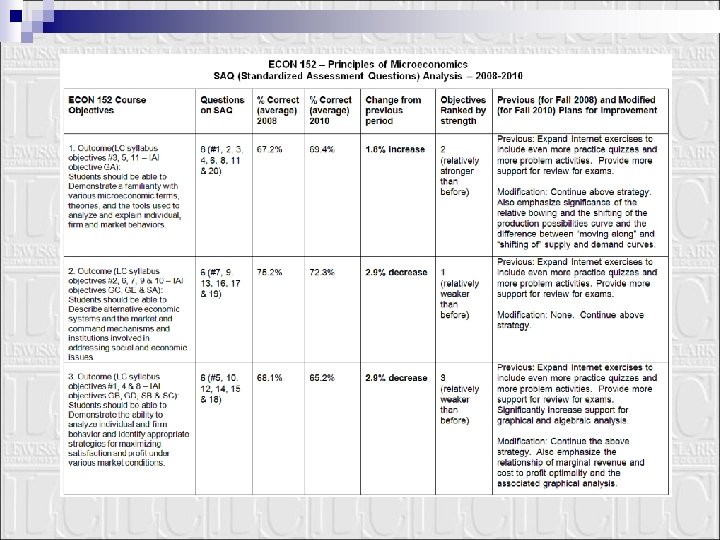
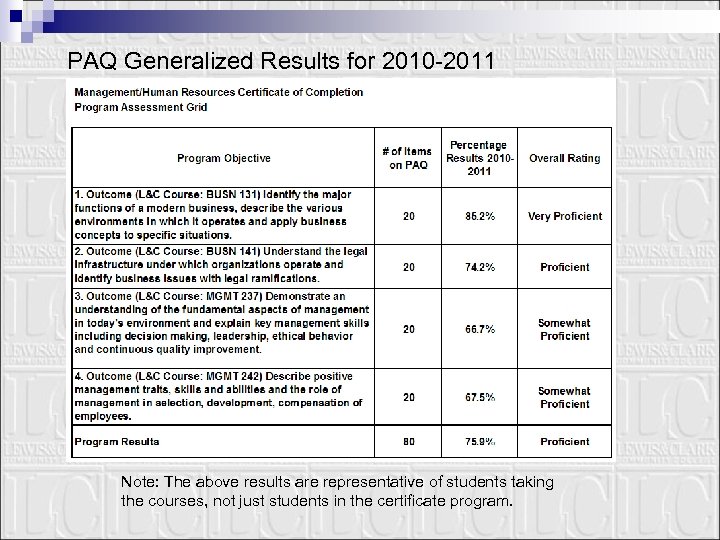 PAQ Generalized Results for 2010 -2011 Note: The above results are representative of students taking the courses, not just students in the certificate program.
 Assessment of Program Need
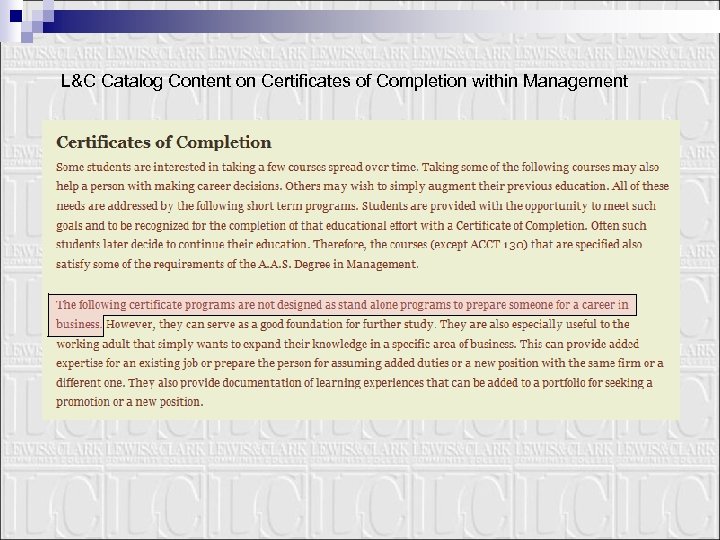
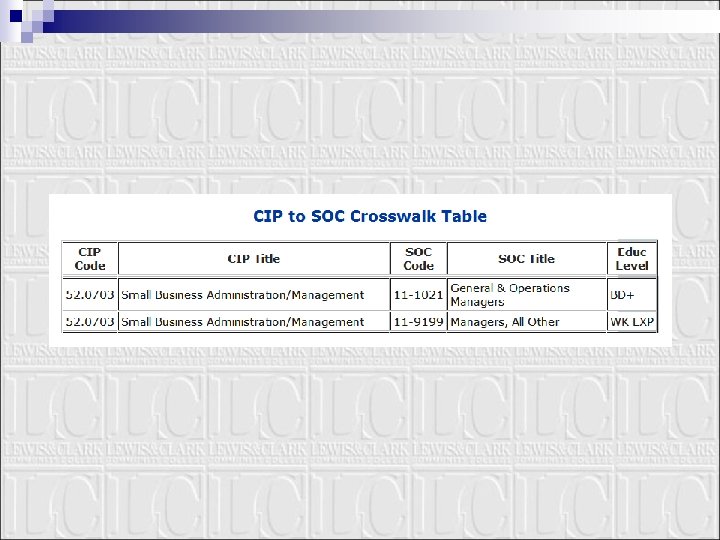
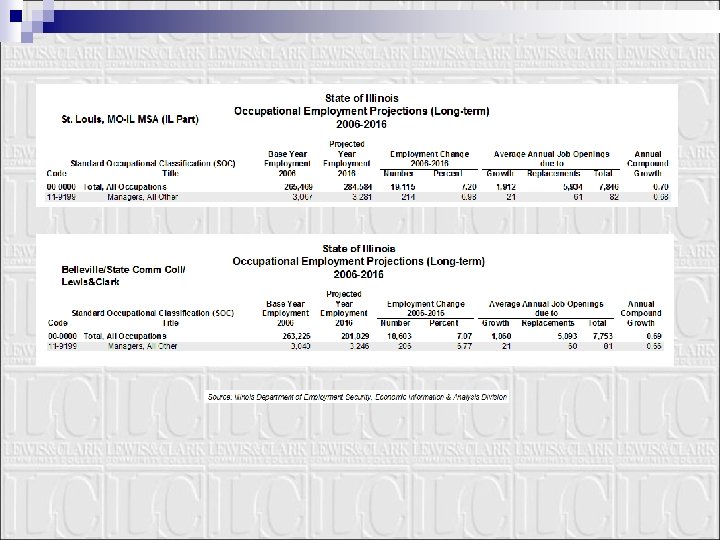
 Certificate Program Need The certificate programs are not designed as stand alone programs to prepare someone for a career in business. However, they can serve as a good foundation for further study. They are also especially useful to the working adult that simply wants to expand their knowledge in a specific area of business. This can provide added expertise for an existing job or prepare the person for assuming added duties or a new position with the same firm or a different one. The certificates also provide documentation of learning experiences that can be added to a portfolio for seeking a promotion, a new position, or venture funding.
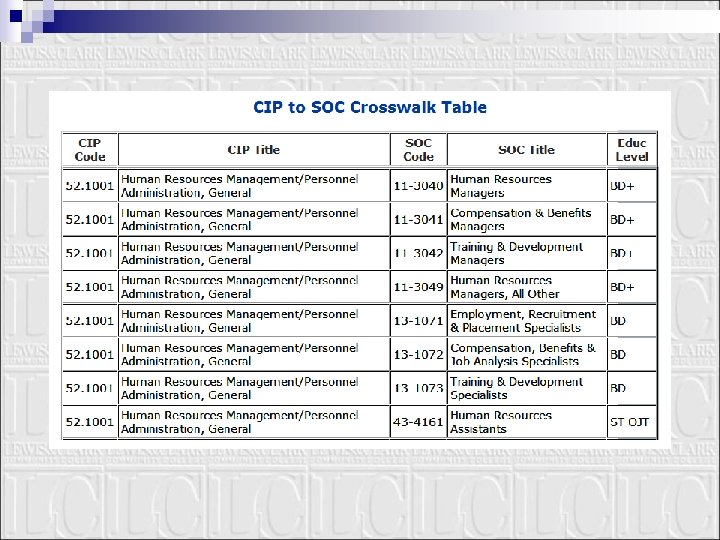
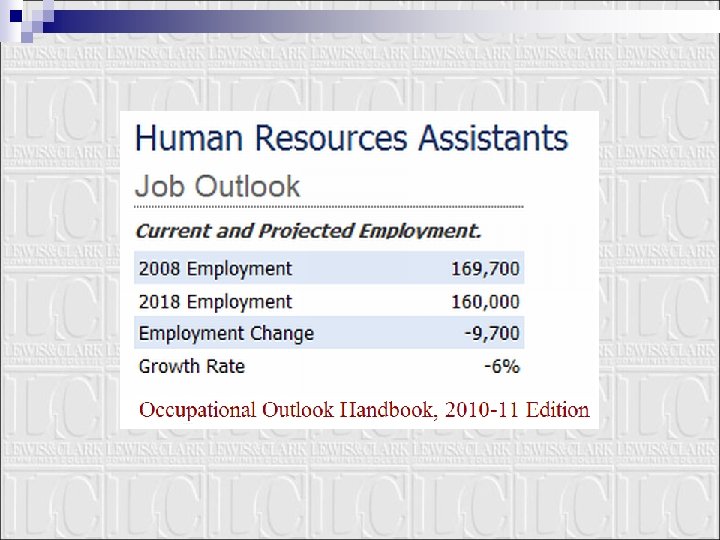
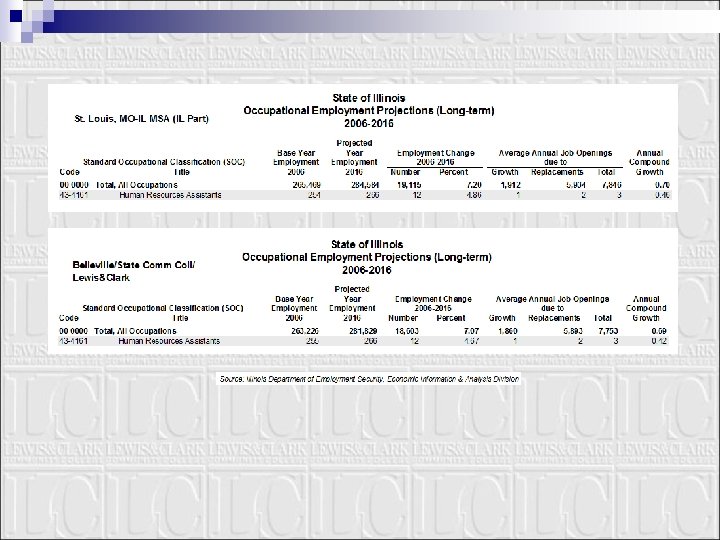
 Local Business Survey Information on Positions at Responding Firms • Data was gathered on the number of supervisory and accounting positions at the responding firms. • Data was also gathered on the educational background of individuals in these positions.
 Information on L&C Business Program Options • Respondents were then given a brief recap of the business program options at L&C. • The respondents were then asked about the appropriateness of the degree and certificate options for existing positions in their firm.
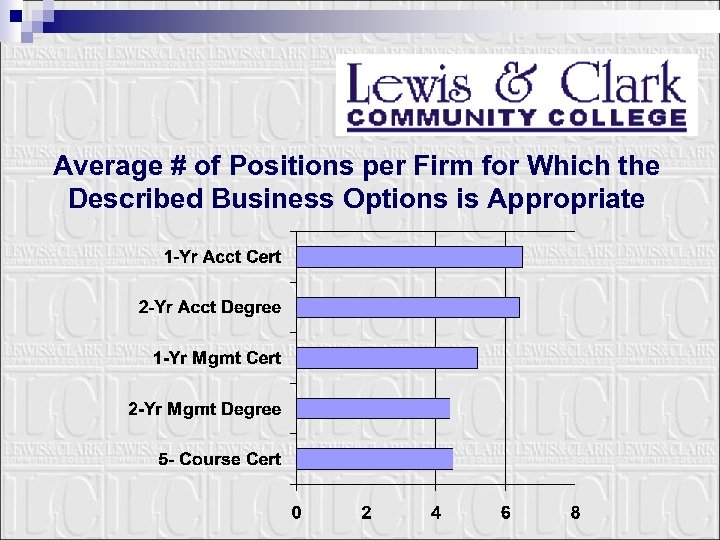 Average # of Positions per Firm for Which the Described Business Options is Appropriate
 Assessment of Program Cost
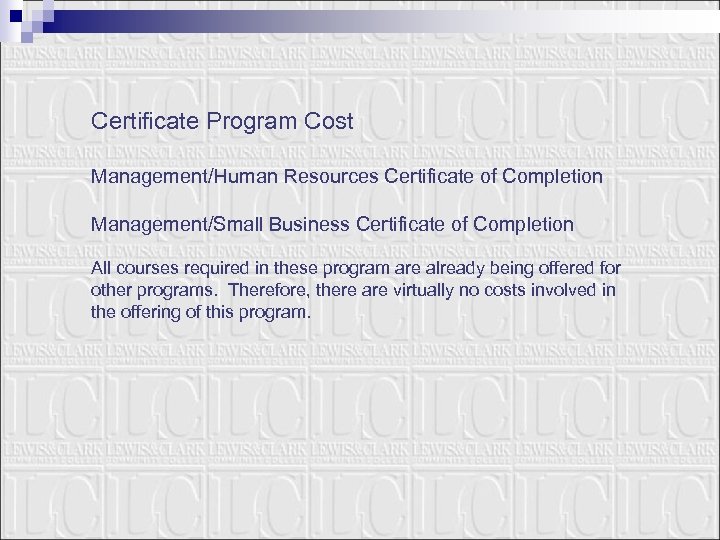 Certificate Program Cost Management/Human Resources Certificate of Completion Management/Small Business Certificate of Completion All courses required in these program are already being offered for other programs. Therefore, there are virtually no costs involved in the offering of this program.
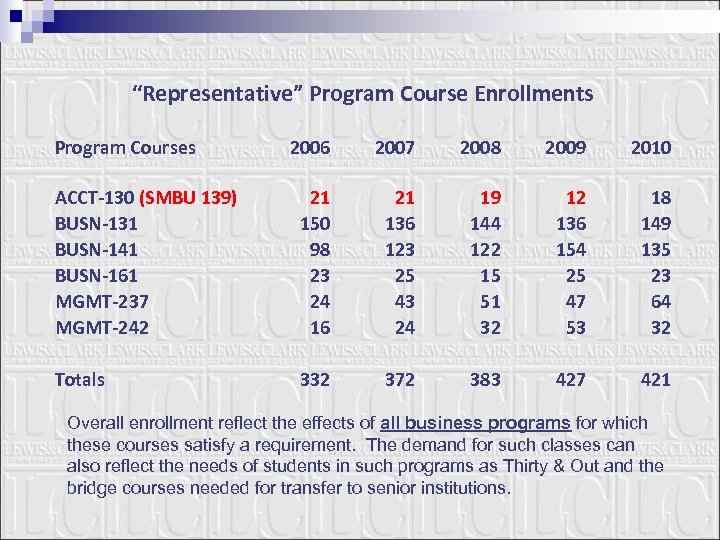 “Representative” Program Course Enrollments Program Courses 2006 2007 2008 2009 2010 ACCT-130 (SMBU 139) BUSN-131 BUSN-141 BUSN-161 MGMT-237 MGMT-242 21 150 98 23 24 16 21 136 123 25 43 24 19 144 122 15 51 32 12 136 154 25 47 53 18 149 135 23 64 32 Totals 332 372 383 427 421 Overall enrollment reflect the effects of all business programs for which these courses satisfy a requirement. The demand for such classes can also reflect the needs of students in such programs as Thirty & Out and the bridge courses needed for transfer to senior institutions.
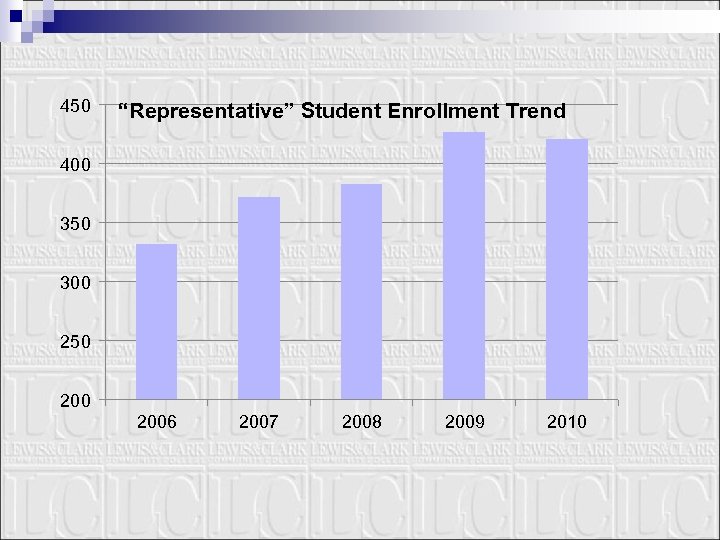 450 “Representative” Student Enrollment Trend 400 350 300 250 2006 2007 2008 2009 2010
 Strategies for Reducing Cost (applicable to all Business Department offerings) q Some program changes resulted in the substitution of higher enrollment courses for lower enrollment courses. q Made some changes to the schedule rotation to reduce the number of multiple-section classes. q Eliminated some day classes and required all students to attend evening classes for some limited program requirements.
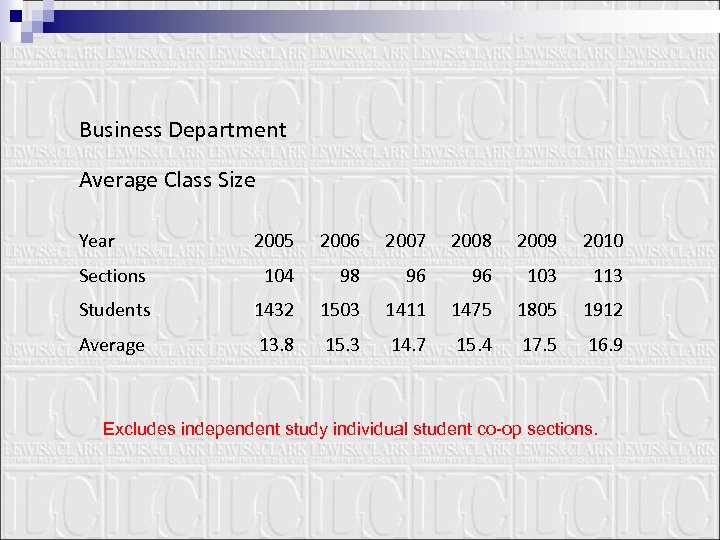 Business Department Average Class Size Year 2005 2006 2007 2008 2009 2010 Sections 104 98 96 96 103 113 Students 1432 1503 1411 1475 1805 1912 Average 13. 8 15. 3 14. 7 15. 4 17. 5 16. 9 Excludes independent study individual student co-op sections.
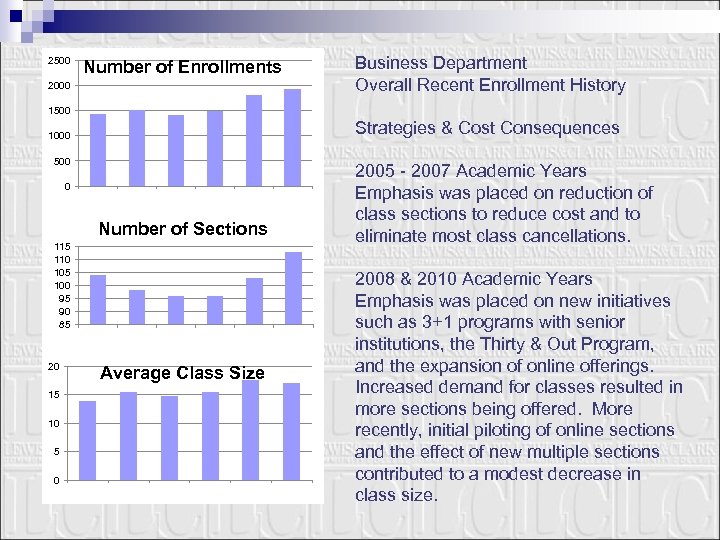 2500 Number of Enrollments 2000 Business Department Overall Recent Enrollment History 1500 Strategies & Cost Consequences 1000 500 0 Number of Sections 115 110 105 100 95 90 85 20 15 10 5 0 Average Class Size 2005 - 2007 Academic Years Emphasis was placed on reduction of class sections to reduce cost and to eliminate most class cancellations. 2008 & 2010 Academic Years Emphasis was placed on new initiatives such as 3+1 programs with senior institutions, the Thirty & Out Program, and the expansion of online offerings. Increased demand for classes resulted in more sections being offered. More recently, initial piloting of online sections and the effect of new multiple sections contributed to a modest decrease in class size.
 Assessment Summary
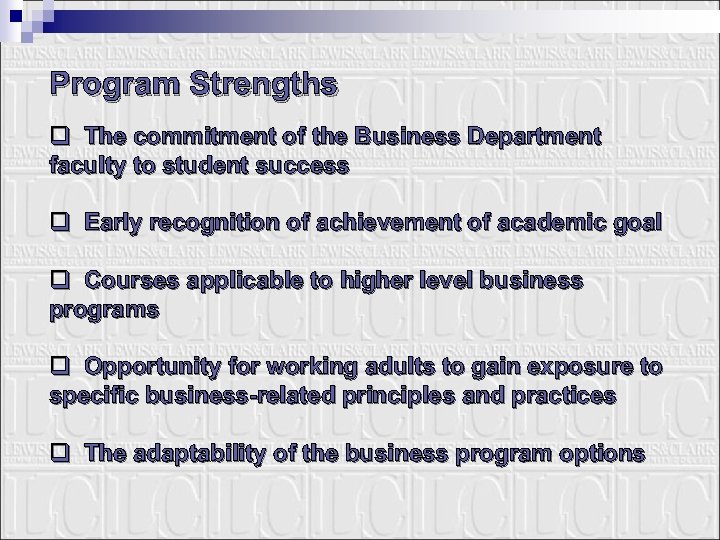 Program Strengths q The commitment of the Business Department faculty to student success q Early recognition of achievement of academic goal q Courses applicable to higher level business programs q Opportunity for working adults to gain exposure to specific business-related principles and practices q The adaptability of the business program options
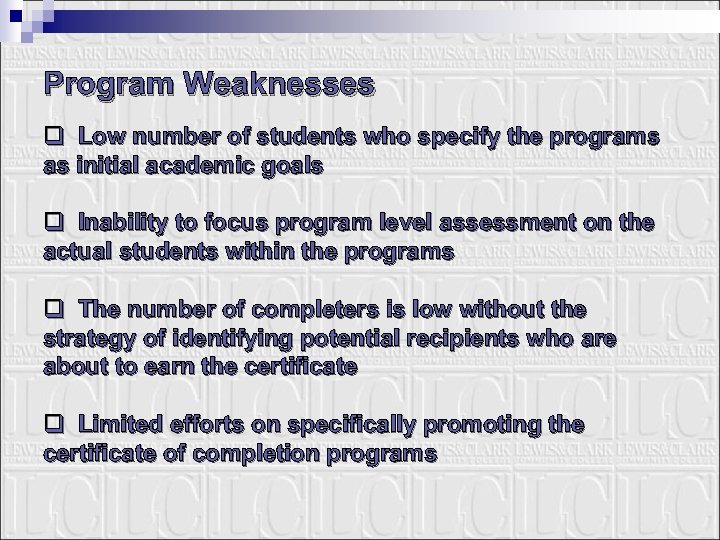 Program Weaknesses q Low number of students who specify the programs as initial academic goals q Inability to focus program level assessment on the actual students within the programs q The number of completers is low without the strategy of identifying potential recipients who are about to earn the certificate q Limited efforts on specifically promoting the certificate of completion programs
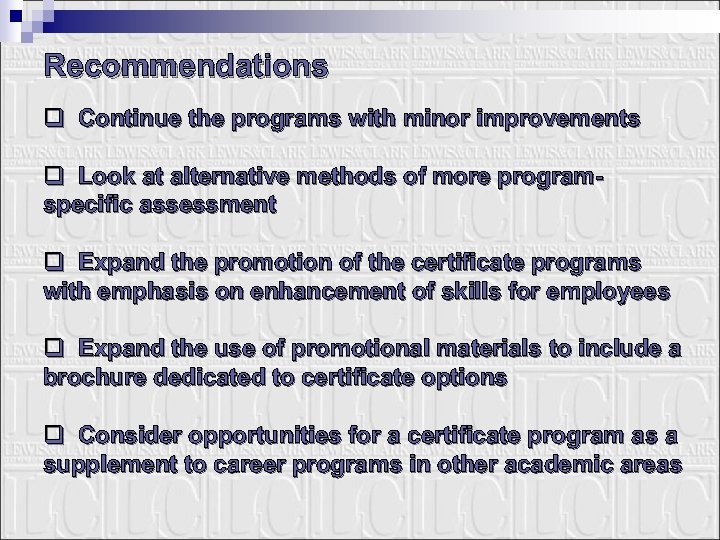 Recommendations q Continue the programs with minor improvements q Look at alternative methods of more programspecific assessment q Expand the promotion of the certificate programs with emphasis on enhancement of skills for employees q Expand the use of promotional materials to include a brochure dedicated to certificate options q Consider opportunities for a certificate program as a supplement to career programs in other academic areas
 Certificate of Completion Program Reviews Management / Human Resources and Management / Small Business 2007 -2011