


 Скачать презентацию Certificate in IP 2015 16 Competition law 5 6
d7491a489377aeda644b13d710c9c252.ppt
- Количество слайдов: 90
 Certificate in IP 2015/16 Competition law 5& 6 TT & related agreements: R&D; Specialisation; Trade Mark and Copyright Licensing; Franchising; Aspects of enforcement
 Note & Reading NB TTBER revised in 2014 • Jones & Sufrin Ch 10, 11, 12, 13 (light), 14 (light) • Marco Colino Ch 10, 22, revisit ch 1 -7 • Whish & Bailey ch 4, 15, 16, 19 (to section 4; v good on patent pools, but see 2014 Guidelines) Commission pages on • Tech transfer • Vertical agreements • Horizontal agreements & press release ‘Multiparty licensing’
 BERs, guidelines for IP • • • TTBER & g/l Verticals & g/l R&D Specialisation Horizontal g/l for R&D, specialisation, and – horizontal coop generally; sectoral – commercialisation – standardization and standard terms
 TTBER & Guidelines Alan Cunningham’s view on Regulation 772/2004 • Peculiar back to front approach • Born exempt • May fall un-exempt Reflected in Reg 316/2014 recital 8
 Non-problematic provisions under Art 101(1) • confidentiality • no sublicensing/ licence personal to l’ee • bans on using technology after expiry of agreement but before expiry of rights • assisting with IP enforcement • minimum royalties or quantities • identification of licensor/use of TMs • many royalty provisions
 Guidelines • general principles concerning Art 101(1) and IP rights • explain TTBER Reg and its application • what happens outside scope of Reg - no presumption of illegality outside TTBER - ‘second safe harbour’: 4 or more other indep controlled and substitutable technologies - no presumption of illegality outside that
 Art 101(1), IP, TT restrictions • • restrictions inter-technology restrictions intra-technology actual/ potential restrictions of competition by object or effect: nb Cartes Bancaires [2014] • appreciable in sense of de minimis notice • market definition and share assessment needed
 Licensing generally procompetitive • Para 17, recital 4 – improve economic efficiency – reduce duplication of R&D – Strengthen incentive for initial R&D – spur incremental innovation – facilitate diffusion &generate product market competition • para 18 balance anti-competitive effects, – unlikely hardcore satisfy 101(3)
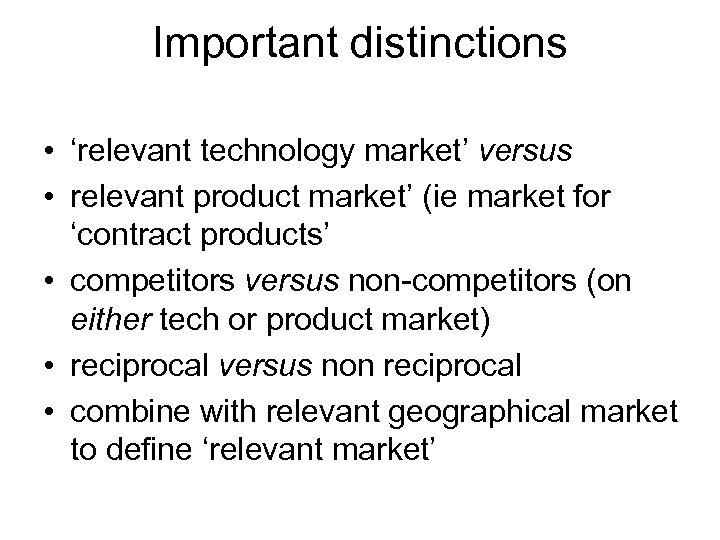 Important distinctions • ‘relevant technology market’ versus • relevant product market’ (ie market for ‘contract products’ • competitors versus non-competitors (on either tech or product market) • reciprocal versus non reciprocal • combine with relevant geographical market to define ‘relevant market’
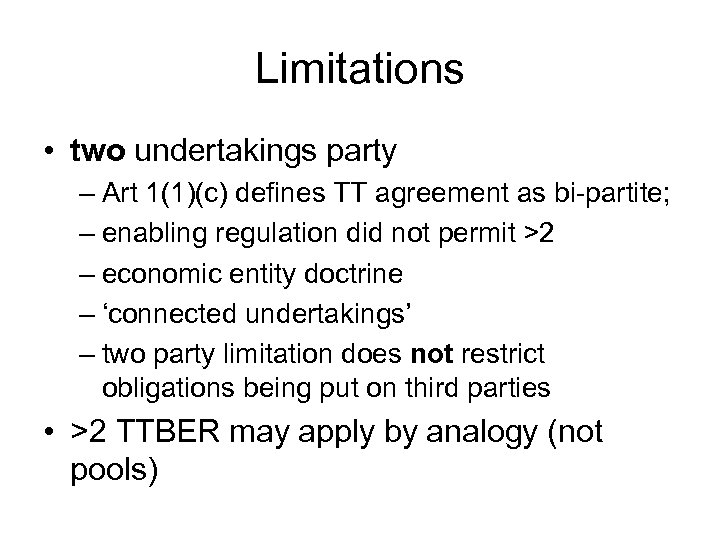 Limitations • two undertakings party – Art 1(1)(c) defines TT agreement as bi-partite; – enabling regulation did not permit >2 – economic entity doctrine – ‘connected undertakings’ – two party limitation does not restrict obligations being put on third parties • >2 TTBER may apply by analogy (not pools)
 Contract products • Goods or services • Purpose of licence must be the production of Contract Products
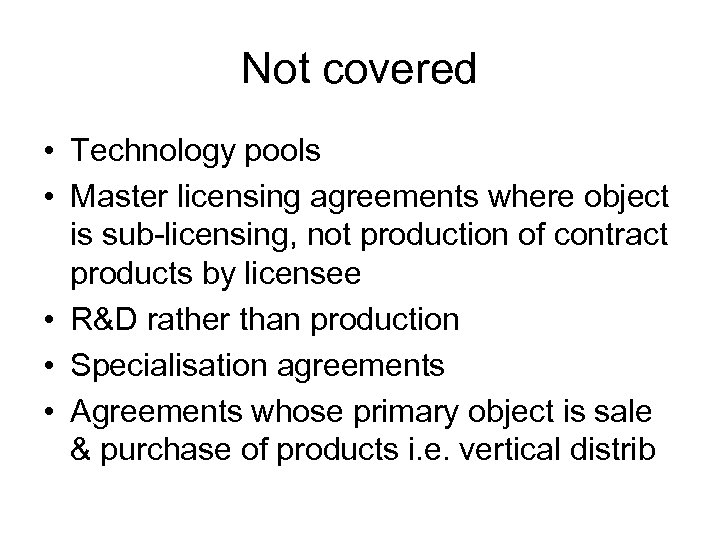 Not covered • Technology pools • Master licensing agreements where object is sub-licensing, not production of contract products by licensee • R&D rather than production • Specialisation agreements • Agreements whose primary object is sale & purchase of products i. e. vertical distrib
 Covered • agreements which permit sub-licensing as long as this is not the primary object, eg allow subcontractors to use technology • agreements in settlement of IP disputes • sub-contracting where licensed products produced excl for the licensor • licensor to carry out development iff contract product ID’d, not pure R&D
![Relevant Technology & Product Markets Technology [+add in geog] • licensed technology plus technologies](https://present5.com/presentation/d7491a489377aeda644b13d710c9c252/image-14.jpg "Relevant Technology & Product Markets Technology [+add in geog] • licensed technology plus technologies") Relevant Technology & Product Markets Technology [+add in geog] • licensed technology plus technologies to which licensees could switch if SSNIP • can also infer from product market Product [+add in geog] • products regarded as interchangeable w/ substitutable for contract products – characteristics, price, intended use
Relevant Technology & Product Markets Technology [+add in geog] • licensed technology plus technologies to which licensees could switch if SSNIP • can also infer from product market Product [+add in geog] • products regarded as interchangeable w/ substitutable for contract products – characteristics, price, intended use
 Competitors or not nb para 28 • Technology market – actual • Product market – Actual – Potential Scrutiny of restrictions depends on this AND reciprocal/non-reciprocal (cross-licensing competitin technologies, or not)
 Safe harbour market shares • Competing < 20% combined • Non-competing <30% each What if change over time? • Market shares up: 2 year grace period • Status non-comp to comp – Apply new market share rule at once, but – Old assessment of restrictions: Art 4(3)
 Hard-core restrictions: art 4 • If any of these are present in agreement – entire agreement is non-exempt • Guideline para 94 ‘experience showing such restrictions are nearly always antcompetitive’, though in ‘an exceptional case’ if ‘objectively necessary’ may fall outside Art 101(1); also, may be justified on efficiency grounds in individual case (!) • 2 lists
 Art 4(1)- competing undertakings 4 (1) (a) price restrictions – object fixing of prices, directly or indirectly (eg rebates) • restriction of party’s ability to determine its prices when selling to third parties • Covers fixed, minimum, maximum or recommended prices • obligation to pay minimum royalty not per se price fixing; depends on calc method
 4(1)(b) output restrictions Limits how much party may produce & sell, but • can be placed on – a non-reciprocal licensee or – only one licensee in reciprocal agreement • provisions that have a similar effect – disincentives – caught: Guideline [103]
 4(1)(c) market or customer allocation • where competitors share markets or customers, object is restriction of competition • However – there are exceptions Exceptions tightened up in the 2014 TTBER; but Guidelines explain some of ‘missing’ exceptions are not hard-core in first place!
 Art 4(1)(c) exceptions (i) in non-reciprocal agreement, licensor/licensee can agree • not to produce within exclusive territories reserved for other party • not to make active and/or passive sales into exclusive territories or to customer groups allocated to the other • para 109: sole licensing not hardcore
 Art 4(1)(c) exceptions, contd • (ii) in non-reciprocal agreement, one licensee can be prevented from active sales into excl territories or to customer groups allocated to another licensee, provided other licensee not competitor of licensor when its own licence granted • (iii) ‘captive use restrictions’ are permitted – eg components for Licensee’s products - iff Licensee allowed to supply spares
 Art 4(1)(c) exceptions, contd • (iv) non-reciprocal agreement may provide that licensee produce contract products only for particular customer iff to provide customer with alternative (‘second’) source of products; licensee can be banned from providing anyone else
 Art 4(1)(c) and field of use restrictions Guideline paras 113 -4: restricting licensee by field of use or product market, does not amount to hard-core restriction (whether reciprocal or non-reciprocal) providing this does not go beyond licensed technologies, and is not tantamount to partitioning merely by territory or customer group. See, also, paras 208 -215
 Art 4(1)(d) – limitation on tech exploitation or R&D Reciprocal or non-reciprocal agreements • neither party can be restricted from carrying out R&D unless it is ‘indispensable’ to prevent licensed knowhow being disclosed to third parties • Licensee must not be prevented from exploiting own technology
 Art 4(2) Competing undertakings • (a) price restrictions – prohibition on price maintenance, ie fixing of prices to third parties (note, vertical-type price fixing) • does not cover maximum or recommended prices so long as they do not amount to fixed or minimum prices, for example by pressure or incentives
 Art 4(2) hardcore, contd (b) passive sale restrictions on licensee – includes disincentives, eg financial/ monitoring; the Guidelines elaborate: – 119 no assumption quantity limitation is passive restr unless combined w other factors – 119 restrictions on sale o/s EU not hard-core – 120 restrictions on licensor for active or passive sales not ‘hard-core’ here, exempt – 120 subj 125 ditto active sales bans on licensee
 Exceptions to Art 4(2)(b) (i) licensee can be prevented from making passive sales into exclusive territory or customer group which licensor has reserved for himself Note: 2004 TTBER also allowed 2 yr passive sales ban into other licensee’s territory. This was deleted, making it hardcore. However, G/l [126] recognises a limited term of protection may be objectively necessary to allow licensee to penetrate a new market, to protect investment & risks taken. In this case passive sales ban outside Art 101(1) (!)
 Exceptions to Art 4(2)(b), contd (ii) captive use restrictions (iii) second source restrictions (iv) allows maintenance of a distinction between wholesale and retail levels of trade (v) allows members of selective distributive system to be restricted from selling to unauthorised distributors
 Art 4(2) (c) active or passive sales bans to end users within selective distribution systems • Licensee who is retail member of selective distribution system cannot be prevented from active or passive selling to end users: para 127 discusses the possibility that this may be objectively necessary for health or safety reasons and therefore not in breach of Art 101(1)
 What is not hard-core? And therefore not fatal to exemption? • Tying and bundling, which are therefore exempted if needed: Guideline paras 221225 give the Commission’s view • Non-compete obligations, whereby the licensee undertakes not to use competing third-party technologies. See paras 226233
 Excluded Restrictions: Art 5 Restrictions not themselves exempted but their inclusion in agreement does not take the whole agreement outside exemption [unlike hard-core]. Seen as reducing incentives to innovate but may be individually assessed under Art 101(3): para 128
 Art 5(1)(a) improvements/grantback Licensee obliged, directly or indirectly, to assign (in whole or in part) or give exclusive licence to licensor (or designated 3 rd party) of improvements made to licensed technology or new applications 2004 TTBER only listed such obligations where the improvements were severable. Seen as discouraging licensee innovation. ? useable without orig licence? Encouragement to cross-licence? Consideration relevant on indiv assessment
 Art 5(1)(b) no-challenge clauses Excludes clauses where licensee prohibited from challenging validity of ‘any IP rights’ which licensor holds in common market [but not re know-how only: G/l 140] • without prejudice to exclusive licensor reserving right to terminate licence in the event of a challenge to licensed rights • [2004 TTBER allowed termination clauses for exclusive and non-exclusive licences]
 5 (2) limitation on Technology exploitation and R&D • Only applies to agreements between noncompetitors – similar to Article 4 (1) (d) re: restrictions between competitors, but here only the specific provision is taken outside of the safe harbour.
 Withdrawal in individual cases Reg 1/2003 where 4 Art 101(3) criteria not met; by decision addressed to parties Art 6 TTBER in partic where • 1(a) Access of 3 rd party technologies to market is restricted, eg cumulative effect of parallel networks • 1(b) Access of potential licensees to market restricted, eg networks, or because excl licensee uses substitutable technology.
 Disapplication, networks, Art 7 Commission may • by regulation, exclude from scope of TTBER parallel networks of similar agreements where these cover more than 50 % of the relevant market, subject to six -month window for undertakings to adapt • regulation – describes certain type of agreement to which it applies
 Duration of exemption: Art 2(2) • As long as (every) IP right in the licensed technology has not expired, lapsed or been declared invalid or • Re know-how – for as long as it remains secret, except where know-how becomes publicly known as result of action by licensee – exemption for duration of contract
 TTBER applied by analogy • Agreements to which more than two undertakings are a party, but not patent pools: para 56 • Master licensing agreements: para 60 • Licensing of copyright for production of contract products: para 48
 TTBER not applied by analogy • Licensing of copyright for purposes of reproduction and distribution of protected work: para 49, 62 • R&D sub-contracting • Rights in performance and other rights related to copyright: para 49 • Trade mark licences: para 50
 TTBER and settlement/nonassertion agreements TTBER covers these insofar as they do not contain hardcore restrictions. Furthermore, non-challenge obligations are usually the essence of settlements of litigation, so are not considered to contravene Art 101 in this context: paras 242, 243
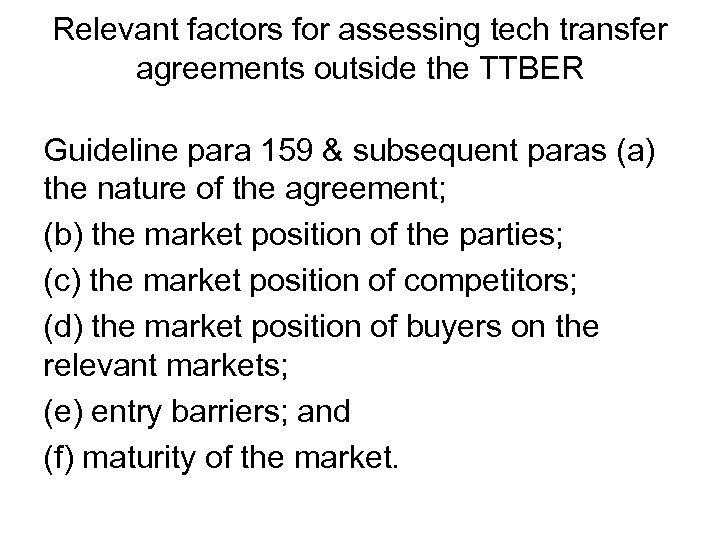 Relevant factors for assessing tech transfer agreements outside the TTBER Guideline para 159 & subsequent paras (a) the nature of the agreement; (b) the market position of the parties; (c) the market position of competitors; (d) the market position of buyers on the relevant markets; (e) entry barriers; and (f) maturity of the market.
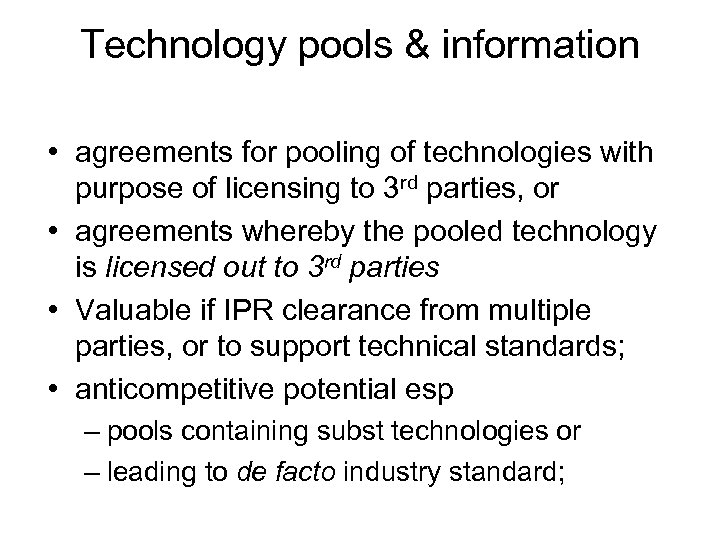 Technology pools & information • agreements for pooling of technologies with purpose of licensing to 3 rd parties, or • agreements whereby the pooled technology is licensed out to 3 rd parties • Valuable if IPR clearance from multiple parties, or to support technical standards; • anticompetitive potential esp – pools containing subst technologies or – leading to de facto industry standard;
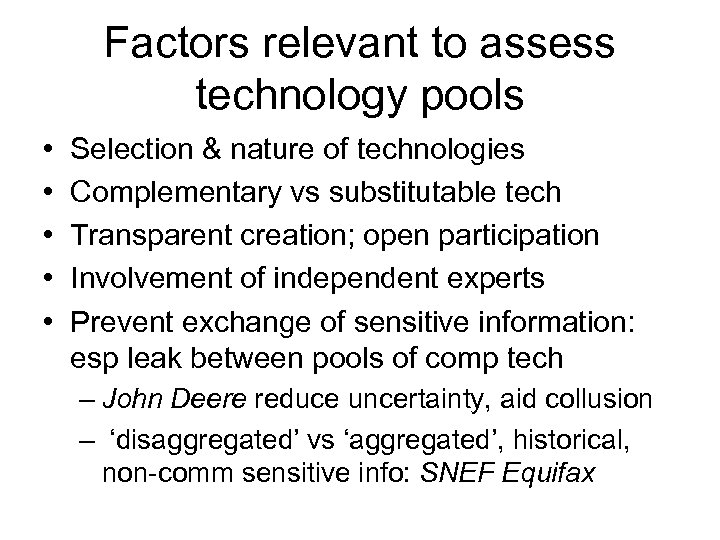 Factors relevant to assess technology pools • • • Selection & nature of technologies Complementary vs substitutable tech Transparent creation; open participation Involvement of independent experts Prevent exchange of sensitive information: esp leak between pools of comp tech – John Deere reduce uncertainty, aid collusion – ‘disaggregated’ vs ‘aggregated’, historical, non-comm sensitive info: SNEF Equifax
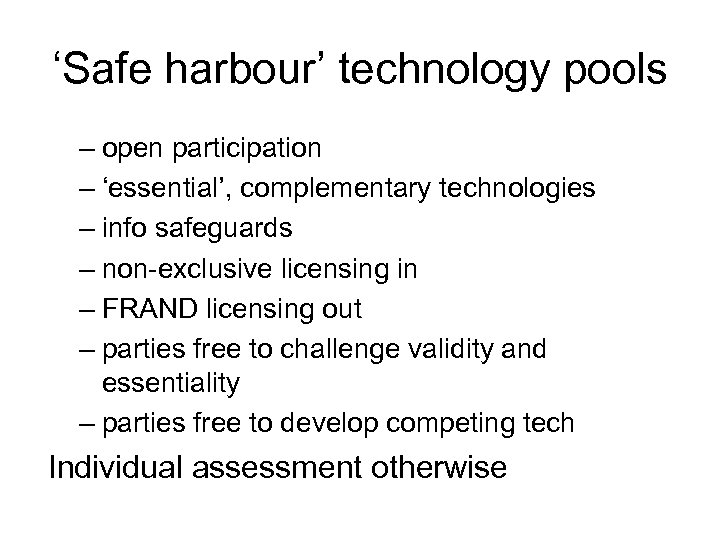 ‘Safe harbour’ technology pools – open participation – ‘essential’, complementary technologies – info safeguards – non-exclusive licensing in – FRAND licensing out – parties free to challenge validity and essentiality – parties free to develop competing tech Individual assessment otherwise
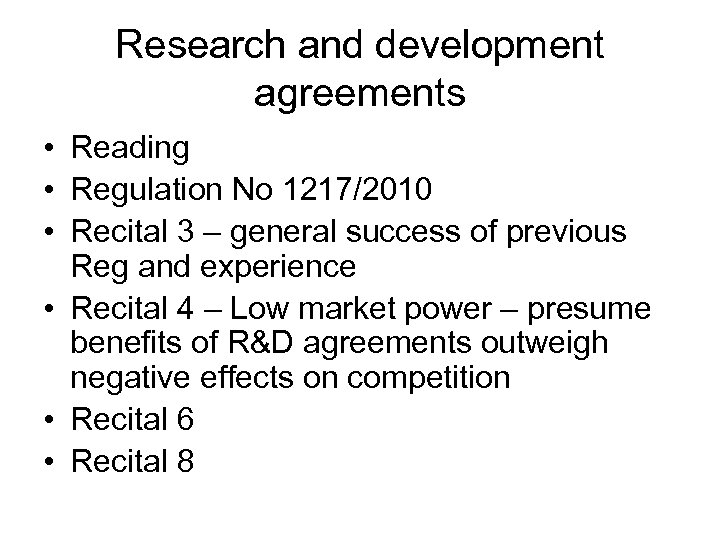 Research and development agreements • Reading • Regulation No 1217/2010 • Recital 3 – general success of previous Reg and experience • Recital 4 – Low market power – presume benefits of R&D agreements outweigh negative effects on competition • Recital 6 • Recital 8
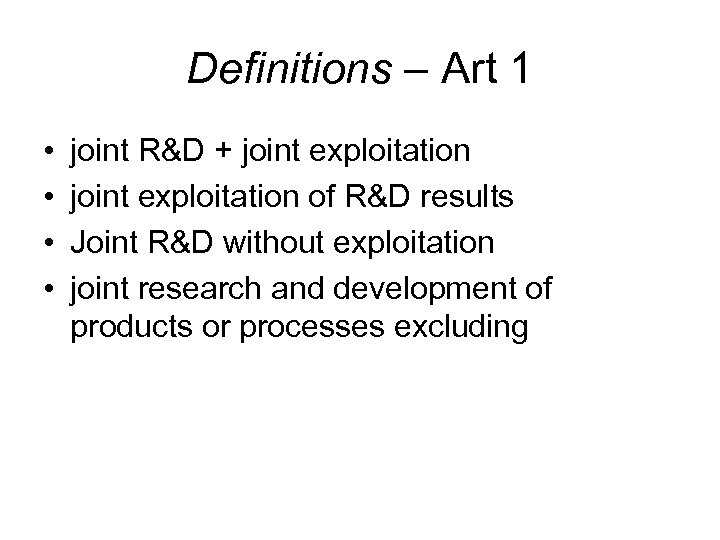 Definitions – Art 1 • • joint R&D + joint exploitation of R&D results Joint R&D without exploitation joint research and development of products or processes excluding
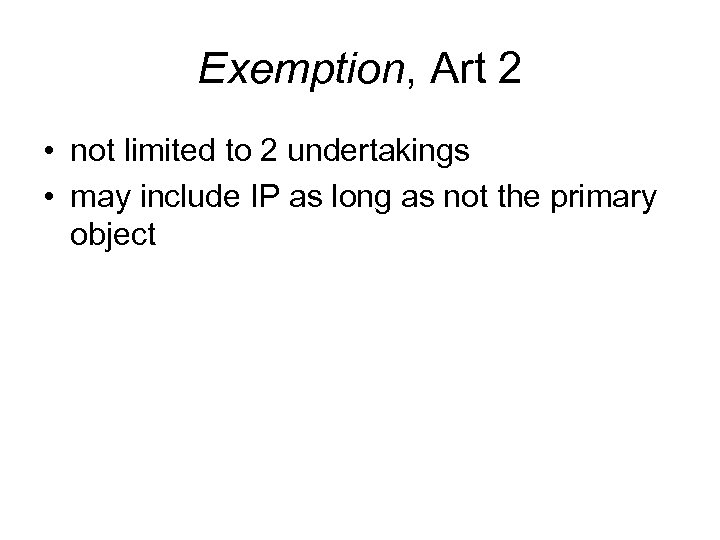 Exemption, Art 2 • not limited to 2 undertakings • may include IP as long as not the primary object
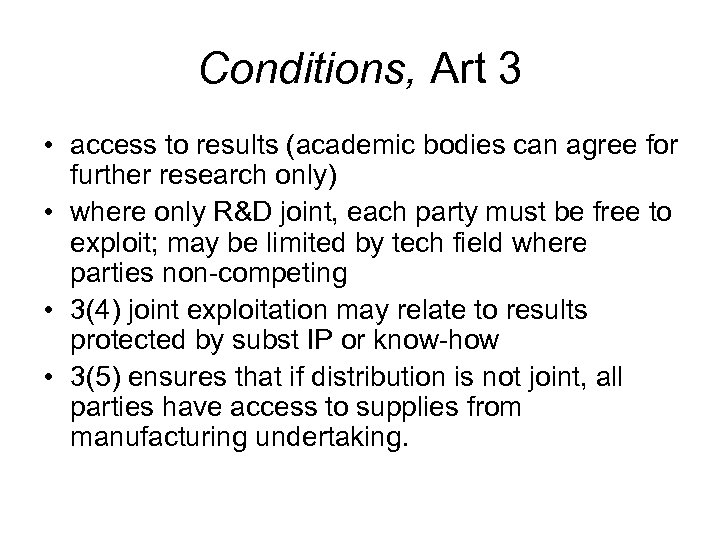 Conditions, Art 3 • access to results (academic bodies can agree for further research only) • where only R&D joint, each party must be free to exploit; may be limited by tech field where parties non-competing • 3(4) joint exploitation may relate to results protected by subst IP or know-how • 3(5) ensures that if distribution is not joint, all parties have access to supplies from manufacturing undertaking.
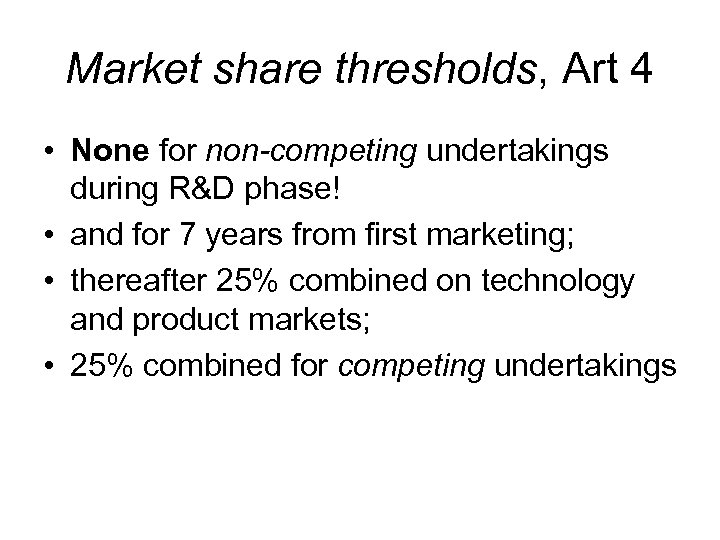 Market share thresholds, Art 4 • None for non-competing undertakings during R&D phase! • and for 7 years from first marketing; • thereafter 25% combined on technology and product markets; • 25% combined for competing undertakings
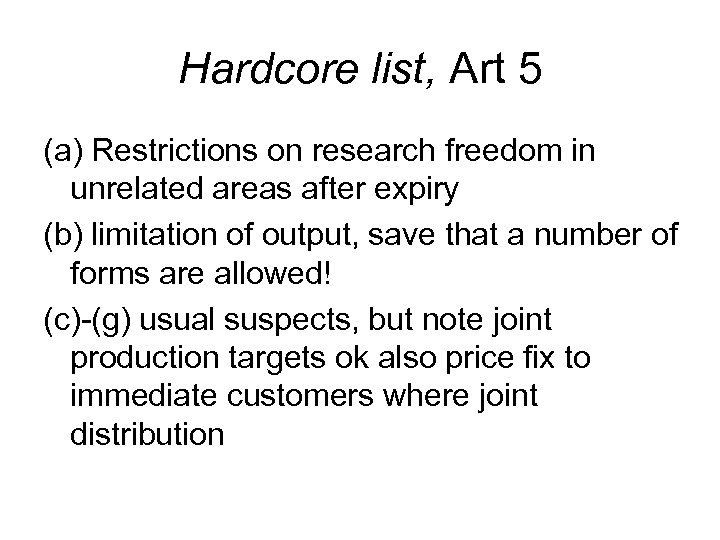 Hardcore list, Art 5 (a) Restrictions on research freedom in unrelated areas after expiry (b) limitation of output, save that a number of forms are allowed! (c)-(g) usual suspects, but note joint production targets ok also price fix to immediate customers where joint distribution
 Other • Excluded restrictions, Art 6 • Into force and Expiry: • 1 January 2011 to 31 December 2022
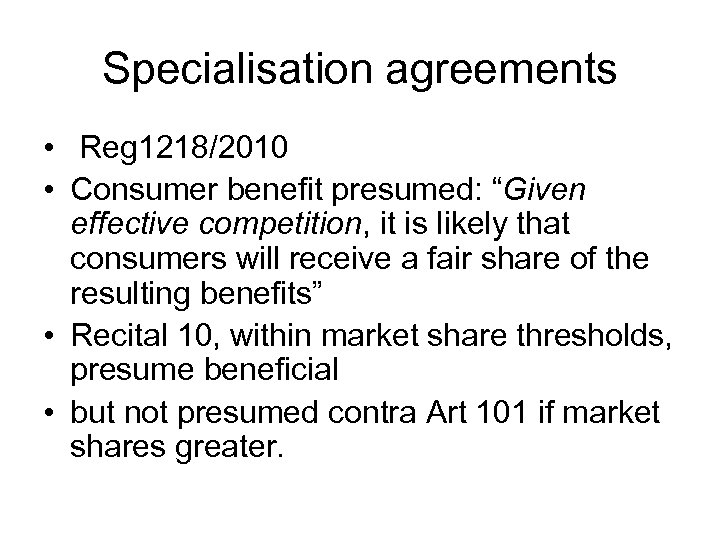 Specialisation agreements • Reg 1218/2010 • Consumer benefit presumed: “Given effective competition, it is likely that consumers will receive a fair share of the resulting benefits” • Recital 10, within market share thresholds, presume beneficial • but not presumed contra Art 101 if market shares greater.
 Definitions, Art 1 • unilateral specialisation agreement • reciprocal specialisation agreement • joint production agreement
 Exemption, Art 2 • IP OK as long as not primary object
 Hardcore list, Art 3 • Price fixing but • OK to price fix to immediate customers where joint distribution; • Limitation of output, couple of exceptions; • Market allocation
 Market share thresholds, Art 5 • No more than 20% combined on any relevant market • Into force and Expiry: • 1 January 2011 to 31 December 2022.
 Horizontal guidelines • deal with standard-setting arrangements, including standard terms • chapter on the assessment of information exchange between companies; • clarification on horizontal joint ventures • As well as R&D and specialisation
 Trademark Licences (or assignments) • Q: how do we know that a trade marks assignment may attract operation of Art 101(1)? • Q: do TMs have a dedicated Block Exemption Reg?
 TMs and the TTBER • TMs may be ancillary to TT licence • beneficial in helping the licensed products gain entry to the market TTBER guidelines, para 47 • Within TTBER, TM must be ancillary to patent, know-how etc and not vice versa • Moosehead/Whitbread [1990] • Nb challenges to ownership may be banned
 • TTBER does not apply, directly or by analogy, to pure TM licenses • For their nature, see Pie Optiek SPRL • or to TM licenses ancillary to distribution: TTBER guidelines, para 50 ? ? quality control provisions given greater credence under TTBER where TM licensing is involved: Guidelines no longer
 TMs and the Verticals BER Reg 330/2010 • vertical agreements containing provisions which relate to the assignment to the buyer or use by the buyer of intellectual property rights Ok • provided that those provisions do not constitute the primary object of such agreements
 o and are directly related to the use, sale or resale of goods or services by the buyer or its customers o Verticals Guidelines para [38] relevant IP TMs, copyright, know-how (esp franchise agreements, para [43]
 Case law essential • Consten and Grundig • Grundig- Verkaufs Gmb. H v Commission [1996] • Moosehead/Whitebread [1990] • Campari: Davide Campari-Milano Sp. A’s Agreement (Decision 78/258/EEC) [1978] • Pie Optiek
 Verticals guidelines para 31 for 5 conditions – Agreement vertical, for purchase, sale, resale of goods – TMs used by/ assigned to buyer, i. e. licence downwards – Not primary object, ie ancillary – Directly related to sale etc of goods or services by buyer or customers – IPR restrictions not equivalent to non-exempt vertical restraints
 franchising and Verticals BER • What is franchising? Verticals guidelines paras 43 -45, 189 -190, example para 191 • Does VBER apply- yes if franchise agreement satisfies the 5 conditions : para 44 • Or by analogy if the IPR is of prime importance: para 44
 franchising • Para 45 lists obligations generally necessary to protect franchisor’s IP, which have the benefit of exemption • Not ‘manufacturing franchise’ eg Campari • Some franchises may not even attract Art 101(1) • Pronuptia de Paris Gmb. H v Pronuptia de Paris Irmgard Schillgalis (C 161/84) [1986] • Former BER relevant: Reg 4087/88 [1988] OJ L 359/46 • Other cases on non-application of Art 101 may also be relevant, eg Maize Seed, O 2 (Germany) v Commission [2006] 5 CMLR 5
 TM delimitation (settlement) agreements • Often the whole point is to partition the market to prevent customer confusion by the use of similar TMs of different proprietors • This may not be prohibited if – there is a genuine risk of confusion, – not market partitioning in disguise,
![• BAT Cigaretten-Fabriken v Commission (C 35/83) [1985] • Bayer v Sulhofer [1988]](https://present5.com/presentation/d7491a489377aeda644b13d710c9c252/image-69.jpg "• BAT Cigaretten-Fabriken v Commission (C 35/83) [1985] • Bayer v Sulhofer [1988]") • BAT Cigaretten-Fabriken v Commission (C 35/83) [1985] • Bayer v Sulhofer [1988] no-challenge • EEC v Syntex Corp [1990] ‘Syntex/ Sythelabo • Bay-O-Nox [1990] field-of-use restrictions • Apple Corps Ltd v Apple Computer Inc [1991]: unless TM clearly invalid, court reluctant to entertain elaborate arguments on validity - cf BAT • Re the agreement of Sirdar Ltd [1995] ‘Sirdar/Phildar’
• BAT Cigaretten-Fabriken v Commission (C 35/83) [1985] • Bayer v Sulhofer [1988] no-challenge • EEC v Syntex Corp [1990] ‘Syntex/ Sythelabo • Bay-O-Nox [1990] field-of-use restrictions • Apple Corps Ltd v Apple Computer Inc [1991]: unless TM clearly invalid, court reluctant to entertain elaborate arguments on validity - cf BAT • Re the agreement of Sirdar Ltd [1995] ‘Sirdar/Phildar’
![• World Wide Fund for Nature v World Wrestling Federation [2002] • Defensive](https://present5.com/presentation/d7491a489377aeda644b13d710c9c252/image-70.jpg "• World Wide Fund for Nature v World Wrestling Federation [2002] • Defensive") • World Wide Fund for Nature v World Wrestling Federation [2002] • Defensive use of these principles: the court will tend to scrutinise carefully, eg • Sandvik AB v K. R. Pfiffner (UK) Ltd [1999] • don’t forget to consider how many undertakings there are! • high degree of vertical integration between the 2 parties will take the agreement outside Art 101 • (though possibly into Art 102)
• World Wide Fund for Nature v World Wrestling Federation [2002] • Defensive use of these principles: the court will tend to scrutinise carefully, eg • Sandvik AB v K. R. Pfiffner (UK) Ltd [1999] • don’t forget to consider how many undertakings there are! • high degree of vertical integration between the 2 parties will take the agreement outside Art 101 • (though possibly into Art 102)
 • Confederacion Espanola de Empresarios de Estaciones de Servicio v Compania Espanola de Petroleos SA C 217/05 [2007] • degree of independence • risk assumed by the service station operators
 ‘Green Dot’ cases • Der Grune Punkt-Duales System Deutschland v Commission (No 1 – Art 102) T-151/01 [2007] 5 CMLR 4 and (No 2 – Art 101) T-289/01 [2007] 5 CMLR 5 • http: //www. tradeangles. fsbusiness. co. uk/articles/ green_dot. htm Further reading • ‘Competition and Trade Marks’ in Maniatis and Botis Trade Marks in Europe: A Practical Jurisprudence (2009, Sweet & Maxwell)
 Copyright Licences • Software copyright licence • regulated by TTBER, art 1(1)(b) G/l 44 • BUT beware interoperability matters, see Art 102 cases • Other types of copyright licence covered by TTBER if ancillary & necess to produce contract products: TTBER G/l para 47
 • Licensing of copyright for reproduction/distribution of work not now covered by analogy: TTBER guidelines, para 62 (look to verticals BER) • NOR licensing of rights in performance and other copyrights: TTBER guidelines, para 49
![• Coditel v Cine Vog (Coditel II) [1982] ECR 3381; [1983] 1 CMLR](https://present5.com/presentation/d7491a489377aeda644b13d710c9c252/image-75.jpg "• Coditel v Cine Vog (Coditel II) [1982] ECR 3381; [1983] 1 CMLR") • Coditel v Cine Vog (Coditel II) [1982] ECR 3381; [1983] 1 CMLR 49 • FAPL v QC Leisure [2011] EUECJ C 429/08 • Nb Commission had approved, see Hornsby
• Coditel v Cine Vog (Coditel II) [1982] ECR 3381; [1983] 1 CMLR 49 • FAPL v QC Leisure [2011] EUECJ C 429/08 • Nb Commission had approved, see Hornsby
 ancillary to agreement within Verticals Regulation 330/2010 • as for TMs, above
![collective licensing • IFPI/ Simulcasting [2003] • Bill Batchelor • Stefan Siebert • T-442/08](https://present5.com/presentation/d7491a489377aeda644b13d710c9c252/image-77.jpg "collective licensing • IFPI/ Simulcasting [2003] • Bill Batchelor • Stefan Siebert • T-442/08") collective licensing • IFPI/ Simulcasting [2003] • Bill Batchelor • Stefan Siebert • T-442/08 CISAC [2013]
collective licensing • IFPI/ Simulcasting [2003] • Bill Batchelor • Stefan Siebert • T-442/08 CISAC [2013]
 Aspects of enforcement • • Reg 1/2003 (the ‘Modernisation Regulation’) Reg was made under the powers of Art 83 EC Commission powers to investigate and sanction under Art 101 TFEU continues Plus ‘structural’ remedies
![• d. Complaints Art 7 –legit interest/ member states Micro Leader [2000]](https://present5.com/presentation/d7491a489377aeda644b13d710c9c252/image-79.jpg "• d. Complaints Art 7 –legit interest/ member states Micro Leader [2000]") • d. Complaints Art 7 –legit interest/ member states Micro Leader [2000]
• d. Complaints Art 7 –legit interest/ member states Micro Leader [2000]
 Remedies – behavioural’ such as cease conduct, give undertaking – ‘structural’ ie change structure of undertaking (only if other remedies no good) – Past infringements, financial penalties
![Confidentiality and whistleblowers: • • • Adams [1986] En. Bw Energie Baden-Württemberg AG v](https://present5.com/presentation/d7491a489377aeda644b13d710c9c252/image-81.jpg "Confidentiality and whistleblowers: • • • Adams [1986] En. Bw Energie Baden-Württemberg AG v") Confidentiality and whistleblowers: • • • Adams [1986] En. Bw Energie Baden-Württemberg AG v European Commission (Gas Insulated Switchgear Cartel) Case C‑ 365/12 Leniency Notice [2006] OJ C 298/17 Settlement Richter
Confidentiality and whistleblowers: • • • Adams [1986] En. Bw Energie Baden-Württemberg AG v European Commission (Gas Insulated Switchgear Cartel) Case C‑ 365/12 Leniency Notice [2006] OJ C 298/17 Settlement Richter
 Power of NCAs to apply Art 101 and 102 under Art 5 of Reg 1/2003 • ( in the UK CMA and sectoral regulators) • References to CJEU: national courts; Competition Appeal Tribunal; ? CMA • Information exchange under Art 11 of Reg 1/2003 • and limits to use Art 12 • European Competition Network & case allocation
 Art 3 Reg 1/2003. • • Duty on NCAs not to conflict Art 101 ( in the UK CMA and sectoral regulators) Days v Pihsiang [2004] CMA will not investigate where block exemption unless Cartel offence under s 188 directed at individuals rather than undertakings, so not clashing marine hose cartel convictions (aka ‘Dunlop 3) Re Carglass Cartel [2010] Commission overhaul of procedure
![aspects of enforcement – extraterritoriality a. Woodpulp [1988] 4 CMLR 901 b. Gencor v](https://present5.com/presentation/d7491a489377aeda644b13d710c9c252/image-84.jpg "aspects of enforcement – extraterritoriality a. Woodpulp [1988] 4 CMLR 901 b. Gencor v") aspects of enforcement – extraterritoriality a. Woodpulp [1988] 4 CMLR 901 b. Gencor v Commission [1999] 4 CMLR 971
aspects of enforcement – extraterritoriality a. Woodpulp [1988] 4 CMLR 901 b. Gencor v Commission [1999] 4 CMLR 971
 aspects of enforcement - UK Competition Act 1988 • • Art 101, 102, Ch I, II investigative powers of CMA: Part 1 s 2628 A – call for docs, enter business premises without a warrant, business/domestic premises with a warrant and E&RR Act 2013 confidentiality assistance to Commission
 • • assistance to NCAs of other EU Member States cartel offence s 188, as amended by 2013 Act: dishonesty element gone but intent to enter into agreement/operate arrangement in question. Selfprotection: notification to customers. Defences that did not intend concealment from customers/ CMA; prof legal advice • R v B (I) [2009] Challenge to jurisdiction of Crown Court unsuccessful on appeal and below • directors’ disqualification s 204 EA • T-Mobile Netherlands Case C-8/08 [2009
 aspects of enforcement – private enforcement a. against states where direct effect: Van Gend en Loos/SABAM/Francovich b. Garden Cottage Foods v MMB [1983] c. Courage Ltd v Crehan [2002] d. Crehan v Interprenneur [2007] e. Devenish & others v Sanofi-Aventis SA & others (Vitamins) [2007] appeal dismissed [2008]. Damages but not exemplary damages or an account of profits
 Directive 2014/104/EU on Antitrust Damages Actions • http: //ec. europa. eu/competition/antitrust/actionsd amages/documents. html • 11 June 2013, draft directive on “certain rules governing actions for damages under national law for infringements of the competition law provisions of the Member States and of the European Union” COM(2013) 404 • 17 April 2014, EP formally adopted draft directive w amendments • Implementation December 2016
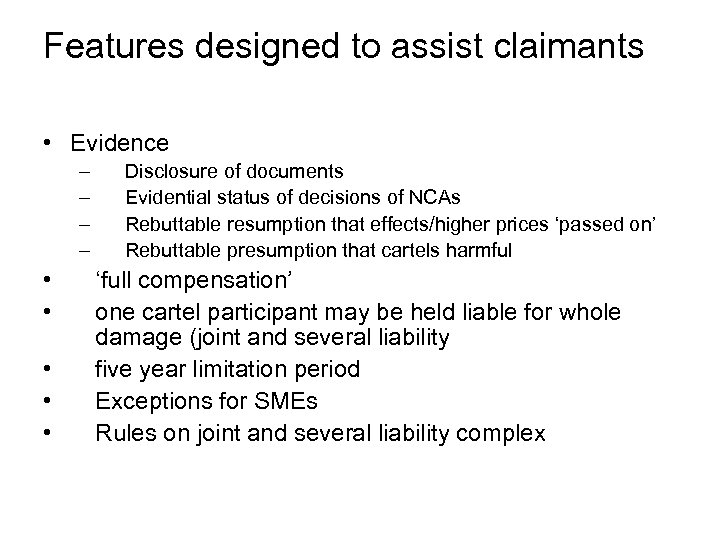 Features designed to assist claimants • Evidence – – • • • Disclosure of documents Evidential status of decisions of NCAs Rebuttable resumption that effects/higher prices ‘passed on’ Rebuttable presumption that cartels harmful ‘full compensation’ one cartel participant may be held liable for whole damage (joint and several liability five year limitation period Exceptions for SMEs Rules on joint and several liability complex
![Finally • Infederation Ltd v Google Inc [2013] • PPQ Next 2 weeks: Article](https://present5.com/presentation/d7491a489377aeda644b13d710c9c252/image-90.jpg "Finally • Infederation Ltd v Google Inc [2013] • PPQ Next 2 weeks: Article") Finally • Infederation Ltd v Google Inc [2013] • PPQ Next 2 weeks: Article 102 – Abuse of Dominant Position; chapter II prohibitions Reading: • Marco Colino 13 -16 • Jones and Sufrin, Chapters 5, 6 & 7 • Online sample chapter of Sufrin & Jones is Ch 5, introduction to Art 102, good to read for next week… http: //www. oup. com/uk/orc/bin/9780199572731/js 4 e_ch 0 5. pdf (nb chapter titles are different in the table of contents) • Whish Ch 5 -7
Finally • Infederation Ltd v Google Inc [2013] • PPQ Next 2 weeks: Article 102 – Abuse of Dominant Position; chapter II prohibitions Reading: • Marco Colino 13 -16 • Jones and Sufrin, Chapters 5, 6 & 7 • Online sample chapter of Sufrin & Jones is Ch 5, introduction to Art 102, good to read for next week… http: //www. oup. com/uk/orc/bin/9780199572731/js 4 e_ch 0 5. pdf (nb chapter titles are different in the table of contents) • Whish Ch 5 -7