


 Скачать презентацию CERN What Happens at CERN In the
6db4f3fac9e4cabdc0b3903362c8342c.ppt
- Количество слайдов: 28
 CERN
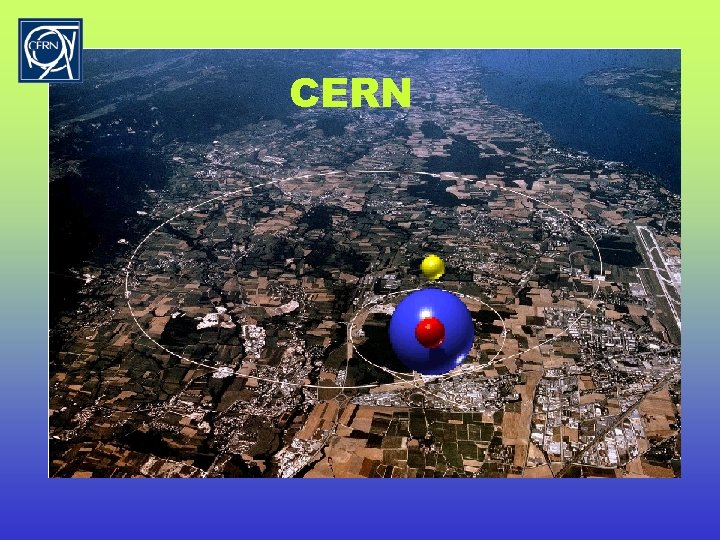
CERN
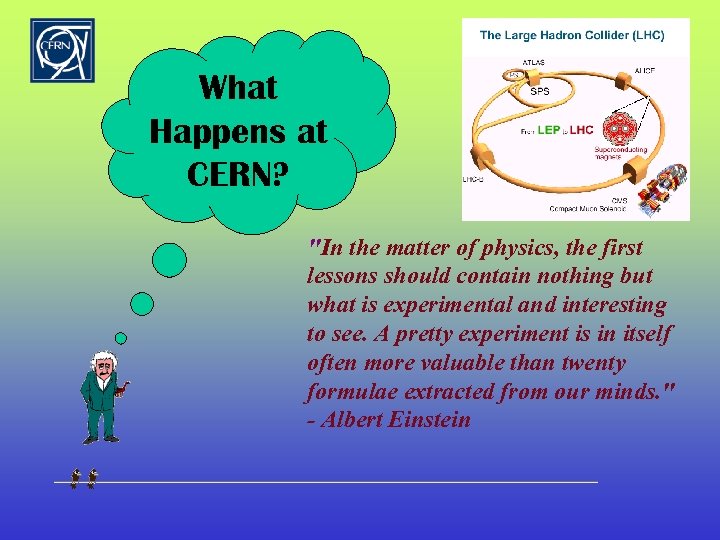 What Happens at CERN? "In the matter of physics, the first lessons should contain nothing but what is experimental and interesting to see. A pretty experiment is in itself often more valuable than twenty formulae extracted from our minds. " - Albert Einstein
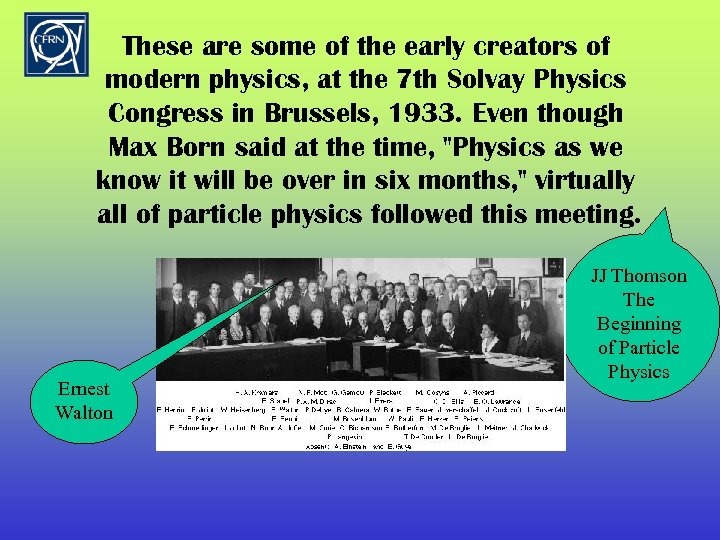 These are some of the early creators of modern physics, at the 7 th Solvay Physics Congress in Brussels, 1933. Even though Max Born said at the time, "Physics as we know it will be over in six months, " virtually all of particle physics followed this meeting. Ernest Walton JJ Thomson The Beginning of Particle Physics
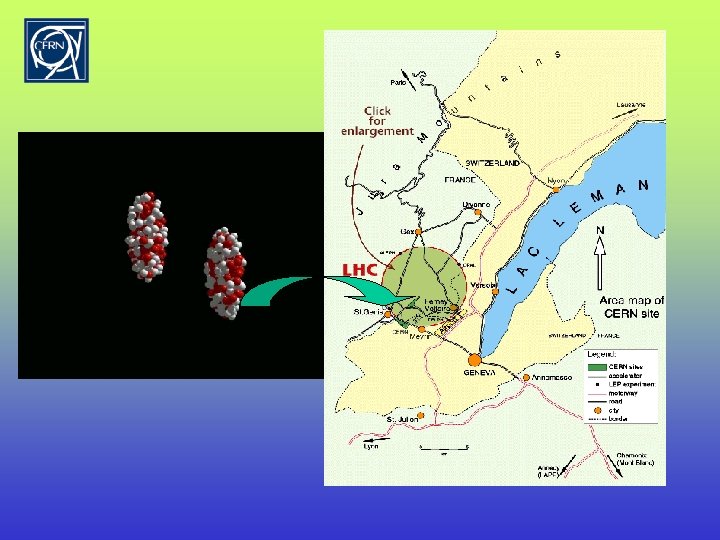
 What is CERN? About CERN's Name from the Web ØAs an outsider, you may refer to us as "CERN, the European Laboratory for Particle Physics near Geneva", but for legal reasons we will always communicate with you as the "European Organization for Nuclear Research". ØCERN staff must use the official name in all CERN published materials. ØCERN does pure scientific research into the laws of nature. We are not involved with nuclear weapons.
 What is CERN? The CERN convention states: The Organization shall provide for collaboration among European States in nuclear research of a pure scientific and fundamental character, and in research essentially related thereto. The Organization shall have no concern with work for military requirements and the results of its experimental and theoretical work shall be published or otherwise made generally available.
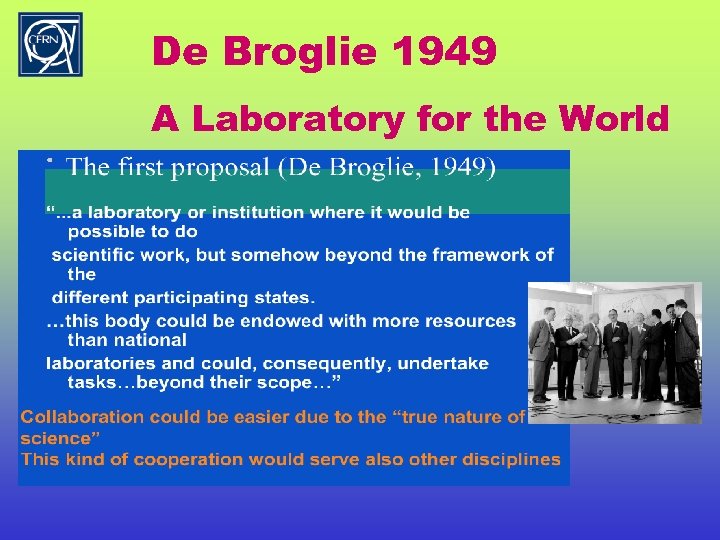 De Broglie 1949 A Laboratory for the World
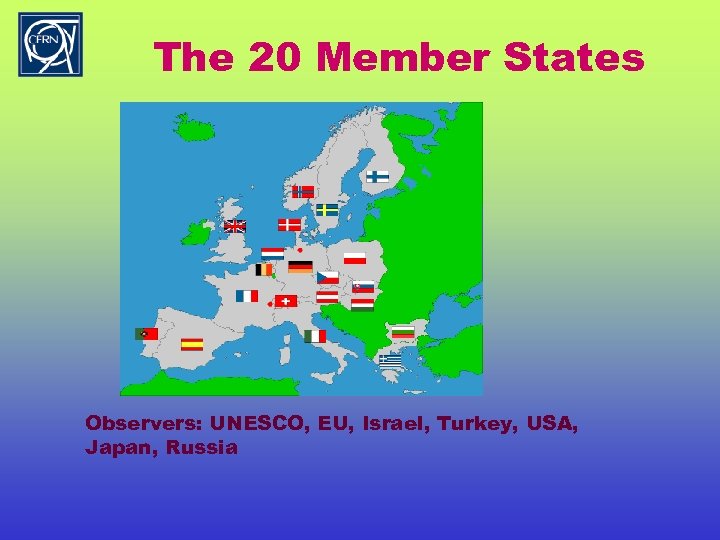 The 20 Member States Observers: UNESCO, EU, Israel, Turkey, USA, Japan, Russia
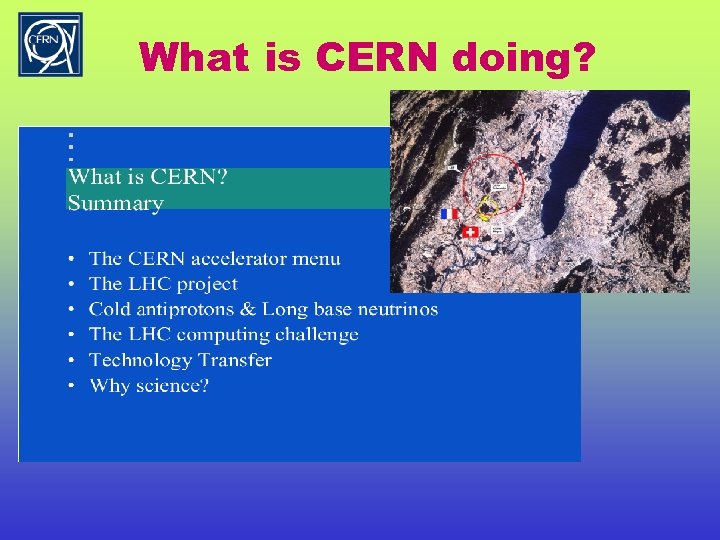 What is CERN doing?
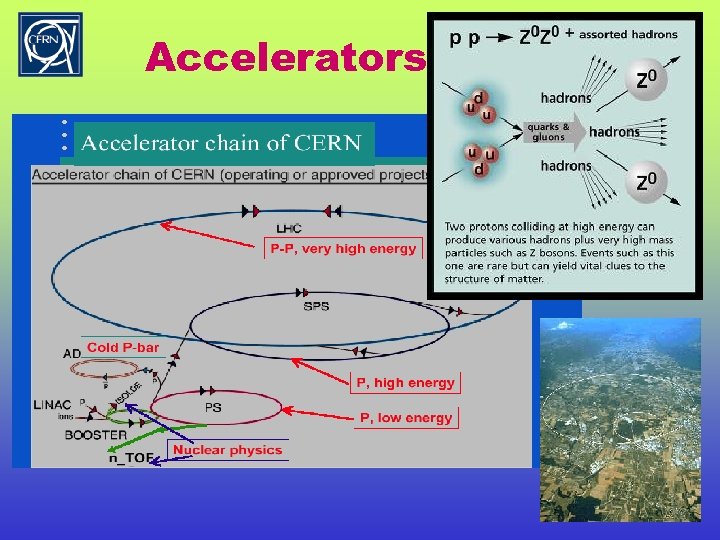 Accelerators
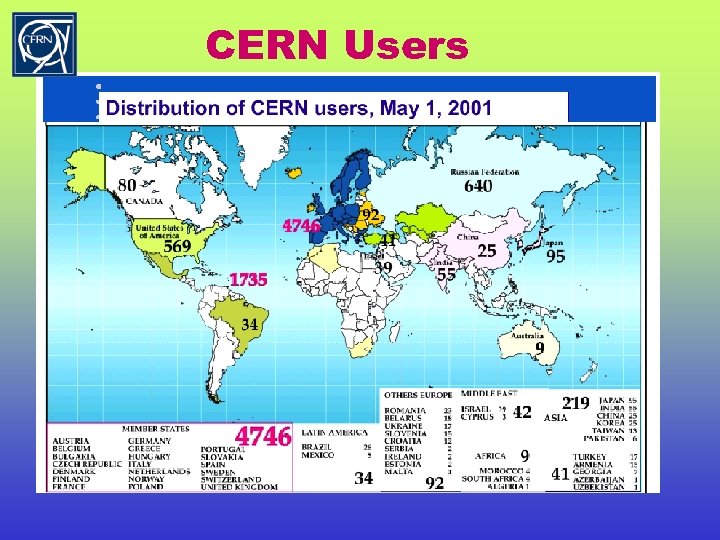 CERN Users
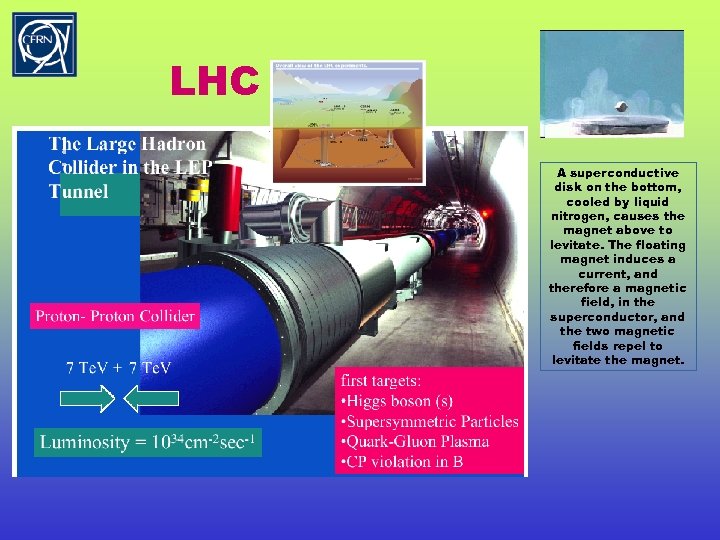 LHC A superconductive disk on the bottom, cooled by liquid nitrogen, causes the magnet above to levitate. The floating magnet induces a current, and therefore a magnetic field, in the superconductor, and the two magnetic fields repel to levitate the magnet.
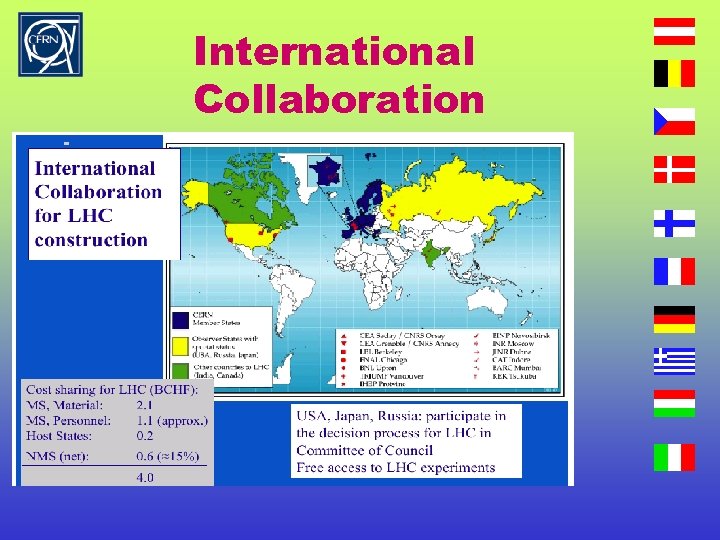 International Collaboration
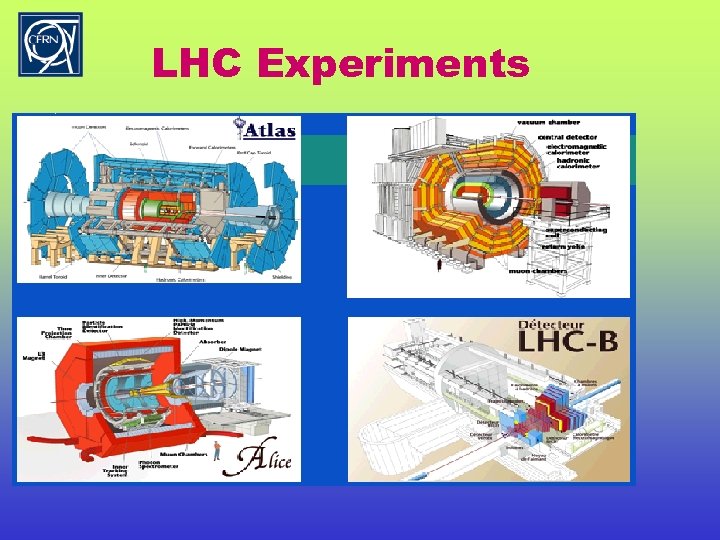 LHC Experiments
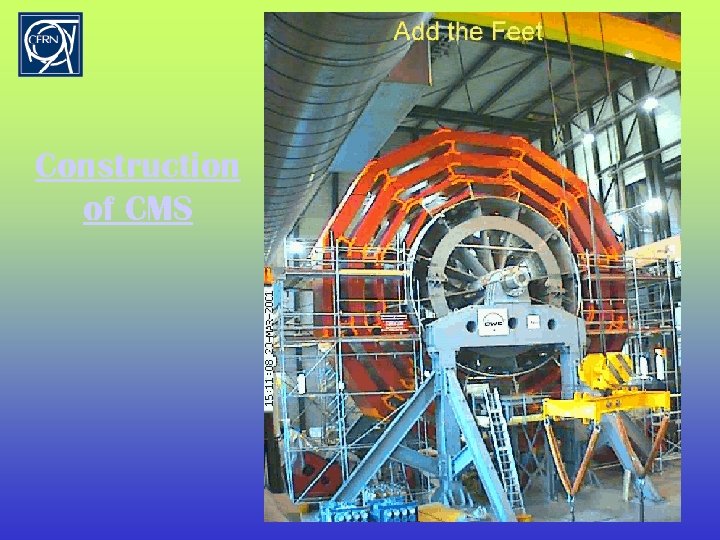 Construction of CMS
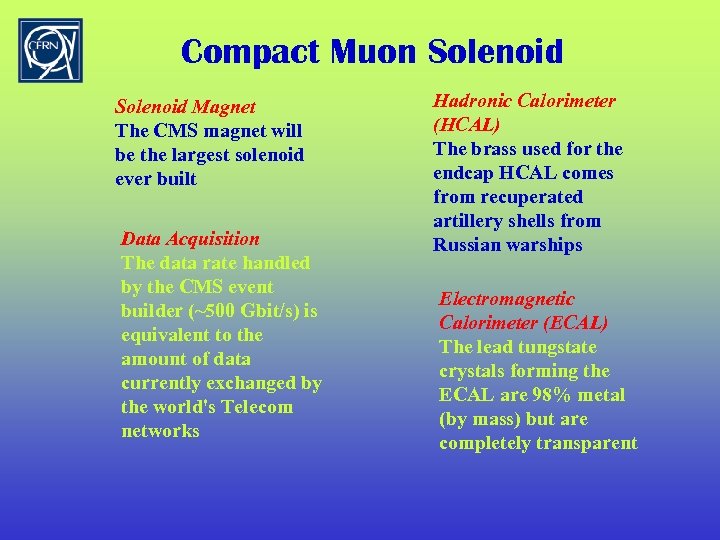 Compact Muon Solenoid Magnet The CMS magnet will be the largest solenoid ever built Data Acquisition The data rate handled by the CMS event builder (~500 Gbit/s) is equivalent to the amount of data currently exchanged by the world's Telecom networks Hadronic Calorimeter (HCAL) The brass used for the endcap HCAL comes from recuperated artillery shells from Russian warships Electromagnetic Calorimeter (ECAL) The lead tungstate crystals forming the ECAL are 98% metal (by mass) but are completely transparent
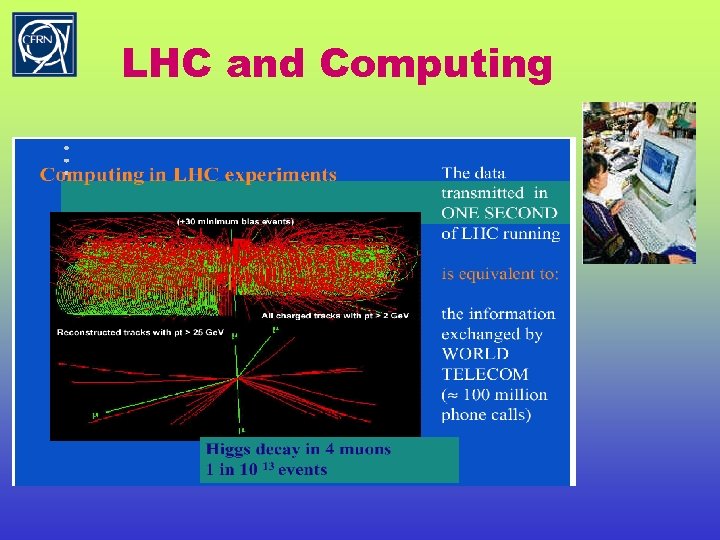 LHC and Computing
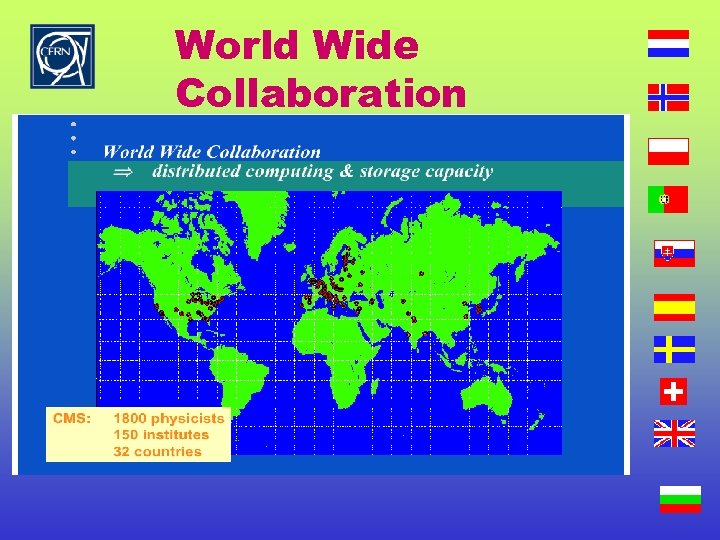 World Wide Collaboration
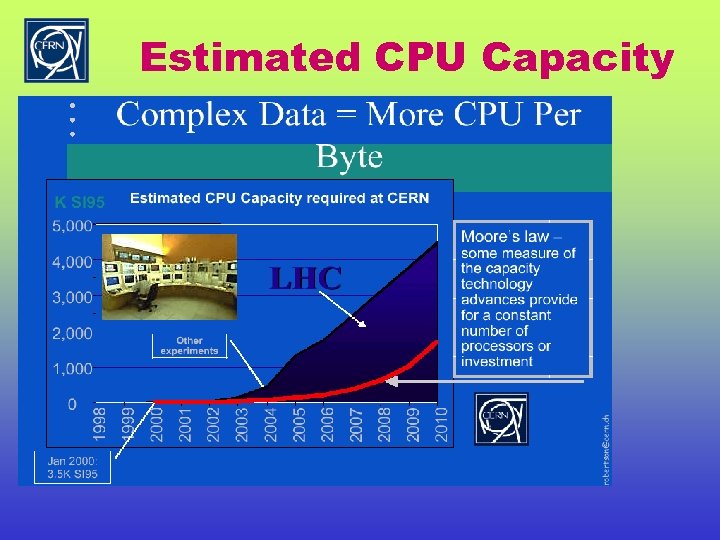 Estimated CPU Capacity
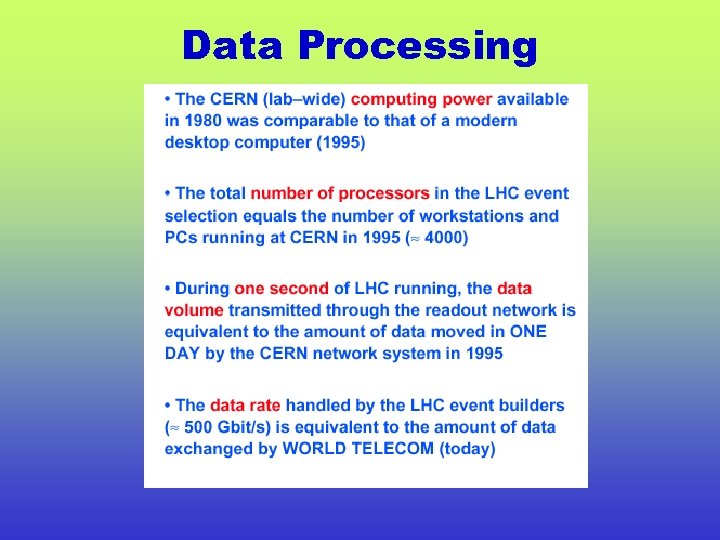 Data Processing
 The Data. Grid Project "Data. Grid" is a project funded by European Union. The objective is to enable next generation scientific exploration which requires intensive computation and analysis of shared large-scale databases, from hundreds of Tera. Bytes to Peta. Bytes, across widely distributed scientific communities. The EU-Data. Grid initiative is led by CERN
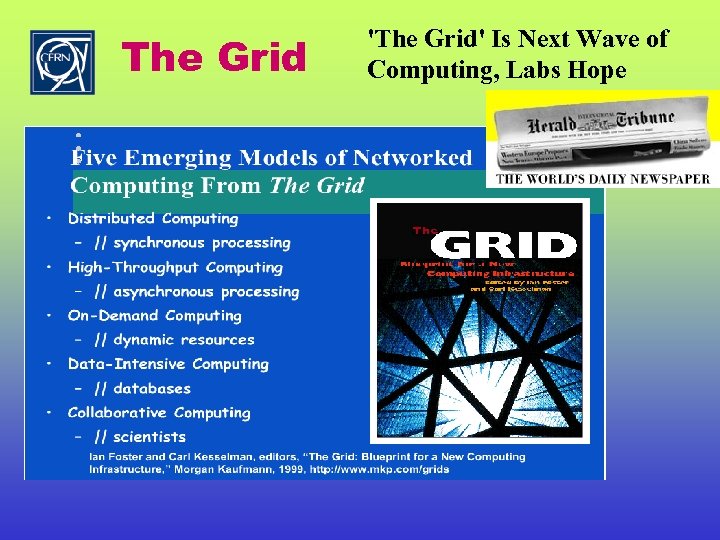 The Grid 'The Grid' Is Next Wave of Computing, Labs Hope
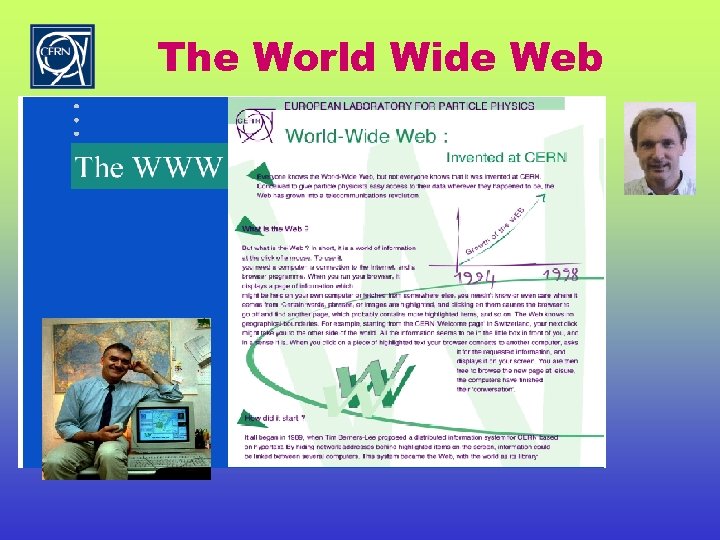 The World Wide Web
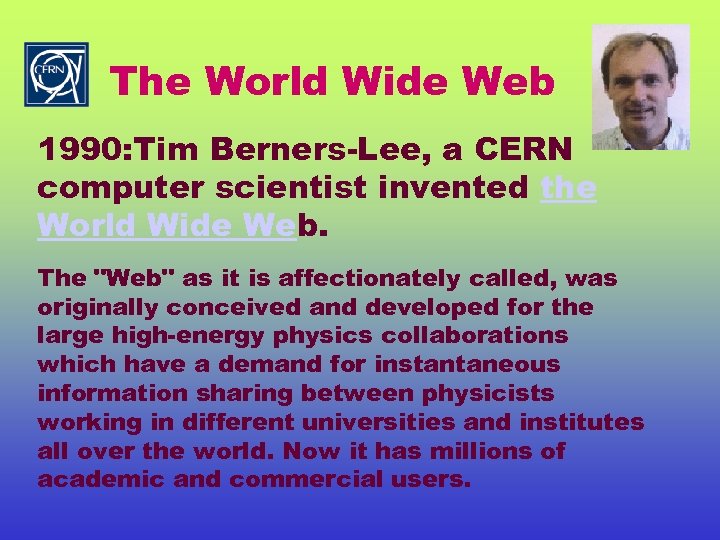 The World Wide Web 1990: Tim Berners-Lee, a CERN computer scientist invented the World Wide Web. The "Web" as it is affectionately called, was originally conceived and developed for the large high-energy physics collaborations which have a demand for instantaneous information sharing between physicists working in different universities and institutes all over the world. Now it has millions of academic and commercial users.
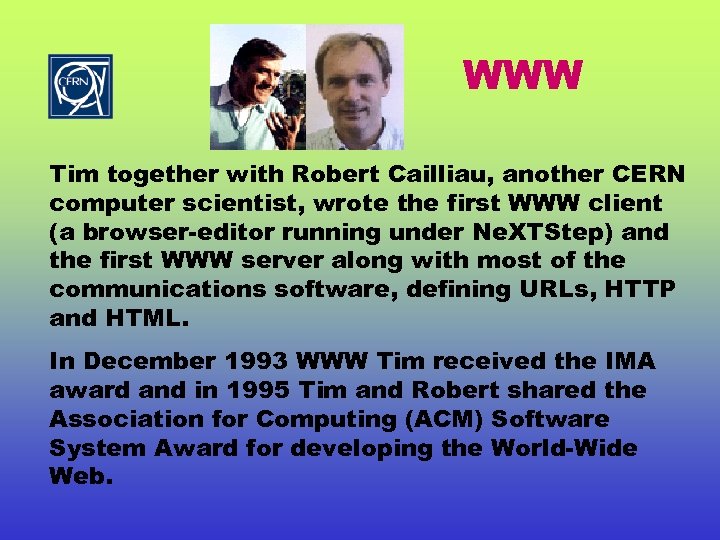 WWW Tim together with Robert Cailliau, another CERN computer scientist, wrote the first WWW client (a browser-editor running under Ne. XTStep) and the first WWW server along with most of the communications software, defining URLs, HTTP and HTML. In December 1993 WWW Tim received the IMA award and in 1995 Tim and Robert shared the Association for Computing (ACM) Software System Award for developing the World-Wide Web.
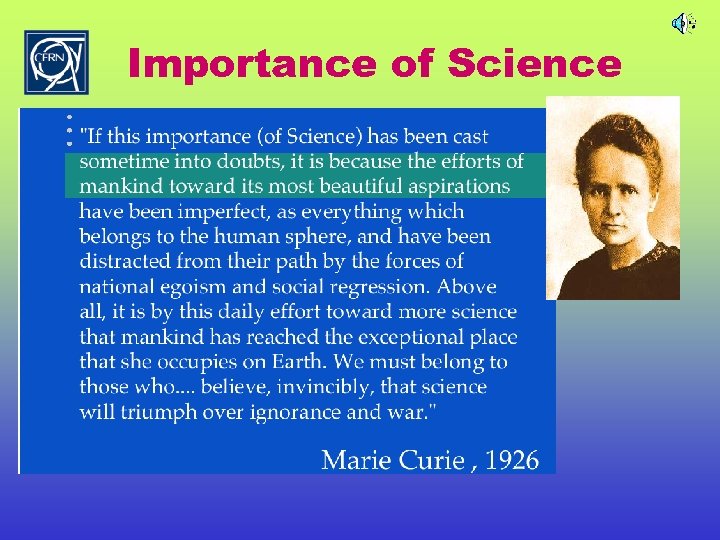 Importance of Science
 For more information on the CERN HST Programme http: //teachers. web. cern. ch/teachers/