Скачать презентацию CERN June 2006 The Pilot WLCG Service Last
40493c6f499ebaf8c9f17a851cb49639.ppt
- Количество слайдов: 62
 CERN, June 2006 The Pilot WLCG Service: Last steps before full production i) Issues Related to Running Production Services ii) Operational Concerns Seen from Five (5) Service Challenges iii) Roadmap for rest of 2006, early 2007 Jamie Shiers, CERN
 Abstract § The production phase of the Service Challenge 4 - aka the Pilot WLCG Service - started at the beginning of June 2006. This leads to the full production WLCG service from October 2006. § Thus the WLCG pilot is the final opportunity to shakedown not only the services provided as part of the WLCG computing environment - including their functionality - but also the operational and support procedures that are required to offer a full production service. § This talk will focus on operational aspects of the service, together with the currently planned production / test activities of the LHC experiments to validate their computing models and the service itself. M Despite the huge achievements over the last 18 months or so, we still have a very long way to go. Some sites / regions may not make it – at least not in time. Have to focus on a few key regions…
 § The Service Challenge programme this year must show that we can run reliable services § Grid reliability is the product of many components – middleware, grid operations, computer centres, …. § Target for September § 90% site availability § 90% user job success § Requires a major effort by everyone to monitor, measure, debug t? des ? o oo m bitious T m oo a T First data will arrive next year NOT an option to get things going later
 Production WLCG Services (a) The building blocks
 Grid Computing § Today there are many definitions of Grid computing: § The definitive definition of a Grid is provided by [1] Ian Foster in his article "What is the Grid? A Three Point Checklist" [2]. § The three points of this checklist are: § Computing resources are not administered centrally. § Open standards are used. § Non trivial quality of service is achieved. Ø … Some sort of Distributed System at least… § that crosses Management / Enterprise domains
 Distributed Systems… “A distributed system is one in which the failure of a computer you didn't even know existed can render your own computer unusable. ” Leslie Lamport §
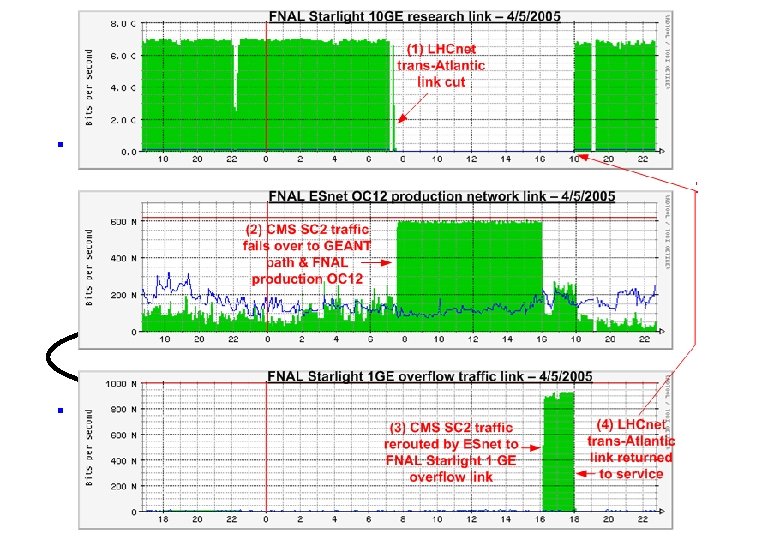 The Creation of the Internet § The USSR's launch of Sputnik spurred the U. S. to create the Defense Advanced Research Projects Agency (DARPA) in February 1958 to regain a technological lead. DARPA created the Information Processing Technology Office to further the research of the Semi Automatic Ground Environment program, which had networked country-wide radar systems together for the first time. J. C. R. Licklider was selected to head the IPTO, and saw universal networking as a potential unifying human revolution. Licklider recruited Lawrence Roberts to head a project to implement a network, and Roberts based the technology on the work of Paul Baran who had written an exhaustive study for the U. S. Air Force that recommended packet switching to make a network highly robust and survivable. § In August 1991 CERN, which straddles the border between France and Switzerland publicized the new World Wide Web project, two years after Tim Berners-Lee had begun creating HTML, HTTP and the first few web pages at CERN (which was set up by international treaty and not bound by the laws of either France or Switzerland).
 Production WLCG Services (b) So What Happens When 1 it Doesn’t Work? 1 Something doesn’t work all of the time
 The 1 st Law Of (Grid) Computing § Murphy's law (also known as Finagle's law or Sod's law) is a popular adage in Western culture, which broadly states that things will go wrong in any given situation. "If there's more than one way to do a job, and one of those ways will result in disaster, then somebody will do it that way. " It is most commonly formulated as "Anything that can go wrong will go wrong. " In American culture the law was named after Major Edward A. Murphy, Jr. , a development engineer working for a brief time on rocket sled experiments done by the United States Air Force in 1949. § … first received public attention during a press conference … it was that nobody had been severely injured during the rocket sled [of testing the human tolerance for g-forces during rapid deceleration. ]. Stapp replied that it was because they took Murphy's Law under consideration.
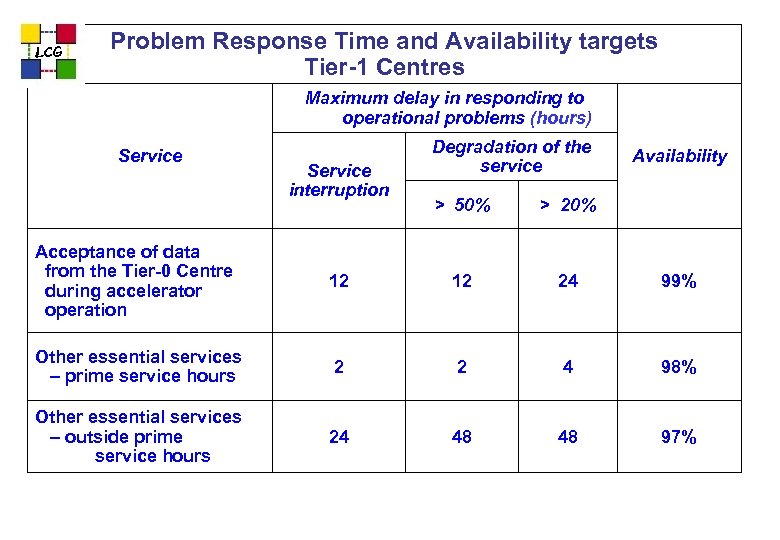 LCG Problem Response Time and Availability targets Tier-1 Centres Maximum delay in responding to operational problems (hours) Service interruption Degradation of the service > 50% Availability > 20% Acceptance of data from the Tier-0 Centre during accelerator operation 12 12 24 99% Other essential services – prime service hours 2 2 4 98% Other essential services – outside prime service hours 24 48 48 97%
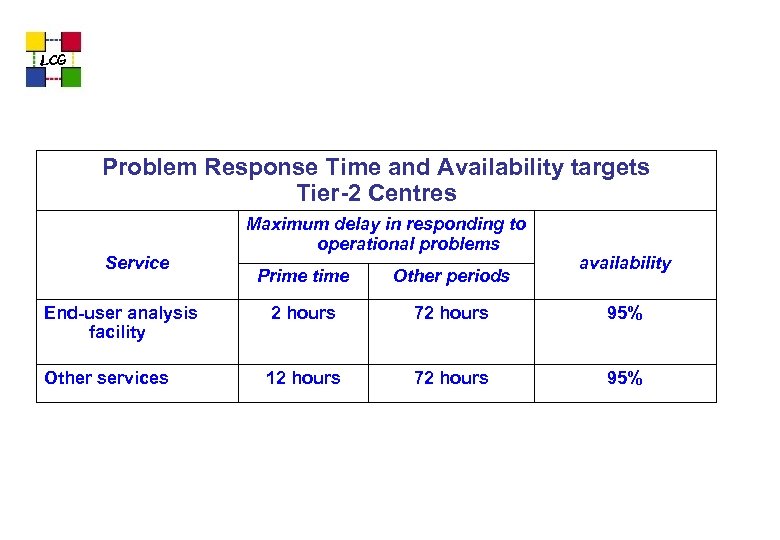 LCG Problem Response Time and Availability targets Tier-2 Centres Service Maximum delay in responding to operational problems availability Prime time Other periods End-user analysis facility 2 hours 72 hours 95% Other services 12 hours 72 hours 95%
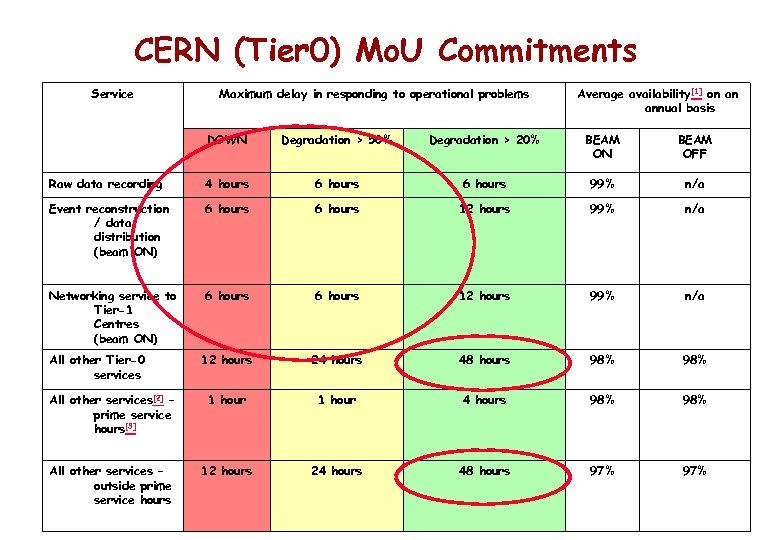 CERN (Tier 0) Mo. U Commitments Service Maximum delay in responding to operational problems Average availability[1] on an annual basis DOWN Degradation > 50% Degradation > 20% BEAM ON BEAM OFF Raw data recording 4 hours 6 hours 99% n/a Event reconstruction / data distribution (beam ON) 6 hours 12 hours 99% n/a Networking service to Tier-1 Centres (beam ON) 6 hours 12 hours 99% n/a 12 hours 24 hours 48 hours 98% All other services[2] – prime service hours[3] 1 hour 4 hours 98% All other services – outside prime service hours 12 hours 24 hours 48 hours 97% All other Tier-0 services
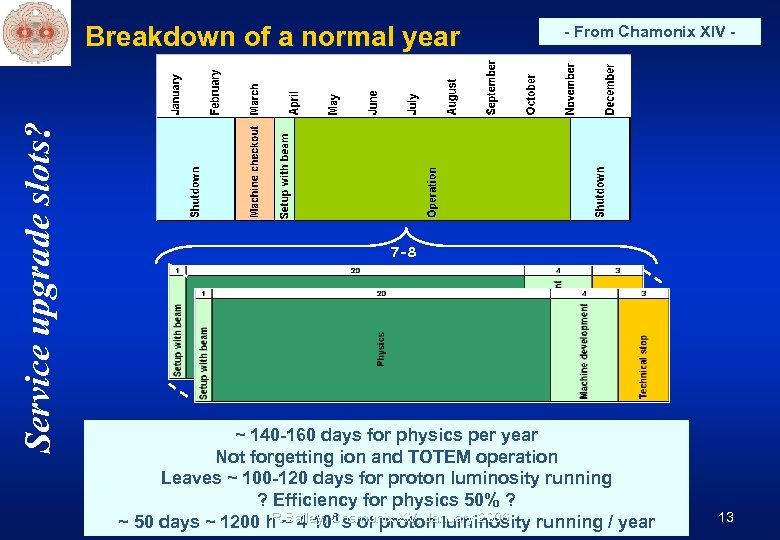 Service upgrade slots? Breakdown of a normal year - From Chamonix XIV - 7 -8 ~ 140 -160 days for physics per year Not forgetting ion and TOTEM operation Leaves ~ 100 -120 days for proton luminosity running ? Efficiency for physics 50% ? R. Bailey, 6 s of proton luminosity ~ 50 days ~ 1200 h ~ 4 10 Chamonix XV, January 2006 running / year 13
 WLCG Operations Beyond EGEE / OSG
 Introduction § Whilst WLCG is built upon existing Grid infrastructures – and must use procedures / tools etc at the underlying level as much as possible, there aspects of the WLCG service that require additional procedures / agreements etc. § Two real-life examples follow § These could eventually be built into procedures of the underlying Grids… § … But we need it now…
 Scheduled Interventions § Need procedures for announcing and handling scheduled interventions § The WLCG Management Board has agreed the following: § Interruptions of up to 4 hours must be announced at least one day in advance; § Interruptions greater than 4 hours but less than 12 must be announced at the weekly operations meeting prior to the event; § Interruptions greater than 12 hours must be announced at the operations meeting of the preceding week. § This is particularly important for services which affect outside users (e. g. CASTOR at CERN!) § LHCb are also keen that batch queues are appropriately closed / drained ¨ (A revised version is attached to the agenda pending MB approval)
 Site Offline Procedure (or Emergency Contact) § So what happens when a site goes offline? Ø Follow operations procedures § But these are on the Web… § So the person who lives closest drives home and uses his/her private Internet connection § Or we have a procedure… Ø And don’t tell me it’ll never happen (again…)
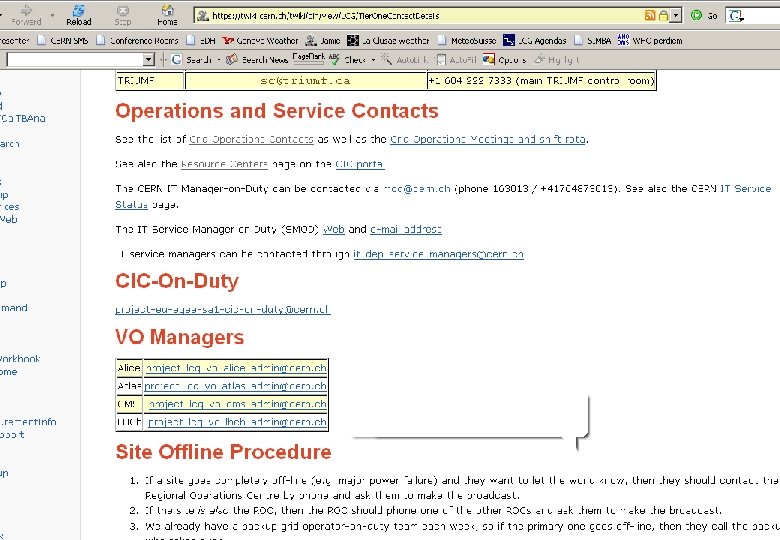
 Pragmatic Solution § I have compiled a table of contacts (e-mail, phone, mobiles) from replies from site contacts / GOCDB § I have printed it, stuck it on my door and in the corridor in B 28 § I have loaded all numbers into my mobile phone but I haven’t called them § This goes beyond GOCDB in any case § CERN MOD, SMOD, GMOD, central computer operator (5011), … § Control room number at some sites … § OK – its not “nice”, but the next time Tony Cass calls to tell me he’s about to shutdown the Computer Centre, at least I’ll have a better answer than § “Romain thinks he might have Steve Traylen’s number at home”
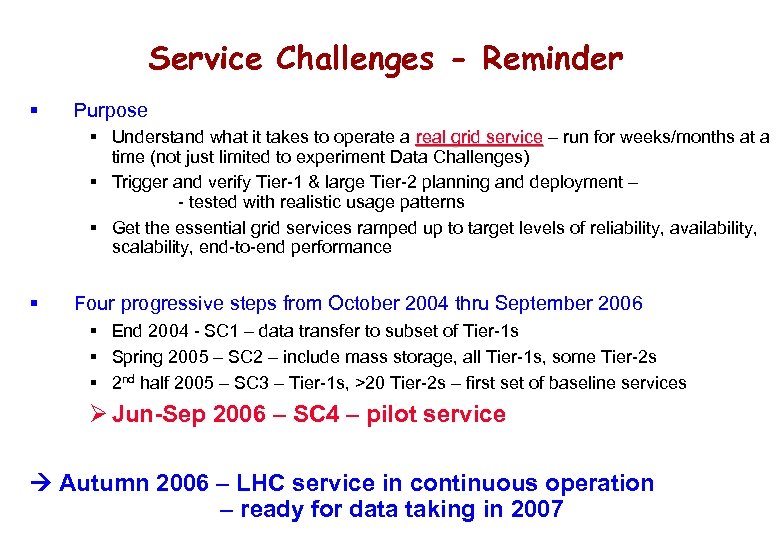 Service Challenges - Reminder § Purpose § Understand what it takes to operate a real grid service – run for weeks/months at a time (not just limited to experiment Data Challenges) § Trigger and verify Tier-1 & large Tier-2 planning and deployment – - tested with realistic usage patterns § Get the essential grid services ramped up to target levels of reliability, availability, scalability, end-to-end performance § Four progressive steps from October 2004 thru September 2006 § End 2004 - SC 1 – data transfer to subset of Tier-1 s § Spring 2005 – SC 2 – include mass storage, all Tier-1 s, some Tier-2 s § 2 nd half 2005 – SC 3 – Tier-1 s, >20 Tier-2 s – first set of baseline services Ø Jun-Sep 2006 – SC 4 – pilot service Autumn 2006 – LHC service in continuous operation – ready for data taking in 2007
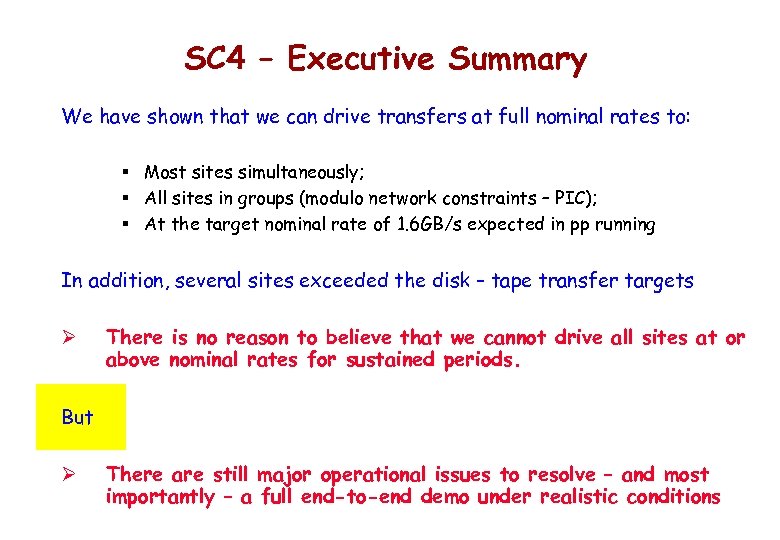 SC 4 – Executive Summary We have shown that we can drive transfers at full nominal rates to: § Most sites simultaneously; § All sites in groups (modulo network constraints – PIC); § At the target nominal rate of 1. 6 GB/s expected in pp running In addition, several sites exceeded the disk – tape transfer targets Ø There is no reason to believe that we cannot drive all sites at or above nominal rates for sustained periods. But Ø There are still major operational issues to resolve – and most importantly – a full end-to-end demo under realistic conditions
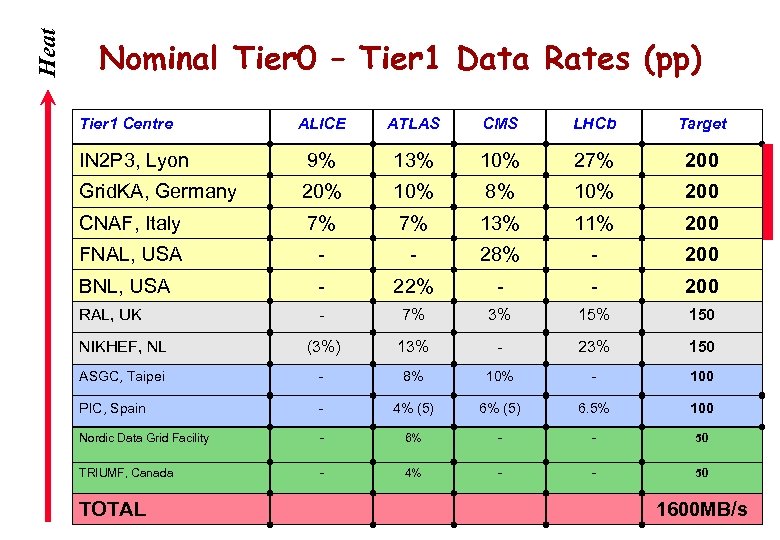 Heat Nominal Tier 0 – Tier 1 Data Rates (pp) Tier 1 Centre ALICE ATLAS CMS LHCb Target IN 2 P 3, Lyon 9% 13% 10% 27% 200 Grid. KA, Germany 20% 10% 8% 10% 200 CNAF, Italy 7% 7% 13% 11% 200 FNAL, USA - - 28% - 200 BNL, USA - 22% - - 200 RAL, UK - 7% 3% 150 NIKHEF, NL (3%) 13% - 23% 150 ASGC, Taipei - 8% 10% - 100 PIC, Spain - 4% (5) 6. 5% 100 Nordic Data Grid Facility - 6% - - 50 TRIUMF, Canada - 4% - - 50 TOTAL 1600 MB/s
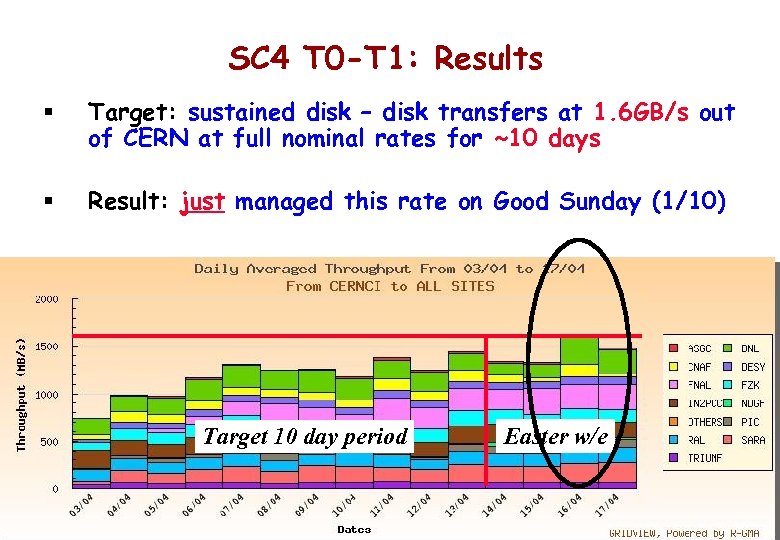 SC 4 T 0 -T 1: Results § Target: sustained disk – disk transfers at 1. 6 GB/s out of CERN at full nominal rates for ~10 days § Result: just managed this rate on Good Sunday (1/10) Target 10 day period Easter w/e
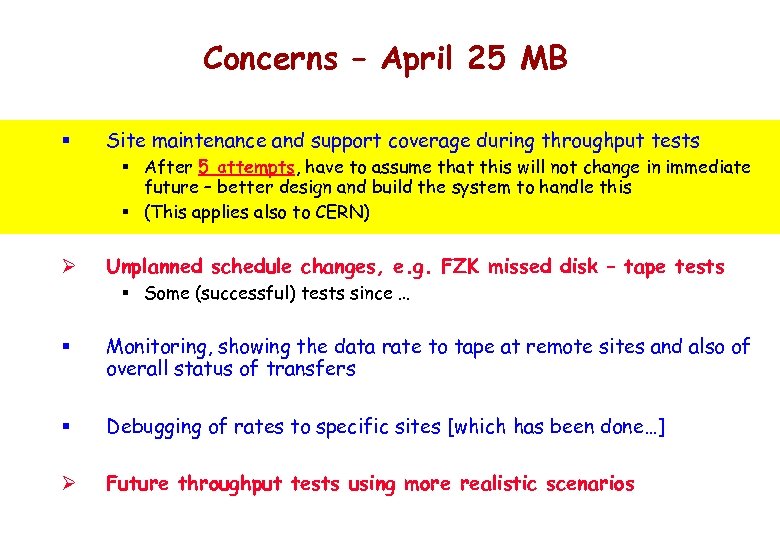 Concerns – April 25 MB § Site maintenance and support coverage during throughput tests § After 5 attempts, have to assume that this will not change in immediate future – better design and build the system to handle this § (This applies also to CERN) Ø Unplanned schedule changes, e. g. FZK missed disk – tape tests § Some (successful) tests since … § Monitoring, showing the data rate to tape at remote sites and also of overall status of transfers § Debugging of rates to specific sites [which has been done…] Ø Future throughput tests using more realistic scenarios
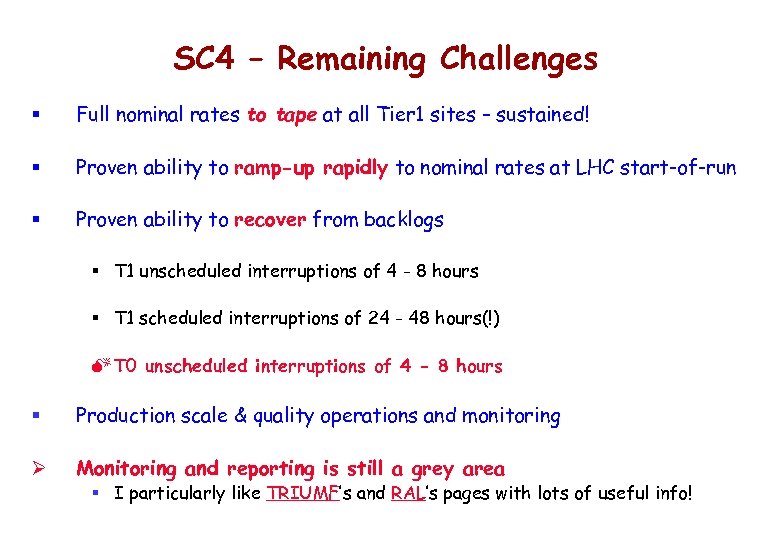 SC 4 – Remaining Challenges § Full nominal rates to tape at all Tier 1 sites – sustained! § Proven ability to ramp-up rapidly to nominal rates at LHC start-of-run § Proven ability to recover from backlogs § T 1 unscheduled interruptions of 4 - 8 hours § T 1 scheduled interruptions of 24 - 48 hours(!) M T 0 unscheduled interruptions of 4 - 8 hours § Production scale & quality operations and monitoring Ø Monitoring and reporting is still a grey area § I particularly like TRIUMF’s and RAL’s pages with lots of useful info!
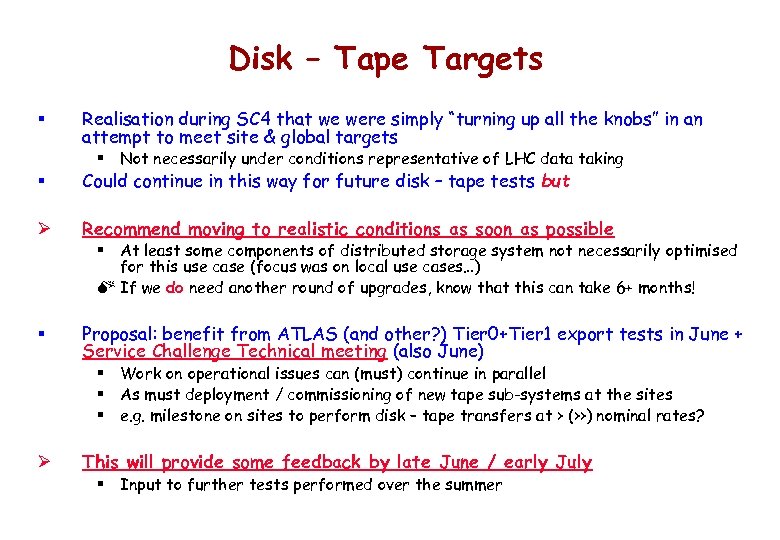 Disk – Tape Targets § Realisation during SC 4 that we were simply “turning up all the knobs” in an attempt to meet site & global targets § Not necessarily under conditions representative of LHC data taking § Could continue in this way for future disk – tape tests but Ø Recommend moving to realistic conditions as soon as possible § At least some components of distributed storage system not necessarily optimised for this use case (focus was on local use cases…) M If we do need another round of upgrades, know that this can take 6+ months! § Proposal: benefit from ATLAS (and other? ) Tier 0+Tier 1 export tests in June + Service Challenge Technical meeting (also June) § Work on operational issues can (must) continue in parallel § As must deployment / commissioning of new tape sub-systems at the sites § e. g. milestone on sites to perform disk – tape transfers at > (>>) nominal rates? Ø This will provide some feedback by late June / early July § Input to further tests performed over the summer
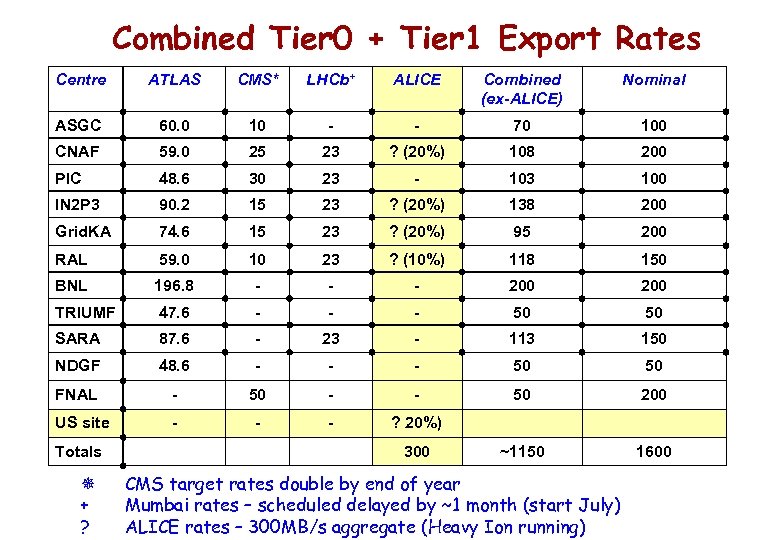 Combined Tier 0 + Tier 1 Export Rates Centre ATLAS CMS* LHCb+ ALICE Combined (ex-ALICE) Nominal ASGC 60. 0 10 - - 70 100 CNAF 59. 0 25 23 ? (20%) 108 200 PIC 48. 6 30 23 - 103 100 IN 2 P 3 90. 2 15 23 ? (20%) 138 200 Grid. KA 74. 6 15 23 ? (20%) 95 200 RAL 59. 0 10 23 ? (10%) 118 150 BNL 196. 8 - - - 200 TRIUMF 47. 6 - - - 50 50 SARA 87. 6 - 23 - 113 150 NDGF 48. 6 - - - 50 50 FNAL - 50 - - 50 200 US site - - - ? 20%) ~1150 1600 Totals ¯ + ? 300 CMS target rates double by end of year Mumbai rates – scheduled delayed by ~1 month (start July) ALICE rates – 300 MB/s aggregate (Heavy Ion running)
 SC 4 – Meeting with LHCC Referees § Following presentation of SC 4 status to LHCC referees, I was asked to write a report (originally confidential to Management Board) summarising issues & concerns Ø I did not want to do this! § This report started with some (uncontested) observations § Made some recommendations § Somewhat luke-warm reception to some of these at MB § … but I still believe that they make sense! (So I’ll show them anyway…) § Rated site-readiness according to a few simple metrics… Ø We are not ready yet!
 Disclaimer § Please find a report reviewing Site Monitoring and Operation in SC 4 attached to the following page: § https: //twiki. cern. ch/twiki/bin/view/LCG/For. Management. Board § (It is not attached to the MB agenda and/or Wiki as it should be considered confidential to MB members). Ø Two seconds later it was attached to the agenda, so no longer confidential… § In the table below tentative service levels are given, based on the experience in April 2006. It is proposed that each site checks these assessments and provides corrections as appropriate and that these are then reviewed on a site-by-site basis. § (By definition, T 0 -T 1 transfers involve source&sink)
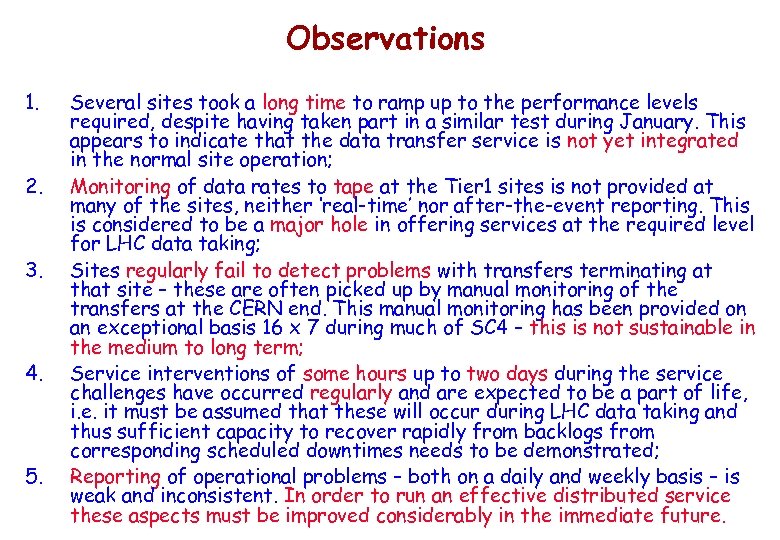 Observations 1. 2. 3. 4. 5. Several sites took a long time to ramp up to the performance levels required, despite having taken part in a similar test during January. This appears to indicate that the data transfer service is not yet integrated in the normal site operation; Monitoring of data rates to tape at the Tier 1 sites is not provided at many of the sites, neither ‘real-time’ nor after-the-event reporting. This is considered to be a major hole in offering services at the required level for LHC data taking; Sites regularly fail to detect problems with transfers terminating at that site – these are often picked up by manual monitoring of the transfers at the CERN end. This manual monitoring has been provided on an exceptional basis 16 x 7 during much of SC 4 – this is not sustainable in the medium to long term; Service interventions of some hours up to two days during the service challenges have occurred regularly and are expected to be a part of life, i. e. it must be assumed that these will occur during LHC data taking and thus sufficient capacity to recover rapidly from backlogs from corresponding scheduled downtimes needs to be demonstrated; Reporting of operational problems – both on a daily and weekly basis – is weak and inconsistent. In order to run an effective distributed service these aspects must be improved considerably in the immediate future.
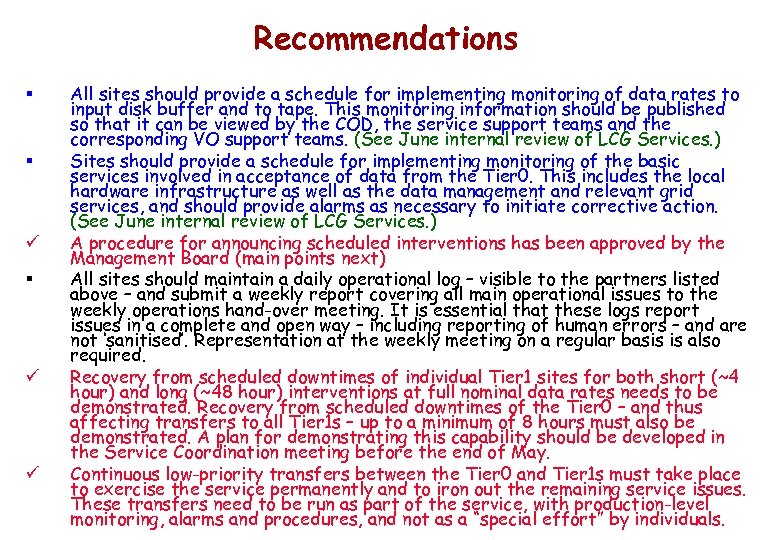 Recommendations § § ü ü All sites should provide a schedule for implementing monitoring of data rates to input disk buffer and to tape. This monitoring information should be published so that it can be viewed by the COD, the service support teams and the corresponding VO support teams. (See June internal review of LCG Services. ) Sites should provide a schedule for implementing monitoring of the basic services involved in acceptance of data from the Tier 0. This includes the local hardware infrastructure as well as the data management and relevant grid services, and should provide alarms as necessary to initiate corrective action. (See June internal review of LCG Services. ) A procedure for announcing scheduled interventions has been approved by the Management Board (main points next) All sites should maintain a daily operational log – visible to the partners listed above – and submit a weekly report covering all main operational issues to the weekly operations hand-over meeting. It is essential that these logs report issues in a complete and open way – including reporting of human errors – and are not ‘sanitised’. Representation at the weekly meeting on a regular basis is also required. Recovery from scheduled downtimes of individual Tier 1 sites for both short (~4 hour) and long (~48 hour) interventions at full nominal data rates needs to be demonstrated. Recovery from scheduled downtimes of the Tier 0 – and thus affecting transfers to all Tier 1 s – up to a minimum of 8 hours must also be demonstrated. A plan for demonstrating this capability should be developed in the Service Coordination meeting before the end of May. Continuous low-priority transfers between the Tier 0 and Tier 1 s must take place to exercise the service permanently and to iron out the remaining service issues. These transfers need to be run as part of the service, with production-level monitoring, alarms and procedures, and not as a “special effort” by individuals.
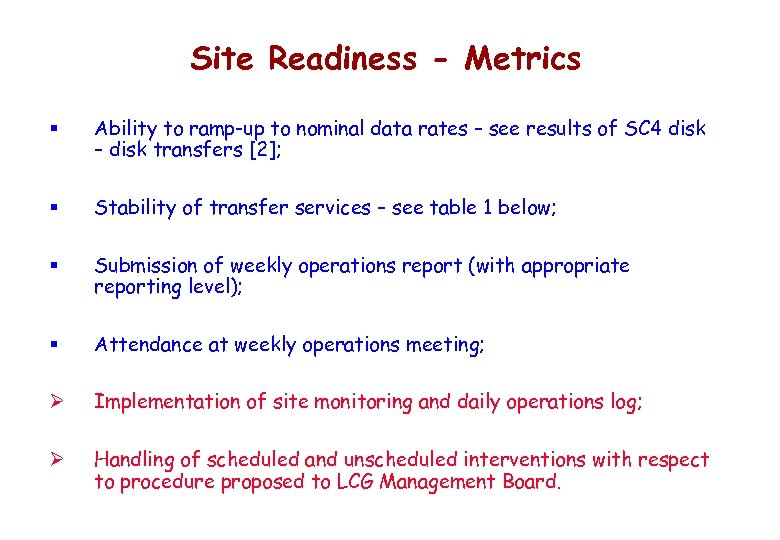 Site Readiness - Metrics § Ability to ramp-up to nominal data rates – see results of SC 4 disk – disk transfers [2]; § Stability of transfer services – see table 1 below; § Submission of weekly operations report (with appropriate reporting level); § Attendance at weekly operations meeting; Ø Implementation of site monitoring and daily operations log; Ø Handling of scheduled and unscheduled interventions with respect to procedure proposed to LCG Management Board.
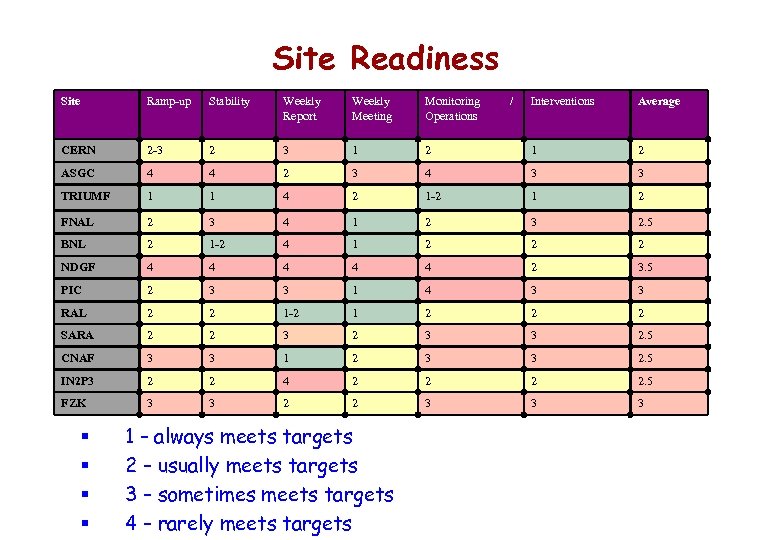 Site Readiness Site Ramp-up Stability Weekly Report Weekly Meeting Monitoring Operations CERN 2 -3 2 3 1 ASGC 4 4 2 TRIUMF 1 1 FNAL 2 BNL Interventions Average 2 1 2 3 4 3 3 4 2 1 -2 1 2 3 4 1 2 3 2. 5 2 1 -2 4 1 2 2 2 NDGF 4 4 4 2 3. 5 PIC 2 3 3 1 4 3 3 RAL 2 2 1 -2 1 2 2 2 SARA 2 2 3 3 2. 5 CNAF 3 3 1 2 3 3 2. 5 IN 2 P 3 2 2 4 2 2. 5 FZK 3 3 2 2 3 3 3 § § 1 – always meets targets 2 – usually meets targets 3 – sometimes meets targets 4 – rarely meets targets /
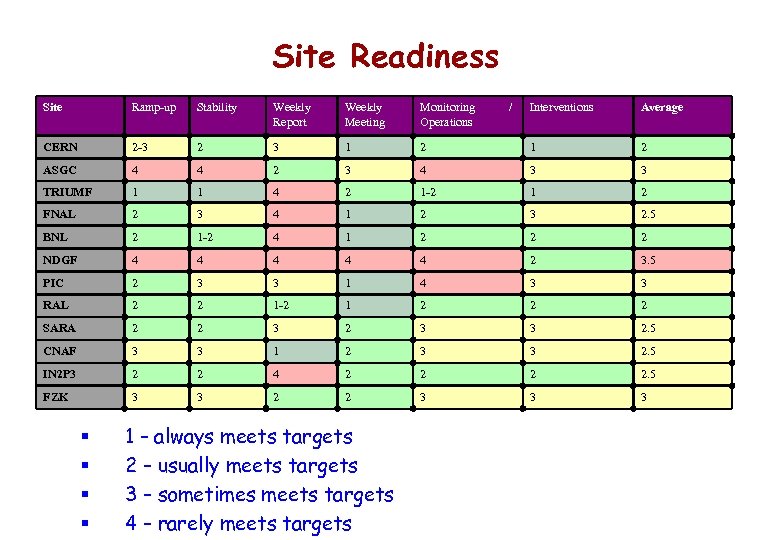 Site Readiness Site Ramp-up Stability Weekly Report Weekly Meeting Monitoring Operations CERN 2 -3 2 3 1 ASGC 4 4 2 TRIUMF 1 1 FNAL 2 BNL Interventions Average 2 1 2 3 4 3 3 4 2 1 -2 1 2 3 4 1 2 3 2. 5 2 1 -2 4 1 2 2 2 NDGF 4 4 4 2 3. 5 PIC 2 3 3 1 4 3 3 RAL 2 2 1 -2 1 2 2 2 SARA 2 2 3 3 2. 5 CNAF 3 3 1 2 3 3 2. 5 IN 2 P 3 2 2 4 2 2. 5 FZK 3 3 2 2 3 3 3 § § 1 – always meets targets 2 – usually meets targets 3 – sometimes meets targets 4 – rarely meets targets /
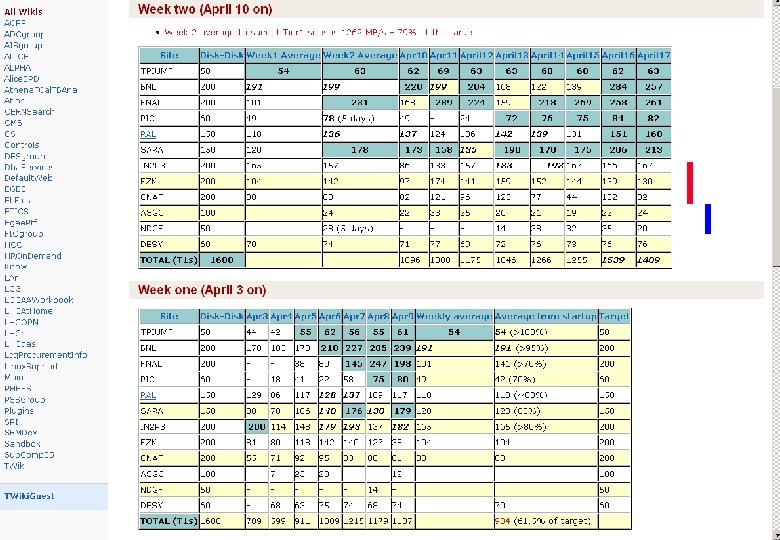
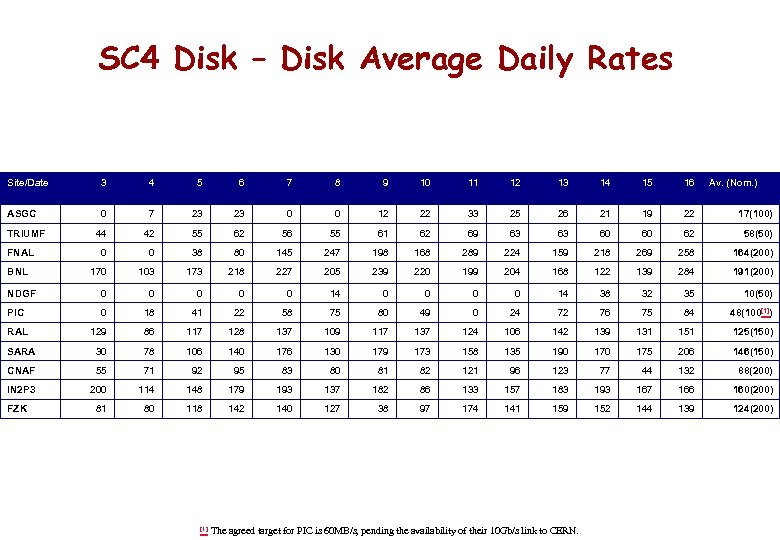 SC 4 Disk – Disk Average Daily Rates Site/Date 3 4 5 6 7 8 9 10 11 12 13 14 15 16 ASGC 0 7 23 23 0 0 12 22 33 25 26 21 19 22 17(100) 44 42 55 62 56 55 61 62 69 63 63 60 60 62 58(50) 0 0 38 80 145 247 198 168 289 224 159 218 269 258 164(200) 170 103 173 218 227 205 239 220 199 204 168 122 139 284 191(200) NDGF 0 0 0 14 38 32 35 10(50) PIC 0 18 41 22 58 75 80 49 0 24 72 76 75 84 48(100[1]) 129 86 117 128 137 109 117 137 124 106 142 139 131 151 125(150) SARA 30 78 106 140 176 130 179 173 158 135 190 175 206 146(150) CNAF 55 71 92 95 83 80 81 82 121 96 123 77 44 132 88(200) IN 2 P 3 200 114 148 179 193 137 182 86 133 157 183 193 167 166 160(200) 81 80 118 142 140 127 38 97 174 141 159 152 144 139 124(200) TRIUMF FNAL BNL RAL FZK [1] The agreed target for PIC is 60 MB/s, pending the availability of their 10 Gb/s link to CERN. Av. (Nom. )
 Site Readiness - Summary § I believe that these subjective metrics paint a fairly realistic picture § The ATLAS and other Challenges will provide more data points § I know the support of multiple VOs, standard Tier 1 responsibilities, plus others taken up by individual sites / projects represent significant effort § But at some stage we have to adapt the plan to reality Ø If a small site is late things can probably be accommodated M If a major site is late we have a major problem
 Site Readiness – Next Steps § Discussion at MB was to repeat review but with rotating reviewers § Clear candidate for next phase would be ATLAS T 0 -T 1 transfers § As this involves all Tier 1 s except FNAL, suggestion is that FNAL nominate a co-reviewer § e. g. Ian Fisk + Harry Renshall § Metrics to be established in advance and agreed by MB and Tier 1 s § (This test also involves a strong Tier 0 component which may have to be factored out) § Possible metrics next:
 June Readiness Review § Readiness for start date § Date at which required information was communicated § T 0 -T 1 transfer rates as daily average 100% of target § List the daily rate, the total average, histogram the distribution § Separate disk and tape contributions § Ramp-up efficiency (# hours, # days) § Mo. U targets for pseudo accelerator operation § Service availability, time to intervene § Problems and their resolution (using standard channels) § # tickets, details § Site report / analysis § Sites own report of the ‘run’, similar to that produced by IN 2 P 3
 WLCG Service Experiment Production Activities During WLCG Pilot Aka SC 4 Service Phase June – September Inclusive
 Overview § All 4 LHC experiments will run major production exercises during WLCG pilot / SC 4 Service Phase § These will test all aspects of the respective Computing Models plus stress Site Readiness to run (collectively) full production services § These plans have been assembled from the material presented at the Mumbai workshop, with follow-up by Harry Renshall with each experiment, together with input from Bernd Panzer (T 0) and the Pre-production team, and summarised on the SC 4 planning page. § We have also held a number of meetings with representatives from all experiments to confirm that we have all the necessary input (all activities: PPS, SC, Tier 0, …) and to spot possible clashes in schedules and / or resource requirements. (See “LCG Resource Scheduling Meetings” under LCG Service Coordination Meetings). § § The conclusions of these meetings has been presented to the weekly operations meetings and the WLCG Management Board in written form (documents, presentations) § Ø fyi; the LCG Service Coordination Meetings (LCGSCM) focus on the CERN component of the service; we also held a WLCGSCM at CERN last December. See for example these points on the MB agenda page for May 24 2006 The Service Challenge Technical meeting (21 June IT amphi) will list the exact requirements by VO and site with timetable, contact details etc.
 DTEAM Activities § § § Ø Background disk-disk transfers from the Tier 0 to all Tier 1 s will start from June 1 st. These transfers will continue – but with low priority – until further notice (it is assumed until the end of SC 4) to debug site monitoring, operational procedures and the ability to ramp-up to full nominal rates rapidly (a matter of hours, not days). These transfers will use the disk end-points established for the April SC 4 tests. Once these transfers have satisfied the above requirements, a schedule for ramping to full nominal disk – tape rates will be established. The current resources available at CERN for DTEAM only permit transfers up to 800 MB/s and thus can be used to test ramp-up and stability, but not to drive all sites at their full nominal rates for pp running. All sites (Tier 0 + Tier 1 s) are expected to operate the required services (as already established for SC 4 throughput transfers) in full production mode. (Transfer) SERVICE COORDINATOR
 ATLAS § § Ø ATLAS will start a major exercise on June 19 th. This exercise is described in more detail in https: //uimon. cern. ch/twiki/bin/view/Atlas/DDMSc 4, and is scheduled to run for 3 weeks. However, preparation for this challenge has already started and will ramp-up in the coming weeks. That is, the basic requisites must be met prior to that time, to allow for preparation and testing before the official starting date of the challenge. The sites in question will be ramped up in phases – the exact schedule is still to be defined. The target data rates that should be supported from CERN to each Tier 1 supporting ATLAS are given in the table below. 40% of these data rates must be written to tape, the remainder to disk. It is a requirement that the tapes in question are at least unloaded having been written. Both disk and tape data maybe recycled after 24 hours. Possible targets: 4 / 8 / all Tier 1 s meet (75 -100%) of nominal rates for 7 days
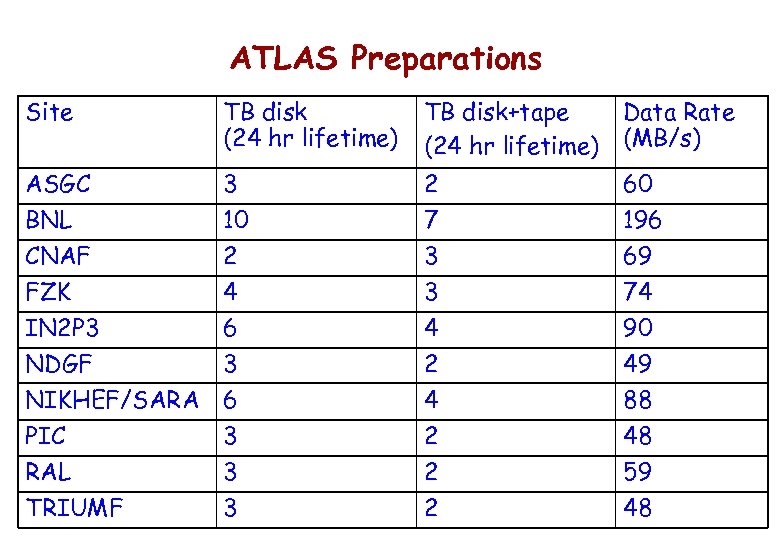 ATLAS Preparations Site TB disk (24 hr lifetime) TB disk+tape (24 hr lifetime) Data Rate (MB/s) ASGC BNL 3 10 2 7 60 196 CNAF FZK IN 2 P 3 NDGF NIKHEF/SARA 2 4 6 3 3 4 2 4 69 74 90 49 88 PIC RAL TRIUMF 3 3 3 2 2 2 48 59 48
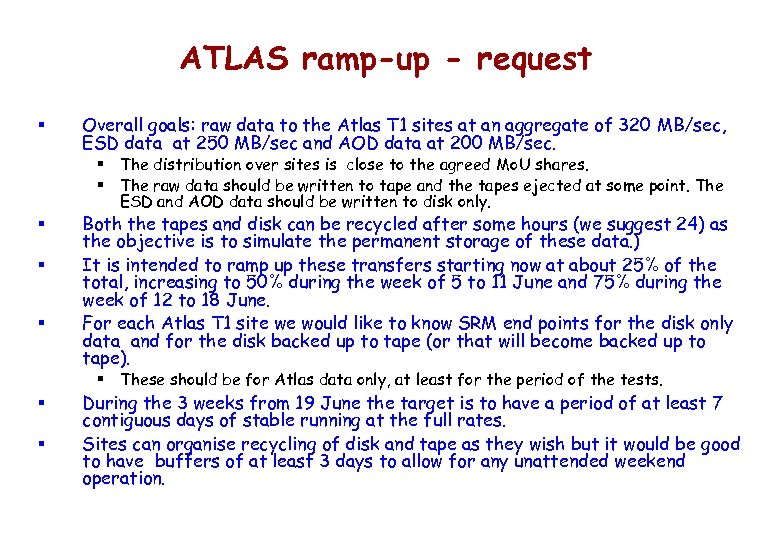 ATLAS ramp-up - request § Overall goals: raw data to the Atlas T 1 sites at an aggregate of 320 MB/sec, ESD data at 250 MB/sec and AOD data at 200 MB/sec. § The distribution over sites is close to the agreed Mo. U shares. § The raw data should be written to tape and the tapes ejected at some point. The ESD and AOD data should be written to disk only. § § § Both the tapes and disk can be recycled after some hours (we suggest 24) as the objective is to simulate the permanent storage of these data. ) It is intended to ramp up these transfers starting now at about 25% of the total, increasing to 50% during the week of 5 to 11 June and 75% during the week of 12 to 18 June. For each Atlas T 1 site we would like to know SRM end points for the disk only data and for the disk backed up to tape (or that will become backed up to tape). § These should be for Atlas data only, at least for the period of the tests. § § During the 3 weeks from 19 June the target is to have a period of at least 7 contiguous days of stable running at the full rates. Sites can organise recycling of disk and tape as they wish but it would be good to have buffers of at least 3 days to allow for any unattended weekend operation.
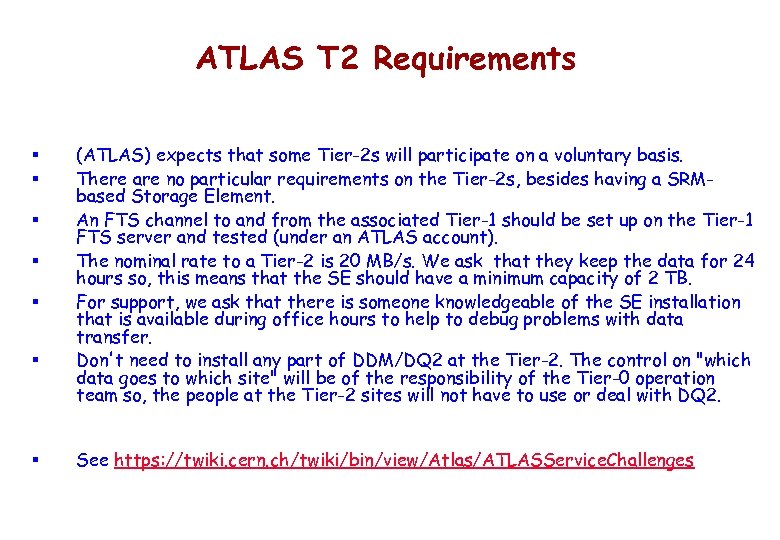 ATLAS T 2 Requirements § § § § (ATLAS) expects that some Tier-2 s will participate on a voluntary basis. There are no particular requirements on the Tier-2 s, besides having a SRMbased Storage Element. An FTS channel to and from the associated Tier-1 should be set up on the Tier-1 FTS server and tested (under an ATLAS account). The nominal rate to a Tier-2 is 20 MB/s. We ask that they keep the data for 24 hours so, this means that the SE should have a minimum capacity of 2 TB. For support, we ask that there is someone knowledgeable of the SE installation that is available during office hours to help to debug problems with data transfer. Don't need to install any part of DDM/DQ 2 at the Tier-2. The control on "which data goes to which site" will be of the responsibility of the Tier-0 operation team so, the people at the Tier-2 sites will not have to use or deal with DQ 2. See https: //twiki. cern. ch/twiki/bin/view/Atlas/ATLASService. Challenges
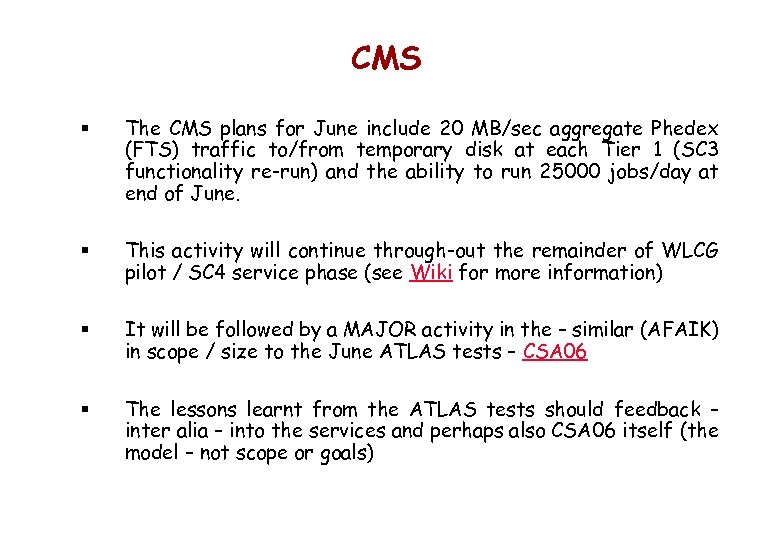 CMS § The CMS plans for June include 20 MB/sec aggregate Phedex (FTS) traffic to/from temporary disk at each Tier 1 (SC 3 functionality re-run) and the ability to run 25000 jobs/day at end of June. § This activity will continue through-out the remainder of WLCG pilot / SC 4 service phase (see Wiki for more information) § It will be followed by a MAJOR activity in the – similar (AFAIK) in scope / size to the June ATLAS tests – CSA 06 § The lessons learnt from the ATLAS tests should feedback – inter alia – into the services and perhaps also CSA 06 itself (the model – not scope or goals)
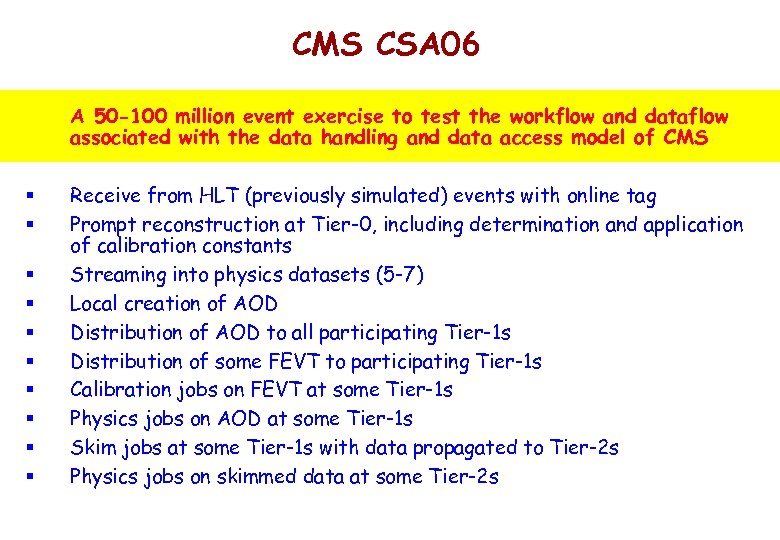 CMS CSA 06 A 50 -100 million event exercise to test the workflow and dataflow associated with the data handling and data access model of CMS § § § § § Receive from HLT (previously simulated) events with online tag Prompt reconstruction at Tier-0, including determination and application of calibration constants Streaming into physics datasets (5 -7) Local creation of AOD Distribution of AOD to all participating Tier-1 s Distribution of some FEVT to participating Tier-1 s Calibration jobs on FEVT at some Tier-1 s Physics jobs on AOD at some Tier-1 s Skim jobs at some Tier-1 s with data propagated to Tier-2 s Physics jobs on skimmed data at some Tier-2 s
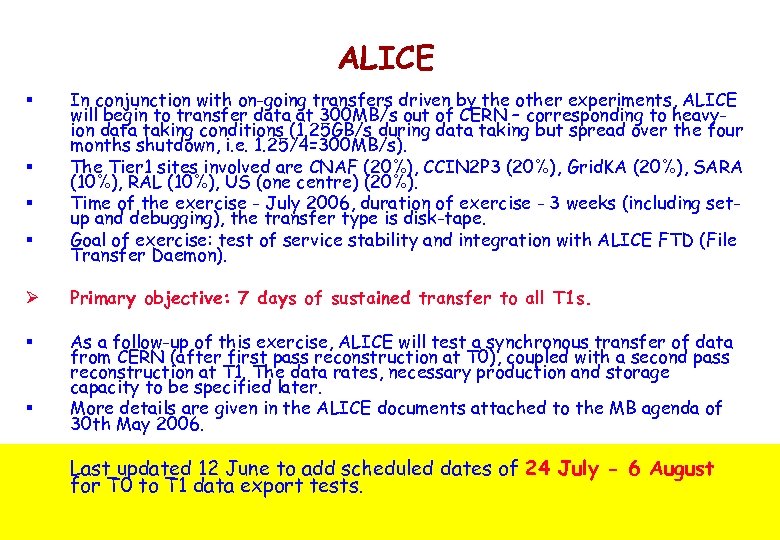 ALICE § § In conjunction with on-going transfers driven by the other experiments, ALICE will begin to transfer data at 300 MB/s out of CERN – corresponding to heavyion data taking conditions (1. 25 GB/s during data taking but spread over the four months shutdown, i. e. 1. 25/4=300 MB/s). The Tier 1 sites involved are CNAF (20%), CCIN 2 P 3 (20%), Grid. KA (20%), SARA (10%), RAL (10%), US (one centre) (20%). Time of the exercise - July 2006, duration of exercise - 3 weeks (including setup and debugging), the transfer type is disk-tape. Goal of exercise: test of service stability and integration with ALICE FTD (File Transfer Daemon). Ø Primary objective: 7 days of sustained transfer to all T 1 s. § As a follow-up of this exercise, ALICE will test a synchronous transfer of data from CERN (after first pass reconstruction at T 0), coupled with a second pass reconstruction at T 1. The data rates, necessary production and storage capacity to be specified later. More details are given in the ALICE documents attached to the MB agenda of 30 th May 2006. § Last updated 12 June to add scheduled dates of 24 July - 6 August for T 0 to T 1 data export tests.
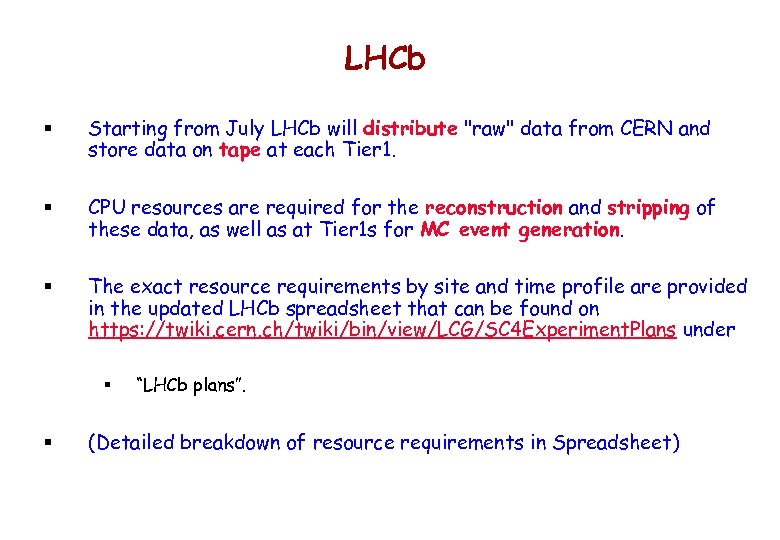 LHCb § Starting from July LHCb will distribute "raw" data from CERN and store data on tape at each Tier 1. § CPU resources are required for the reconstruction and stripping of these data, as well as at Tier 1 s for MC event generation. § The exact resource requirements by site and time profile are provided in the updated LHCb spreadsheet that can be found on https: //twiki. cern. ch/twiki/bin/view/LCG/SC 4 Experiment. Plans under § § “LHCb plans”. (Detailed breakdown of resource requirements in Spreadsheet)
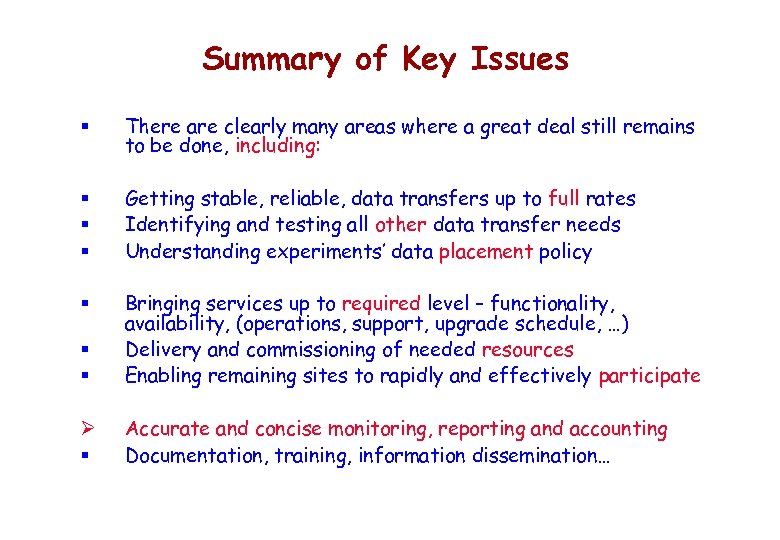 Summary of Key Issues § There are clearly many areas where a great deal still remains to be done, including: § § § Getting stable, reliable, data transfers up to full rates Identifying and testing all other data transfer needs Understanding experiments’ data placement policy § § § Bringing services up to required level – functionality, availability, (operations, support, upgrade schedule, …) Delivery and commissioning of needed resources Enabling remaining sites to rapidly and effectively participate Ø § Accurate and concise monitoring, reporting and accounting Documentation, training, information dissemination…
 Monitoring of Data Management § Grid. View is far from sufficient in terms of data management monitoring § We cannot really tell what is going on: § Globally; § At individual sites. § This is an area where we urgently need to improve things § Service Challenge Throughput tests are one thing… Ø But providing a reliable service for data distribution during accelerator operation is yet another… Ø Cannot just ‘go away’ for the weekend; staffing; coverage etc.
 The Carminati Maxim § What is not there for SC 4 (aka WLCG pilot) will not be there for WLCG production (and vice-versa) § This means: § We have to be using – consistantly, systematically, daily, ALWAYS – all of the agreed tools and procedures that have been put in place by Grid projects such as EGEE, OSG, … Ø BY USING THEM WE WILL FIND – AND FIX – THE HOLES § If we continue to use – or invent more – stop-gap solutions, then these will continue well into production, resulting in confusion, duplication of effort, waste of time, … § (None of which can we afford)
 Issues & Concerns § Operations: we have to be much more formal and systematic about logging and reporting. Much of the activity e. g. on the Service Challenge throughput phases – including major service interventions – has not been systematically reported by all sites. Nor do sites regularly and systematically participate. Network operations needs to be included (site; global) § Support: move to GGUS as primary (sole? ) entry point advancing well. Need to continue efforts in this direction and ensure that support teams behind are correctly staffed and trained. § Monitoring and Accounting: we are well behind what is desirable here. Many activities – need better coordination and direction. The recently available SAM monitoring shows how valuable this is! (LFC, FTS etc. ) § Services: all of the above need to be in place by June 1 st(!) and fully debugged through WLCG pilot phase. In conjunction with the specific services, based on Grid Middleware, Data Management products (CASTOR, d. Cache, … ) etc.
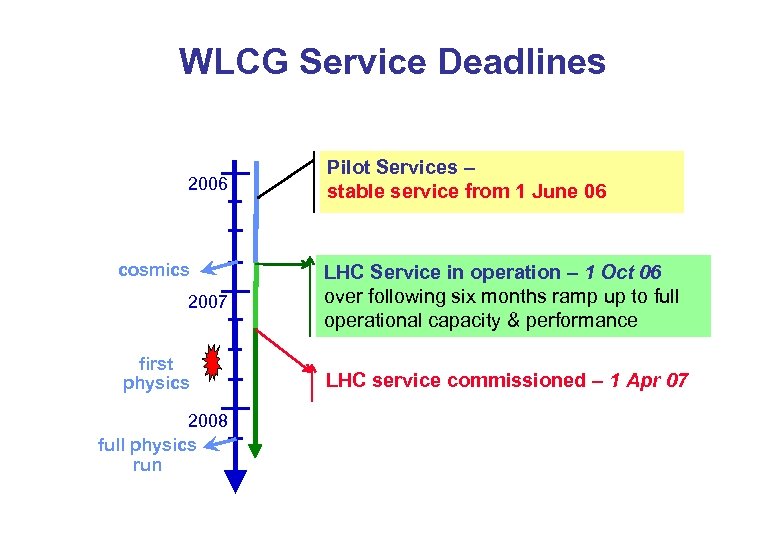 WLCG Service Deadlines 2006 cosmics 2007 first physics 2008 full physics run Pilot Services – stable service from 1 June 06 LHC Service in operation – 1 Oct 06 over following six months ramp up to full operational capacity & performance LHC service commissioned – 1 Apr 07
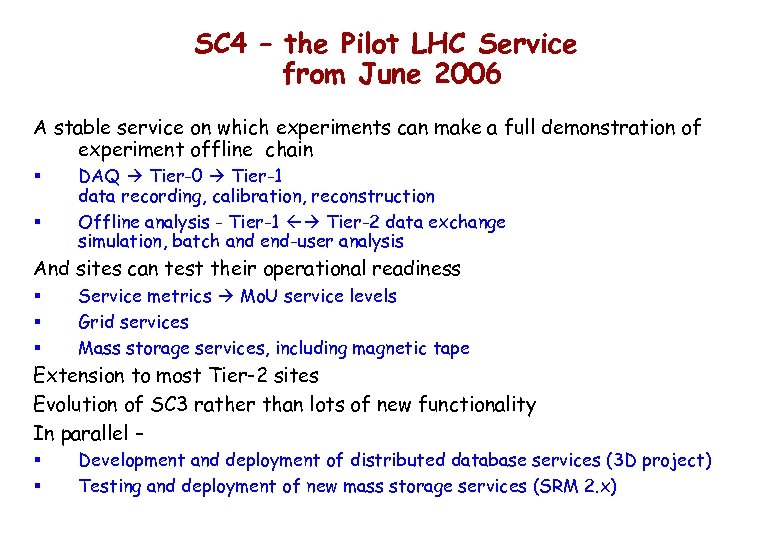 SC 4 – the Pilot LHC Service from June 2006 A stable service on which experiments can make a full demonstration of experiment offline chain § § DAQ Tier-0 Tier-1 data recording, calibration, reconstruction Offline analysis - Tier-1 Tier-2 data exchange simulation, batch and end-user analysis And sites can test their operational readiness § § § Service metrics Mo. U service levels Grid services Mass storage services, including magnetic tape Extension to most Tier-2 sites Evolution of SC 3 rather than lots of new functionality In parallel – § § Development and deployment of distributed database services (3 D project) Testing and deployment of new mass storage services (SRM 2. x)
 Future Workshops § Suggest ‘regional’ workshops to analyse results of experiment activities in SC 4 during Q 3/Q 4 this year § A ‘global’ workshop early 2007 focussing on experiment plans for 2007 § Another just prior to CHEP
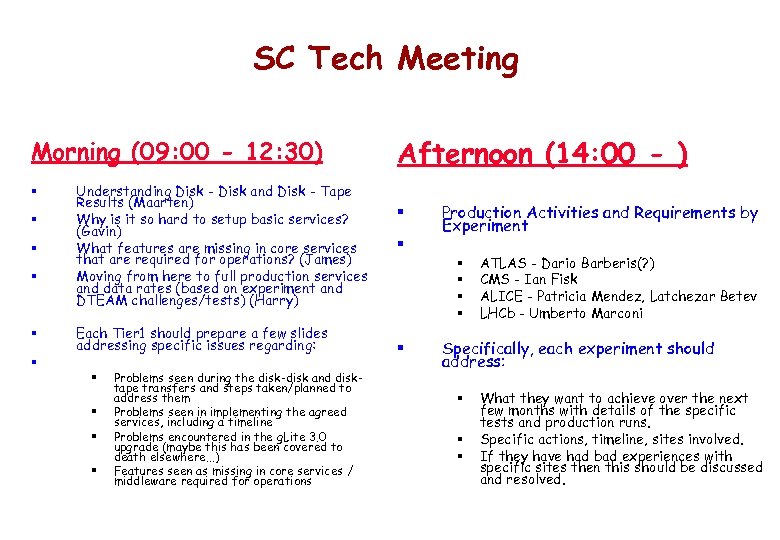 SC Tech Meeting Morning (09: 00 - 12: 30) § § § Understanding Disk - Disk and Disk - Tape Results (Maarten) Why is it so hard to setup basic services? (Gavin) What features are missing in core services that are required for operations? (James) Moving from here to full production services and data rates (based on experiment and DTEAM challenges/tests) (Harry) Each Tier 1 should prepare a few slides addressing specific issues regarding: § § Problems seen during the disk-disk and disktape transfers and steps taken/planned to address them Problems seen in implementing the agreed services, including a timeline Problems encountered in the g. Lite 3. 0 upgrade (maybe this has been covered to death elsewhere. . . ) Features seen as missing in core services / middleware required for operations Afternoon (14: 00 - ) § § Production Activities and Requirements by Experiment § § § ATLAS - Dario Barberis(? ) CMS - Ian Fisk ALICE - Patricia Mendez, Latchezar Betev LHCb - Umberto Marconi Specifically, each experiment should address: § § § What they want to achieve over the next few months with details of the specific tests and production runs. Specific actions, timeline, sites involved. If they have had bad experiences with specific sites then this should be discussed and resolved.
 Jan 23 -25 2007, CERN § This workshop will cover: For each LHC experiment, detailed plans / requirements / timescales for 2007 activities. § Exactly what (technical detail) is required where (sites by name), by which date, coordination & follow-up, responsibles, contacts, etc There will also be an initial session covering the status of the various software / middleware and outlook. § § Dates: from 23 January 2007 09: 00 to 25 January 2007 18: 00 Location: CERN Room: Main auditorium
 Sep 1 -2, Victoria, BC § Workshop focussing on service needs for initial data taking: commissioning, calibration and alignment, early physics. Target audience: all active sites plus experiments § We start with a detailed update on the schedule and operation of the accelerator for 2007/2008, followed by similar sessions from each experiment. We wrap-up with a session on operations and support, leaving a slot for parallel sessions (e. g. 'regional' meetings, such as Grid. PP etc. ) before the foreseen social event on Sunday evening. § § § Dates: 1 -2 September 2007 Location: Victoria, BC, Canada co-located with CHEP 2007
 Conclusions § The Service Challenge programme this year must show that we can run reliable services § Grid reliability is the product of many components – middleware, grid operations, computer centres, …. § Target for September § 90% site availability § 90% user job success § Requires a major effort by everyone to monitor, measure, debug t? des ? o oo m bitious T m oo a T First data will arrive next year NOT an option to get things going later