 Скачать презентацию Cereal Systems Initiative for South Asia CSISA Objective
9ea7c8d9835bae694469b83865094b35.ppt
- Количество слайдов: 26



Cereal Systems Initiative for South Asia (CSISA) Objective 2 J. K. Ladha
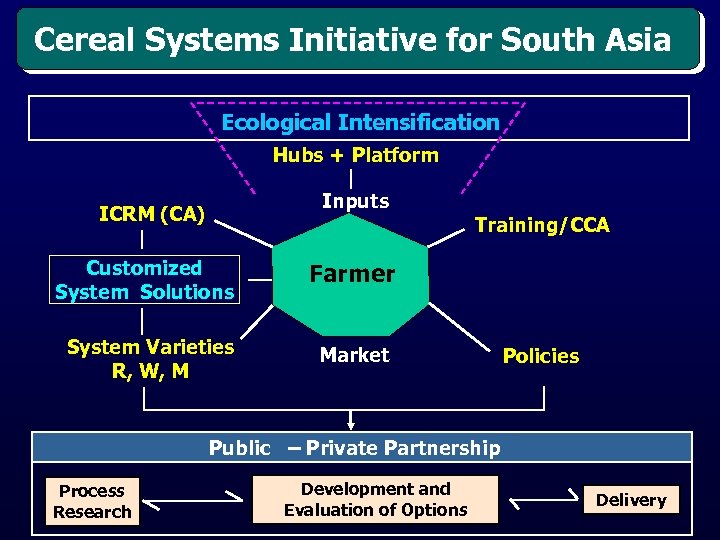
Cereal Systems Initiative for South Asia Ecological Intensification Hubs + Platform Inputs ICRM (CA) Training/CCA Customized System Solutions Farmer System Varieties R, W, M Market Policies Public – Private Partnership Process Research Development and Evaluation of Options Delivery
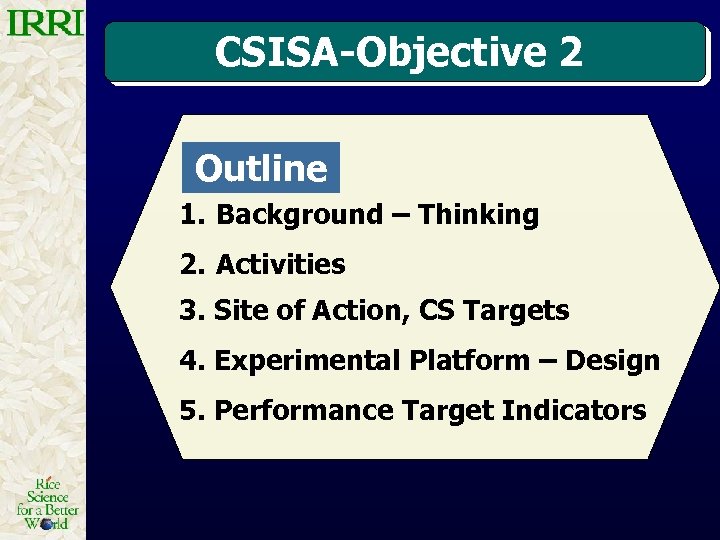
CSISA-Objective 2 Outline 1. Background – Thinking 2. Activities 3. Site of Action, CS Targets 4. Experimental Platform – Design 5. Performance Target Indicators
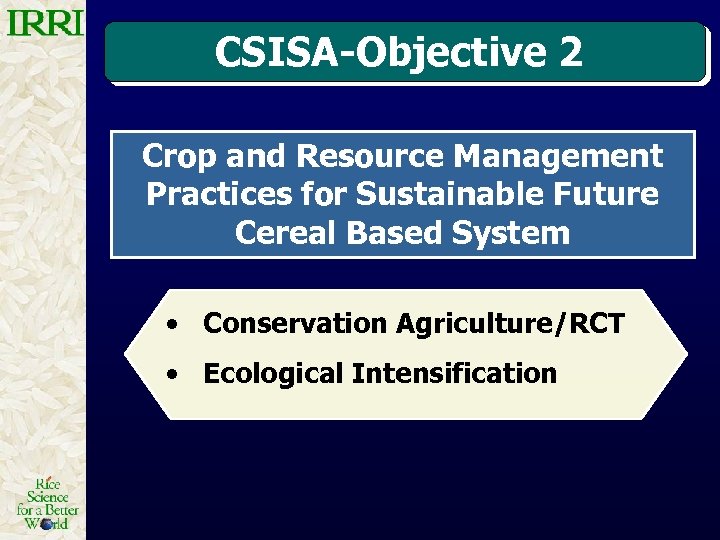
CSISA-Objective 2 Crop and Resource Management Practices for Sustainable Future Cereal Based System • Conservation Agriculture/RCT • Ecological Intensification
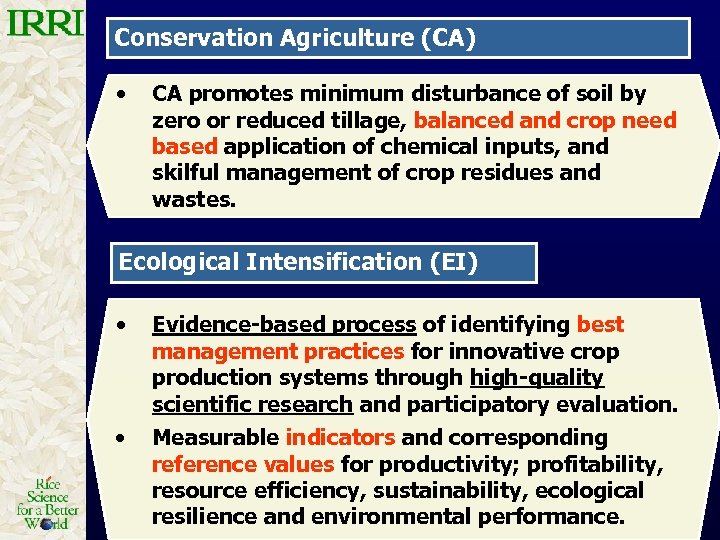
Conservation Agriculture (CA) • CA promotes minimum disturbance of soil by zero or reduced tillage, balanced and crop need based application of chemical inputs, and skilful management of crop residues and wastes. Ecological Intensification (EI) • Evidence-based process of identifying best management practices for innovative crop production systems through high-quality scientific research and participatory evaluation. • Measurable indicators and corresponding reference values for productivity; profitability, resource efficiency, sustainability, ecological resilience and environmental performance.
Underlined Assumption • Conservation tillage with other best practices can help meet the food demand, protect the environment and provide income to the farmer.
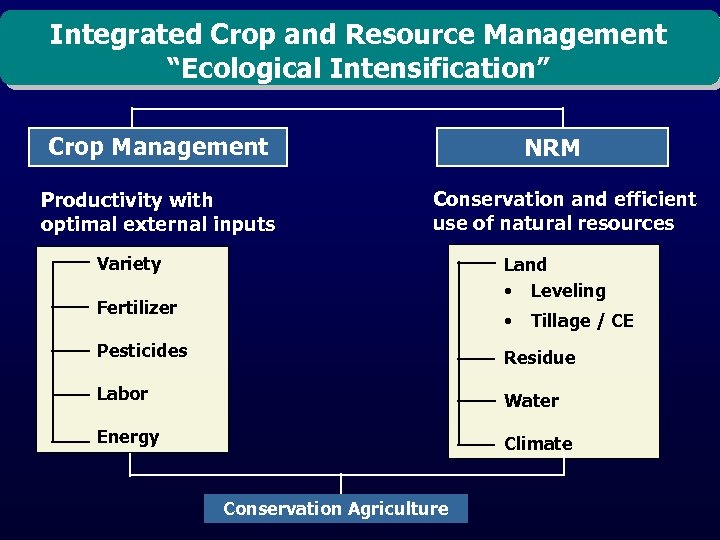
Integrated Crop and Resource Management “Ecological Intensification” Crop Management Productivity with optimal external inputs NRM Conservation and efficient use of natural resources Variety Land • Leveling Fertilizer • Tillage / CE Pesticides Residue Labor Water Energy Climate Conservation Agriculture
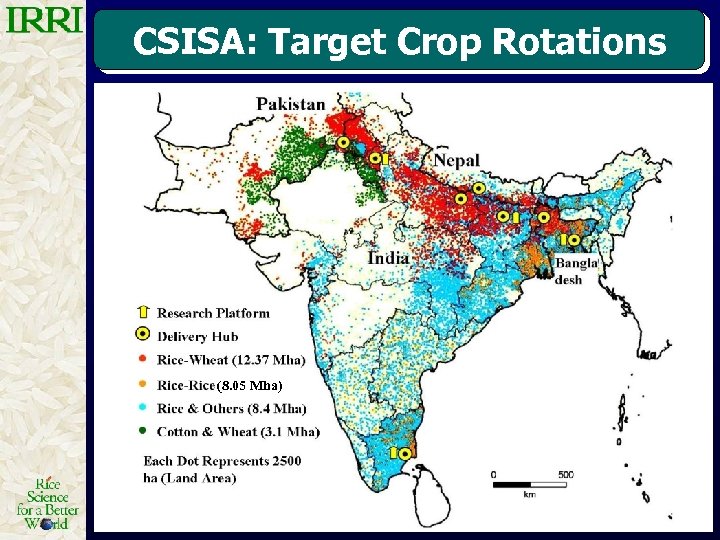
CSISA: Target Crop Rotations (8. 05 Mha)
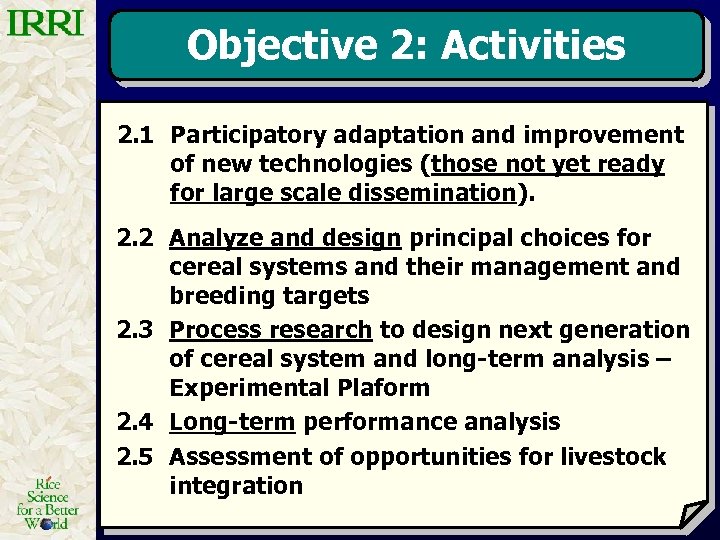
Objective 2: Activities 2. 1 Participatory adaptation and improvement of new technologies (those not yet ready for large scale dissemination). 2. 2 Analyze and design principal choices for cereal systems and their management and breeding targets 2. 3 Process research to design next generation of cereal system and long-term analysis – Experimental Plaform 2. 4 Long-term performance analysis 2. 5 Assessment of opportunities for livestock integration
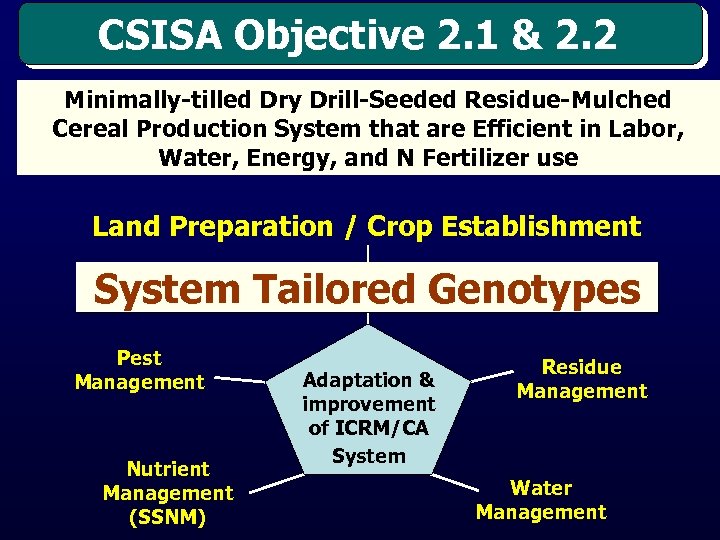
CSISA Objective 2. 1 & 2. 2 Minimally-tilled Dry Drill-Seeded Residue-Mulched Cereal Production System that are Efficient in Labor, Water, Energy, and N Fertilizer use Land Preparation / Crop Establishment System Tailored Genotypes Pest Management Nutrient Management (SSNM) Adaptation & improvement of ICRM/CA System Residue Management Water Management
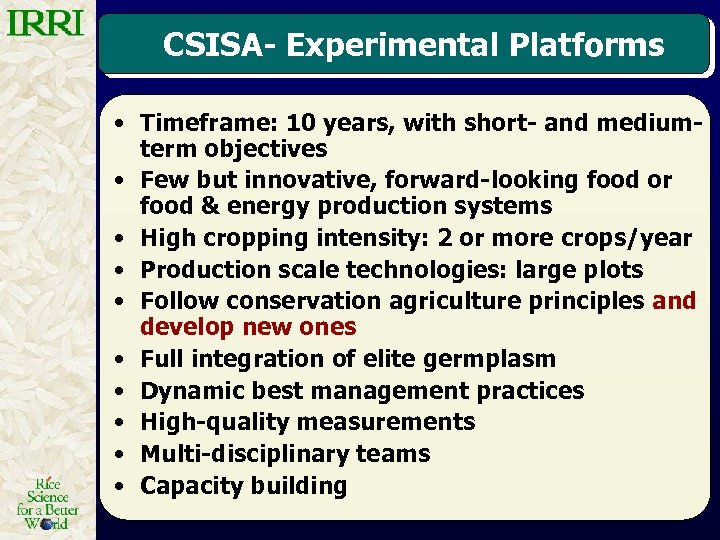
CSISA- Experimental Platforms • Timeframe: 10 years, with short- and mediumterm objectives • Few but innovative, forward-looking food or food & energy production systems • High cropping intensity: 2 or more crops/year • Production scale technologies: large plots • Follow conservation agriculture principles and develop new ones • Full integration of elite germplasm • Dynamic best management practices • High-quality measurements • Multi-disciplinary teams • Capacity building
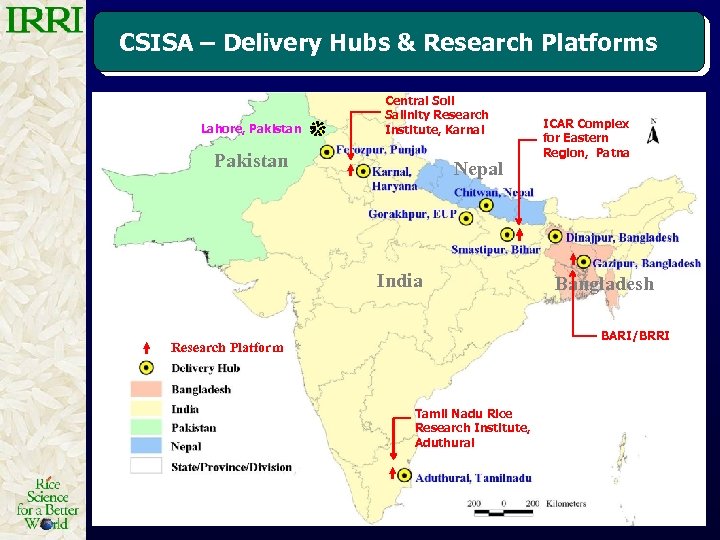
CSISA – Delivery Hubs & Research Platforms Lahore, Pakistan Central Soil Salinity Research Institute, Karnal Pakistan Nepal India ICAR Complex for Eastern Region, Patna Bangladesh BARI/BRRI Research Platform Tamil Nadu Rice Research Institute, Aduthurai
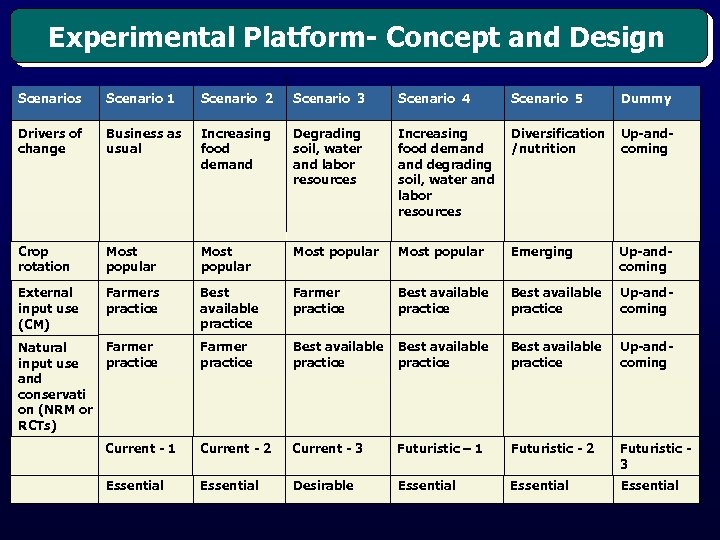
Experimental Platform- Concept and Design Scenarios Scenario 1 Scenario 2 Scenario 3 Scenario 4 Scenario 5 Dummy Drivers of change Business as usual Increasing food demand Degrading soil, water and labor resources Increasing food demand degrading soil, water and labor resources Diversification /nutrition Up-andcoming Crop rotation Most popular Emerging Up-andcoming External input use (CM) Farmers practice Best available practice Farmer practice Best available practice Up-andcoming Farmer practice Best available practice Up-andcoming Current - 1 Current - 2 Current - 3 Futuristic – 1 Futuristic - 2 Futuristic 3 Essential Desirable Essential Farmer Natural practice input use and conservati on (NRM or RCTs)
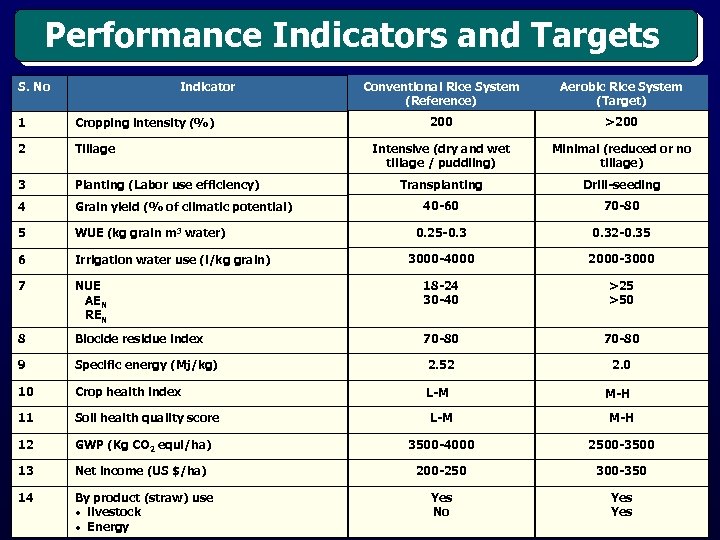
Performance Indicators and Targets S. No Indicator Conventional Rice System (Reference) Aerobic Rice System (Target) 200 >200 Intensive (dry and wet tillage / puddling) Minimal (reduced or no tillage) Transplanting Drill-seeding 40 -60 70 -80 0. 25 -0. 32 -0. 35 3000 -4000 2000 -3000 1 Cropping intensity (%) 2 Tillage 3 Planting (Labor use efficiency) 4 Grain yield (% of climatic potential) 5 WUE (kg grain m 3 water) 6 Irrigation water use (l/kg grain) 7 NUE AEN REN 18 -24 30 -40 >25 >50 8 Biocide residue index 70 -80 9 Specific energy (Mj/kg) 2. 52 2. 0 10 Crop health index L-M 11 Soil health quality score 12 M-H L-M M-H GWP (Kg CO 2 equi/ha) 3500 -4000 2500 -3500 13 Net income (US $/ha) 200 -250 300 -350 14 By product (straw) use livestock Energy Yes No Yes
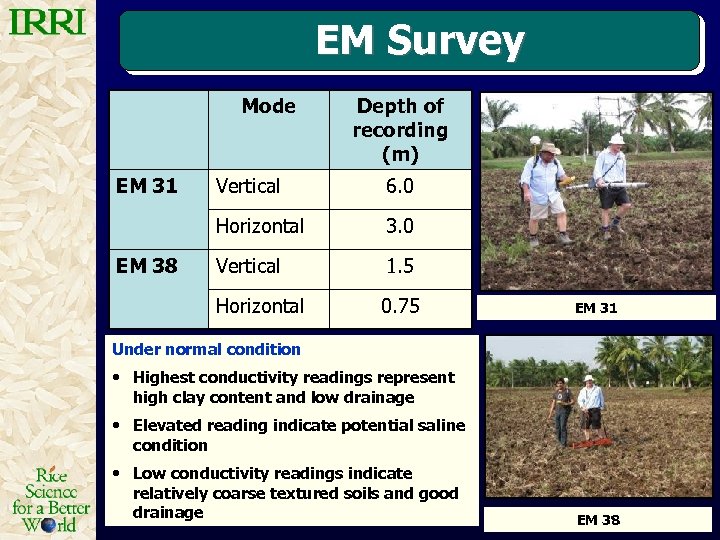
EM Survey Mode EM 31 Depth of recording (m) 6. 0 Horizontal 3. 0 Vertical 1. 5 Horizontal EM 38 Vertical 0. 75 EM 31 Under normal condition • Highest conductivity readings represent high clay content and low drainage • Elevated reading indicate potential saline condition • Low conductivity readings indicate relatively coarse textured soils and good drainage EM 38
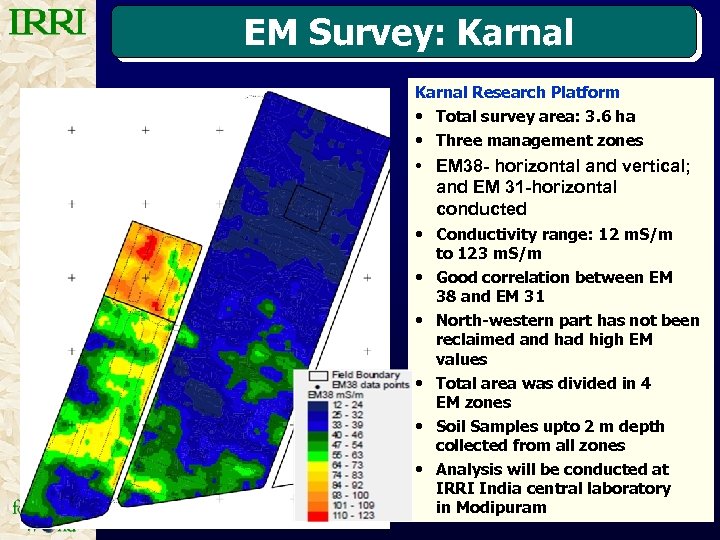
EM Survey: Karnal Research Platform • Total survey area: 3. 6 ha • Three management zones • EM 38 - horizontal and vertical; and EM 31 -horizontal conducted • Conductivity range: 12 m. S/m to 123 m. S/m • Good correlation between EM 38 and EM 31 • North-western part has not been reclaimed and had high EM values • Total area was divided in 4 EM zones • Soil Samples upto 2 m depth collected from all zones • Analysis will be conducted at IRRI India central laboratory in Modipuram
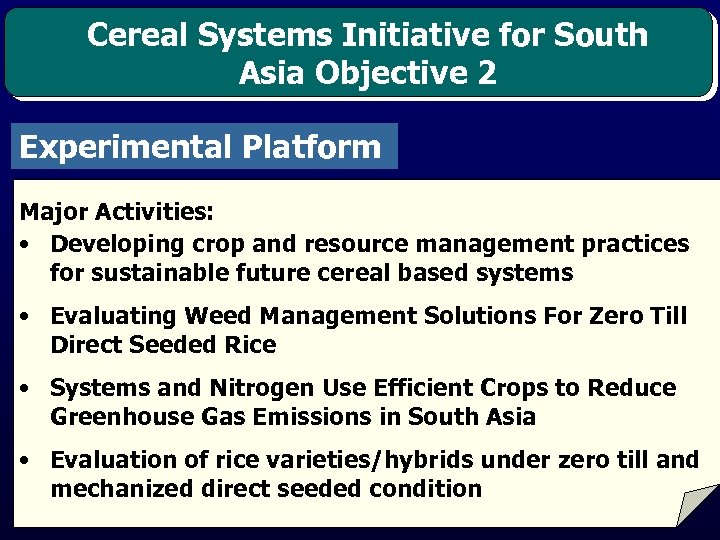
Cereal Systems Initiative for South Asia Objective 2 Experimental Platform Major Activities: • Developing crop and resource management practices for sustainable future cereal based systems • Evaluating Weed Management Solutions For Zero Till Direct Seeded Rice • Systems and Nitrogen Use Efficient Crops to Reduce Greenhouse Gas Emissions in South Asia • Evaluation of rice varieties/hybrids under zero till and mechanized direct seeded condition
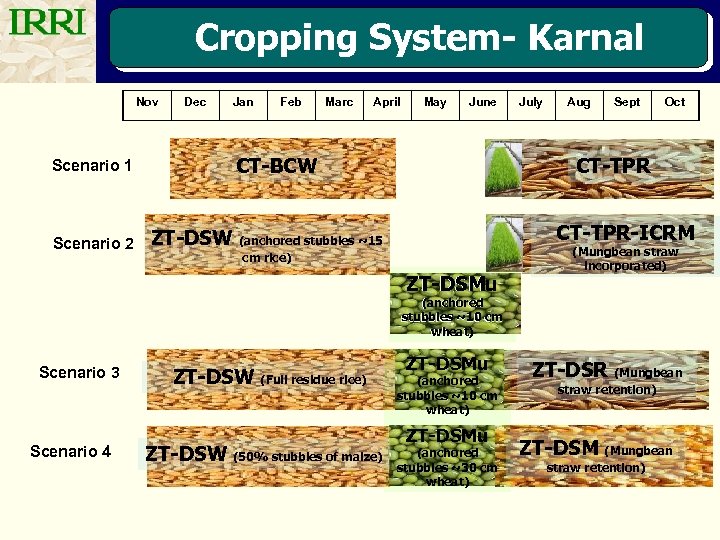
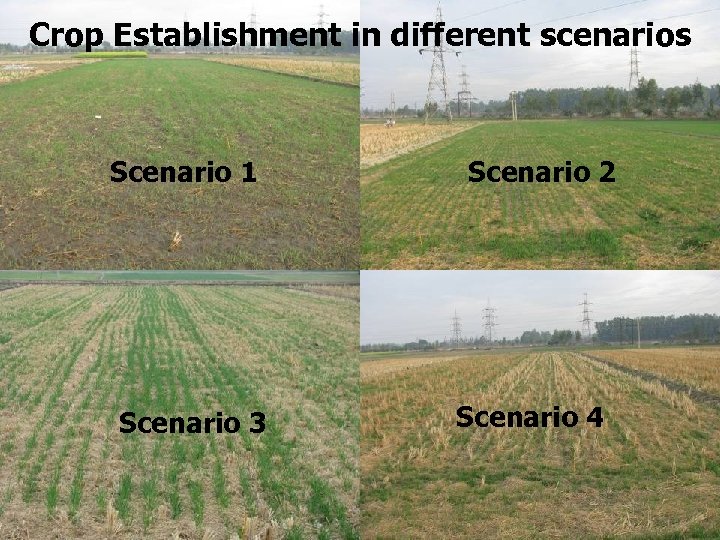
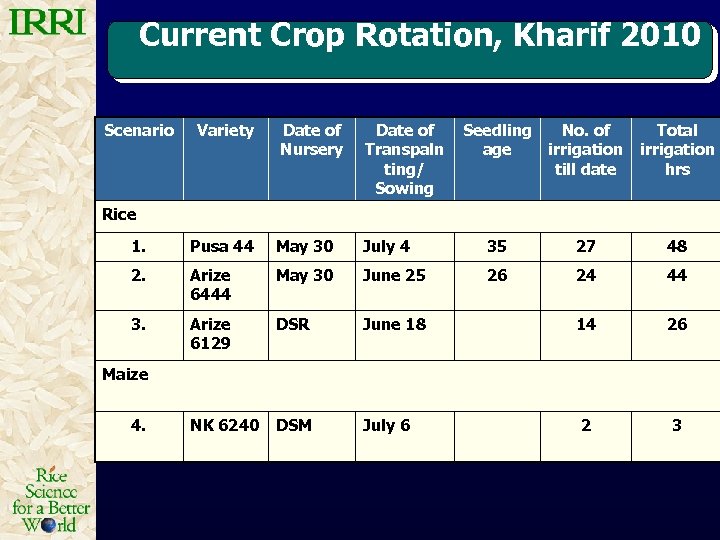
Cropping System- Karnal Nov Scenario 1 Scenario 2 Dec Jan Feb Marc April May June CT-BCW July Aug Sept Oct CT-TPR-ICRM ZT-DSW (anchored stubbles ~15 cm rice) ZT-DSMu (Mungbean straw incorporated) (anchored stubbles ~10 cm wheat) Scenario 3 Scenario 4 ZT-DSW (Full residue rice) ZT-DSW (50% stubbles of maize) ZT-DSMu (anchored stubbles ~10 cm wheat) ZT-DSMu (anchored stubbles ~30 cm wheat) ZT-DSR (Mungbean straw retention) ZT-DSM (Mungbean straw retention)
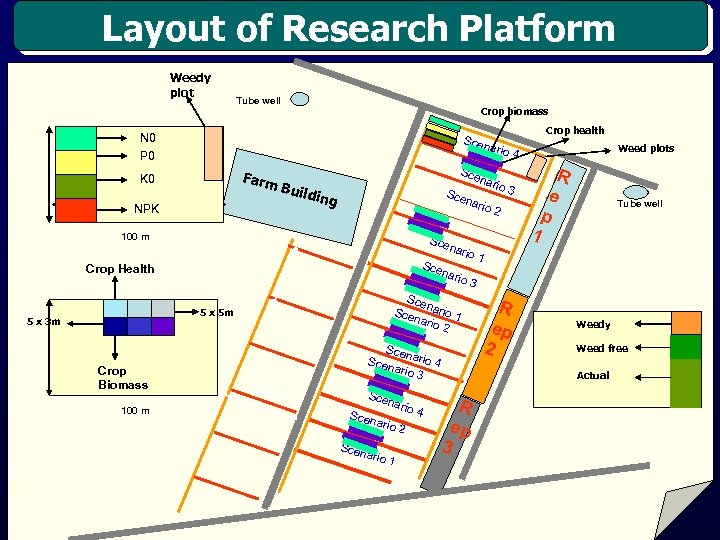
Layout of Research Platform Weedy plot Tube well Crop biomass N 0 P 0 ario Farm K 0 Sce Build NPK nari o Scen ario 4 ario 3 50 m Sce nari Scen ario 1 o 4 2 3 2 Weed plots 4 R R e e p p 1 1 Tube well 1 3 Sce nari o 1 o 2 5 x 5 m 100 m nari o Sce Crop Health Crop Biomass nar io Sce ing 100 m 5 x 3 m Crop health Scen R ep 2 Weedy Weed free Actual R ep 3
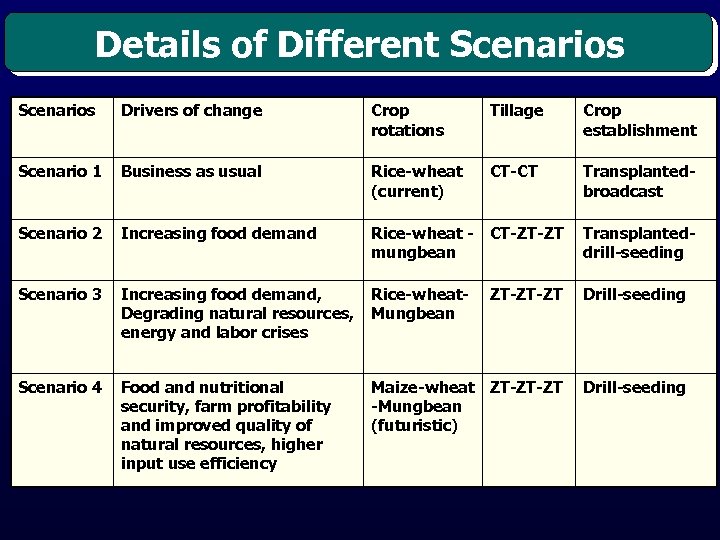
Details of Different Scenarios Drivers of change Crop rotations Tillage Crop establishment Scenario 1 Business as usual Rice-wheat (current) CT-CT Transplantedbroadcast Scenario 2 Increasing food demand Rice-wheat - CT-ZT-ZT mungbean Transplanteddrill-seeding Scenario 3 Increasing food demand, Degrading natural resources, energy and labor crises Rice-wheat. Mungbean ZT-ZT-ZT Drill-seeding Scenario 4 Food and nutritional security, farm profitability and improved quality of natural resources, higher input use efficiency Maize-wheat ZT-ZT-ZT -Mungbean (futuristic) Drill-seeding
Data Recording § Crop health § Soil health § Environmental studies) health (Green § Agronomic/Yield paraments § Input Efficiency § Water balance § Bench mark surveys § Weed dynamics and management § Economics § Crop, soil, water modelling § Ph. D student at each site house gas
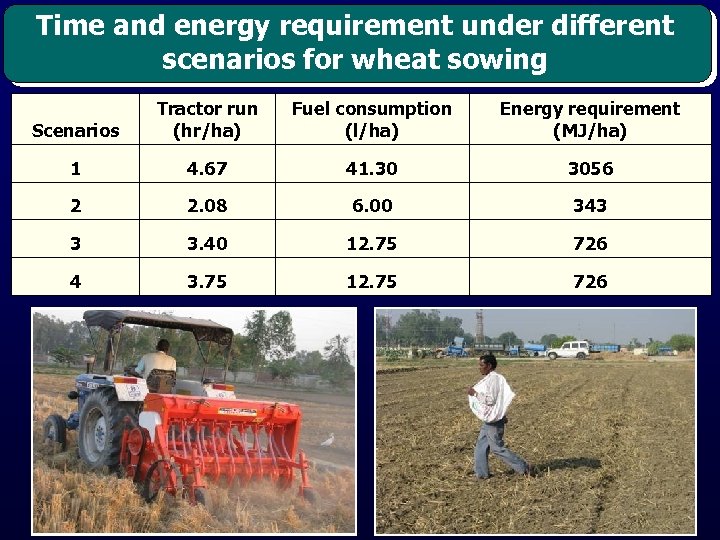
Time and energy requirement under different scenarios for wheat sowing Scenarios Tractor run (hr/ha) Fuel consumption (l/ha) Energy requirement (MJ/ha) 1 4. 67 41. 30 3056 2 2. 08 6. 00 343 3 3. 40 12. 75 726 4 3. 75 12. 75 726
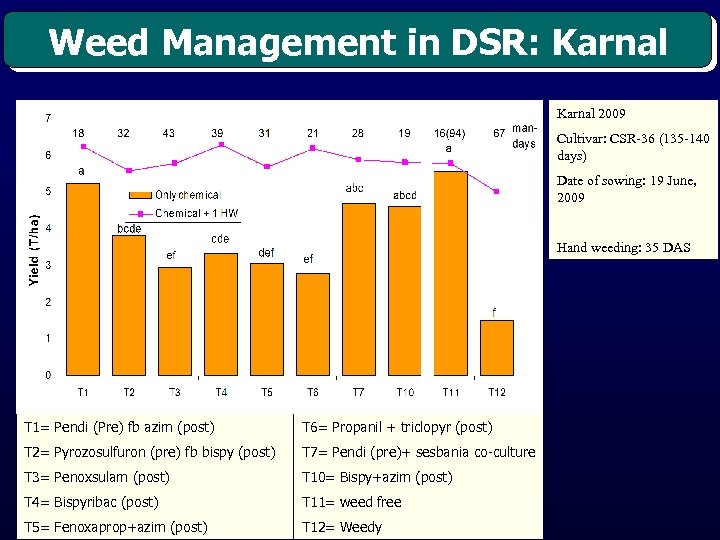
Weed Management in DSR: Karnal 2009 Cultivar: CSR-36 (135 -140 days) Date of sowing: 19 June, 2009 Hand weeding: 35 DAS T 1= Pendi (Pre) fb azim (post) T 6= Propanil + triclopyr (post) T 2= Pyrozosulfuron (pre) fb bispy (post) T 7= Pendi (pre)+ sesbania co-culture T 3= Penoxsulam (post) T 10= Bispy+azim (post) T 4= Bispyribac (post) T 11= weed free T 5= Fenoxaprop+azim (post) T 12= Weedy
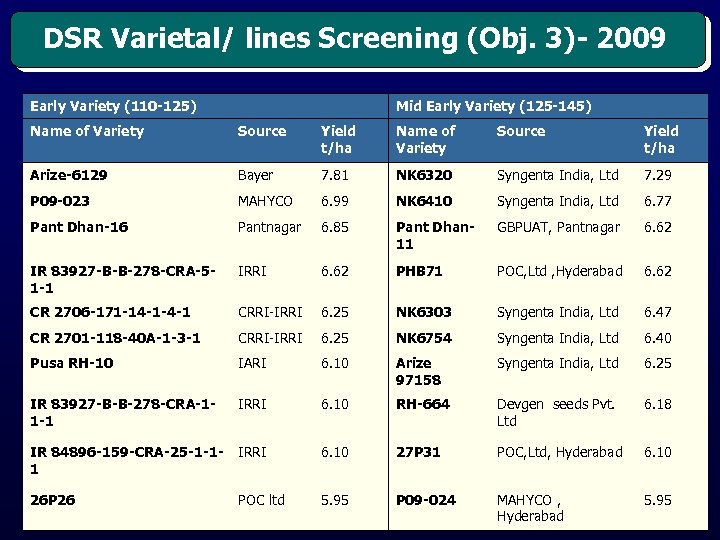
DSR Varietal/ lines Screening (Obj. 3)- 2009 Early Variety (110 -125) Mid Early Variety (125 -145) Name of Variety Source Yield t/ha Arize-6129 Bayer 7. 81 NK 6320 Syngenta India, Ltd 7. 29 P 09 -023 MAHYCO 6. 99 NK 6410 Syngenta India, Ltd 6. 77 Pant Dhan-16 Pantnagar 6. 85 Pant Dhan 11 GBPUAT, Pantnagar 6. 62 IR 83927 -B-B-278 -CRA-51 -1 IRRI 6. 62 PHB 71 POC, Ltd , Hyderabad 6. 62 CR 2706 -171 -14 -1 -4 -1 CRRI-IRRI 6. 25 NK 6303 Syngenta India, Ltd 6. 47 CR 2701 -118 -40 A-1 -3 -1 CRRI-IRRI 6. 25 NK 6754 Syngenta India, Ltd 6. 40 Pusa RH-10 IARI 6. 10 Arize 97158 Syngenta India, Ltd 6. 25 IR 83927 -B-B-278 -CRA-11 -1 IRRI 6. 10 RH-664 Devgen seeds Pvt. Ltd 6. 18 IR 84896 -159 -CRA-25 -1 -11 IRRI 6. 10 27 P 31 POC, Ltd, Hyderabad 6. 10 26 P 26 POC ltd 5. 95 P 09 -024 MAHYCO , Hyderabad 5. 95
Crop Establishment in different scenarios Scenario 1 Scenario 3 Scenario 2 Scenario 4
Current Crop Rotation, Kharif 2010 Scenario Variety Date of Nursery Date of Transpaln ting/ Sowing Seedling age No. of irrigation till date Total irrigation hrs Rice 1. Pusa 44 May 30 July 4 35 27 48 2. Arize 6444 May 30 June 25 26 24 44 3. Arize 6129 DSR June 18 14 26 NK 6240 DSM July 6 2 3 Maize 4.
Скачать презентацию Cereal Systems Initiative for South Asia CSISA Objective
9ea7c8d9835bae694469b83865094b35.ppt