


 Скачать презентацию CEQA City of Sacramento Community Development Dept March
3e966965ef552d6ba55d0b816abcce5e.ppt
- Количество слайдов: 34
 CEQA City of Sacramento Community Development Dept. March 2016 CEQA 101
 Environmental Planning Services Ellie Ewigleben, Manager Tom Buford, Senior Planner Dana Allen, Associate Planner Scott Johnson, Association Planner CEQA 101
 CEQA Law and Regulations • CEQA: California Environmental Quality Act • Statute: Public Resources Code Sections 21000 et seq. • Guidelines: Adopted by the Governor’s Office of Planning and Research CEQA 101
 Purpose of CEQA • • • Identify environmental effects Provide information to public agencies Provide information to public Identify ways to avoid adverse effects Identify alternatives CEQA 101
 How it Works • • CEQA review at same time as project review Decision on CEQA before project approval Public notice and comment Written documents CEQA 101
 Enforcing CEQA • Staff responsibility • Public review and comment • Hearing body (Planning and Design Commission, City Council) • Court enforcement CEQA 101
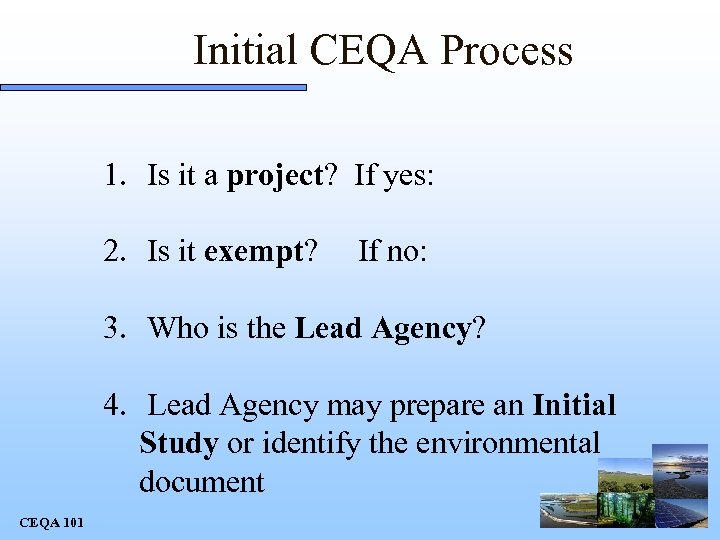 Initial CEQA Process 1. Is it a project? If yes: 2. Is it exempt? If no: 3. Who is the Lead Agency? 4. Lead Agency may prepare an Initial Study or identify the environmental document CEQA 101
 What is a Project? • Activity has potential for a direct physical change or a reasonably foreseeable indirect physical change in the environment. • Activity involves a discretionary approval by a public agency. - Requires the exercise of judgment or deliberation - Ministerial approvals require little or no judgment by a public official & are not projects. CEQA 101
 What is a Project? (cont. ) • Activity is one of the following types of activities: - Activities directly undertaken by a public agency. - Activities that are supported (in whole or in part) by public agency. - An activity involving the issuance of a lease, permit, license, certificate or other entitlement for use by a public agency. CEQA 101
 What is a Ministerial Action? An action is ministerial if it: “…involves little or no personal judgment by the public official as to the wisdom or manner of carrying out the project. ” Definition of a “ministerial” project. See CEQA Guidelines § 15369 CEQA 101
 Ministerial Action (cont. ) Examples of Ministerial Permits include: • Automobile registrations • Dog licenses • Marriage licenses Actions Presumed to be Ministerial include: • Issuance of building permits • Issuance of business licenses • Approval of final subdivision maps • Approval of individual utility service connections/disconnections See CEQA Guidelines § 15268 CEQA 101
 When is a project exempt? Types of Exemptions: • Statutory Exemption - Statutory exemption: types of projects for which the California Legislature has provided a blanket exemption from CEQA procedures & policies. - Statutory exemptions are found in various places in the California Code - Section 15282 of the CEQA Guidelines lists current statutory exemptions. CEQA 101
 When is a project Exempt? (cont. ) • Categorical Exemptions - Descriptions of types of projects which the Secretary of the Resources Agency has determined do not have a significant effect on the environment. - Examples: repair or maintenance of existing facilities, new gardening or landscaping - Article 19 of the CEQA Guidelines. CEQA 101
 When is a project Exempt? (cont. ) Categorical Exemptions: – Unlike statutory exemptions, categorical exemptions are not absolute. There are exceptions to the exemptions depending on the nature or location of the project. – No exemption for project with cumulative impacts, or reasonable possibility of having significant impact. (Section 15300. 2 Guidelines) CEQA 101
 Categorical Exemptions Commonly used exemptions for private projects*: • • Class 1, Section 15301 – Existing facilities Class 2, Section 15302 – Replacement or Reconstruction Class 3, Section 15303 – New Construction or Conversion Class 5, Section 15305 – Minor Alteration in Land Use Limitations Class 11, Section 15311 – Accessory Structures Class 15, Section 15315 – Minor Land Divisions Class 31, Section 15331 – Historical Resource Restoration/Rehabilitation Class 32, Section 15332 – Infill *Projects with unusual circumstances and/or characteristics should be carefully reviewed for issues that may be cause for additional or more extensive review. CEQA 101
 Basic Impact Analysis (SIMC) • • CEQA 101 Setting (physical and regulatory) Impact (threshold of significance) Mitigation (feasible) Conclusion
 Setting • Physical setting: Provides the “baseline” for changes that the project would have on the physical environment. • Regulatory: Describes the federal, state and local statutes, regulations and rules that apply to the project. CEQA 101
 Impact • Key Words: – Threshold of significance – Mitigation – Mitigated to a less than significant level – Negative Declaration – Mitigated Negative Declaration – Environmental Impact Report CEQA 101
 Impact: Project Description • Describes each of the actions to be taken that would affect the physical environment • Establishes the basis for the review of potential impacts • Identifies agency approvals that would be required to implement the proposed project CEQA 101
 Impact Can all significant effects be mitigated to a less than significant level? • If yes: Negative Declaration Mitigated Negative Declaration • If no: Prepare Environmental Impact Report (EIR) CEQA 101
 Impact Does the EIR mitigate all significant impacts to a less than significant level? • If yes: EIR must be certified prior to any project approval. • If no: Lead agency must adopt a statement of overriding considerations (economic, legal, social, technological and other benefits) & certify the EIR for project approval. CEQA 101
 Mitigation • Mitigation of a significant impact: – Avoids the impact altogether – Minimizes the impact – Rectifies the impact by repairing or restoring – Reduces the impact over time by preservation and maintenance during the project – Compensates by replacing or providing substitute resources or environments CEQA 101
 Mitigation • Public agencies should not approve projects if there are feasible alternatives or mitigation measures • “Feasible”: Capable of being accomplished in a successful manner within a reasonable period of time, taking into account economic, environmental, social and technological factors CEQA 101
 Conclusion: CEQA Documents • Negative Declaration: No significant impacts shown in Initial Study • Mitigated Negative Declaration: All impacts can be mitigated to a less-than-significant level. • EIR: Analysis of impacts is required because it is not clear that a MND is appropriate. CEQA 101
 Environmental Impact Report (EIR) • Key Words: – Draft EIR – Alternatives to the project – No project alternative – Environmentally superior alternative – Public Comment Period – Response to Comments – Final EIR CEQA 101
 EIR Procedure • Key Words: – Notice of Preparation (NOP) – Notice of Completion (NOC) – Notice of Availability (NOA) – Notice of Determination (NOD) – Statement of Overriding Considerations – Findings – Mitigation Monitoring Program CEQA 101
 Time Estimate: ND or MND • Mitigated Negative Declaration – Initial Study: 2 -6 weeks – Studies (e. g. , noise): 6 weeks – Public Review: 20 or 30 days – Total: 2 to weeks to 3 months – Cost: $25 -30, 000 CEQA 101
 Time Estimate: EIR • Environmental Impact Report – Studies: 2 to 3 months – Notice of Preparation: 30 days – Notice of Availability: 45 days – Responses to agencies: 10 days – Absolute minimum: 85 days – Usual: 4 to 8 months – Cost: $100, 000 + CEQA 101
 Documenting CEQA Review • Findings: Establish the factual basis for analysis. • Findings: Document public review. • Notice of Exemption (NOE): Reduce statute of limitations for CEQA action. • Notice of Determination (NOD): same • County Clerk and State Clearinghouse. CEQA 101
 NOD/NOE Procedure • Planner: Obtain check from applicant payable to County Clerk Amount (fees typically change each new year): • $40 for NOE (or NOD with Dept of Fish and Wildlife No Effect Determination (NED*); • $2, 250. 25** NOD with ND or MND or • $3, 110** (NOD with EIR) • Deliver check to EPS • . pdf of stamped copy with receipt to project directory * Fish & Wildlife NED can be requested from CA Dept. of Fish & Wildlife if no impacts to fish or game will occur. They approve and issue form to waive fees. ** Amount includes the Sacramento County filing fee of $40. 00. CEQA 101 must
 Historical Resources • Any project, any structure: take care re: historical resources! (Not just those 50 years or older) • Roberta Deering, Preservation Director • CEQA uses California Register of Historical Resources criteria • Generally: 50 years old, six feet deep* * In sensitive areas Native American groups may have concerns at shallower depths. CEQA 101
 Department of Fish & Wildlife Fees • Fish and Game Code Section 711. 4 • Payable with the filing of the Notice of Determination • No Effect Determination • DFW needs to approve No Effect Determination • $3, 110 (EIR) or $2, 250 (ND) (Changing January 2015) CEQA 101
 Native American Issues • Tribal cultural resources • Required notice from City to tribes • Consultation with tribes regarding tribal resources, investigation, impacts and mitigation • General plan amendment: notice to all tribes on NAHC list • MND/EIR: notice to requesting tribes CEQA 101
 QUESTIONS • Scott Johnson 916 -808 -5842 • Dana Mahaffey 916 -808 -2762 • Tom Buford 916 -799 -1531 CEQA 101