


 Скачать презентацию CEOS Disaster Risk Management Pilots as a Use
a9b03a3ee460f0683e385536ae36837c.ppt
- Количество слайдов: 38
 CEOS Disaster Risk Management Pilots as a Use Case Scenario Presented at the joint WGISS/ESIP Federation Disasters Session in Cocoa Beach Florida by Stu Frye (stuart. frye@nasa. gov) 17 April 2014 Slide: 1 Acknowledgment is to be given to Dan Mandl, Pat Cappelaere, Karen Moe, John Evans, and Fritz Policelli for contributions to this presentation
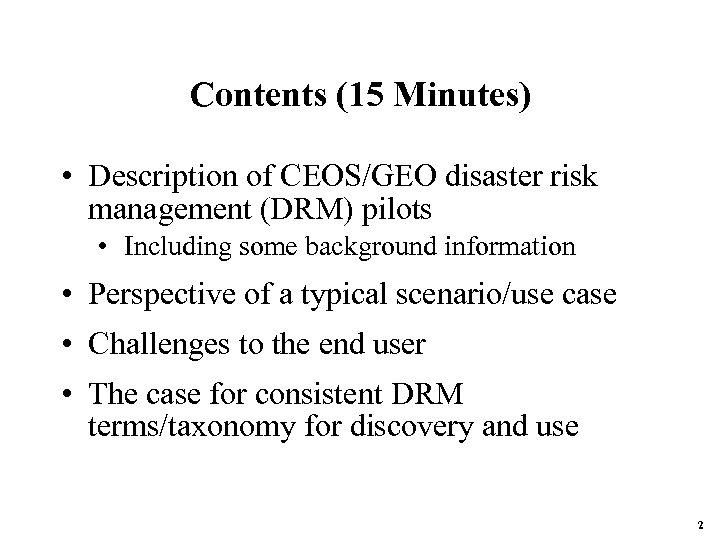 Contents (15 Minutes) • Description of CEOS/GEO disaster risk management (DRM) pilots • Including some background information • Perspective of a typical scenario/use case • Challenges to the end user • The case for consistent DRM terms/taxonomy for discovery and use 2
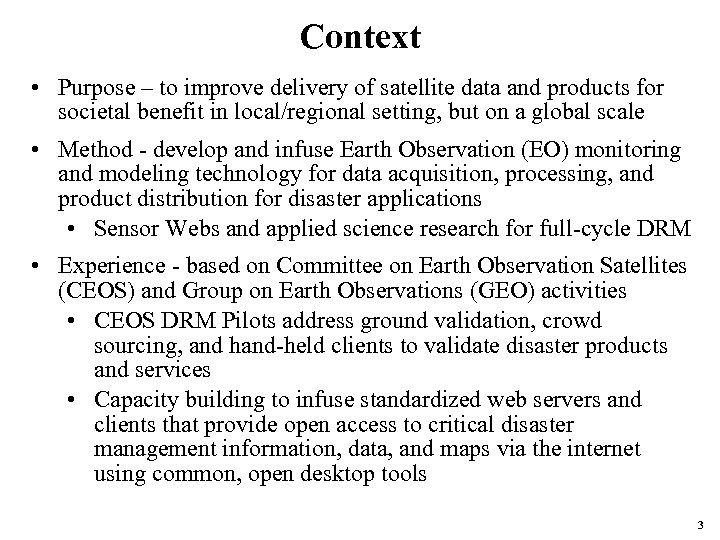 Context • Purpose – to improve delivery of satellite data and products for societal benefit in local/regional setting, but on a global scale • Method - develop and infuse Earth Observation (EO) monitoring and modeling technology for data acquisition, processing, and product distribution for disaster applications • Sensor Webs and applied science research for full-cycle DRM • Experience - based on Committee on Earth Observation Satellites (CEOS) and Group on Earth Observations (GEO) activities • CEOS DRM Pilots address ground validation, crowd sourcing, and hand-held clients to validate disaster products and services • Capacity building to infuse standardized web servers and clients that provide open access to critical disaster management information, data, and maps via the internet using common, open desktop tools 3
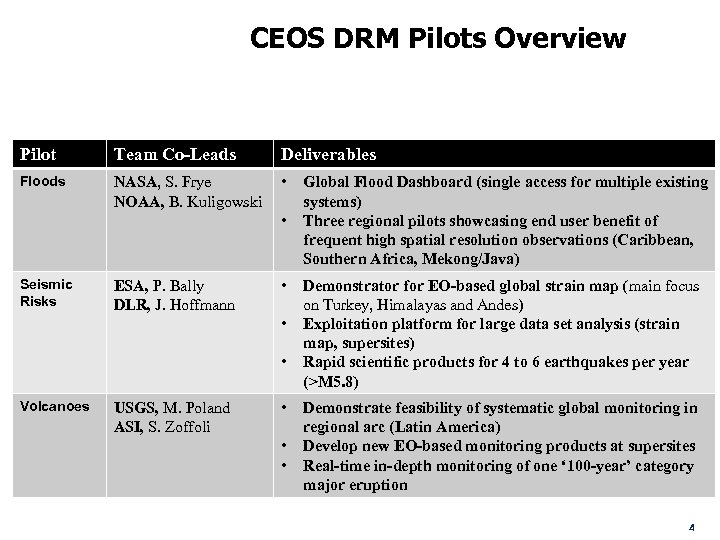 CEOS DRM Pilots Overview Pilot Team Co-Leads Deliverables Floods NASA, S. Frye • NOAA, B. Kuligowski • Global Flood Dashboard (single access for multiple existing systems) Three regional pilots showcasing end user benefit of frequent high spatial resolution observations (Caribbean, Southern Africa, Mekong/Java) Seismic Risks ESA, P. Bally DLR, J. Hoffmann • Demonstrator for EO-based global strain map (main focus on Turkey, Himalayas and Andes) Exploitation platform for large data set analysis (strain map, supersites) Rapid scientific products for 4 to 6 earthquakes per year (>M 5. 8) • • Volcanoes USGS, M. Poland ASI, S. Zoffoli • • • Demonstrate feasibility of systematic global monitoring in regional arc (Latin America) Develop new EO-based monitoring products at supersites Real-time in-depth monitoring of one ‘ 100 -year’ category major eruption 4
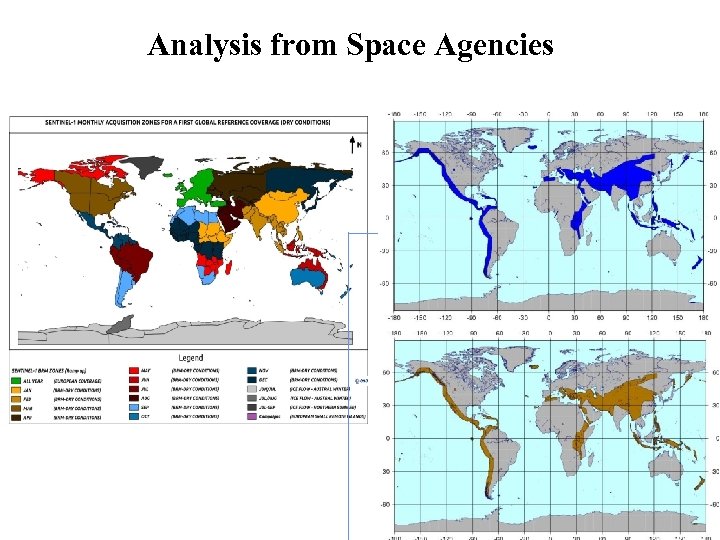
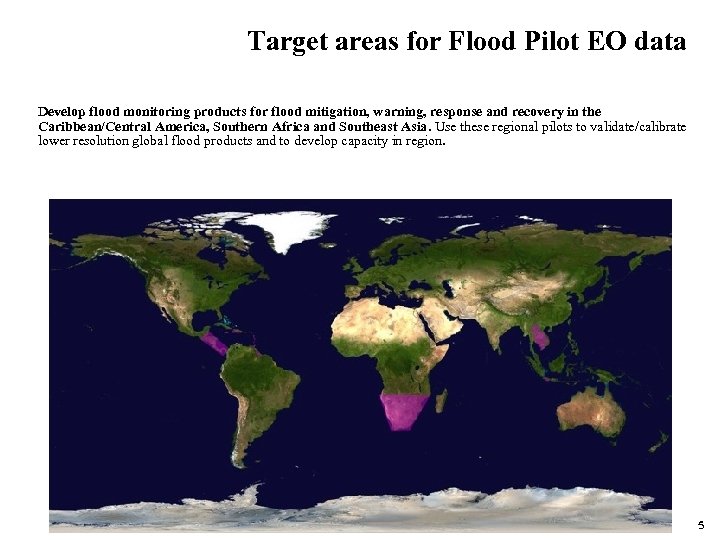 Target areas for Flood Pilot EO data Develop flood monitoring products for flood mitigation, warning, response and recovery in the Caribbean/Central America, Southern Africa and Southeast Asia. Use these regional pilots to validate/calibrate lower resolution global flood products and to develop capacity in region. 5
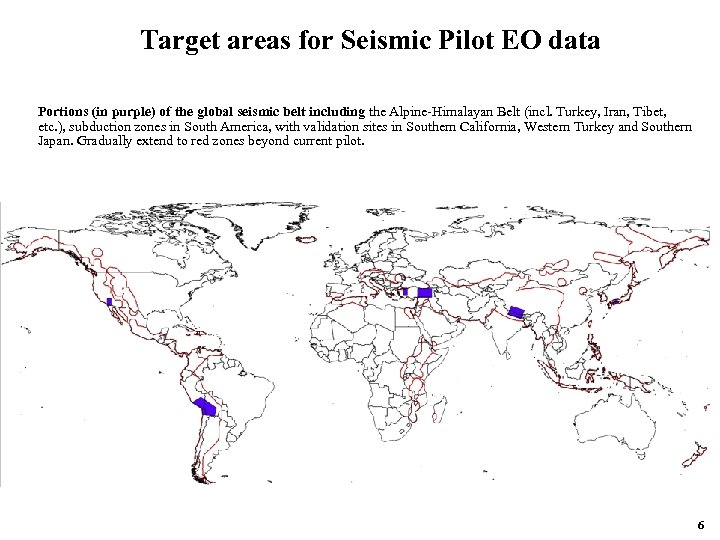 Target areas for Seismic Pilot EO data Portions (in purple) of the global seismic belt including the Alpine-Himalayan Belt (incl. Turkey, Iran, Tibet, etc. ), subduction zones in South America, with validation sites in Southern California, Western Turkey and Southern Japan. Gradually extend to red zones beyond current pilot. 6
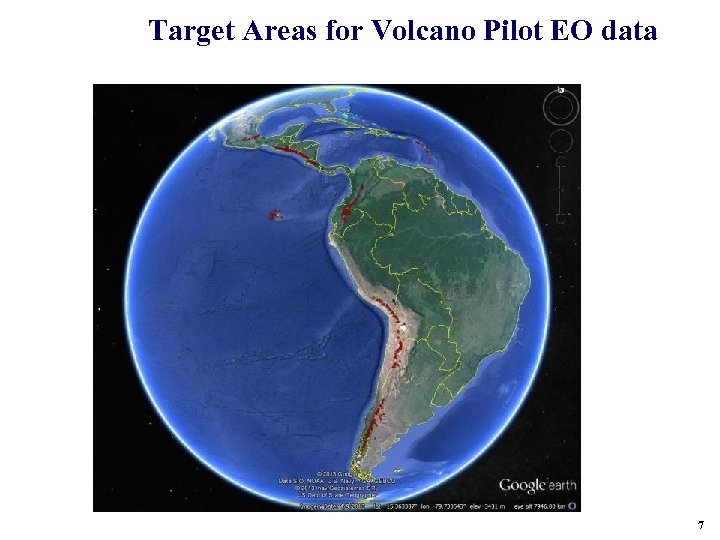 Target Areas for Volcano Pilot EO data 7
 CEOS Agency Response to Pilots: Strategic EO Data Acquisition Plan • Detailed EO Requirements for each pilot approved at last Plenary • Pilot definition included types of data required, frequency of observations and polygons of interest, etc • Pilot EO Requirements submitted to Data Coordination Team made up of representatives from CEOS agencies • Assessment of EO Requirements between last Plenary and SIT-29 by each individual agency • Agencies’ responses analysed and consolidated by Data Coordination Team and pilot Leads. (WGDisasters meeting # 1, Montreal 17 -19 March) • Analysis included trade-offs between pilots (e. g. Pleiades data to be used in priority for volcanoes and seismic hazards), synergies across pilots (volcanoes and seismic hazards) and possible overlaps with other major initiatives (GEOGLAM, GFOI in S-E Asia, Supersites) 8
 Analysis from Space Agencies
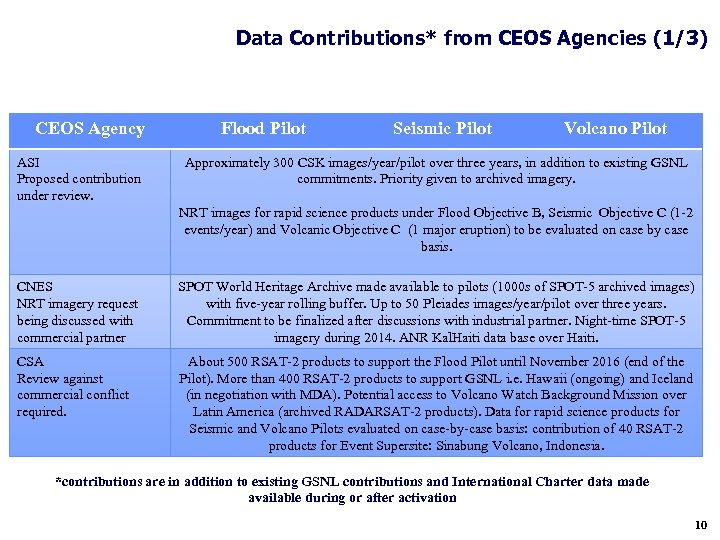 Data Contributions* from CEOS Agencies (1/3) CEOS Agency ASI Proposed contribution under review. Flood Pilot Seismic Pilot Volcano Pilot Approximately 300 CSK images/year/pilot over three years, in addition to existing GSNL commitments. Priority given to archived imagery. NRT images for rapid science products under Flood Objective B, Seismic Objective C (1 -2 events/year) and Volcanic Objective C (1 major eruption) to be evaluated on case by case basis. CNES NRT imagery request being discussed with commercial partner SPOT World Heritage Archive made available to pilots (1000 s of SPOT-5 archived images) with five-year rolling buffer. Up to 50 Pleiades images/year/pilot over three years. Commitment to be finalized after discussions with industrial partner. Night-time SPOT-5 imagery during 2014. ANR Kal. Haiti data base over Haiti. CSA Review against commercial conflict required. About 500 RSAT-2 products to support the Flood Pilot until November 2016 (end of the Pilot). More than 400 RSAT-2 products to support GSNL i. e. Hawaii (ongoing) and Iceland (in negotiation with MDA). Potential access to Volcano Watch Background Mission over Latin America (archived RADARSAT-2 products). Data for rapid science products for Seismic and Volcano Pilots evaluated on case-by-case basis: contribution of 40 RSAT-2 products for Event Supersite: Sinabung Volcano, Indonesia. *contributions are in addition to existing GSNL contributions and International Charter data made available during or after activation 10
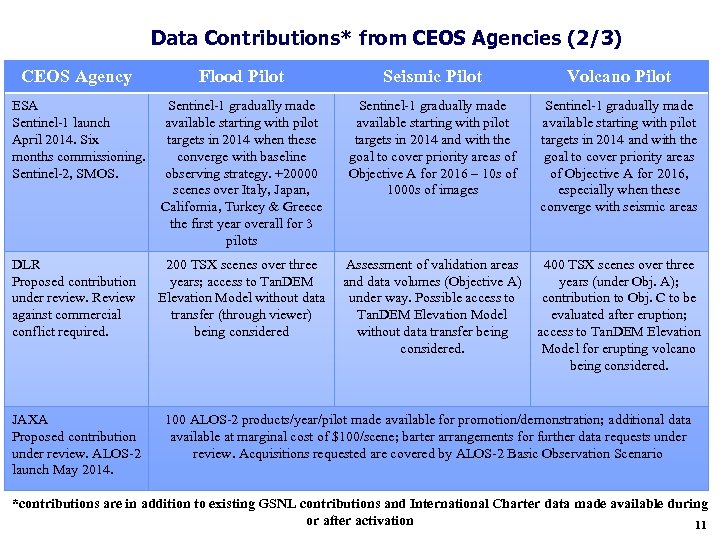 Data Contributions* from CEOS Agencies (2/3) CEOS Agency Flood Pilot Seismic Pilot Volcano Pilot ESA Sentinel-1 launch April 2014. Six months commissioning. Sentinel-2, SMOS. Sentinel-1 gradually made available starting with pilot targets in 2014 when these converge with baseline observing strategy. +20000 scenes over Italy, Japan, California, Turkey & Greece the first year overall for 3 pilots Sentinel-1 gradually made available starting with pilot targets in 2014 and with the goal to cover priority areas of Objective A for 2016 – 10 s of 1000 s of images Sentinel-1 gradually made available starting with pilot targets in 2014 and with the goal to cover priority areas of Objective A for 2016, especially when these converge with seismic areas DLR Proposed contribution under review. Review against commercial conflict required. 200 TSX scenes over three years; access to Tan. DEM Elevation Model without data transfer (through viewer) being considered JAXA Proposed contribution under review. ALOS-2 launch May 2014. Assessment of validation areas 400 TSX scenes over three and data volumes (Objective A) years (under Obj. A); under way. Possible access to contribution to Obj. C to be Tan. DEM Elevation Model evaluated after eruption; without data transfer being access to Tan. DEM Elevation considered. Model for erupting volcano being considered. 100 ALOS-2 products/year/pilot made available for promotion/demonstration; additional data available at marginal cost of $100/scene; barter arrangements for further data requests under review. Acquisitions requested are covered by ALOS-2 Basic Observation Scenario *contributions are in addition to existing GSNL contributions and International Charter data made available during or after activation 11
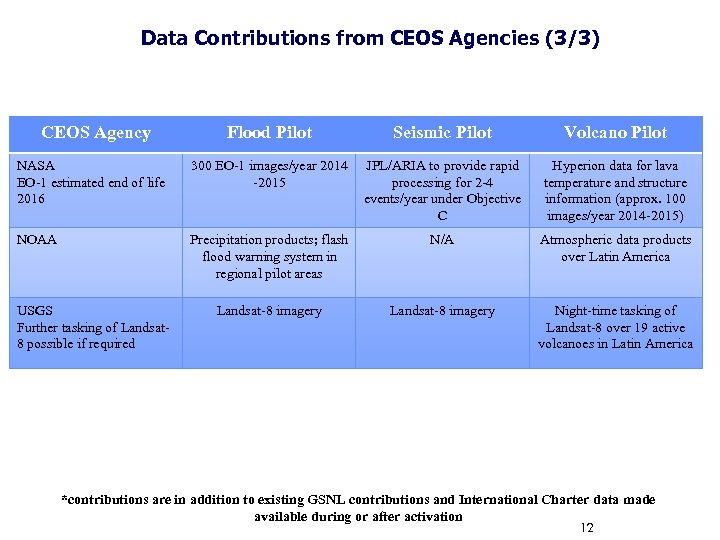 Data Contributions from CEOS Agencies (3/3) CEOS Agency Flood Pilot Seismic Pilot Volcano Pilot NASA EO-1 estimated end of life 2016 300 EO-1 images/year 2014 -2015 JPL/ARIA to provide rapid processing for 2 -4 events/year under Objective C Hyperion data for lava temperature and structure information (approx. 100 images/year 2014 -2015) NOAA Precipitation products; flash flood warning system in regional pilot areas N/A Atmospheric data products over Latin America Landsat-8 imagery Night-time tasking of Landsat-8 over 19 active volcanoes in Latin America USGS Further tasking of Landsat 8 possible if required *contributions are in addition to existing GSNL contributions and International Charter data made available during or after activation 12
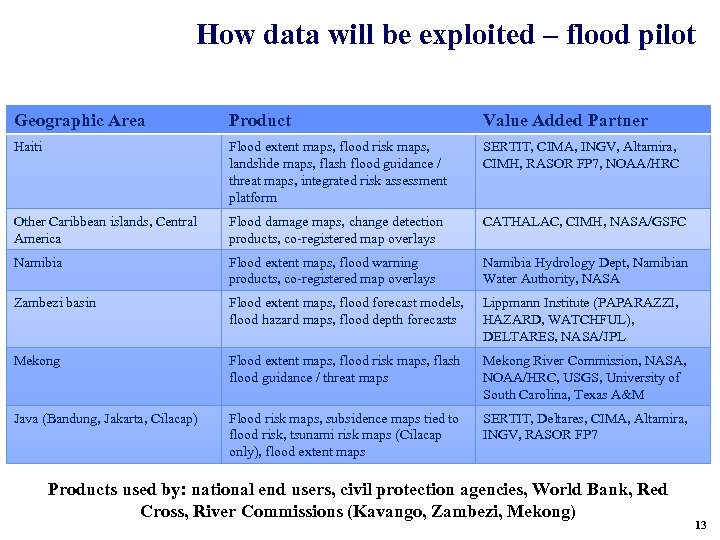 How data will be exploited – flood pilot Geographic Area Product Value Added Partner Haiti Flood extent maps, flood risk maps, landslide maps, flash flood guidance / threat maps, integrated risk assessment platform SERTIT, CIMA, INGV, Altamira, CIMH, RASOR FP 7, NOAA/HRC Other Caribbean islands, Central America Flood damage maps, change detection products, co-registered map overlays CATHALAC, CIMH, NASA/GSFC Namibia Flood extent maps, flood warning products, co-registered map overlays Namibia Hydrology Dept, Namibian Water Authority, NASA Zambezi basin Flood extent maps, flood forecast models, flood hazard maps, flood depth forecasts Lippmann Institute (PAPARAZZI, HAZARD, WATCHFUL), DELTARES, NASA/JPL Mekong Flood extent maps, flood risk maps, flash flood guidance / threat maps Mekong River Commission, NASA, NOAA/HRC, USGS, University of South Carolina, Texas A&M Java (Bandung, Jakarta, Cilacap) Flood risk maps, subsidence maps tied to flood risk, tsunami risk maps (Cilacap only), flood extent maps SERTIT, Deltares, CIMA, Altamira, INGV, RASOR FP 7 Products used by: national end users, civil protection agencies, World Bank, Red Cross, River Commissions (Kavango, Zambezi, Mekong) 13
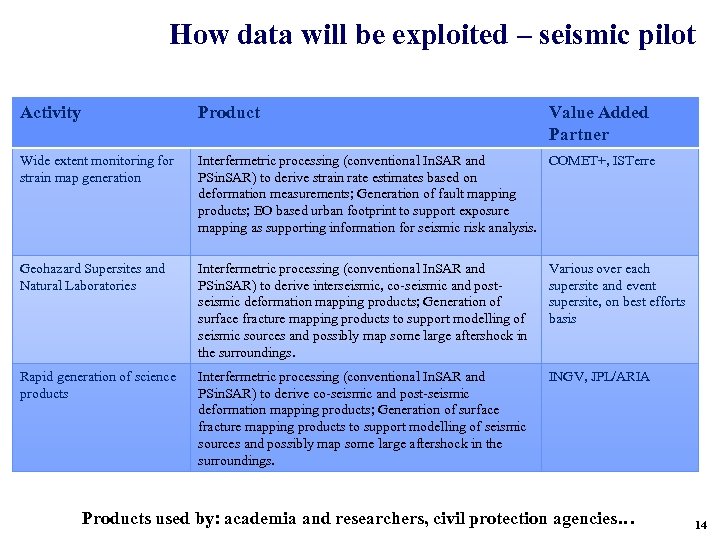 How data will be exploited – seismic pilot Activity Product Value Added Partner Wide extent monitoring for strain map generation Interfermetric processing (conventional In. SAR and COMET+, ISTerre PSin. SAR) to derive strain rate estimates based on deformation measurements; Generation of fault mapping products; EO based urban footprint to support exposure mapping as supporting information for seismic risk analysis. Geohazard Supersites and Natural Laboratories Interfermetric processing (conventional In. SAR and PSin. SAR) to derive interseismic, co-seismic and postseismic deformation mapping products; Generation of surface fracture mapping products to support modelling of seismic sources and possibly map some large aftershock in the surroundings. Various over each supersite and event supersite, on best efforts basis Rapid generation of science products Interfermetric processing (conventional In. SAR and PSin. SAR) to derive co-seismic and post-seismic deformation mapping products; Generation of surface fracture mapping products to support modelling of seismic sources and possibly map some large aftershock in the surroundings. INGV, JPL/ARIA Products used by: academia and researchers, civil protection agencies… 14
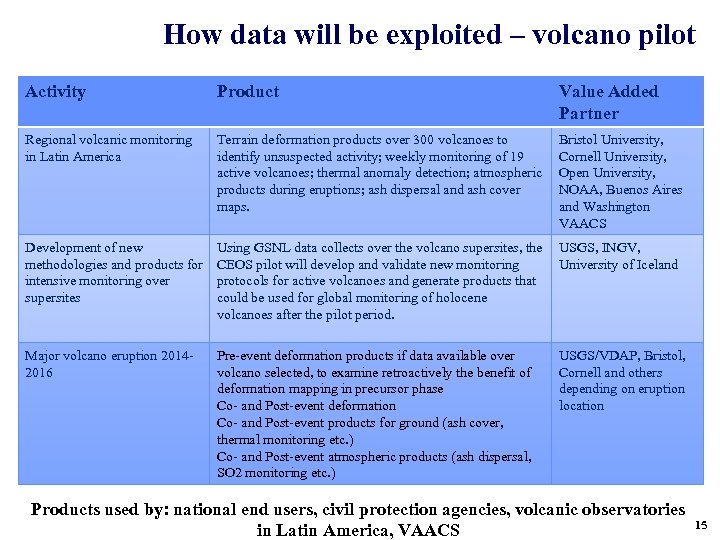 How data will be exploited – volcano pilot Activity Product Value Added Partner Regional volcanic monitoring in Latin America Terrain deformation products over 300 volcanoes to identify unsuspected activity; weekly monitoring of 19 active volcanoes; thermal anomaly detection; atmospheric products during eruptions; ash dispersal and ash cover maps. Bristol University, Cornell University, Open University, NOAA, Buenos Aires and Washington VAACS Development of new methodologies and products for intensive monitoring over supersites Using GSNL data collects over the volcano supersites, the USGS, INGV, CEOS pilot will develop and validate new monitoring University of Iceland protocols for active volcanoes and generate products that could be used for global monitoring of holocene volcanoes after the pilot period. Major volcano eruption 20142016 Pre-event deformation products if data available over volcano selected, to examine retroactively the benefit of deformation mapping in precursor phase Co- and Post-event deformation Co- and Post-event products for ground (ash cover, thermal monitoring etc. ) Co- and Post-event atmospheric products (ash dispersal, SO 2 monitoring etc. ) USGS/VDAP, Bristol, Cornell and others depending on eruption location Products used by: national end users, civil protection agencies, volcanic observatories in Latin America, VAACS 15
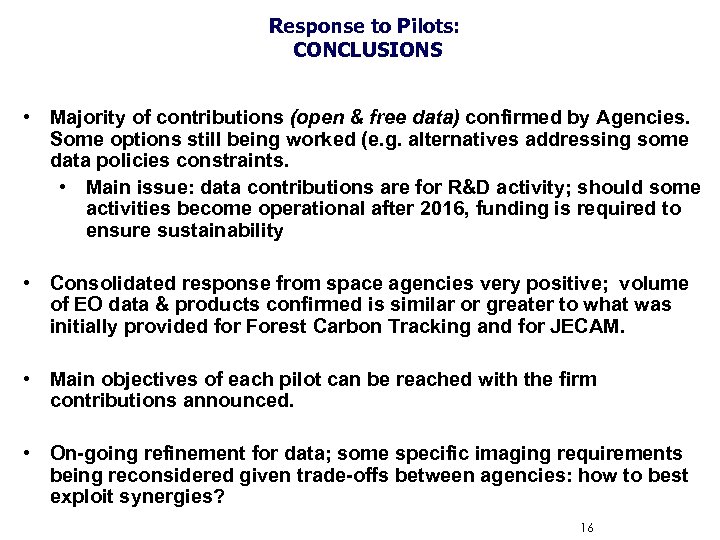 Response to Pilots: CONCLUSIONS • Majority of contributions (open & free data) confirmed by Agencies. Some options still being worked (e. g. alternatives addressing some data policies constraints. • Main issue: data contributions are for R&D activity; should some activities become operational after 2016, funding is required to ensure sustainability • Consolidated response from space agencies very positive; volume of EO data & products confirmed is similar or greater to what was initially provided for Forest Carbon Tracking and for JECAM. • Main objectives of each pilot can be reached with the firm contributions announced. • On-going refinement for data; some specific imaging requirements being reconsidered given trade-offs between agencies: how to best exploit synergies? 16
 User Challenges • Users are split into three categories: a) Satellite operators and their value added providers, b) National agencies/ regional centers/ international organizations, and c) The general public (think weather app on your smart phone) • Users b) and c): • Want products specific to their disaster event, not data they have to manipulate • Don’t want to program, they want to execute requests with point and click apps • Don’t want to purchase software tools, they want open source tools that are freely available and ubiquitous 17
 User Challenges #2 • All users want products to be accessible using tools they usually have installed on their desktop or hand held devices • Digital products are preferred over paper (important to disaster users we have in our regional pilots) • PNG and JPEG are nice for pictures in reports and presentations, BUT… • All users want map based products such as • KML raster overlays and vectorized polygons • These can be combined with other data on a common map background for mashups/analysis/reporting 18
 User Challenges #3 There are hidden services that the users will expect without necessarily knowing they need to ask for it. • Situational awareness requires a stream of new data in addition to static overlays and archive data • New acquisitions need to be visible to all users so they can know what to request for tomorrow and the next day, available from the variety of feasibilities that are provided • Automated mapping servers and map service organizations need to have new data availability published and the capability to subscribe for notification of URL/URI of those data sets • Product processing should be automated for every available user option – either for every data set or on-demand for specific detection and classification algorithms 19
 User Challenges #4 More hidden services that the users will expect without necessarily knowing they need to ask for it. • Tiling and compression should be available for raster and vector-based products that can be ingested and visualized by desktop and hand-held devices without any programming knowledge • Product publication and distribution can be via RSS or Atom-type feeds, but should evolve to become “product feeds” • Product providers need to ensure that • Native resolution is maintained • Products are terrain corrected and co-registered to map control points • Products are delivered only within the user area of interest (i. e. , down scaling global-regional-local) • Delivered products can be easily validated/corrected by nonexperts 20
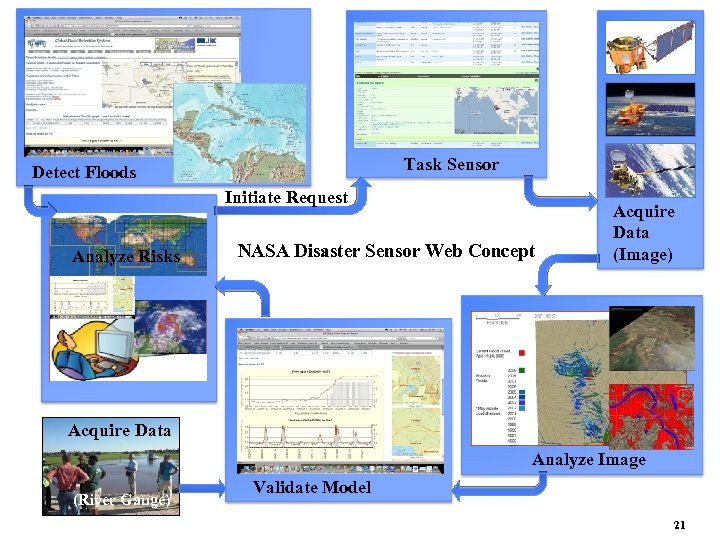 Task Sensor Detect Floods Initiate Request Analyze Risks NASA Disaster Sensor Web Concept Acquire Data (Image) Acquire Data Analyze Image (River Gauge) Validate Model 21
 NASA Web Service URLs • Open. ID Provider-Server https: //op. geobliki. com/ controls the security (this is where you setup your account) • Campaign Manager http: //geobpms. geobliki. com/home allows tasking requests to be submitted (i. e. , target requests) • EO-1 Server http: //eo 1. geobliki. com/ this is where EO-1 data can be found along with the status of future and past task requests • Radarsat Server http: //radarsat. geobliki. com/radarsat where we provide access to Radarsat-2 browse images, metadata, and processed flood products in several formats • MODIS Flood Server http: //oas. gsfc. nasa. gov/floodmap/ is where you can point your browser to manually check on daily MODIS flood maps (browser GUI-based only) • MODIS Flood Server API http: //modis. geobliki. com/modis is the server that provides an Application Programmer Interface (API) for accessing the daily MODIS maps 22
 NASA URLs Concluded • Flood Dashboard Client http: //matsu. opencloudconsortium. org/namibiaflood this is an example of a client implementation that runs on a cloud computing platform provided through a collaboration with the University of Illinois/Chicago and Open Cloud Consortium • Web Coverage Processing Service (WCPS) http: //matsu. opencloudconsortium. org/wcps/session/login is for generating and executing algorithms against satellite data • Pub/Sub Server http: //opsb. geobliki. com/session/new is for setting up subscriptions to be notified when new products of interest to you are published…. The notifications come via Email, SMS, or twitter and contain RSS or Atom feeds for you to follow to find the product. Clients can be automated to monitor the feeds and pull the data they are programmed to look for NASA URLs, server descriptions, and instructions available at http: //eo 1. gsfc. nasa. gov/new/sensor. Web. Exp/Sensor. Web. Read. More. html 23
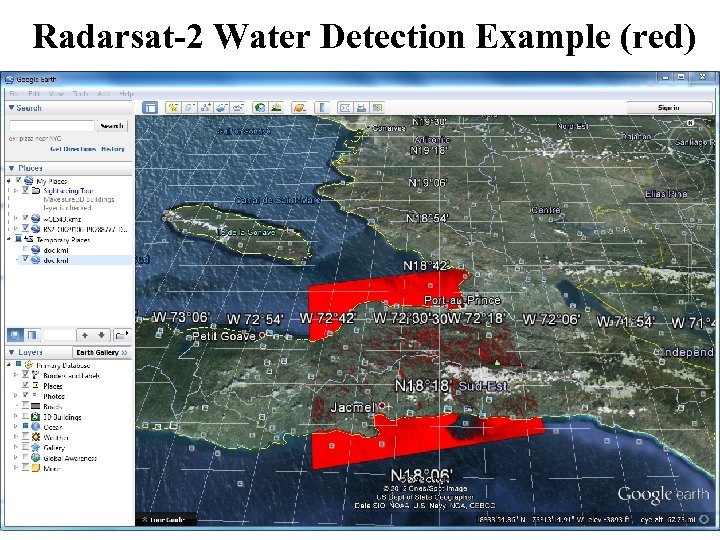 Radarsat-2 Water Detection Example (red)
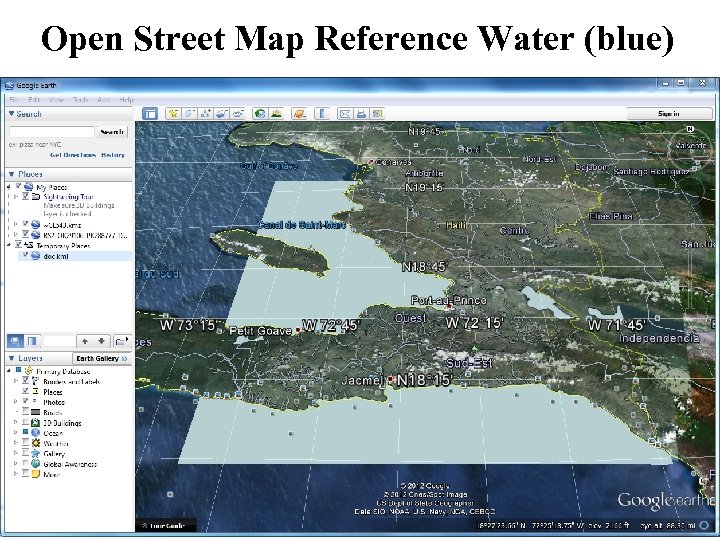 Open Street Map Reference Water (blue)
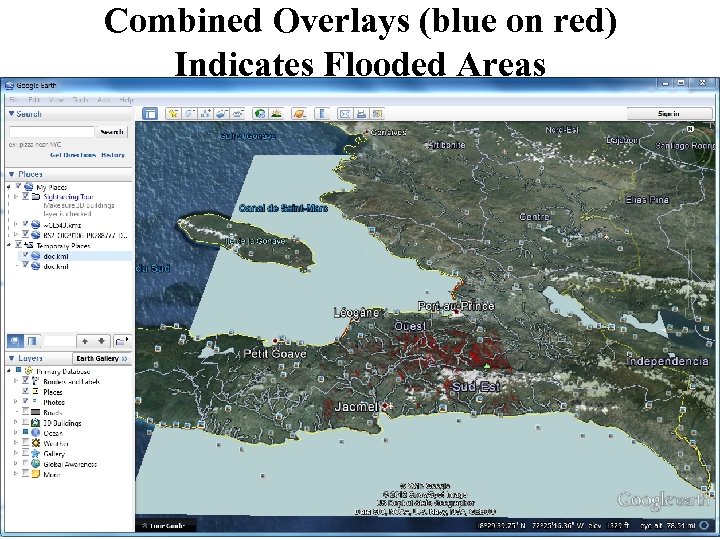 Combined Overlays (blue on red) Indicates Flooded Areas
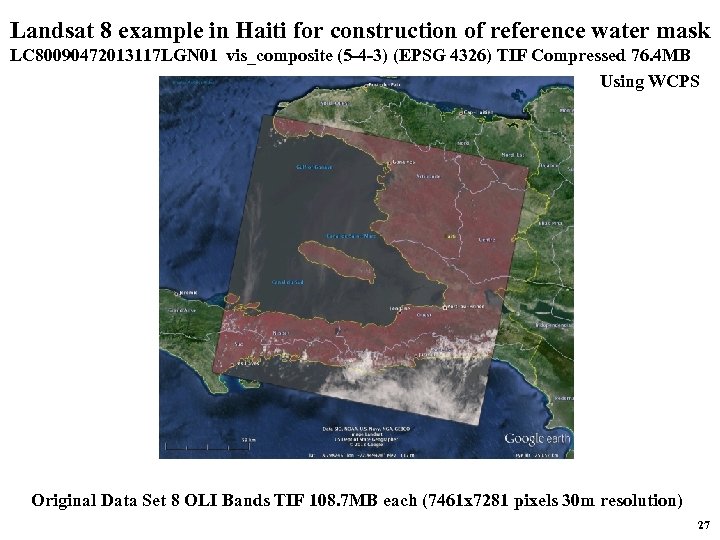 Landsat 8 example in Haiti for construction of reference water mask LC 80090472013117 LGN 01 vis_composite (5 -4 -3) (EPSG 4326) TIF Compressed 76. 4 MB Using WCPS Original Data Set 8 OLI Bands TIF 108. 7 MB each (7461 x 7281 pixels 30 m resolution) 27
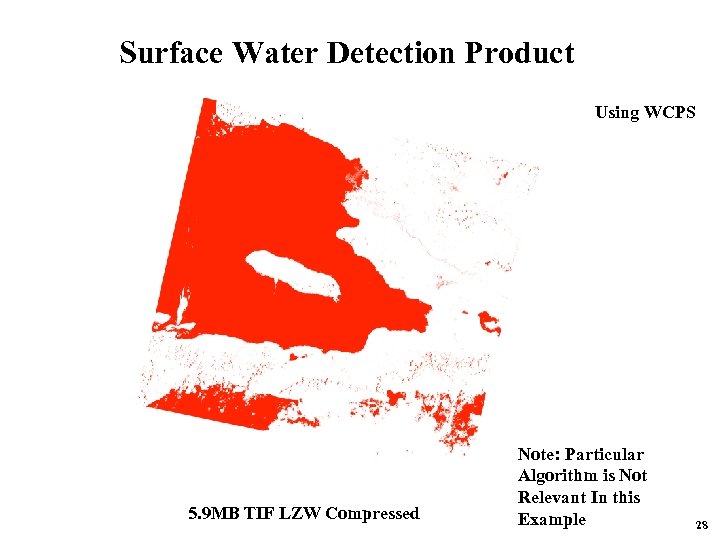 Surface Water Detection Product Using WCPS 5. 9 MB TIF LZW Compressed Note: Particular Algorithm is Not Relevant In this Example 28
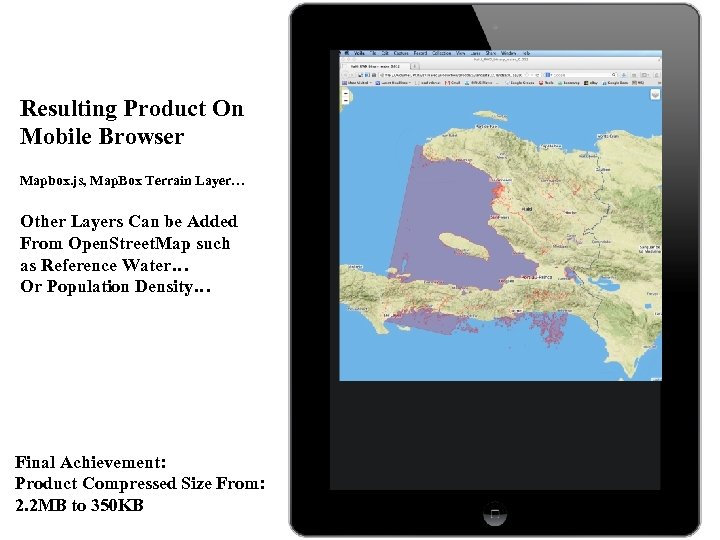 Resulting Product On Mobile Browser Mapbox. js, Map. Box Terrain Layer… Other Layers Can be Added From Open. Street. Map such as Reference Water… Or Population Density… Final Achievement: Product Compressed Size From: 2. 2 MB to 350 KB
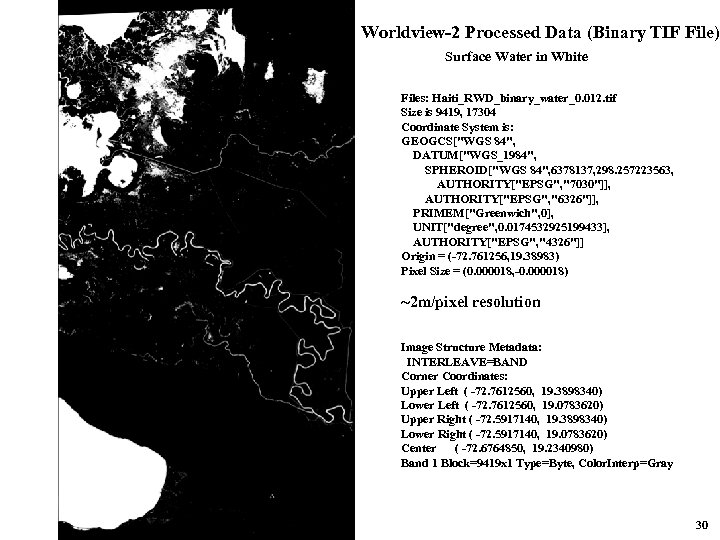 Worldview-2 Processed Data (Binary TIF File) Surface Water in White Files: Haiti_RWD_binary_water_0. 012. tif Size is 9419, 17304 Coordinate System is: GEOGCS["WGS 84", DATUM["WGS_1984", SPHEROID["WGS 84", 6378137, 298. 257223563, AUTHORITY["EPSG", "7030"]], AUTHORITY["EPSG", "6326"]], PRIMEM["Greenwich", 0], UNIT["degree", 0. 0174532925199433], AUTHORITY["EPSG", "4326"]] Origin = (-72. 761256, 19. 38983) Pixel Size = (0. 000018, -0. 000018) ~2 m/pixel resolution Image Structure Metadata: INTERLEAVE=BAND Corner Coordinates: Upper Left ( -72. 7612560, 19. 3898340) Lower Left ( -72. 7612560, 19. 0783620) Upper Right ( -72. 5917140, 19. 3898340) Lower Right ( -72. 5917140, 19. 0783620) Center ( -72. 6764850, 19. 2340980) Band 1 Block=9419 x 1 Type=Byte, Color. Interp=Gray 30
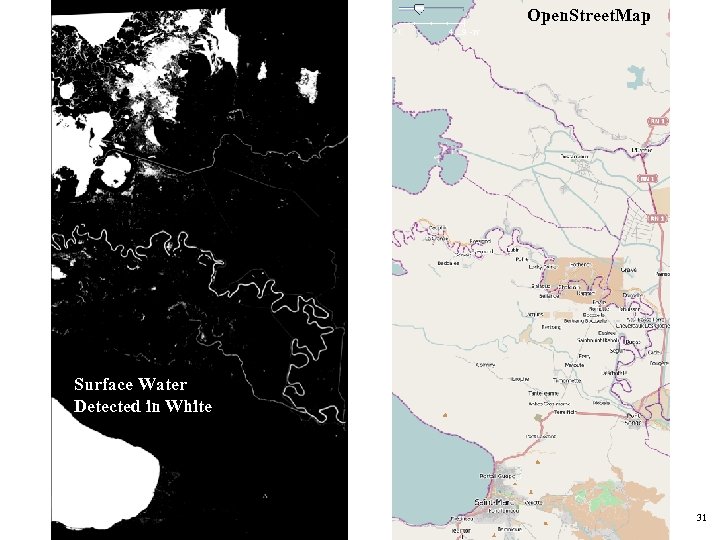 Open. Street. Map Surface Water Detected in White 31
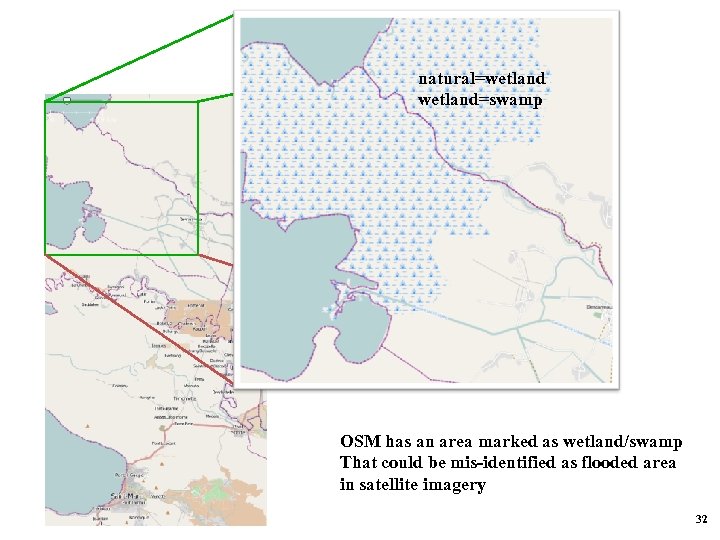 natural=wetland=swamp OSM has an area marked as wetland/swamp That could be mis-identified as flooded area in satellite imagery 32
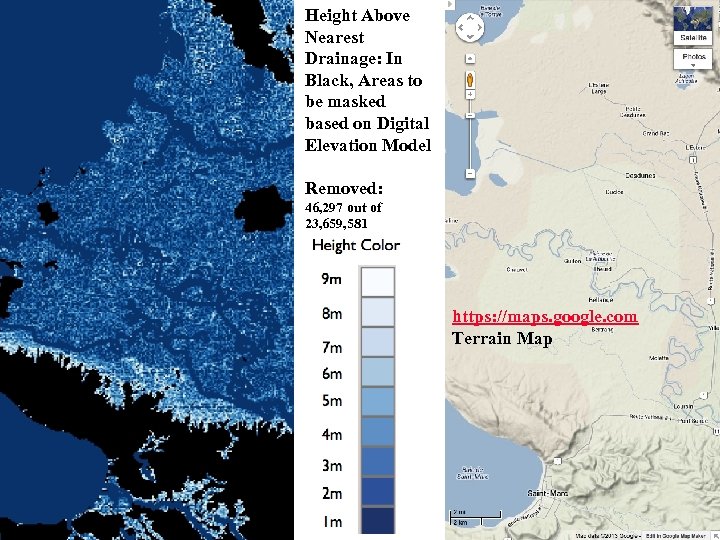 Height Above Nearest Drainage: In Black, Areas to be masked based on Digital Elevation Model Removed: 46, 297 out of 23, 659, 581 https: //maps. google. com Terrain Map
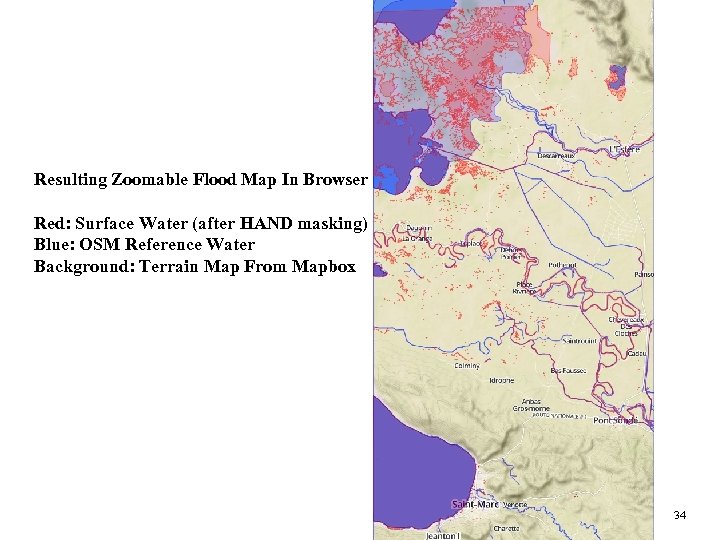 Resulting Zoomable Flood Map In Browser Red: Surface Water (after HAND masking) Blue: OSM Reference Water Background: Terrain Map From Mapbox 34
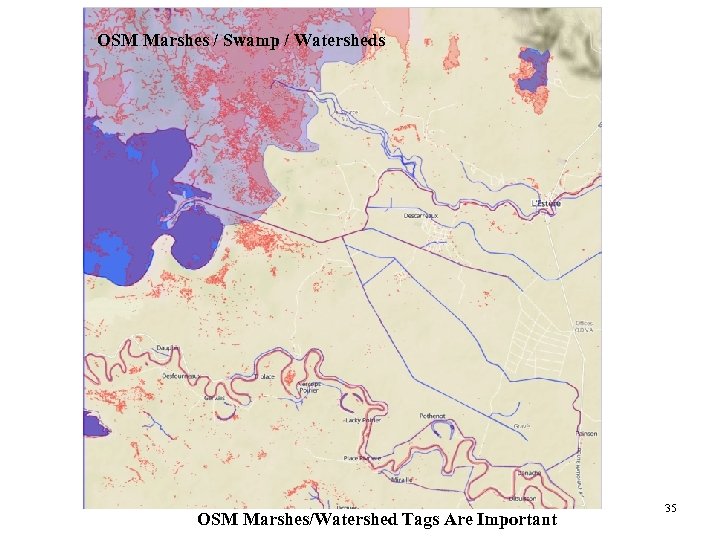 OSM Marshes / Swamp / Watersheds OSM Marshes/Watershed Tags Are Important 35
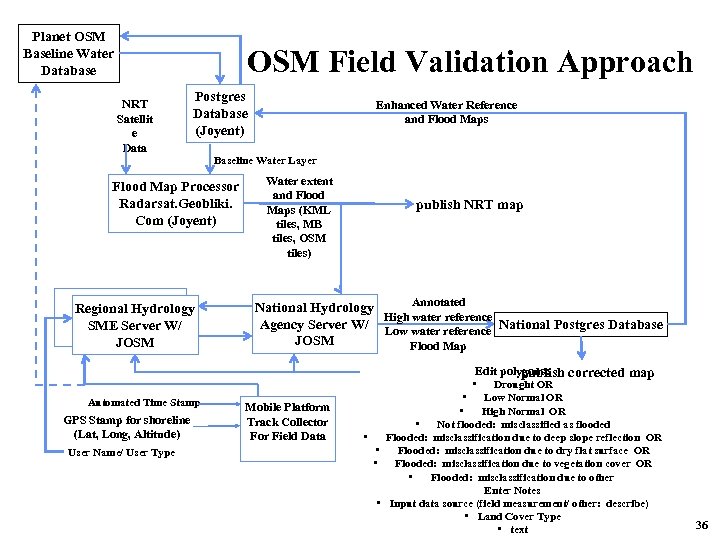 Planet OSM Baseline Water Database OSM Field Validation Approach NRT Satellit e Data Postgres Database (Joyent) Enhanced Water Reference and Flood Maps Baseline Water Layer Flood Map Processor Radarsat. Geobliki. Com (Joyent) Regional Hydrology SME Server W/ JOSM Water extent and Flood Maps (KML tiles, MB tiles, OSM tiles) publish NRT map Annotated National Hydrology High water reference Agency Server W/ Low water reference National Postgres Database JOSM Flood Map Edit polygons: publish corrected map • Drought OR Automated Time Stamp GPS Stamp for shoreline (Lat, Long, Altitude) User Name/ User Type Mobile Platform Track Collector Field Data • Low Normal OR • High Normal OR • Not flooded: misclassified as flooded • Flooded: misclassification due to deep slope reflection OR • Flooded: misclassification due to dry flat surface OR • Flooded: misclassification due to vegetation cover OR • Flooded: misclassification due to other Enter Notes • Input data source (field measurement/ other: describe) • Land Cover Type • text 36
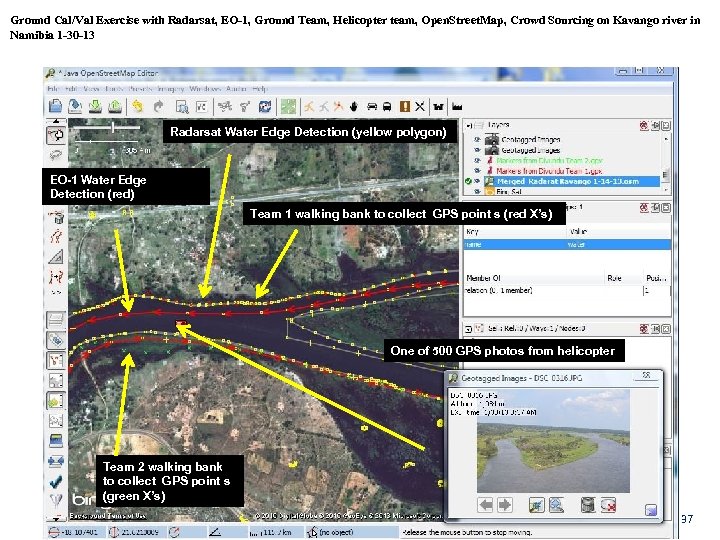 Ground Cal/Val Exercise with Radarsat, EO-1, Ground Team, Helicopter team, Open. Street. Map, Crowd Sourcing. African Flood Pilot on Kavango river in Namibia 1 -30 -13 Radarsat Water Edge Detection (yellow polygon) EO-1 Water Edge Detection (red) Team 1 walking bank to collect GPS point s (red X’s) One of 500 GPS photos from helicopter Team 2 walking bank to collect GPS point s (green X’s) 37
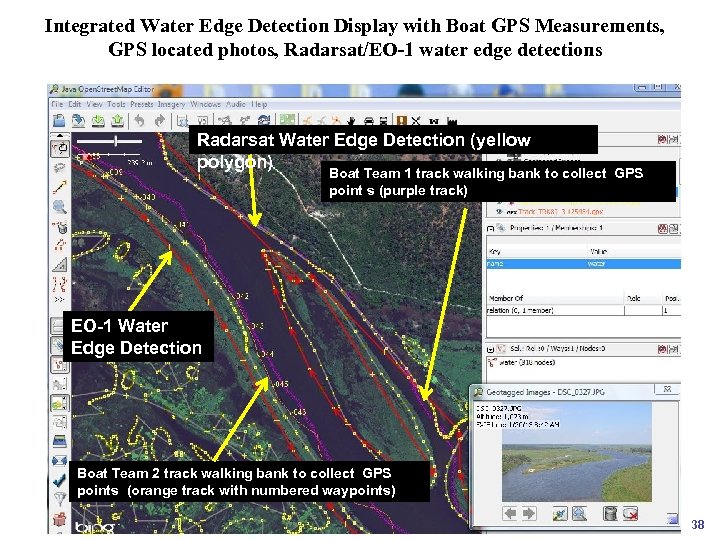 Integrated Water Edge Detection Display with Boat GPS Measurements, GPS located photos, Radarsat/EO-1 water edge detections Radarsat Water Edge Detection (yellow polygon) Boat Team 1 track walking bank to collect GPS point s (purple track) EO-1 Water Edge Detection Boat Team 2 track walking bank to collect GPS points (orange track with numbered waypoints) 38