 Скачать презентацию CEO Roundtable 2005 IPAA Annual Meeting
07aa1e61cd2fc353f2de8fef0c4a7cdf.ppt
- Количество слайдов: 33



CEO Roundtable – 2005 IPAA Annual Meeting – 10/26/05 CEO Roundtable – 2005 IPAA Annual Meeting Houston, Texas October 26, 2005 1
CEO Roundtable – 2005 IPAA Annual Meeting – 10/26/05 CHK Overview § 2 nd largest independent producer of U. S. natural gas: (trail only DVN), #5 overall (includes majors, utilities and pipelines) § #1 driller in U. S. : 74 operated rigs, 72 non-operated rigs, collector of 10% of all daily drilling info generated in the U. S. § Active consolidator in focused areas: $9. 9 billion since ’ 98, $2. 1 billion in ’ 04, $4. 5 billion to date in ’ 05 § Increasing production: 1, 270 mmcfe/day projected ’ 05 production - 28% YOY increase; 1, 543 mmcfe/day projected ’ 06 production - 22% YOY increase § Increasing reserves: 7. 1 tcfe of proved reserves at 6/30/05, 92% natural gas, 64% proved developed, 13. 8 year R/P § Upside potential: 6. 4 tcfe of non-proved reserve potential in: i) conventional, ii) unconventional gas resource and iii) emerging gas resource plays: 12 -year drilling inventory § Industry leading leasehold and seismic position: 7. 6 mm acres of U. S. onshore leasehold plus 10. 9 mm acres of 3 -D seismic § $19. 4 billion EV: $14. 2 billion equity value, $5. 2 billion long-term debt § 2006 estimates: ebitda $3. 4 billion; operating cash flow $3. 1 billion; net income to common $1. 2 billion § CHK offers great value to investors: 4. 5 x operating cash flow, 5. 7 x ebitda, 12. 1 x P/E ratio § Top stock price performance: CHK up 25 x in 12 years as a public company, #2 performer among mid and large-cap E&P companies during that period Data above incorporates: • CHK’s Outlook as of 10/3/05; • Pro forma adjustments for August 2005 acquisitions and pending acquisition of Columbia Natural Resources (CNR); • An assumed common stock price of $34. 00, NYMEX prices of $8. 00/mcf and $50. 00/bbl for 2006 and excluding effects of FAS 133 (unrealized hedging gain or loss) and charges incurred in connection with stock based compensation; and • The August 2005 $600 mm senior notes issuance, the September 2005 issuance of 9. 2 million shares of common stock, the September 2005 issuance of $345 million of convertible preferred stock and the estimated debt and equity financings of the pending acquisition of CNR 2
CEO Roundtable – 2005 IPAA Annual Meeting – 10/26/05 Review of CNR Acquisition § Agreed to acquire Columbia Natural Resources, LLC (CNR) for $2. 2 billion in cash and assume approximately $75 million working capital deficit and additional liabilities related to prepaid sales and hedging agreements valued as follows: – Proved reserves: 1. 1 tcfe for $1. 5 billion = $1. 45/mcfe(1) – Probable/possible reserves and unevaluated leasehold: 1. 4 tcfe and 4. 1 mm net acres (3. 6 mm net acres onshore U. S. ) for $500 mm – Midstream: 6, 500 miles of gathering pipeline and infrastructure for $175 mm § All-in cost to develop 2. 5 tcfe of 3 P reserves = $2. 48/mcfe (1) § 99% natural gas; 70% proved developed reserves; 125 mmcfe current daily production rate; 23 -year R/P ratio (16 years on proved developed); operate 91% of wells with a 93% average working interest § Anticipate hedging at least 50% of CNR’s estimated base production through 12/08 § Price decks used to value CNR were much lower than the price decks on the forward curve; this arbitrage opportunity has significantly expanded over the last four years 3 (1) Excludes negative working capital and liabilities associated with assumed prepaid sales and hedging agreements
CEO Roundtable – 2005 IPAA Annual Meeting – 10/26/05 CNR Acquisition Highlights § Immediate critical mass and scale in a proven gas prone basin – Fourth largest gas producer in Appalachian Basin behind Equitable, Consol and Dominion – Over 46 tcf of cumulative gas production in Appalachia with 9 tcf of proved and 68 tcf of unproved gas remaining(1) § Attractive all-in economics – Premium gas price realizations: High btu gas (1, 140 btu/mcf); positive basis differentials of $0. 25 to $0. 50/mmbtu over NYMEX vs. $2. 00 to $4. 00/mmbtu discounts to NYMEX in various southwestern and western basins – Attractive lease operating and future development costs: $1. 35/mcfe and $2. 35/mcfe § Multiple value creation opportunities: – Fragmented basin that is ripe for consolidation – Drilling acceleration to enhance PV of inventory • Plan to triple capex to over $200 mm in 2006 • Low-risk gas-farming opportunities of long-lived, low production decline rate assets • Proven blanket sand shale horizons ideal for accelerated drilling program – Future reserve upside? • CHK has identified 1, 316 PUDs and 8, 119 unproved drillsites and initially recognized 2. 5 tcfe of 3 P reserves vs. 1, 611 PUDs and 14, 000 unproved locations and 3. 9 tcf of 3 P reserves determined by seller’s third-party engineers – Deeper drilling potential that plays to CHK’s expertise in largely under-explored basin • <1% of more than 400, 000 wells drilled below 7, 500 feet – Over 3, 000 wells with workover potential at >50% rates of return CHK believes the Appalachian Basin is the last frontier for American onshore gas exploration and consolidation (1) Source: National Petroleum Council - September 2003 4
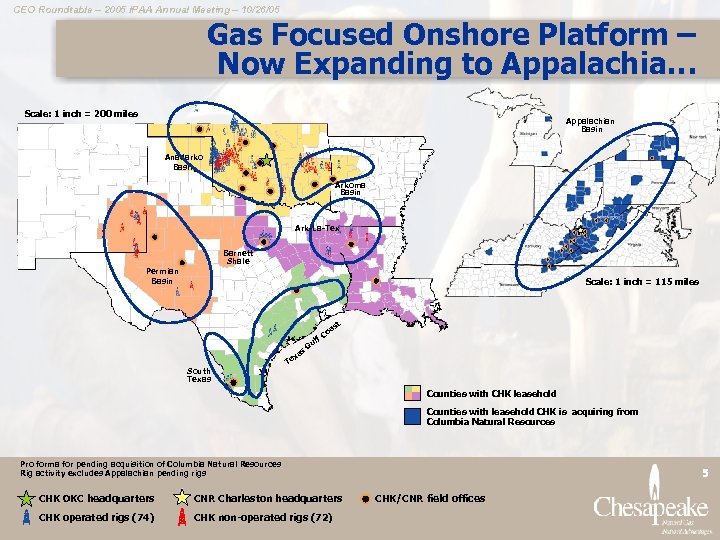
CEO Roundtable – 2005 IPAA Annual Meeting – 10/26/05 Gas Focused Onshore Platform – Now Expanding to Appalachia… Scale: 1 inch = 200 miles Appalachian Basin Anadarko Basin Arkoma Basin Ark-La-Tex Barnett Shale Permian Basin Scale: 1 inch = 115 miles t as o f. C ul s. G a South Texas x Te Counties with CHK leasehold Counties with leasehold CHK is acquiring from Columbia Natural Resources Pro forma for pending acquisition of Columbia Natural Resources Rig activity excludes Appalachian pending rigs CHK OKC headquarters CNR Charleston headquarters CHK operated rigs (74) CHK non-operated rigs (72) 5 CHK/CNR field offices
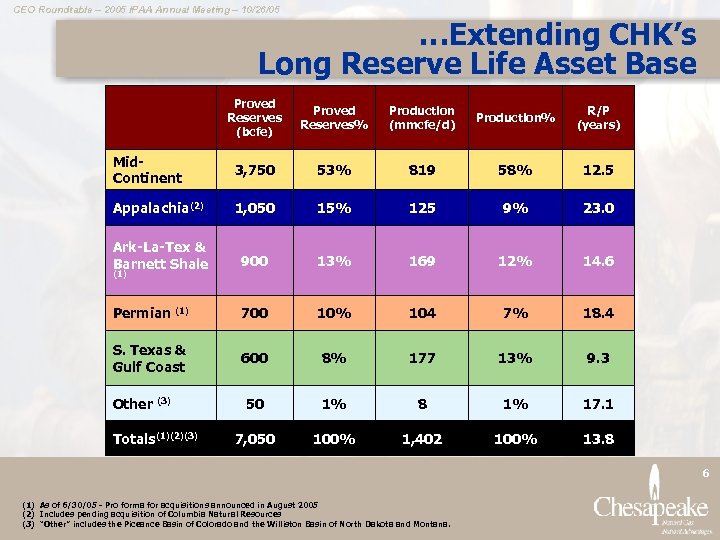
CEO Roundtable – 2005 IPAA Annual Meeting – 10/26/05 …Extending CHK’s Long Reserve Life Asset Base Proved Reserves (bcfe) Proved Reserves% Production (mmcfe/d) Production% R/P (years) Mid. Continent 3, 750 53% 819 58% 12. 5 Appalachia(2) 1, 050 15% 125 9% 23. 0 Ark-La-Tex & Barnett Shale 900 13% 169 12% 14. 6 Permian (1) 700 10% 104 7% 18. 4 S. Texas & Gulf Coast 600 8% 177 13% 9. 3 50 1% 8 1% 17. 1 7, 050 100% 1, 402 100% 13. 8 (1) Other (3) Totals(1)(2)(3) 6 (1) As of 6/30/05 - Pro forma for acquisitions announced in August 2005 (2) Includes pending acquisition of Columbia Natural Resources (3) “Other” includes the Piceance Basin of Colorado and the Williston Basin of North Dakota and Montana.
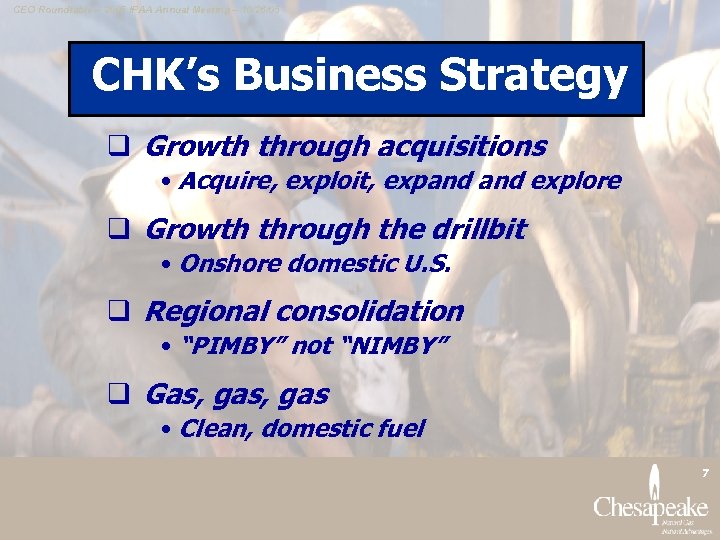
CEO Roundtable – 2005 IPAA Annual Meeting – 10/26/05 CHK’s Business Strategy q Growth through acquisitions • Acquire, exploit, expand explore q Growth through the drillbit • Onshore domestic U. S. q Regional consolidation • “PIMBY” not “NIMBY” q Gas, gas • Clean, domestic fuel 7
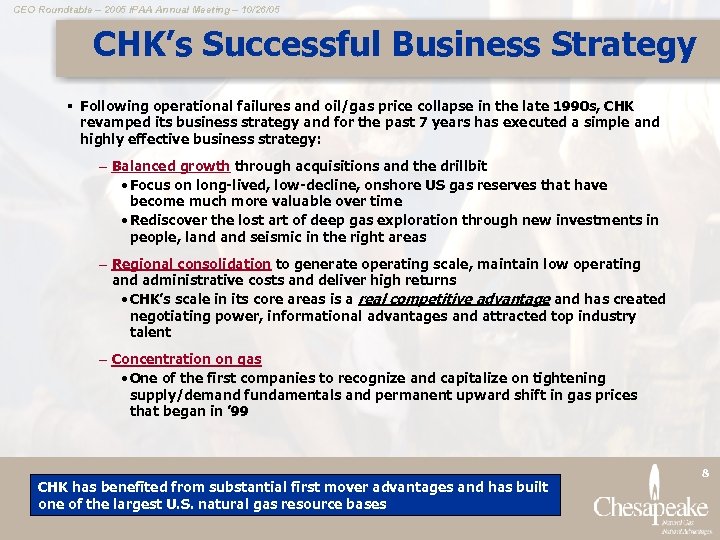
CEO Roundtable – 2005 IPAA Annual Meeting – 10/26/05 CHK’s Successful Business Strategy § Following operational failures and oil/gas price collapse in the late 1990 s, CHK revamped its business strategy and for the past 7 years has executed a simple and highly effective business strategy: – Balanced growth through acquisitions and the drillbit • Focus on long-lived, low-decline, onshore US gas reserves that have become much more valuable over time • Rediscover the lost art of deep gas exploration through new investments in people, land seismic in the right areas – Regional consolidation to generate operating scale, maintain low operating and administrative costs and deliver high returns • CHK’s scale in its core areas is a real competitive advantage and has created negotiating power, informational advantages and attracted top industry talent – Concentration on gas • One of the first companies to recognize and capitalize on tightening supply/demand fundamentals and permanent upward shift in gas prices that began in ’ 99 CHK has benefited from substantial first mover advantages and has built one of the largest U. S. natural gas resource bases 8
CEO Roundtable – 2005 IPAA Annual Meeting – 10/26/05 CHK’s Business Strategy q Growth through acquisitions • Acquire, exploit, expand explore q Growth through the drillbit • Onshore domestic U. S. q Regional consolidation • “PIMBY” not “NIMBY” q Gas, gas • Clean, domestic fuel 9
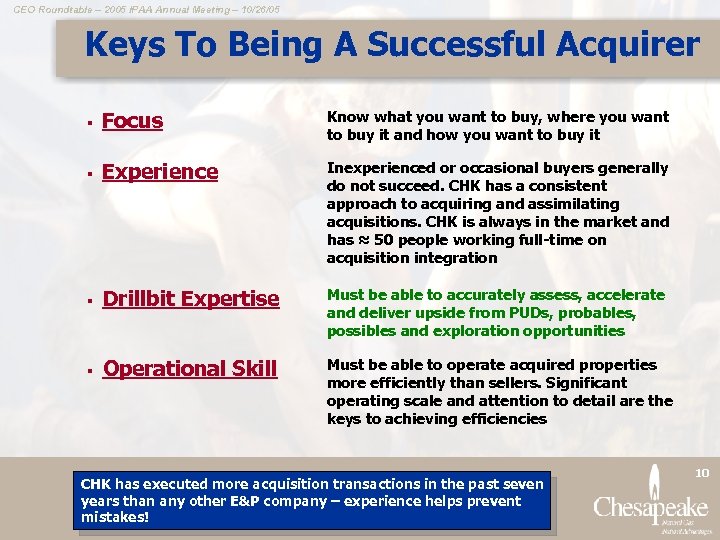
CEO Roundtable – 2005 IPAA Annual Meeting – 10/26/05 Keys To Being A Successful Acquirer § Focus Know what you want to buy, where you want to buy it and how you want to buy it § Experience Inexperienced or occasional buyers generally do not succeed. CHK has a consistent approach to acquiring and assimilating acquisitions. CHK is always in the market and has ≈ 50 people working full-time on acquisition integration § Drillbit Expertise Must be able to accurately assess, accelerate and deliver upside from PUDs, probables, possibles and exploration opportunities § Operational Skill Must be able to operate acquired properties more efficiently than sellers. Significant operating scale and attention to detail are the keys to achieving efficiencies CHK has executed more acquisition transactions in the past seven years than any other E&P company – experience helps prevent mistakes! 10
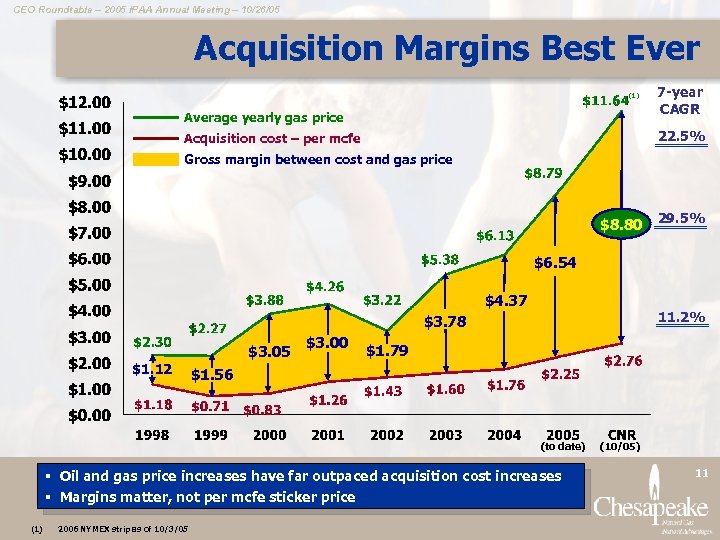
CEO Roundtable – 2005 IPAA Annual Meeting – 10/26/05 Acquisition Margins Best Ever (1) Average yearly gas price 7 -year CAGR 22. 5% Acquisition cost – per mcfe Gross margin between cost and gas price $8. 80 29. 5% $6. 54 $4. 37 11. 2% $3. 78 $1. 12 $3. 05 $3. 00 $1. 79 $1. 56 (to date) § Oil and gas price increases have far outpaced acquisition cost increases § Margins matter, not per mcfe sticker price (1) 2006 NYMEX strip as of 10/3/05 (10/05) 11
CEO Roundtable – 2005 IPAA Annual Meeting – 10/26/05 CHK’s Business Strategy q Growth through acquisitions • Acquire, exploit, expand explore q Growth through the drillbit • Onshore domestic U. S. q Regional consolidation • “PIMBY” not “NIMBY” q Gas, gas • Clean, domestic fuel 12
CEO Roundtable – 2005 IPAA Annual Meeting – 10/26/05 Why Is CHK the #1 Driller in the U. S. ? § Most active driller in U. S. by a wide margin – 74 operated rigs currently drilling (plus 72 non-operated rigs drilling) – CHK gathers ≈10% of all the daily drilling information generated in America • This is a distinctive competitive advantage. § 1/4 of rigs drilling to targets > 15, 000’; 1/2 between 10 -15, 000’; 1/4 < than 10, 000’ – Drill more deep onshore wells than anyone in the industry – Also one of the leading horizontal drillers in the industry § If properly executed, good drilling easily generates the highest returns on capital: 100%+ vs. 20 -25% acquisitions § However, creating value through the drillbit today is difficult – You had to start getting ready 5 years ago – Quality land, people and seismic are scarce resources § Over the past 7 years, CHK has differentially invested over $2. 4 billion to build the industry’s largest inventories of U. S. leasehold (7. 6 mm acres) and 3 -D seismic (10. 9 mm acres)(1) – Amassed a 12 -year inventory of over 23, 500 drill sites – Now in every major U. S. onshore gas resource play out side of the Rockies CHK is uniquely positioned to transfer and apply technology, data and geoscience knowledgebase across all of its operating regions (1) Pro forma for pending acquisition of Columbia Natural Resources 13
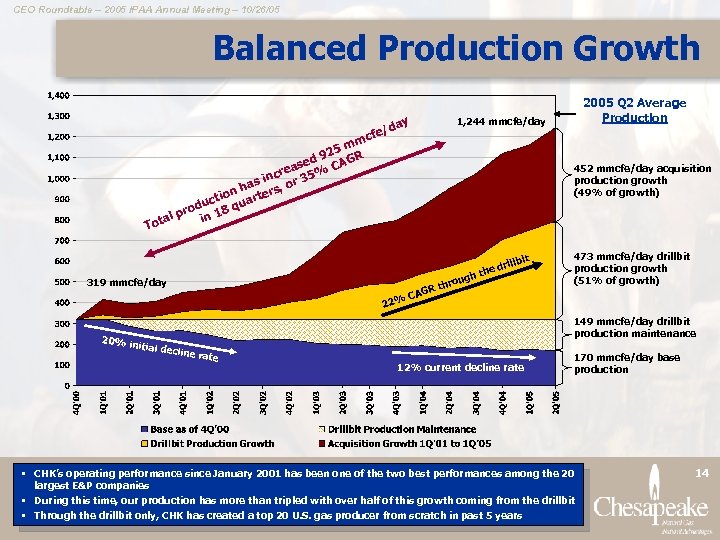
CEO Roundtable – 2005 IPAA Annual Meeting – 10/26/05 Balanced Production Growth ay 2005 Q 2 Average Production 1, 244 mmcfe/day /d cfe mm 925 GR ed A eas 5% C cr 3 in has rs, or tion rte duc 8 qua o l pr in 1 ota 452 mmcfe/day acquisition production growth (49% of growth) T it 319 mmcfe/day r R th AG %C illb e dr h th oug 473 mmcfe/day drillbit production growth (51% of growth) 22 20% in itial de 149 mmcfe/day drillbit production maintenance cline ra te 12% current decline rate 170 mmcfe/day base production § CHK’s operating performance since January 2001 has been one of the two best performances among the 20 largest E&P companies § During this time, our production has more than tripled with over half of this growth coming from the drillbit § Through the drillbit only, CHK has created a top 20 U. S. gas producer from scratch in past 5 years 14
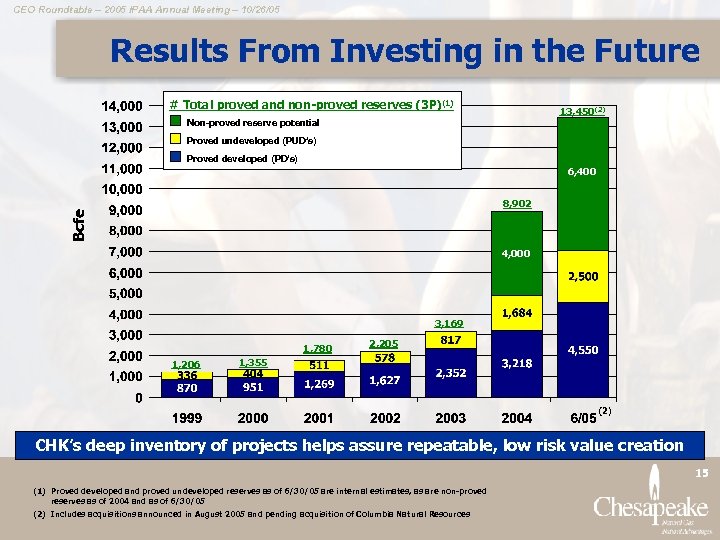
CEO Roundtable – 2005 IPAA Annual Meeting – 10/26/05 Results From Investing in the Future # Total proved and non-proved reserves (3 P)(1) 13, 450(2) Non-proved reserve potential Proved undeveloped (PUD’s) Proved developed (PD’s) 6, 400 Bcfe 8, 902 4, 000 3, 169 1, 780 1, 206 2, 205 1, 355 (2) CHK’s deep inventory of projects helps assure repeatable, low risk value creation 15 (1) Proved developed and proved undeveloped reserves as of 6/30/05 are internal estimates, as are non-proved reserves as of 2004 and as of 6/30/05 (2) Includes acquisitions announced in August 2005 and pending acquisition of Columbia Natural Resources
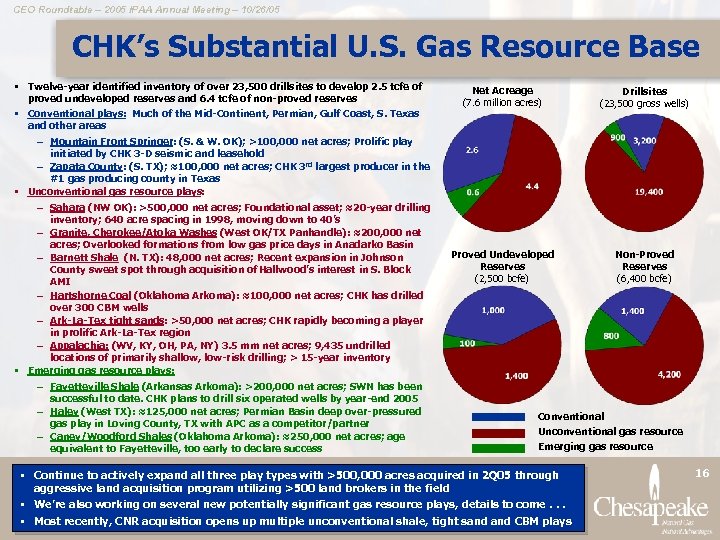
CEO Roundtable – 2005 IPAA Annual Meeting – 10/26/05 CHK’s Substantial U. S. Gas Resource Base § Twelve-year identified inventory of over 23, 500 drillsites to develop 2. 5 tcfe of proved undeveloped reserves and 6. 4 tcfe of non-proved reserves § Conventional plays: Much of the Mid-Continent, Permian, Gulf Coast, S. Texas and other areas – Mountain Front Springer: (S. & W. OK); >100, 000 net acres; Prolific play initiated by CHK 3 -D seismic and leasehold – Zapata County: (S. TX); ≈100, 000 net acres; CHK 3 rd largest producer in the #1 gas producing county in Texas § Unconventional gas resource plays: – Sahara (NW OK): >500, 000 net acres; Foundational asset; ≈20 -year drilling inventory; 640 acre spacing in 1998, moving down to 40’s – Granite, Cherokee/Atoka Washes (West OK/TX Panhandle): ≈200, 000 net acres; Overlooked formations from low gas price days in Anadarko Basin – Barnett Shale (N. TX): 48, 000 net acres; Recent expansion in Johnson County sweet spot through acquisition of Hallwood’s interest in S. Block AMI – Hartshorne Coal (Oklahoma Arkoma): ≈100, 000 net acres; CHK has drilled over 300 CBM wells – Ark-La-Tex tight sands: >50, 000 net acres; CHK rapidly becoming a player in prolific Ark-La-Tex region – Appalachia: (WV, KY, OH, PA, NY) 3. 5 mm net acres; 9, 435 undrilled locations of primarily shallow, low-risk drilling; > 15 -year inventory § Emerging gas resource plays: – Fayetteville Shale (Arkansas Arkoma): >200, 000 net acres; SWN has been successful to date. CHK plans to drill six operated wells by year-end 2005 – Haley (West TX): ≈125, 000 net acres; Permian Basin deep over-pressured gas play in Loving County, TX with APC as a competitor/partner – Caney/Woodford Shales (Oklahoma Arkoma): ≈250, 000 net acres; age equivalent to Fayetteville, too early to declare success Net Acreage (7. 6 million acres) Drillsites (23, 500 gross wells) Proved Undeveloped Reserves (2, 500 bcfe) Non-Proved Reserves (6, 400 bcfe) Conventional Unconventional gas resource Emerging gas resource § Continue to actively expand all three play types with >500, 000 acres acquired in 2 Q 05 through aggressive land acquisition program utilizing >500 land brokers in the field § We’re also working on several new potentially significant gas resource plays, details to come. . . § Most recently, CNR acquisition opens up multiple unconventional shale, tight sand CBM plays 16
CEO Roundtable – 2005 IPAA Annual Meeting – 10/26/05 CHK’s Business Strategy q Growth through acquisitions • Acquire, exploit, expand explore q Growth through the drillbit • Onshore domestic U. S. q Regional consolidation • “PIMBY” not “NIMBY” q Gas, gas • Clean, domestic fuel 17
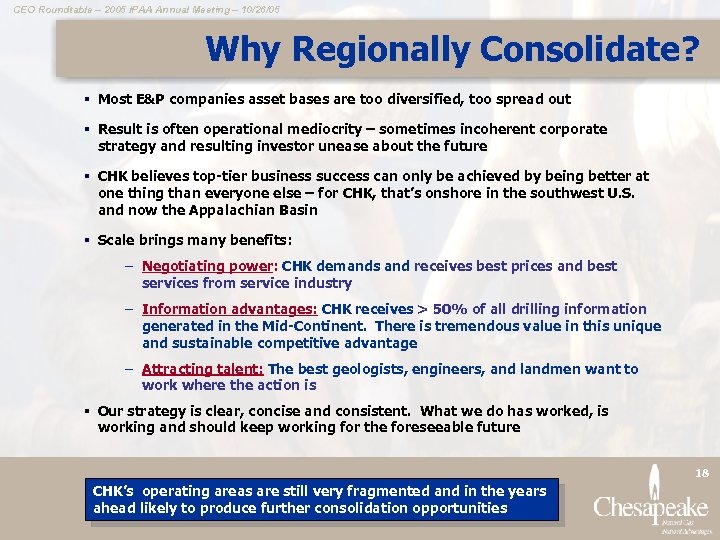
CEO Roundtable – 2005 IPAA Annual Meeting – 10/26/05 Why Regionally Consolidate? § Most E&P companies asset bases are too diversified, too spread out § Result is often operational mediocrity – sometimes incoherent corporate strategy and resulting investor unease about the future § CHK believes top-tier business success can only be achieved by being better at one thing than everyone else – for CHK, that’s onshore in the southwest U. S. and now the Appalachian Basin § Scale brings many benefits: – Negotiating power: CHK demands and receives best prices and best services from service industry – Information advantages: CHK receives > 50% of all drilling information generated in the Mid-Continent. There is tremendous value in this unique and sustainable competitive advantage – Attracting talent: The best geologists, engineers, and landmen want to work where the action is § Our strategy is clear, concise and consistent. What we do has worked, is working and should keep working for the foreseeable future 18 CHK’s operating areas are still very fragmented and in the years ahead likely to produce further consolidation opportunities
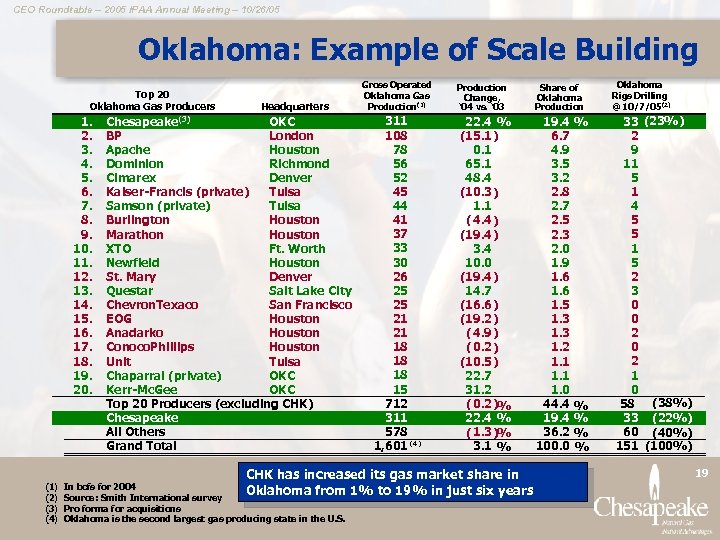
CEO Roundtable – 2005 IPAA Annual Meeting – 10/26/05 Oklahoma: Example of Scale Building Top 20 Oklahoma Gas Producers 1. 2. 3. 4. 5. 6. 7. 8. 9. 10. 11. 12. 13. 14. 15. 16. 17. 18. 19. 20. (1) (2) (3) (4) Headquarters Chesapeake(3) OKC BP London Apache Houston Dominion Richmond Cimarex Denver Kaiser-Francis (private) Tulsa Samson (private) Tulsa Burlington Houston Marathon Houston XTO Ft. Worth Newfield Houston St. Mary Denver Questar Salt Lake City Chevron. Texaco San Francisco EOG Houston Anadarko Houston Conoco. Phillips Houston Unit Tulsa Chaparral (private) OKC Kerr-Mc. Gee OKC Top 20 Producers (excluding CHK) Chesapeake All Others Grand Total Gross Operated Oklahoma Gas Production(1) 311 108 78 56 52 45 44 41 37 33 30 26 25 25 21 21 18 18 18 15 712 311 578 1, 601 (4) Production Change, ‘ 04 vs. ‘ 03 22. 4 % (15. 1 ) 0. 1 65. 1 48. 4 (10. 3 ) 1. 1 ( 4. 4 ) (19. 4 ) 3. 4 10. 0 (19. 4 ) 14. 7 (16. 6 ) (19. 2 ) ( 4. 9 ) ( 0. 2 ) (10. 5 ) 22. 7 31. 2 ( 0. 2 )% 22. 4 % ( 1. 3 )% 3. 1 % CHK has increased its gas market share in 1% to 19% in just six years In bcfs for 2004 Oklahoma from Source: Smith International survey Pro forma for acquisitions Oklahoma is the second largest gas producing state in the U. S. Share of Oklahoma Production 19. 4 6. 7 4. 9 3. 5 3. 2 2. 8 2. 7 2. 5 2. 3 2. 0 1. 9 1. 6 1. 5 1. 3 1. 2 1. 1 1. 0 44. 4 19. 4 36. 2 100. 0 % % % Oklahoma Rigs Drilling @ 10/7/05(2) 33 (23%) 2 9 11 5 1 4 5 5 1 5 2 3 0 0 2 1 0 58 (38%) 33 (22%) 60 (40%) 151 (100%) 19
CEO Roundtable – 2005 IPAA Annual Meeting – 10/26/05 CHK’s Business Strategy q Growth through acquisitions • Acquire, exploit, expand explore q Growth through the drillbit • Onshore domestic U. S. q Regional consolidation • “PIMBY” not “NIMBY” q Gas, gas • Clean, domestic fuel 20
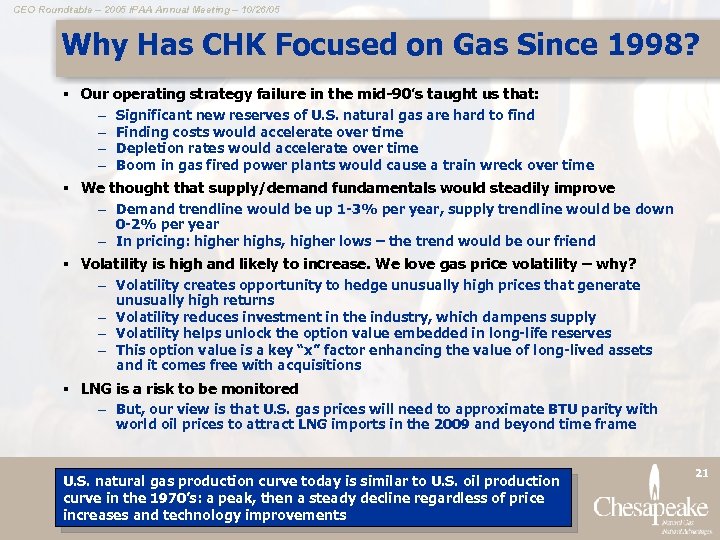
CEO Roundtable – 2005 IPAA Annual Meeting – 10/26/05 Why Has CHK Focused on Gas Since 1998? § Our operating strategy failure in the mid-90’s taught us that: – – Significant new reserves of U. S. natural gas are hard to find Finding costs would accelerate over time Depletion rates would accelerate over time Boom in gas fired power plants would cause a train wreck over time § We thought that supply/demand fundamentals would steadily improve – Demand trendline would be up 1 -3% per year, supply trendline would be down 0 -2% per year – In pricing: higher highs, higher lows – the trend would be our friend § Volatility is high and likely to increase. We love gas price volatility – why? – Volatility creates opportunity to hedge unusually high prices that generate unusually high returns – Volatility reduces investment in the industry, which dampens supply – Volatility helps unlock the option value embedded in long-life reserves – This option value is a key “x” factor enhancing the value of long-lived assets and it comes free with acquisitions § LNG is a risk to be monitored – But, our view is that U. S. gas prices will need to approximate BTU parity with world oil prices to attract LNG imports in the 2009 and beyond time frame U. S. natural gas production curve today is similar to U. S. oil production curve in the 1970’s: a peak, then a steady decline regardless of price increases and technology improvements 21
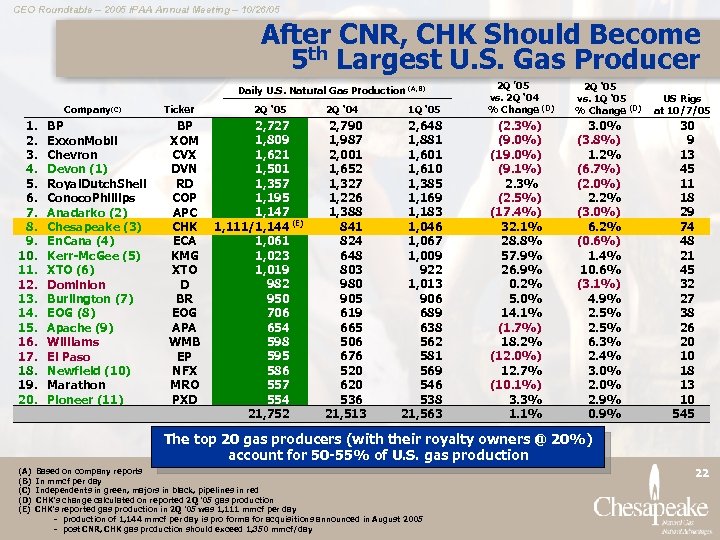
CEO Roundtable – 2005 IPAA Annual Meeting – 10/26/05 After CNR, CHK Should Become 5 th Largest U. S. Gas Producer Daily U. S. Natural Gas Production (A, B) Company(C) 1. 2. 3. 4. 5. 6. 7. 8. 9. 10. 11. 12. 13. 14. 15. 16. 17. 18. 19. 20. BP Exxon. Mobil Chevron Devon (1) Royal. Dutch. Shell Conoco. Phillips Anadarko (2) Chesapeake (3) En. Cana (4) Kerr-Mc. Gee (5) XTO (6) Dominion Burlington (7) EOG (8) Apache (9) Williams El Paso Newfield (10) Marathon Pioneer (11) Ticker BP XOM CVX DVN RD COP APC CHK ECA KMG XTO D BR EOG APA WMB EP NFX MRO PXD 2 Q ‘ 05 2, 727 1, 809 1, 621 1, 501 1, 357 1, 195 1, 147 1, 111/1, 144 (E) 1, 061 1, 023 1, 019 982 950 706 654 598 595 586 557 554 21, 752 2 Q ‘ 04 2, 790 1, 987 2, 001 1, 652 1, 327 1, 226 1, 388 841 824 648 803 980 905 619 665 506 676 520 620 536 21, 513 1 Q ‘ 05 2, 648 1, 881 1, 601 1, 610 1, 385 1, 169 1, 183 1, 046 1, 067 1, 009 922 1, 013 906 689 638 562 581 569 546 538 21, 563 2 Q ’ 05 vs. 2 Q ‘ 04 % Change (D) (2. 3%) (9. 0%) (19. 0%) (9. 1%) 2. 3% (2. 5%) (17. 4%) 32. 1% 28. 8% 57. 9% 26. 9% 0. 2% 5. 0% 14. 1% (1. 7%) 18. 2% (12. 0%) 12. 7% (10. 1%) 3. 3% 1. 1% 2 Q ‘ 05 vs. 1 Q ‘ 05 % Change (D) 3. 0% (3. 8%) 1. 2% (6. 7%) (2. 0%) 2. 2% (3. 0%) 6. 2% (0. 6%) 1. 4% 10. 6% (3. 1%) 4. 9% 2. 5% 6. 3% 2. 4% 3. 0% 2. 9% 0. 9% US Rigs at 10/7/05 30 9 13 45 11 18 29 74 48 21 45 32 27 38 26 20 10 18 13 10 545 The top 20 gas producers (with their royalty owners @ 20%) account for 50 -55% of U. S. gas production (A) (B) (C) (D) (E) Based on company reports In mmcf per day Independents in green, majors in black, pipelines in red CHK’s change calculated on reported 2 Q ’ 05 gas production CHK’s reported gas production in 2 Q ’ 05 was 1, 111 mmcf per day - production of 1, 144 mmcf per day is pro forma for acquisitions announced in August 2005 - post CNR, CHK gas production should exceed 1, 350 mmcf/day 22
CEO Roundtable – 2005 IPAA Annual Meeting – 10/26/05 Financial Information 23
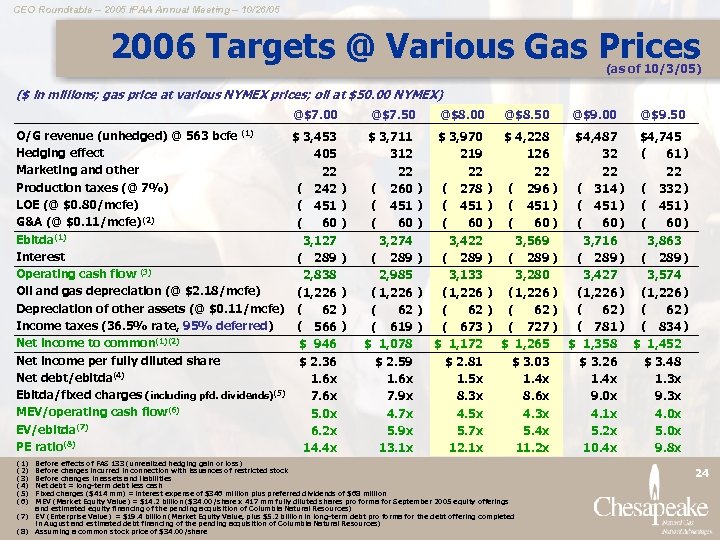
CEO Roundtable – 2005 IPAA Annual Meeting – 10/26/05 2006 Targets @ Various Gas Prices (as of 10/3/05) ($ in millions; gas price at various NYMEX prices; oil at $50. 00 NYMEX) @$7. 00 O/G revenue (unhedged) @ 563 bcfe (1) Hedging effect Marketing and other Production taxes (@ 7%) LOE (@ $0. 80/mcfe) G&A (@ $0. 11/mcfe)(2) Ebitda(1) Interest Operating cash flow (3) Oil and gas depreciation (@ $2. 18/mcfe) Depreciation of other assets (@ $0. 11/mcfe) Income taxes (36. 5% rate, 95% deferred) Net income to common(1)(2) Net income per fully diluted share Net debt/ebitda(4) Ebitda/fixed charges (including pfd. dividends)(5) MEV/operating cash flow(6) EV/ebitda(7) PE ratio(8) (1) (2) (3) (4) (5) (6) (7) (8) @$7. 50 @$8. 00 $ 3, 453 405 22 ( 242 ( 451 ( 60 3, 127 ( 289 2, 838 ( 1, 226 ( 62 ( 566 $ 946 $ 2. 36 1. 6 x 7. 6 x 5. 0 x 6. 2 x 14. 4 x $ 3, 711 312 22 ( 260 ( 451 ( 60 3, 274 ( 289 2, 985 ( 1, 226 62 ( ( 619 $ 1, 078 $ 2. 59 1. 6 x 7. 9 x 4. 7 x 5. 9 x 13. 1 x $ 3, 970 219 22 ( 278 ( 451 ( 60 3, 422 ( 289 3, 133 ( 1, 226 62 ( ( 673 $ 1, 172 $ 2. 81 1. 5 x 8. 3 x 4. 5 x 5. 7 x 12. 1 x ) ) ) ) @$8. 50 ) ) ) ) $ 4, 228 126 22 ( 296 ) ( 451 ) @$9. 00 $4, 487 32 22 ( 314 ) ( 451 ) @$9. 50 $4, 745 ( 61 ) 22 ( 332 ) ( 451 ) ( ( 60 ) 3, 569 3, 716 3, 863 ( 289 ) 3, 280 3, 427 3, 574 ( 1, 226 ) ( 62 ) ( ( 781 ) ( 834 ) ( 727 ) $ 1, 265 $ 1, 358 $ 1, 452 $ 3. 03 $ 3. 26 $ 3. 48 1. 4 x 1. 3 x 8. 6 x 9. 0 x 9. 3 x 4. 1 x 4. 0 x 5. 4 x 5. 2 x 5. 0 x 11. 2 x 10. 4 x 9. 8 x Before effects of FAS 133 (unrealized hedging gain or loss) Before charges incurred in connection with issuances of restricted stock Before changes in assets and liabilities Net debt = long-term debt less cash Fixed charges ($414 mm) = interest expense of $346 million plus preferred dividends of $68 million MEV (Market Equity Value) = $14. 2 billion ($34. 00/share x 417 mm fully diluted shares pro forma for September 2005 equity offerings and estimated equity financing of the pending acquisition of Columbia Natural Resources) EV (Enterprise Value) = $19. 4 billion (Market Equity Value, plus $5. 2 billion in long-term debt pro forma for the debt offering completed in August and estimated debt financing of the pending acquisition of Columbia Natural Resources) Assuming a common stock price of $34. 00/share 24
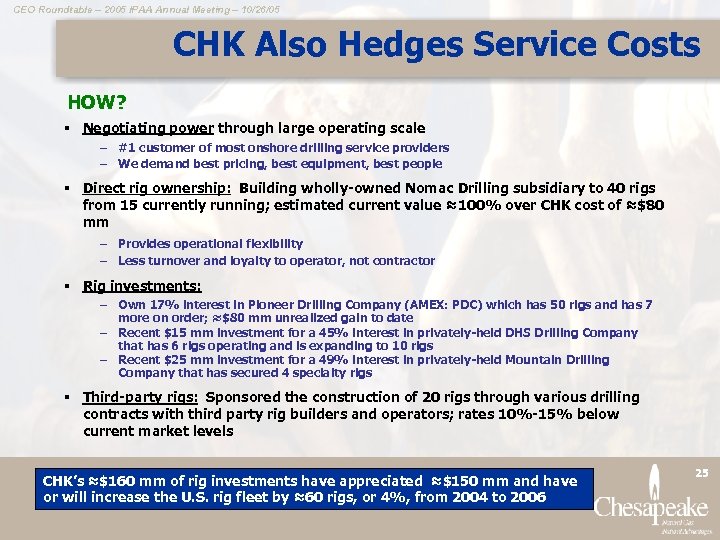
CEO Roundtable – 2005 IPAA Annual Meeting – 10/26/05 CHK Also Hedges Service Costs HOW? § Negotiating power through large operating scale – #1 customer of most onshore drilling service providers – We demand best pricing, best equipment, best people § Direct rig ownership: Building wholly-owned Nomac Drilling subsidiary to 40 rigs from 15 currently running; estimated current value ≈100% over CHK cost of ≈$80 mm – Provides operational flexibility – Less turnover and loyalty to operator, not contractor § Rig investments: – Own 17% interest in Pioneer Drilling Company (AMEX: PDC) which has 50 rigs and has 7 more on order; ≈$80 mm unrealized gain to date – Recent $15 mm investment for a 45% interest in privately-held DHS Drilling Company that has 6 rigs operating and is expanding to 10 rigs – Recent $25 mm investment for a 49% interest in privately-held Mountain Drilling Company that has secured 4 specialty rigs § Third-party rigs: Sponsored the construction of 20 rigs through various drilling contracts with third party rig builders and operators; rates 10%-15% below current market levels CHK’s ≈$160 mm of rig investments have appreciated ≈$150 mm and have or will increase the U. S. rig fleet by ≈60 rigs, or 4%, from 2004 to 2006 25
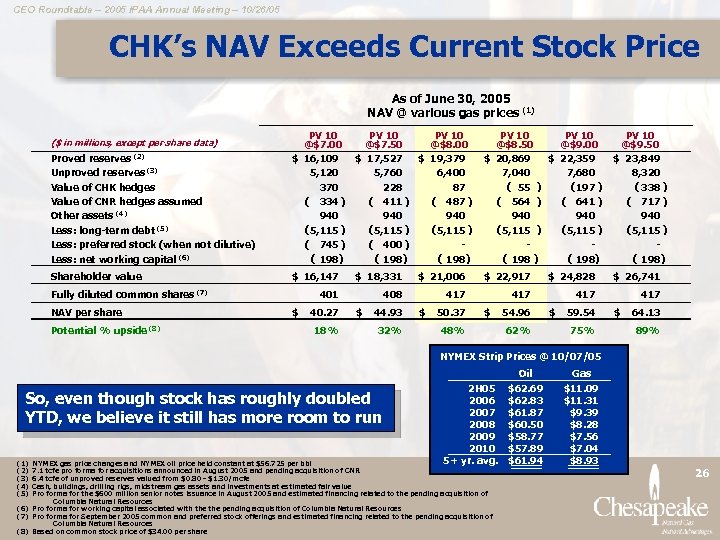
CEO Roundtable – 2005 IPAA Annual Meeting – 10/26/05 CHK’s NAV Exceeds Current Stock Price As of June 30, 2005 NAV @ various gas prices (1) Proved reserves (2) Unproved reserves (3) Value of CHK hedges Value of CNR hedges assumed Other assets (4) Less: long-term debt (5) Less: preferred stock (when not dilutive) Less: net working capital (6) PV 10 @$7. 00 @$7. 50 @$8. 00 $ 16, 109 $ 17, 527 $ 19, 379 5, 120 5, 760 6, 400 370 228 87 ( 334 ) ( 411 ) ( 487 ) 940 940 ( 5, 115 ) ( 745 ) ( 400 ) ( 198 ) PV 10 @$8. 50 @$9. 00 $ 20, 869 $ 22, 359 7, 040 7, 680 ( 55 ) (197 ) ( 564 ) ( 641 ) 940 ( 5, 115 ) ( 198 ) PV 10 @$9. 50 $ 23, 849 8, 320 ( 338 ) ( 717 ) 940 ( 5, 115 ) ( 198 ) Shareholder value $ 16, 147 $ 18, 331 $ 21, 006 $ 22, 917 $ 24, 828 $ 26, 741 408 417 417 ($ in millions, except per share data) Fully diluted common shares (7) NAV per share Potential % upside (8) $ 40. 27 18% $ 44. 93 32% $ 50. 37 $ 48% 54. 96 62% $ 59. 54 75% $ 64. 13 89% NYMEX Strip Prices @ 10/07/05 Oil So, even though stock has roughly doubled YTD, we believe it still has more room to run (1) (2) (3) (4) (5) 2 H 05 2006 2007 2008 2009 2010 5+ yr. avg. NYMEX gas price changes and NYMEX oil price held constant at $56. 725 per bbl 7. 1 tcfe pro forma for acquisitions announced in August 2005 and pending acquisition of CNR 6. 4 tcfe of unproved reserves valued from $0. 80 - $1. 30/mcfe Cash, buildings, drilling rigs, midstream gas assets and investments at estimated fair value Pro forma for the $600 million senior notes issuance in August 2005 and estimated financing related to the pending acquisition of Columbia Natural Resources (6) Pro forma for working capital associated with the pending acquisition of Columbia Natural Resources (7) Pro forma for September 2005 common and preferred stock offerings and estimated financing related to the pending acquisition of Columbia Natural Resources (8) Based on common stock price of $34. 00 per share Gas $62. 69 $62. 83 $61. 87 $60. 50 $58. 77 $57. 89 $61. 94 $11. 09 $11. 31 $9. 39 $8. 28 $7. 56 $7. 04 $8. 93 26
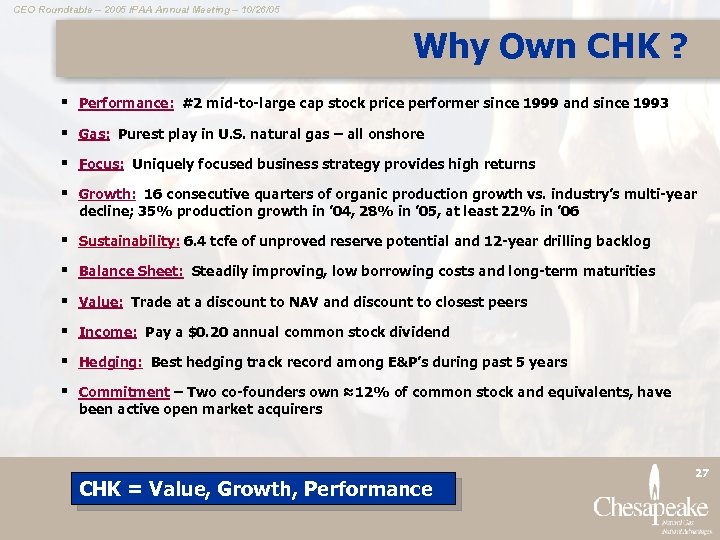
CEO Roundtable – 2005 IPAA Annual Meeting – 10/26/05 Why Own CHK ? § Performance: #2 mid-to-large cap stock price performer since 1999 and since 1993 § Gas: Purest play in U. S. natural gas – all onshore § Focus: Uniquely focused business strategy provides high returns § Growth: 16 consecutive quarters of organic production growth vs. industry’s multi-year decline; 35% production growth in ’ 04, 28% in ’ 05, at least 22% in ’ 06 § Sustainability: 6. 4 tcfe of unproved reserve potential and 12 -year drilling backlog § Balance Sheet: Steadily improving, low borrowing costs and long-term maturities § Value: Trade at a discount to NAV and discount to closest peers § Income: Pay a $0. 20 annual common stock dividend § Hedging: Best hedging track record among E&P’s during past 5 years § Commitment – Two co-founders own ≈12% of common stock and equivalents, have been active open market acquirers CHK = Value, Growth, Performance 27

CEO Roundtable – 2005 IPAA Annual Meeting – 10/26/05 Gas Market Thoughts 28
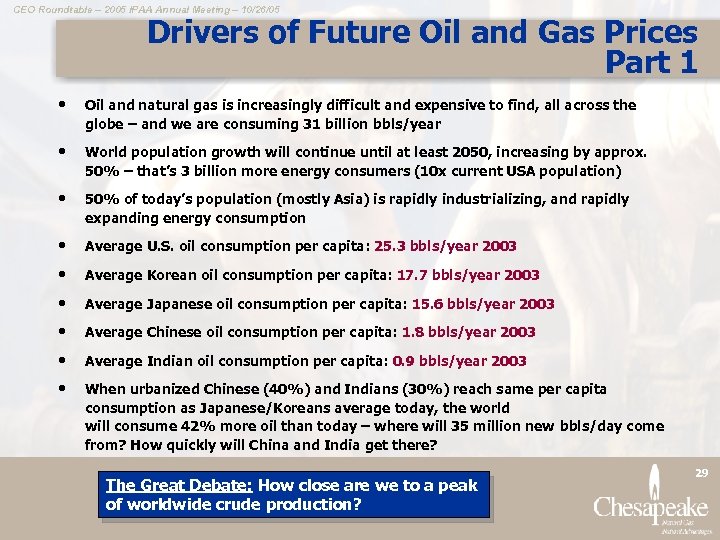
CEO Roundtable – 2005 IPAA Annual Meeting – 10/26/05 Drivers of Future Oil and Gas Prices Part 1 • Oil and natural gas is increasingly difficult and expensive to find, all across the globe – and we are consuming 31 billion bbls/year • World population growth will continue until at least 2050, increasing by approx. 50% – that’s 3 billion more energy consumers (10 x current USA population) • 50% of today’s population (mostly Asia) is rapidly industrializing, and rapidly expanding energy consumption • Average U. S. oil consumption per capita: 25. 3 bbls/year 2003 • Average Korean oil consumption per capita: 17. 7 bbls/year 2003 • Average Japanese oil consumption per capita: 15. 6 bbls/year 2003 • Average Chinese oil consumption per capita: 1. 8 bbls/year 2003 • Average Indian oil consumption per capita: 0. 9 bbls/year 2003 • When urbanized Chinese (40%) and Indians (30%) reach same per capita consumption as Japanese/Koreans average today, the world will consume 42% more oil than today – where will 35 million new bbls/day come from? How quickly will China and India get there? The Great Debate: How close are we to a peak of worldwide crude production? 29
CEO Roundtable – 2005 IPAA Annual Meeting – 10/26/05 Drivers of Future Oil and Gas Prices Part II • In addition to Asia, the U. S. and others will also continue to grow – remember, the U. S. adds the equivalent of a new Texas every 7 -8 years in population and energy demand • Despite the obvious need for massive new resources of oil and natural gas, futures markets and most investors/analysts believe that lower oil and gas prices are inevitable – although this is changing before our eyes • Why so much denial of what appear to be easily visible trends? – – • Bush’s inaugural “Freedom from Tyranny” policy is bullish for energy prices – – • Energy has not been expensive for 20 years (almost half of U. S. population has never known anything other than cheap energy) It’s inconvenient to think about the implications of energy prices – every thing you own and do today is predicated on cheap energy Policies favoring cheap energy and a pristine environment are often in conflict Technology will save us – maybe, but much higher prices will be needed to drive the needed increases in energy technology investment If he’s right, strong demand increases will overwhelm supply increases If he’s wrong, supply will be at risk for a long time Hurricane Katrina demonstrates the folly of putting too many of our energy infrastructure eggs in one (very fragile) basket And finally, when will peace, love and harmony break out in oil producing regions of the world? 30
CEO Roundtable – 2005 IPAA Annual Meeting – 10/26/05 Other Questions to Ponder • Can LNG gas supply accretion (from a 2. 5 bcf/day base in ‘ 05) overcome continuing U. S. /Canada gas supply depletion (from a 70 bcf/day current base)? • • Will all (or enough) spot cargoes of LNG come to the U. S. and at what price? • When will we build gas pipeline from Mc. Kenzie Delta Alaska? How much of the Mc. Kenzie gas gets past Canadian oil sands projects? Should Alaska gas be liquefied instead? • What happens if energy demand in India and China (40% of the world’s population) increases by 35 million bbls/day in next 15 years? • How will U. S. resolve its public policy conflicts between cheap energy vs. a pristine environment? • • Will world oil production peak? When? ’ 05, ’ 10, ’ 15? • How high do oil/natural gas prices have to rise to cut short economic growth/induce conservation/curb demand? • How will Iraq and Iran play out and what happens if (or when? ) House of Saud falls? Will LNG importers have financial motivation to undercut U. S. gas prices at the moment of importation? After an oil production peak, how much stranded gas becomes converted to liquids rather than to LNG? At what prices for oil and gas are you willing to change your consumption habits? 31
CEO Roundtable – 2005 IPAA Annual Meeting – 10/26/05 Corporate Information Chesapeake Headquarters 6100 N. Western Avenue Oklahoma City, OK 73118 Contacts: Jeffrey L. Mobley, CFA Vice President – Investor Relations and Research (405) 767 -4763 jmobley@chkenergy. com Web site: www. chkenergy. com Common Stock – NYSE: CHK Other Publicly Traded Securities 6. 0% Convertible Preferred Stock 5. 0% Convertible Preferred Stock (2003 Series) 4. 125% Convertible Preferred Stock 5. 0% Convertible Preferred Stock (2005 Series) 4. 5% Convertible Preferred Stock 8. 375% Senior Notes Due 2008 7. 5% Senior Notes Due 2013 7. 5% Senior Notes Due 2014 7. 0% Senior Notes Due 2014 7. 75% Senior Notes Due 2015 6. 875% Senior Notes Due 2016 6. 375% Senior Notes Due 2015 6. 625% Senior Notes Due 2016 6. 50% Senior Notes Due 2017 6. 25% Senior Notes Due 2018 CUSIP #165167701 #165167800 #165167875 #165167859 #165167842 #165167 AV 9 #165167 BC 0 #165167 BF 3 #165167 BJ 5 #165167 BA 4 #165167 BE 6 #165167 BL 0 #165167 BN 6 #165167 BR 7 #165167 BQ 9 Ticker CHKPr. A CHKPr. B n/a pending CHK 08 CHK 13 CHK 14 CHKA 14 CHK 15 CHK 16 CHKJ 15 CHKJ 16 pending CHK 18 Marcus C. Rowland Executive Vice President and Chief Financial Officer (405) 879 -9232 mrowland@chkenergy. com 32
CEO Roundtable – 2005 IPAA Annual Meeting – 10/26/05 Forward-Looking Statements This report includes “forward-looking statements” within the meaning of Section 27 A of the Securities Act of 1933 and Section 21 E of the Securities Exchange Act of 1934. Forward-looking statements give our current expectations or forecasts of future events. They include estimates of oil and gas reserves, expected oil and gas production and future expenses, projections of future oil and gas prices, planned capital expenditures for drilling, leasehold acquisitions and seismic data, and statements concerning anticipated cash flow and liquidity, our business strategy and other plans and objectives for future operations, including our acquisition of Columbia Natural Resources, LLC. and related financings. In addition, statements concerning the fair value of derivative contracts and their estimated contribution to our future results of operations are based upon market information as of a specific date. These market prices are subject to significant volatility. Although we believe the expectations and forecasts reflected in these and other forward-looking statements are reasonable, we can give no assurance they will prove to have been correct. They can be affected by inaccurate assumptions or by known or unknown risks and uncertainties. Factors that could cause actual results to differ materially from expected results are described under “Risk Factors” beginning on page S-13 of the Prospectus Supplement dated September 8, 2005 for our offering of 4. 50% Convertible Preferred Stock we filed with the Securities and Exchange Commission on September 9, 2005. They include the volatility of oil and gas prices, adverse effects our substantial indebtedness and preferred stock obligations could have on our operations and future growth and on our ability to make debt service and preferred stock dividend payments as they become due, our ability to compete effectively against strong independent oil and gas companies and majors, the availability of capital on an economic basis to fund reserve replacement costs, uncertainties inherent in estimating quantities of oil and gas reserves and projecting future rates of production and the timing of development expenditures, our ability to replace reserves and sustain production, uncertainties in evaluating oil and gas reserves of acquired properties and associated potential liabilities, unsuccessful exploration and development drilling, declines in the values of our oil and gas properties resulting in ceiling test write-downs, lower prices realized on oil and gas sales and collateral required to secure hedging liabilities resulting from our commodity price risk management activities, drilling and operating risks, and the loss of key personnel. In addition, the CNR acquisition is subject to conditions which must be satisfied before closing. We caution you not to place undue reliance on these forward-looking statements, which speak only as of the date of this presentation, and we undertake no obligation to update this information. We urge you to carefully review and consider the disclosures made in this presentation and our filings with the Securities and Exchange Commission that attempt to advise interested parties of the risks and factors that may affect our business. 33
Скачать презентацию CEO Roundtable 2005 IPAA Annual Meeting
07aa1e61cd2fc353f2de8fef0c4a7cdf.ppt