 Скачать презентацию Centro de Estudos do Ambiente e do Mar
8b6f7f75e72f595da02c2c053d31bd0a.ppt
- Количество слайдов: 17



Centro de Estudos do Ambiente e do Mar Laboratório Associado |www. cesam. ua. pt CESAM Traceability of marine products through a microbiological ID Ricardo Calado Newton Gomes Dourada de Aquacultura da Ria de Aveiro
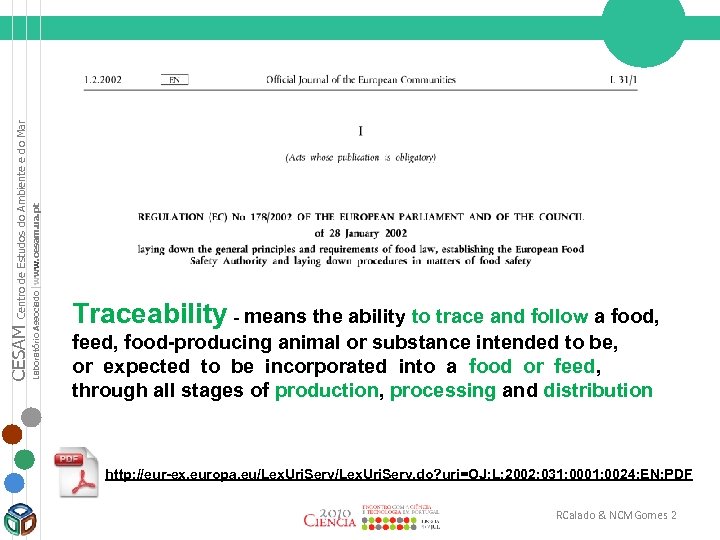
Centro de Estudos do Ambiente e do Mar Laboratório Associado |www. cesam. ua. pt CESAM Traceability - means the ability to trace and follow a food, feed, food-producing animal or substance intended to be, or expected to be incorporated into a food or feed, through all stages of production, processing and distribution http: //eur-ex. europa. eu/Lex. Uri. Serv. do? uri=OJ: L: 2002: 031: 0001: 0024: EN: PDF RCalado & NCMGomes 2
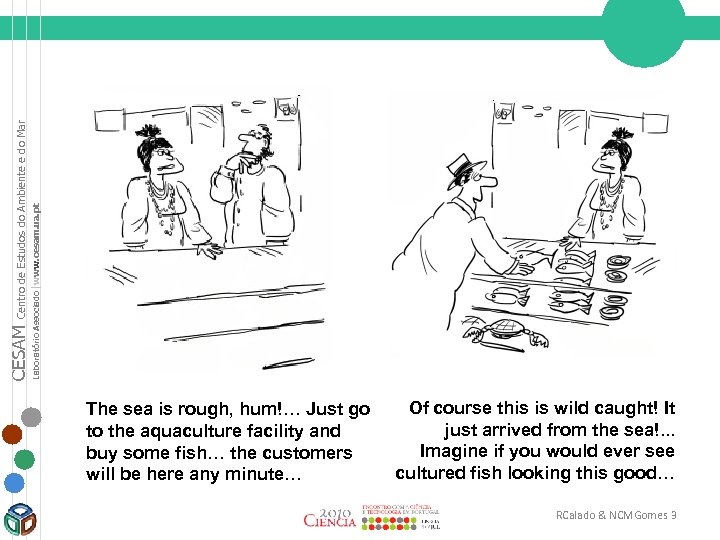
Centro de Estudos do Ambiente e do Mar CESAM Laboratório Associado |www. cesam. ua. pt The sea is rough, hum!… Just go to the aquaculture facility and buy some fish… the customers will be here any minute… Of course this is wild caught! It just arrived from the sea!. . . Imagine if you would ever see cultured fish looking this good… RCalado & NCMGomes 3
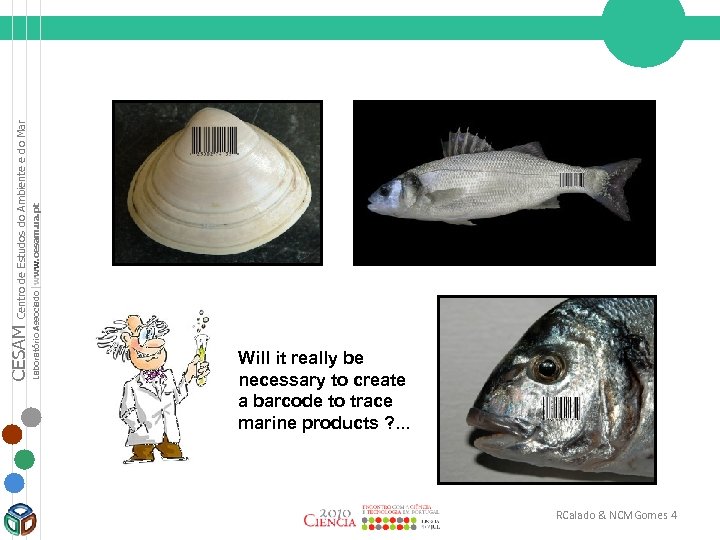
Centro de Estudos do Ambiente e do Mar Laboratório Associado |www. cesam. ua. pt CESAM Will it really be necessary to create a barcode to trace marine products ? . . . RCalado & NCMGomes 4
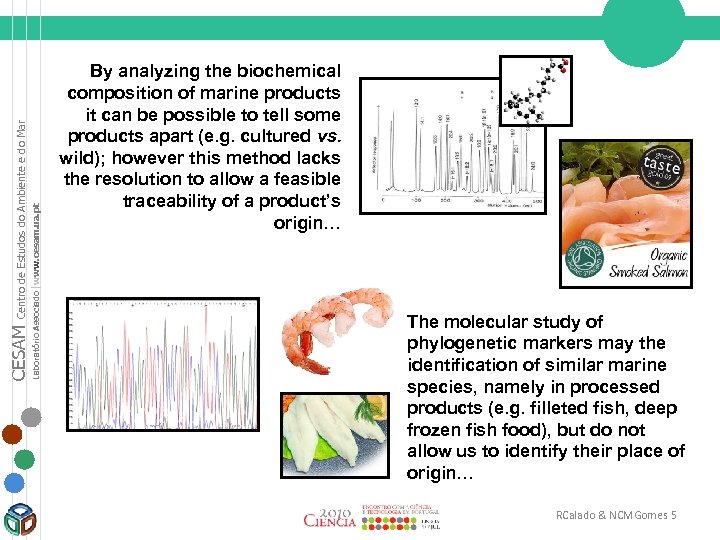
Centro de Estudos do Ambiente e do Mar Laboratório Associado |www. cesam. ua. pt CESAM By analyzing the biochemical composition of marine products it can be possible to tell some products apart (e. g. cultured vs. wild); however this method lacks the resolution to allow a feasible traceability of a product’s origin… The molecular study of phylogenetic markers may the identification of similar marine species, namely in processed products (e. g. filleted fish, deep frozen fish food), but do not allow us to identify their place of origin… RCalado & NCMGomes 5
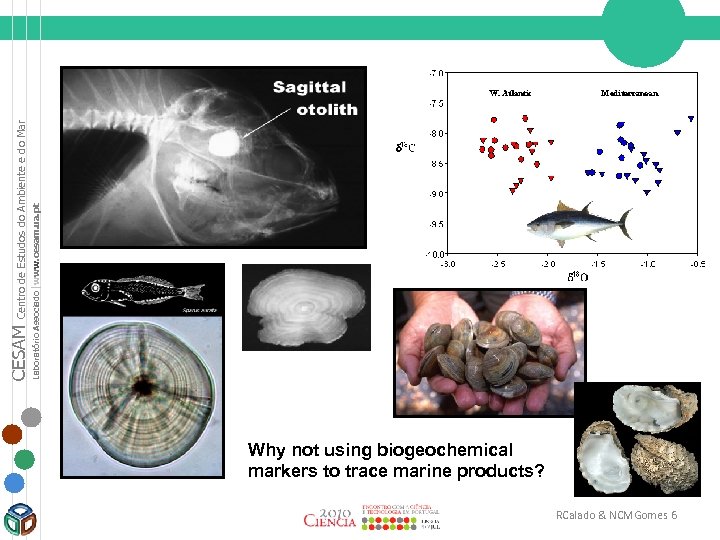
Centro de Estudos do Ambiente e do Mar CESAM Laboratório Associado |www. cesam. ua. pt Why not using biogeochemical markers to trace marine products? RCalado & NCMGomes 6
Centro de Estudos do Ambiente e do Mar Laboratório Associado |www. cesam. ua. pt CESAM The use of biogeochemical markers requires the seasonal, or at least the annual, calibration of a “signature matrix” from each location… This “issue” is more relevant in regions exposed to the “chemical contamination” of surrounding areas – e. g. estuaries and coastal lagoons. RCalado & NCMGomes 7
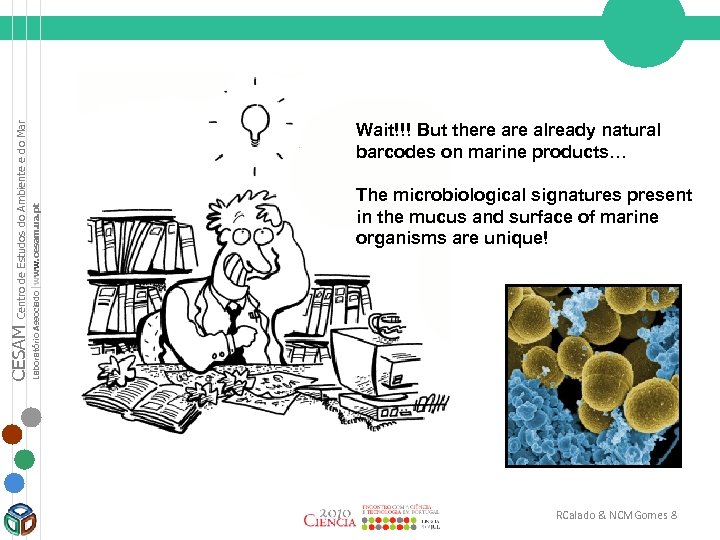
Centro de Estudos do Ambiente e do Mar Laboratório Associado |www. cesam. ua. pt CESAM Wait!!! But there already natural barcodes on marine products… The microbiological signatures present in the mucus and surface of marine organisms are unique! RCalado & NCMGomes 8
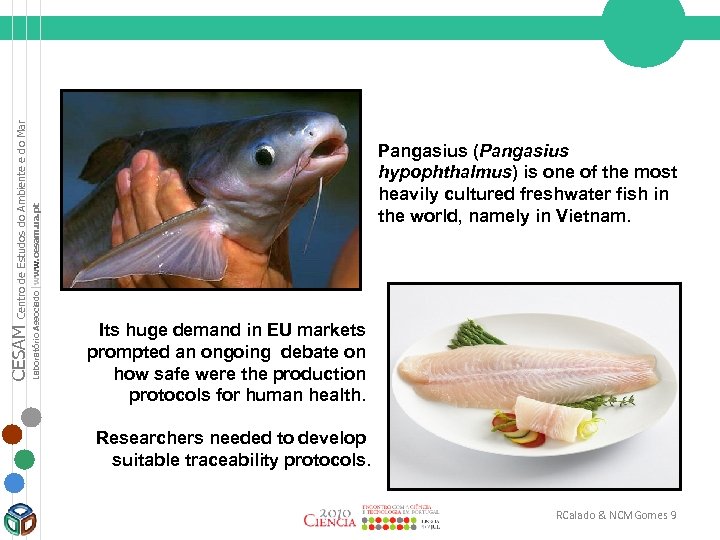
Centro de Estudos do Ambiente e do Mar Laboratório Associado |www. cesam. ua. pt CESAM Pangasius (Pangasius hypophthalmus) is one of the most heavily cultured freshwater fish in the world, namely in Vietnam. Its huge demand in EU markets prompted an ongoing debate on how safe were the production protocols for human health. Researchers needed to develop suitable traceability protocols. RCalado & NCMGomes 9
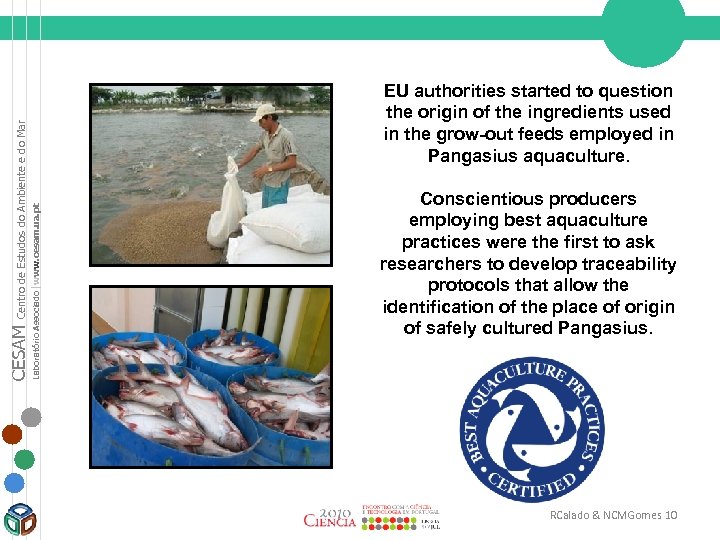
Centro de Estudos do Ambiente e do Mar Laboratório Associado |www. cesam. ua. pt CESAM EU authorities started to question the origin of the ingredients used in the grow-out feeds employed in Pangasius aquaculture. Conscientious producers employing best aquaculture practices were the first to ask researchers to develop traceability protocols that allow the identification of the place of origin of safely cultured Pangasius. RCalado & NCMGomes 10
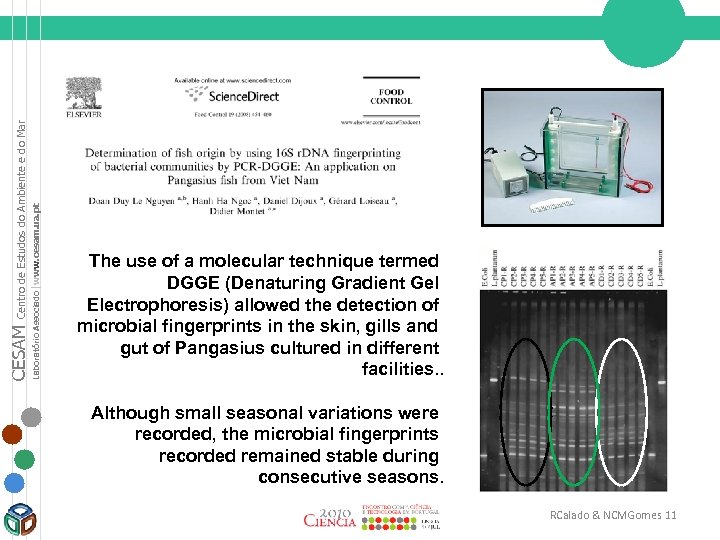
Centro de Estudos do Ambiente e do Mar Laboratório Associado |www. cesam. ua. pt CESAM The use of a molecular technique termed DGGE (Denaturing Gradient Gel Electrophoresis) allowed the detection of microbial fingerprints in the skin, gills and gut of Pangasius cultured in different facilities. . Although small seasonal variations were recorded, the microbial fingerprints recorded remained stable during consecutive seasons. RCalado & NCMGomes 11
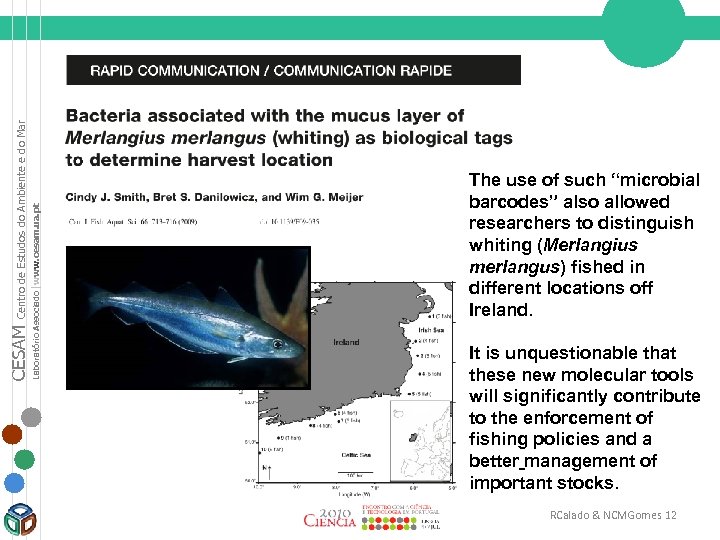
Centro de Estudos do Ambiente e do Mar Laboratório Associado |www. cesam. ua. pt CESAM The use of such “microbial barcodes” also allowed researchers to distinguish whiting (Merlangius merlangus) fished in different locations off Ireland. It is unquestionable that these new molecular tools will significantly contribute to the enforcement of fishing policies and a better management of important stocks. RCalado & NCMGomes 12
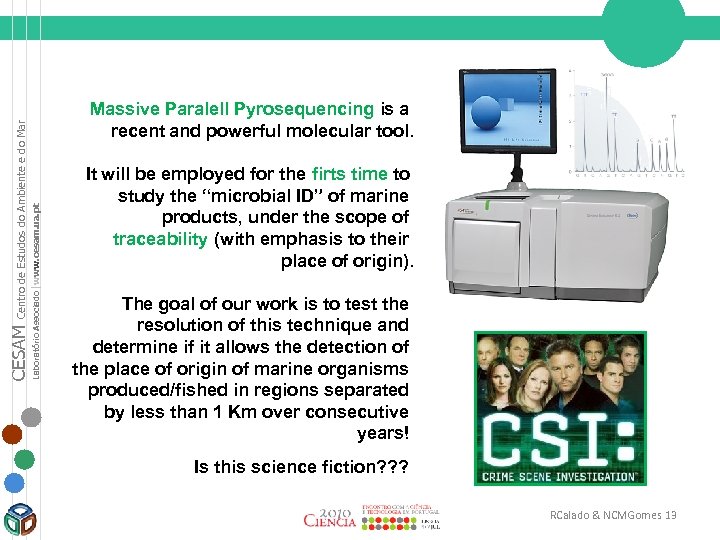
Centro de Estudos do Ambiente e do Mar Laboratório Associado |www. cesam. ua. pt CESAM Massive Paralell Pyrosequencing is a recent and powerful molecular tool. It will be employed for the firts time to study the “microbial ID” of marine products, under the scope of traceability (with emphasis to their place of origin). The goal of our work is to test the resolution of this technique and determine if it allows the detection of the place of origin of marine organisms produced/fished in regions separated by less than 1 Km over consecutive years! Is this science fiction? ? ? RCalado & NCMGomes 13
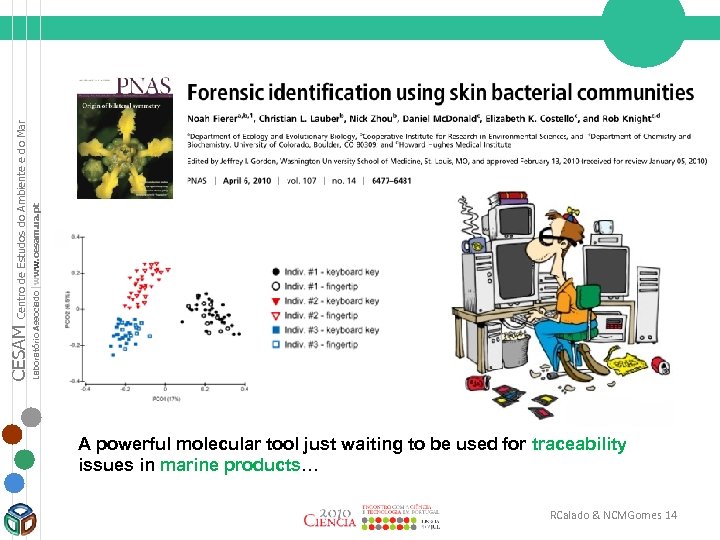
Centro de Estudos do Ambiente e do Mar CESAM Laboratório Associado |www. cesam. ua. pt A powerful molecular tool just waiting to be used for traceability issues in marine products… RCalado & NCMGomes 14
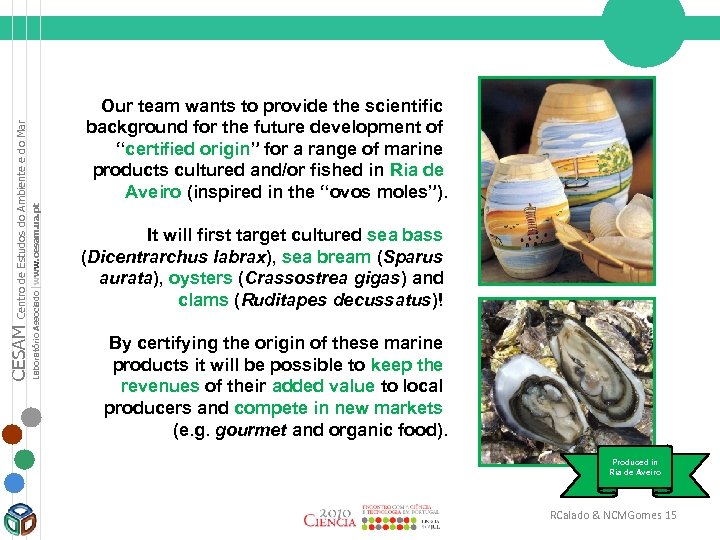
Centro de Estudos do Ambiente e do Mar Laboratório Associado |www. cesam. ua. pt CESAM Our team wants to provide the scientific background for the future development of “certified origin” for a range of marine products cultured and/or fished in Ria de Aveiro (inspired in the “ovos moles”). It will first target cultured sea bass (Dicentrarchus labrax), sea bream (Sparus aurata), oysters (Crassostrea gigas) and clams (Ruditapes decussatus)! By certifying the origin of these marine products it will be possible to keep the revenues of their added value to local producers and compete in new markets (e. g. gourmet and organic food). Produced in Ria de Aveiro RCalado & NCMGomes 15
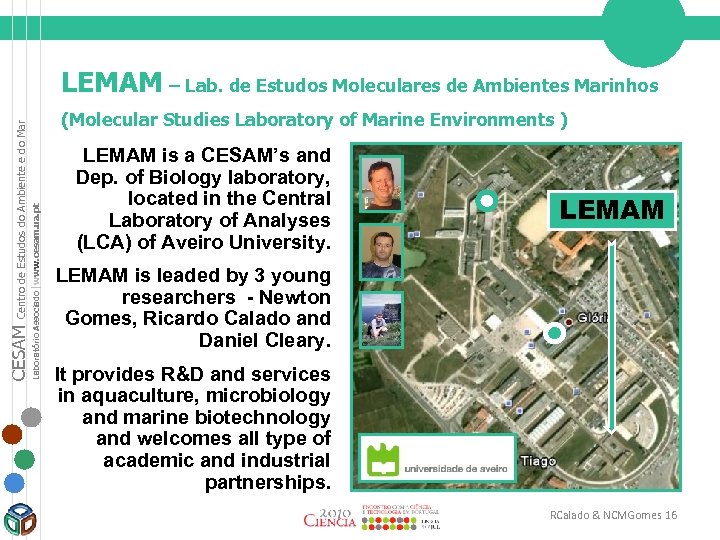
(Molecular Studies Laboratory of Marine Environments ) Laboratório Associado |www. cesam. ua. pt CESAM Centro de Estudos do Ambiente e do Mar LEMAM – Lab. de Estudos Moleculares de Ambientes Marinhos LEMAM is a CESAM’s and Dep. of Biology laboratory, located in the Central Laboratory of Analyses (LCA) of Aveiro University. LEMAM is leaded by 3 young researchers - Newton Gomes, Ricardo Calado and Daniel Cleary. It provides R&D and services in aquaculture, microbiology and marine biotechnology and welcomes all type of academic and industrial partnerships. RCalado & NCMGomes 16
Thank you for your attention!
Скачать презентацию Centro de Estudos do Ambiente e do Mar
8b6f7f75e72f595da02c2c053d31bd0a.ppt