 Скачать презентацию Centre for Sustainable Development and Management of the
ee0875e7ceaaaacf45e737138a2bda96.ppt
- Количество слайдов: 14



Centre for Sustainable Development and Management of the Black Sea Region CESUM–BS “Centers of Excellence” INCO, 5 FP Contract N ICA 1 - BULGARIAN ACADEMY OF SCIENCES Institute of Oceanology Consultants Institute of Sociology Institute of Economics Institute of Inorganic Chemistry
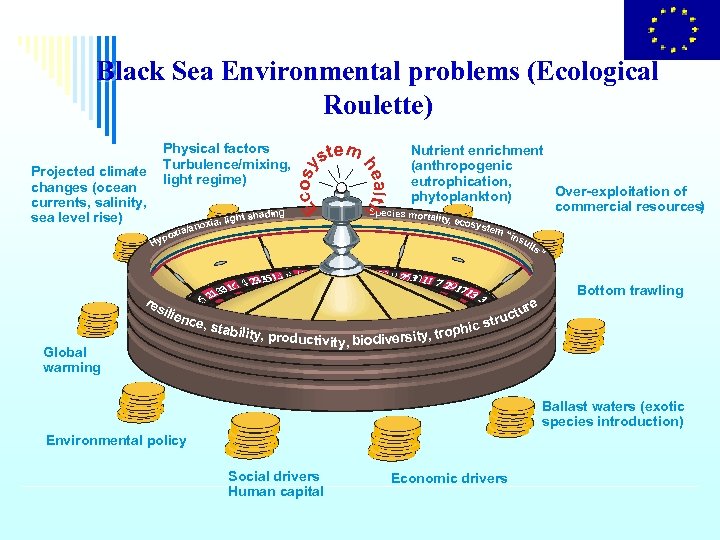
Black Sea Environmental problems (Ecological Roulette) H Global warming ia/an pox y Nutrient enrichment (anthropogenic eutrophication, Over-exploitation of phytoplankton) commercial resources ) Species m alth o Ec s y stem he Physical factors Turbulence/mixing, Projected climate light regime) changes (ocean currents, salinity, ading sea level rise) light sh oxia, ortality, e cosys tem “in su lts ” re sili ure enc uct e, sta ic str bility, pro , troph ductivity, biodiversity Bottom trawling Ballast waters (exotic species introduction) Environmental policy Social drivers Human capital Economic drivers
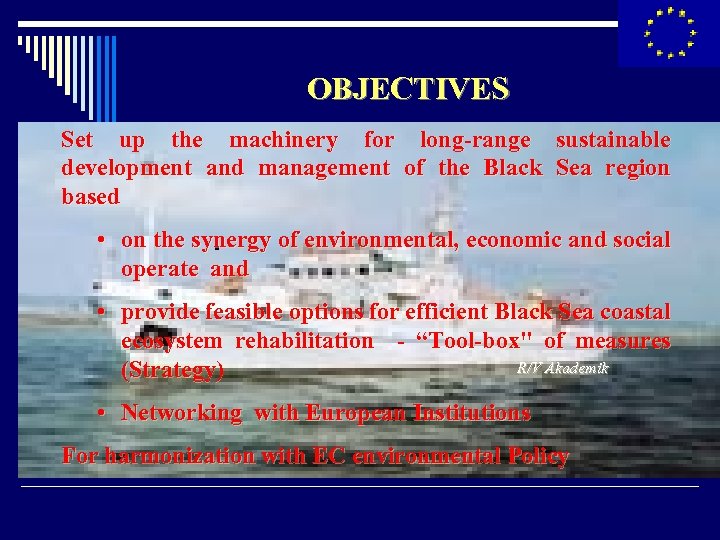
OBJECTIVES Set up the machinery for long-range sustainable development and management of the Black Sea region based • on the synergy of environmental, economic and social operate and • provide feasible options for efficient Black Sea coastal ecosystem rehabilitation - “Tool-box" of measures R/V Akademik (Strategy) • Networking with European Institutions For harmonization with EC environmental Policy
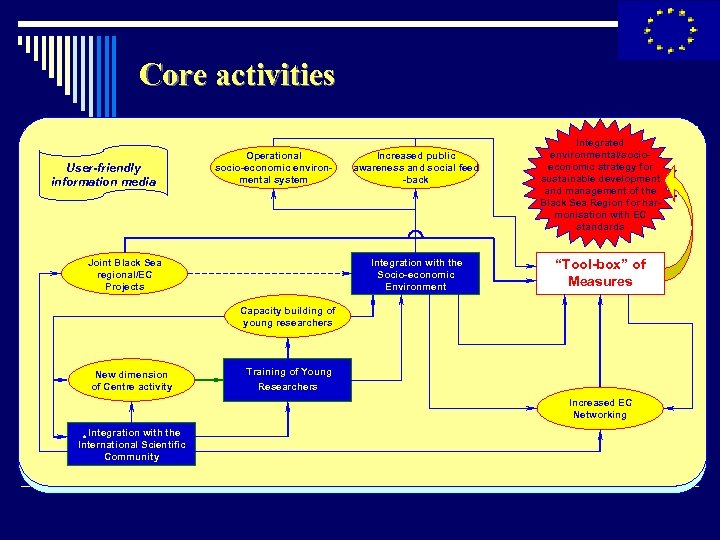
Core activities User-friendly information media interface Operational socio-economic environmental system Joint Black Sea regional/EC Projects Increased public awareness and social feed -back Integration with the Socio-economic Environment Integrated environmental/socioeconomic strategy for sustainable development and management of the Black Sea Region for harmonisation with EC standards “Tool-box” of Measures Capacity building of young researchers New dimension of Centre activity Training of Young Researchers Increased EC Networking . Integration with the International Scientific Community
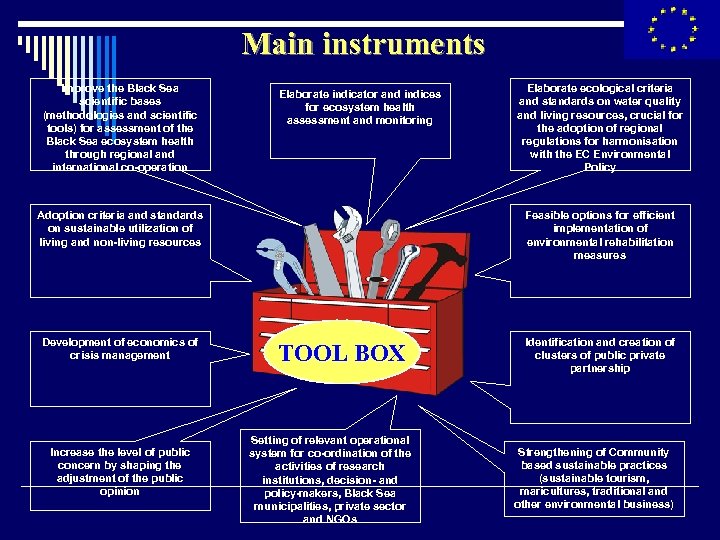
Main instruments Improve the Black Sea scientific bases (methodologies and scientific tools) for assessment of the Black Sea ecosystem health through regional and international co-operation Elaborate indicator and indices for ecosystem health assessment and monitoring Elaborate ecological criteria and standards on water quality and living resources, crucial for the adoption of regional regulations for harmonisation with the EC Environmental Policy Adoption criteria and standards on sustainable utilization of living and non-living resources Feasible options for efficient implementation of environmental rehabilitation measures Development of economics of crisis management Identification and creation of clusters of public private partnership Increase the level of public concern by shaping the adjustment of the public opinion TOOL BOX Setting of relevant operational system for co-ordination of the activities of research institutions, decision- and policy-makers, Black Sea municipalities, private sector and NGOs Strengthening of Community based sustainable practices (sustainable tourism, maricultures, traditional and other environmental business)
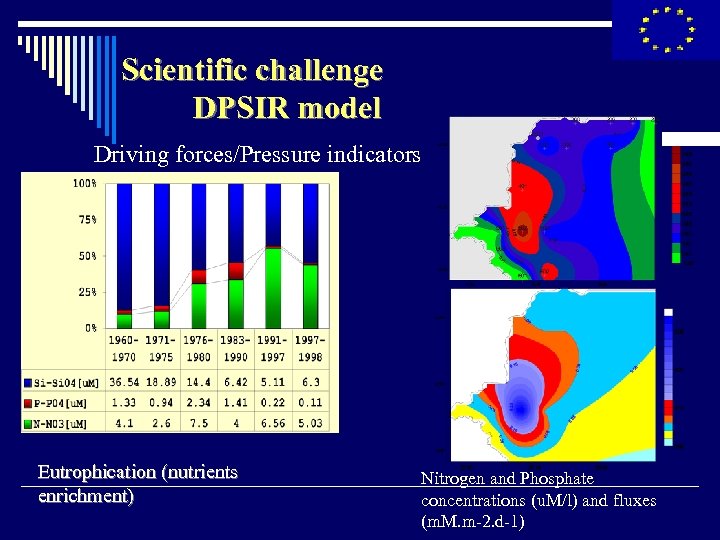
Scientific challenge DPSIR model Driving forces/Pressure indicators Eutrophication (nutrients enrichment) Nitrogen and Phosphate concentrations (u. M/l) and fluxes (m. M. m-2. d-1)
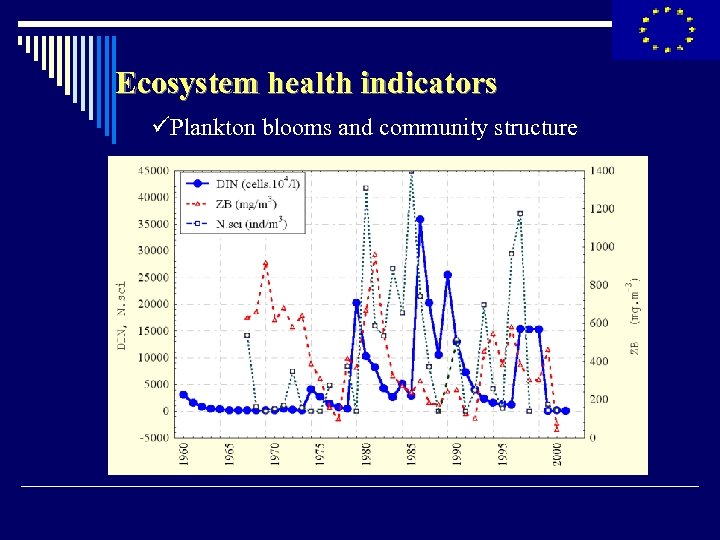
Ecosystem health indicators üPlankton blooms and community structure
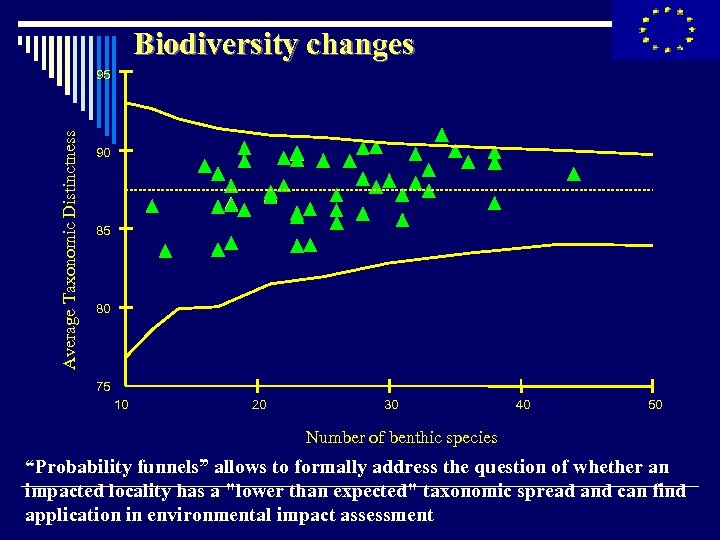
Biodiversity changes Average Taxonomic Distinctness 95 90 85 80 75 10 20 30 40 50 Number of benthic species “Probability funnels” allows to formally address the question of whether an impacted locality has a "lower than expected" taxonomic spread and can find application in environmental impact assessment
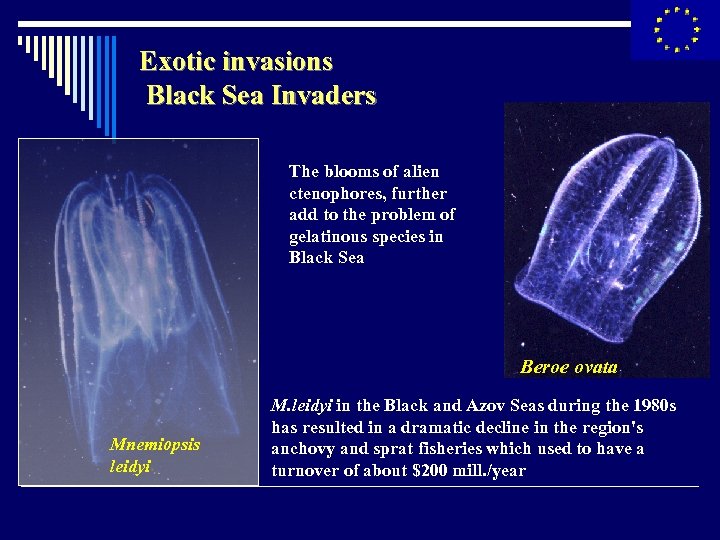
Exotic invasions Black Sea Invaders The blooms of alien ctenophores, further add to the problem of gelatinous species in Black Sea Beroe ovata Mnemiopsis leidyi M. leidyi in the Black and Azov Seas during the 1980 s has resulted in a dramatic decline in the region's anchovy and sprat fisheries which used to have a turnover of about $200 mill. /year
ONGOING PROJECTS-5 th FP o o o o Caspian Scientific Network (CASPSCIENCE – NET) Contract no: ICA 2 -CT-2000 -10054 European Catchments – (EUROCAT) Catchment changes and their impact on the coast Proposal no: EVK 1 -2002 -00549 Pan-European Network For Ocean & Marine Data and Information Management (SEASEARCH) Proposal no: EVR 1 -2001 -00052 European Seismic Metadata and Information Centre –NAS (EUROSEISMIC-NAS) Proposal No. EVR 1 -2000 -00519 Creating a long-term infrastructure for marine biodiversity research in the European Economic Area and the Newly Associated States (MARBENA) Proposal no: EVK 3 -2001 -00177 Implementation and networking of large scale long term Marine Biodiversity research in Europe (BIOMARE) Hindcast of Dynamic Processes of the Ocean and Coastal Areas of Europe - New Associated Countries (HIPOCAS-NAS) A Regional Capacity Building and Networking Programme to Upgrade Monitoring and Forecasting Activity in the Black Sea Basin (ARENA) Assessment of the Black Sea sedimentary system since the Last Glacial Extreme (ASSEMBLAGE)
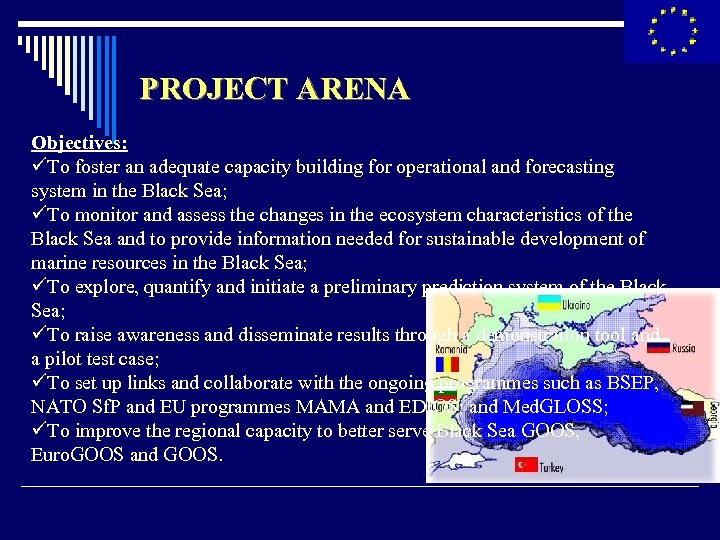
PROJECT ARENA Objectives: üTo foster an adequate capacity building for operational and forecasting system in the Black Sea; üTo monitor and assess the changes in the ecosystem characteristics of the Black Sea and to provide information needed for sustainable development of marine resources in the Black Sea; üTo explore, quantify and initiate a preliminary prediction system of the Black Sea; üTo raise awareness and disseminate results through a demonstration tool and a pilot test case; üTo set up links and collaborate with the ongoing programmes such as BSEP, NATO Sf. P and EU programmes MAMA and EDIOS; and Med. GLOSS; üTo improve the regional capacity to better serve Black Sea GOOS, Euro. GOOS and GOOS.
PROJECT BIOMARE Goal: implement and network large-scale, longterm Marine Biodiversity Research in Europe Results: Ø Network of European Marine Biodiversity Focal Sites (EMBi. FS) as the basis for longterm and large-scale marine biodiversity research in Europe Ø Set of internationally agreed tools, measures and indicators for (the degree of) biodiversity
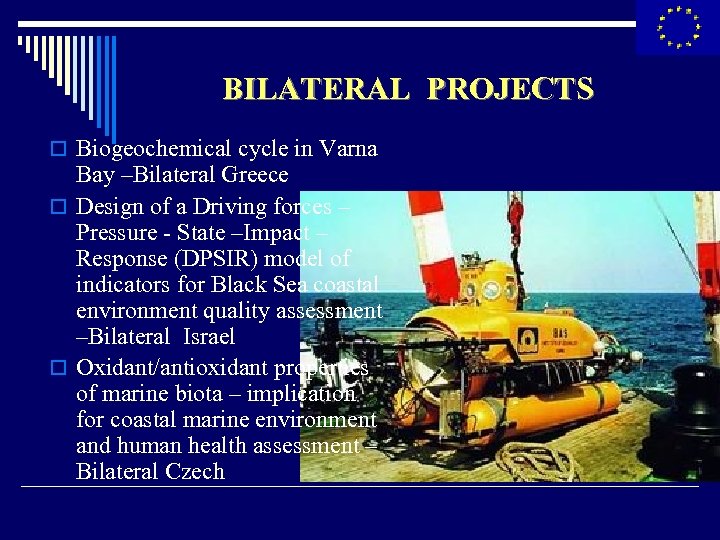
BILATERAL PROJECTS o Biogeochemical cycle in Varna Bay –Bilateral Greece o Design of a Driving forces – Pressure - State –Impact – Response (DPSIR) model of indicators for Black Sea coastal environment quality assessment –Bilateral Israel o Oxidant/antioxidant properties of marine biota – implication for coastal marine environment and human health assessment – Bilateral Czech
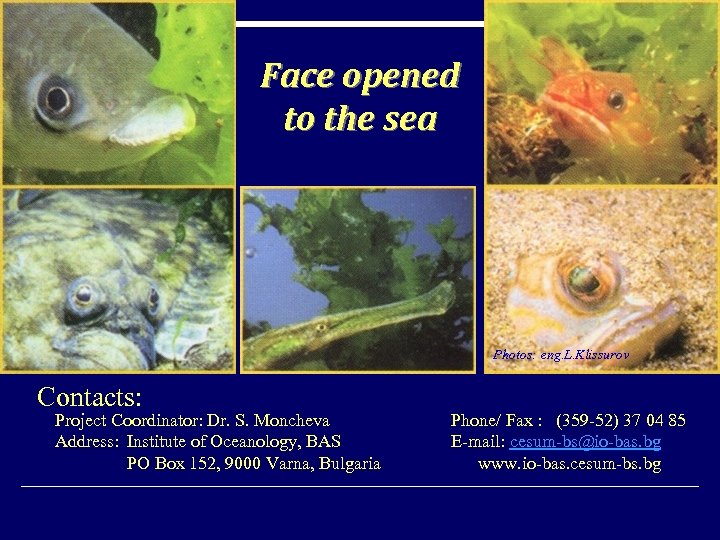
Face opened to the sea Photos: eng. L. Klissurov Contacts: Project Coordinator: Dr. S. Moncheva Address: Institute of Oceanology, BAS PO Box 152, 9000 Varna, Bulgaria Phone/ Fax : (359 -52) 37 04 85 E-mail: cesum-bs@io-bas. bg www. io-bas. cesum-bs. bg
Скачать презентацию Centre for Sustainable Development and Management of the
ee0875e7ceaaaacf45e737138a2bda96.ppt