 Скачать презентацию Centre for Market and Public Organisation Decomposing the
0efbd0569abc2df30575a7d29404ac06.ppt
- Количество слайдов: 49



Centre for Market and Public Organisation Decomposing the income gradients in child outcomes: What is it about low-income households that’s bad for kids? Paul Gregg, Lindsey Macmillan, Carol Propper and Elizabeth Washbrook Family Background and Child Development Conference LSE, 18 th July, 2006
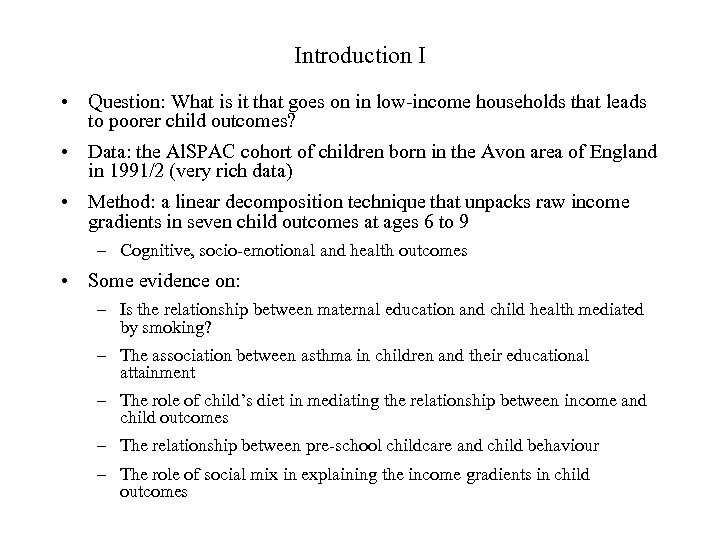
Introduction I • Question: What is it that goes on in low-income households that leads to poorer child outcomes? • Data: the Al. SPAC cohort of children born in the Avon area of England in 1991/2 (very rich data) • Method: a linear decomposition technique that unpacks raw income gradients in seven child outcomes at ages 6 to 9 – Cognitive, socio-emotional and health outcomes • Some evidence on: – Is the relationship between maternal education and child health mediated by smoking? – The association between asthma in children and their educational attainment – The role of child’s diet in mediating the relationship between income and child outcomes – The relationship between pre-school childcare and child behaviour – The role of social mix in explaining the income gradients in child outcomes
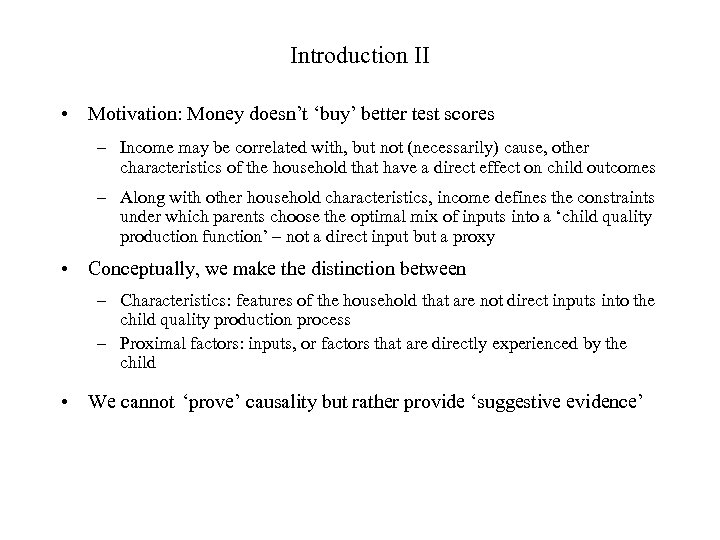
Introduction II • Motivation: Money doesn’t ‘buy’ better test scores – Income may be correlated with, but not (necessarily) cause, other characteristics of the household that have a direct effect on child outcomes – Along with other household characteristics, income defines the constraints under which parents choose the optimal mix of inputs into a ‘child quality production function’ – not a direct input but a proxy • Conceptually, we make the distinction between – Characteristics: features of the household that are not direct inputs into the child quality production process – Proximal factors: inputs, or factors that are directly experienced by the child • We cannot ‘prove’ causality but rather provide ‘suggestive evidence’
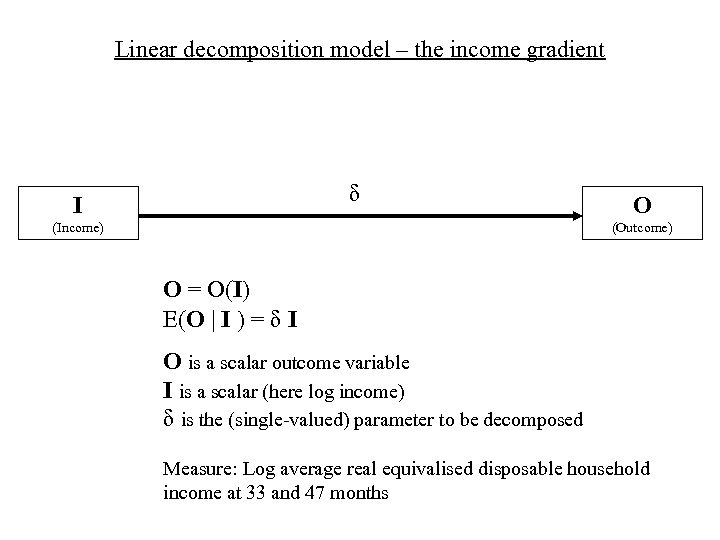
Linear decomposition model – the income gradient δ I (Income) O (Outcome) O = O(I) E(O | I ) = δ I O is a scalar outcome variable I is a scalar (here log income) δ is the (single-valued) parameter to be decomposed Measure: Log average real equivalised disposable household income at 33 and 47 months
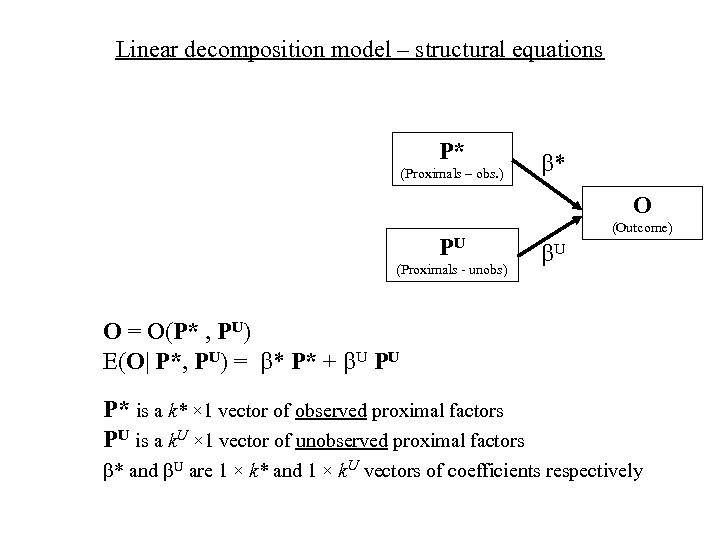
Linear decomposition model – structural equations P* (Proximals – obs. ) * O PU (Proximals - unobs) (Outcome) U O = O(P* , PU) E(O| P*, PU) = * P* + U PU P* is a k* × 1 vector of observed proximal factors PU is a k. U × 1 vector of unobserved proximal factors * and U are 1 × k* and 1 × k. U vectors of coefficients respectively
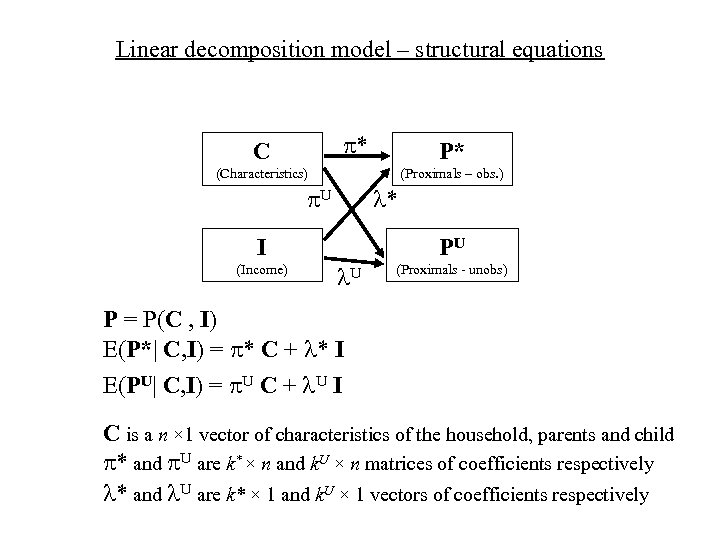
Linear decomposition model – structural equations * C P* (Characteristics) (Proximals – obs. ) * U I (Income) PU U (Proximals - unobs) P = P(C , I) E(P*| C, I) = * C + * I E(PU| C, I) = U C + U I C is a n × 1 vector of characteristics of the household, parents and child * and U are k* × n and k. U × n matrices of coefficients respectively * and U are k* × 1 and k. U × 1 vectors of coefficients respectively
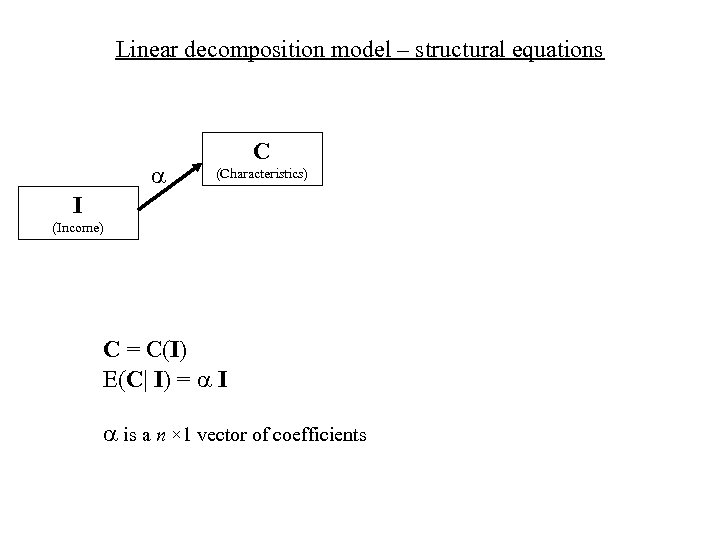
Linear decomposition model – structural equations C (Characteristics) I (Income) C = C(I) E(C| I) = I is a n × 1 vector of coefficients
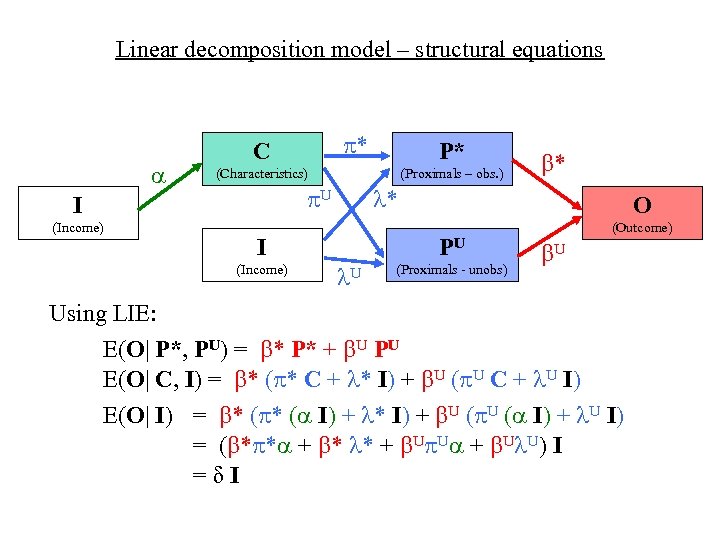
Linear decomposition model – structural equations P* (Characteristics) (Proximals – obs. ) I (Income) * * U I (Income) * C O PU U (Proximals - unobs) (Outcome) U Using LIE: E(O| P*, PU) = * P* + U PU E(O| C, I) = * ( * C + * I) + U ( U C + U I) E(O| I) = * ( I) + * I) + U ( I) + U I) = ( * * + U U) I =δI
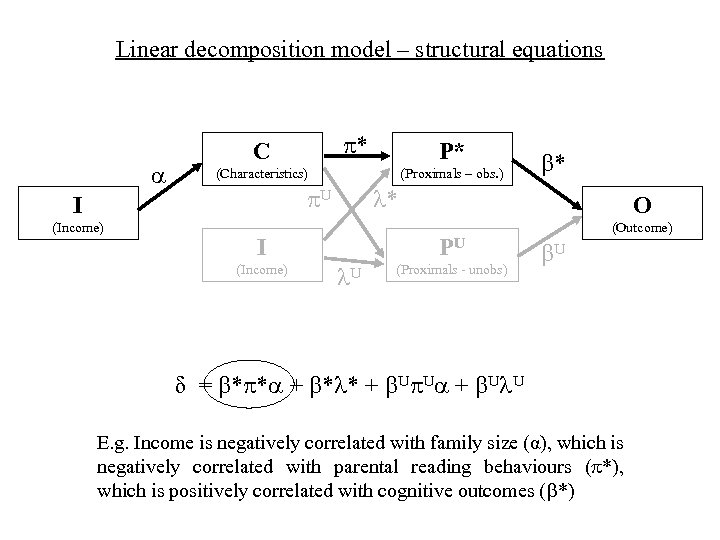
Linear decomposition model – structural equations P* (Characteristics) (Proximals – obs. ) I (Income) * * U I (Income) * C O PU U (Proximals - unobs) (Outcome) U δ = * * + U U E. g. Income is negatively correlated with family size (α), which is negatively correlated with parental reading behaviours ( *), which is positively correlated with cognitive outcomes ( *)
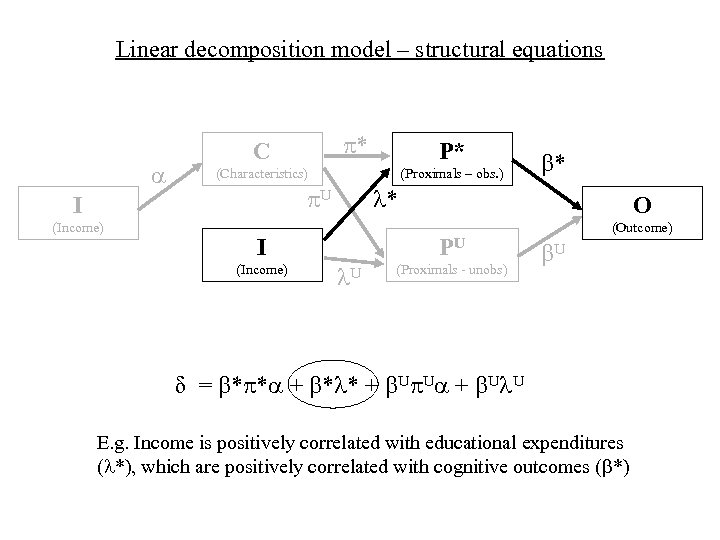
Linear decomposition model – structural equations P* (Characteristics) (Proximals – obs. ) I (Income) * * U I (Income) * C O PU U (Proximals - unobs) (Outcome) U δ = * * + U U E. g. Income is positively correlated with educational expenditures ( *), which are positively correlated with cognitive outcomes ( *)
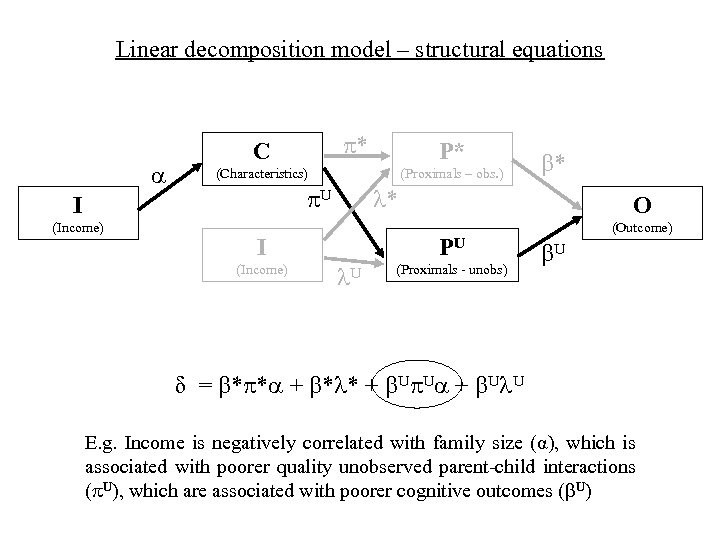
Linear decomposition model – structural equations P* (Characteristics) (Proximals – obs. ) I (Income) * * U I (Income) * C O PU U (Proximals - unobs) (Outcome) U δ = * * + U U E. g. Income is negatively correlated with family size (α), which is associated with poorer quality unobserved parent-child interactions ( U), which are associated with poorer cognitive outcomes ( U)
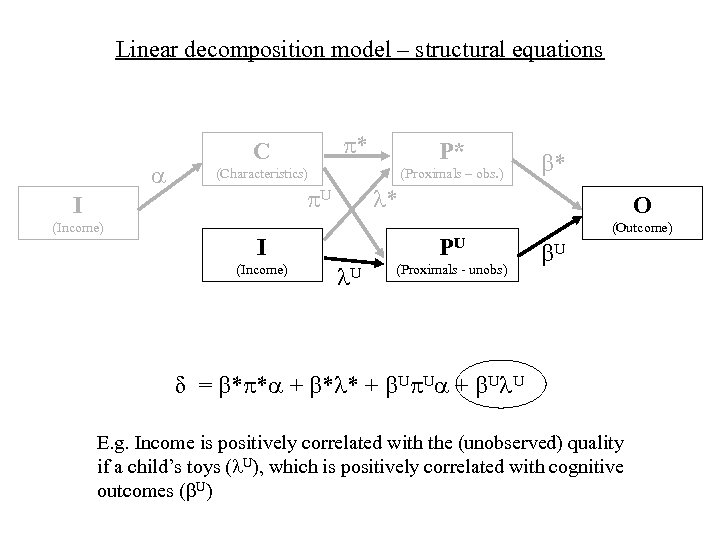
Linear decomposition model – structural equations P* (Characteristics) (Proximals – obs. ) I (Income) * * U I (Income) * C O PU U (Proximals - unobs) (Outcome) U δ = * * + U U E. g. Income is positively correlated with the (unobserved) quality if a child’s toys ( U), which is positively correlated with cognitive outcomes ( U)
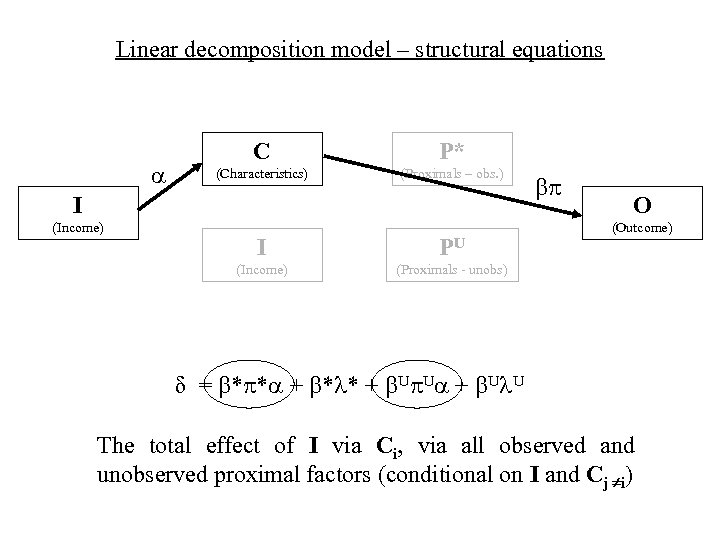
Linear decomposition model – structural equations C P* (Characteristics) (Proximals – obs. ) I (Income) I PU (Income) O (Outcome) (Proximals - unobs) δ = * * + U U The total effect of I via Ci, via all observed and unobserved proximal factors (conditional on I and Cj i)
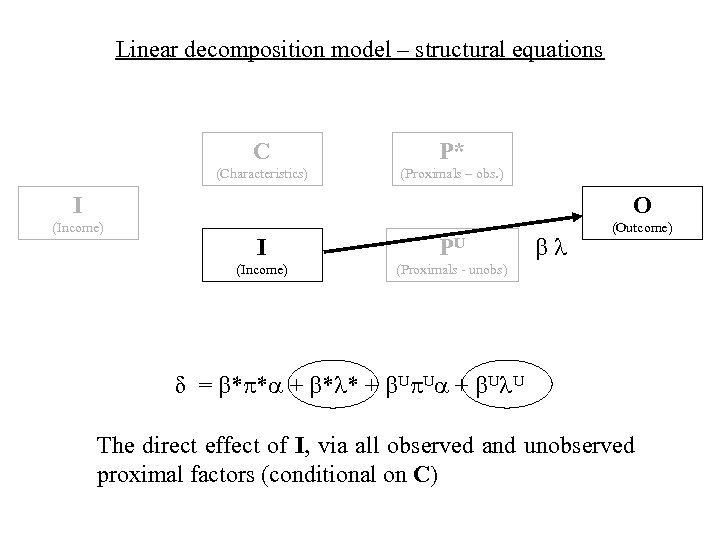
Linear decomposition model – structural equations C P* (Characteristics) (Proximals – obs. ) I O (Income) (Outcome) I PU (Income) (Proximals - unobs) δ = * * + U U The direct effect of I, via all observed and unobserved proximal factors (conditional on C)
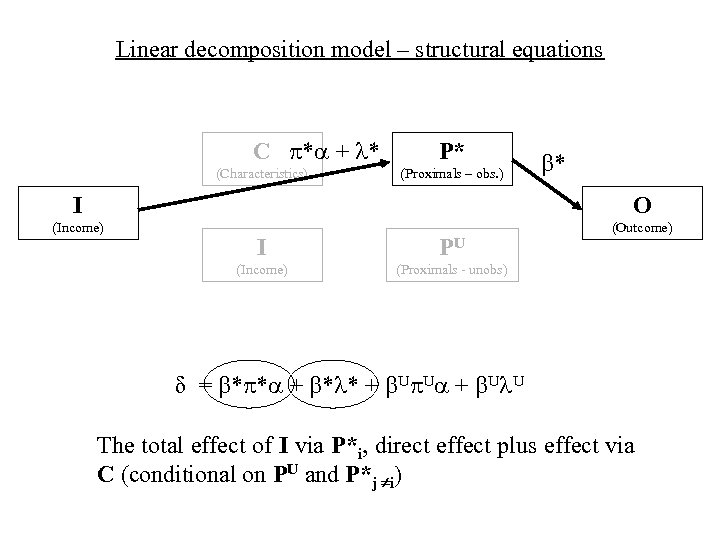
Linear decomposition model – structural equations C * + * (Characteristics) P* (Proximals – obs. ) * I O (Income) (Outcome) I PU (Income) (Proximals - unobs) δ = * * + U U The total effect of I via P*i, direct effect plus effect via C (conditional on PU and P*j i)
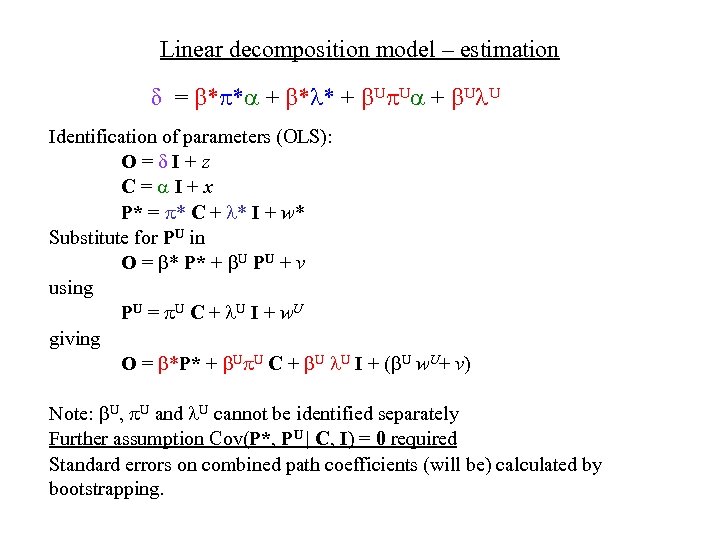
Linear decomposition model – estimation δ = * * + U U Identification of parameters (OLS): O=δI+z C= I+x P* = * C + * I + w* Substitute for PU in O = * P* + U PU + v using PU = U C + U I + w. U giving O = *P* + U U C + U U I + ( U w. U+ v) Note: U, U and U cannot be identified separately Further assumption Cov(P*, PU | C, I) = 0 required Standard errors on combined path coefficients (will be) calculated by bootstrapping.
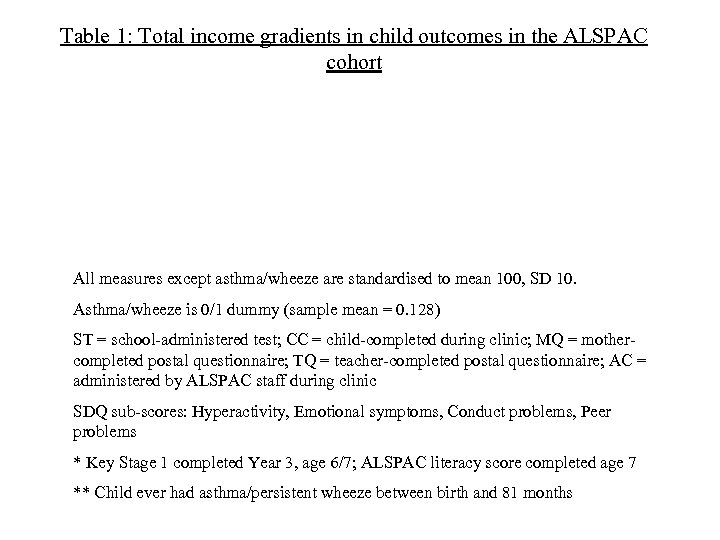
Table 1: Total income gradients in child outcomes in the ALSPAC cohort All measures except asthma/wheeze are standardised to mean 100, SD 10. Asthma/wheeze is 0/1 dummy (sample mean = 0. 128) ST = school-administered test; CC = child-completed during clinic; MQ = mothercompleted postal questionnaire; TQ = teacher-completed postal questionnaire; AC = administered by ALSPAC staff during clinic SDQ sub-scores: Hyperactivity, Emotional symptoms, Conduct problems, Peer problems * Key Stage 1 completed Year 3, age 6/7; ALSPAC literacy score completed age 7 ** Child ever had asthma/persistent wheeze between birth and 81 months
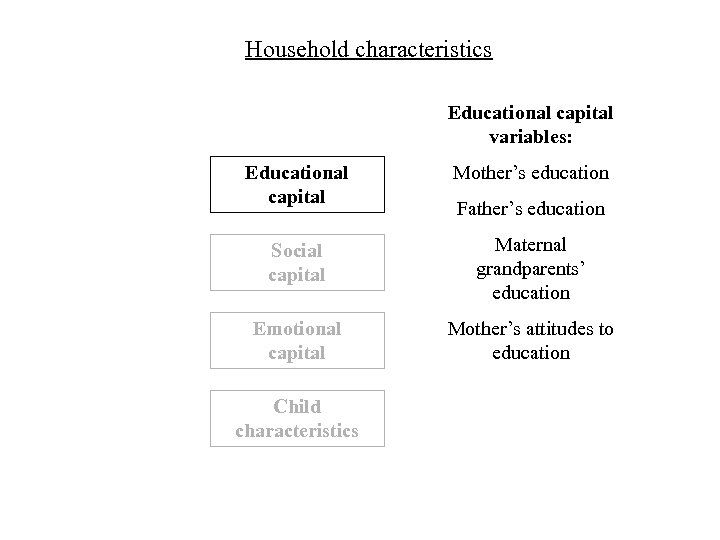
Household characteristics Educational capital variables: Educational capital Mother’s education Social capital Maternal grandparents’ education Emotional capital Mother’s attitudes to education Child characteristics Father’s education
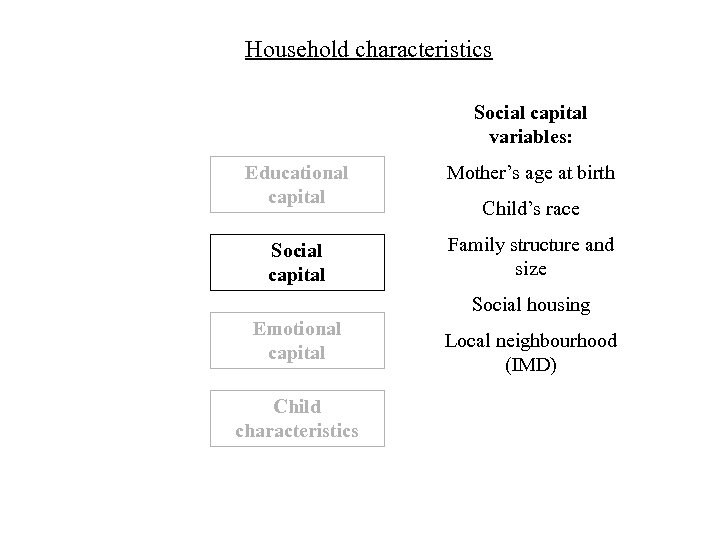
Household characteristics Social capital variables: Educational capital Mother’s age at birth Social capital Family structure and size Child’s race Social housing Emotional capital Child characteristics Local neighbourhood (IMD)
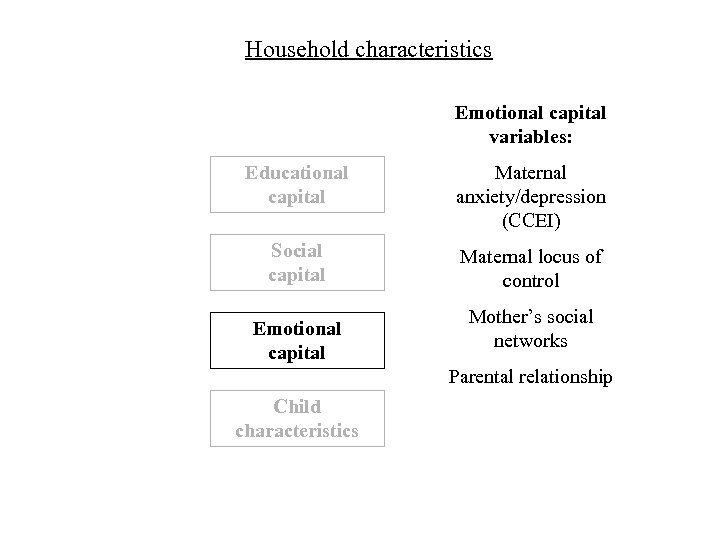
Household characteristics Emotional capital variables: Educational capital Maternal anxiety/depression (CCEI) Social capital Maternal locus of control Emotional capital Mother’s social networks Parental relationship Child characteristics
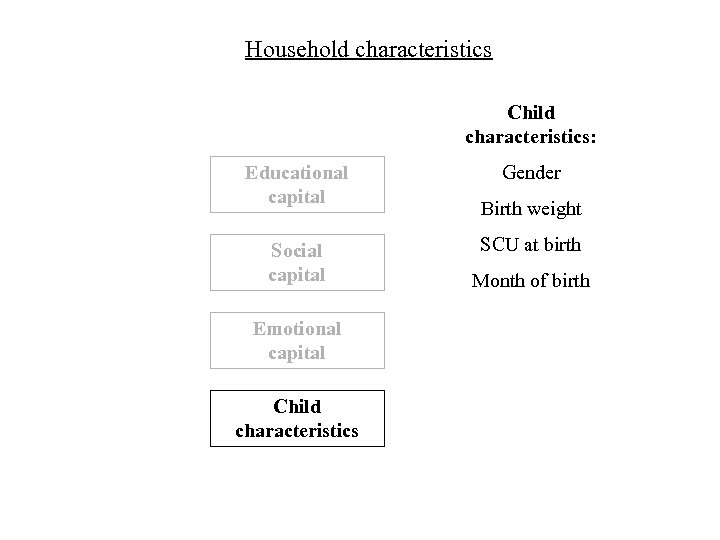
Household characteristics Child characteristics: Educational capital Social capital Emotional capital Child characteristics Gender Birth weight SCU at birth Month of birth
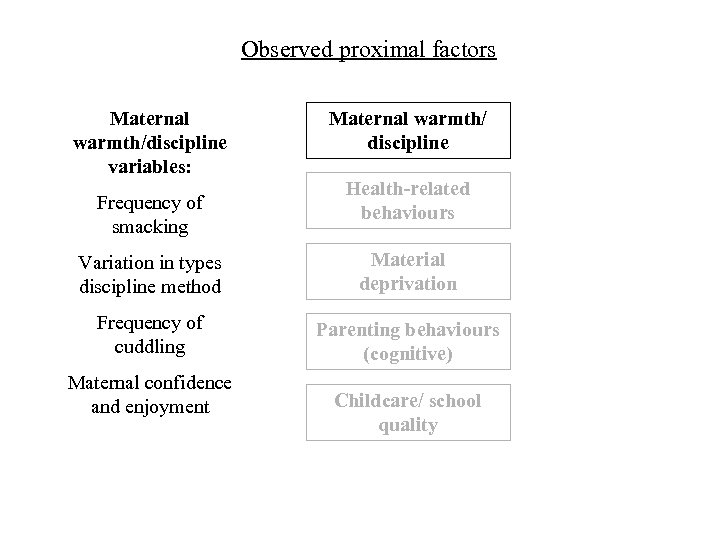
Observed proximal factors Maternal warmth/discipline variables: Frequency of smacking Maternal warmth/ discipline Health-related behaviours Variation in types discipline method Material deprivation Frequency of cuddling Parenting behaviours (cognitive) Maternal confidence and enjoyment Childcare/ school quality
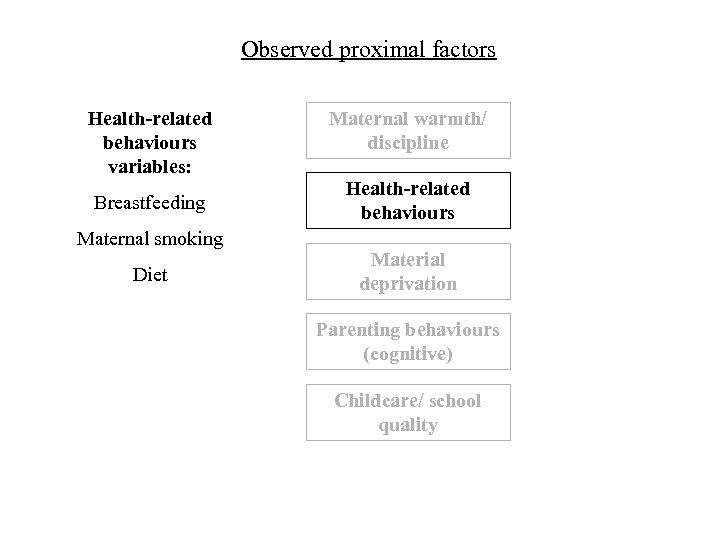
Observed proximal factors Health-related behaviours variables: Breastfeeding Maternal smoking Diet Maternal warmth/ discipline Health-related behaviours Material deprivation Parenting behaviours (cognitive) Childcare/ school quality
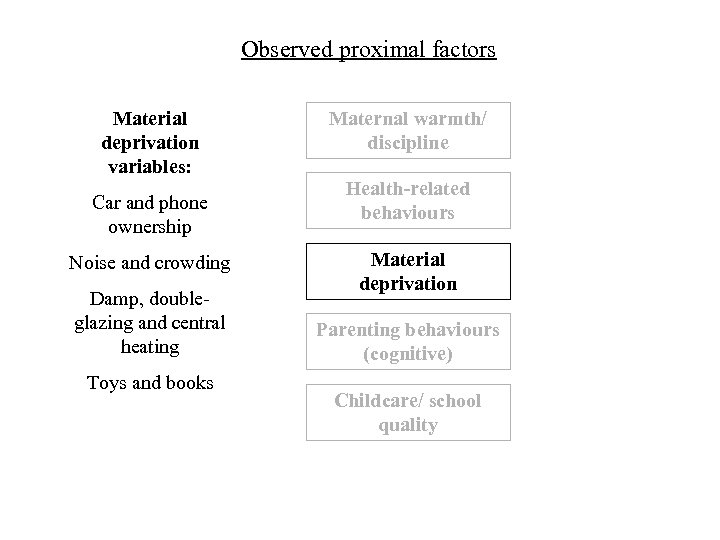
Observed proximal factors Material deprivation variables: Car and phone ownership Noise and crowding Damp, doubleglazing and central heating Toys and books Maternal warmth/ discipline Health-related behaviours Material deprivation Parenting behaviours (cognitive) Childcare/ school quality
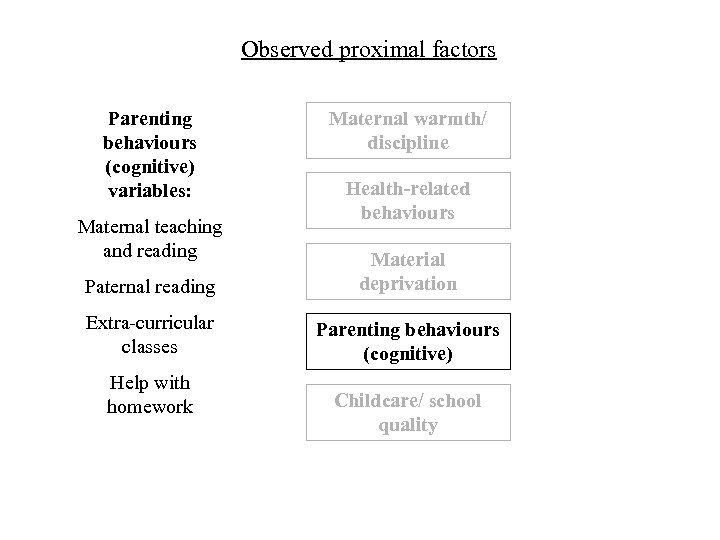
Observed proximal factors Parenting behaviours (cognitive) variables: Maternal teaching and reading Maternal warmth/ discipline Health-related behaviours Paternal reading Material deprivation Extra-curricular classes Parenting behaviours (cognitive) Help with homework Childcare/ school quality
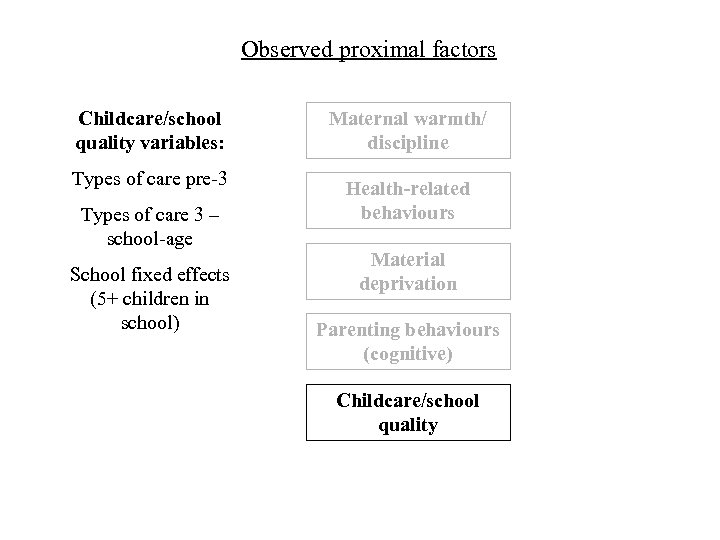
Observed proximal factors Childcare/school quality variables: Types of care pre-3 Types of care 3 – school-age School fixed effects (5+ children in school) Maternal warmth/ discipline Health-related behaviours Material deprivation Parenting behaviours (cognitive) Childcare/school quality
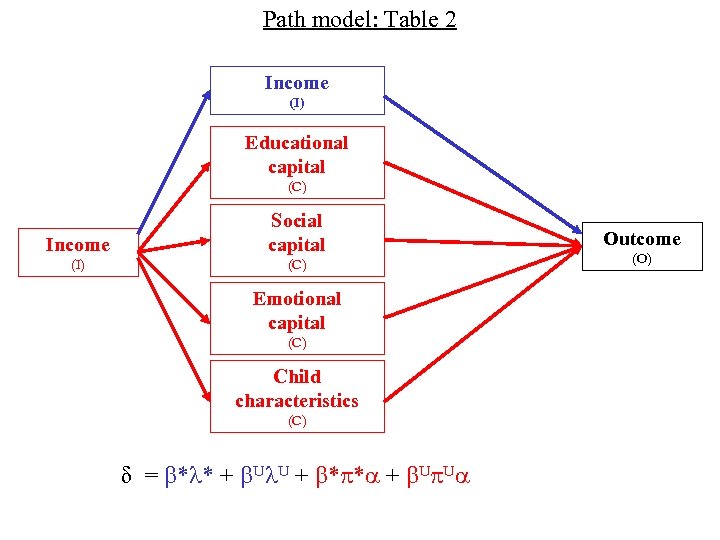
Path model: Table 2 Income (I) Educational capital (C) Income Social capital (I) (C) Emotional capital (C) Child characteristics (C) δ = * * + U U + * * + U U Outcome (O)
Table 2: Decomposition of overall income gradients: direct income effects and parental capital > 30% 20 - 30% 10 - 20% 5 - 10% < -5%
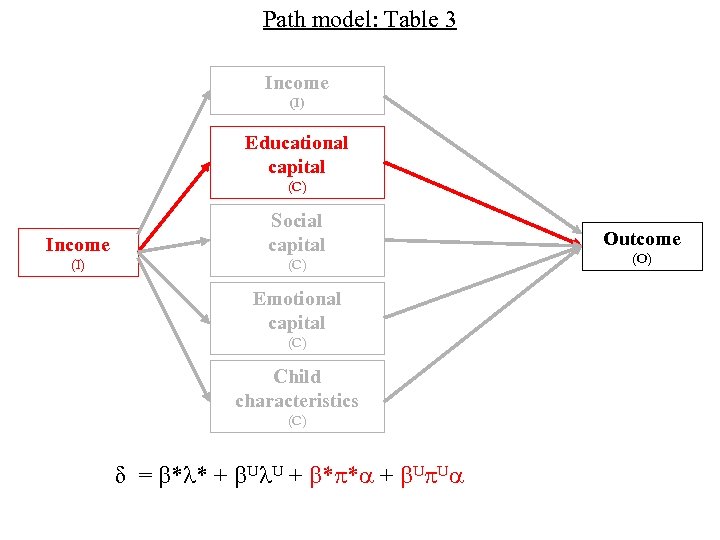
Path model: Table 3 Income (I) Educational capital (C) Income Social capital (I) (C) Emotional capital (C) Child characteristics (C) δ = * * + U U + * * + U U Outcome (O)
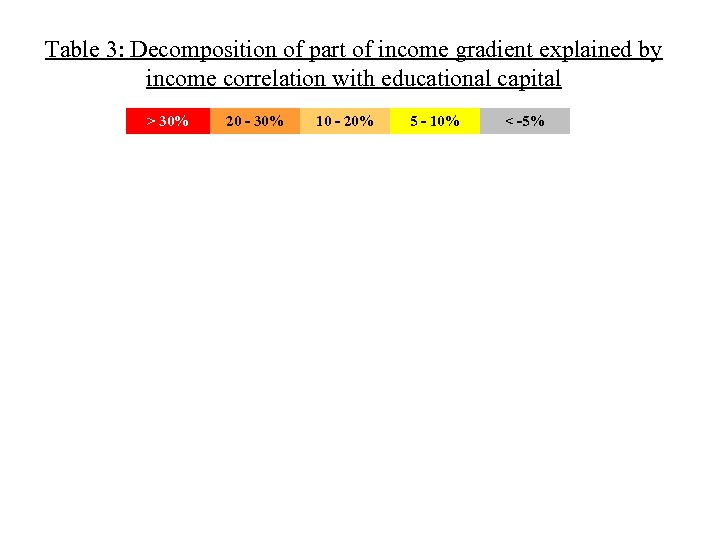
Table 3: Decomposition of part of income gradient explained by income correlation with educational capital > 30% 20 - 30% 10 - 20% 5 - 10% < -5%
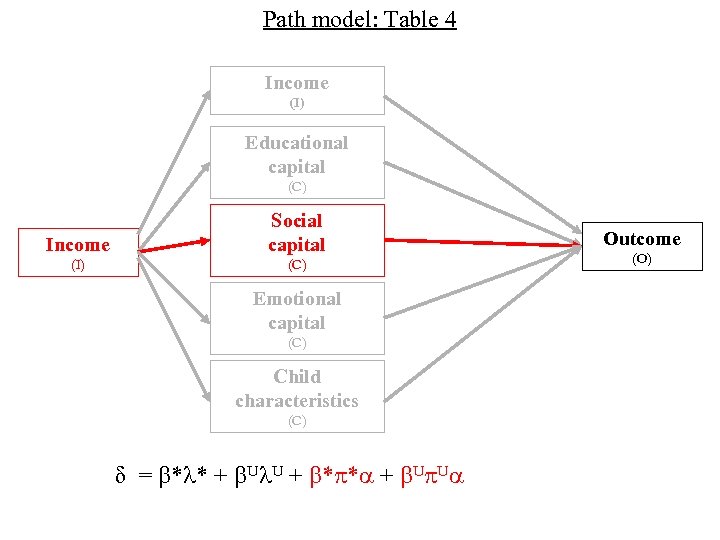
Path model: Table 4 Income (I) Educational capital (C) Income Social capital (I) (C) Emotional capital (C) Child characteristics (C) δ = * * + U U + * * + U U Outcome (O)
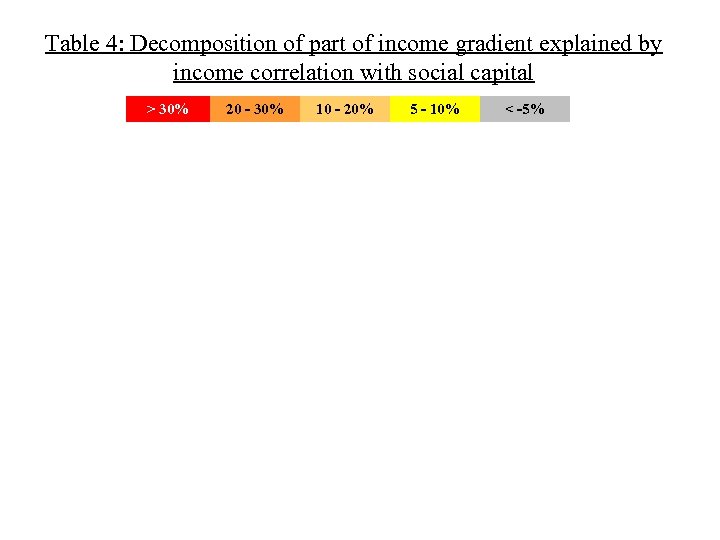
Table 4: Decomposition of part of income gradient explained by income correlation with social capital > 30% 20 - 30% 10 - 20% 5 - 10% < -5%
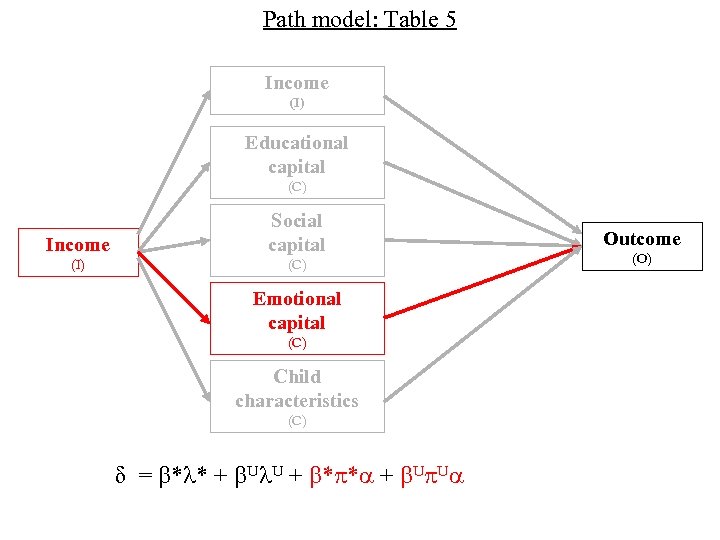
Path model: Table 5 Income (I) Educational capital (C) Income Social capital (I) (C) Emotional capital (C) Child characteristics (C) δ = * * + U U + * * + U U Outcome (O)
Table 5: Decomposition of part of income gradient explained by income correlation with emotional capital > 30% 20 - 30% 10 - 20% 5 - 10% < -5%
Table 6: Characteristics than can singly account for 10% or more of the income gradient
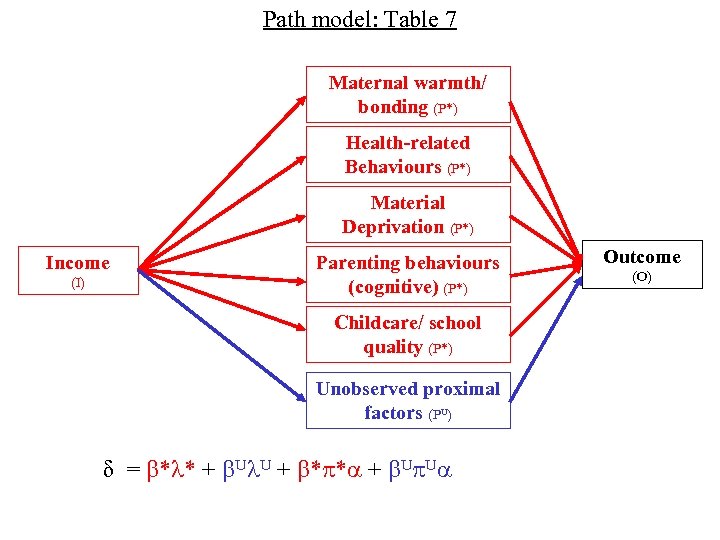
Path model: Table 7 Maternal warmth/ bonding (P*) Health-related Behaviours (P*) Material Deprivation (P*) Income (I) Parenting behaviours (cognitive) (P*) Childcare/ school quality (P*) Unobserved proximal factors (PU) δ = * * + U U + * * + U U Outcome (O)
Table 7: Decomposition of overall income gradients: observed and unobserved proximal factors > 30% 20 - 30% 10 - 20% 5 - 10% < -5%
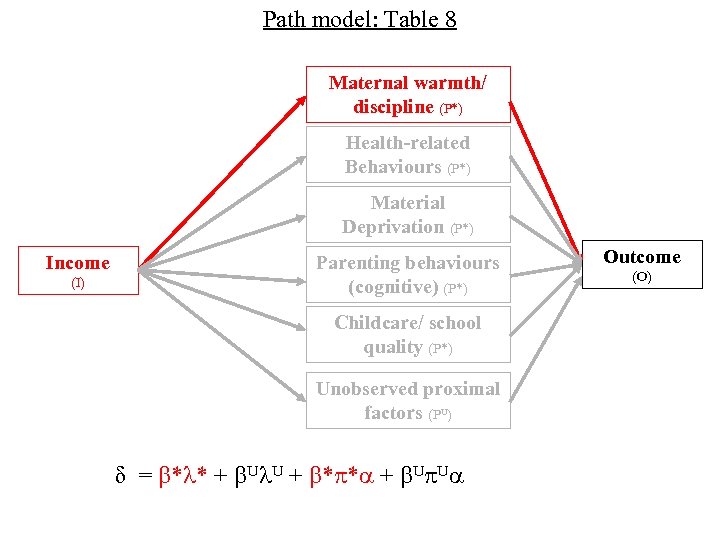
Path model: Table 8 Maternal warmth/ discipline (P*) Health-related Behaviours (P*) Material Deprivation (P*) Income (I) Parenting behaviours (cognitive) (P*) Childcare/ school quality (P*) Unobserved proximal factors (PU) δ = * * + U U + * * + U U Outcome (O)
Table 8: Decomposition of part of income gradient explained by income correlation with maternal warmth/discipline > 30% 20 - 30% 10 - 20% 5 - 10% < -5%
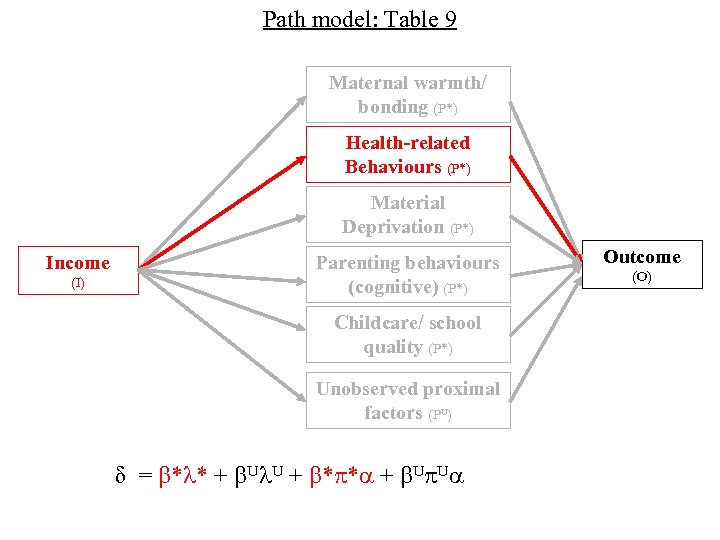
Path model: Table 9 Maternal warmth/ bonding (P*) Health-related Behaviours (P*) Material Deprivation (P*) Income (I) Parenting behaviours (cognitive) (P*) Childcare/ school quality (P*) Unobserved proximal factors (PU) δ = * * + U U + * * + U U Outcome (O)
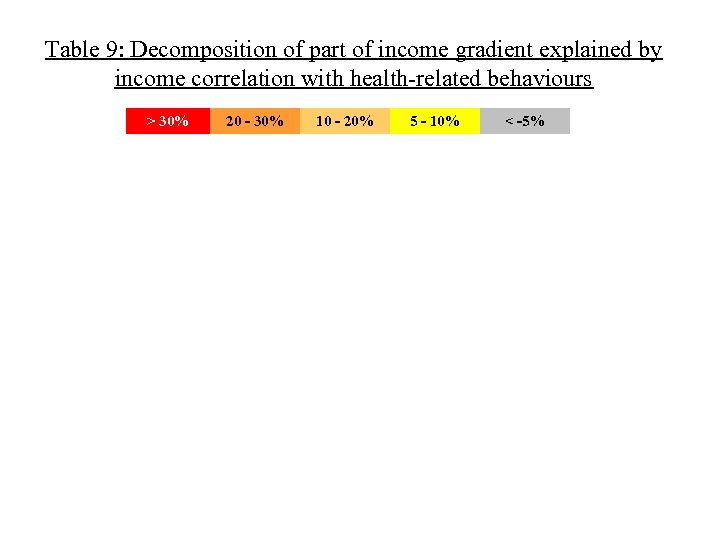
Table 9: Decomposition of part of income gradient explained by income correlation with health-related behaviours > 30% 20 - 30% 10 - 20% 5 - 10% < -5%
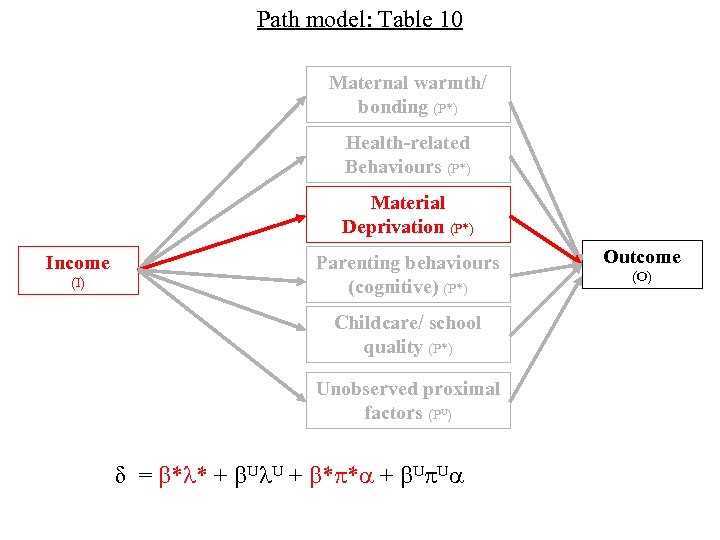
Path model: Table 10 Maternal warmth/ bonding (P*) Health-related Behaviours (P*) Material Deprivation (P*) Income (I) Parenting behaviours (cognitive) (P*) Childcare/ school quality (P*) Unobserved proximal factors (PU) δ = * * + U U + * * + U U Outcome (O)
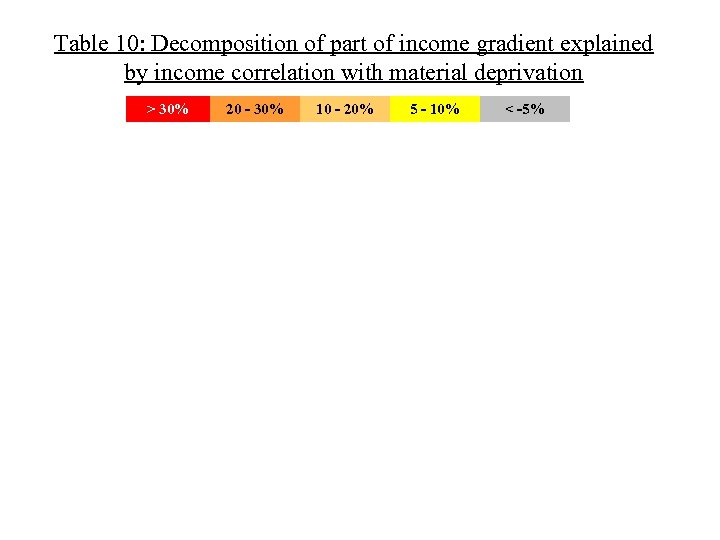
Table 10: Decomposition of part of income gradient explained by income correlation with material deprivation > 30% 20 - 30% 10 - 20% 5 - 10% < -5%
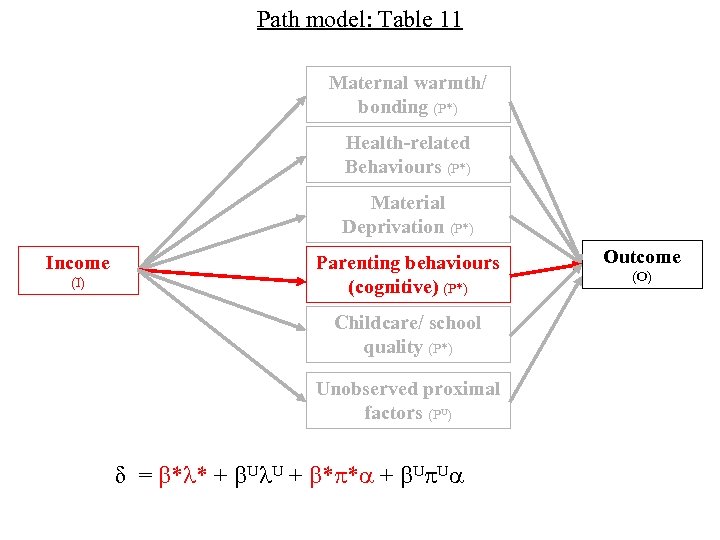
Path model: Table 11 Maternal warmth/ bonding (P*) Health-related Behaviours (P*) Material Deprivation (P*) Income (I) Parenting behaviours (cognitive) (P*) Childcare/ school quality (P*) Unobserved proximal factors (PU) δ = * * + U U + * * + U U Outcome (O)
Table 11: Decomposition of part of income gradient explained by income correlation with cognitive parenting behaviours
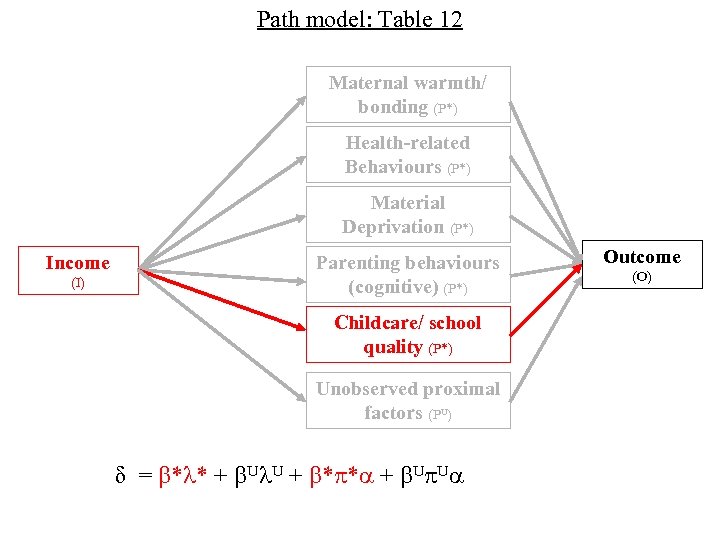
Path model: Table 12 Maternal warmth/ bonding (P*) Health-related Behaviours (P*) Material Deprivation (P*) Income (I) Parenting behaviours (cognitive) (P*) Childcare/ school quality (P*) Unobserved proximal factors (PU) δ = * * + U U + * * + U U Outcome (O)
Table 12: Decomposition of part of income gradient explained by income correlation with childcare/school quality > 30% 20 - 30% 10 - 20% 5 - 10% < -5%
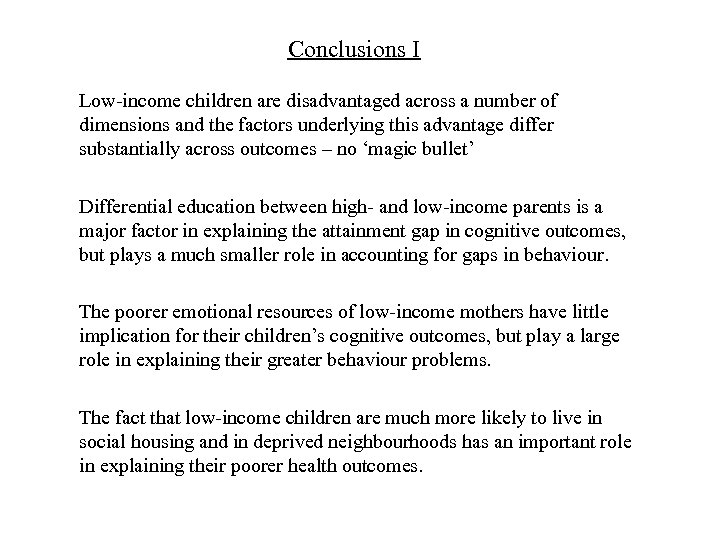
Conclusions I Low-income children are disadvantaged across a number of dimensions and the factors underlying this advantage differ substantially across outcomes – no ‘magic bullet’ Differential education between high- and low-income parents is a major factor in explaining the attainment gap in cognitive outcomes, but plays a much smaller role in accounting for gaps in behaviour. The poorer emotional resources of low-income mothers have little implication for their children’s cognitive outcomes, but play a large role in explaining their greater behaviour problems. The fact that low-income children are much more likely to live in social housing and in deprived neighbourhoods has an important role in explaining their poorer health outcomes.
Conclusions II We find evidence of systematic differences in the factors associated with teacher and mother reports of children’s behaviour. Not all the characteristics of low-income families are associated with poorer outcomes. Lack of car ownership and colder homes are associated with reduced risk of obesity; childcare choices between 3 and school entry are associated with fewer behavioural problems. Next steps: • Standard errors • Three-part pathways
Скачать презентацию Centre for Market and Public Organisation Decomposing the
0efbd0569abc2df30575a7d29404ac06.ppt