 Скачать презентацию Centre for Management Development STAFF BRIEFING — EMOTIONAL
547ed81dce849aae236b4d7adf6add3b.ppt
- Количество слайдов: 62



Centre for Management Development STAFF BRIEFING - EMOTIONAL INTELLIGENCE(EI) AS A DERIVATIVE TO QUALITY ASSURANCE AND CUSTOMERS CARE BY Kabir Kabo Usman Director – General, Centre for Management Development Lagos. Date: Wednesday 10 th July, 2013 Time: 2. 00 pm Venue: CMD Training Complex, Lagos
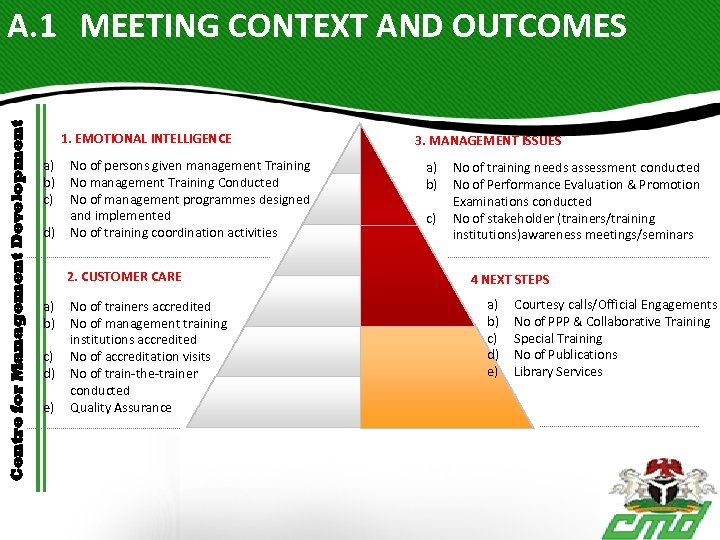
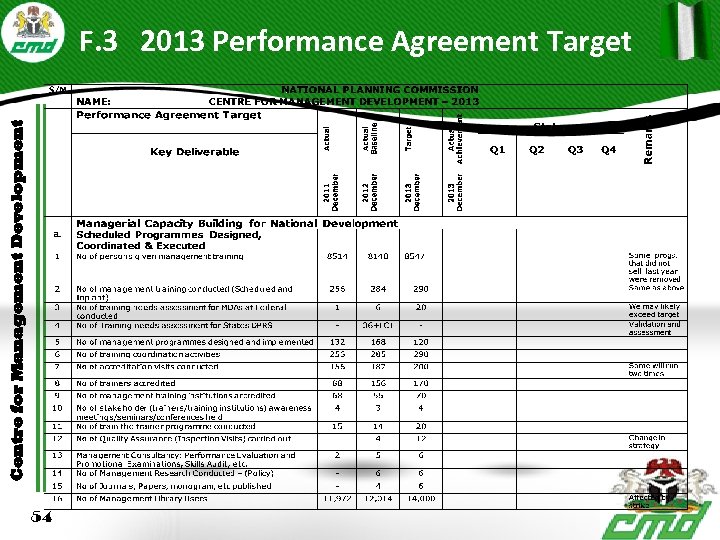
Centre for Management Development A. 1 MEETING CONTEXT AND OUTCOMES 1. EMOTIONAL INTELLIGENCE a) b) c) d) No of persons given management Training No management Training Conducted No of management programmes designed and implemented No of training coordination activities 2. CUSTOMER CARE a) b) c) d) e) No of trainers accredited No of management training institutions accredited No of accreditation visits No of train-the-trainer conducted Quality Assurance 3. MANAGEMENT ISSUES a) b) c) No of training needs assessment conducted No of Performance Evaluation & Promotion Examinations conducted No of stakeholder (trainers/training institutions)awareness meetings/seminars 4 NEXT STEPS a) b) c) d) e) Courtesy calls/Official Engagements No of PPP & Collaborative Training Special Training No of Publications Library Services
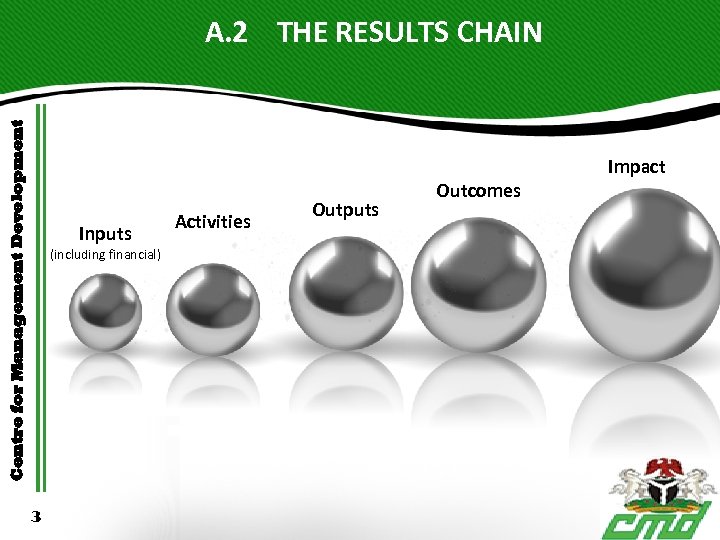
Centre for Management Development A. 2 THE RESULTS CHAIN Inputs (including financial) 3 Activities Outputs Outcomes Impact

Centre for Management Development Dr. Kabir Kabo Usman, Director-General, CMD Signing the 2012 Performance Contract while the Honourable Minister/Deputy Chairman, NPC watches with keen interest 4
Centre for Management Development Food for Thought! • “If you can not be a pencil to write anyone's happiness, try at least to be a nice rubber to erase everyone's sorrows…………” • It’s not just how smart you are but how you are smart! • We hire people for technical reasons and fire them for behavioral reasons. • To find yourself you must accept that you are lost
Centre for Management Development Introduction There is more to the workplace than the business itself. An employee’s makeup, emotions and ability to manage them, level of Emotional Intelligence and communication skills are all a part of whether or not a business is successful. Understanding one’s emotions and learning how to use them is the responsibility of each person. Deciding which style is best can be done by weighing the pros and cons of each as well as which would result in the most positive outcome.
Centre for Management Development Introduction Emotions are human beings warning system that alerts them as to what is really going on around them. There a complex state of human mind, involving physiological changes on the one hand psychological changes on the other. There are TWO dimensions of emotions: • physiological side: ‘Emotion’ is a complex state of human mind, involving bodily changes of widespread character such as breathing, pounding heart, flushed face, sweating palms, pulse rate, gland secretions, etc. • psychological side, a state of excitement or perturbation marked by strong feelings. Some of the main emotions are: anger, depression, anxiety, happiness, love, surprise, and embarrassment. . .
Centre for Management Development Intelligence "An intelligence is the ability to solve problems, or to create products, that are valued within one or more cultural settings (Gardner, 1983/2003, )“
Centre for Management Development What is EI (Emotional Intelligence)? Micro-perspective: “EI is an ability to perceive emotions in oneself and others, to facilitate thought, to understand manage emotions. ” (Salovey et al. ) Macro-perspective: - An organizational ability to intelligently handle matters with empathy.
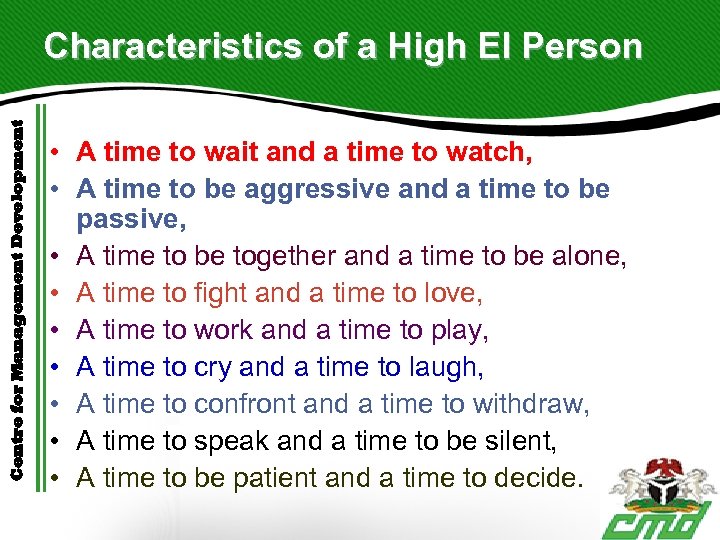
Centre for Management Development Characteristics of a High EI Person • A time to wait and a time to watch, • A time to be aggressive and a time to be passive, • A time to be together and a time to be alone, • A time to fight and a time to love, • A time to work and a time to play, • A time to cry and a time to laugh, • A time to confront and a time to withdraw, • A time to speak and a time to be silent, • A time to be patient and a time to decide.
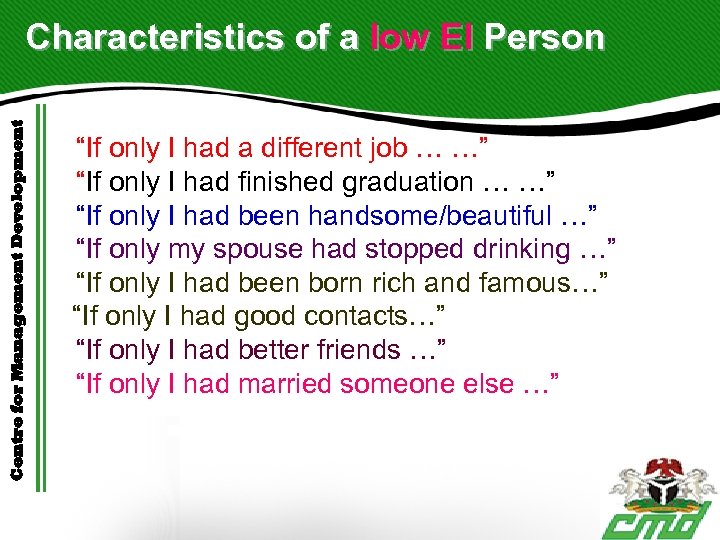
Centre for Management Development Characteristics of a low EI Person “If only I had a different job … …” “If only I had finished graduation … …” “If only I had been handsome/beautiful …” “If only my spouse had stopped drinking …” “If only I had been born rich and famous…” “If only I had good contacts…” “If only I had better friends …” “If only I had married someone else …”
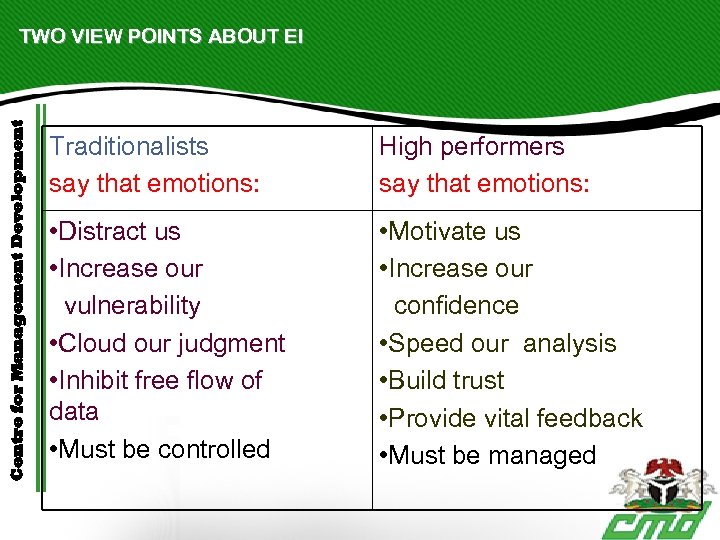
Centre for Management Development TWO VIEW POINTS ABOUT EI Traditionalists say that emotions: High performers say that emotions: • Distract us • Increase our vulnerability • Cloud our judgment • Inhibit free flow of data • Must be controlled • Motivate us • Increase our confidence • Speed our analysis • Build trust • Provide vital feedback • Must be managed
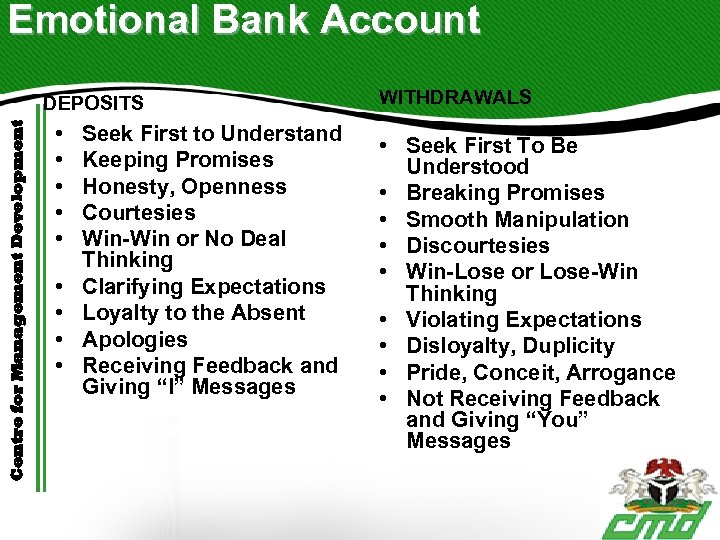
Emotional Bank Account Centre for Management Development DEPOSITS • • • Seek First to Understand Keeping Promises Honesty, Openness Courtesies Win-Win or No Deal Thinking Clarifying Expectations Loyalty to the Absent Apologies Receiving Feedback and Giving “I” Messages WITHDRAWALS • Seek First To Be Understood • Breaking Promises • Smooth Manipulation • Discourtesies • Win-Lose or Lose-Win Thinking • Violating Expectations • Disloyalty, Duplicity • Pride, Conceit, Arrogance • Not Receiving Feedback and Giving “You” Messages
Centre for Management Development Importance of EI • EI is the distinguishing factor that determines if we make lemonade when life hands us lemons or spend our life stuck in bitterness. • EI is the distinguishing factor that helps us to maintain a warm relationship or a distant contacts. • EI is the distinguishing factor which draws others to us or repels them. • EI is the distinguishing factor which enables us to work in coordination with others or to create a disputed situation. • EI is the distinguishing factor which enables us to win the heart of people or to win the situation by argument.
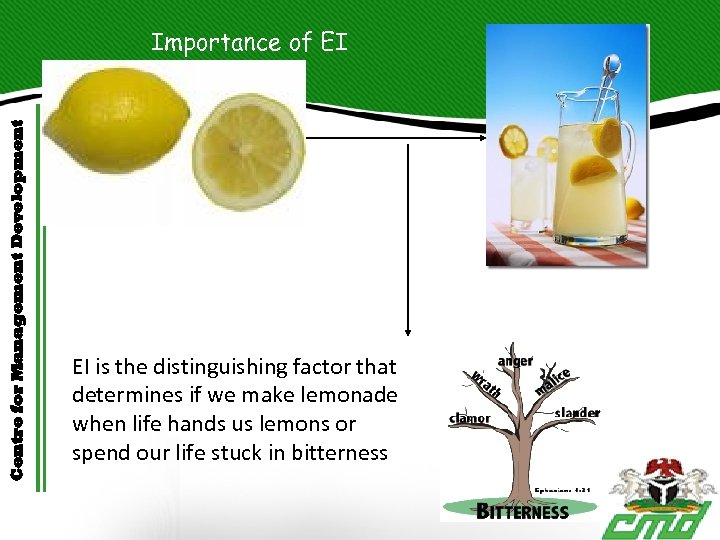
Centre for Management Development Importance of EI EI is the distinguishing factor that determines if we make lemonade when life hands us lemons or spend our life stuck in bitterness
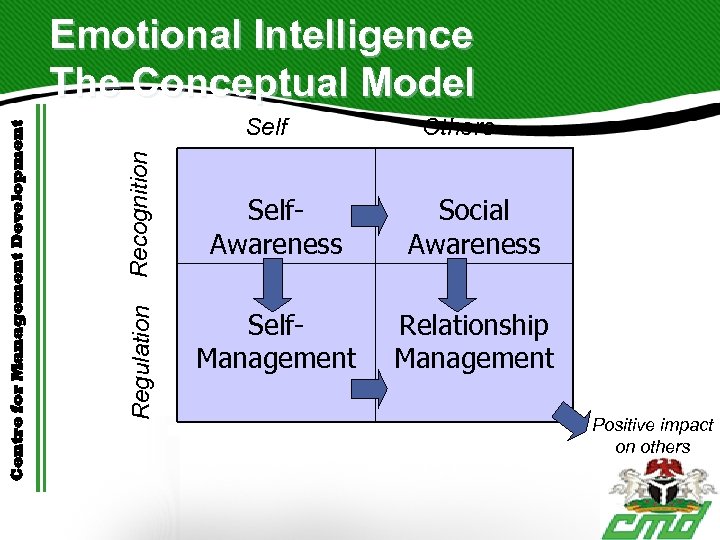
Recognition Self Regulation Centre for Management Development Emotional Intelligence The Conceptual Model Others Self. Awareness Social Awareness Self. Management Relationship Management Positive impact on others
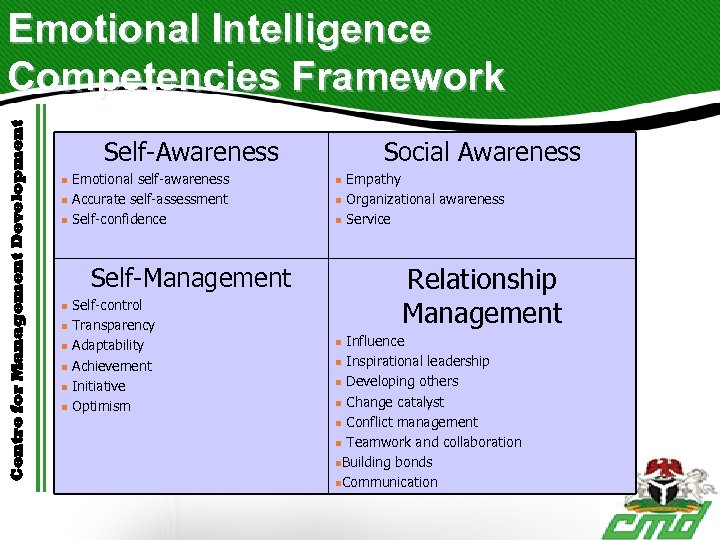
Centre for Management Development Emotional Intelligence Competencies Framework Self-Awareness n n n Emotional self-awareness Accurate self-assessment Self-confidence Social Awareness n n n Relationship Management Self-Management n n n Self-control Transparency Adaptability Achievement Initiative Optimism Empathy Organizational awareness Service Influence n Inspirational leadership n Developing others n Change catalyst n Conflict management n Teamwork and collaboration n. Building bonds n. Communication n
Centre for Management Development Use of EI at Workplace • It is EI that will: – – solve our retention & morale problems improve our creativity create synergy from teamwork speed our information by way of sophisticated people networks – drive our purpose; and – ignite the best and most inspired performance from our followers.
Centre for Management Development Why use EI in the Workplace • The workplace & workplace culture is changing. • Today the emphasis is more on people-focused style of leadership. • Today employees are motivated by the relationship they have in their workplace & EI seems like a logical framework to help build these relationships. • Emotions influence all aspect s of our lives. • Its impossible to separate them from work. • They play a large role in how others perceive us through our tone of voice, facial expressions and body language.
Centre for Management Development Negative Workplace Emotions • Negative emotions can lead to negative workplace behaviours: – Production (leaving early, intentionally working slowly) – Property (stealing, sabotage) – Political (gossiping, blaming co-workers) – Personal aggression (sexual harassment, verbal abuse)
Centre for Management Development What is Group Emotional Intelligence? • The ability of a team to generate operating norms that increase awareness of emotion and management of behaviour in ways that have positive emotional consequences
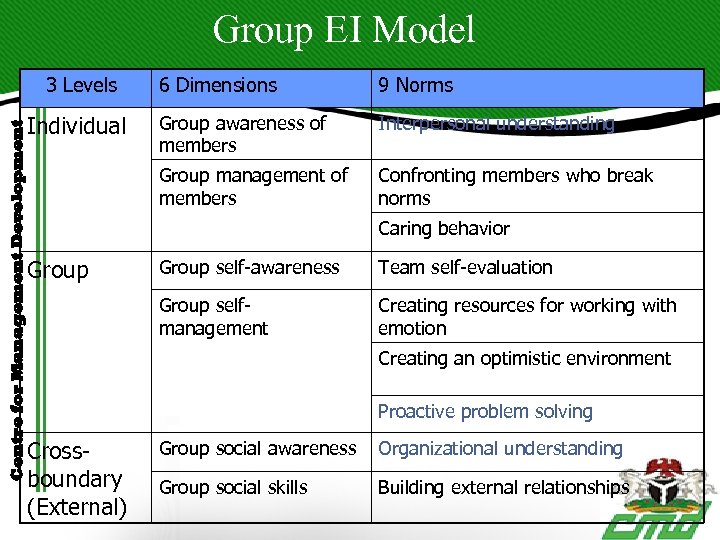
Group EI Model Centre for Management Development 3 Levels 9 Norms Group awareness of members Interpersonal understanding Group management of members Individual 6 Dimensions Confronting members who break norms Caring behavior Group self-awareness Team self-evaluation Group selfmanagement Creating resources for working with emotion Creating an optimistic environment Proactive problem solving Crossboundary (External) Group social awareness Organizational understanding Group social skills Building external relationships
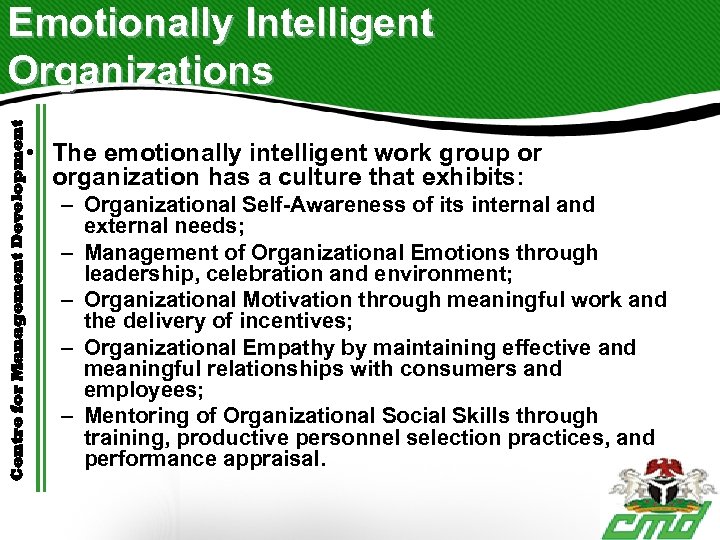
Centre for Management Development Emotionally Intelligent Organizations • The emotionally intelligent work group or organization has a culture that exhibits: – Organizational Self-Awareness of its internal and external needs; – Management of Organizational Emotions through leadership, celebration and environment; – Organizational Motivation through meaningful work and the delivery of incentives; – Organizational Empathy by maintaining effective and meaningful relationships with consumers and employees; – Mentoring of Organizational Social Skills through training, productive personnel selection practices, and performance appraisal.
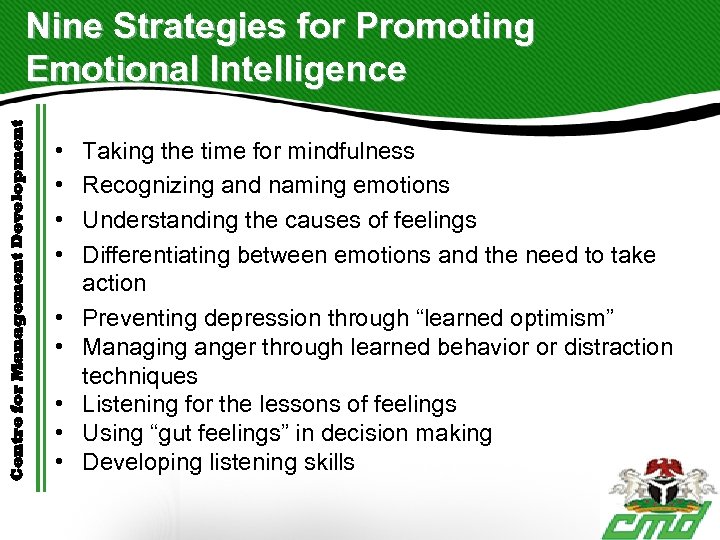
Centre for Management Development Nine Strategies for Promoting Emotional Intelligence • • • Taking the time for mindfulness Recognizing and naming emotions Understanding the causes of feelings Differentiating between emotions and the need to take action Preventing depression through “learned optimism” Managing anger through learned behavior or distraction techniques Listening for the lessons of feelings Using “gut feelings” in decision making Developing listening skills
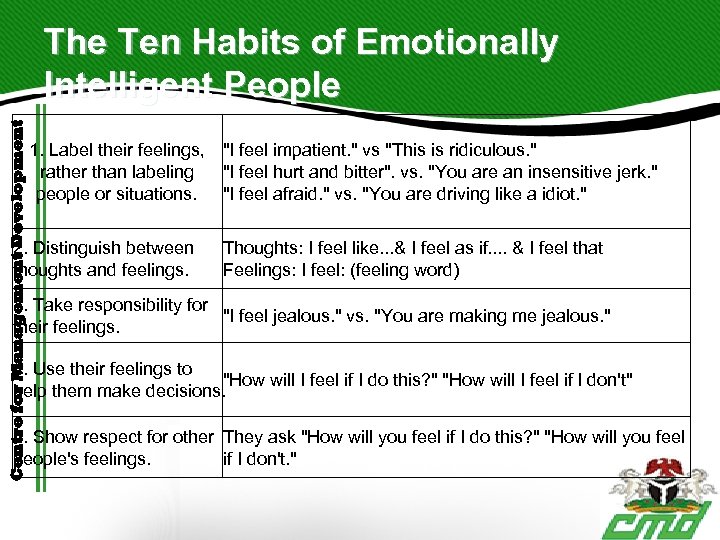
Centre for Management Development The Ten Habits of Emotionally Intelligent People 1. Label their feelings, "I feel impatient. " vs "This is ridiculous. " rather than labeling "I feel hurt and bitter". vs. "You are an insensitive jerk. " people or situations. "I feel afraid. " vs. "You are driving like a idiot. " 2. Distinguish between thoughts and feelings. Thoughts: I feel like. . . & I feel as if. . & I feel that Feelings: I feel: (feeling word) 3. Take responsibility for "I feel jealous. " vs. "You are making me jealous. " their feelings. 4. Use their feelings to "How will I feel if I do this? " "How will I feel if I don't" help them make decisions. 5. Show respect for other They ask "How will you feel if I do this? " "How will you feel people's feelings. if I don't. "
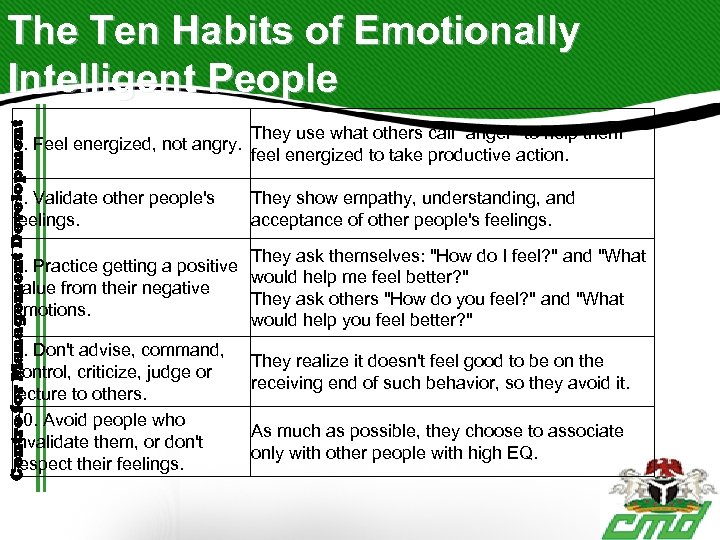
Centre for Management Development The Ten Habits of Emotionally Intelligent People 6. Feel energized, not angry. They use what others call "anger" to help them feel energized to take productive action. 7. Validate other people's feelings. They show empathy, understanding, and acceptance of other people's feelings. They ask themselves: "How do I feel? " and "What 8. Practice getting a positive would help me feel better? " value from their negative They ask others "How do you feel? " and "What emotions. would help you feel better? " 9. Don't advise, command, control, criticize, judge or lecture to others. 10. Avoid people who invalidate them, or don't respect their feelings. They realize it doesn't feel good to be on the receiving end of such behavior, so they avoid it. As much as possible, they choose to associate only with other people with high EQ.
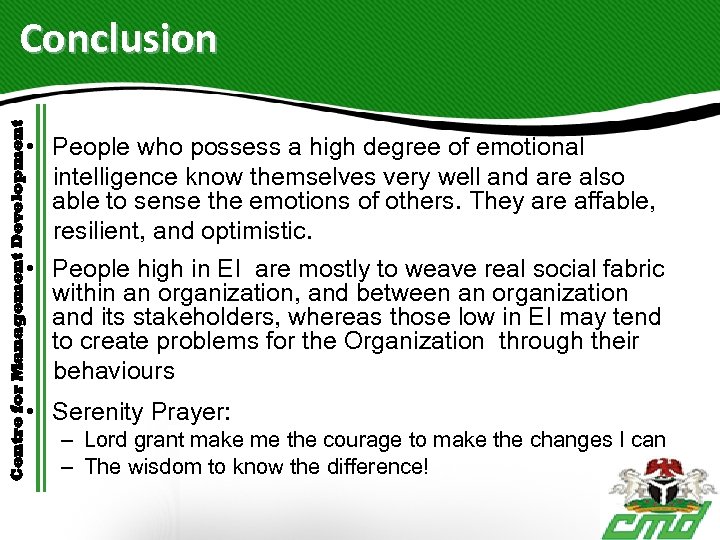
Centre for Management Development Conclusion • People who possess a high degree of emotional intelligence know themselves very well and are also able to sense the emotions of others. They are affable, resilient, and optimistic. • People high in EI are mostly to weave real social fabric within an organization, and between an organization and its stakeholders, whereas those low in EI may tend to create problems for the Organization through their behaviours • Serenity Prayer: – Lord grant make me the courage to make the changes I can – The wisdom to know the difference!
Centre for Management Development CUSTOMER C C 28 C CUSTOMER CARE C
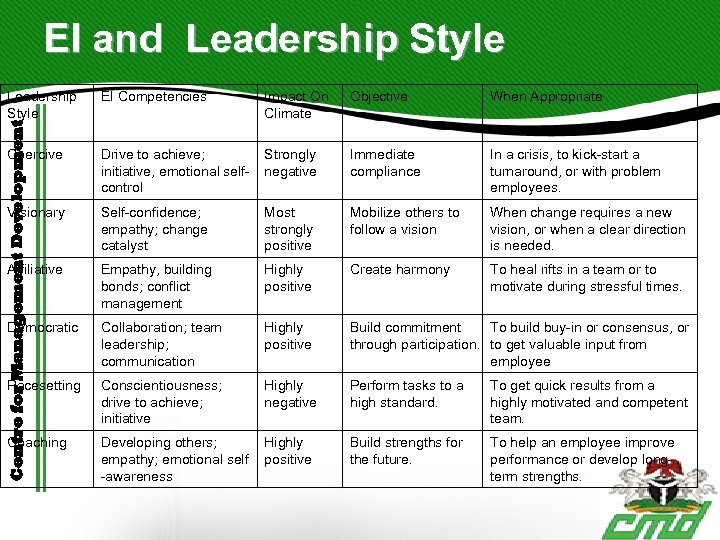
EI and Leadership Style EI Competencies Impact On Climate Objective When Appropriate Coercive Drive to achieve; initiative, emotional selfcontrol Strongly negative Immediate compliance In a crisis, to kick-start a turnaround, or with problem employees. Visionary Self-confidence; empathy; change catalyst Most strongly positive Mobilize others to follow a vision When change requires a new vision, or when a clear direction is needed. Affiliative Empathy, building bonds; conflict management Highly positive Create harmony To heal rifts in a team or to motivate during stressful times. Democratic Collaboration; team leadership; communication Highly positive Build commitment To build buy-in or consensus, or through participation. to get valuable input from employee Pacesetting Conscientiousness; drive to achieve; initiative Highly negative Perform tasks to a high standard. To get quick results from a highly motivated and competent team. Coaching Developing others; empathy; emotional self -awareness Highly positive Build strengths for the future. To help an employee improve performance or develop longterm strengths. Centre for Management Development Leadership Style
Centre for Management Development • There is only one way to ensure that people who work in an organisation will delight their customers – by giving proper recognition and reward to those people who show a willingness and a passion to care for customers. • We cannot delight our customers unless we first find out what they want from us. • Let’s constantly ask them.
Centre for Management Development • The levels of delight felt by our customers must be regularly measured. We also need to know how they feel about our competitors, and how our competitors’ customers feel about us, and about them. • Fast reaction time, (even when not requested), is one of the pillars on which great customer care rest.
Centre for Management Development • No- one is born with the skills to provide outstanding service for delighting customers. • People must be trained and coached until the skills become second nature, and that won’t happen overnight. • If we don’t keep getting better and better, our competitors will.
Centre for Management Development • When we delight our customers, we delight ourselves. • Studies show a direct correlation between customer satisfaction and employee satisfaction. • When we have an unhappy experience as a customer, ask yourself whether we are guilty of treating our own customers in the same way.
Centre for Management Development • More than two-thirds of customers who were asked why they quit a particular business replied that it had nothing to do with product or pricing. • It was because of a lack of personal attention, an attitude of apathy and indifference which was displayed by staff of that business.
Centre for Management Development • Most unhappy customers become disillusioned with our organisation not because something bad really happened, but because something good did not happen. Their initial excitement about buying from us fades away because they encounter apathy. • We cannot delight our customers, unless our team works together.
Centre for Management Development • There is only one boss here – the customer. He can fire everyone in the organisation, from the CEO down, by spending his money elsewhere. • When people working in organisation are treated with a lack of care, courtesy and respect, they will treat their customers with a lack of care, courtesy and respect.
Centre for Management Development • You cannot meet and exceed customer needs unless you know what those customer needs are, • Always talk to your customers about their expectations of you, and never assume that you know what they want.
Centre for Management Development • When service providers don’t bother about doing the job right, nor to be polite and courteous to customers, nor to keep themselves neat and clean, then it may be that they hate their bosses, their jobs or their organisations. • But it is also because they do not think much of themselves in the first place.
Centre for Management Development • Only customers provide jobs – not organisations. • If we want to know how our customers feel about us …. Just ask them! • We always need to focus on doing different things all the time. It’s what keeps us alive. • Dead people do the same thing all of the time.
Centre for Management Development • Never ignore the importance of the tangibles that lead to happy customers: the appearance and packaging of our products, the image of our premises, and above all, our own physical demeanour, neatness and appearance.
Centre for Management Development • Your customer is anyone who is on the receiving end of whatever you do, anyone who gets the results of your efforts. This includes both traditional clients outside our organisation, as well as colleagues at all levels, threat them all with respect.
Centre for Management Development • There are only two kinds of people in our organisation: – Those who do their best to delight our customer; and – Those who do their best to delight those who delight our customers.
Centre for Management Development Make it easy for our customers to do business with us. Remove the difficulties, barriers, bureaucracy, and petty rules – no matter what it takes. Unhappy customers hardly ever complain. Sometimes they give you another chance to get it right But most just never come back. Yes, customers are difficult, illogical, irrational, emotional, demanding, rude, ungrateful, annoying, cynical and distrustful.
Centre for Management Development • Customers are not perfect, nor are they saints, nor are they always polite, but that’s our problem, not theirs. • Quality is never an accident – it is the result of hard work. • Since we aren’t in the gambling business, and we cannot leave anything to chance, we had better be sure that we get organised.
Centre for Management Development • It may not always be true that “the customer is always right”. • But it is always true that we treat them with respect and dignity, even when they are wrong. • There’s no law which tells customers that they have to be nice.
Centre for Management Development • The customer is not an interruption of our work – he is the purpose of it. • We are not doing him a favour by serving him – he is doing us a favour by giving us the opportunity to do so. • When things go wrong, as they inevitably do, apologize and sort out the problems for the customer immediately.
Centre for Management Development • Then follow-up by asking: “What can we do that will prevent this from ever going wrong again? How can we guarantee that this problem will never repeat itself? ” • There is only one kind of customer that can really hurt us – the customer who is unhappy, but doesn’t say anything to us.
Centre for Management Development • Delighting your customers start right at the beginning, when you hire people who have got the ability and the desire to care for others. • You cannot create an incredible organisation with ordinary people. • Hire incredible people. • We hire people for their technical skills and fire them for their behavioural faults. • Shouldn’t we start considering behavious when we are hiring?
Centre for Management Development • Good customer service is the end result of a good quality process. • You cannot ask employees to provide service with a smile when the system is all messed up. • Focus on your systems and processes.
Centre for Management Development MANAGEMENT C C 50 C ISSUES C
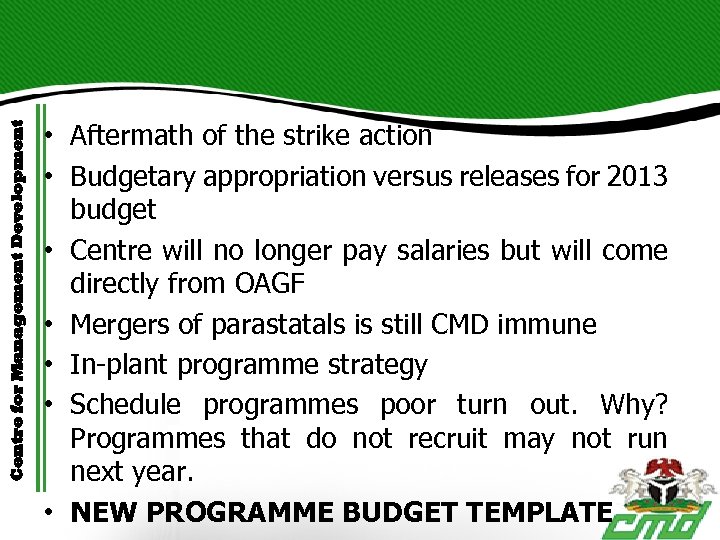
Centre for Management Development • Aftermath of the strike action • Budgetary appropriation versus releases for 2013 budget • Centre will no longer pay salaries but will come directly from OAGF • Mergers of parastatals is still CMD immune • In-plant programme strategy • Schedule programmes poor turn out. Why? Programmes that do not recruit may not run next year. • NEW PROGRAMME BUDGET TEMPLATE
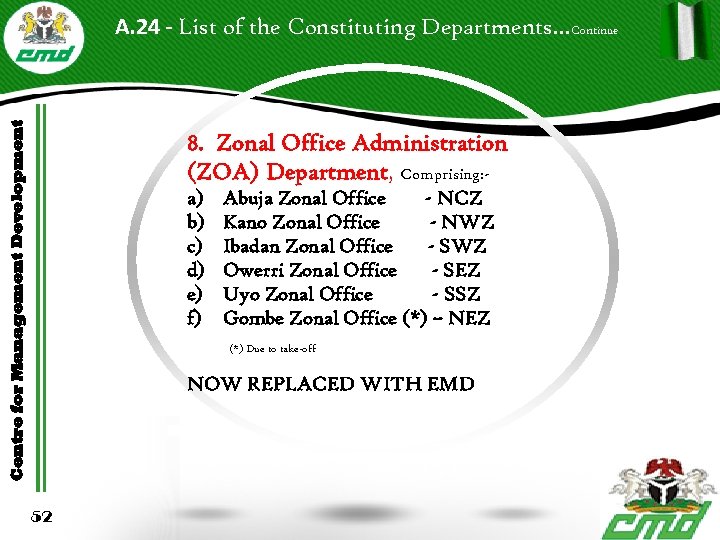
Centre for Management Development A. 24 - List of the Constituting Departments. . . Continue 8. Zonal Office Administration (ZOA) Department, Comprising: a) b) c) d) e) f) Abuja Zonal Office - NCZ Kano Zonal Office - NWZ Ibadan Zonal Office - SWZ Owerri Zonal Office - SEZ Uyo Zonal Office - SSZ Gombe Zonal Office (*) – NEZ (*) Due to take-off NOW REPLACED WITH EMD 52
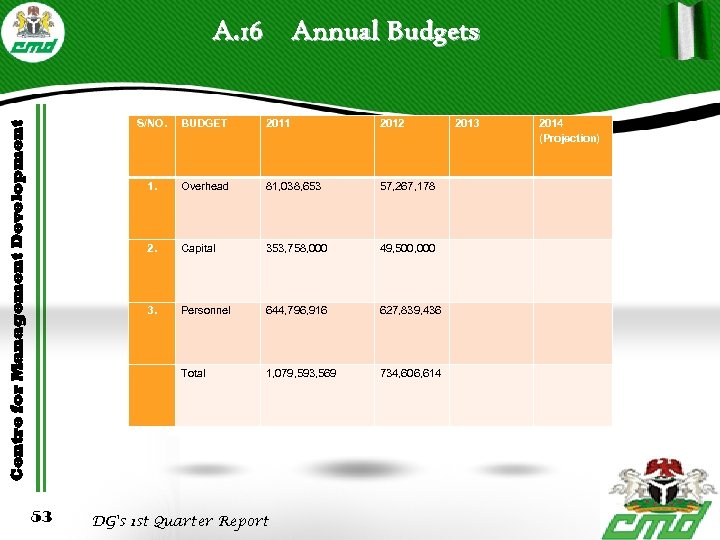
A. 16 Annual Budgets 2011 2012 2013 2014 (Projection) Overhead 81, 038, 653 57, 267, 178 2. Capital 353, 758, 000 49, 500, 000 3. Personnel 644, 796, 916 627, 839, 436 53 BUDGET 1. Centre for Management Development S/NO. Total 1, 079, 593, 569 734, 606, 614 DG's 1 st Quarter Report
Centre for Management Development F. 3 2013 Performance Agreement Target 54
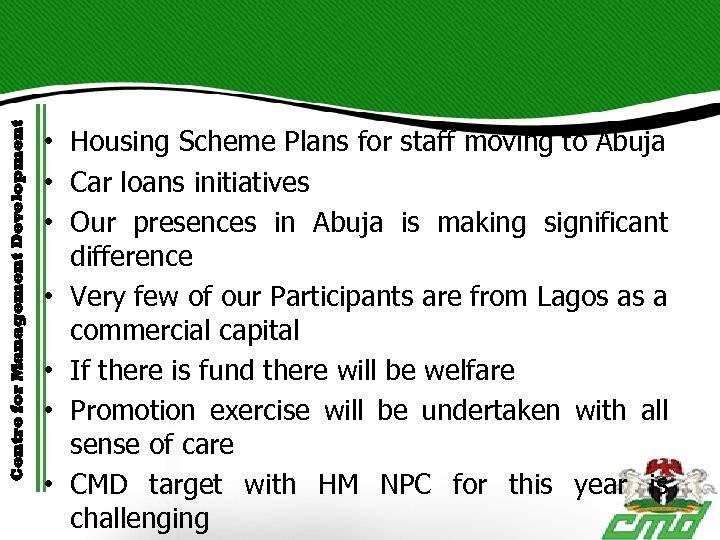
Centre for Management Development • Housing Scheme Plans for staff moving to Abuja • Car loans initiatives • Our presences in Abuja is making significant difference • Very few of our Participants are from Lagos as a commercial capital • If there is fund there will be welfare • Promotion exercise will be undertaken with all sense of care • CMD target with HM NPC for this year is challenging

Centre for Management Development • • • CMD ACT AMENDMENTS STAFF DEVELOPMENT ACBF PROJECT EMD EXECUTIVE MBA AND ENTERPRISE INSTITUTE DEPUTISING FOR ME IN LAGOS

C. 5 ACHIEVEMENTS…continued Centre for Management Development 7. Proposed CMD Headquarter in Abuja 57 DG's 1 st Quarter Report
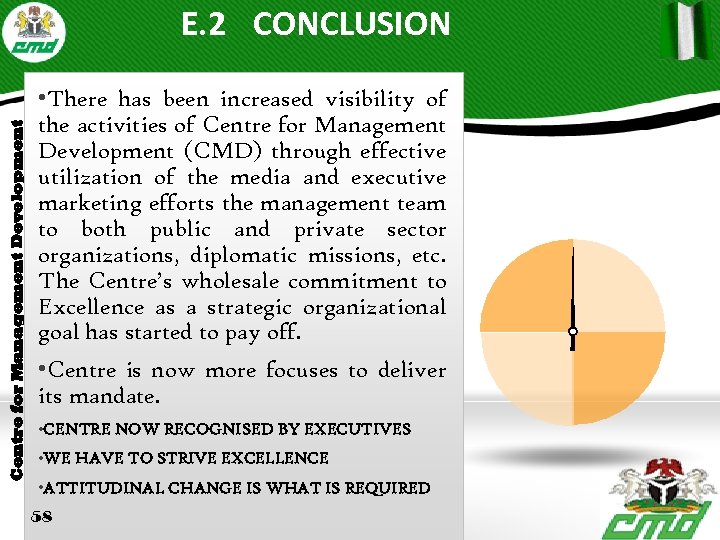
Centre for Management Development E. 2 CONCLUSION • There has been increased visibility of the activities of Centre for Management Development (CMD) through effective utilization of the media and executive marketing efforts the management team to both public and private sector organizations, diplomatic missions, etc. The Centre’s wholesale commitment to Excellence as a strategic organizational goal has started to pay off. • Centre is now more focuses to deliver its mandate. • CENTRE NOW RECOGNISED BY EXECUTIVES • WE HAVE TO STRIVE EXCELLENCE • ATTITUDINAL CHANGE IS WHAT IS REQUIRED 58
Centre for Management Development NEXT STEP C C PRODUCTIVITY AND HIGH PERFORMANCE C 59 C
Centre for Management Development NEXT STEPS • Never speak out of anger; Never act out of fear; Never choose from impatience; But wait…and peace will appear. • People may forget what you said and forget what you did, but may never forget how you made them feel. • Feeling gratitude and not expressing it is like wrapping a present and not giving it • BUILD THE CENTRE YOU FOUND BUT NOT TO DESTROY IT FOR SELFISH REASONS • WE MUST REMAIN COMPETITIVE TO SURVIVE
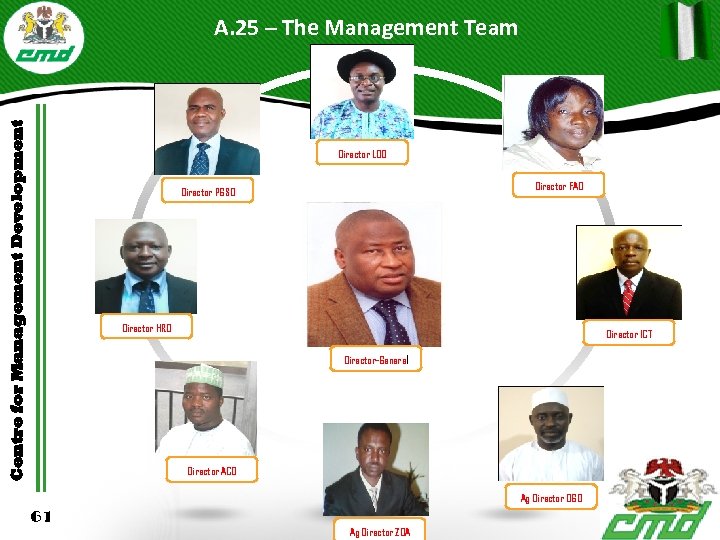
Centre for Management Development A. 25 – The Management Team Director LDD Director FAD Director PGSD Director HRD Director ICT Director-General Director ACD Ag Director DGO 61 Ag Director ZOA
Centre for Management Development THANK YOU FOR YOUR ATTENTION! Management Village, Shangisha, Off Old Lagos – Ibadan Expressway Toll-Gate, Lagos. Website: www. npc. gov. ng Dr Kabir Kabo Usman DIRECTOR GENERAL 62
Скачать презентацию Centre for Management Development STAFF BRIEFING — EMOTIONAL
547ed81dce849aae236b4d7adf6add3b.ppt