


 Скачать презентацию Centre for Applied Studies in International Negotiations CASIN
11343b684b52d88937c0c859452f274e.ppt
- Количество слайдов: 41
 Centre for Applied Studies in International Negotiations (CASIN) Geneva, August 29, 2002 ICT for Development Vanessa. Gray@itu. int International Telecommunication Union (ITU) Telecommunication Development Bureau (BDT) Telecommunication Data & Statistics Unit (TDS)
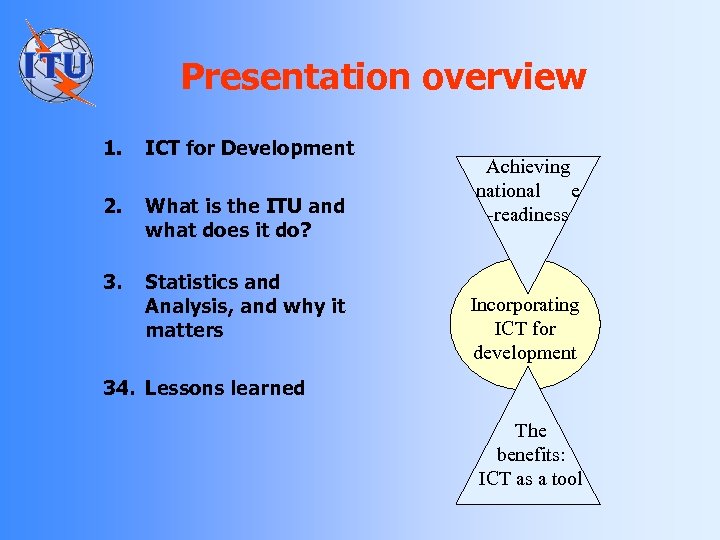 Presentation overview 1. ICT for Development 2. What is the ITU and what does it do? 3. Statistics and Analysis, and why it matters Achieving national e -readiness Incorporating ICT for development 34. Lessons learned The benefits: ICT as a tool
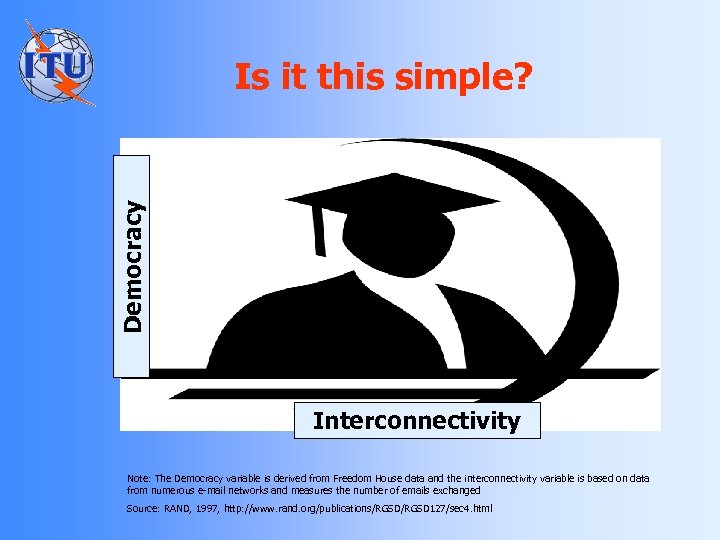 Democracy Is it this simple? Interconnectivity Note: The Democracy variable is derived from Freedom House data and the interconnectivity variable is based on data from numerous e-mail networks and measures the number of emails exchanged Source: RAND, 1997, http: //www. rand. org/publications/RGSD 127/sec 4. html
 ? How can ICT promote development?
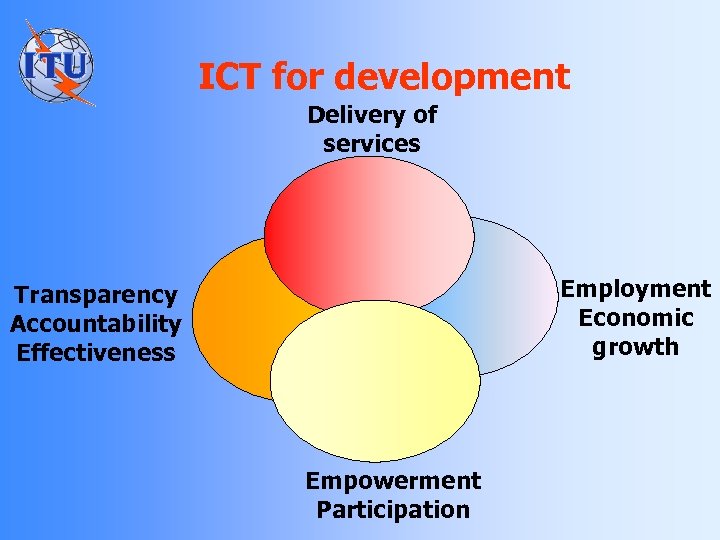 ICT for development Delivery of services Employment Economic growth Transparency Accountability Effectiveness Empowerment Participation
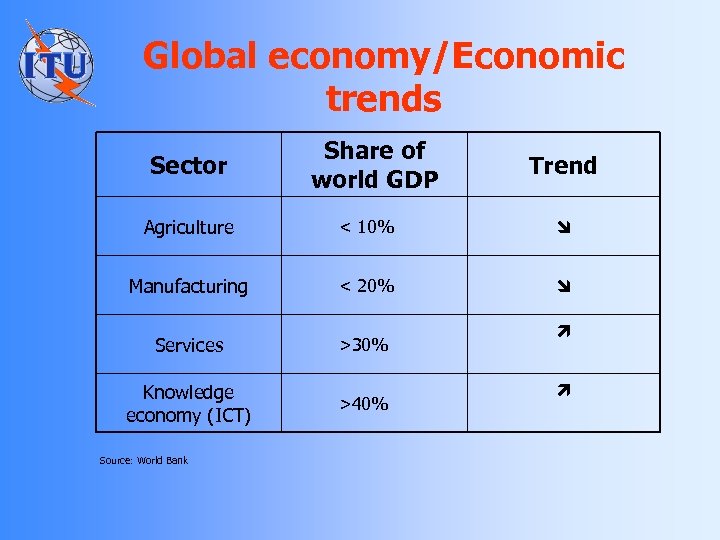 Global economy/Economic trends Sector Share of world GDP Trend Agriculture < 10% Manufacturing < 20% Services >30% Knowledge economy (ICT) >40% Source: World Bank
 Global Telecom Revenues US$ Billion Source: ITU
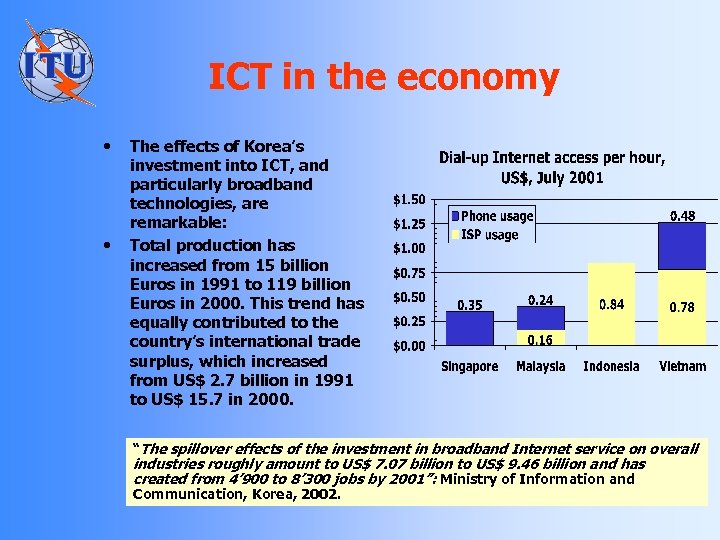 ICT in the economy • • The effects of Korea’s investment into ICT, and particularly broadband technologies, are remarkable: Total production has increased from 15 billion Euros in 1991 to 119 billion Euros in 2000. This trend has equally contributed to the country’s international trade surplus, which increased from US$ 2. 7 billion in 1991 to US$ 15. 7 in 2000. “The spillover effects of the investment in broadband Internet service on overall industries roughly amount to US$ 7. 07 billion to US$ 9. 46 billion and has created from 4’ 900 to 8’ 300 jobs by 2001”: Ministry of Information and Communication, Korea, 2002.
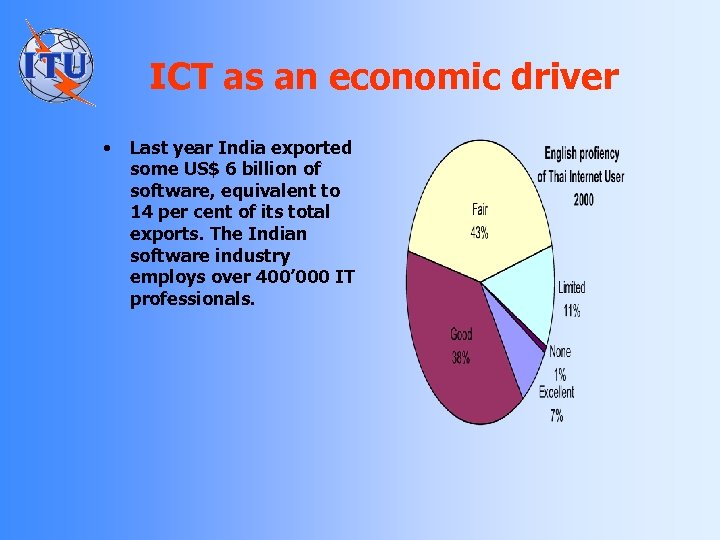 ICT as an economic driver • Last year India exported some US$ 6 billion of software, equivalent to 14 per cent of its total exports. The Indian software industry employs over 400’ 000 IT professionals.
 ICT creates better jobs… ü Many jobs of different levels / skills ü Higher pay ü Higher productivity jobs ü “White-collar” jobs ü Socially respected jobs ü Women participation in the workforce
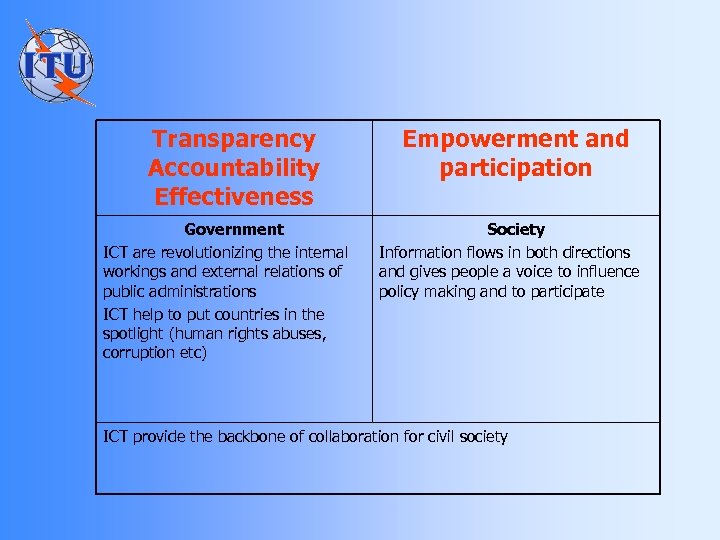 Transparency Accountability Effectiveness Government ICT are revolutionizing the internal workings and external relations of public administrations ICT help to put countries in the spotlight (human rights abuses, corruption etc) Empowerment and participation Society Information flows in both directions and gives people a voice to influence policy making and to participate ICT provide the backbone of collaboration for civil society
 Transparency Accountability Effectiveness • Witness. org is a human rights website that supports local activists and uses PCs, imaging and editing software, satellite phones and email to reveal human rights violations to governments and communities • In El Salvador Probidad (www. probidad. org) promotes democratization efforts by using ICT to monitor corruption, mobilize awareness about the complexities and costs of corruption and promote local and contextspecific measures to promote good governance
 Transparency Accountability Effectiveness • • South Africa’s Political Information and Monitoring Service (PIMS) aims to promote democracy by providing easy-to-understand summaries of complicated documents and by helping citizens to make submissions to parliament In Vietnam “Your lawyer” is a CD-ROM with information on citizens’ rights, how to start a business, protect land rights and get a divorce. It is distributed to media organizations, and representations in all provinces and peoples’ councils.
 Delivery of services • The South Africa IT Strategy project (SAITIS) provides Internet access in schools as well as community Internet access points where public information terminals allow citizens to access government online services
 Delivery of services • In Estonia and in Hungary the state and local governments have set up rural telecottages to promote education and research in rural areas. Farmers are expanding their access to markets by offering their products online locally. Estonian web designers, some of which live in rural areas, have clients all over the world.
 For more ICT success stories… ITU’s Information and Communication Technology success factor home page http: //www. itu. int/osg/spu/wsis-themes/ict_stories/index. html
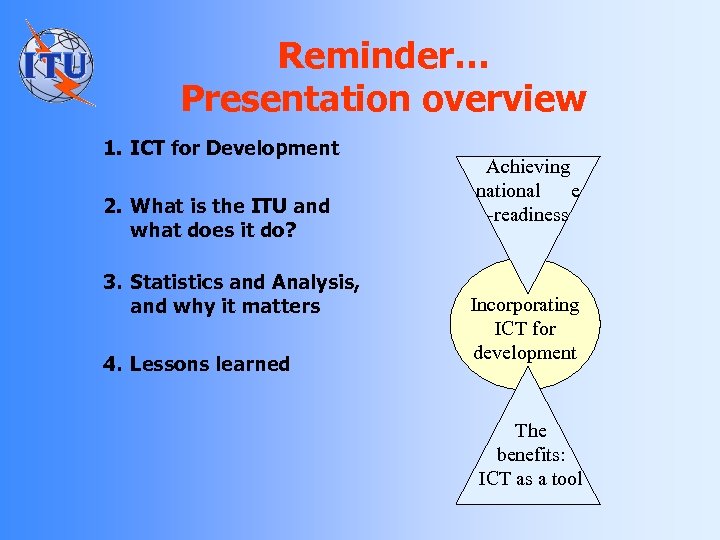 Reminder… Presentation overview 1. ICT for Development 2. What is the ITU and what does it do? 3. Statistics and Analysis, and why it matters 4. Lessons learned Achieving national e -readiness Incorporating ICT for development The benefits: ICT as a tool
 ITU • The International Telecommunication Union (ITU) is the United Nation specialized agency for telecommunications • Founded in 1865, the ITU has 189 Member states and 667 sector members • It is based in Geneva and has 11 regional offices around the world • The three Sectors of the ITU are – Radiocommunication – Telecommunication Standardization – Telecommunication Development Bureau (BDT)
 ITU’s purpose • The ITU is an impartial, international organization within which governments and the private sector work together to coordinate the operation of telecommunication networks and services and advance the development of communications technology • The International Telecommunication Union is unique among international organizations in that it was founded on the principle of cooperation between governments and the private sector • Its members include telecommunication policy-makers and regulators, network operators, equipment manufacturers, hardware and software developers, regional standardsmaking organizations and financing institutions
 The World Summit on the Information Society (WSIS) • • To bring together major players to discuss the changes, the opportunities, and the dangers, emerging from the fundamental global transformation Participants will include heads of state, executive heads of the UN agencies, industry leaders, nongovernmental organizations, media representatives and civil society
 Statistics and Analysis – and why it matters • As a UN agency the ITU is in charge of producing statistics covering its sector. This activity is part of the global statistical system of the UN • The Telecommunication, Data, and Statistics Unit collects data for some 200 economies • Data is collected by means of an annual questionnaire and provided by government ministries, regulators, and telecom operators
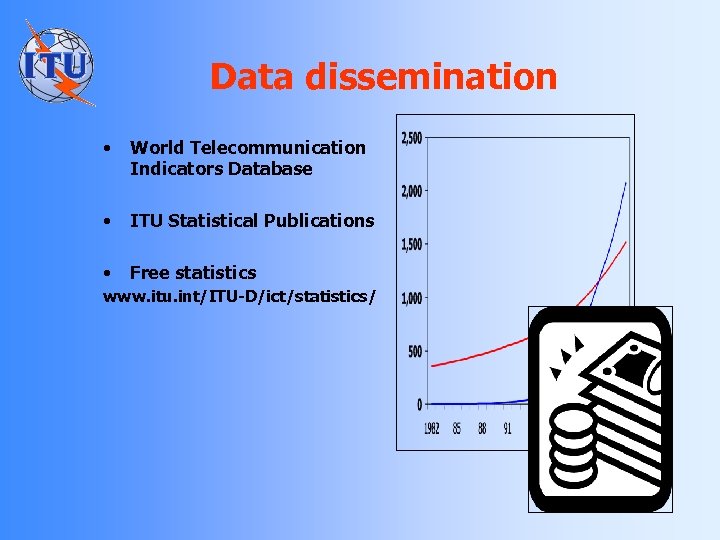 Data dissemination • World Telecommunication Indicators Database • ITU Statistical Publications • Free statistics www. itu. int/ITU-D/ict/statistics/
 Analysis – using and interpreting the statistics World Telecommunication Development Reports • Analyzing trends and developments • What has worked and what hasn’t?
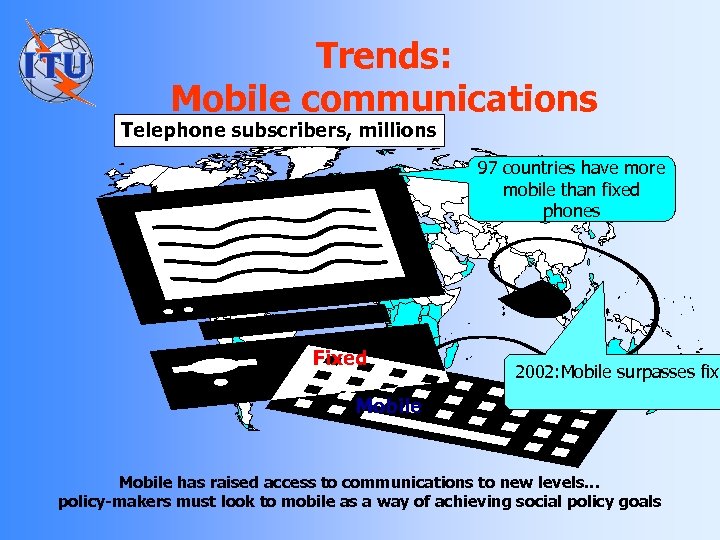 Trends: Mobile communications Telephone subscribers, millions 97 countries have more mobile than fixed phones Fixed 2002: Mobile surpasses fixe Mobile has raised access to communications to new levels… policy-makers must look to mobile as a way of achieving social policy goals
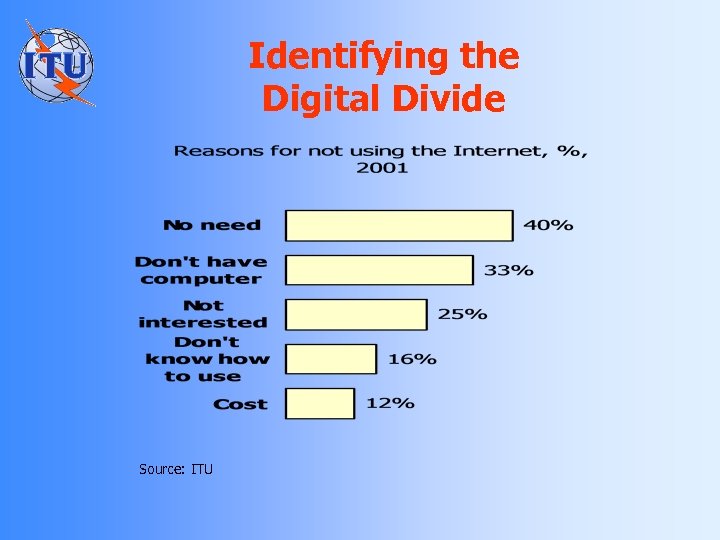 Identifying the Digital Divide Source: ITU
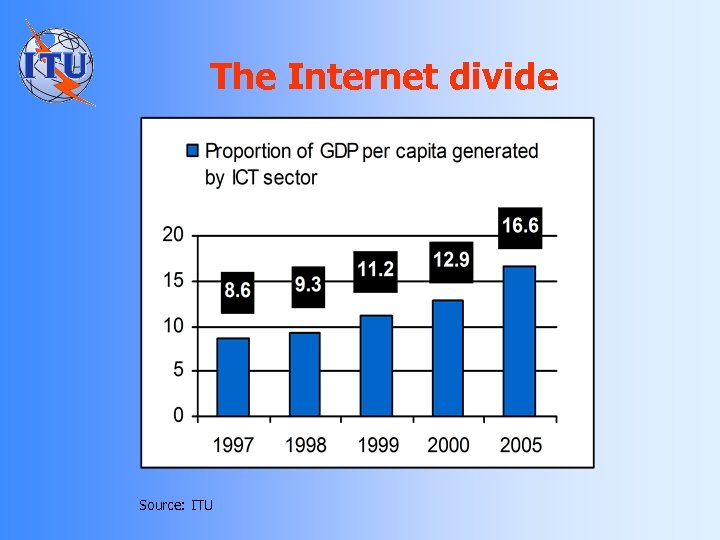 The Internet divide Source: ITU
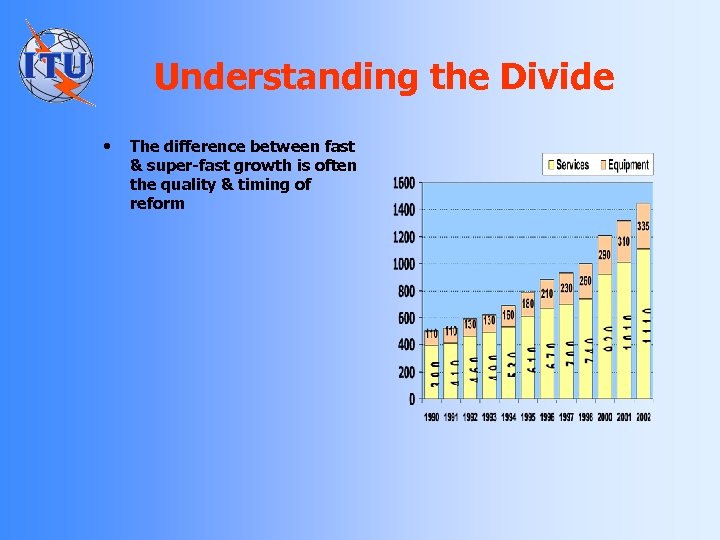 Understanding the Divide • The difference between fast & super-fast growth is often the quality & timing of reform
 Understanding the Divide • Awareness and content are major factors that influence Internet usage
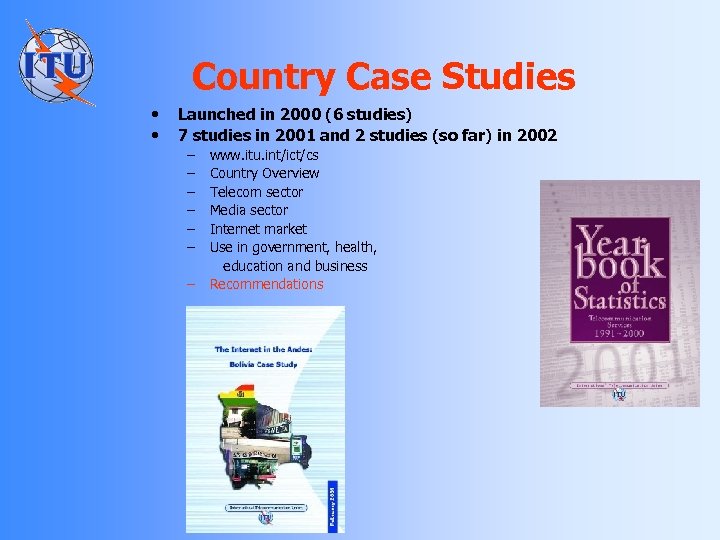 Country Case Studies • • Launched in 2000 (6 studies) 7 studies in 2001 and 2 studies (so far) in 2002 – – – – www. itu. int/ict/cs Country Overview Telecom sector Media sector Internet market Use in government, health, education and business Recommendations
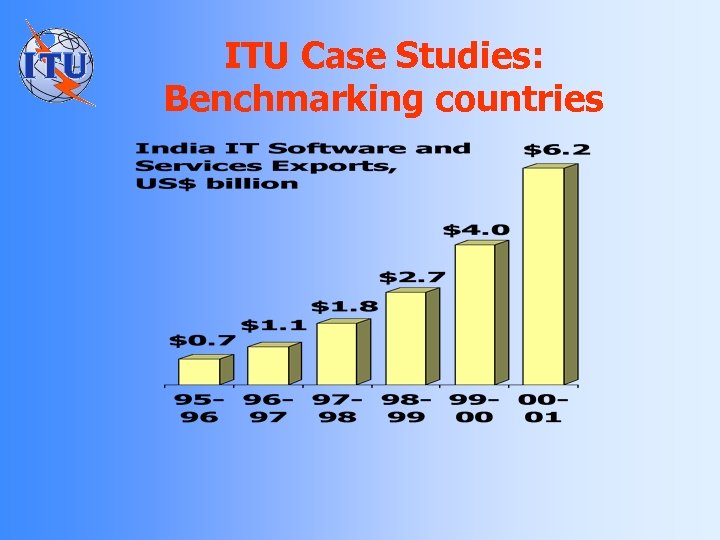 ITU Case Studies: Benchmarking countries
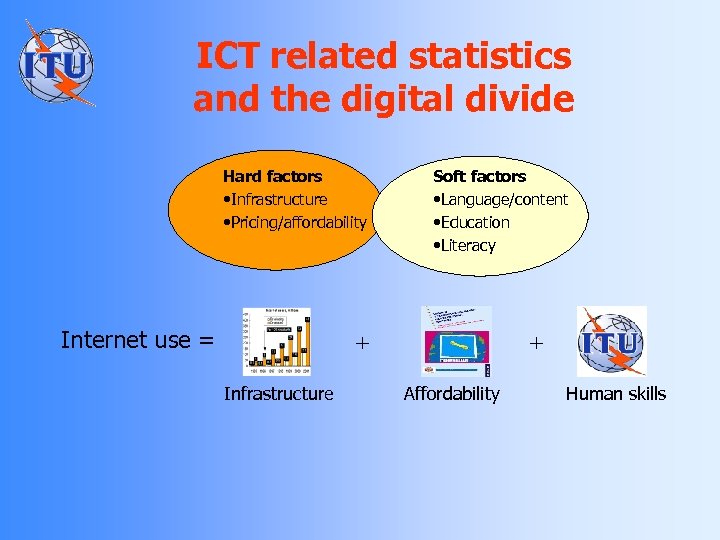 ICT related statistics and the digital divide Hard factors • Infrastructure • Pricing/affordability Internet use = Soft factors • Language/content • Education • Literacy + Infrastructure + Affordability Human skills
 Pricing/affordability
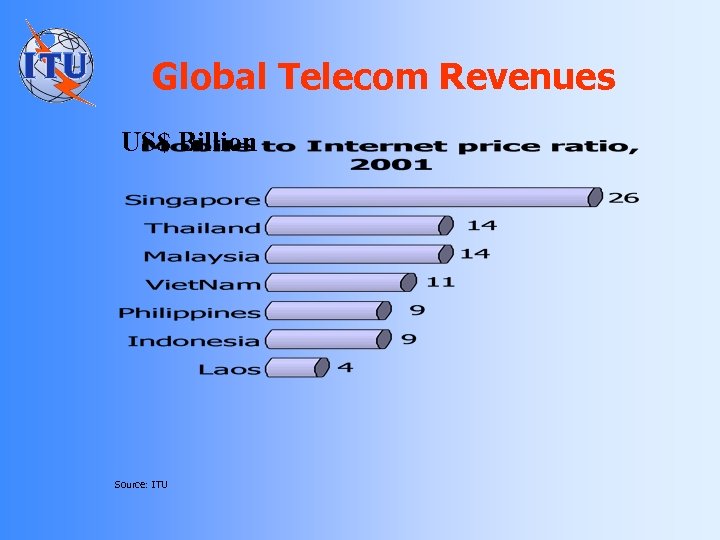
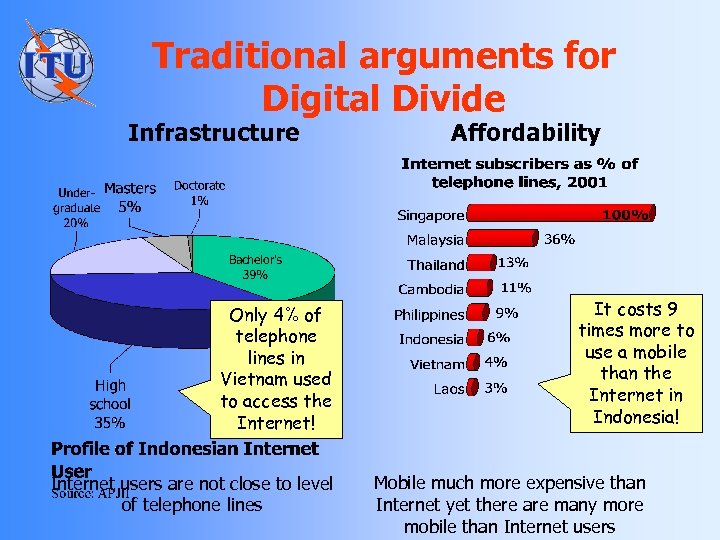 Traditional arguments for Digital Divide Infrastructure Only 4% of telephone lines in Vietnam used to access the Internet! Internet users are not close to level of telephone lines Affordability It costs 9 times more to use a mobile than the Internet in Indonesia! Mobile much more expensive than Internet yet there are many more mobile than Internet users
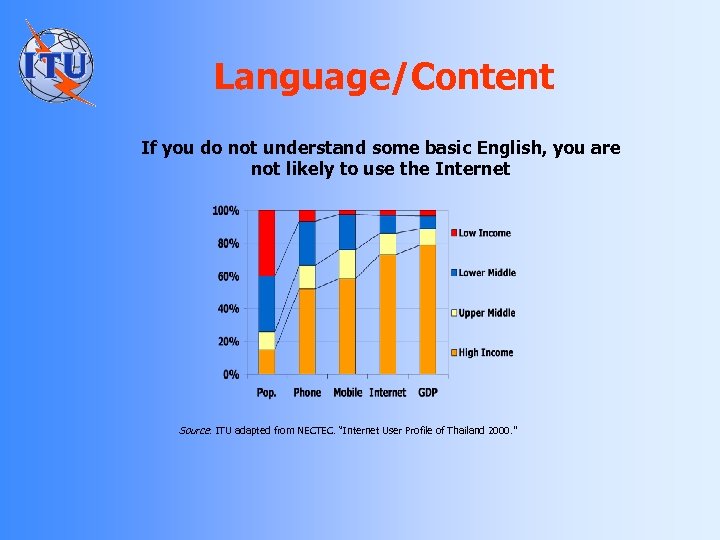 Language/Content If you do not understand some basic English, you are not likely to use the Internet Source: ITU adapted from NECTEC. “Internet User Profile of Thailand 2000. ”
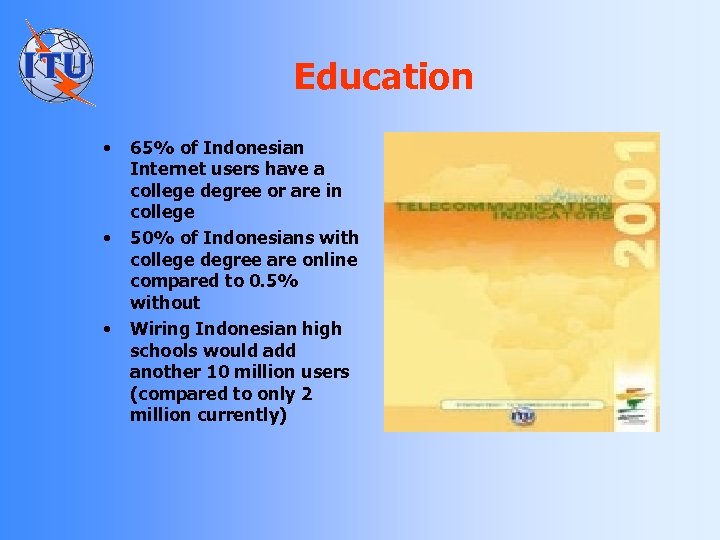 Education • • • 65% of Indonesian Internet users have a college degree or are in college 50% of Indonesians with college degree are online compared to 0. 5% without Wiring Indonesian high schools would add another 10 million users (compared to only 2 million currently)
 Lessons learned… Know where you stand where you are going…. ! To adopt the appropriate policies, a government needs to identify its SWOTs? • • • Collection of statistics (beyond the pure ICT statistics) Analysis Trends User profiles What are your needs? Strengths Weaknesses Opportunities Threats
 Vison! • Top-level support and a vision for ICT development • Coordination of ICT initiatives to avoid duplication and guarantee success • A comprehensive ICT and e-development strategy
 Private/public partnership Governments – need to attract and work closely with the private sector – need to create the appropriate environment for private companies to invest “A combination of well-designed concession agreements with foreign telecommunications operators, clear government support for a broad e-readiness program, aggressive public awareness-raising, and governmental commitment to the digital revolution have made for Estonia’s successful adoption of ICT to both position the economy, but also to address selected development goals” Toomas Hendrik Ilves, Estonian Minister of Foreign Affairs, 2001
 Be critical! • Objectivity about achievements/goals • ‘We can do better’ mentality
 External aid • Governments can learn a lot from other countries, including from the mistakes they made. Cooperating with other countries and participation in international/regional forums and meetings is of great importance. • When asking for development assistance governments should • develop their own ideas/projects because no one knows their needs better than they themselves • get involved in the project, without letting outsiders decide unilaterally • Have a (financial) stake in the project • Incorporate ICT element in projects
 Thank you Vanessa. Gray@itu. int