


 Скачать презентацию Central Electricity Authority Presentation on Hydro Power Development
81d6409fc87ded21e41c5e6be305f3a0.ppt
- Количество слайдов: 71
 Central Electricity Authority Presentation on “Hydro Power Development in India” 1
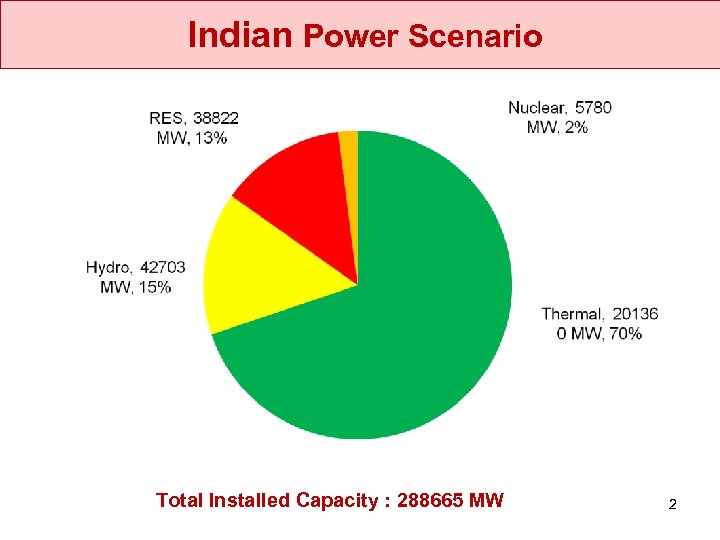 Indian Power Scenario Total Installed Capacity : 288665 MW 2
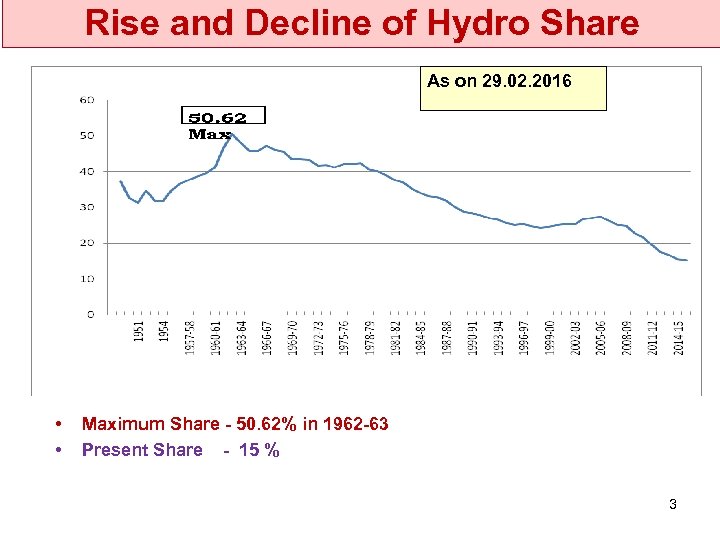 Rise and Decline of Hydro Share As on 29. 02. 2016 • • Maximum Share - 50. 62% in 1962 -63 Present Share - 15 % 3
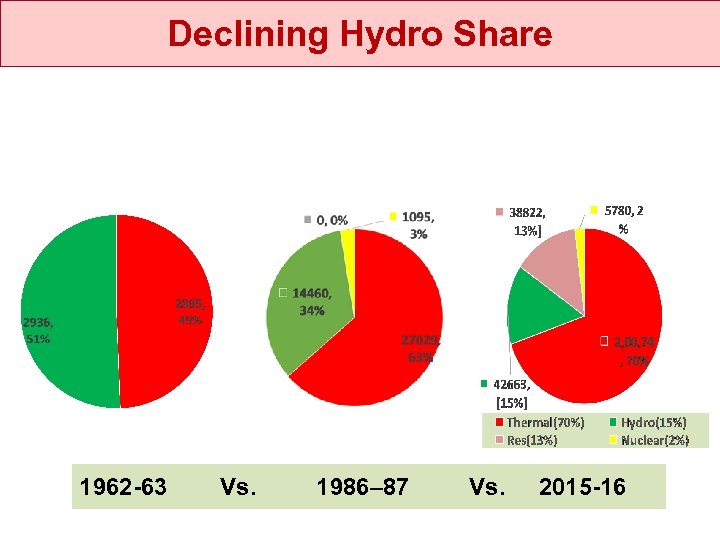 Declining Hydro Share 1962 -63 Vs. 1986– 87 Vs. 2015 -16
 Reason for Decline of Share of Hydro Power in Indian Energy Mix • Decline in Share of hydro - from about 51% in 1962 -63 to about 15% now. Factors contributed to the slow growth/ decline of hydro share: • Upto 1960 s, the major emphasis of the Govt. was on development of multi-purpose reservoir based hydro projects like Hirakund, Bhakhra, Damodar Valley projects etc. mainly to have irrigation for better food security which also led to development of hydro capacity. • Greater emphasis on rapid development of thermal power during 1970 s for quicker capacity addition in view of large scale industrialization. • Drying-up/ cancellation of bi-lateral/ multi-lateral funding for projects like Sardar Sarovar, Upper Indravati, Sharavathy TR and Kalinadi-2 etc. and non-tie-up of WBloan in respect of others like Indira Sagar Project (1000 MW) etc. • Increasingly stringent environment clearance regime after 1970 s due to world-wide focus on environmental, ecological and R&R issues and activism against development of hydro projects by NGOs/ Environmental activists leading to delay in projects. • Factors like Lack of adequate infrastructure, Land acquisition issues, R&R issues, inter-state issues and non-tie-up/ non-availability of requisite finances on long term basis etc. have further slowed down the development of hydro power. 5
 Hydro Power - Sustainable, Clean and Green Alternative • Renewable, Non-Polluting and Environmental Friendly. Promotes Conservation of Fossil Fuel. • No fuel cost, remains escalation free and economical in long run. • Improves quality of life in remote hilly and backward areas by accruing incidental benefits of electrification, industrialization & road/ rail communication development. • Ability for instantaneous starting, stopping and load variation, thereby ideally suited for peaking operation and improves reliability of power system. • Storage projects provide flood control, irrigation, drinking water supply, recreation facilities etc and thus help in the maximum utilization of scarce water resources. • Pumped Storage Hydro schemes besides providing peaking power also act as Energy storage devices. • Improves Reliability of Power System, particularly in view of emphasis on Solar/ Wind power 6
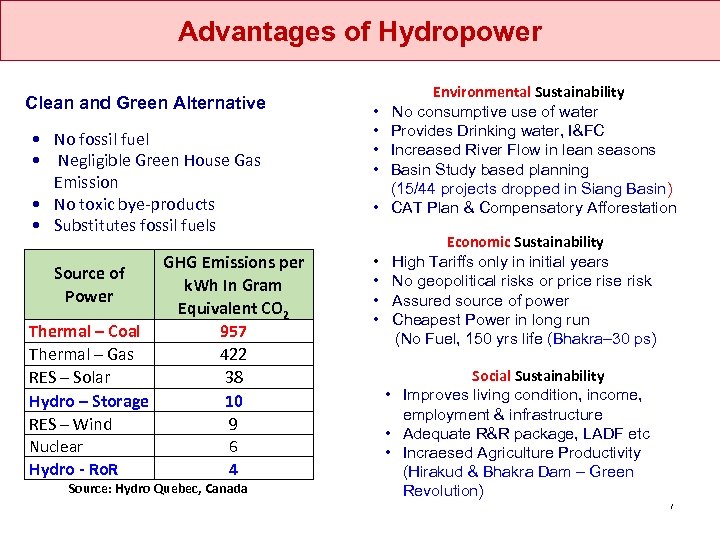 Advantages of Hydropower Clean and Green Alternative • No fossil fuel • Negligible Green House Gas Emission • No toxic bye-products • Substitutes fossil fuels GHG Emissions per k. Wh In Gram Equivalent CO 2 Thermal – Coal 957 Thermal – Gas 422 RES – Solar 38 Hydro – Storage 10 RES – Wind 9 Source of Power Nuclear 6 Hydro - Ro. R 4 Source: Hydro Quebec, Canada Environmental Sustainability • No consumptive use of water • Provides Drinking water, I&FC • Increased River Flow in lean seasons • Basin Study based planning (15/44 projects dropped in Siang Basin) • CAT Plan & Compensatory Afforestation Economic Sustainability • High Tariffs only in initial years • No geopolitical risks or price risk • Assured source of power • Cheapest Power in long run (No Fuel, 150 yrs life (Bhakra– 30 ps) Social Sustainability • Improves living condition, income, employment & infrastructure • Adequate R&R package, LADF etc • Incraesed Agriculture Productivity (Hirakud & Bhakra Dam – Green Revolution) 7 7
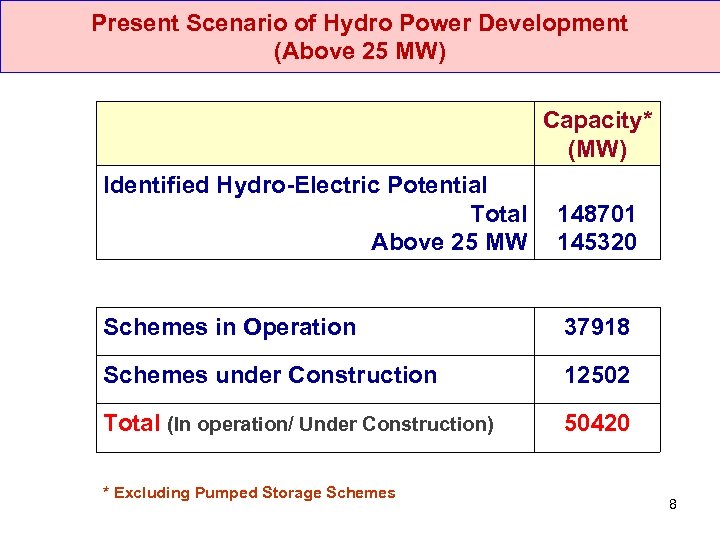 Present Scenario of Hydro Power Development (Above 25 MW) Capacity* (MW) Identified Hydro-Electric Potential Total 148701 Above 25 MW 145320 Schemes in Operation 37918 Schemes under Construction 12502 Total (In operation/ Under Construction) 50420 * Excluding Pumped Storage Schemes 8
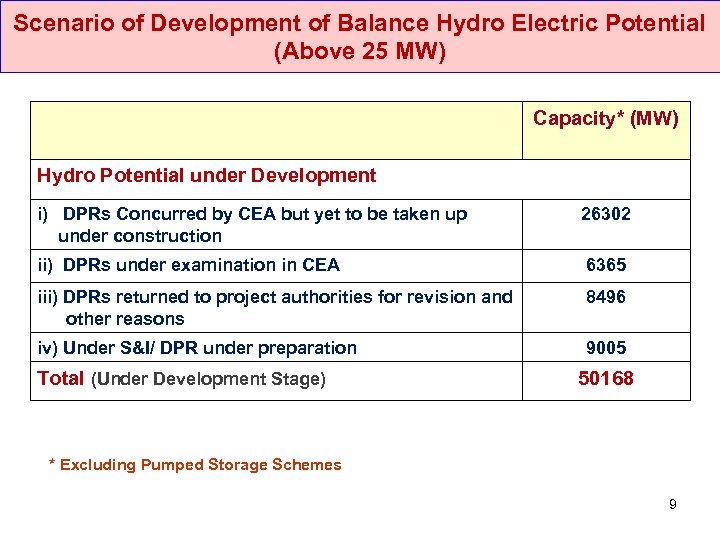 Scenario of Development of Balance Hydro Electric Potential (Above 25 MW) Capacity* (MW) Hydro Potential under Development i) DPRs Concurred by CEA but yet to be taken up under construction 26302 ii) DPRs under examination in CEA 6365 iii) DPRs returned to project authorities for revision and other reasons 8496 iv) Under S&I/ DPR under preparation 9005 Total (Under Development Stage) 50168 * Excluding Pumped Storage Schemes 9
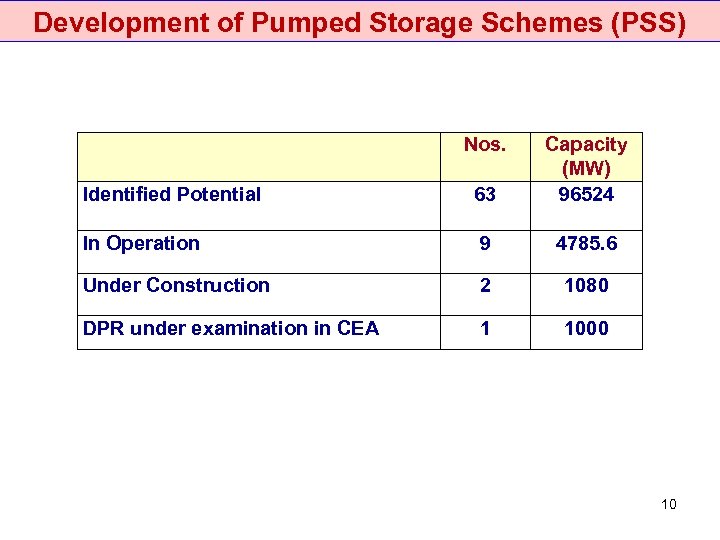 Development of Pumped Storage Schemes (PSS) Nos. Identified Potential 63 Capacity (MW) 96524 In Operation 9 4785. 6 Under Construction 2 1080 DPR under examination in CEA 1 1000 10
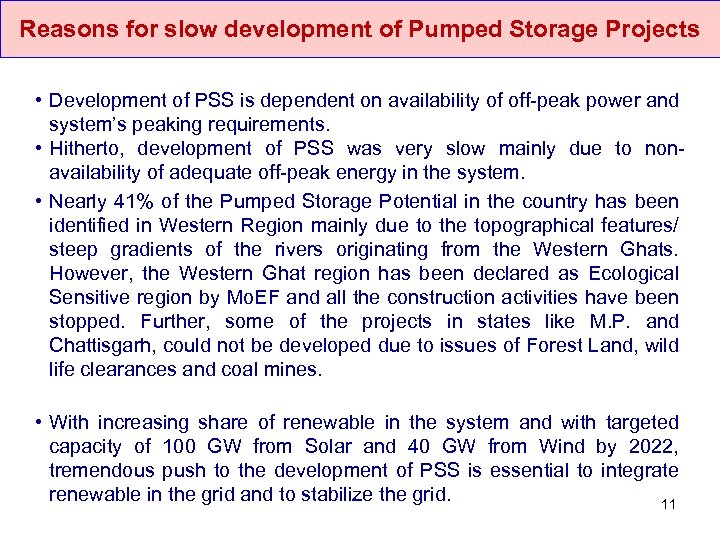 Reasons for slow development of Pumped Storage Projects • Development of PSS is dependent on availability of off-peak power and system’s peaking requirements. • Hitherto, development of PSS was very slow mainly due to nonavailability of adequate off-peak energy in the system. • Nearly 41% of the Pumped Storage Potential in the country has been identified in Western Region mainly due to the topographical features/ steep gradients of the rivers originating from the Western Ghats. However, the Western Ghat region has been declared as Ecological Sensitive region by Mo. EF and all the construction activities have been stopped. Further, some of the projects in states like M. P. and Chattisgarh, could not be developed due to issues of Forest Land, wild life clearances and coal mines. • With increasing share of renewable in the system and with targeted capacity of 100 GW from Solar and 40 GW from Wind by 2022, tremendous push to the development of PSS is essential to integrate renewable in the grid and to stabilize the grid. 11
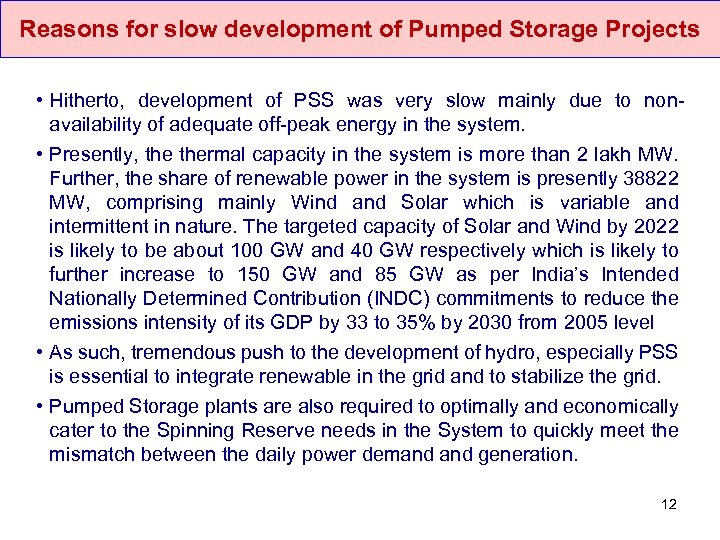 Reasons for slow development of Pumped Storage Projects • Hitherto, development of PSS was very slow mainly due to nonavailability of adequate off-peak energy in the system. • Presently, thermal capacity in the system is more than 2 lakh MW. Further, the share of renewable power in the system is presently 38822 MW, comprising mainly Wind and Solar which is variable and intermittent in nature. The targeted capacity of Solar and Wind by 2022 is likely to be about 100 GW and 40 GW respectively which is likely to further increase to 150 GW and 85 GW as per India’s Intended Nationally Determined Contribution (INDC) commitments to reduce the emissions intensity of its GDP by 33 to 35% by 2030 from 2005 level • As such, tremendous push to the development of hydro, especially PSS is essential to integrate renewable in the grid and to stabilize the grid. • Pumped Storage plants are also required to optimally and economically cater to the Spinning Reserve needs in the System to quickly meet the mismatch between the daily power demand generation. 12
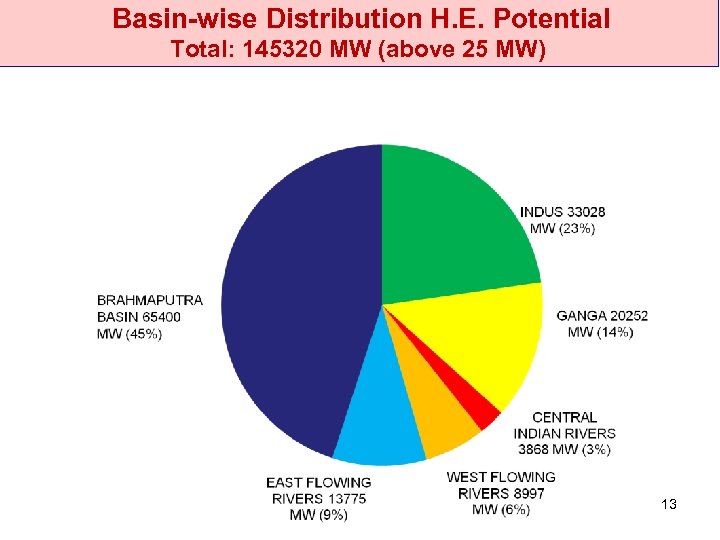 Basin-wise Distribution H. E. Potential Total: 145320 MW (above 25 MW) 13
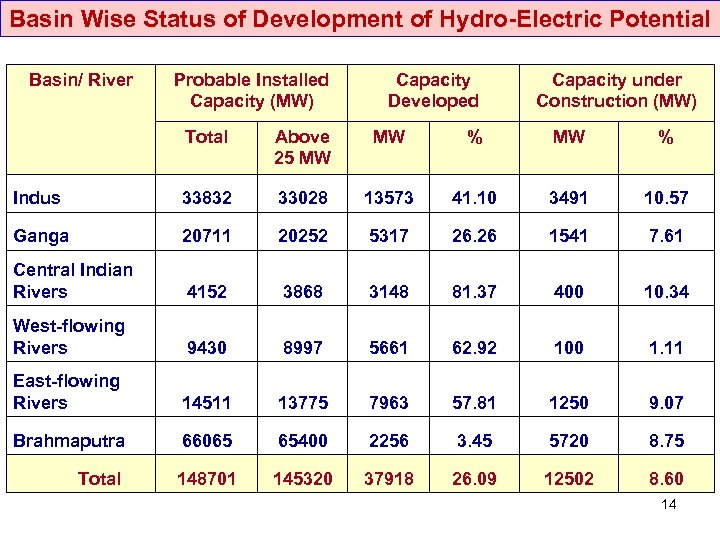 Basin Wise Status of Development of Hydro-Electric Potential Basin/ River Probable Installed Capacity (MW) Capacity Developed Capacity under Construction (MW) Total Above 25 MW MW % Indus 33832 33028 13573 41. 10 3491 10. 57 Ganga 20711 20252 5317 26. 26 1541 7. 61 Central Indian Rivers 4152 3868 3148 81. 37 400 10. 34 West-flowing Rivers 9430 8997 5661 62. 92 100 1. 11 East-flowing Rivers 14511 13775 7963 57. 81 1250 9. 07 Brahmaputra 66065 65400 2256 3. 45 5720 8. 75 Total 145320 148701 37918 26. 09 12502 8. 60 14
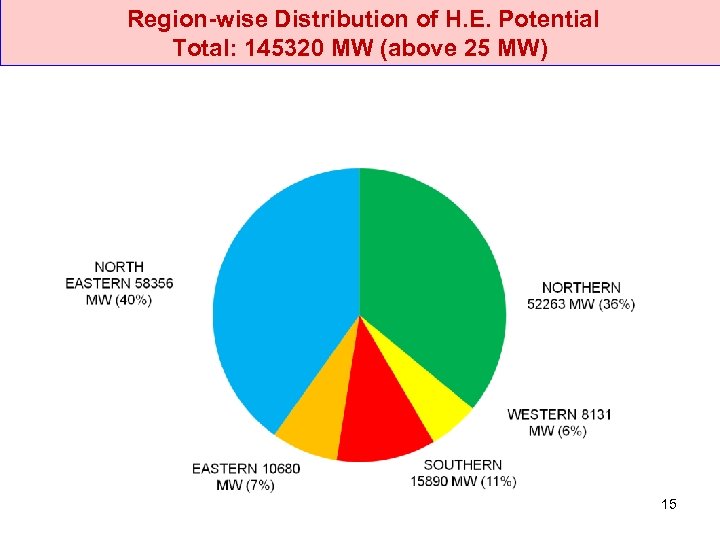 Region-wise Distribution of H. E. Potential Total: 145320 MW (above 25 MW) 15
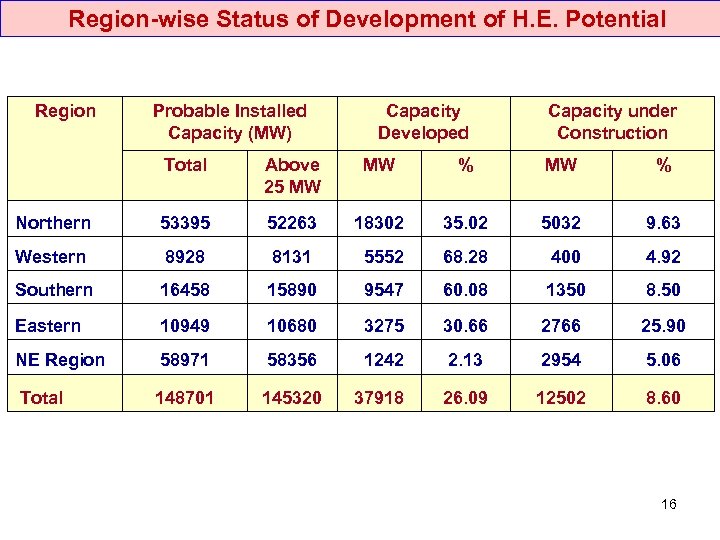 Region-wise Status of Development of H. E. Potential Region Probable Installed Capacity (MW) Capacity Developed Capacity under Construction Total Above 25 MW MW % Northern 53395 52263 18302 35. 02 5032 9. 63 Western 8928 8131 5552 68. 28 400 4. 92 Southern 16458 15890 9547 60. 08 1350 8. 50 Eastern 10949 10680 3275 30. 66 2766 25. 90 NE Region 58971 58356 1242 2. 13 2954 5. 06 Total 148701 145320 37918 26. 09 12502 8. 60 16
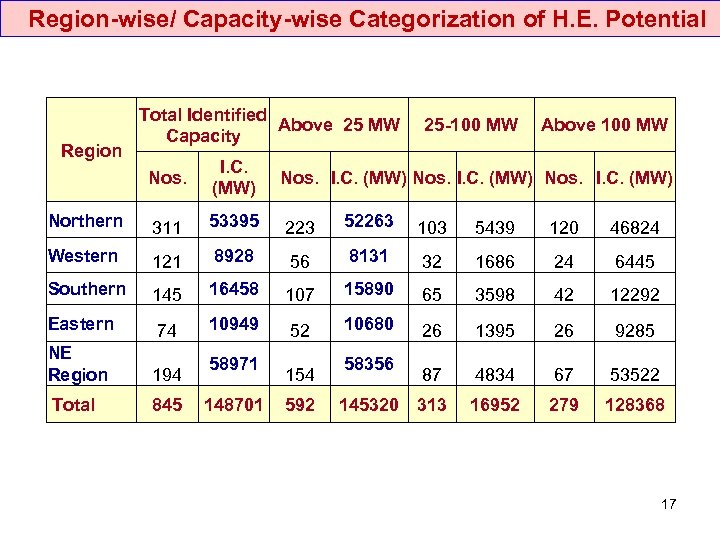 Region-wise/ Capacity-wise Categorization of H. E. Potential Region Total Identified Above 25 MW Capacity 25 -100 MW Above 100 MW Nos. I. C. (MW) Nos. I. C. (MW) Northern 311 53395 223 52263 103 5439 120 46824 Western 121 8928 56 8131 32 1686 24 6445 Southern 145 16458 107 15890 65 3598 42 12292 Eastern 74 10949 52 10680 26 1395 26 9285 NE Region 194 87 4834 67 53522 145320 313 16952 279 128368 58971 Total 845 148701 154 592 58356 17
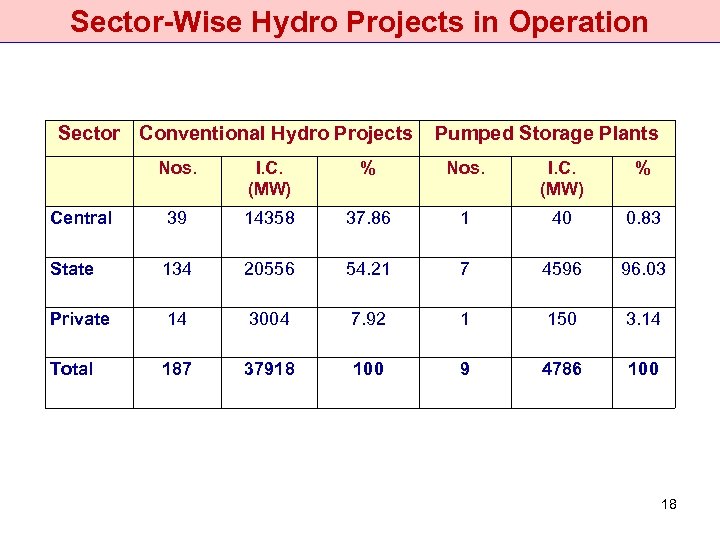 Sector-Wise Hydro Projects in Operation Sector Conventional Hydro Projects Pumped Storage Plants Nos. I. C. (MW) % Central 39 14358 37. 86 1 40 0. 83 State 134 20556 54. 21 7 4596 96. 03 Private 14 3004 7. 92 1 150 3. 14 Total 187 37918 100 9 4786 100 18
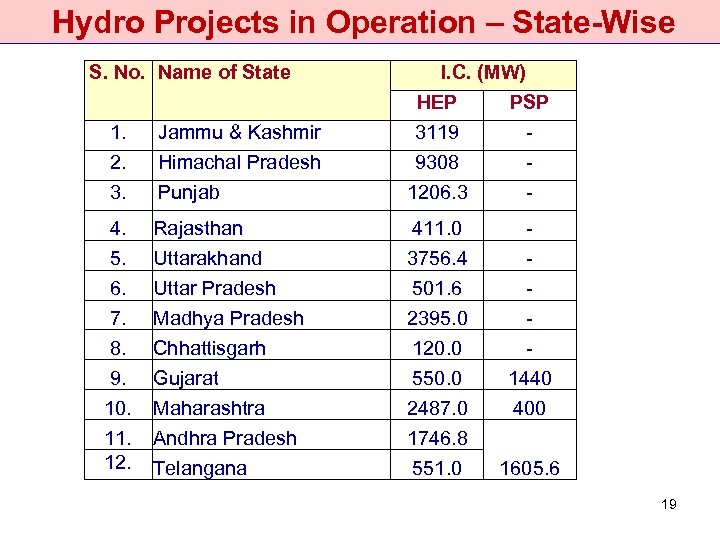 Hydro Projects in Operation – State-Wise S. No. Name of State 1. 2. 3. Jammu & Kashmir Himachal Pradesh Punjab I. C. (MW) HEP PSP 3119 9308 1206. 3 - 4. 5. 6. 7. 8. 9. 10. 11. 12. Rajasthan Uttarakhand Uttar Pradesh Madhya Pradesh Chhattisgarh Gujarat Maharashtra Andhra Pradesh Telangana 411. 0 3756. 4 501. 6 2395. 0 120. 0 550. 0 2487. 0 1746. 8 551. 0 1440 400 1605. 6 19
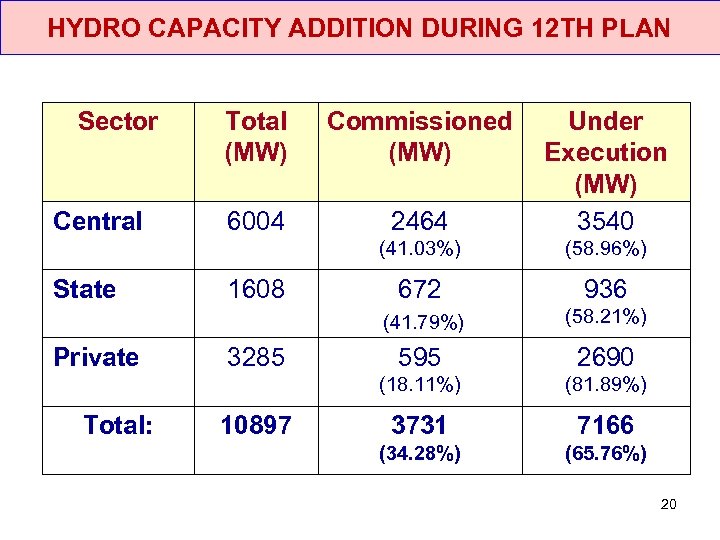 HYDRO CAPACITY ADDITION DURING 12 TH PLAN Sector Central Total (MW) 6004 Commissioned Under (MW) Execution (MW) 2464 3540 (41. 03%) Private Total: 1608 672 936 (58. 21%) 3285 (41. 79%) 595 (18. 11%) State (58. 96%) (81. 89%) 3731 7166 (34. 28%) (65. 76%) 10897 2690 20
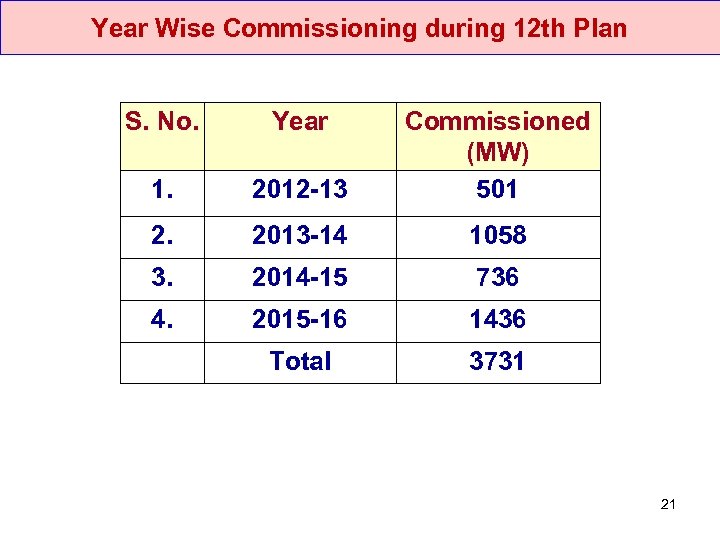 Year Wise Commissioning during 12 th Plan S. No. Year 1. 2012 -13 Commissioned (MW) 501 2. 2013 -14 1058 3. 2014 -15 736 4. 2015 -16 1436 Total 3731 21
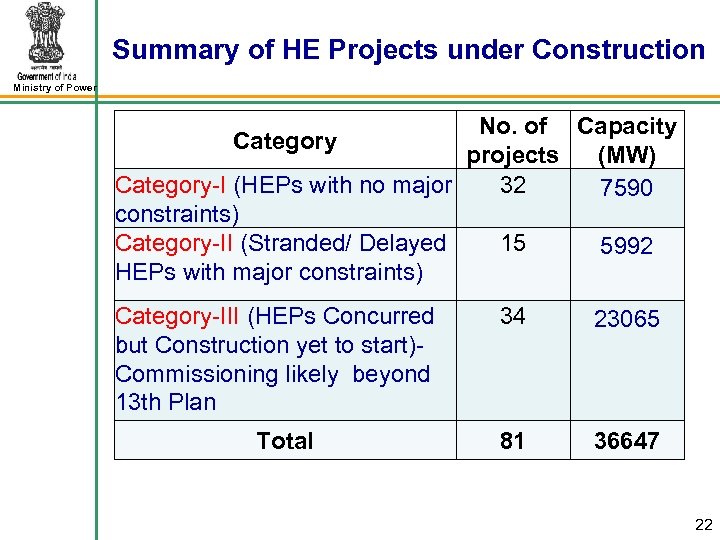 Summary of HE Projects under Construction Ministry of Power No. of Capacity Category projects (MW) Category-I (HEPs with no major 32 7590 constraints) Category-II (Stranded/ Delayed 15 5992 HEPs with major constraints) Category-III (HEPs Concurred but Construction yet to start)Commissioning likely beyond 13 th Plan 34 23065 Total 81 36647 22
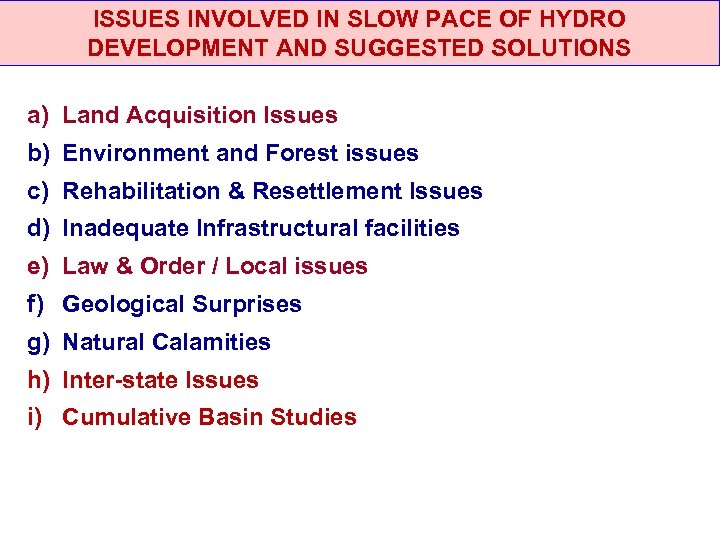 ISSUES INVOLVED IN SLOW PACE OF HYDRO DEVELOPMENT AND SUGGESTED SOLUTIONS a) Land Acquisition Issues b) Environment and Forest issues c) Rehabilitation & Resettlement Issues d) Inadequate Infrastructural facilities e) Law & Order / Local issues f) Geological Surprises g) Natural Calamities h) Inter-state Issues i) Cumulative Basin Studies
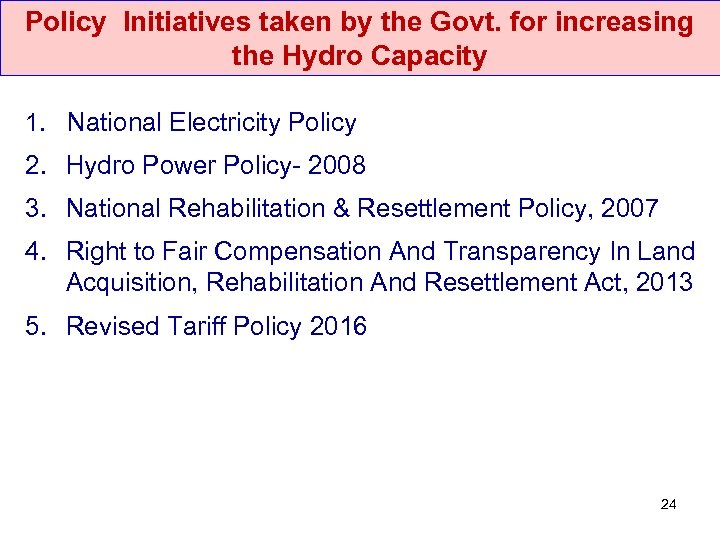 Policy Initiatives taken by the Govt. for increasing the Hydro Capacity 1. National Electricity Policy 2. Hydro Power Policy- 2008 3. National Rehabilitation & Resettlement Policy, 2007 4. Right to Fair Compensation And Transparency In Land Acquisition, Rehabilitation And Resettlement Act, 2013 5. Revised Tariff Policy 2016 24
 National Electricity Policy • Emphasis on full development of the feasible hydro potential in the country which will facilitate economic development of hydro-rich States like North Eastern States, Uttarakhand, Himachal Pradesh and Jammu & Kashmir. • Debt financing of longer tenure has been recommended. • State Governments advised to review procedure for land acquisition and other approvals/ clearances for speedy implementation of hydro projects. • Full support of Central Government has been extended for hydel development by offering the services of CPSUs like NHPC, NEEPCO, SJVNL, THDC etc. 25
 Hydro Power Policy- 2008: Salient Features (including subsequent changes) • Transparent selection criteria for awarding sites to private developers. • Enables developer to recover his additional costs through merchant sale of upto a maximum of 40% of the saleable energy. 5% reduction for a delay of every six months. – Balance long term PPAs • The cost plus Tariff regime (in which tariff is to be determined by the regulator under section 62 of Electricity Act, 2003) has been extended for public as well as private sector hydro power projects up to 15. 08. 2022. (as notified in Revised Tariff Policy, 2016) 26
 Hydro Power Policy- 2008: Salient Features (including subsequent changes) • For 10 years from the COD, developer to provide 100 units of electricity per month to each PAF - in cash or kind or a combination of both. • Project developer assists in implementing rural electrification in the vicinity of the project area and contributes the 10% share of the State Govt. under the RGGVY scheme. • Additional 1% free power from the project for a Local Area Development Fund with matching 1% by the State Governments from their share of 12% free power. 27
 National Rehabilitation & Resettlement Policy 2007 • National Rehabilitation & Resettlement Policy 2007 seeks to provide a broad canvas for an effective dialogue between the Project Affected Families and the Administration for Resettlement & Rehabilitation to enable timely completion of project with a sense of definiteness. • The rehabilitation grants and other monetary benefits proposed in the Policy are minimum and applicable to all Project Affected Families. • States, where R&R package are higher than proposed in the Policy, are free to adopt their own package. • The objectives of the Policy are to minimize displacement, to plan the R&R of PAFs including special needs of Tribals and vulnerable sections, to provide better standard of living to PAFs and to facilitate harmonious relationship between the Requiring Body and PAFs through mutual cooperation. 28
 Right to Fair Compensation and Transparency in Land Acquisition, Rehabilitation and Resettlement Act, 2013 Main objectives : • Ensure a humane, participative, informed and transparent process for land acquisition with the least disturbance to the owners of the land other affected families • Provide just and fair compensation to the affected families whose land has been acquired or proposed to be acquired or are affected by such acquisition • Make adequate provisions for such affected persons for their rehabilitation and resettlement • Ensure that affected persons become partners in development leading to an improvement in their post acquisition social and economic status. 29
 Revised Tariff Policy 2016 • Revised Tariff Policy has been notified by the Govt. of India on 28. 01. 2016. • One of the objectives of the policy is to promote Hydroelectric Power generation including Pumped Storage Projects (PSP) to provide adequate peaking reserves, reliable grid operation and integration of variable renewable energy sources. • The developer of Hydro Electric project (HEP) including PSP (PSP), would have the option of getting the tariff determined by the Appropriate Commission for the power to be sold through long term PPAs on the basis of performance based cost of service regulation if concurrence of CEA (if required under section 8 of the Act), financial closure, award of work and long term PPA (of the duration of 35 years or more) with distribution licensees are completed by 15. 08. 2022. • The Appropriate Commission shall provide for suitable regulatory framework for incentivizing the developers of HEPs including PSPs for using long term financial instruments in order to reduce the tariff burden in initial years. • Hydro Capacity to be excluded while working out Renewable Purchase Obligations in respect of solar energy. 30
 OTHER MEASURES TAKEN FOR INCREASING THE HYDRO CAPACITY • A Power Project Monitoring Panel (PPMP) has been set up by the Ministry of Power to independently follow up and monitor the progress of the hydro projects. • Regular review meetings are taken by Ministry of Power/ CEA with equipment manufacturers, State Utilities/ CPSUs/ Project developers, etc. to sort out the critical issues. • Review meetings are taken by Mo. P/ CEA with Border Road Organization, Ministry of Road Transport and Highways etc. to sort out the infrastructure issues. 31
 OTHER MEASURES TAKEN FOR INCREASING THE HYDRO CAPACITY • A Consultation Process has been evolved for Fast Tracking of S&I activities and preparation of Quality DPRs wherein appraising agencies advise Developer in carrying out various investigations and firming up the project layout etc. • Time bound appraisal norms have been evolved in CEA for examination of DPRs. • A number of projects have been prioritized which are being monitored regularly at highest levels by the Govt. of India for their expeditious implementation. • Central Electricity Authority (CEA) is monitoring the progress of each project regularly through frequent site visits, interaction with the developers and critical study of monthly progress reports. 32
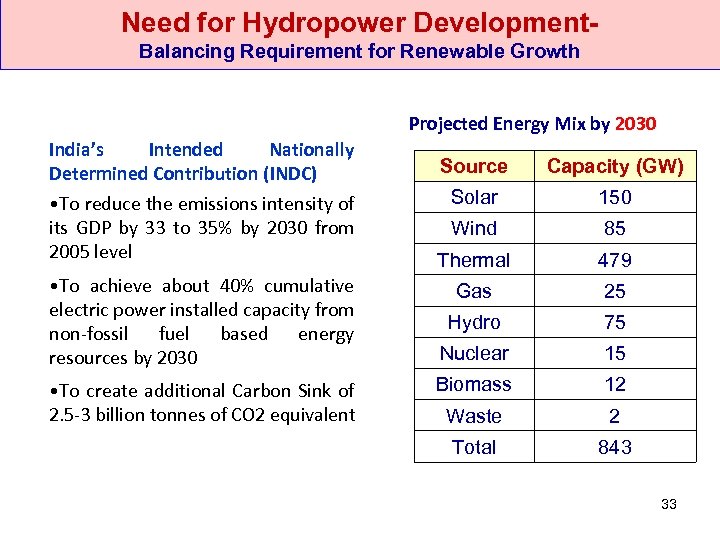 Need for Hydropower Development- Balancing Requirement for Renewable Growth Projected Energy Mix by 2030 India’s Intended Nationally Determined Contribution (INDC) • To reduce the emissions intensity of its GDP by 33 to 35% by 2030 from 2005 level • To achieve about 40% cumulative electric power installed capacity from non-fossil fuel based energy resources by 2030 • To create additional Carbon Sink of 2. 5 -3 billion tonnes of CO 2 equivalent Source Capacity (GW) Solar 150 Wind 85 Thermal 479 Gas 25 Hydro 75 Nuclear 15 Biomass 12 Waste 2 Total 843 33
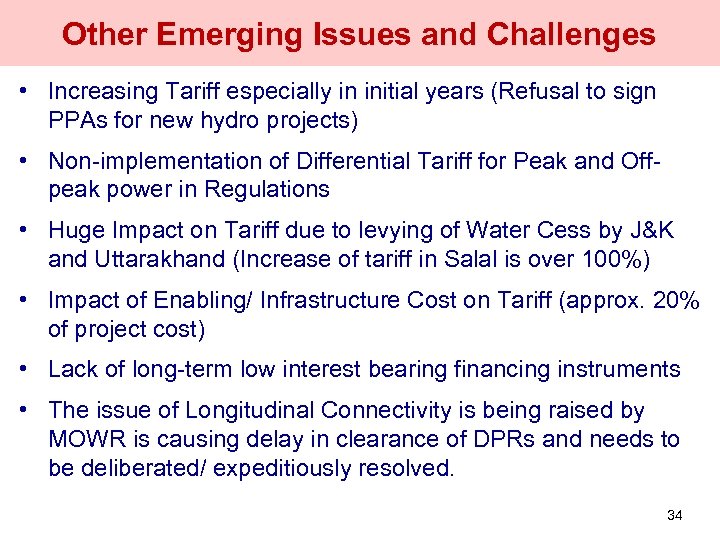 Other Emerging Issues and Challenges • Increasing Tariff especially in initial years (Refusal to sign PPAs for new hydro projects) • Non-implementation of Differential Tariff for Peak and Offpeak power in Regulations • Huge Impact on Tariff due to levying of Water Cess by J&K and Uttarakhand (Increase of tariff in Salal is over 100%) • Impact of Enabling/ Infrastructure Cost on Tariff (approx. 20% of project cost) • Lack of long-term low interest bearing financing instruments • The issue of Longitudinal Connectivity is being raised by MOWR is causing delay in clearance of DPRs and needs to be deliberated/ expeditiously resolved. 34 34
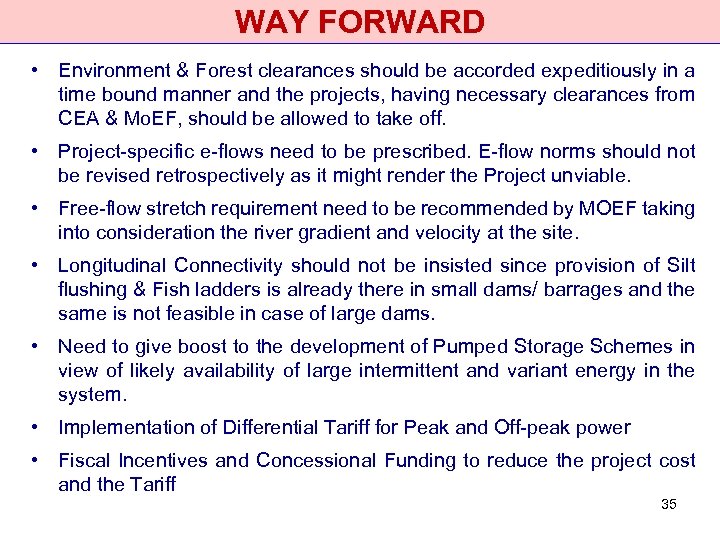 WAY FORWARD • Environment & Forest clearances should be accorded expeditiously in a time bound manner and the projects, having necessary clearances from CEA & Mo. EF, should be allowed to take off. • Project-specific e-flows need to be prescribed. E-flow norms should not be revised retrospectively as it might render the Project unviable. • Free-flow stretch requirement need to be recommended by MOEF taking into consideration the river gradient and velocity at the site. • Longitudinal Connectivity should not be insisted since provision of Silt flushing & Fish ladders is already there in small dams/ barrages and the same is not feasible in case of large dams. • Need to give boost to the development of Pumped Storage Schemes in view of likely availability of large intermittent and variant energy in the system. • Implementation of Differential Tariff for Peak and Off-peak power • Fiscal Incentives and Concessional Funding to reduce the project cost and the Tariff 35
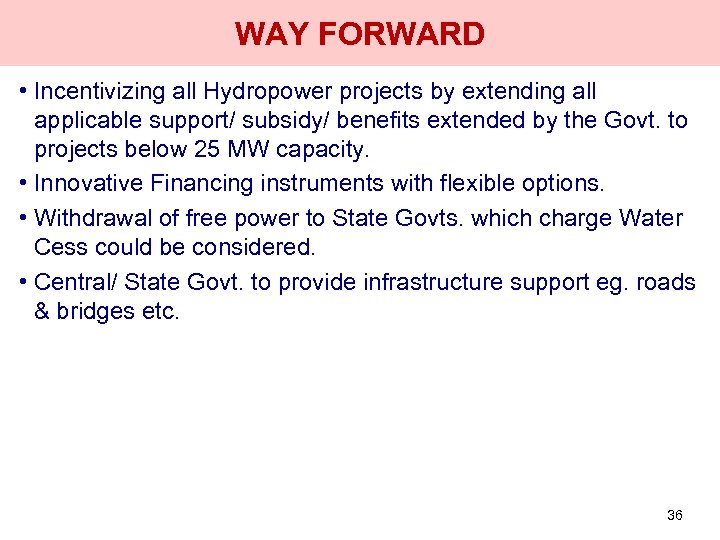 WAY FORWARD • Incentivizing all Hydropower projects by extending all applicable support/ subsidy/ benefits extended by the Govt. to projects below 25 MW capacity. • Innovative Financing instruments with flexible options. • Withdrawal of free power to State Govts. which charge Water Cess could be considered. • Central/ State Govt. to provide infrastructure support eg. roads & bridges etc. 36 36
 37
37
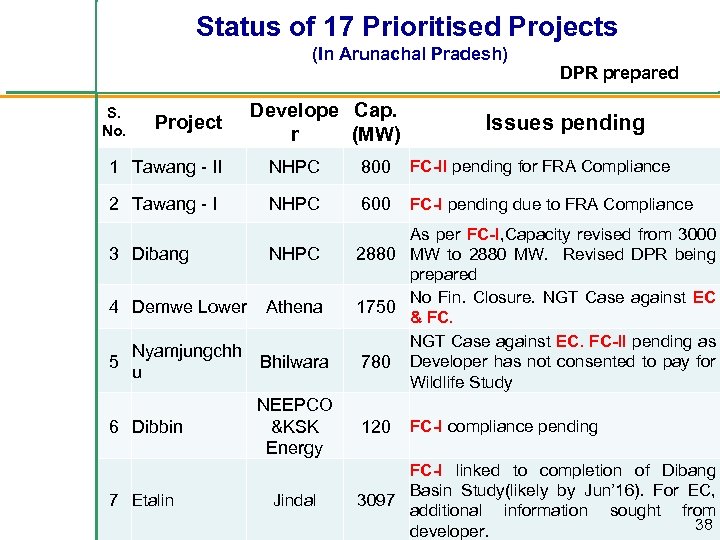 Status of 17 Prioritised Projects (In Arunachal Pradesh) S. No. Project Develope Cap. r (MW) DPR prepared Issues pending 1 Tawang - II NHPC 800 FC-II pending for FRA Compliance 2 Tawang - I NHPC 600 FC-I pending due to FRA Compliance 3 Dibang NHPC 4 Demwe Lower Athena 5 Nyamjungchh u 6 Dibbin 7 Etalin Bhilwara NEEPCO &KSK Energy Jindal As per FC-I, Capacity revised from 3000 2880 MW to 2880 MW. Revised DPR being prepared No Fin. Closure. NGT Case against EC 1750 & FC. NGT Case against EC. FC-II pending as 780 Developer has not consented to pay for Wildlife Study 120 FC-I compliance pending FC-I linked to completion of Dibang Basin Study(likely by Jun’ 16). For EC, 3097 additional information sought from 38 developer.
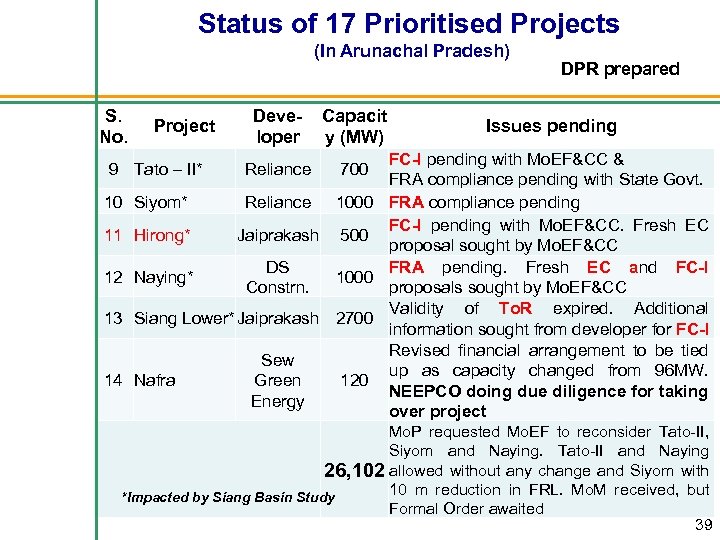 Status of 17 Prioritised Projects (In Arunachal Pradesh) S. No. Project Developer Capacit y (MW) DPR prepared Issues pending FC-I pending with Mo. EF&CC & FRA compliance pending with State Govt. 10 Siyom* Reliance 1000 FRA compliance pending FC-I pending with Mo. EF&CC. Fresh EC 11 Hirong* Jaiprakash 500 proposal sought by Mo. EF&CC DS FRA pending. Fresh EC and FC-I 12 Naying* 1000 Constrn. proposals sought by Mo. EF&CC Validity of To. R expired. Additional 13 Siang Lower* Jaiprakash 2700 information sought from developer for FC-I Revised financial arrangement to be tied Sew up as capacity changed from 96 MW. 14 Nafra Green 120 NEEPCO doing due diligence for taking Energy over project 9 Tato – II* Reliance 700 Mo. P requested Mo. EF to reconsider Tato-II, Siyom and Naying. Tato-II and Naying 26, 102 allowed without any change and Siyom with 10 m reduction in FRL. Mo. M received, but *Impacted by Siang Basin Study Formal Order awaited 39
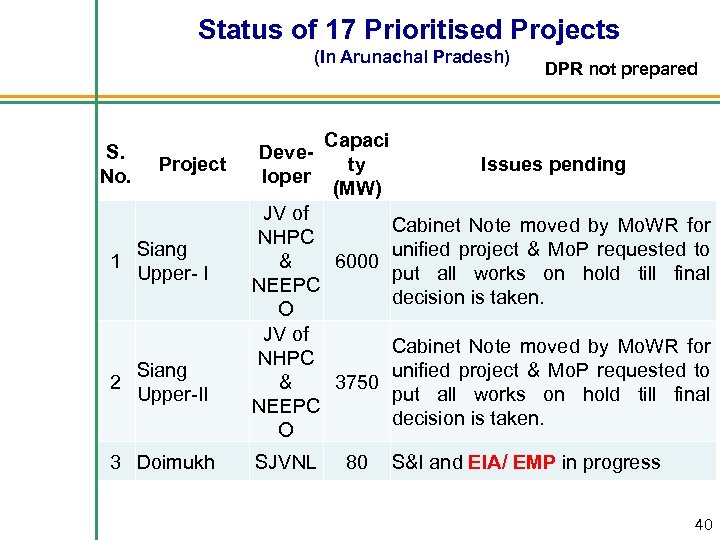 Status of 17 Prioritised Projects (In Arunachal Pradesh) S. No. Project 1 Siang Upper- I 2 Siang Upper-II 3 Doimukh Developer Capaci ty (MW) DPR not prepared Issues pending JV of Cabinet Note moved by Mo. WR for NHPC unified project & Mo. P requested to & 6000 put all works on hold till final NEEPC decision is taken. O JV of Cabinet Note moved by Mo. WR for NHPC unified project & Mo. P requested to & 3750 put all works on hold till final NEEPC decision is taken. O SJVNL 80 S&I and EIA/ EMP in progress 40
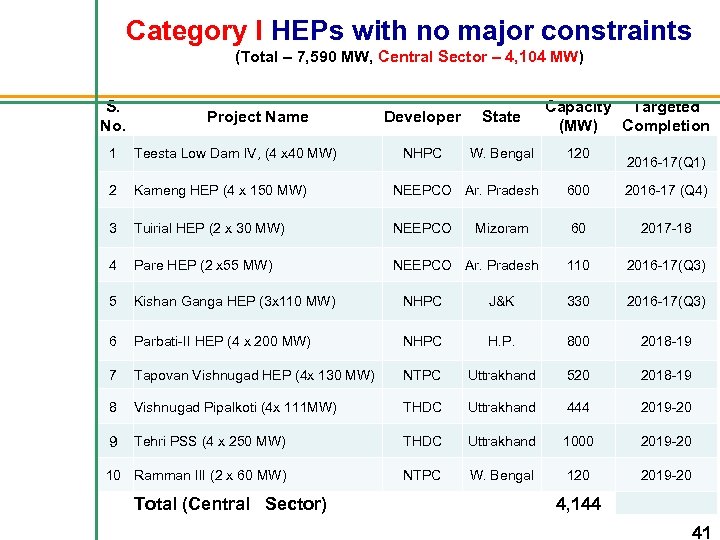 Category I HEPs with no major constraints (Total – 7, 590 MW, Central Sector – 4, 104 MW) S. No. Project Name Developer State NHPC W. Bengal Capacity Targeted (MW) Completion 1 Teesta Low Dam IV, (4 x 40 MW) 2 Kameng HEP (4 x 150 MW) NEEPCO Ar. Pradesh 600 2016 -17 (Q 4) 3 Tuirial HEP (2 x 30 MW) NEEPCO 60 2017 -18 4 Pare HEP (2 x 55 MW) NEEPCO Ar. Pradesh 110 2016 -17(Q 3) 5 Kishan Ganga HEP (3 x 110 MW) NHPC J&K 330 2016 -17(Q 3) 6 Parbati-II HEP (4 x 200 MW) NHPC H. P. 800 2018 -19 7 Tapovan Vishnugad HEP (4 x 130 MW) NTPC Uttrakhand 520 2018 -19 8 Vishnugad Pipalkoti (4 x 111 MW) THDC Uttrakhand 444 2019 -20 9 Tehri PSS (4 x 250 MW) THDC Uttrakhand 1000 2019 -20 10 Ramman III (2 x 60 MW) NTPC W. Bengal 120 2019 -20 4, 144 Total (Central Sector) Mizoram 120 2016 -17(Q 1) 41
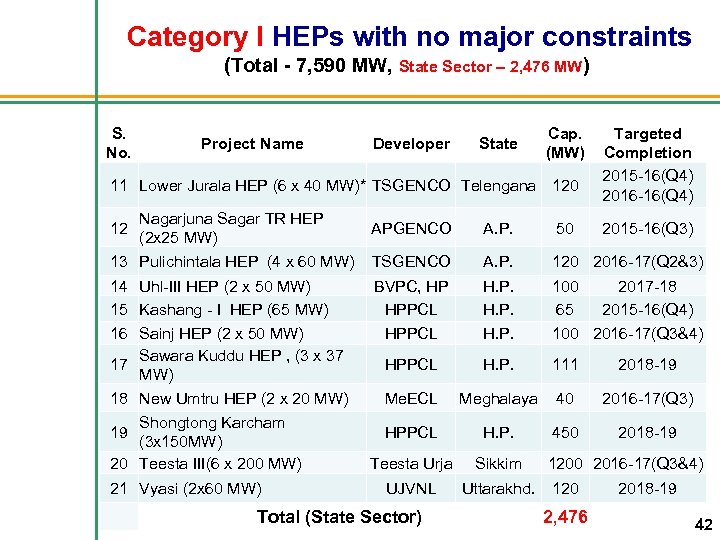 Category I HEPs with no major constraints (Total - 7, 590 MW, State Sector – 2, 476 MW) S. No. Project Name Developer State Cap. (MW) 11 Lower Jurala HEP (6 x 40 MW)* TSGENCO Telengana 120 Targeted Completion 2015 -16(Q 4) 2016 -16(Q 4) Nagarjuna Sagar TR HEP (2 x 25 MW) APGENCO A. P. 50 13 Pulichintala HEP (4 x 60 MW) TSGENCO A. P. 120 2016 -17(Q 2&3) 14 Uhl-III HEP (2 x 50 MW) 15 Kashang - I HEP (65 MW) BVPC, HP HPPCL H. P. 100 65 16 Sainj HEP (2 x 50 MW) Sawara Kuddu HEP , (3 x 37 17 MW) HPPCL H. P. 100 2016 -17(Q 3&4) HPPCL H. P. 111 2018 -19 18 New Umtru HEP (2 x 20 MW) Me. ECL Meghalaya 40 2016 -17(Q 3) HPPCL H. P. 450 2018 -19 Teesta Urja Sikkim UJVNL Uttarakhd. 12 Shongtong Karcham (3 x 150 MW) 20 Teesta III(6 x 200 MW) 19 21 Vyasi (2 x 60 MW) Total (State Sector) 2015 -16(Q 3) 2017 -18 2015 -16(Q 4) 1200 2016 -17(Q 3&4) 120 2, 476 2018 -19 42
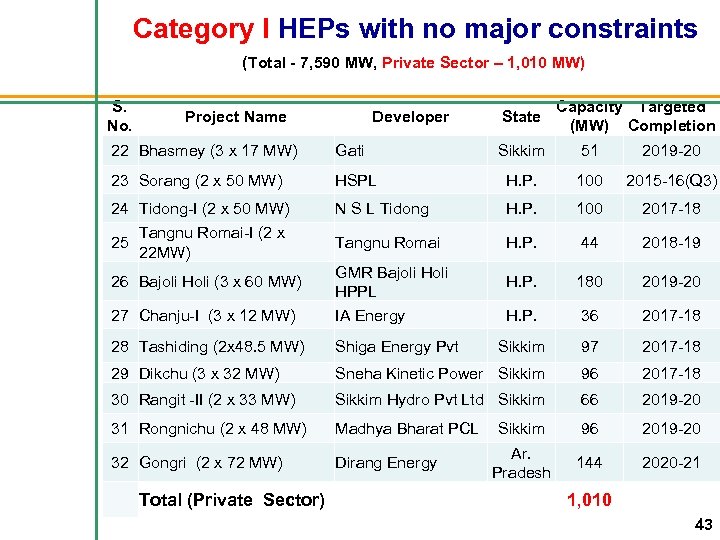 Category I HEPs with no major constraints (Total - 7, 590 MW, Private Sector – 1, 010 MW) S. No. Project Name Developer 22 Bhasmey (3 x 17 MW) Gati 23 Sorang (2 x 50 MW) 24 Tidong-I (2 x 50 MW) State Capacity Targeted (MW) Completion Sikkim 51 2019 -20 HSPL H. P. 100 2015 -16(Q 3) N S L Tidong H. P. 100 2017 -18 Tangnu Romai H. P. 44 2018 -19 26 Bajoli Holi (3 x 60 MW) GMR Bajoli HPPL H. P. 180 2019 -20 27 Chanju-I (3 x 12 MW) IA Energy H. P. 36 2017 -18 28 Tashiding (2 x 48. 5 MW) Shiga Energy Pvt Sikkim 97 2017 -18 29 Dikchu (3 x 32 MW) Sneha Kinetic Power Sikkim 96 2017 -18 30 Rangit -II (2 x 33 MW) Sikkim Hydro Pvt Ltd Sikkim 66 2019 -20 31 Rongnichu (2 x 48 MW) Madhya Bharat PCL Sikkim 96 2019 -20 32 Gongri (2 x 72 MW) Dirang Energy Ar. Pradesh 144 2020 -21 1, 010 25 Tangnu Romai-I (2 x 22 MW) Total (Private Sector) 43
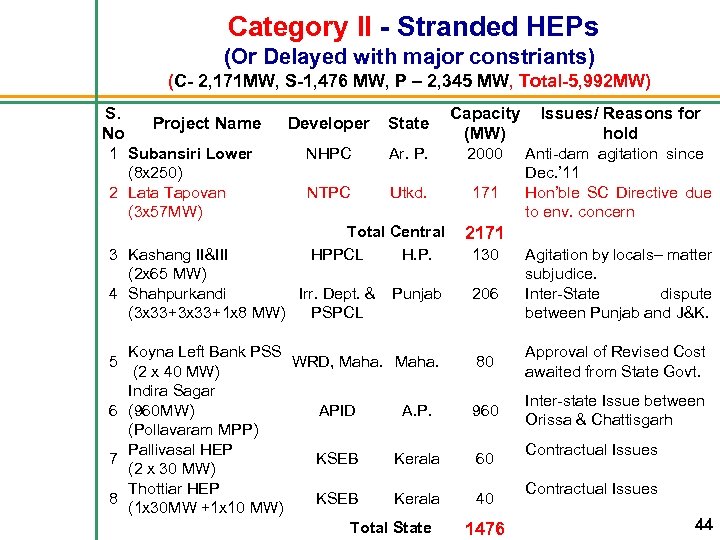 Category II - Stranded HEPs (Or Delayed with major constriants) (C- 2, 171 MW, S-1, 476 MW, P – 2, 345 MW, Total-5, 992 MW) S. No Project Name 1 Subansiri Lower (8 x 250) 2 Lata Tapovan (3 x 57 MW) Capacity Issues/ Reasons for (MW) hold Developer State NHPC Ar. P. 2000 NTPC Utkd. 171 Total Central 2171 HPPCL H. P. 130 3 Kashang II&III (2 x 65 MW) 4 Shahpurkandi Irr. Dept. & Punjab (3 x 33+1 x 8 MW) PSPCL Koyna Left Bank PSS WRD, Maha. (2 x 40 MW) Indira Sagar 6 (960 MW) APID A. P. (Pollavaram MPP) Pallivasal HEP 7 KSEB Kerala (2 x 30 MW) Thottiar HEP 8 KSEB Kerala (1 x 30 MW +1 x 10 MW) Total State 5 206 Anti-dam agitation since Dec. ’ 11 Hon’ble SC Directive due to env. concern Agitation by locals– matter subjudice. Inter-State dispute between Punjab and J&K. 80 Approval of Revised Cost awaited from State Govt. 960 Inter-state Issue between Orissa & Chattisgarh 60 40 1476 Contractual Issues 44
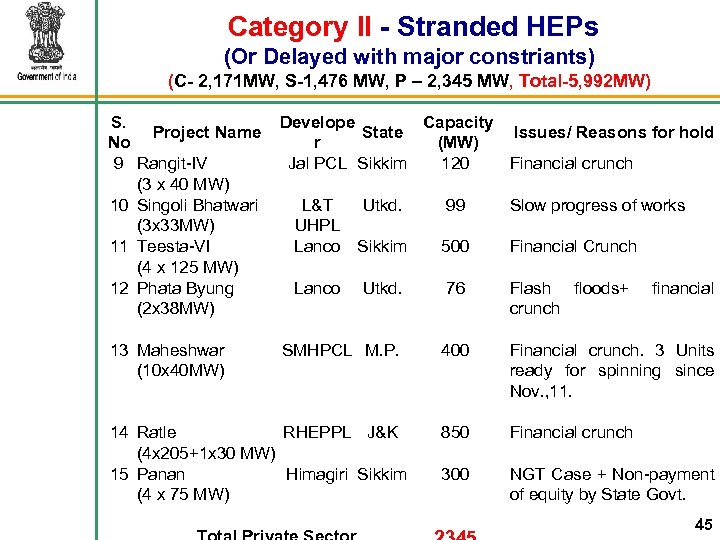 Category II - Stranded HEPs (Or Delayed with major constriants) (C- 2, 171 MW, S-1, 476 MW, P – 2, 345 MW, Total-5, 992 MW) S. Develope Capacity Project Name State Issues/ Reasons for hold No r (MW) 9 Rangit-IV Jal PCL Sikkim 120 Financial crunch (3 x 40 MW) 10 Singoli Bhatwari L&T Utkd. 99 Slow progress of works (3 x 33 MW) UHPL 11 Teesta-VI Lanco Sikkim 500 Financial Crunch (4 x 125 MW) 12 Phata Byung Lanco Utkd. 76 Flash floods+ financial (2 x 38 MW) crunch 13 Maheshwar (10 x 40 MW) SMHPCL M. P. 14 Ratle RHEPPL J&K (4 x 205+1 x 30 MW) 15 Panan Himagiri Sikkim (4 x 75 MW) 400 Financial crunch. 3 Units ready for spinning since Nov. , 11. 850 Financial crunch 300 NGT Case + Non-payment of equity by State Govt. 45
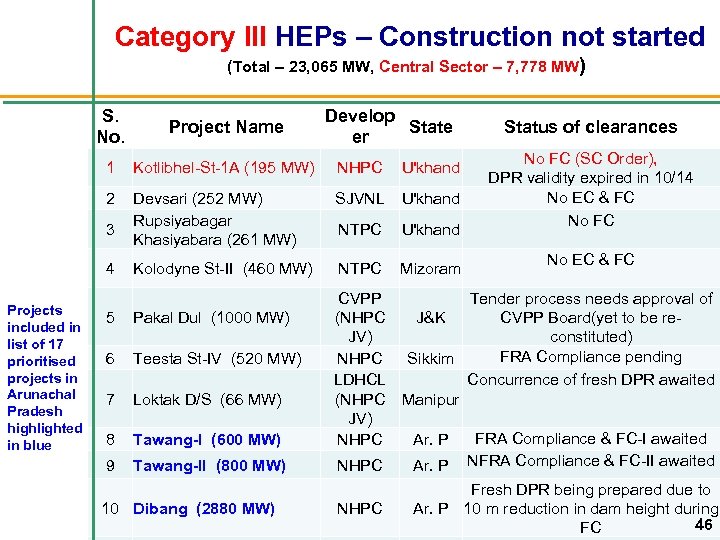 Category III HEPs – Construction not started (Total – 23, 065 MW, Central Sector – 7, 778 MW) S. No. Project Name 1 Kotlibhel-St-1 A (195 MW) NHPC U'khand 2 Devsari (252 MW) Rupsiyabagar Khasiyabara (261 MW) SJVNL U'khand NTPC U'khand Kolodyne St-II (460 MW) NTPC Mizoram 3 4 Projects included in list of 17 prioritised projects in Arunachal Pradesh highlighted in blue 5 Pakal Dul (1000 MW) 6 Teesta St-IV (520 MW) 7 Loktak D/S (66 MW) 8 Tawang-I (600 MW) 9 Tawang-II (800 MW) 10 Dibang (2880 MW) Develop State er Status of clearances No FC (SC Order), DPR validity expired in 10/14 No EC & FC Tender process needs approval of CVPP Board(yet to be re(NHPC J&K constituted) JV) FRA Compliance pending NHPC Sikkim Concurrence of fresh DPR awaited LDHCL (NHPC Manipur JV) FRA Compliance & FC-I awaited NHPC Ar. P NFRA Compliance & FC-II awaited NHPC Fresh DPR being prepared due to Ar. P 10 m reduction in dam height during 46 FC
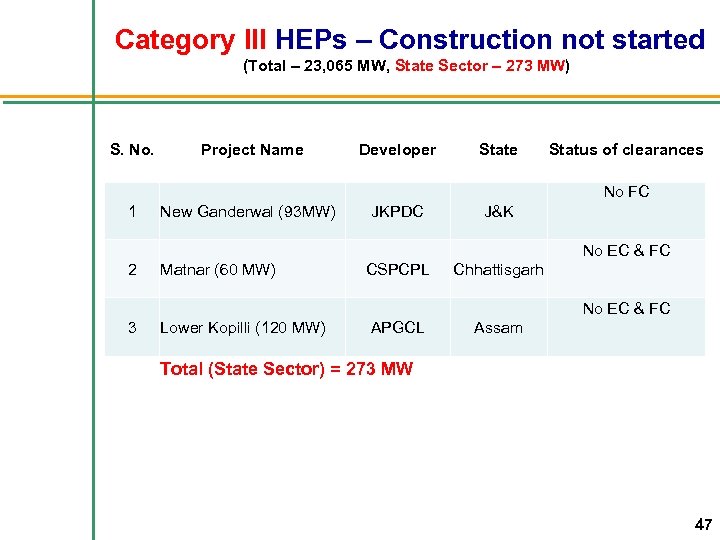 Category III HEPs – Construction not started (Total – 23, 065 MW, State Sector – 273 MW) S. No. Project Name Developer State Status of clearances No FC 1 New Ganderwal (93 MW) JKPDC J&K No EC & FC 2 Matnar (60 MW) CSPCPL Chhattisgarh No EC & FC 3 Lower Kopilli (120 MW) APGCL Total (State Sector) = 273 MW Assam 47
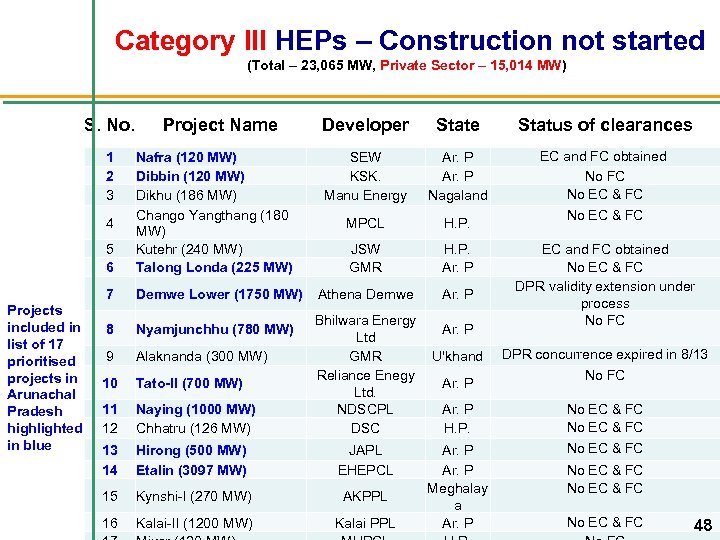 Category III HEPs – Construction not started (Total – 23, 065 MW, Private Sector – 15, 014 MW) S. No. 1 2 3 Project Name Developer State Status of clearances SEW KSK. Manu Energy Ar. P Nagaland MPCL H. P. EC and FC obtained No FC No EC & FC JSW GMR H. P. Ar. P Athena Demwe Ar. P 5 6 Nafra (120 MW) Dibbin (120 MW) Dikhu (186 MW) Chango Yangthang (180 MW) Kutehr (240 MW) Talong Londa (225 MW) 7 Demwe Lower (1750 MW) 8 Nyamjunchhu (780 MW) 9 Alaknanda (300 MW) 10 Tato-II (700 MW) 11 12 Naying (1000 MW) Chhatru (126 MW) 13 14 Hirong (500 MW) Etalin (3097 MW) JAPL EHEPCL 15 Kynshi-I (270 MW) AKPPL 16 Kalai-II (1200 MW) Kalai PPL 4 Projects included in list of 17 prioritised projects in Arunachal Pradesh highlighted in blue Bhilwara Energy Ar. P Ltd GMR U'khand Reliance Enegy Ar. P Ltd. NDSCPL Ar. P DSC H. P. Ar. P Meghalay a Ar. P EC and FC obtained No EC & FC DPR validity extension under process No FC DPR concurrence expired in 8/13 No FC No EC & FC No EC & FC 48
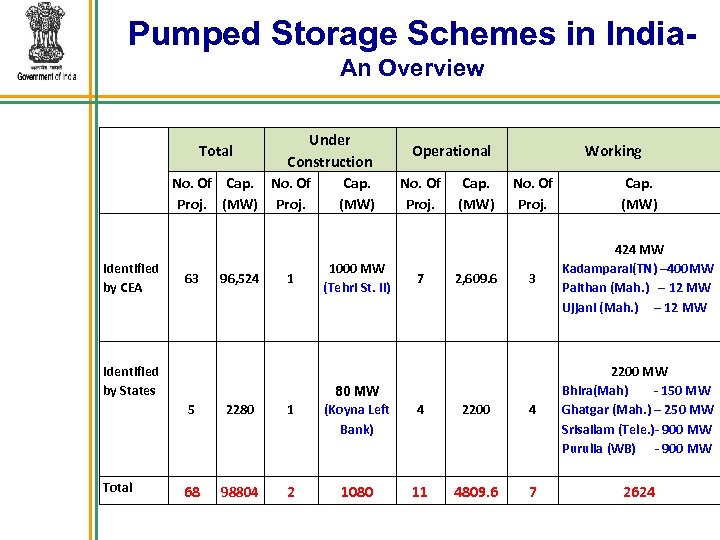 Pumped Storage Schemes in India. An Overview Total Under Construction No. Of Cap. No. Of Proj. (MW) Proj. Identified by CEA 63 96, 524 1 Identified by States Cap. (MW) 1000 MW (Tehri St. II) 5 Total 2280 1 80 MW (Koyna Left Bank) 68 98804 2 1080 Operational No. Of Proj. 7 Cap. (MW) 2, 609. 6 Working No. Of Proj. Cap. (MW) 3 424 MW Kadamparai(TN) – 400 MW Paithan (Mah. ) – 12 MW Ujjani (Mah. ) – 12 MW 4 2200 MW Bhira(Mah) - 150 MW Ghatgar (Mah. ) – 250 MW Srisailam (Tele. )- 900 MW Purulia (WB) - 900 MW 11 4809. 6 7 2624
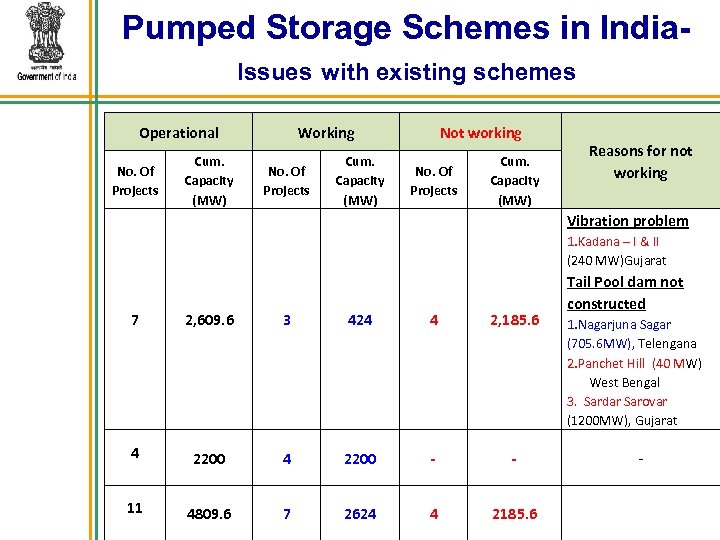 Pumped Storage Schemes in India. Issues with existing schemes Operational No. Of Projects Cum. Capacity (MW) Working No. Of Projects Cum. Capacity (MW) Not working No. Of Projects Cum. Capacity (MW) Reasons for not working Vibration problem 1. Kadana – I & II (240 MW)Gujarat 7 2, 609. 6 3 424 4 2, 185. 6 4 2200 - - 11 4809. 6 7 2624 4 2185. 6 Tail Pool dam not constructed 1. Nagarjuna Sagar (705. 6 MW), Telengana 2. Panchet Hill (40 MW) West Bengal 3. Sardar Sarovar (1200 MW), Gujarat -
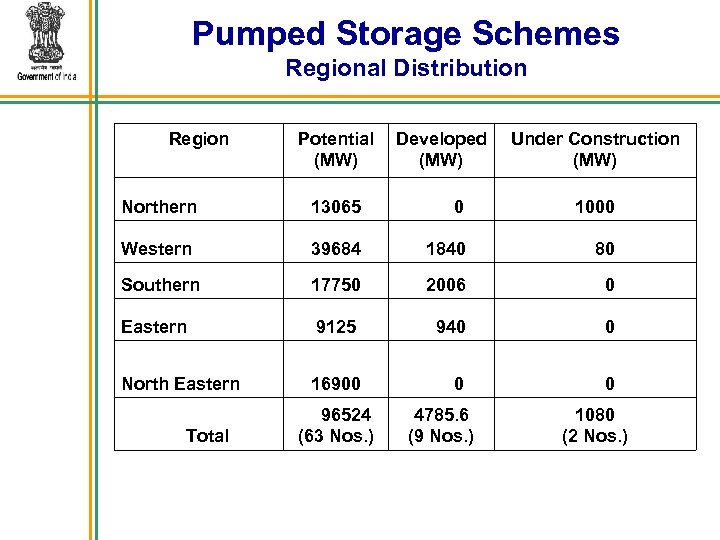 Pumped Storage Schemes Regional Distribution Region Potential (MW) Developed (MW) Under Construction (MW) Northern 13065 0 1000 Western 39684 1840 80 Southern 17750 2006 0 Eastern 9125 940 0 North Eastern 16900 0 0 4785. 6 (9 Nos. ) 1080 (2 Nos. ) 96524 Total (63 Nos. )
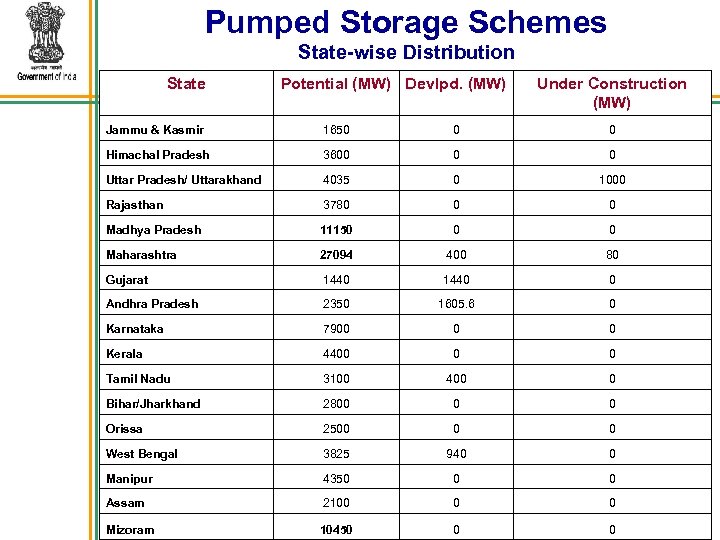 Pumped Storage Schemes State-wise Distribution State Potential (MW) Devlpd. (MW) Under Construction (MW) Jammu & Kasmir 1650 0 0 Himachal Pradesh 3600 0 0 Uttar Pradesh/ Uttarakhand 4035 0 1000 Rajasthan 3780 0 0 Madhya Pradesh 11150 0 0 Maharashtra 27094 400 80 Gujarat 1440 0 Andhra Pradesh 2350 1605. 6 0 Karnataka 7900 0 0 Kerala 4400 0 0 Tamil Nadu 3100 400 0 Bihar/Jharkhand 2800 0 0 Orissa 2500 0 0 West Bengal 3825 940 0 Manipur 4350 0 0 Assam 2100 0 0 Mizoram 10450 0 0
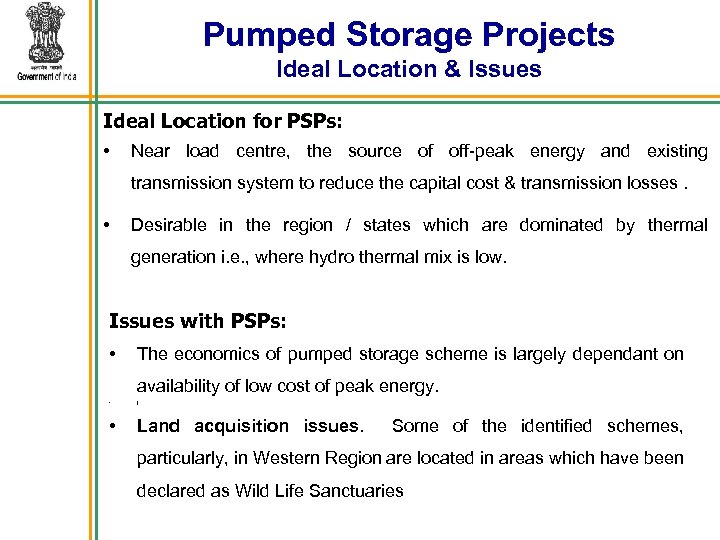 Pumped Storage Projects Ideal Location & Issues Ideal Location for PSPs: • Near load centre, the source of off-peak energy and existing transmission system to reduce the capital cost & transmission losses. • Desirable in the region / states which are dominated by thermal generation i. e. , where hydro thermal mix is low. Issues with PSPs: • The economics of pumped storage scheme is largely dependant on availability of low cost of peak energy. • ] • Land acquisition issues. Some of the identified schemes, particularly, in Western Region are located in areas which have been declared as Wild Life Sanctuaries
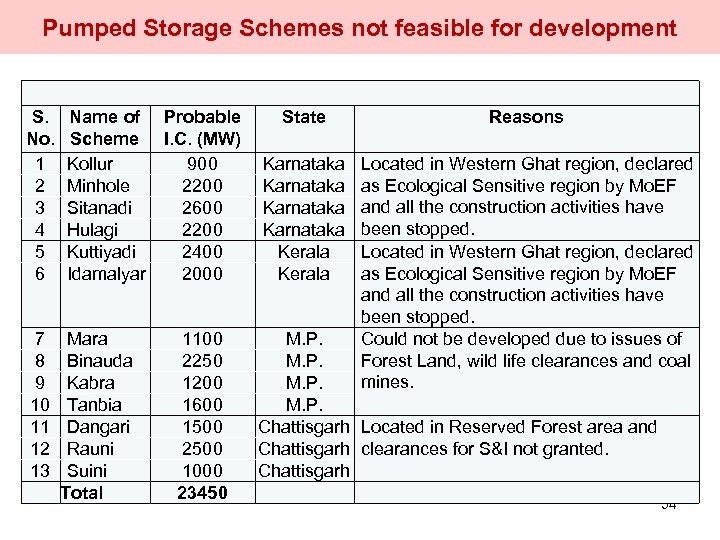 Pumped Storage Schemes not feasible for development S. No. 1 2 3 4 5 6 7 8 9 10 11 12 13 Name of Probable State Reasons Scheme I. C. (MW) Kollur 900 Karnataka Located in Western Ghat region, declared Minhole 2200 Karnataka as Ecological Sensitive region by Mo. EF Sitanadi 2600 Karnataka and all the construction activities have Hulagi 2200 Karnataka been stopped. Kuttiyadi 2400 Kerala Located in Western Ghat region, declared as Ecological Sensitive region by Mo. EF Idamalyar 2000 Kerala and all the construction activities have been stopped. Mara 1100 M. P. Could not be developed due to issues of Forest Land, wild life clearances and coal Binauda 2250 M. P. mines. Kabra 1200 M. P. Tanbia 1600 M. P. Dangari 1500 Chattisgarh Located in Reserved Forest area and Rauni 2500 Chattisgarh clearances for S&I not granted. Suini 1000 Chattisgarh Total 23450 54
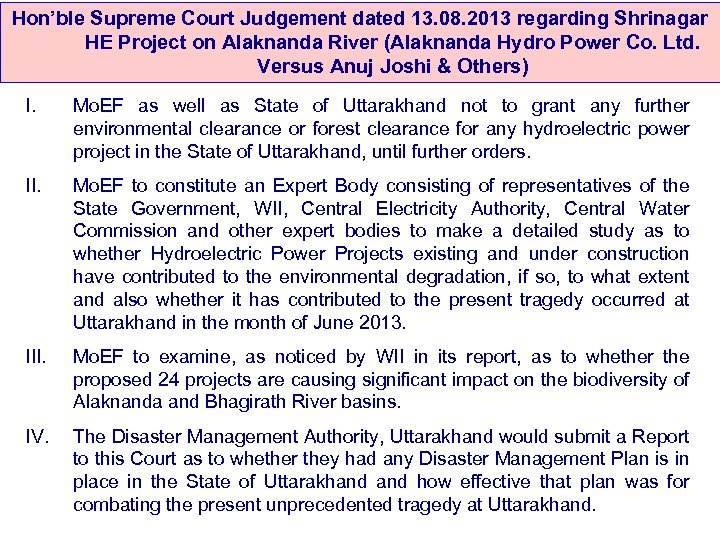 Hon’ble Supreme Court Judgement dated 13. 08. 2013 regarding Shrinagar HE Project on Alaknanda River (Alaknanda Hydro Power Co. Ltd. Versus Anuj Joshi & Others) I. Mo. EF as well as State of Uttarakhand not to grant any further environmental clearance or forest clearance for any hydroelectric power project in the State of Uttarakhand, until further orders. II. Mo. EF to constitute an Expert Body consisting of representatives of the State Government, WII, Central Electricity Authority, Central Water Commission and other expert bodies to make a detailed study as to whether Hydroelectric Power Projects existing and under construction have contributed to the environmental degradation, if so, to what extent and also whether it has contributed to the present tragedy occurred at Uttarakhand in the month of June 2013. III. Mo. EF to examine, as noticed by WII in its report, as to whether the proposed 24 projects are causing significant impact on the biodiversity of Alaknanda and Bhagirath River basins. IV. The Disaster Management Authority, Uttarakhand would submit a Report to this Court as to whether they had any Disaster Management Plan is in place in the State of Uttarakhand how effective that plan was for combating the present unprecedented tragedy at Uttarakhand.
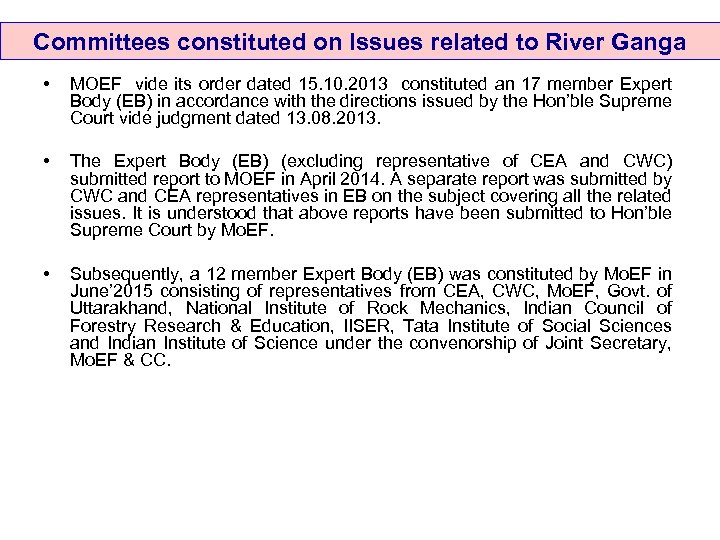 Committees constituted on Issues related to River Ganga • MOEF vide its order dated 15. 10. 2013 constituted an 17 member Expert Body (EB) in accordance with the directions issued by the Hon’ble Supreme Court vide judgment dated 13. 08. 2013. • The Expert Body (EB) (excluding representative of CEA and CWC) submitted report to MOEF in April 2014. A separate report was submitted by CWC and CEA representatives in EB on the subject covering all the related issues. It is understood that above reports have been submitted to Hon’ble Supreme Court by Mo. EF. • Subsequently, a 12 member Expert Body (EB) was constituted by Mo. EF in June’ 2015 consisting of representatives from CEA, CWC, Mo. EF, Govt. of Uttarakhand, National Institute of Rock Mechanics, Indian Council of Forestry Research & Education, IISER, Tata Institute of Social Sciences and Indian Institute of Science under the convenorship of Joint Secretary, Mo. EF & CC.
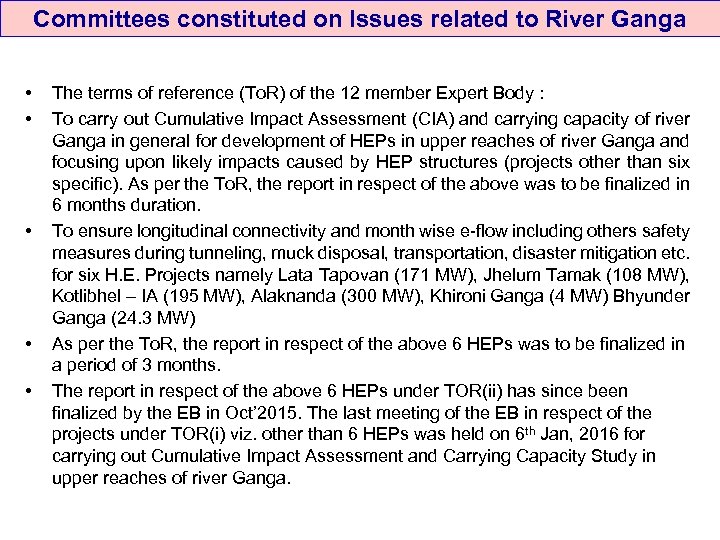 Committees constituted on Issues related to River Ganga • • • The terms of reference (To. R) of the 12 member Expert Body : To carry out Cumulative Impact Assessment (CIA) and carrying capacity of river Ganga in general for development of HEPs in upper reaches of river Ganga and focusing upon likely impacts caused by HEP structures (projects other than six specific). As per the To. R, the report in respect of the above was to be finalized in 6 months duration. To ensure longitudinal connectivity and month wise e-flow including others safety measures during tunneling, muck disposal, transportation, disaster mitigation etc. for six H. E. Projects namely Lata Tapovan (171 MW), Jhelum Tamak (108 MW), Kotlibhel – IA (195 MW), Alaknanda (300 MW), Khironi Ganga (4 MW) Bhyunder Ganga (24. 3 MW) As per the To. R, the report in respect of the above 6 HEPs was to be finalized in a period of 3 months. The report in respect of the above 6 HEPs under TOR(ii) has since been finalized by the EB in Oct’ 2015. The last meeting of the EB in respect of the projects under TOR(i) viz. other than 6 HEPs was held on 6 th Jan, 2016 for carrying out Cumulative Impact Assessment and Carrying Capacity Study in upper reaches of river Ganga.
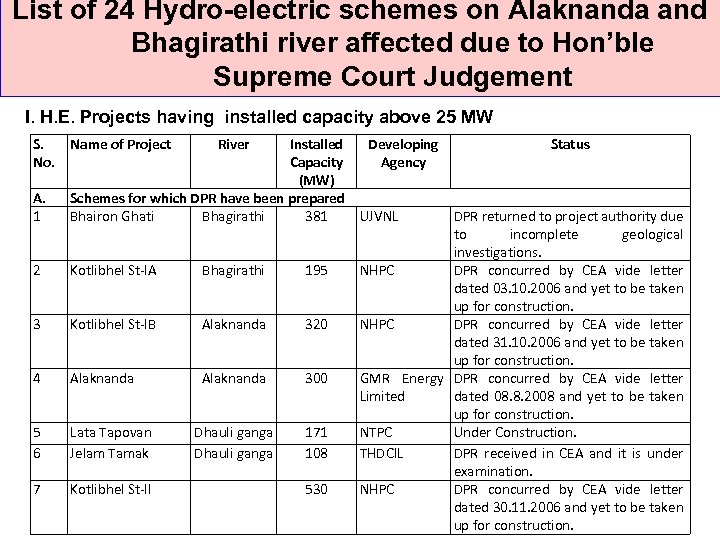 List of 24 Hydro-electric schemes on Alaknanda and Bhagirathi river affected due to Hon’ble Supreme Court Judgement I. H. E. Projects having installed capacity above 25 MW S. No. Name of Project River A. 1 Installed Developing Capacity Agency (MW) Schemes for which DPR have been prepared Bhairon Ghati Bhagirathi 381 UJVNL 2 Kotlibhel St-IA Bhagirathi 195 3 Kotlibhel St-IB Alaknanda 320 4 Alaknanda 300 5 6 Lata Tapovan Jelam Tamak Dhauli ganga 171 108 7 Kotlibhel St-II 530 Status DPR returned to project authority due to incomplete geological investigations. NHPC DPR concurred by CEA vide letter dated 03. 10. 2006 and yet to be taken up for construction. NHPC DPR concurred by CEA vide letter dated 31. 10. 2006 and yet to be taken up for construction. GMR Energy DPR concurred by CEA vide letter Limited dated 08. 8. 2008 and yet to be taken up for construction. NTPC Under Construction. THDCIL DPR received in CEA and it is under examination. NHPC DPR concurred by CEA vide letter dated 30. 11. 2006 and yet to be taken up for construction.
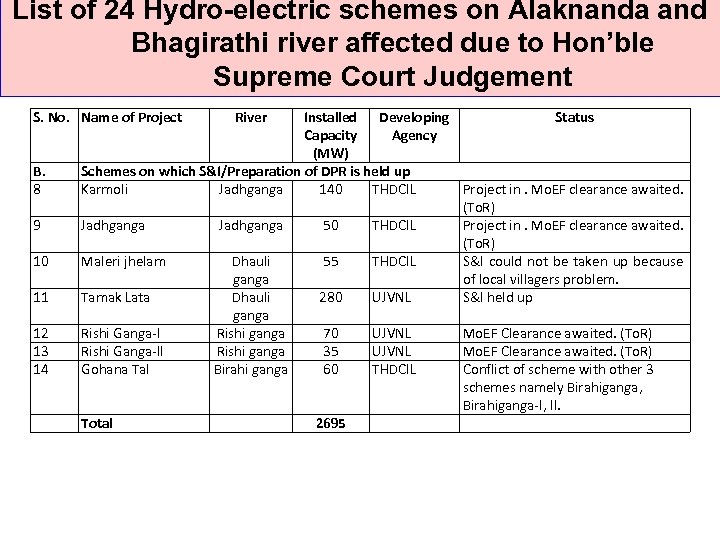 List of 24 Hydro-electric schemes on Alaknanda and Bhagirathi river affected due to Hon’ble Supreme Court Judgement S. No. Name of Project B. 8 9 10 11 12 13 14 River Installed Developing Status Capacity Agency (MW) Schemes on which S&I/Preparation of DPR is held up Karmoli Jadhganga 140 THDCIL Project in. Mo. EF clearance awaited. (To. R) Jadhganga 50 THDCIL Project in. Mo. EF clearance awaited. (To. R) Maleri jhelam Dhauli 55 THDCIL S&I could not be taken up because ganga of local villagers problem. Tamak Lata Dhauli 280 UJVNL S&I held up ganga Rishi Ganga-I Rishi ganga 70 UJVNL Mo. EF Clearance awaited. (To. R) Rishi Ganga-II Rishi ganga 35 UJVNL Mo. EF Clearance awaited. (To. R) Gohana Tal Birahi ganga 60 THDCIL Conflict of scheme with other 3 schemes namely Birahiganga, Birahiganga-I, II. Total 2695
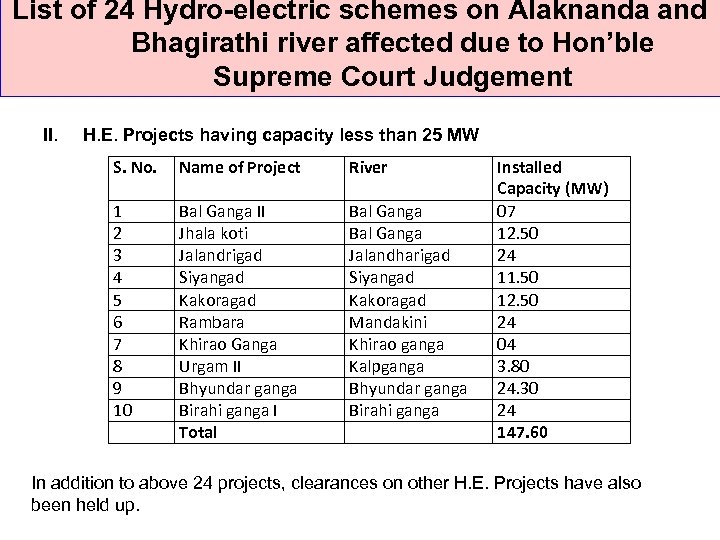 List of 24 Hydro-electric schemes on Alaknanda and Bhagirathi river affected due to Hon’ble Supreme Court Judgement II. H. E. Projects having capacity less than 25 MW S. No. Name of Project River 1 2 3 4 5 6 7 8 9 10 Bal Ganga II Jhala koti Jalandrigad Siyangad Kakoragad Rambara Khirao Ganga Urgam II Bhyundar ganga Birahi ganga I Total Bal Ganga Jalandharigad Siyangad Kakoragad Mandakini Khirao ganga Kalpganga Bhyundar ganga Birahi ganga Installed Capacity (MW) 07 12. 50 24 11. 50 12. 50 24 04 3. 80 24. 30 24 147. 60 In addition to above 24 projects, clearances on other H. E. Projects have also been held up.
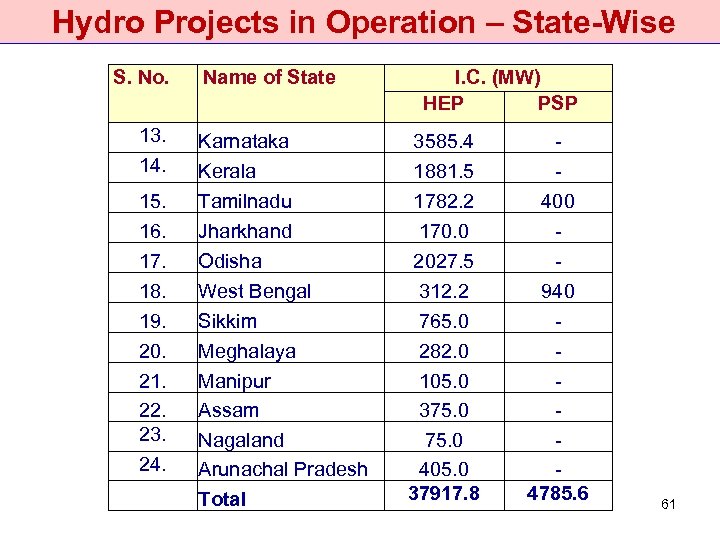 Hydro Projects in Operation – State-Wise S. No. 13. 14. 15. 16. 17. 18. 19. 20. 21. 22. 23. 24. Name of State Karnataka Kerala Tamilnadu Jharkhand Odisha West Bengal Sikkim Meghalaya Manipur Assam Nagaland Arunachal Pradesh Total I. C. (MW) HEP PSP 3585. 4 1881. 5 1782. 2 170. 0 2027. 5 312. 2 765. 0 282. 0 105. 0 375. 0 405. 0 37917. 8 400 940 4785. 6 61
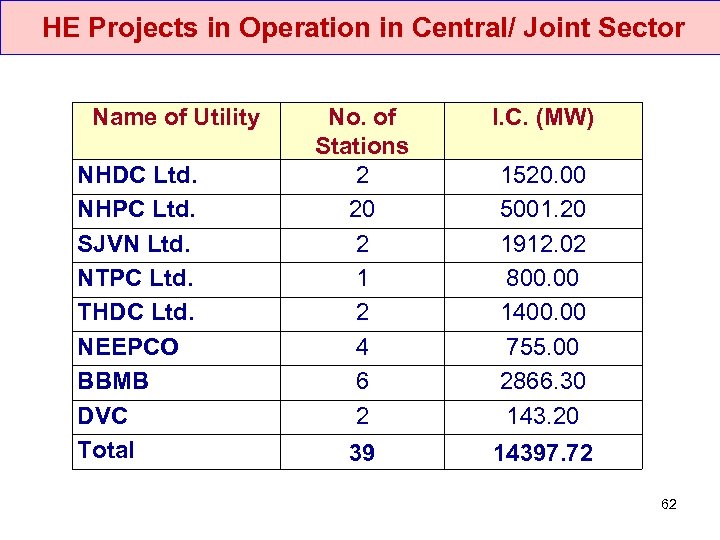 HE Projects in Operation in Central/ Joint Sector Name of Utility NHDC Ltd. NHPC Ltd. SJVN Ltd. NTPC Ltd. THDC Ltd. NEEPCO BBMB DVC Total No. of Stations 2 20 2 1 2 4 6 2 I. C. (MW) 39 14397. 72 1520. 00 5001. 20 1912. 02 800. 00 1400. 00 755. 00 2866. 30 143. 20 62
 Land Acquisition Land acquisition is a persistent issue involved in the implementation of hydro projects. Acquisition of land for various locations of the project such as Dam, HRT, Power House, Switch yard etc. delay the commencement / progress of works. Suggested solution: It is suggested that land required for construction of hydro projects and for afforestation purpose should be arranged to be allotted to developer by the respective state authorities and cost recovered later on, from the developer.
 Environment and Forest issues Issue: Due to the considerable time taken in the process of Environment and Forest Clearances due to various issues relating to e-flows, free flow stretch requirement, Longitudinal Connectivity etc. , commencement of construction works of Hydro projects often gets delayed. Suggested solution: • It is desirable that all the clearances relating to Environment & Forest, Wildlife etc. should be given in time bound manner. • The e-flows may be prescribed for hydro projects considering case to case basis and in a judicious manner. • Free flow stretch requirements should be based on river gradient and velocity. • The e-flows, once prescribed should not be revisited for a project. 64
 Rehabilitation & Resettlement Issue: Dislocation of the people from their houses/ workplaces etc. and their resettlement is a sensitive issue and involves a lot of time and money. Many times this issue leads to court cases resulting in delay in project execution/completion. Suggested solution: State should play a pro-active role in R&R to mitigate the issues. 65
 Inadequate Infrastructural facilities Issue: Hydro projects are normally located in difficult terrain having poor accessibility. As such, substantial time is lost due to lack of adequate Infrastructural facilities at the project site allotted to a developer by the State Govt. Suggested solution: Adequate infrastructure facilities need to be developed in the States by concerned agencies, matching with the schedule of development of hydro projects to reduce their gestation period. 66
 Law & Order / Local issues Issue: Protests by the local people against the construction activities like blasting, muck disposal etc. and demands for employment, extra compensation etc. often create law and order problems which delays the commencement and affects progress of the works. Suggested solution: State should play a pro-active role to provide a conducive environment for construction of hydro projects. Implementation of various Corporate Social Responsibility Plans and proper co-ordination with local bodies & State Authorities can also minimize the issues. 67
 Geological Surprises Issue: A large number of HE projects has been delayed due to geological surprises. Suggested solution: With the use of latest technologies in Survey & Investigation and preparation of Bankable DPR, the geological surprises could be reduced to some extent. 68
 Natural Calamities Issue: Natural calamities like unprecedented rain / flash floods, cloud burst, earthquake etc delay the completion of project. Suggested solution: Efficient preparedness and Disaster Management Plan should be in place to tackle Natural Calamaties. 69
 Inter-state Issues Issue: Delay in implementation due to inter-state disputes between the states. Suggested solution: Concerned State Governments have to play active role to resolve the inter-state matters for hydro development in their states. Pending resolution of inter-state aspects, some of the projects could be taken up in Central Sector to avoid time and cost overruns. 70
 Cumulative Basin Studies Issue: The impact of recommendations of Cumulative Basin studies of different basins result in change in parameters such as FRL, Head and Annual Energy Generation etc. of hydro projects necessitating formulation of new DPR. Suggested solution: Cumulative Basin studies of different basins should be expeditiously completed. Hydro Projects which have already got concurrence from CEA should not be revisited since it would impact the economies of the project and make them unviable and would delay their implementation. 71