


 Скачать презентацию Centers and Small Group Instruction for Foreign Language
55856d4ef9a7bee6456164c1a3ee977c.ppt
- Количество слайдов: 49
 Centers and Small Group Instruction for Foreign Language Classrooms
 Jessica Haxhi Maloney Interdistrict Magnet School Waterbury, CT jhaxhi@waterbury. k 12. ct. us Japanese Language and Culture Program http: //teacherweb. com/CT/ maloneymagnetschool/japanese/ Wiki for Resources and Handouts http: //maloneyjapanese. wikispaces. com/ (“For World Language Teachers” Section)
 What is “small group instruction? ”
 Why use Small Group Instruction? Lessons from the Homeroom • • • opportunity for “guided reading” teachers can engage the learner teachers can use “strategic coaching” teachers can “scaffold” the learning students develop as independent learners Taken from Ford, M. P. & Opitz, M. F. (2002) “Using centers to engage children during guided reading time: Intensifying learning experiences away from the teacher. ” The Reading Teacher
 Why use Small Group Instruction and Centers in our FL Classrooms? Students • develop individual study skills • develop group work skills • get one-on-one time with teachers • get to interact with technology, realia, or content • can access a variety of activities in all of the 5 Cs and for various intelligences • appeals to the “i. Generation”
 Why use Small Group Instruction and Centers in our FL Classrooms? Teachers • can get to know students more individually • can collect a variety of data all at once • can use materials that are difficult to use in large groups • can reduce class management issues • can sit down for awhile!
 Planning How much time for each center? • A whole class period • Half a period • One-third • One-fourth • One-fifth
 Planning Brainstorming Activities • Teacher Table • Four to five student centers
 The Teacher Table What could you do. . . if you had 20 minutes with 5 of your students around a table?
 Student Centers What types of things can your students do on their own? 3 -4 7 -8 5 -6 K-2
 Planning The Best Centers • • • can be used independently can be used by all have accountability are not too hard to make or change build around class routines Taken from Ford, M. P. & Opitz, M. F. (2002) “Using centers to engage children during guided reading time: Intensifying learning experiences away from the teacher. ” The Reading Teacher
 Planning Let’s Get Specific • What are the objectives of this unit? What do students need to know and be able to do? • What learning and practice would best be done at the teacher table? • What experiences are best done in small groups or individually? • What skills really need extra practice or support? • What are engaging realia, videos, etc. for this unit? • What materials and technology do I have access to? • How shall I group students to maximize learning?
 Planning Grouping Students • Depends on your objectives • heterogeneous groups • homogeneous groups (assessing oral) • behavior issues • Ways of Keeping Track of Groups – class list highlighted – construction paper list-up – nametags in bunches • If a particular center is an assessment, keep track of who is absent for that center each day so that you can send them to it next class.
 Planning Keeping Students in the Target Language • • • Very tricky! Keep them busy. Maybe use a reward system. Maybe use a penalty system. Buy i. Pods! Build in accountability. . .
 Planning Accountability for Students • Teacher – Collect papers each time and check – Ask homeroom teacher to circulate • Group (with lead student) – – Group checklist Lead student collects finished papers Group behavior system – gain/lose points, money, etc. Group test at end • Individual student – Checklist for each student as they go through centers (objectives or activities) – Completing a packet as they go – Correcting papers as they go, inserting in folder – Test on content at end – Behavior system for good work/problems
 Cassette Player Recorder • $16 new • very easy to use • almost retro cool! • Best for one-time use for your scoring purposes
 Digital Voice Recorder • $25 -200 • Easy for kids to use • Uploads to computer so you can save for the future • Must make them say their names each time
 Computer Sound Recorder • Already on any PC in Accessories>Entertainment • Students can delete and re-record until it is perfect • Saves easily to computer • Kids can name files with their own names • May need a microphone
 Photostory 3 for Windows • Students can record something specific to a photo that you or they have put in. • Students can delete and fix it until it is perfect. • Requires whole-class training, using some English. • Requires plan for saving to disk or computers.
 Flip Camera • • • About $150 each Very easy to use Doesn’t require tapes Students can instantly view Uploads to computer for saving for later
 Other Recording Options • Regular video camera • Camera already installed on computer • For voice – www. audacity. com • For creativity – www. voki. com
 Activity Ideas The 5 C’s • Interpersonal (two-way conversations) • Interpretive (listening/reading/watching) • Presentational (creating a final product) • Culture • Connections • Comparisons • Communities
 Interpersonal Skills Teacher Table • • Having simple conversations about personal information Talking about likes, dislikes, or opinions Playing “Go Fish” or a variation Describing pictures Talking about a holiday, folktale or books read in class Role-playing with puppets or animals Introducing or using situation cards Hints: – Always ask “push” questions – Have a class list, rubric copy, or laptop for recording scores and making notes
 Interpersonal Skills Student Centers • Practicing a situation card or known dialogue • Learning new content with vocabulary, hint sheets, dictionaries or computer kiosks • Using puppets, cell-phones, or walkie talkies to make it fun • Recording with laptops, digital recorder, i. Pods, flip camera, or cassette player
 Interpersonal Skills Student Center Games • Hangman • “Guess who? ” or Eggspert games with a designated leader • Teacher-created games with dice • Candyland or Chutes and Ladders (no English!) • Go Fish • Culturally authentic games • Online games with one student as “Vanna White”
 Interpretive Skills Listening Center • Tapes • i. Pods • Laptops • Books • Songs • Conversations • Poetry • Speeches • Listen for a certain word and count instances • Teacher-created simple listening test • Listening comprehension test • Fill in the missing words (with or without word bank) • Match what you hear to a picture • Listen and put book pictures in order • Put words in order (on sentence strips or copies)
 Interpretive Skills Watching Center • VCR • Laptop • • Cartoon • Song video • Conversation video • Drama • Other You. Tube find!30 Put scenes in order by pictures Put written sentences describing scenes in order Match pictures from story to written sentences Answer main idea questions Answer comprehension questions Write a sentence about different scenes or characters
 Interpretive Skills Reading Center Authentic Materials • Books • Poetry • Articles • Advertisements • Cartoons • Look for a certain word and count or highlight • Find words that begin with “_” and list • Put summary sentences in order • Choose best sentence to describe character, main idea, problem, solution. • Answer comprehension questions. • Draw a picture to illustrate poem, paragraph, etc.
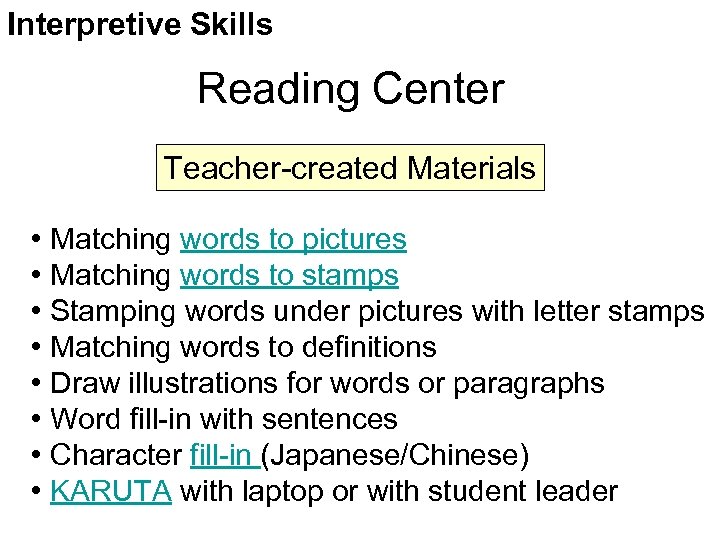 Interpretive Skills Reading Center Teacher-created Materials • Matching words to pictures • Matching words to stamps • Stamping words under pictures with letter stamps • Matching words to definitions • Draw illustrations for words or paragraphs • Word fill-in with sentences • Character fill-in (Japanese/Chinese) • KARUTA with laptop or with student leader
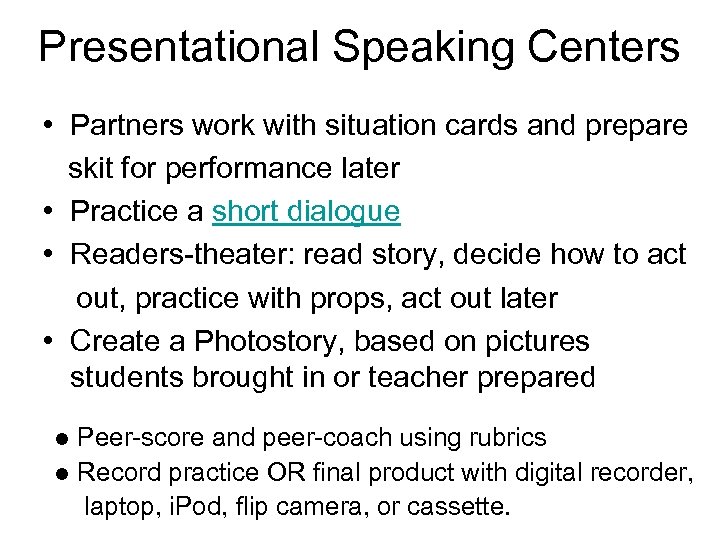 Presentational Speaking Centers • Partners work with situation cards and prepare skit for performance later • Practice a short dialogue • Readers-theater: read story, decide how to act out, practice with props, act out later • Create a Photostory, based on pictures students brought in or teacher prepared Peer-score and peer-coach using rubrics l Record practice OR final product with digital recorder, laptop, i. Pod, flip camera, or cassette. l
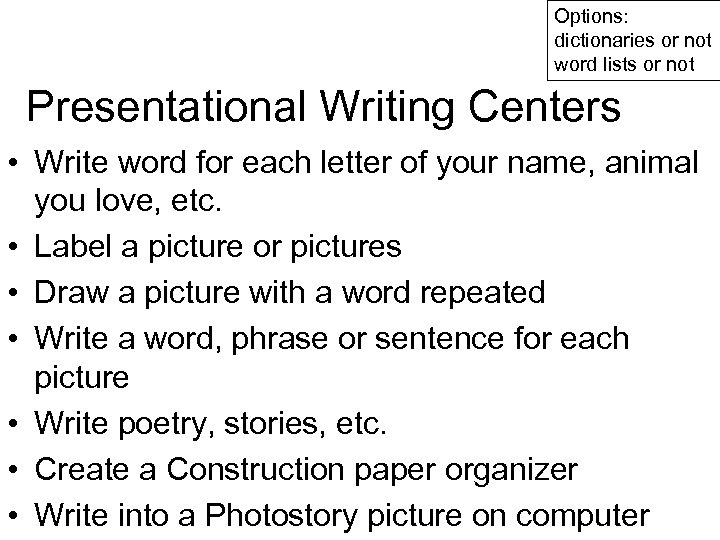 Options: dictionaries or not word lists or not Presentational Writing Centers • Write word for each letter of your name, animal you love, etc. • Label a picture or pictures • Draw a picture with a word repeated • Write a word, phrase or sentence for each picture • Write poetry, stories, etc. • Create a Construction paper organizer • Write into a Photostory picture on computer
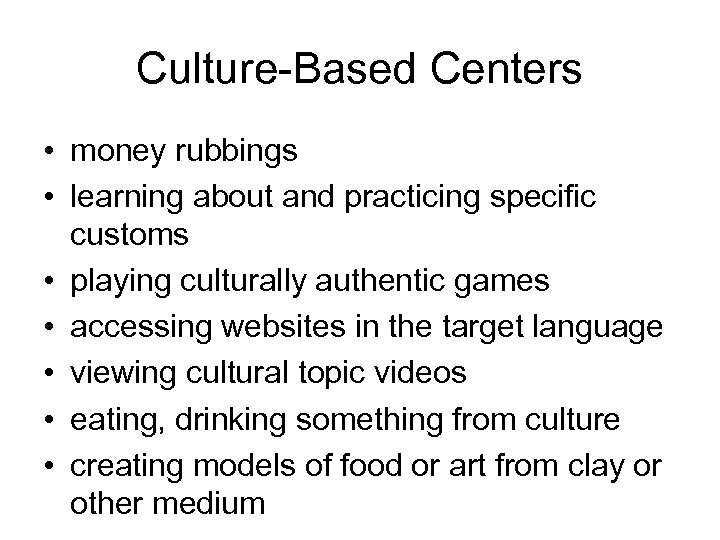 Culture-Based Centers • money rubbings • learning about and practicing specific customs • playing culturally authentic games • accessing websites in the target language • viewing cultural topic videos • eating, drinking something from culture • creating models of food or art from clay or other medium
 Art-Based Culture Centers • match art piece to sentence that describes it • brainstorm words or phrases about each art piece • one partner describes, other points to the art piece • do “color-by-number” of art piece, 1 = rojo 2 = verde
 Connections: Math Centers • one student reads number card, others use straws, base 10 rods, blocks, etc. to create number • measuring various objects in Metric and British • writing greater than/less than sentences • monetary conversions and websites • Sudoku (characters or written words) • Written word math (cinco x cinco = ___)
 Connections: Science Centers • What in the room is magnetic? (room is labeled - list up in target language) • What in the room is metal, wood, etc. ? • Classifying animals by various characteristics and creating chart • Putting together life-cycle pictures for plants, animals, etc. • Listening to a You. Tube video explaining simple science concept in target language
 Connections : Art, Music and PE Centers • Make a target culture craft • Draw a scene to be labeled later • Compare 2 target culture songs for various characteristics • Write a few sentences about why one song is better. • Learn a dance step or dance from written directions, video, etc.
 Comparisons-based Centers • Creating Venn diagrams (written or pictures) or other graphic organizers. • Writing about own family, home, etc. versus target culture family, home, studied (perhaps English) • Investigating written work in both languages (ex. same picture book in two languages) and answering questions about similarities/differences • Looking at maps from different countries and answering comparison questions or highlighting countries.
 Communities-based Centers • Native-speaker visitor(s) as the center (be sure to give task or games!) • Reading, listening to or writing pen pal letters • Looking at video from pen pals • Looking at You. Tube video of peers • Constructing an email, letter, picture, etc. to share with native speakers • Creating something in target language to be shared with the school or home for the purpose of language sharing/teaching
 Assessment How does assessment fit into Small Group Instruction and Centers?
 Classroom Set-up Priorities • Easy to change quickly • Match activity to setting • Provide logical circular flow • Have a way to signal centers change
 On a Cart • “Center in a Box” • CD/DVD to put in classroom computer • Talk with teacher about using his/her reading table • Start with less centers (or even 1 group at your table) • Learning Stations Concept
 Giving Directions for Centers • Written sheets on table • Instructions on slides of Powerpoint • Go over on first day of centers and/or previous class • Walk them through transitions
 For Early finishers. . . • • • Word searches Crossword puzzles Color-by-directions Continue drawings Help others
 Tracking Student Progress Self-Assessment • “Can Do” Checklist for students as they go through centers • “Can Do” Checklist for after centers are complete
 Work that Students Correct • Keep answer papers in a separate area, near you, or on a later slide of Powerpoint • OR, correct as a class after last center
 Work you need to score • Collect in “Finished Work” folder for later grading • Put folder on desktop of computer with class name for students to save recordings into • Consider recording/videotaping assessments at your table for later scoring • Consider having your computer in front of you to enter scores • Consider having rubric in front of you to score as they speak
 A final note. . . • Let unit goals drive center activities • Do your best to have every activity be a language activity • Don’t spend TOO much time making centers • Use centers, whole group, and partner activities to maximize learning • Enjoy!
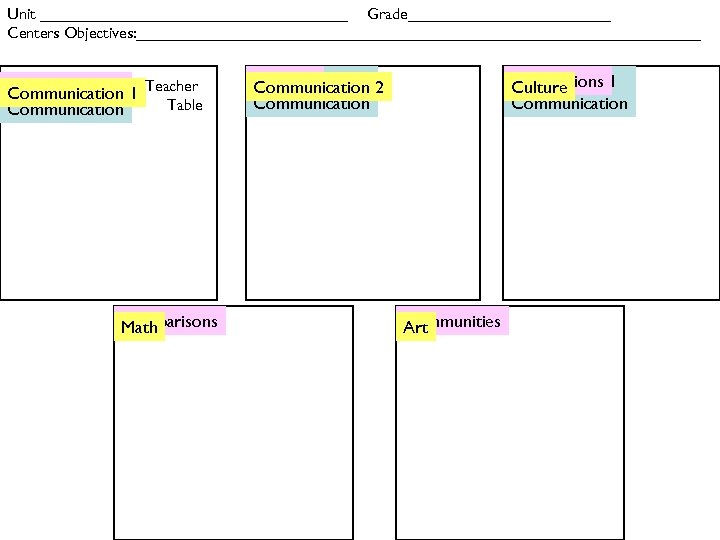 Unit __________________ Grade____________ Centers Objectives: ________________________________ Communication Interpersonal Communication 1 Teacher Table Communication Comparisons Other Math “C” Cultures Interpretive Communication 2 Communication Connections Presentational Culture Communication Communities Other “C” Art
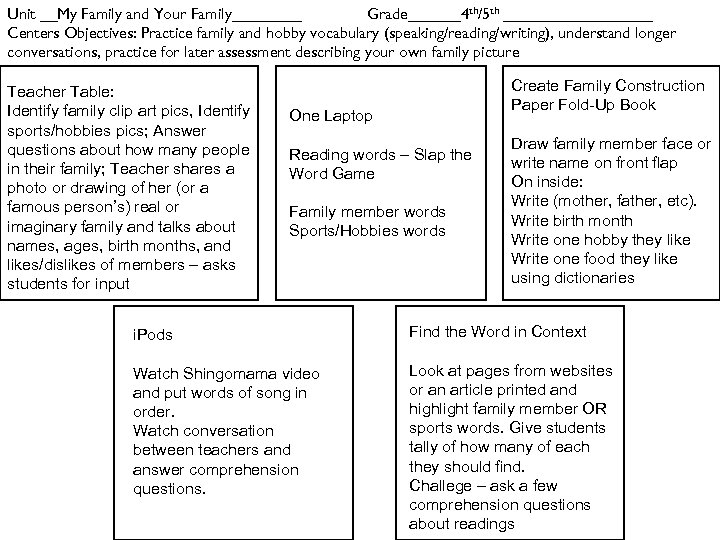 Unit __My Family and Your Family____ Grade______4 th/5 th _________ Centers Objectives: Practice family and hobby vocabulary (speaking/reading/writing), understand longer conversations, practice for later assessment describing your own family picture Teacher Table: Identify family clip art pics, Identify sports/hobbies pics; Answer questions about how many people in their family; Teacher shares a photo or drawing of her (or a famous person’s) real or imaginary family and talks about names, ages, birth months, and likes/dislikes of members – asks students for input Create Family Construction Paper Fold-Up Book One Laptop Reading words – Slap the Word Game Family member words Sports/Hobbies words Draw family member face or write name on front flap On inside: Write (mother, father, etc). Write birth month Write one hobby they like Write one food they like using dictionaries i. Pods Find the Word in Context Watch Shingomama video and put words of song in order. Watch conversation between teachers and answer comprehension questions. Look at pages from websites or an article printed and highlight family member OR sports words. Give students tally of how many of each they should find. Challege – ask a few comprehension questions about readings