


 Скачать презентацию Center for Research and Policy Making Local Economic
daf211679a49f42586a4f234ce9004f3.ppt
- Количество слайдов: 23
 Center for Research and Policy Making Local Economic Development of Gostivar municipality. Collapse of the industry, emigrants key for surviving 10 December 2005 NGO Fair- Skopje
 History of Gostivar • • Gostivar is mentioned for the first time in Middle Ages In XVII century Gostivar became center of Gorni Polog In 1904 Gostivar had 3 400 inhabitants. Today the municipality of Gostivar has 35 inhabited places with the population of: - the municipality of Gostivar 81035 inhabitants - the town of Gostivar 35 847 inhabitants
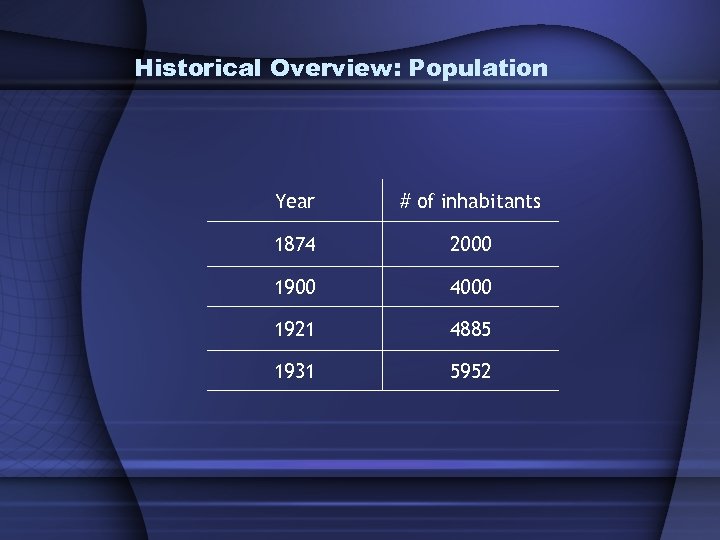 Historical Overview: Population Year # of inhabitants 1874 2000 1900 4000 1921 4885 1931 5952
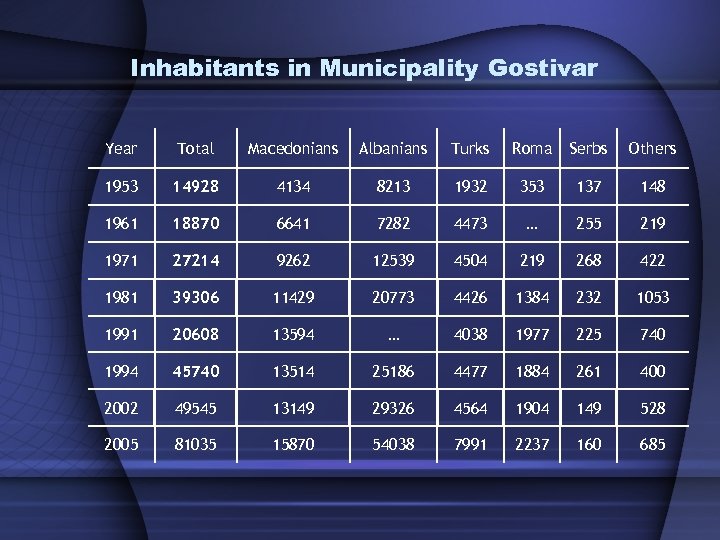 Inhabitants in Municipality Gostivar Year Total Macedonians Albanians Turks Roma Serbs Others 1953 14928 4134 8213 1932 353 137 148 1961 18870 6641 7282 4473 … 255 219 1971 27214 9262 12539 4504 219 268 422 1981 39306 11429 20773 4426 1384 232 1053 1991 20608 13594 … 4038 1977 225 740 1994 45740 13514 25186 4477 1884 261 400 2002 49545 13149 29326 4564 1904 149 528 2005 81035 15870 54038 7991 2237 160 685
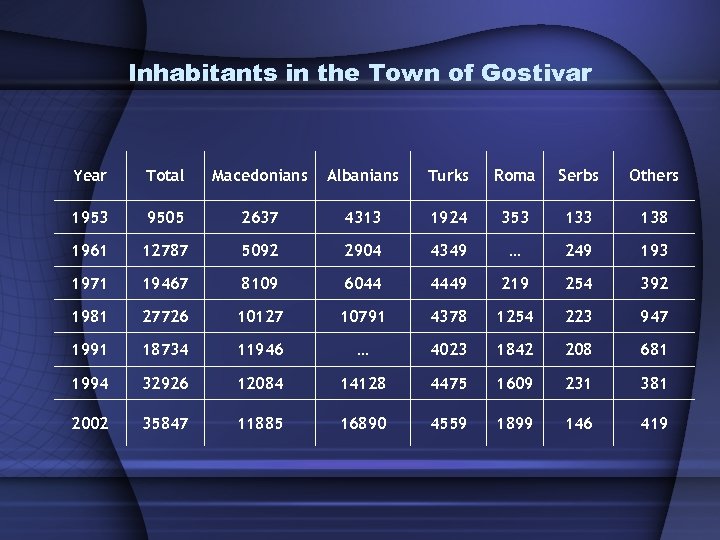 Inhabitants in the Town of Gostivar Year Total Macedonians Albanians Turks Roma Serbs Others 1953 9505 2637 4313 1924 353 138 1961 12787 5092 2904 4349 … 249 193 1971 19467 8109 6044 4449 219 254 392 1981 27726 10127 10791 4378 1254 223 947 1991 18734 11946 … 4023 1842 208 681 1994 32926 12084 14128 4475 1609 231 381 2002 35847 11885 16890 4559 1899 146 419
 Developments in Socialist Times Internal migration • The rural population from the mountains descended to the Polog valley; many people from the villages moved to the town of Gostivar. • In 1954 the Turkish “left”. Macedonians and Albanians moved in from the surrounded villages. • Gorni Polog is highly fertile land – key economic activities crafts and agriculture. • But! Incoming peasants are being employed in Industry.
 Developments in Socialist Times Rapid Industrialization • Dekon (clothing manufacturing) founded in 1948 • Silika (fire proof materials) in 1954 • Mermeri c. 1955 (industry for decorative stone -industrija za ukrasen kamen) • Goteks founded in 1958 • Gorni Polog Slaughterhouse 1960
 Developments in Socialist Times Decline of Agriculture, Old Crafts • In 1971 agriculture sector provides only 20% of total revenues of the municipality whereas the industry makes 41% of the revenues. • But! Many still work in agriculture- in 1973, 4720 households employed in agriculture and cattlebreeding, 98% of cultivation area (obrabotliva povrsina) private. • Old craft is dying the younger craftsmen do not show any interest. Turks “left. ”
 The Story of “Silika” Before Transformation • Giant in ex-Yu consists of Alumosilikatna, Dolomitna and Chajle mine • Selling all over Europe, 70% of production. • In 1980 exported 8882 tons. • In 1989, total turnover USD 100 mil, out of which USD 63 mil. profit.
 The Story of “Silika” Before Transformation • Major employer - total of 1900 employees Alumosilikatna worked in 5 shifts; Dolomitna in 4 shifts the mines in 2 shifts. • The average salary was DEM 750. • Equipped with top technology, imported from Europe, staff trained abroad.
 Factors For Fall of “Silika” After 89 • Break Down of Traditional Markets • Transport Costs Increase (x-Yu Wars) • Over- employment (450 employees as technological surplus). • Increasing debts • Problems with enforcement of payments • Government policy stimulating SME based economy
 The leftovers of “Silika” In 1995, RIOM”SILIKA” started bankruptcy procedure. SILIKA was divided in three business units: 1. 2. 3. • • AD “ALUMO SILIKAT” AD ”REMONT” AD “DOLOMIT” The mines “Chajle” Chajle and “Minerals Silika” Makedonski Brod, as well as the brick-plant “Ciglana” had been separated. Nowadays only AD”DOLOMIT” works- bought in 2003 by “HAZNEDAR” - exports 45. 000 tones fireproof materials annually to Bulgaria
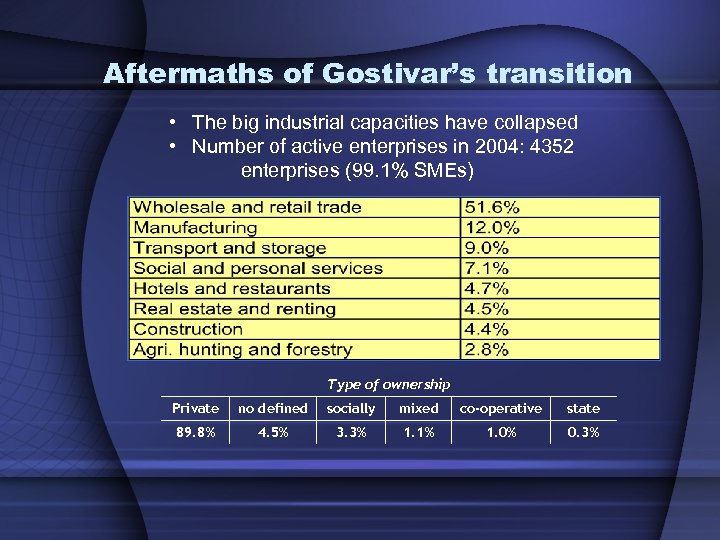 Aftermaths of Gostivar’s transition • The big industrial capacities have collapsed • Number of active enterprises in 2004: 4352 enterprises (99. 1% SMEs) Type of ownership Private no defined socially mixed co-operative state 89. 8% 4. 5% 3. 3% 1. 1% 1. 0% 0. 3%
 Main employers in today's Gostivar economy • Only 37 of registered companies have more than 10 employees • Only 5 of them have more than 100 employees (DEKON, OHIM Ges, Komunalec, Zito Sar, Getro) • ESM branch Gostivar is a major employer, but recorded in Skopje • The rest are dominated by companies dealing with trade and production of furniture and construction materials
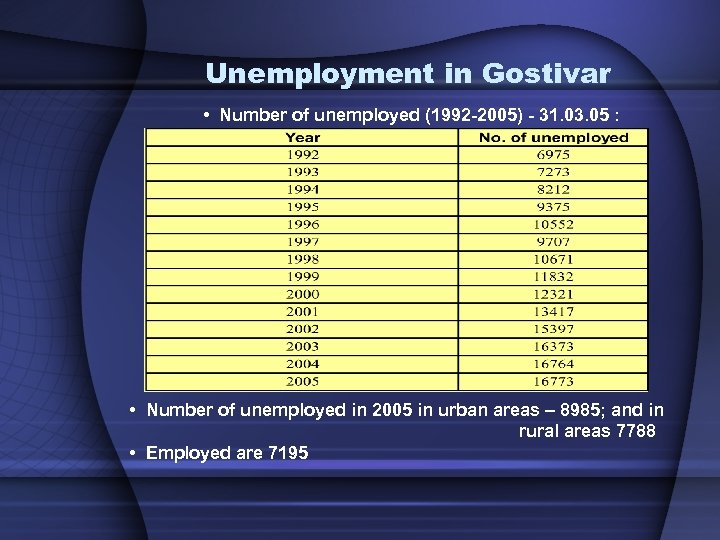 Unemployment in Gostivar • Number of unemployed (1992 -2005) - 31. 03. 05 : • Number of unemployed in 2005 in urban areas – 8985; and in rural areas 7788 • Employed are 7195
 Emigrants – key for survival • CRPM estimation on basis of its research is that the number of emigrants from Gostivar is between 15. 000 -20. 000 • The vast majority of migrants- for economic reasons, guest workers • 54. 60% of remittances for family needs, home investments - 15. 30%, renovations of the family houses - 13%, buying house/apartment - 9. 20%, savings - 3. 10%, and other reasons - 4. 80%. • From 1993 until 2004 the Macedonian economic emigrants brought to the country 3 billion dollars
 Effect of Remittances on town’s dynamics • The town becomes lively when the guest workers arrive / summer and New Years / • This summer 1000 weddings some worth of 20. 000 euros • Construction of houses main activity in the summer period • Belvicica street – the housing and furniture paradise • Trade and services booming in summer
 New trends in emigration With negative impact on economy • In recent years emigrants come in smaller numbers • Spend less time and money • They take the entire family • Buy apartments rather than houses With positive impact on economy • Home comers bringing in investment and know-how (Gudalat, Fejzi, Fatina)
 Decentralization and municipal good governance • Dynamic new mayor • 800. 000 euro invested in municipal infrastructure in the last 6 months (parking, improvement of the water supply, park, street, organization of traffic, waste depot) • One stop shop • Removal of illegally built houses • Gradual payment of the municipal debts
 CRPM basic findings • 80 companies and individuals were interviewed in the period April-December 2005 • Highlight – decent / fair inter ethnic relations • Most of them identified the same issues of concern: - unfaithful competition - problems with enforcing payments - limited access to finance (bad loan criteria) - no state aid - high dependence on emigrant’s financial assistance - lack of industrial capacities in the town and employment - predominance of petty trade - high level of corruption and nepotism - lack of FDI - too many seasonal jobs / no stable employment
 Recommendations and conclusions Discussion paper on CRPM’s Gostivar research – coming soon -
 Thanks to our Partners and Donors European Stability Initiative The German Marshall Fund of the United States of America Libertas Institute Olof Palme International Center Foundation Open Society Institute Macedonia Journal of Southeast European Politics
 CRPM Your comments and suggestions are welcomed at crpm@europe. com