 Скачать презентацию Center for Environmental Leadership in Business FY 08
87dbc8ccf257349f73b08fb971284446.ppt
- Количество слайдов: 34



Center for Environmental Leadership in Business FY 08 Successes and FY 09 Goals Conservation International Annual Planning May 5, 2008
CELB Mission and Division Goals § Mission: To engage the private sector worldwide as a positive force for biodiversity conservation § Division Goals: Conservation Investments: $100 M in corporate funding raised for Future for Life Campaign (FY 05 -10) Business Practices: Biodiversity policies and practices adopted by leading companies in key industries -- agriculture, forestry, fisheries, energy, mining, tourism, financial services (goal and target to be updated with new CI strategic plan)
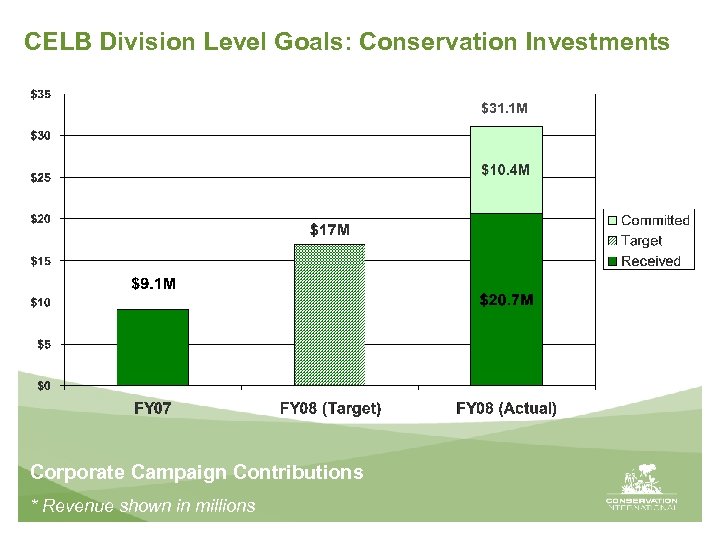
CELB Division Level Goals: Conservation Investments $31. 1 M Corporate Campaign Contributions * Revenue shown in millions
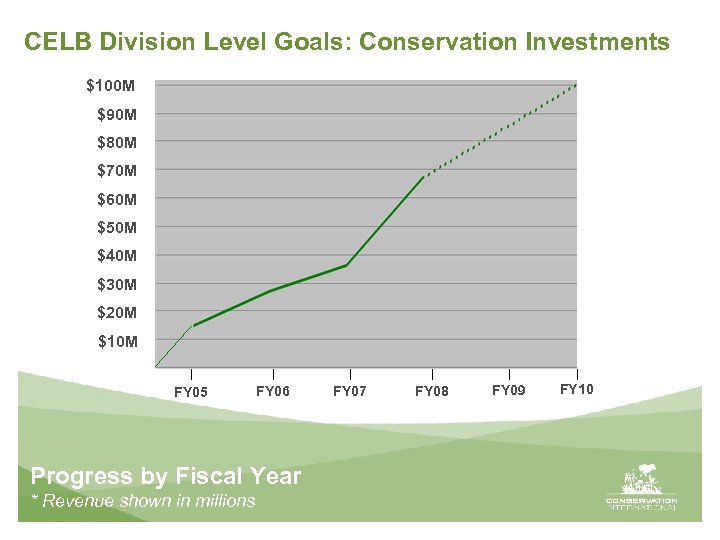
CELB Division Level Goals: Conservation Investments $100 M $90 M $80 M $70 M $60 M $50 M $40 M $30 M $20 M $10 M FY 05 FY 06 Progress by Fiscal Year * Revenue shown in millions FY 07 FY 08 FY 09 FY 10
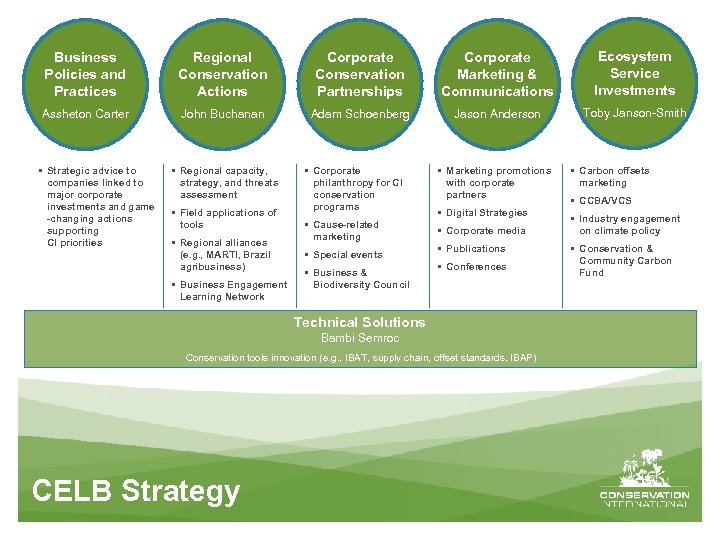
Business Policies and Practices Regional Conservation Actions Corporate Conservation Partnerships Corporate Marketing & Communications Ecosystem Service Investments Assheton Carter John Buchanan Adam Schoenberg Jason Anderson Toby Janson-Smith § Strategic advice to companies linked to major corporate investments and game -changing actions supporting CI priorities § Regional capacity, strategy, and threats assessment § Field applications of tools § Regional alliances (e. g. , MARTI, Brazil agribusiness) § Business Engagement § Corporate philanthropy for CI conservation programs § Cause-related marketing § Special events § Business & § Marketing promotions with corporate partners § Digital Strategies § Corporate media § Publications § Conferences Biodiversity Council Learning Network Technical Solutions Bambi Semroc Conservation tools innovation (e. g. , IBAT, supply chain, offset standards, IBAP) CELB Strategy § Carbon offsets marketing § CCBA/VCS § Industry engagement on climate policy § Conservation & Community Carbon Fund
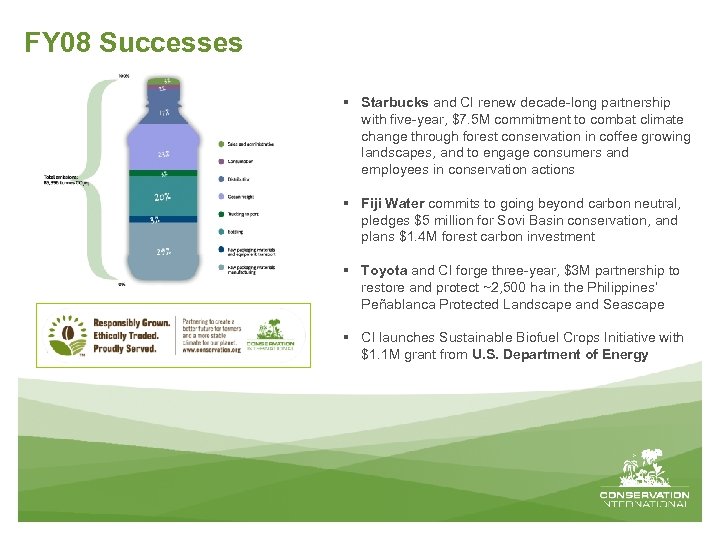
FY 08 Successes § Starbucks and CI renew decade-long partnership with five-year, $7. 5 M commitment to combat climate change through forest conservation in coffee growing landscapes, and to engage consumers and employees in conservation actions § Fiji Water commits to going beyond carbon neutral, pledges $5 million for Sovi Basin conservation, and plans $1. 4 M forest carbon investment § Toyota and CI forge three-year, $3 M partnership to restore and protect ~2, 500 ha in the Philippines’ Peñablanca Protected Landscape and Seascape § CI launches Sustainable Biofuel Crops Initiative with $1. 1 M grant from U. S. Department of Energy
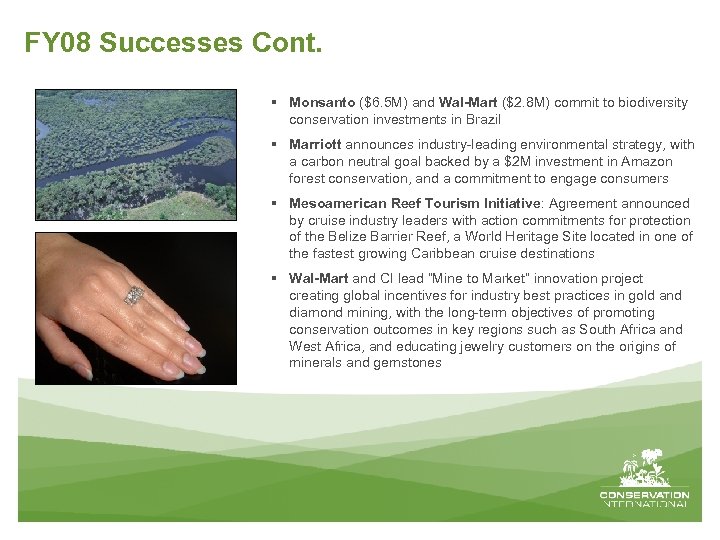
FY 08 Successes Cont. § Monsanto ($6. 5 M) and Wal-Mart ($2. 8 M) commit to biodiversity conservation investments in Brazil § Marriott announces industry-leading environmental strategy, with a carbon neutral goal backed by a $2 M investment in Amazon forest conservation, and a commitment to engage consumers § Mesoamerican Reef Tourism Initiative: Agreement announced by cruise industry leaders with action commitments for protection of the Belize Barrier Reef, a World Heritage Site located in one of the fastest growing Caribbean cruise destinations § Wal-Mart and CI lead “Mine to Market” innovation project creating global incentives for industry best practices in gold and diamond mining, with the long-term objectives of promoting conservation outcomes in key regions such as South Africa and West Africa, and educating jewelry customers on the origins of minerals and gemstones
FY 08 Successes Cont. § Forest conservation provisions included in the Voluntary Carbon Standard – the definitive reference point for verifying carbon offsets for the voluntary carbon market ($100 M today and projected to rise to $1 B by 2010) § Bunge, CI and local partners in Brazil create Bio. Cerrado Alliance to recruit additional companies (e. g. , Kraft, Du. Pont) and increase the scale of business engagement for conservation and sustainable agriculture in the Cerrado hotspot, including ~250 K ha of new protected private lands § Business & Biodiversity Council grows to 22 companies, with new members including Bank of America, Disney, Du. Pont, General Growth, General Mills, Royal Caribbean, Shell, United, and White Wave Foods § Wrigley Company Foundation awards $2. 5 million to CI for promotion of a global conservation ethic
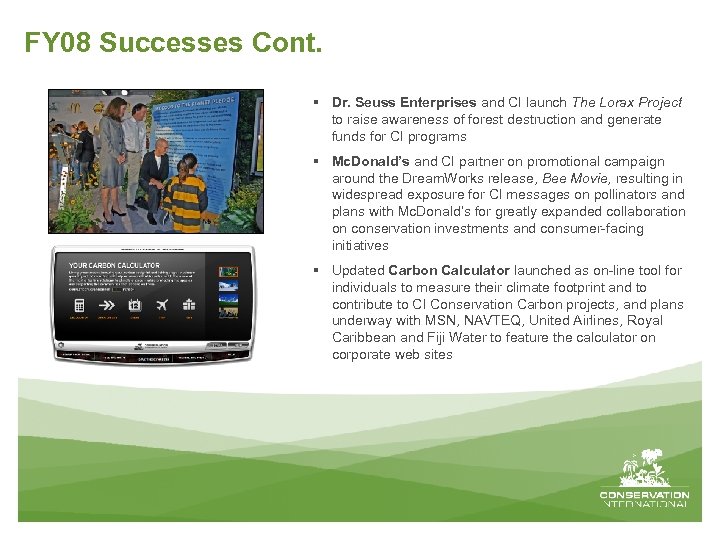
FY 08 Successes Cont. § Dr. Seuss Enterprises and CI launch The Lorax Project to raise awareness of forest destruction and generate funds for CI programs § Mc. Donald’s and CI partner on promotional campaign around the Dream. Works release, Bee Movie, resulting in widespread exposure for CI messages on pollinators and plans with Mc. Donald’s for greatly expanded collaboration on conservation investments and consumer-facing initiatives § Updated Carbon Calculator launched as on-line tool for individuals to measure their climate footprint and to contribute to CI Conservation Carbon projects, and plans underway with MSN, NAVTEQ, United Airlines, Royal Caribbean and Fiji Water to feature the calculator on corporate web sites
FY 09 Plan Outcome: Corporate Engagement in the Regions CI knowledge and tools mobilized, strategies developed, and capacity built to maximize corporate engagement opportunities for mitigating industry threats and achieving conservation outcomes in the regions
Corporate Engagement in the Regions: Outputs § Business Engagement Learning Network implemented with point people identified in all CI regions § CI business engagement toolkit version 1. 0 created, with content based on CELB and regional program experiences to date with corporate partners on fundraising, environmental best practices, and supply chain guidelines § Corporate engagement strategies developed and implemented in CI regions—already underway in South America, Africa, China, Indo-Pacific; need to agree on timing and sequencing with other regions § Methodology for private sector threats assessment developed with Regional Divisions, CABS, and Conservation Strategies § Corporate fundraising strategies developed and implemented, including identification of major prospects, for CI regions FY 09 Plan
FY 09 Plan Outcome: Corporate Funding for Conservation Through CELB strategy lines, $20 M in corporate funding secured in FY 09 to hit 90% of Future for Life target with one year left in campaign
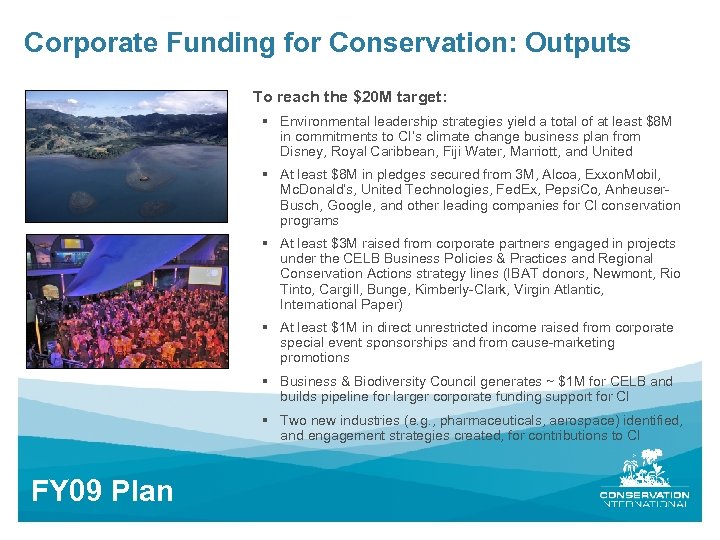
Corporate Funding for Conservation: Outputs To reach the $20 M target: § Environmental leadership strategies yield a total of at least $8 M in commitments to CI’s climate change business plan from Disney, Royal Caribbean, Fiji Water, Marriott, and United § At least $8 M in pledges secured from 3 M, Alcoa, Exxon. Mobil, Mc. Donald’s, United Technologies, Fed. Ex, Pepsi. Co, Anheuser. Busch, Google, and other leading companies for CI conservation programs § At least $3 M raised from corporate partners engaged in projects under the CELB Business Policies & Practices and Regional Conservation Actions strategy lines (IBAT donors, Newmont, Rio Tinto, Cargill, Bunge, Kimberly-Clark, Virgin Atlantic, International Paper) § At least $1 M in direct unrestricted income raised from corporate special event sponsorships and from cause-marketing promotions § Business & Biodiversity Council generates ~ $1 M for CELB and builds pipeline for larger corporate funding support for CI § Two new industries (e. g. , pharmaceuticals, aerospace) identified, and engagement strategies created, for contributions to CI FY 09 Plan
FY 09 Plan Outcome: Ecosystem Service Investments Markets developed forest carbon and other ecosystem services through assisting corporations with development of robust climate strategies and offset portfolios, creating vehicles for consumers to offset their carbon footprints, and supporting development of market-oriented voluntary carbon standards.
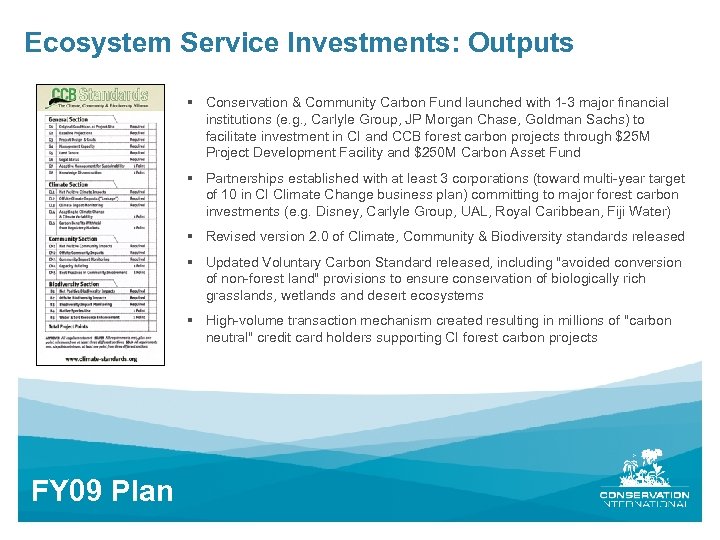
Ecosystem Service Investments: Outputs § Conservation & Community Carbon Fund launched with 1 -3 major financial institutions (e. g. , Carlyle Group, JP Morgan Chase, Goldman Sachs) to facilitate investment in CI and CCB forest carbon projects through $25 M Project Development Facility and $250 M Carbon Asset Fund § Partnerships established with at least 3 corporations (toward multi-year target of 10 in CI Climate Change business plan) committing to major forest carbon investments (e. g. Disney, Carlyle Group, UAL, Royal Caribbean, Fiji Water) § Revised version 2. 0 of Climate, Community & Biodiversity standards released § Updated Voluntary Carbon Standard released, including "avoided conversion of non-forest land" provisions to ensure conservation of biologically rich grasslands, wetlands and desert ecosystems § High-volume transaction mechanism created resulting in millions of "carbon neutral" credit card holders supporting CI forest carbon projects FY 09 Plan
FY 09 Plan Outcome: Industry Threats Through leading companies’ use of CI strategy advice and tools, global threats to biodiversity significantly abated and converted to positive results for conservation
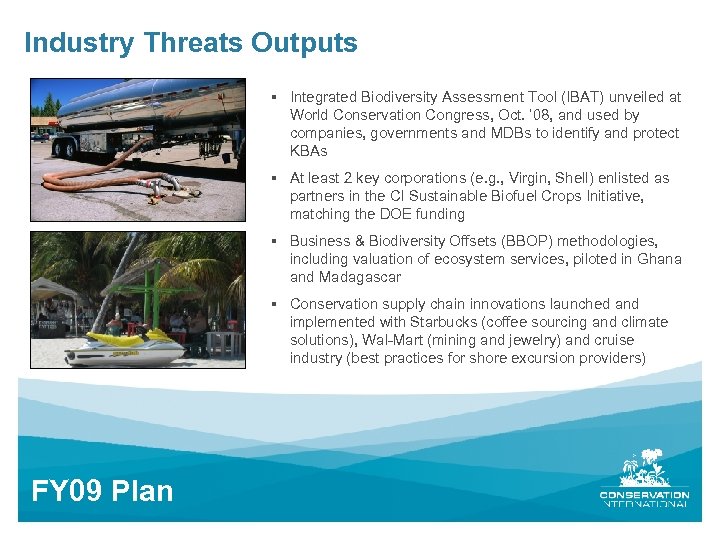
Industry Threats Outputs § Integrated Biodiversity Assessment Tool (IBAT) unveiled at World Conservation Congress, Oct. ’ 08, and used by companies, governments and MDBs to identify and protect KBAs § At least 2 key corporations (e. g. , Virgin, Shell) enlisted as partners in the CI Sustainable Biofuel Crops Initiative, matching the DOE funding § Business & Biodiversity Offsets (BBOP) methodologies, including valuation of ecosystem services, piloted in Ghana and Madagascar § Conservation supply chain innovations launched and implemented with Starbucks (coffee sourcing and climate solutions), Wal-Mart (mining and jewelry) and cruise industry (best practices for shore excursion providers) FY 09 Plan
FY 09 Plan Outcome: Conservation Ethic and CI Branding Through strategic joint marketing promotions, employee engagement initiatives and on-line campaigns, CI corporate partner communications channels help spark a conservation ethic within society and generate increased awareness for CI and our mission
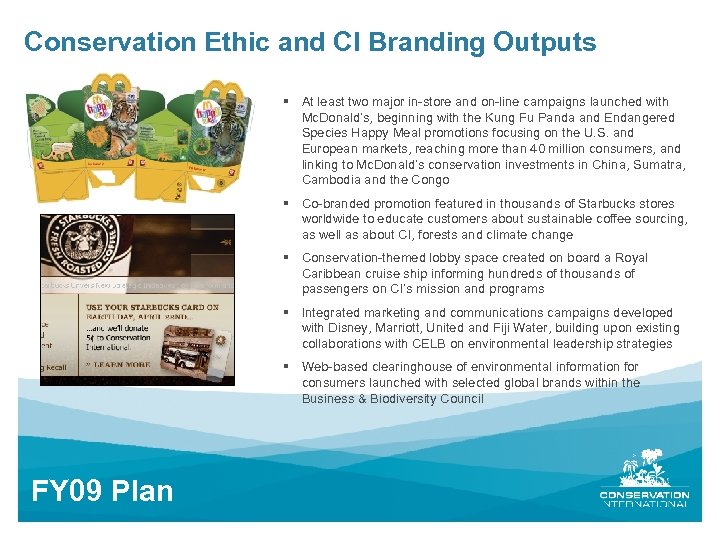
Conservation Ethic and CI Branding Outputs § § Co-branded promotion featured in thousands of Starbucks stores worldwide to educate customers about sustainable coffee sourcing, as well as about CI, forests and climate change § Conservation-themed lobby space created on board a Royal Caribbean cruise ship informing hundreds of thousands of passengers on CI’s mission and programs § Integrated marketing and communications campaigns developed with Disney, Marriott, United and Fiji Water, building upon existing collaborations with CELB on environmental leadership strategies § FY 09 Plan At least two major in-store and on-line campaigns launched with Mc. Donald’s, beginning with the Kung Fu Panda and Endangered Species Happy Meal promotions focusing on the U. S. and European markets, reaching more than 40 million consumers, and linking to Mc. Donald’s conservation investments in China, Sumatra, Cambodia and the Congo Web-based clearinghouse of environmental information for consumers launched with selected global brands within the Business & Biodiversity Council
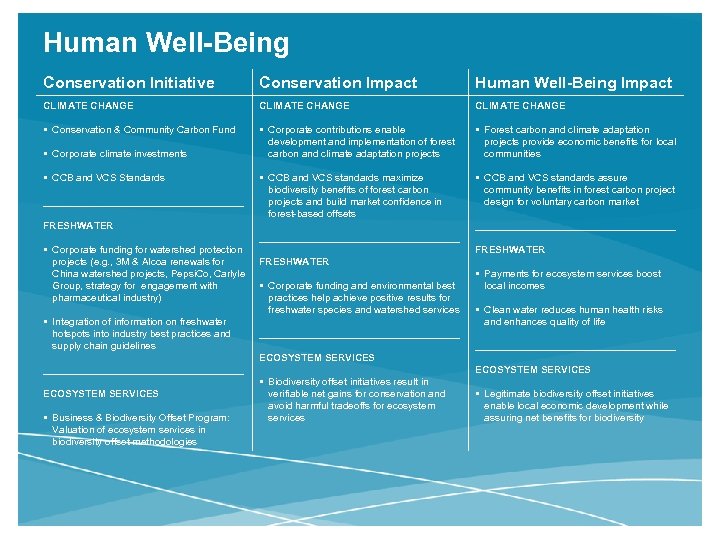
Human Well-Being Conservation Initiative Conservation Impact Human Well-Being Impact CLIMATE CHANGE § Conservation & Community Carbon Fund § Corporate contributions enable § Forest carbon and climate adaptation § Corporate climate investments § CCB and VCS Standards __________________ development and implementation of forest carbon and climate adaptation projects § CCB and VCS standards maximize biodiversity benefits of forest carbon projects and build market confidence in forest-based offsets FRESHWATER projects provide economic benefits for local communities § CCB and VCS standards assure community benefits in forest carbon project design for voluntary carbon market ____________________________________ § Corporate funding for watershed protection projects (e. g. , 3 M & Alcoa renewals for China watershed projects, Pepsi. Co, Carlyle Group, strategy for engagement with pharmaceutical industry) FRESHWATER § Payments for ecosystem services boost § Corporate funding and environmental best practices help achieve positive results for freshwater species and watershed services § Integration of information on freshwater hotspots into industry best practices and supply chain guidelines local incomes § Clean water reduces human health risks and enhances quality of life ____________________________________ ECOSYSTEM SERVICES § Biodiversity offset initiatives result in ECOSYSTEM SERVICES § Business & Biodiversity Offset Program: Valuation of ecosystem services in biodiversity offset methodologies verifiable net gains for conservation and avoid harmful tradeoffs for ecosystem services § Legitimate biodiversity offset initiatives enable local economic development while assuring net benefits for biodiversity
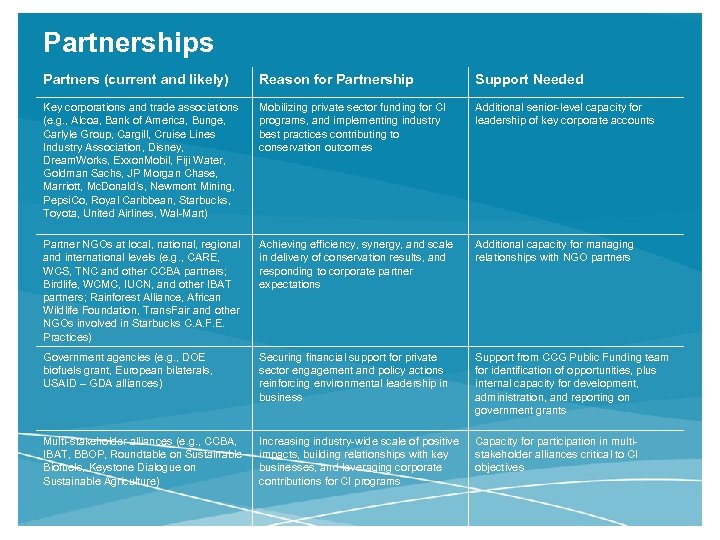
Partnerships Partners (current and likely) Reason for Partnership Support Needed Key corporations and trade associations (e. g. , Alcoa, Bank of America, Bunge, Carlyle Group, Cargill, Cruise Lines Industry Association, Disney, Dream. Works, Exxon. Mobil, Fiji Water, Goldman Sachs, JP Morgan Chase, Marriott, Mc. Donald’s, Newmont Mining, Pepsi. Co, Royal Caribbean, Starbucks, Toyota, United Airlines, Wal-Mart) Mobilizing private sector funding for CI programs, and implementing industry best practices contributing to conservation outcomes Additional senior-level capacity for leadership of key corporate accounts Partner NGOs at local, national, regional and international levels (e. g. , CARE, WCS, TNC and other CCBA partners; Birdlife, WCMC, IUCN, and other IBAT partners; Rainforest Alliance, African Wildlife Foundation, Trans. Fair and other NGOs involved in Starbucks C. A. F. E. Practices) Achieving efficiency, synergy, and scale in delivery of conservation results, and responding to corporate partner expectations Additional capacity for managing relationships with NGO partners Government agencies (e. g. , DOE biofuels grant, European bilaterals, USAID – GDA alliances) Securing financial support for private sector engagement and policy actions reinforcing environmental leadership in business Support from CCG Public Funding team for identification of opportunities, plus internal capacity for development, administration, and reporting on government grants Multi-stakeholder alliances (e. g. , CCBA, IBAT, BBOP, Roundtable on Sustainable Biofuels, Keystone Dialogue on Sustainable Agriculture) Increasing industry-wide scale of positive impacts, building relationships with key businesses, and leveraging corporate contributions for CI programs Capacity for participation in multistakeholder alliances critical to CI objectives
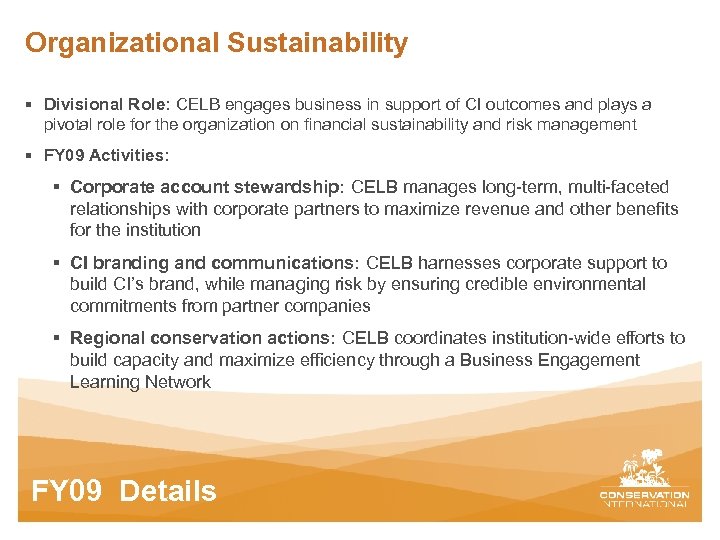
Organizational Sustainability § Divisional Role: CELB engages business in support of CI outcomes and plays a pivotal role for the organization on financial sustainability and risk management § FY 09 Activities: § Corporate account stewardship: CELB manages long-term, multi-faceted relationships with corporate partners to maximize revenue and other benefits for the institution § CI branding and communications: CELB harnesses corporate support to build CI’s brand, while managing risk by ensuring credible environmental commitments from partner companies § Regional conservation actions: CELB coordinates institution-wide efforts to build capacity and maximize efficiency through a Business Engagement Learning Network FY 09 Details
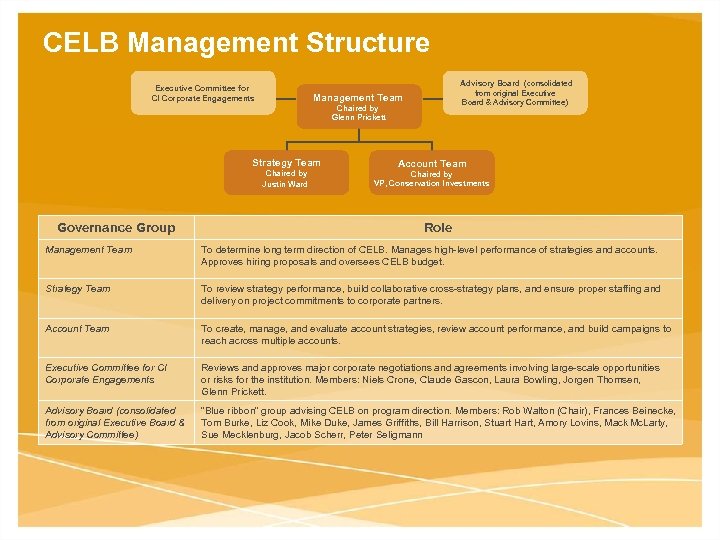
CELB Management Structure Executive Committee for CI Corporate Engagements Advisory Board (consolidated from original Executive Board & Advisory Committee) Management Team Chaired by Glenn Prickett Strategy Team Governance Group Account Team Chaired by Justin Ward Chaired by VP, Conservation Investments Role Management Team To determine long term direction of CELB. Manages high-level performance of strategies and accounts. Approves hiring proposals and oversees CELB budget. Strategy Team To review strategy performance, build collaborative cross-strategy plans, and ensure proper staffing and delivery on project commitments to corporate partners. Account Team To create, manage, and evaluate account strategies, review account performance, and build campaigns to reach across multiple accounts. Executive Committee for CI Corporate Engagements Reviews and approves major corporate negotiations and agreements involving large-scale opportunities or risks for the institution. Members: Niels Crone, Claude Gascon, Laura Bowling, Jorgen Thomsen, Glenn Prickett. Advisory Board (consolidated from original Executive Board & Advisory Committee) “Blue ribbon” group advising CELB on program direction. Members: Rob Walton (Chair), Frances Beinecke, Tom Burke, Liz Cook, Mike Duke, James Griffiths, Bill Harrison, Stuart Hart, Amory Lovins, Mack Mc. Larty, Sue Mecklenburg, Jacob Scherr, Peter Seligmann
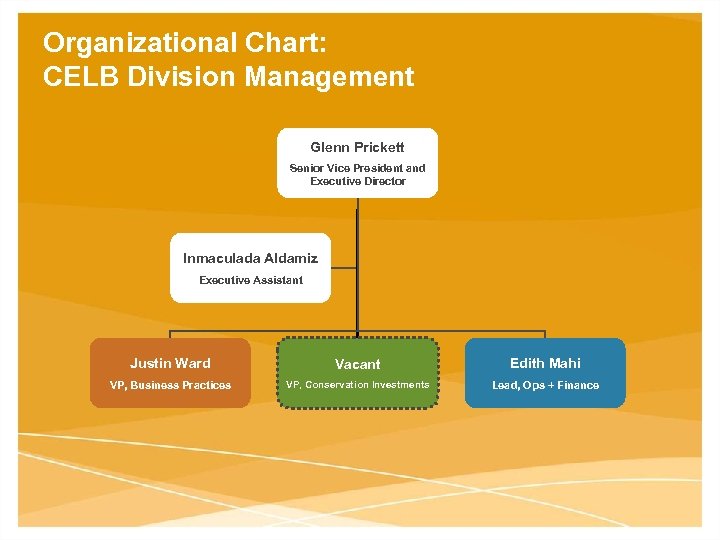
Organizational Chart: CELB Division Management Glenn Prickett Senior Vice President and Executive Director Inmaculada Aldamiz Executive Assistant Justin Ward Vacant Edith Mahi VP, Business Practices VP, Conservation Investments Lead, Ops + Finance
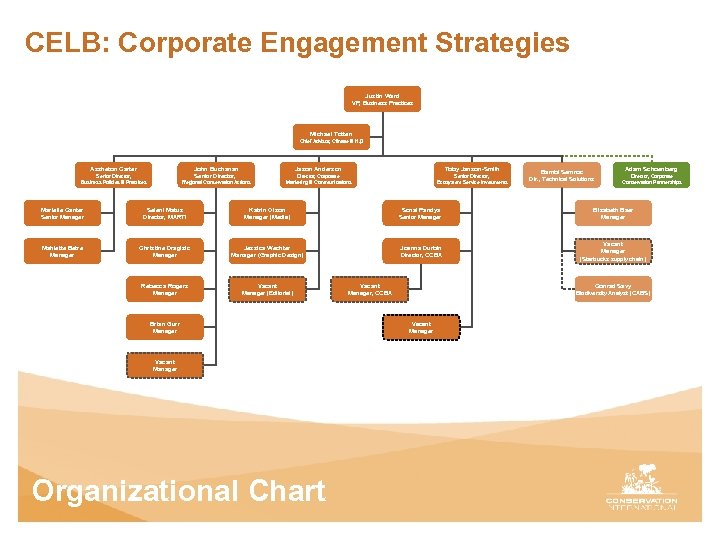
CELB: Corporate Engagement Strategies Justin Ward VP, Business Practices Michael Totten Chief Advisor, Climate & H 20 John Buchanan Senior Director, Assheton Carter Senior Director, Business Policies & Practices Jason Anderson Regional Conservation Actions Toby Janson-Smith Director, Corporate Marketing & Communications Senior Director, Ecosystem Service Investments Bambi Semroc Dir. , Technical Solutions Adam Schoenberg Director, Corporate Conservation Partnerships Marielle Canter Senior Manager Seleni Matus Director, MARTI Katrin Olson Manager (Media) Sonal Pandya Senior Manager Elizabeth Baer Manager Mahlette Betre Manager Christine Dragisic Manager Jessica Wechter Manager (Graphic Design) Joanna Durbin Director, CCBA Vacant Manager (Starbucks supply chain) Rebecca Rogers Manager Vacant Manager (Editorial) Brian Gurr Manager Vacant Manager Organizational Chart Vacant Manager, CCBA Conrad Savy Biodiversity Analyst (CABS) Vacant Manager
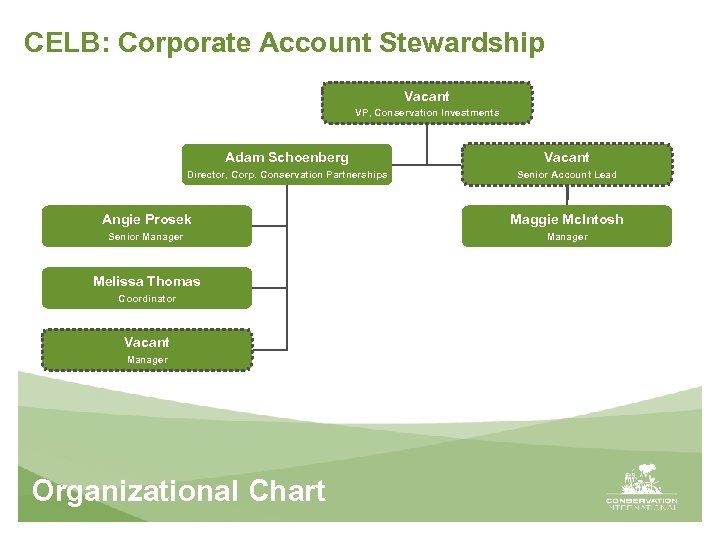
CELB: Corporate Account Stewardship Vacant VP, Conservation Investments Adam Schoenberg Vacant Director, Corp. Conservation Partnerships Senior Account Lead Angie Prosek Maggie Mc. Intosh Senior Manager Melissa Thomas Coordinator Vacant Manager Organizational Chart
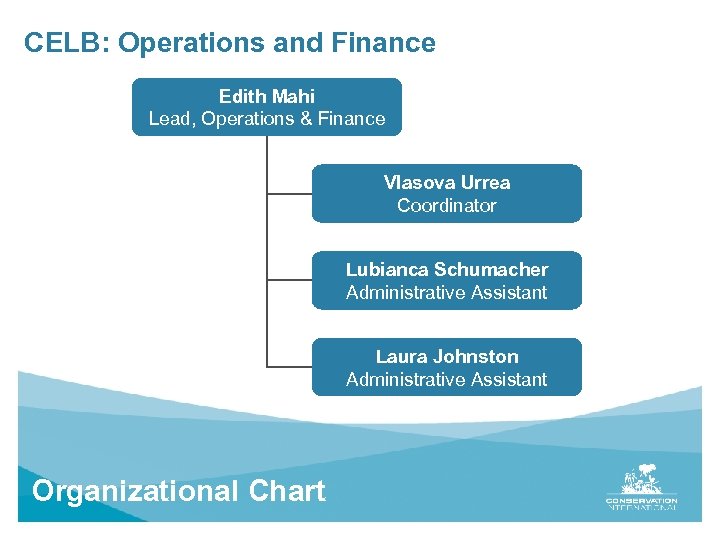
CELB: Operations and Finance Edith Mahi Lead, Operations & Finance Vlasova Urrea Coordinator Lubianca Schumacher Administrative Assistant Laura Johnston Administrative Assistant Organizational Chart
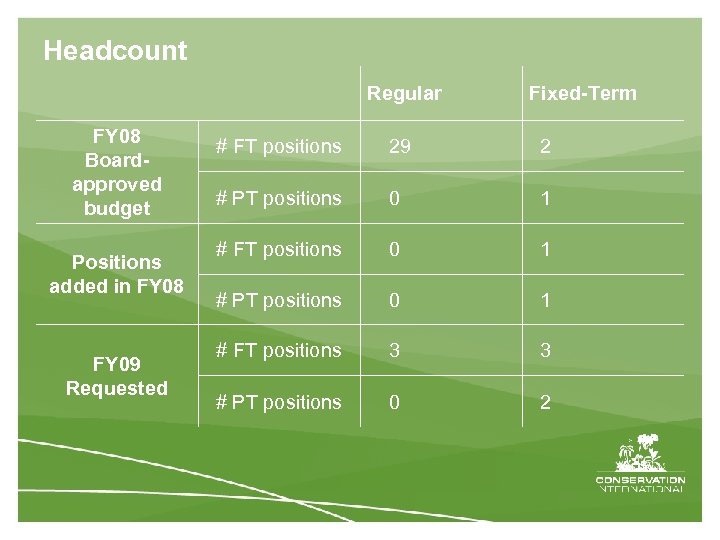
Headcount Regular FY 08 Boardapproved budget Positions added in FY 08 FY 09 Requested Fixed-Term # FT positions 29 2 # PT positions 0 1 # FT positions 0 1 # PT positions 0 1 # FT positions 3 3 # PT positions 0 2
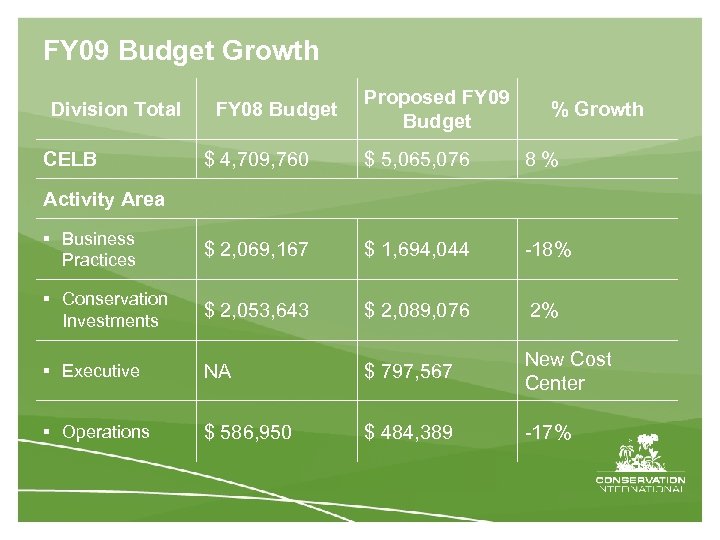
FY 09 Budget Growth Division Total CELB FY 08 Budget Proposed FY 09 Budget % Growth $ 4, 709, 760 $ 5, 065, 076 8% $ 2, 069, 167 $ 1, 694, 044 -18% $ 2, 053, 643 $ 2, 089, 076 2% § Executive NA $ 797, 567 New Cost Center § Operations $ 586, 950 $ 484, 389 -17% Activity Area § Business Practices § Conservation Investments
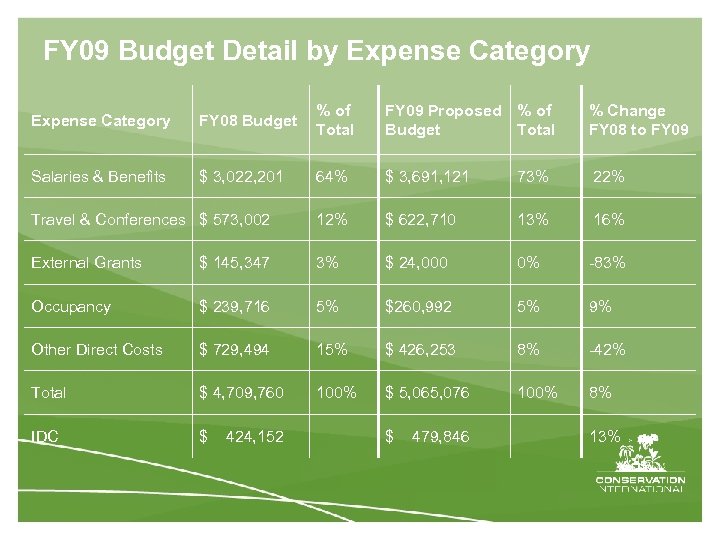
FY 09 Budget Detail by Expense Category FY 08 Budget % of Total FY 09 Proposed % of Budget Total % Change FY 08 to FY 09 Salaries & Benefits $ 3, 022, 201 64% $ 3, 691, 121 73% 22% Travel & Conferences $ 573, 002 12% $ 622, 710 13% 16% External Grants $ 145, 347 3% $ 24, 000 0% -83% Occupancy $ 239, 716 5% $260, 992 5% 9% Other Direct Costs $ 729, 494 15% $ 426, 253 8% -42% Total $ 4, 709, 760 100% $ 5, 065, 076 100% 8% IDC $ 424, 152 $ 479, 846 13%
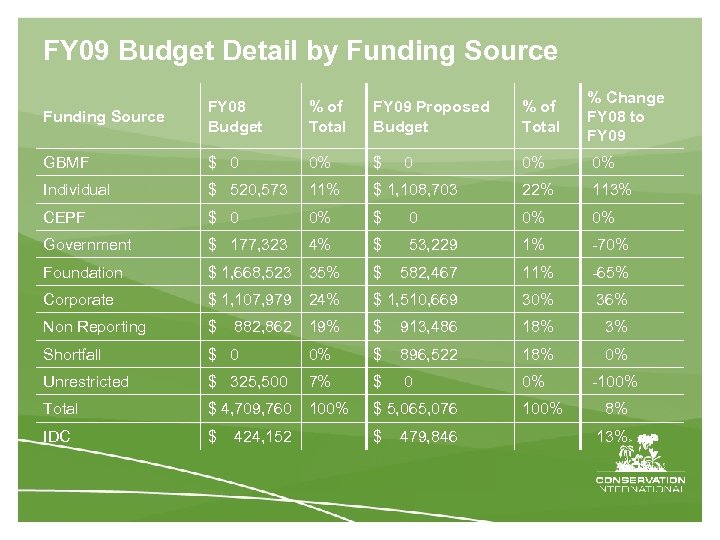
FY 09 Budget Detail by Funding Source FY 08 Budget % of Total FY 09 Proposed Budget % of Total % Change FY 08 to FY 09 GBMF $ 0 0% $ 0% 0% Individual $ 520, 573 11% $ 1, 108, 703 22% 113% CEPF $ 0 0% 0% Government $ 177, 323 4% $ 53, 229 1% -70% Foundation $ 1, 668, 523 35% $ 582, 467 11% -65% Corporate $ 1, 107, 979 24% $ 1, 510, 669 30% 36% Non Reporting $ 19% $ 913, 486 18% 3% Shortfall $ 0 0% $ 896, 522 18% 0% Unrestricted $ 325, 500 7% $ 0 0% -100% Total $ 4, 709, 760 100% $ 5, 065, 076 IDC $ 882, 862 424, 152 $ 0 479, 846 100% 8% 13%
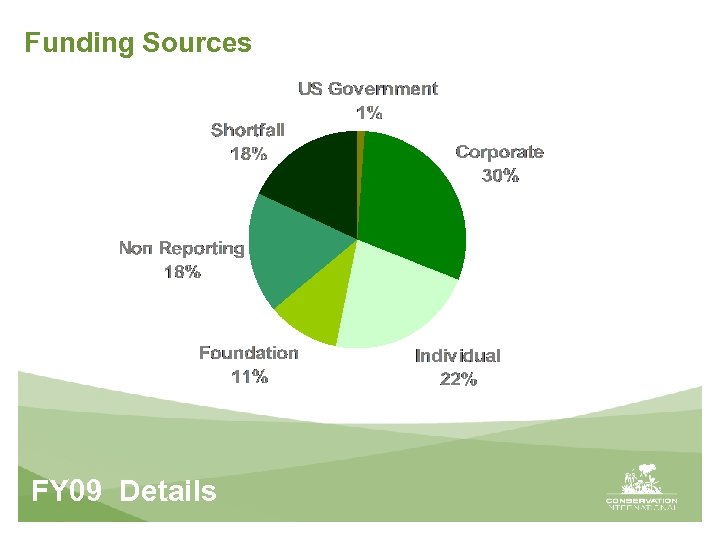
Funding Sources FY 09 Details
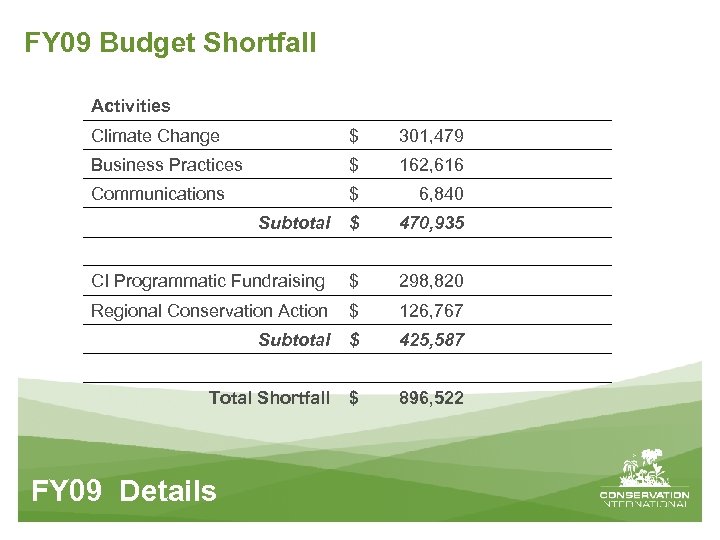
FY 09 Budget Shortfall Activities Climate Change $ 301, 479 Business Practices $ 162, 616 Communications $ 6, 840 Subtotal $ 470, 935 CI Programmatic Fundraising $ 298, 820 Regional Conservation Action $ 126, 767 Subtotal $ 425, 587 Total Shortfall $ 896, 522 FY 09 Details
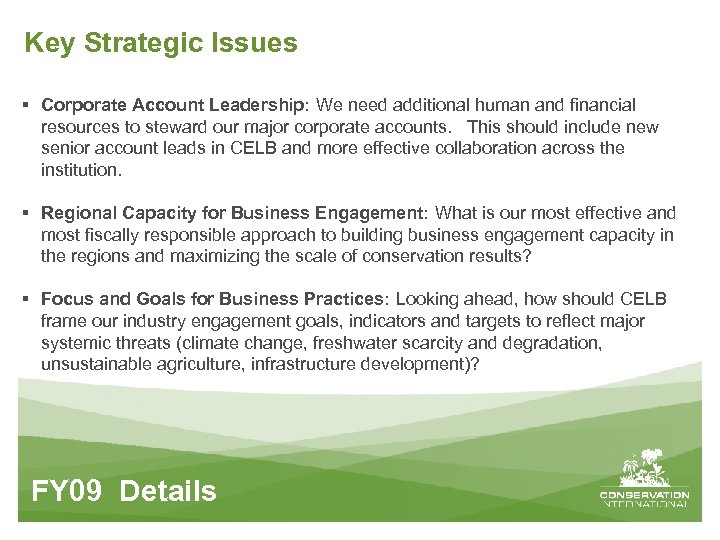
Key Strategic Issues § Corporate Account Leadership: We need additional human and financial resources to steward our major corporate accounts. This should include new senior account leads in CELB and more effective collaboration across the institution. § Regional Capacity for Business Engagement: What is our most effective and most fiscally responsible approach to building business engagement capacity in the regions and maximizing the scale of conservation results? § Focus and Goals for Business Practices: Looking ahead, how should CELB frame our industry engagement goals, indicators and targets to reflect major systemic threats (climate change, freshwater scarcity and degradation, unsustainable agriculture, infrastructure development)? FY 09 Details
Скачать презентацию Center for Environmental Leadership in Business FY 08
87dbc8ccf257349f73b08fb971284446.ppt