


 Скачать презентацию Center for Adaptive Optics 15 Nov 1999 Meeting
f20063d92e094ddfc3e061fe608f30f9.ppt
- Количество слайдов: 27
 Center for Adaptive Optics 15 Nov 1999 Meeting Microfabricated Segmented Micromirror Arrays Major William D. Cowan, Ph. D. Air Force Research Laboratory Materials and Manufacturing Directorate, AFRL/ML Wright-Patterson AFB, Ohio 45433 1
 Overview • • • Introduction Foundry Processes MUMPs 19 MEM-DM Continuous Facesheet Designs Micromirror Surface Figure Proposed Cf. AO SUMMi. T Design 2
 Introduction Problem: Make practical deformable mirrors (DMs) for adaptive optics (AO) in foundry microfabrication processes (Reduce cost, size, weight, power dissipation) DMs among the most expensive components in AO systems: $1000/channel Microelectromechanical systems (MEMS) ideally suited for optical applications - deflections consistent with optical wavelengths - photolithographic (parallel) fabrication of parts with identical characteristics Deflection uniformity critical for low cost AO (eliminate 100% testing) Use foundry fabrication processes to reduce cost for low volume applications Lessons learned applicable to specialized microfabrication processes 3
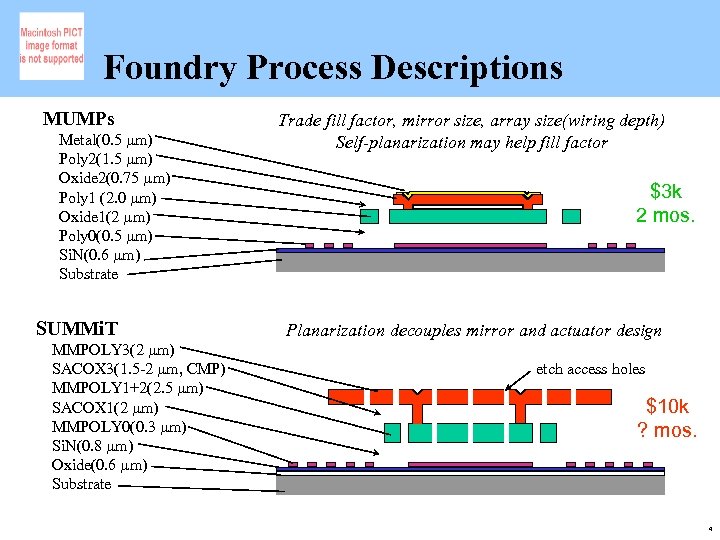 Foundry Process Descriptions MUMPs Metal(0. 5 m) Poly 2(1. 5 m) Oxide 2(0. 75 m) Poly 1 (2. 0 m) Oxide 1(2 m) Poly 0(0. 5 m) Si. N(0. 6 m) Substrate SUMMi. T MMPOLY 3(2 m) SACOX 3(1. 5 -2 m, CMP) MMPOLY 1+2(2. 5 m) SACOX 1(2 m) MMPOLY 0(0. 3 m) Si. N(0. 8 m) Oxide(0. 6 m) Substrate Trade fill factor, mirror size, array size(wiring depth) Self-planarization may help fill factor $3 k 2 mos. Planarization decouples mirror and actuator design etch access holes $10 k ? mos. 4
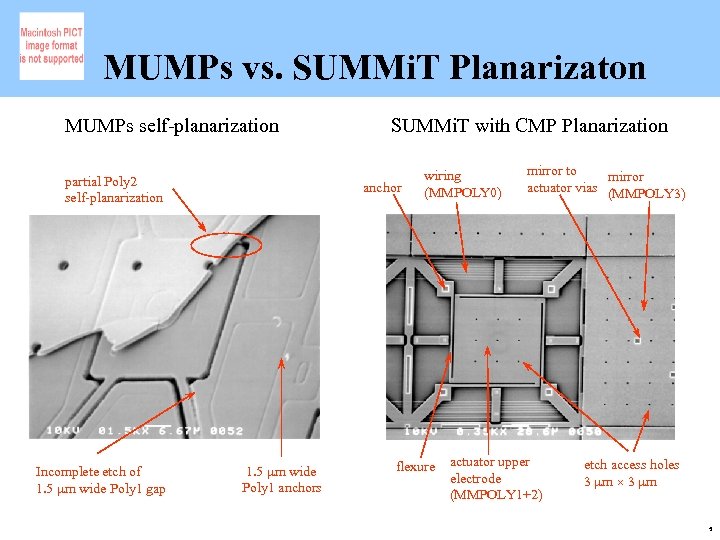 MUMPs vs. SUMMi. T Planarizaton MUMPs self-planarization partial Poly 2 self-planarization Incomplete etch of 1. 5 m wide Poly 1 gap SUMMi. T with CMP Planarization anchor 1. 5 m wide Poly 1 anchors wiring (MMPOLY 0) flexure mirror to mirror actuator vias (MMPOLY 3) actuator upper electrode (MMPOLY 1+2) etch access holes 3 m 5
 Electrostatic Piston Micromirror top electrode, mirror plate to bottom electrode k, spring constant Movable top electrode d g t V A Fixed bottom electrode Deflection of electrostatic piston micromirror , for d=0 to ~t/3 anchor flexure k is a function of flexure number, geometry, and material stiffness (note how unidirectional layout mitigates the effect of residual stress) t is fixed by sacrificial layer thickness of process d is defined by optical modulation requirements Trade k and A for desired V, uniformity, yield, etc. 6
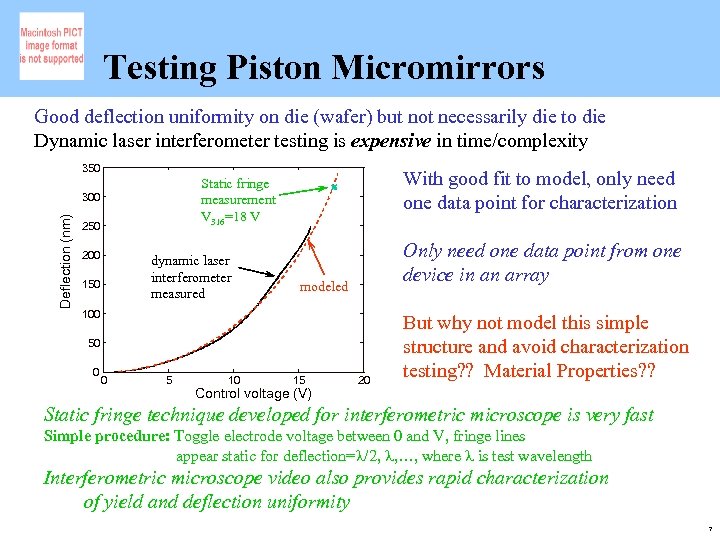 Testing Piston Micromirrors Good deflection uniformity on die (wafer) but not necessarily die to die Dynamic laser interferometer testing is expensive in time/complexity 350 300 Deflection (nm) With good fit to model, only need one data point for characterization Static fringe measurement V 316=18 V 250 200 dynamic laser interferometer measured 150 Only need one data point from one device in an array modeled 100 50 0 0 5 10 15 Control voltage (V) 20 But why not model this simple structure and avoid characterization testing? ? Material Properties? ? Static fringe technique developed for interferometric microscope is very fast Simple procedure: Toggle electrode voltage between 0 and V, fringe lines appear static for deflection=l/2, l, …, where l is test wavelength Interferometric microscope video also provides rapid characterization of yield and deflection uniformity 7
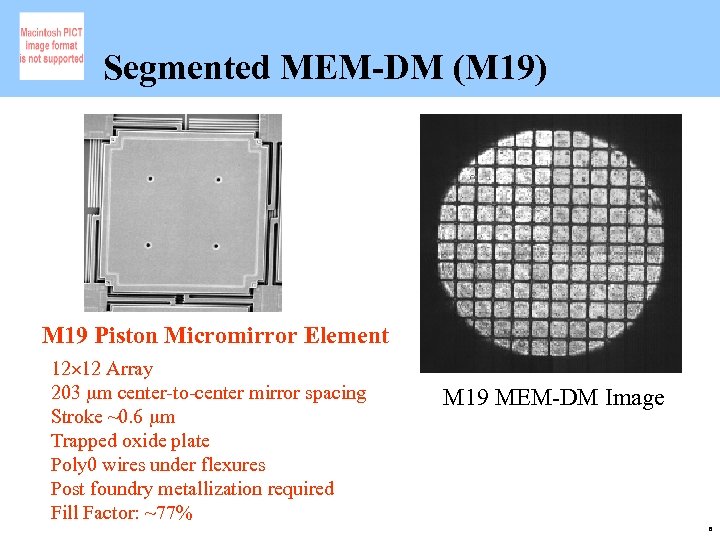 Segmented MEM-DM (M 19) M 19 Piston Micromirror Element 12 12 Array 203 m center-to-center mirror spacing Stroke ~0. 6 m Trapped oxide plate Poly 0 wires under flexures Post foundry metallization required Fill Factor: ~77% M 19 MEM-DM Image 8
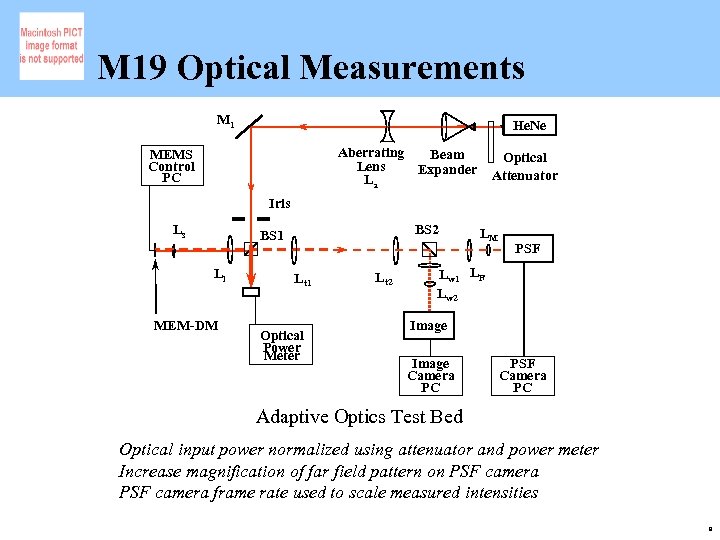 M 19 Optical Measurements M 1 He. Ne Aberrating Beam Lens Expander La MEMS Control PC Optical Attenuator Iris Ls BS 2 BS 1 Ll MEM-DM Lt 1 Optical Power Meter Lt 2 LM PSF Lw 1 LF Lw 2 Image Camera PC PSF Camera PC Adaptive Optics Test Bed Optical input power normalized using attenuator and power meter Increase magnification of far field pattern on PSF camera frame rate used to scale measured intensities 9
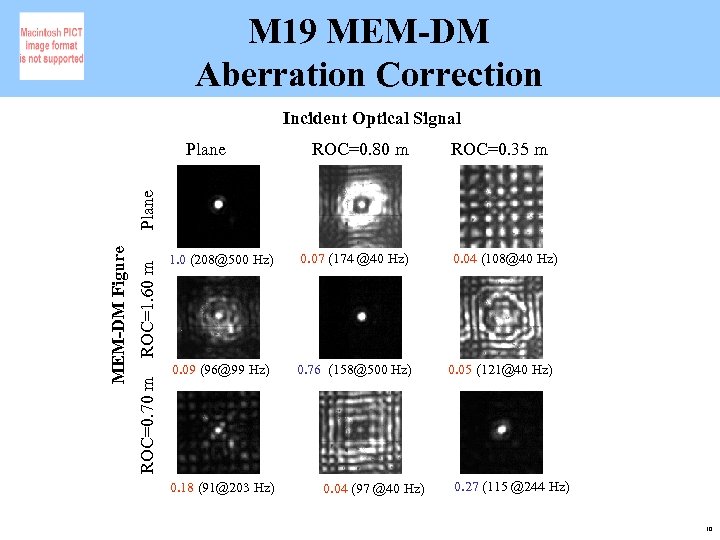 M 19 MEM-DM Aberration Correction Incident Optical Signal ROC=0. 80 m ROC=0. 35 m 0. 07 (174 @40 Hz) 0. 09 (96@99 Hz) ROC=1. 60 m 1. 0 (208@500 Hz) 0. 76 (158@500 Hz) 0. 04 (108@40 Hz) 0. 05 (121@40 Hz) ROC=0. 70 m MEM-DM Figure Plane 0. 18 (91@203 Hz) 0. 04 (97 @40 Hz) 0. 27 (115 @244 Hz) 10
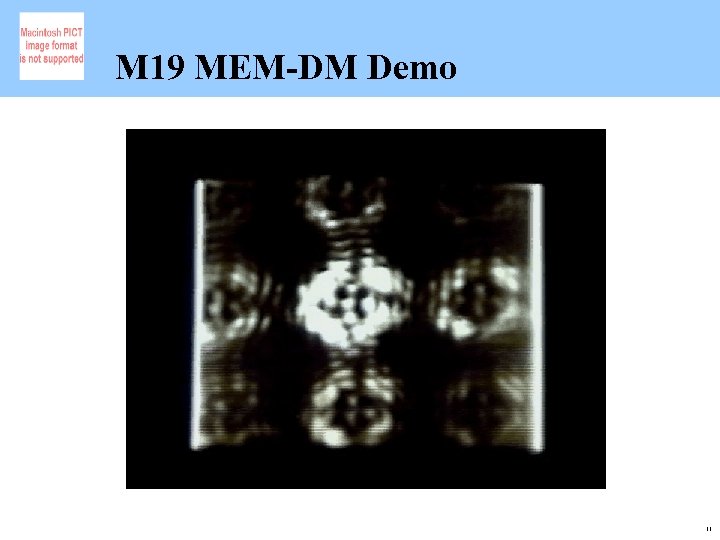 M 19 MEM-DM Demo 11
 Status of MUMPs 19 Design Still have the same device operating in the AFIT AO testbed • Approaching 2 years of intermittent operation exposed to laboratory air • Stan Rogers using to demonstrate phase retrieval Delivered 2 packaged devices to Dr Wild and Dr Kibblewhite at University of Chicago, Yerkes Observatory • Don’t know status of their work, but recently had inquiry from MEMS Optical who had seen MUMPs 19 devices while visiting U of C May have a couple left - have been requested by USAF Academy For quick (~4 months), moderate performance, low-cost devices this design can be shoehorned into a 0. 5 cm square die with 4 copies per MUMPs die site • Will yield >50 devices for $3 k + packaging costs • Still need post foundry metallization 12
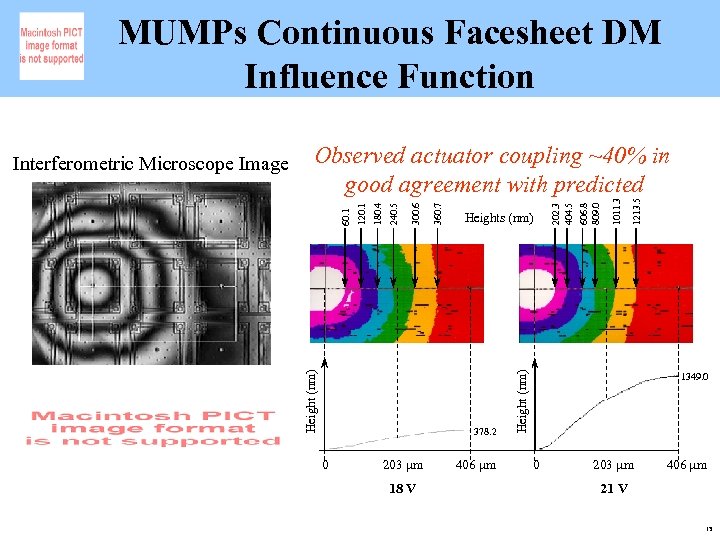 MUMPs Continuous Facesheet DM Influence Function 378. 2 0 203 m 18 V 406 m 1213. 5 1011. 3 202. 3 404. 5 606. 8 809. 0 Heights (nm) Height (nm) 360. 7 300. 6 240. 5 180. 4 120. 1 60. 1 Observed actuator coupling ~40% in good agreement with predicted Height (nm) Interferometric Microscope Image 1349. 0 0 203 m 406 m 21 V 13
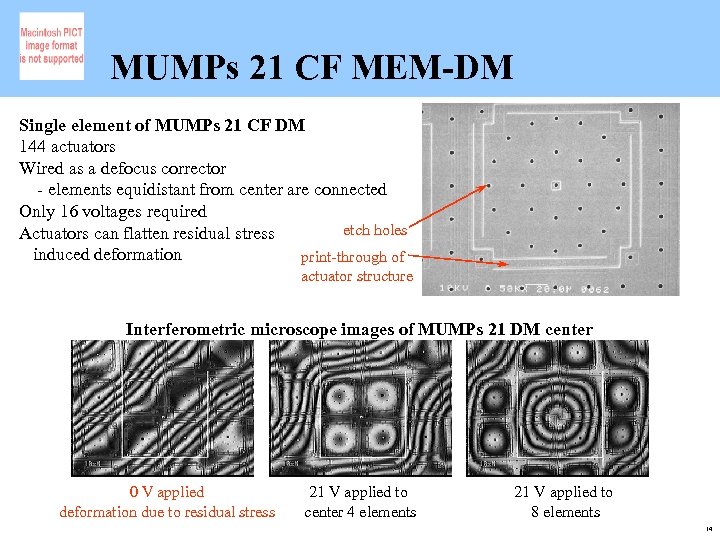 MUMPs 21 CF MEM-DM Single element of MUMPs 21 CF DM 144 actuators Wired as a defocus corrector - elements equidistant from center are connected Only 16 voltages required etch holes Actuators can flatten residual stress induced deformation print-through of actuator structure Interferometric microscope images of MUMPs 21 DM center 0 V applied deformation due to residual stress 21 V applied to center 4 elements 21 V applied to 8 elements 14
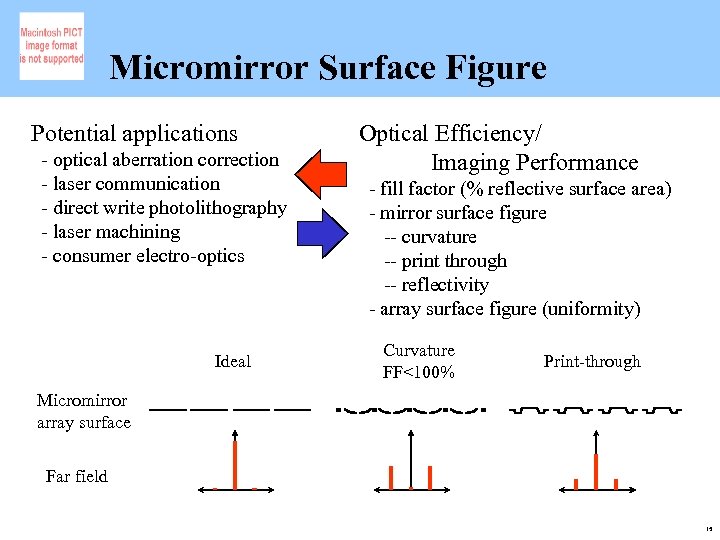 Micromirror Surface Figure Potential applications - optical aberration correction - laser communication - direct write photolithography - laser machining - consumer electro-optics Ideal Optical Efficiency/ Imaging Performance - fill factor (% reflective surface area) - mirror surface figure -- curvature -- print through -- reflectivity - array surface figure (uniformity) Curvature FF<100% Print-through Micromirror array surface Far field 15
 MUMPs Mirror Designs All arrays employ 203 mm center-to-center mirror spacing M 19_A 12 12 Trapped oxide plate Poly 0 wires under flexures Post foundry metal Fill Factor: 77% 8 8 Trapped oxide plate MUMPs metal Fill Factor: 67. 4% M 19_B 8 8 Trapped oxide plate Post foundry metal Fill Factor: 67% M 19_C 8 8 Poly 2 mirror plate attached to actuator by vias Post foundry metal Fill Factor: 71. 9% MUMPs flexures 4 m wide for better yield and deflection uniformity 16
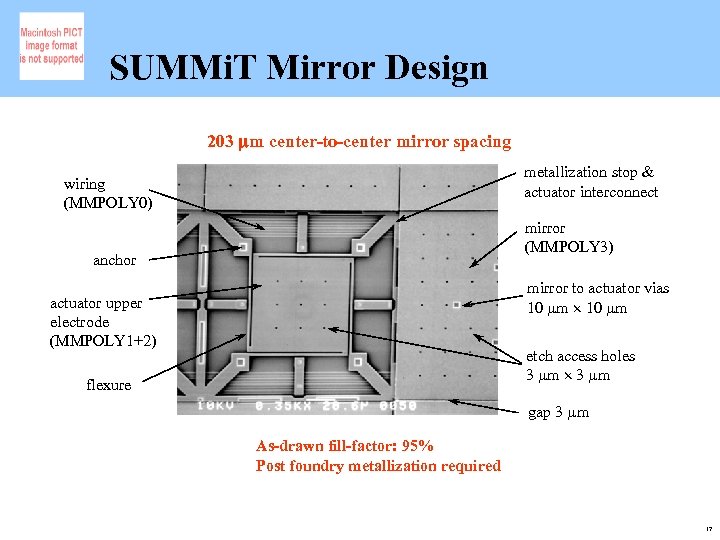 SUMMi. T Mirror Design 203 mm center-to-center mirror spacing metallization stop & actuator interconnect wiring (MMPOLY 0) mirror (MMPOLY 3) anchor mirror to actuator vias 10 m actuator upper electrode (MMPOLY 1+2) etch access holes 3 m flexure gap 3 m As-drawn fill-factor: 95% Post foundry metallization required 17
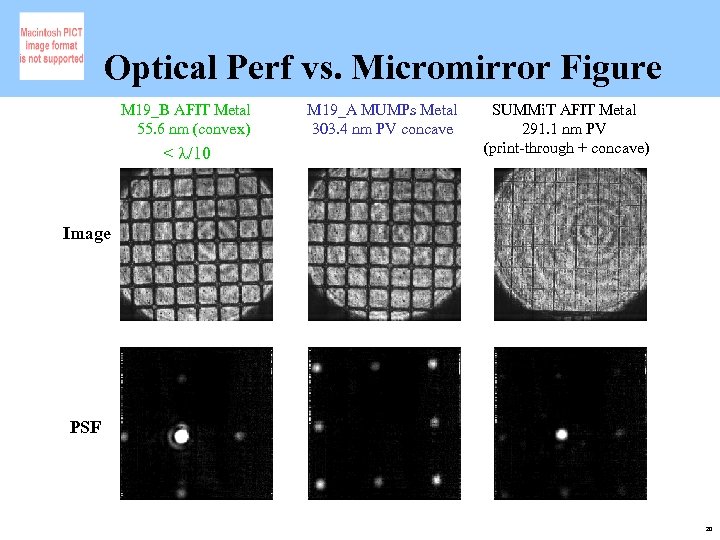
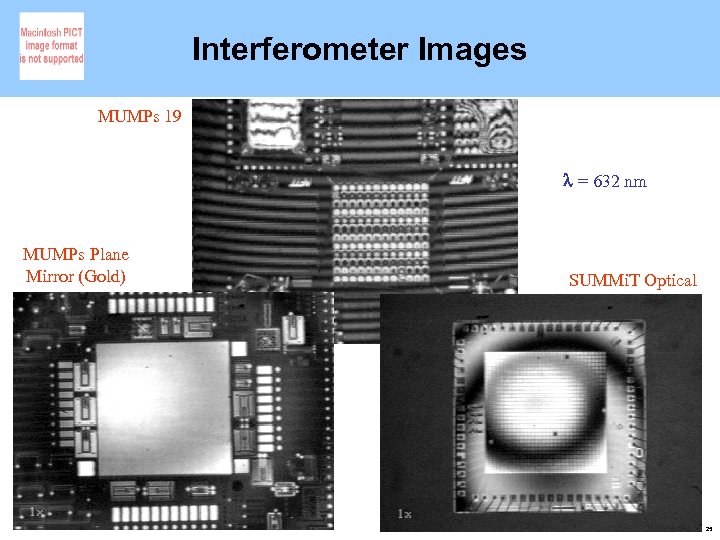
 Micromirror Surface Characterization M 19_A Instrument: Zygo Maxim 3 -D Laser interferometric microscope Accuracy: 3 nm RMS Manual scan of mirror middle to get Peak-to-Valley (PV) False color image of surface height MUMPs devices - only Poly 0 electrode under mirror - curvature due to residual material stresses in plate structure - metal ~50 MPa tensile - polys ~10 MPa compressive - trapped oxide ? Mesh of surface figure PV=303 nm Scan line 18
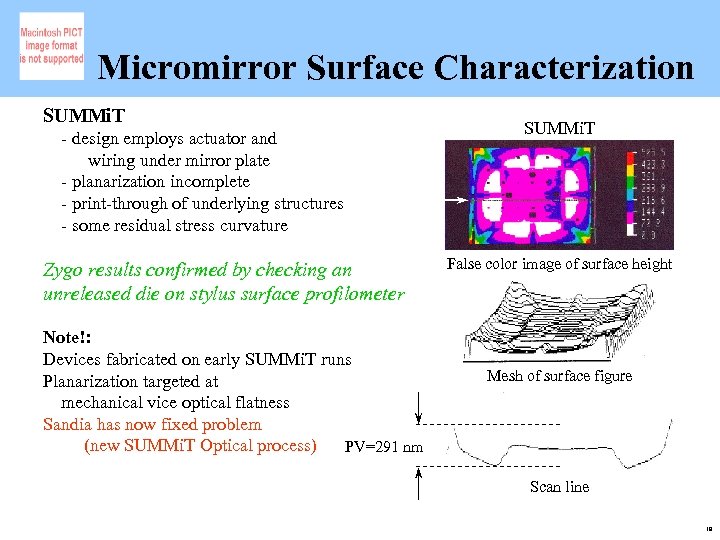 Micromirror Surface Characterization SUMMi. T - design employs actuator and wiring under mirror plate - planarization incomplete - print-through of underlying structures - some residual stress curvature Zygo results confirmed by checking an unreleased die on stylus surface profilometer Note!: Devices fabricated on early SUMMi. T runs Planarization targeted at mechanical vice optical flatness Sandia has now fixed problem (new SUMMi. T Optical process) PV=291 nm SUMMi. T False color image of surface height Mesh of surface figure Scan line 19
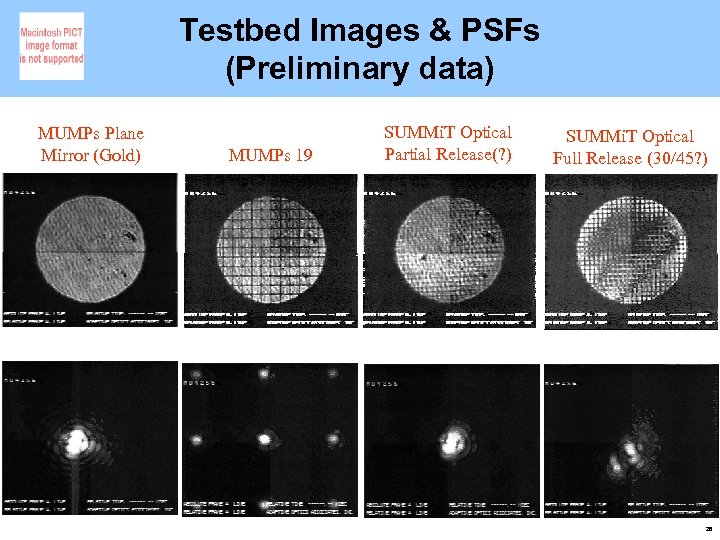
 Optical Perf vs. Micromirror Figure M 19_B AFIT Metal 55. 6 nm (convex) < l/10 M 19_A MUMPs Metal 303. 4 nm PV concave SUMMi. T AFIT Metal 291. 1 nm PV (print-through + concave) Image PSF 20
 Optical Measurement Summary Reflected Optical Mirror Description Optical Efficiency Power Normalized % % MUMPs Plane Mirror 76. 3 100 M 19 No Metal 29. 2 38. 3 M 19_A MUMPs Metal 56. 9 74. 5 M 19 AFIT Metal 1 62. 6 82. 0 M 19 AFIT Metal 2 60. 8 79. 7 M 19_B AFIT Metal 53. 6 70. 2 M 19_C AFIT Metal 30. 0 39. 3 SUMMi. T No Metal 44. 0 57. 7 SUMMi. T AFIT Metal 1 66. 0 86. 5 SUMMi. T AFIT Metal 2 67. 5 88. 4 PSF Peak Intensity Normalized % 100 5. 2 0. 6 24. 9 25. 8 35. 7 7. 8 7. 2 6. 9 Effective Fill Factor % 100 22. 8 10. 0 49. 9 50. 8 59. 8 28. 0 26. 7 26. 2 FWHM Normalized % 100 104 221 98 99 105 117 116 109 111 21
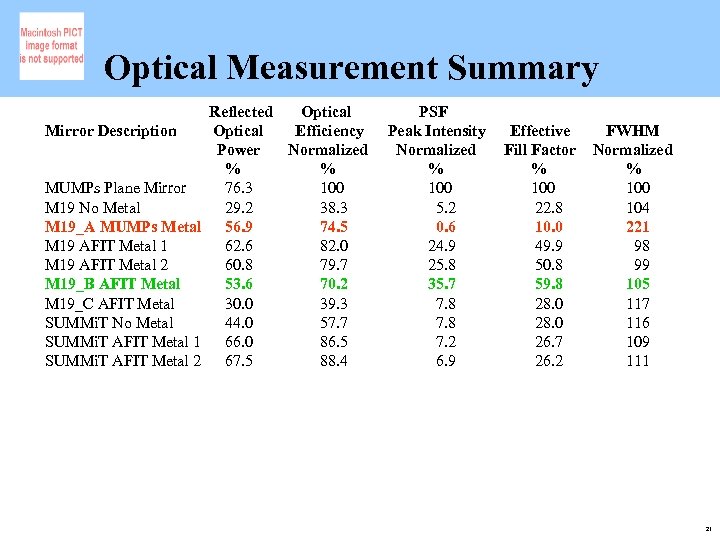
 Surface Figure Study Results Fill factor and optical efficiency (power) not good metrics - don’t measure imaging performance Surface figure is most important factor for imaging performance “Good” polysilicon piston micromirror arrays require - planarization - residual stress control/characterization Sputtered chromium/gold metallization promising Proposed fabrication approach - design in an initial convex curvature using residual stresses - sample lot (release and measure curvature) - design metallization to yield flat mirror surfaces - metallize lot 22
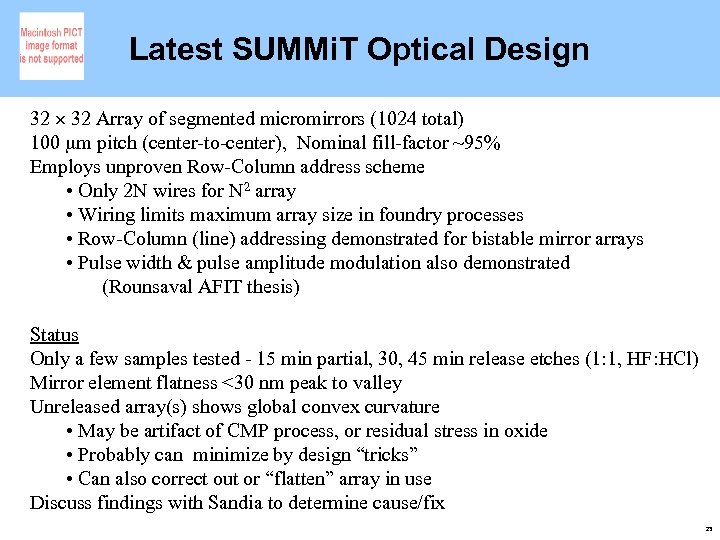 Latest SUMMi. T Optical Design 32 Array of segmented micromirrors (1024 total) 100 m pitch (center-to-center), Nominal fill-factor ~95% Employs unproven Row-Column address scheme • Only 2 N wires for N 2 array • Wiring limits maximum array size in foundry processes • Row-Column (line) addressing demonstrated for bistable mirror arrays • Pulse width & pulse amplitude modulation also demonstrated (Rounsaval AFIT thesis) Status Only a few samples tested - 15 min partial, 30, 45 min release etches (1: 1, HF: HCl) Mirror element flatness <30 nm peak to valley Unreleased array(s) shows global convex curvature • May be artifact of CMP process, or residual stress in oxide • Probably can minimize by design “tricks” • Can also correct out or “flatten” array in use Discuss findings with Sandia to determine cause/fix 23
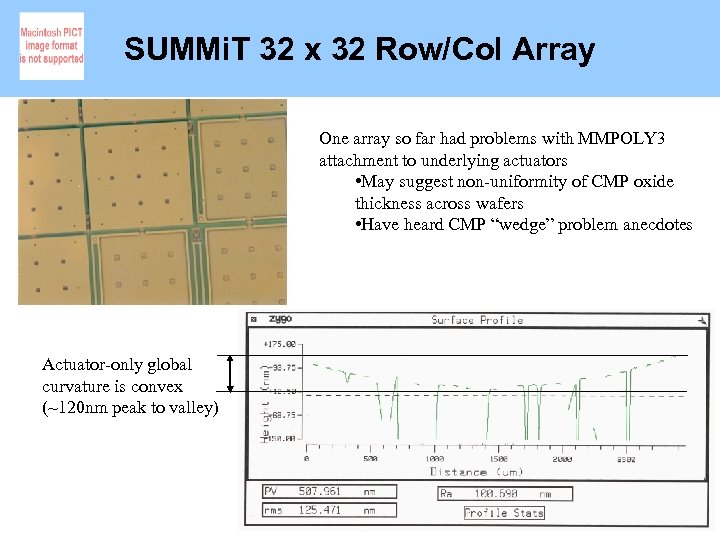 SUMMi. T 32 x 32 Row/Col Array One array so far had problems with MMPOLY 3 attachment to underlying actuators • May suggest non-uniformity of CMP oxide thickness across wafers • Have heard CMP “wedge” problem anecdotes Actuator-only global curvature is convex (~120 nm peak to valley) 24
 Interferometer Images MUMPs 19 = 632 nm MUMPs Plane Mirror (Gold) SUMMi. T Optical 25
 Testbed Images & PSFs (Preliminary data) MUMPs Plane Mirror (Gold) MUMPs 19 SUMMi. T Optical Partial Release(? ) SUMMi. T Optical Full Release (30/45? ) 26
 Proposed Cf. AO SUMMi. T Design 128 to 256 element array of segmented micromirrors Single wire per element address scheme (die size/wire bond limited design) • Wire-bonded electrical connections Minimum 100 m pitch (center-to-center) • Larger element size for increased fill & lower operating voltage • Have 128 element 203 m designs on 0. 5 cm square die • Trade of bond pad space & mirror size required to optimize Minimum fill-factor ~95% Minimum stroke: 0. 5 m Mirror element flatness <30 nm peak to valley Optimize global flatness by design and study of process using current arrays Status Have had initial discussions with Sandia about approach • Want design that they will agree to release/package/bond • Standard module run should yield 50 -75 finished parts (untested) Will explore progress of metallization - use if available • Otherwise design for ease of post-foundry (user) metallization 27