 Скачать презентацию Centenary Bank s Challenges in Moving Up-Market into SME
8770a41202b942f4ebd93eed3fc9f8af.ppt
- Количество слайдов: 18



Centenary Bank’s Challenges in Moving “Up-Market” into SME Lending June 26 th – 27 th 2007 at Dar es Salaam Presentation by John R. Giles Managing Director 1
Presentation Topics: Overview: Uganda (Slide 3) Overview: Uganda’s Financial Sector (Slide 4) Moving “Up-Market” or “Down-Market” – does it matter? (slide 5) Mission & Vision of Centenary Bank (slide 6) Centenary’s Loan Products (slide 7 & 8) Why Centenary bank moved into SME/Commercial lending: 1. 2. 3. 4. 5. 6. n 7. 8. 9. A short history of Centenary Bank (slide 9, 10, 11, & 12) Current Loan Portfolio and Deposit Dilemma (slide 13 & 14) Challenges in moving “Up-Market” into SME lending (slide 15 & 16) Summary (slide 17) 2
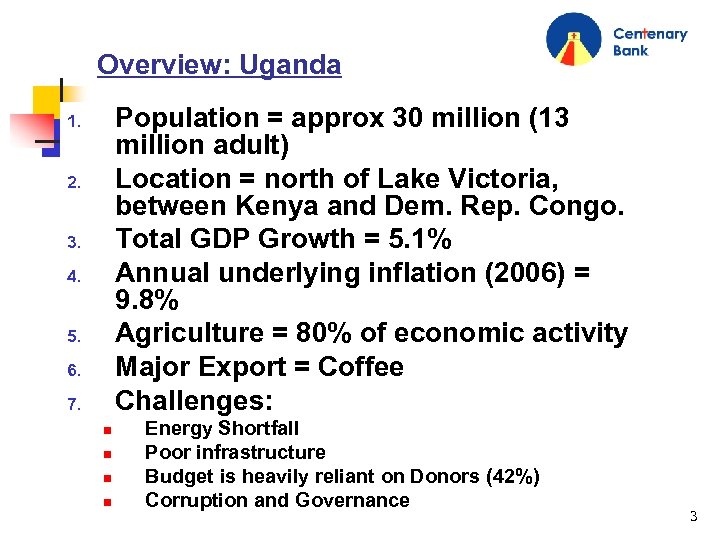
Overview: Uganda Population = approx 30 million (13 million adult) Location = north of Lake Victoria, between Kenya and Dem. Rep. Congo. Total GDP Growth = 5. 1% Annual underlying inflation (2006) = 9. 8% Agriculture = 80% of economic activity Major Export = Coffee Challenges: 1. 2. 3. 4. 5. 6. 7. n n Energy Shortfall Poor infrastructure Budget is heavily reliant on Donors (42%) Corruption and Governance 3
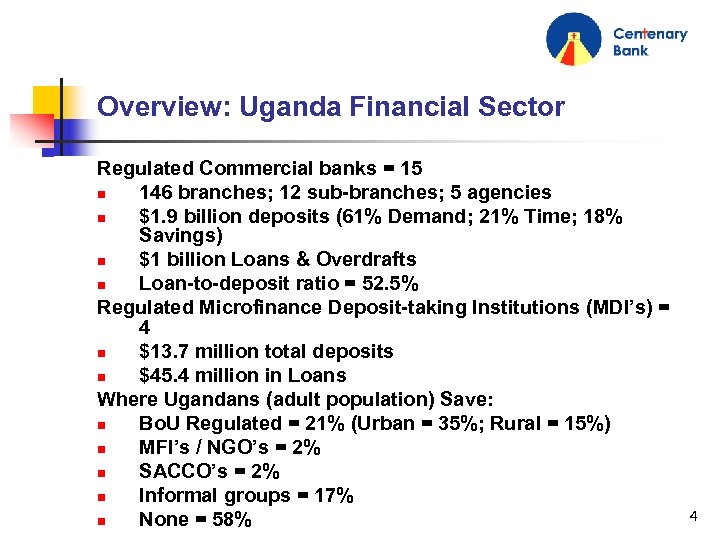
Overview: Uganda Financial Sector Regulated Commercial banks = 15 n 146 branches; 12 sub-branches; 5 agencies n $1. 9 billion deposits (61% Demand; 21% Time; 18% Savings) n $1 billion Loans & Overdrafts n Loan-to-deposit ratio = 52. 5% Regulated Microfinance Deposit-taking Institutions (MDI’s) = 4 n $13. 7 million total deposits n $45. 4 million in Loans Where Ugandans (adult population) Save: n Bo. U Regulated = 21% (Urban = 35%; Rural = 15%) n MFI’s / NGO’s = 2% n SACCO’s = 2% n Informal groups = 17% n None = 58% 4
Moving “Up-market” into SME lending: Does it matter whether SME loans are a “Downmarket” product or an “Up-market” product for your bank? From Centenary Bank’s experience, the answer to that question is definitely “YES!” There are significant challenges in moving “Up. Market” into SME and Commercial lending. Let’s look at Centenary’s operational history and experiences: 5
The Mission & Vision of Centenary Bank: Mission: To provide appropriate financial services, especially Microfinance, to all people in Uganda, particularly in rural areas, in a sustainable manner. The Bank was created as a finance institution to serve the economically disadvantaged people, especially in rural areas, and contribute to the overall economic development of the country. However, to reduce business risk, the bank has, over time. diversified its activities to include lending to small and medium enterprises as well as to large corporations, in order to provide services to sectors that are complimentary to our target market and customers. Although Centenary Bank is a licensed full-service commercial bank, it can be (and often is), described as a “Commercial Micro Bank. ” 6
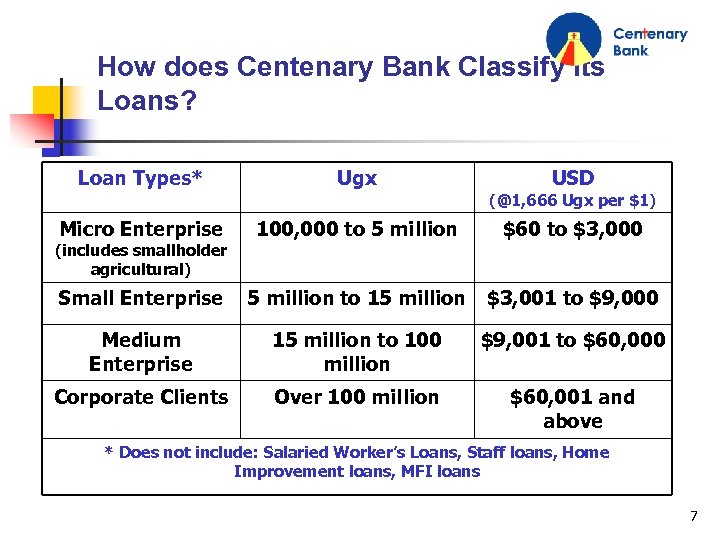
How does Centenary Bank Classify its Loans? Loan Types* Ugx Micro Enterprise 100, 000 to 5 million $60 to $3, 000 Small Enterprise 5 million to 15 million $3, 001 to $9, 000 Medium Enterprise 15 million to 100 million $9, 001 to $60, 000 Corporate Clients Over 100 million $60, 001 and above (includes smallholder agricultural) USD (@1, 666 Ugx per $1) * Does not include: Salaried Worker’s Loans, Staff loans, Home Improvement loans, MFI loans 7
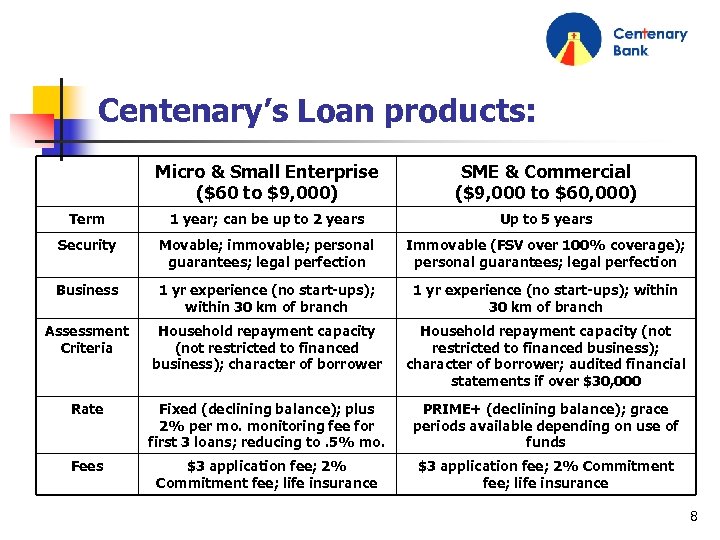
Centenary’s Loan products: Micro & Small Enterprise ($60 to $9, 000) SME & Commercial ($9, 000 to $60, 000) Term 1 year; can be up to 2 years Up to 5 years Security Movable; immovable; personal guarantees; legal perfection Immovable (FSV over 100% coverage); personal guarantees; legal perfection Business 1 yr experience (no start-ups); within 30 km of branch Assessment Criteria Household repayment capacity (not restricted to financed business); character of borrower; audited financial statements if over $30, 000 Rate Fixed (declining balance); plus 2% per mo. monitoring fee for first 3 loans; reducing to. 5% mo. PRIME+ (declining balance); grace periods available depending on use of funds Fees $3 application fee; 2% Commitment fee; life insurance 8
Why did Centenary Bank move into SME and Commercial Lending? n n n Not in its mission statement Was it a deliberate decision? Has Centenary reached ‘scale’ in SME lending, and if not, why not? Let’s take a brief look at the history of the bank: 9
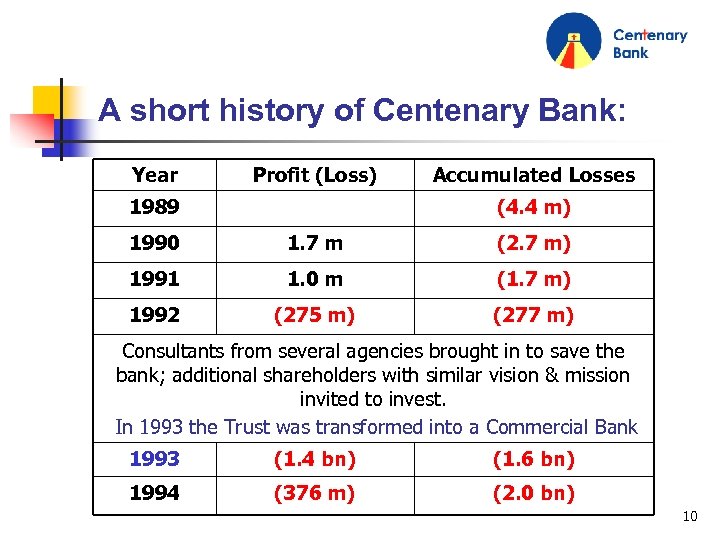
A short history of Centenary Bank: Year Profit (Loss) 1989 Accumulated Losses (4. 4 m) 1990 1. 7 m (2. 7 m) 1991 1. 0 m (1. 7 m) 1992 (275 m) (277 m) Consultants from several agencies brought in to save the bank; additional shareholders with similar vision & mission invited to invest. In 1993 the Trust was transformed into a Commercial Bank 1993 (1. 4 bn) (1. 6 bn) 1994 (376 m) (2. 0 bn) 10
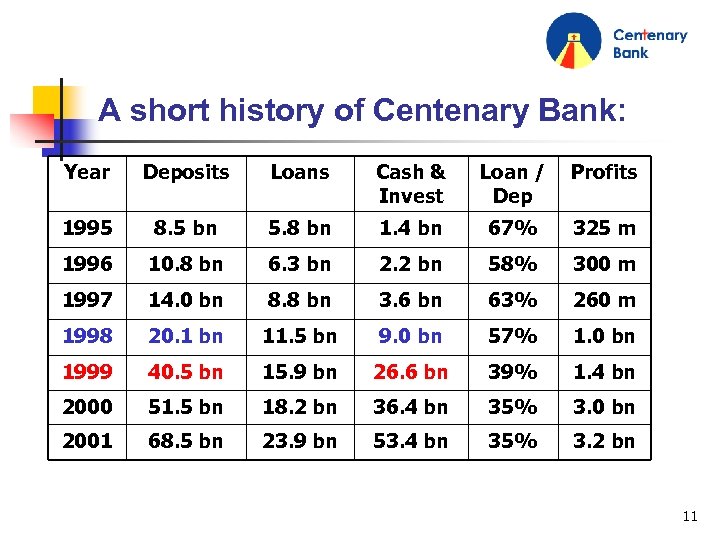
A short history of Centenary Bank: Year Deposits Loans Cash & Invest Loan / Dep Profits 1995 8. 5 bn 5. 8 bn 1. 4 bn 67% 325 m 1996 10. 8 bn 6. 3 bn 2. 2 bn 58% 300 m 1997 14. 0 bn 8. 8 bn 3. 6 bn 63% 260 m 1998 20. 1 bn 11. 5 bn 9. 0 bn 57% 1. 0 bn 1999 40. 5 bn 15. 9 bn 26. 6 bn 39% 1. 4 bn 2000 51. 5 bn 18. 2 bn 36. 4 bn 35% 3. 0 bn 2001 68. 5 bn 23. 9 bn 53. 4 bn 35% 3. 2 bn 11
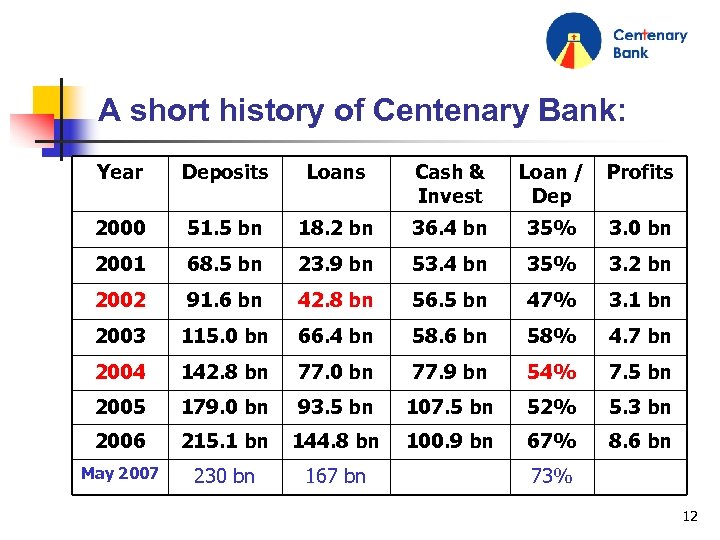
A short history of Centenary Bank: Year Deposits Loans Cash & Invest Loan / Dep Profits 2000 51. 5 bn 18. 2 bn 36. 4 bn 35% 3. 0 bn 2001 68. 5 bn 23. 9 bn 53. 4 bn 35% 3. 2 bn 2002 91. 6 bn 42. 8 bn 56. 5 bn 47% 3. 1 bn 2003 115. 0 bn 66. 4 bn 58. 6 bn 58% 4. 7 bn 2004 142. 8 bn 77. 0 bn 77. 9 bn 54% 7. 5 bn 2005 179. 0 bn 93. 5 bn 107. 5 bn 52% 5. 3 bn 2006 215. 1 bn 144. 8 bn 100. 9 bn 67% 8. 6 bn May 2007 230 bn 167 bn 73% 12
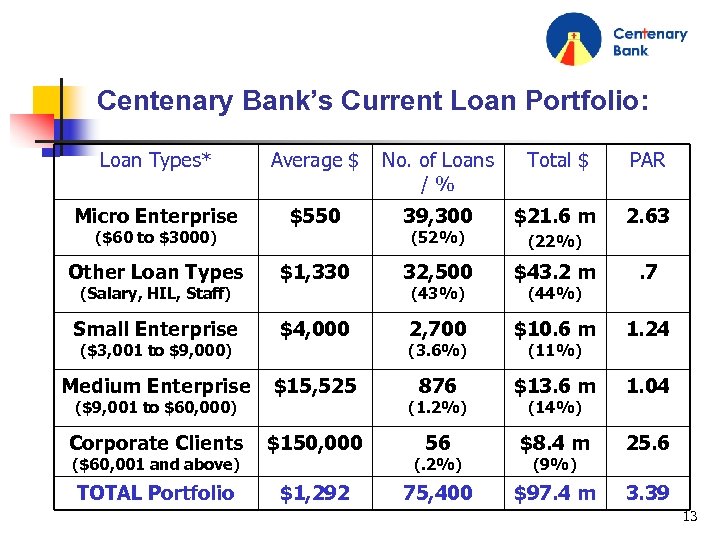
Centenary Bank’s Current Loan Portfolio: Loan Types* Average $ No. of Loans /% Total $ PAR Micro Enterprise $550 39, 300 $21. 6 m 2. 63 ($60 to $3000) (52%) (22%) Other Loan Types $1, 330 32, 500 $43. 2 m . 7 Small Enterprise $4, 000 2, 700 $10. 6 m 1. 24 Medium Enterprise $15, 525 876 $13. 6 m 1. 04 Corporate Clients $150, 000 56 $8. 4 m 25. 6 TOTAL Portfolio $1, 292 75, 400 $97. 4 m 3. 39 (Salary, HIL, Staff) ($3, 001 to $9, 000) ($9, 001 to $60, 000) ($60, 001 and above) (43%) (3. 6%) (1. 2%) (44%) (11%) (14%) (9%) 13
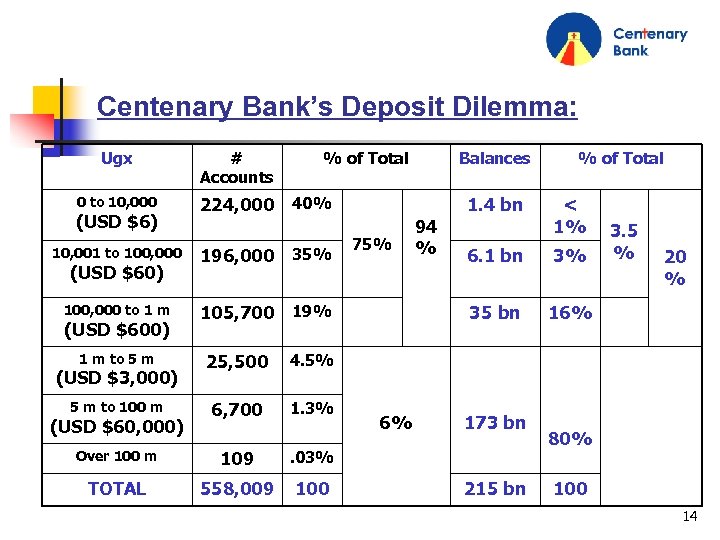
Centenary Bank’s Deposit Dilemma: Ugx # Accounts 0 to 10, 000 224, 000 (USD $6) % of Total Balances 40% 10, 001 to 100, 000 196, 000 35% 100, 000 to 1 m 105, 700 19% 1 m to 5 m 25, 500 6, 700 1. 3% < 1% (USD $60) (USD $600) (USD $3, 000) (USD $60, 000) Over 100 m 109 558, 009 100 16% 173 bn . 03% TOTAL 3% 35 bn 6% 6. 1 bn 3. 5 % 4. 5% 5 m to 100 m 75% 94 % 1. 4 bn % of Total 215 bn 20 % 80% 100 14
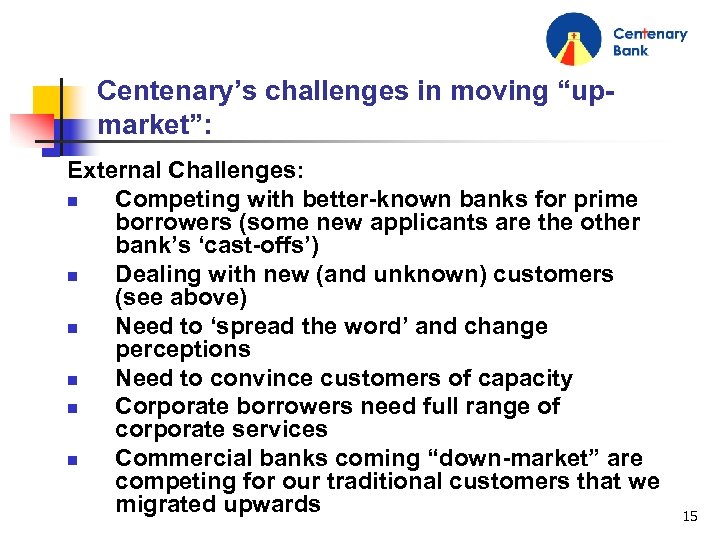
Centenary’s challenges in moving “upmarket”: External Challenges: n Competing with better-known banks for prime borrowers (some new applicants are the other bank’s ‘cast-offs’) n Dealing with new (and unknown) customers (see above) n Need to ‘spread the word’ and change perceptions n Need to convince customers of capacity n Corporate borrowers need full range of corporate services n Commercial banks coming “down-market” are competing for our traditional customers that we migrated upwards 15
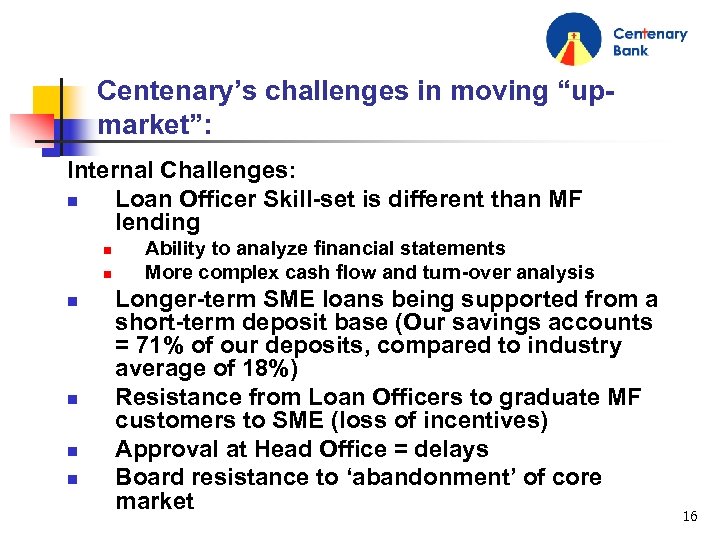
Centenary’s challenges in moving “upmarket”: Internal Challenges: n Loan Officer Skill-set is different than MF lending n n n Ability to analyze financial statements More complex cash flow and turn-over analysis Longer-term SME loans being supported from a short-term deposit base (Our savings accounts = 71% of our deposits, compared to industry average of 18%) Resistance from Loan Officers to graduate MF customers to SME (loss of incentives) Approval at Head Office = delays Board resistance to ‘abandonment’ of core market 16
Centenary’s challenges in moving “upmarket”: IN SUMMARY: If you are successful in overcoming the internal and external challenges of going “Up-Market”, and your SME lending begins to accelerate, then you have a new challenge: DEPOSIT MOBILIZATION in an environment where there is a mismatch in funding sources: A bank with a Microfinance background has a large number of small balance accounts (poor people’s money) that are now funding a loan portfolio with a much higher fundabsorption rate. This is where the ‘down-market’ vs. ‘up-market’ difference becomes a major issue. 17
Centenary’s challenges in moving “upmarket”: Thank You. 18
Скачать презентацию Centenary Bank s Challenges in Moving Up-Market into SME
8770a41202b942f4ebd93eed3fc9f8af.ppt