 Скачать презентацию CENG 352 Database Management Systems Nihan Kesim Çiçekli
b7e575340a2e297fbc021c591f013eb8.ppt
- Количество слайдов: 43



CENG 352 Database Management Systems Nihan Kesim Çiçekli email: nihan@ceng. metu. edu. tr URL: http: //www. ceng. metu. edu. tr/~nihan
CENG 352 • • Instructor: Nihan Kesim Çiçekli Office: A 308 Email: nihan@ceng. metu. edu. tr Lecture Hours: Tue. 13: 40, 14: 40 (BMB 3); Thu. 9: 40 (BMB 3) • Course Web page: http: //cow. ceng. metu. edu. tr • Teaching Assistant: Ali Anıl Sınacı CENG 352 Database Management Systems 2
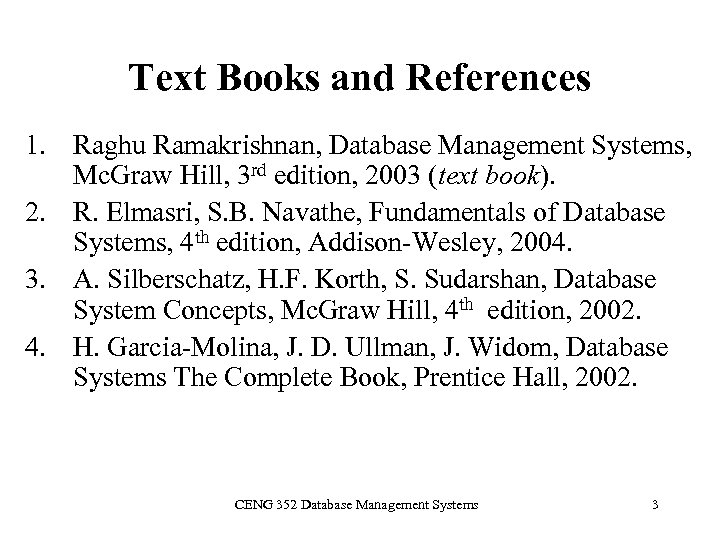
Text Books and References 1. Raghu Ramakrishnan, Database Management Systems, Mc. Graw Hill, 3 rd edition, 2003 (text book). 2. R. Elmasri, S. B. Navathe, Fundamentals of Database Systems, 4 th edition, Addison-Wesley, 2004. 3. A. Silberschatz, H. F. Korth, S. Sudarshan, Database System Concepts, Mc. Graw Hill, 4 th edition, 2002. 4. H. Garcia-Molina, J. D. Ullman, J. Widom, Database Systems The Complete Book, Prentice Hall, 2002. CENG 352 Database Management Systems 3
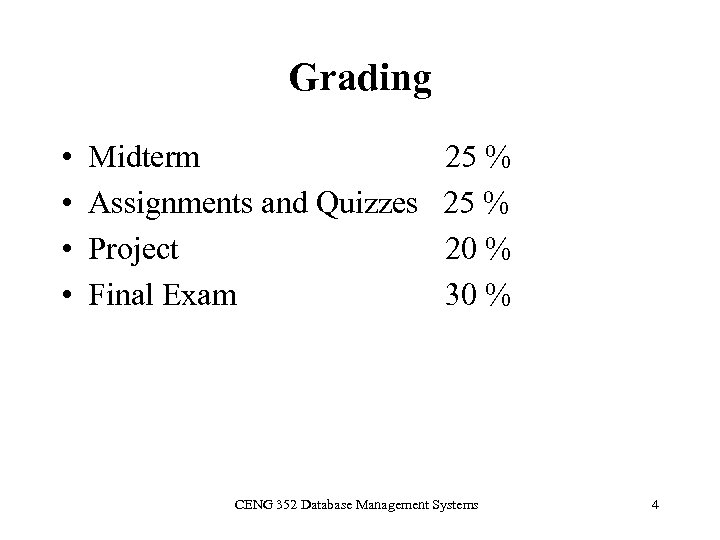
Grading • • Midterm Assignments and Quizzes Project Final Exam 25 % 20 % 30 % CENG 352 Database Management Systems 4
Grading Policies • Policy on missed midterm: – no make-up exam • Lateness policy: – Late assignments are penalized up to 10% per day. • All assignments are to be your own work. Projects in groups of two. CENG 352 Database Management Systems 5
Course Outline • • • The Relational Data Model Query Languages: Relational Calculus and SQL Relational Database Design and Tuning Query Evaluation and Optimization Transaction Management Concurrency Control Crash Recovery XML, XQuery, XPath Internet Applications CENG 352 Database Management Systems 6
Basic Definitions • • • Database Mini-world Database Management System (DBMS) Database System CENG 352 Database Management Systems 7
Basic Definitions • Data: Known facts that can be recorded and have an implicit meaning. • Database: A collection of related data. • Mini-world: Some part of the real world about which data is stored in a database. For example, student grades and transcripts at a university. • Database Management System (DBMS): A software package/ system to facilitate the creation and maintenance of a computerized database. • Database System: The DBMS software together with the data itself. Sometimes, the applications are also included. CENG 352 Database Management Systems 8
Files vs. DBMS • Application must stage large datasets between main memory and secondary storage (e. g. , buffering, page-oriented access, etc. ) • Special code for different queries • Must protect data from inconsistency due to multiple concurrent users • Crash recovery • Security and access control CENG 352 Database Management Systems 9
Typical DBMS Functionality • Define a database : in terms of data types, structures and constraints • Construct or load the database on a secondary storage medium • Manipulating the database : querying, generating reports, insertions, deletions and modifications to its content • Concurrent Processing and Sharing by a set of users and programs – yet, keeping all data valid and consistent CENG 352 Database Management Systems 10
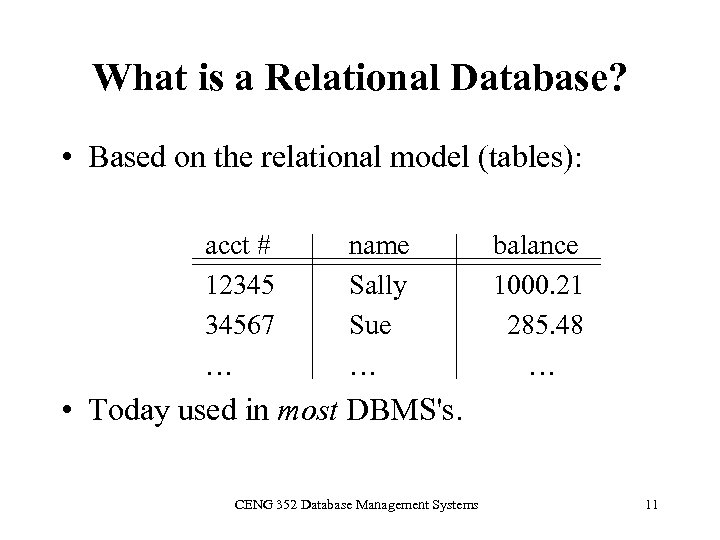
What is a Relational Database? • Based on the relational model (tables): acct # 12345 34567 … name Sally Sue … balance 1000. 21 285. 48 … • Today used in most DBMS's. CENG 352 Database Management Systems 11
Relational Model Relational model is good for: • Large amounts of data —> simple operations • Navigate among small number of relations Difficult Applications for relational model: • VLSI Design (CAD in general) • CASE • Graphical Data CENG 352 Database Management Systems 12
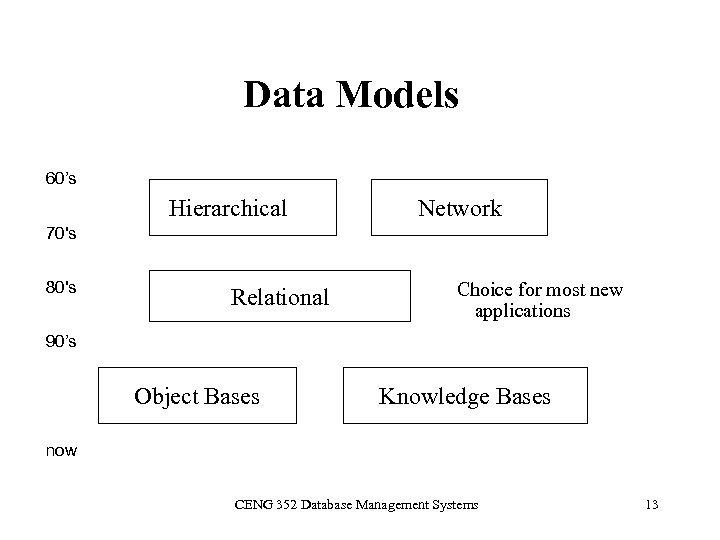
Data Models 60’s Hierarchical Network 70's 80's Relational Choice for most new applications 90’s Object Bases Knowledge Bases now CENG 352 Database Management Systems 13
The DBMS Marketplace • Relational DBMS companies – Oracle, Sybase – are among the largest software companies in the world. • IBM offers its relational DB 2 system. • Microsoft offers SQL-Server, plus Microsoft Access for the cheap DBMS on the desktop, answered by “lite” systems from other competitors. • Relational companies also challenged by “object-oriented DB” companies. • But countered with “object-relational” systems, which retain the relational core while allowing type extension as in OO systems. CENG 352 Database Management Systems 14
Three Aspects to Studying DBMS's 1. Modeling and design of databases. – Allows exploration of issues before committing to an implementation. 2. Programming: queries and DB operations like update. – SQL 3. DBMS implementation. CENG 352 Database Management Systems 15
Database Schema vs. Database State • Database State (Instance): Refers to the content of a database at a moment in time. • Initial Database State: Refers to the database when it is loaded • Valid State: A state that satisfies the structure and constraints of the database. • Distinction • The database schema changes very infrequently. The database state changes every time the database is updated. • Schema is also called intension, whereas state is called extension. CENG 352 Database Management Systems 16
Three-Schema Architecture • Proposed to support DBMS characteristics of: • Program-data independence. • Support of multiple views of the data. CENG 352 Database Management Systems 17
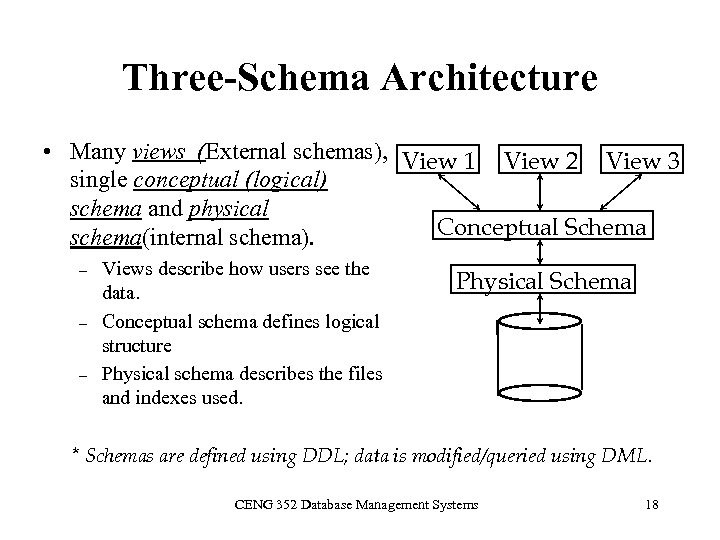
Three-Schema Architecture • Many views (External schemas), View 1 View 2 View 3 single conceptual (logical) schema and physical Conceptual Schema schema(internal schema). – – – Views describe how users see the data. Conceptual schema defines logical structure Physical schema describes the files and indexes used. Physical Schema * Schemas are defined using DDL; data is modified/queried using DML. CENG 352 Database Management Systems 18
Three-Schema Architecture Mappings among schema levels are needed to transform requests and data. Programs refer to an external schema, and are mapped by the DBMS to the internal schema for execution. CENG 352 Database Management Systems 19
Data Independence • Logical Data Independence: The capacity to change the conceptual schema without having to change the external schemas and their application programs. • Physical Data Independence: The capacity to change the internal schema without having to change the conceptual schema. CENG 352 Database Management Systems 20
Data Independence • When a schema at a lower level is changed, only the mappings between this schema and higher-level schemas need to be changed in a DBMS that fully supports data independence. • The higher-level schemas themselves are unchanged. Hence, the application programs need not be changed since they refer to the external schemas. CENG 352 Database Management Systems 21
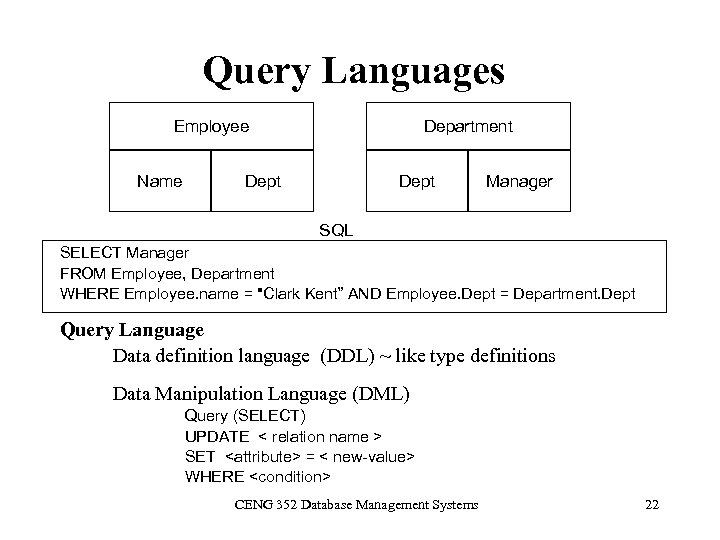
Query Languages Employee Name Department Dept Manager SQL SELECT Manager FROM Employee, Department WHERE Employee. name = "Clark Kent” AND Employee. Dept = Department. Dept Query Language Data definition language (DDL) ~ like type definitions Data Manipulation Language (DML) Query (SELECT) UPDATE < relation name > SET <attribute> = < new-value> WHERE <condition> CENG 352 Database Management Systems 22
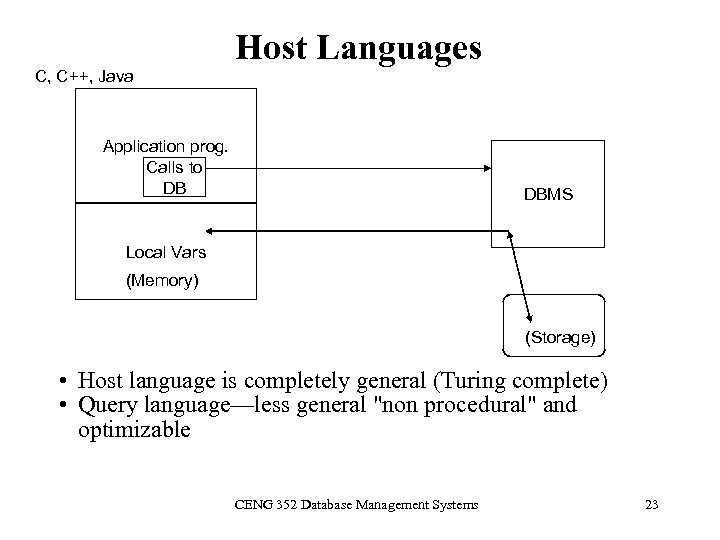
Host Languages C, C++, Java Application prog. Calls to DB DBMS Local Vars (Memory) (Storage) • Host language is completely general (Turing complete) • Query language—less general "non procedural" and optimizable CENG 352 Database Management Systems 23
Concurrency Control • Concurrent execution of user programs is essential for good DBMS performance. – Because disk accesses are frequent, and relatively slow, it is important to keep the CPU humming by working on several user programs concurrently. • Interleaving actions of different user programs can lead to inconsistency: – e. g. , check is cleared while account balance is being computed. • DBMS ensures such problems don’t arise: users can pretend they are using a single-user system. CENG 352 Database Management Systems 24
Transaction: An Execution of a DB Program • Key concept is transaction, which is an atomic sequence of database actions (reads/writes). • Each transaction, executed completely, must leave the DB in a consistent state if DB is consistent when the transaction begins. – – – Users can specify some simple integrity constraints on the data, and the DBMS will enforce these constraints. Beyond this, the DBMS does not really understand the semantics of the data. (e. g. , it does not understand how the interest on a bank account is computed). Thus, ensuring that a transaction (run alone) preserves consistency is ultimately the user’s responsibility! CENG 352 Database Management Systems 25
Scheduling Concurrent Transactions • DBMS ensures that execution of {T 1, . . . , Tn} is equivalent to some serial execution T 1’. . . Tn’. – – – Before reading/writing an object, a transaction requests a lock on the object, and waits till the DBMS gives it the lock. All locks are released at the end of the transaction. (Strict 2 PL locking protocol. ) Idea: If an action of Ti (say, writing X) affects Tj (which perhaps reads X), one of them, say Ti, will obtain the lock on X first and Tj is forced to wait until Ti completes; this effectively orders the transactions. What if Tj already has a lock on Y and Ti later requests a lock on Y? (Deadlock!) Ti or Tj is aborted and restarted! CENG 352 Database Management Systems 26
Ensuring Atomicity • DBMS ensures atomicity (all-or-nothing property) even if system crashes in the middle of a Xact. • Idea: Keep a log (history) of all actions carried out by the DBMS while executing a set of Xacts: – – Before a change is made to the database, the corresponding log entry is forced to a safe location. (WAL protocol; OS support for this is often inadequate. ) After a crash, the effects of partially executed transactions are undone using the log. (Thanks to WAL, if log entry wasn’t saved before the crash, corresponding change was not applied to database!) CENG 352 Database Management Systems 27
The Log • The following actions are recorded in the log: – Ti writes an object: The old value and the new value. • Log record must go to disk before the changed page! – Ti commits/aborts: A log record indicating this action. • Log records chained together by Xact id, so it’s easy to undo a specific Xact (e. g. , to resolve a deadlock). • Log is often duplexed and archived on “stable” storage. • All log related activities (and in fact, all CC related activities such as lock/unlock, dealing with deadlocks etc. ) are handled transparently by the DBMS. CENG 352 Database Management Systems 28
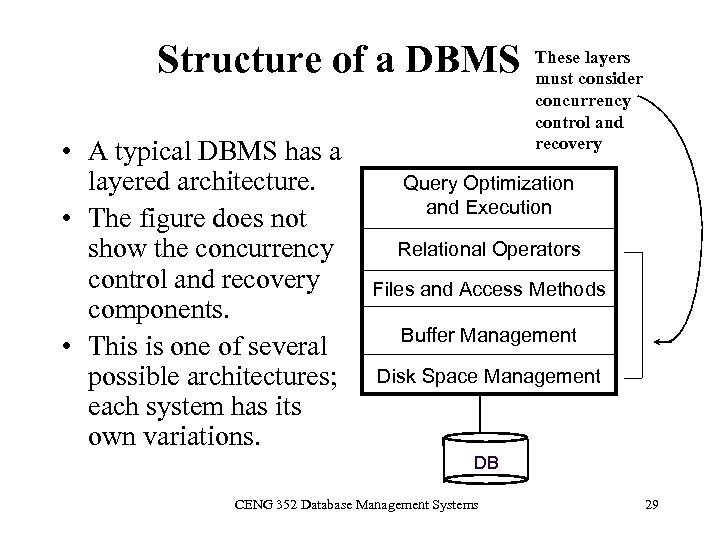
Structure of a DBMS • A typical DBMS has a layered architecture. • The figure does not show the concurrency control and recovery components. • This is one of several possible architectures; each system has its own variations. These layers must consider concurrency control and recovery Query Optimization and Execution Relational Operators Files and Access Methods Buffer Management Disk Space Management DB CENG 352 Database Management Systems 29
Centralized Architectures • Centralized DBMS: combines everything into single system including- DBMS software, hardware, application programs and user interface processing software. CENG 352 Database Management Systems 30
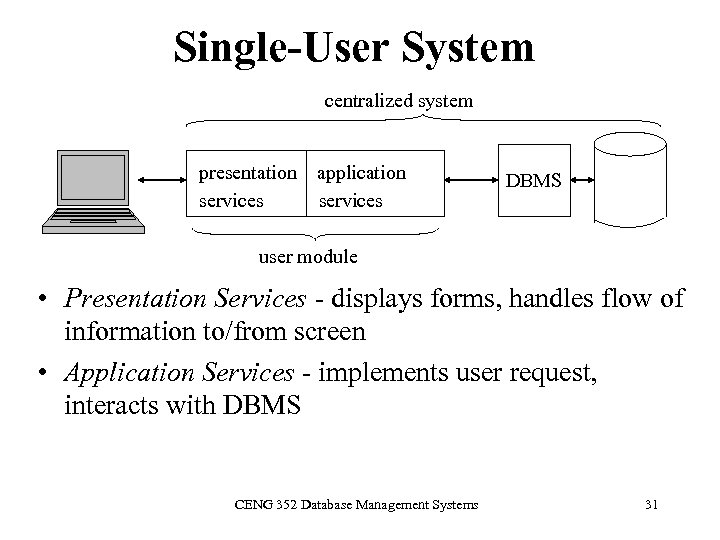
Single-User System centralized system presentation services application services DBMS user module • Presentation Services - displays forms, handles flow of information to/from screen • Application Services - implements user request, interacts with DBMS CENG 352 Database Management Systems 31
Centralized Multi-User System • Dumb terminals connected to mainframe – Application and presentation services on mainframe • Transactions can be executed concurrently – Isolation: DBMS sees an interleaved schedule – Atomicity and durability: system supports a major enterprise • Transaction abstraction is necessary; supplied by DBMS’s transaction support module. CENG 352 Database Management Systems 32
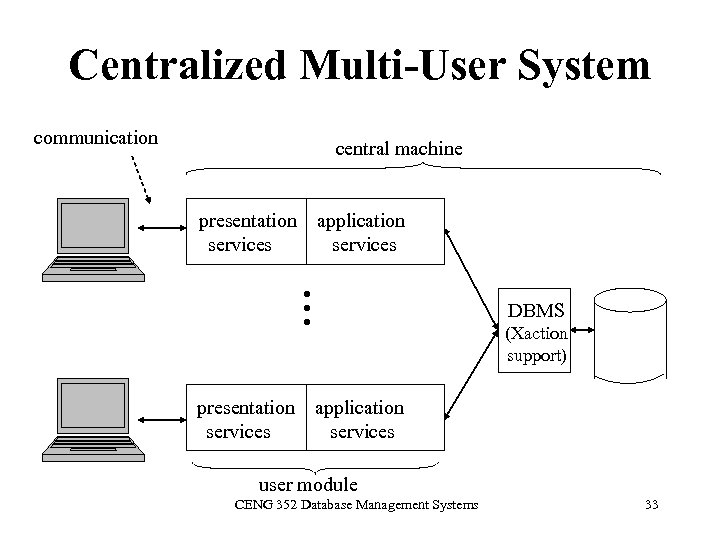
Centralized Multi-User System communication central machine application services • • • presentation services DBMS (Xaction support) application services user module CENG 352 Database Management Systems 33
Transaction Processing in a Distributed System • Decreased cost of hardware and communication makes it possible to distribute components of transaction processing system – Dumb terminals replaced by computers • Client/server organization generally used CENG 352 Database Management Systems 34
Basic Client-Server Architecture • The idea is to define specialized servers with specific functions. • • File Servers Printer Servers Web Servers E-mail Servers … • The client machines provide the user with the appropriate interfaces to utilize these servers, as well as with local processing power to run local applications. • All equipment is connected via a network. CENG 352 Database Management Systems 35
DBMS Server • DBMS server provides database query and transaction services to the clients • Sometimes called query and transaction servers • It is common that client and server software run on separate machines. • Two main types of basic DBMS architectures were created under this client/server framework: • Two-tier • Three-tier CENG 352 Database Management Systems 36
Two Tier Client-Server Architecture • User Interface Programs and Application Programs run on the client side • An interface (e. g. JDBC (Java Database Connectivity)) provides an Application program interface (API) allow client side programs to call the DBMS. CENG 352 Database Management Systems 37
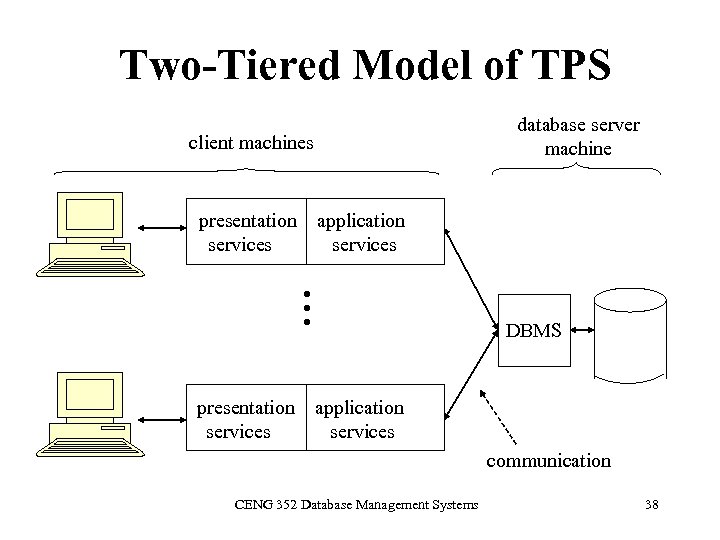
Two-Tiered Model of TPS database server machine client machines application services • • • presentation services DBMS application services communication CENG 352 Database Management Systems 38
Three Tier Client-Server Architecture • Common for Web applications • Intermediate Layer called Application Server or Web Server: • stores the web connectivity software and the rules and business logic (constraints) part of the application used to access the right amount of data from the database server • acts like a conduit for sending partially processed data between the database server and the client. • Additional Features- Security: • encrypt the data at the server before transmission • decrypt data at the client CENG 352 Database Management Systems 39
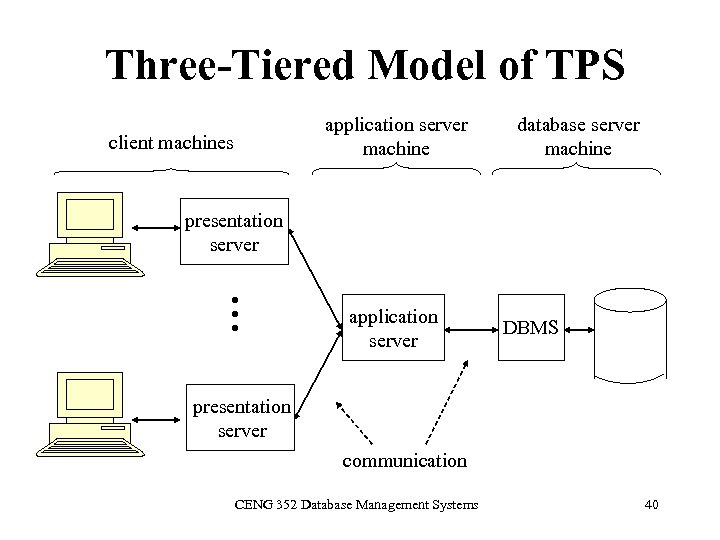
Three-Tiered Model of TPS application server machine client machines database server machine • • • presentation server application server DBMS presentation server communication CENG 352 Database Management Systems 40
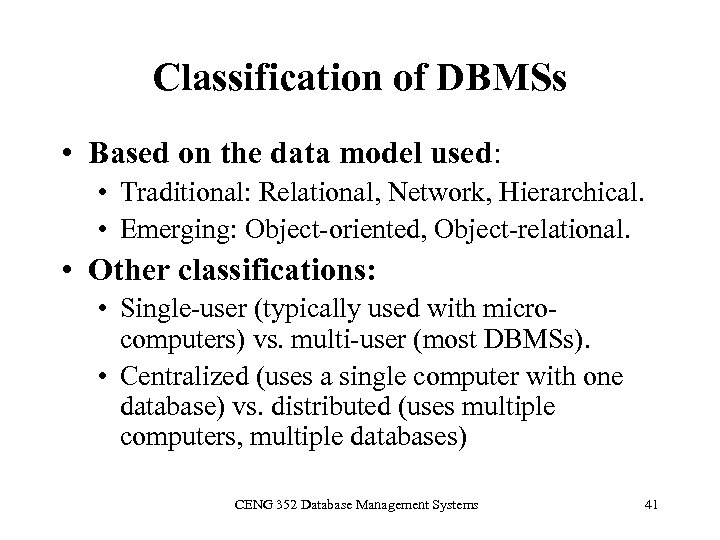
Classification of DBMSs • Based on the data model used: • Traditional: Relational, Network, Hierarchical. • Emerging: Object-oriented, Object-relational. • Other classifications: • Single-user (typically used with microcomputers) vs. multi-user (most DBMSs). • Centralized (uses a single computer with one database) vs. distributed (uses multiple computers, multiple databases) CENG 352 Database Management Systems 41
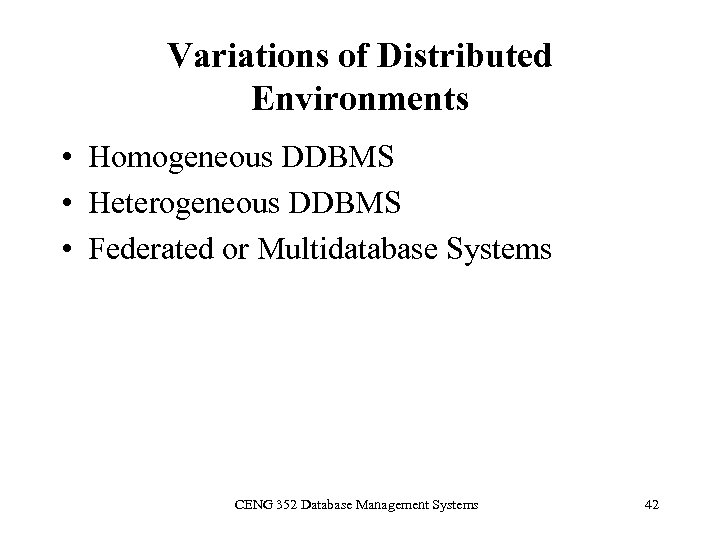
Variations of Distributed Environments • Homogeneous DDBMS • Heterogeneous DDBMS • Federated or Multidatabase Systems CENG 352 Database Management Systems 42
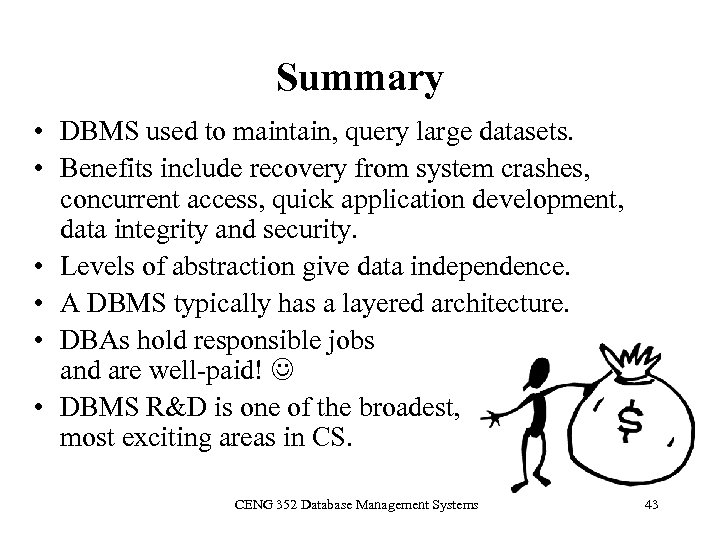
Summary • DBMS used to maintain, query large datasets. • Benefits include recovery from system crashes, concurrent access, quick application development, data integrity and security. • Levels of abstraction give data independence. • A DBMS typically has a layered architecture. • DBAs hold responsible jobs and are well-paid! • DBMS R&D is one of the broadest, most exciting areas in CS. CENG 352 Database Management Systems 43
Скачать презентацию CENG 352 Database Management Systems Nihan Kesim Çiçekli
b7e575340a2e297fbc021c591f013eb8.ppt