 Скачать презентацию Cellular Mobile Communications An Introduction Cellular Mobile
c4551f5d6d1bce2ab95427c83e3a3348.ppt
- Количество слайдов: 16



Cellular Mobile Communications An Introduction
Cellular Mobile Communications An Introduction v. Several Types of Mobile Radio Systems v Garage Door Controller [<100 MHz] v Remote Controllers [TV/VCR/DISH][Infra-Red: 1 -100 THz] v Cordless Telephone [<100 MHz] v Hand-Held Radio [Walki-Talki] [VHF-UHF: 40 -480 MHz] v Pagers/Beepers [< 1 GHz] v Cellular Mobile Telephone[<2 GHz] v. Classification v Simplex System: Communication is possible in only one direction : Garage Door Controller, Remote Controllers [TV/VCR/DISH] Pagers/Beepers v Semi-Duplex System: Communication is possible in two directions but one talks and other listens at any time[Push to Talk System]: Walki-Talki v Duplex System: Communication is possible in both directions at any time: Cellular Telephone [FDD or TDD]
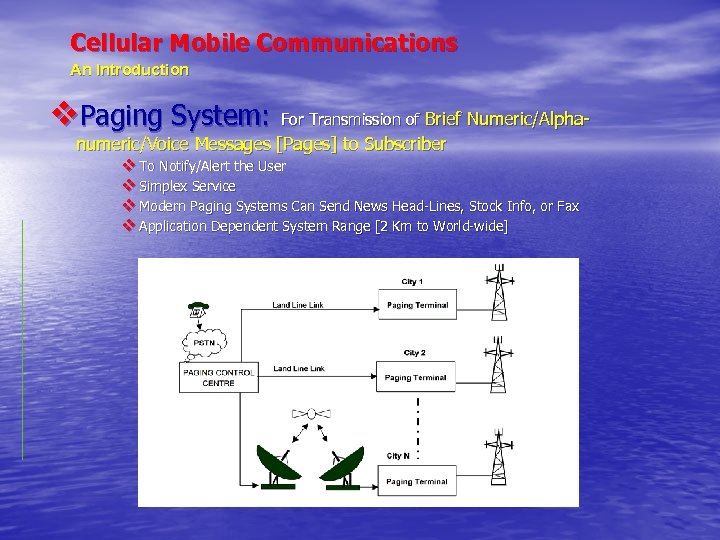
Cellular Mobile Communications An Introduction v. Paging System: For Transmission of Brief Numeric/Alphanumeric/Voice Messages [Pages] to Subscriber v To Notify/Alert the User v Simplex Service v Modern Paging Systems Can Send News Head-Lines, Stock Info, or Fax v Application Dependent System Range [2 Km to World-wide]
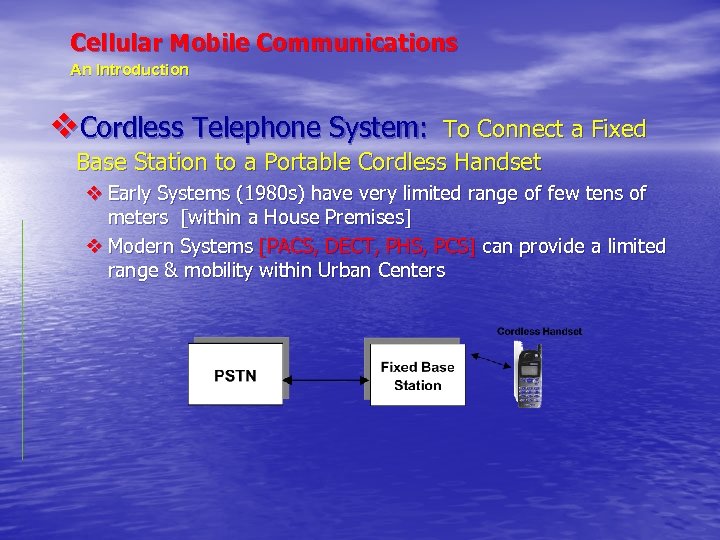
Cellular Mobile Communications An Introduction v. Cordless Telephone System: To Connect a Fixed Base Station to a Portable Cordless Handset v Early Systems (1980 s) have very limited range of few tens of meters [within a House Premises] v Modern Systems [PACS, DECT, PHS, PCS] can provide a limited range & mobility within Urban Centers
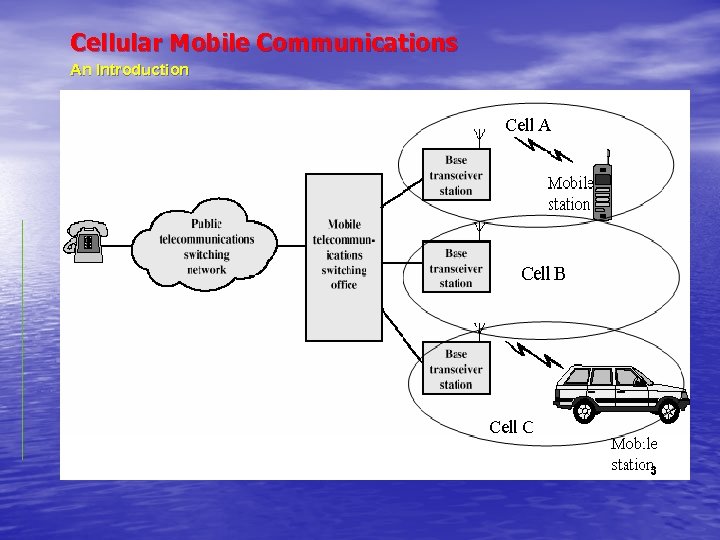
Cellular Mobile Communications An Introduction v Basic Components of a Cellular Telephone System v Cellular Mobile Phone: A light-weight hand-held set which is an outcome of the marriage of Graham Bell’s Plain Old Telephone Technology [1876] and Marconi’s Radio Technology [1894] [although a very late delivery but very cute] v Base Station: A Low Power Transmitter, other Radio Equipment [Transceivers] plus a small Tower v Mobile Switching Center [MSC] /Mobile Telephone Switching Office[MTSO] v An Interface between Base Stations and the PSTN v Controls all the Base Stations in the Region and Processes User ID and other Call Parameters v A typical MSC can handle up to 100, 000 Mobiles, and 5000 Simultaneous Calls v Handles Handoff Requests, Call Initiation Requests, and all Billing & System Maintenance Functions
Cellular Mobile Communications An Introduction
Cellular Mobile Communications An Introduction v The Cellular Concept v RF spectrum is a valuable and scarce commodity v RF signals attenuate over distance v Cellular network divides coverage area into cells, each served by its own base station transceiver and antenna v Low (er) power transmitters used by BSs; transmission range determines cell boundary v RF spectrum divided into distinct groups of channels v Adjacent cells are (usually) assigned different channel groups to avoid interference v Cells separated by a sufficiently large distance to avoid mutual interference can be assigned the same channel group frequency reuse among co-channel cells
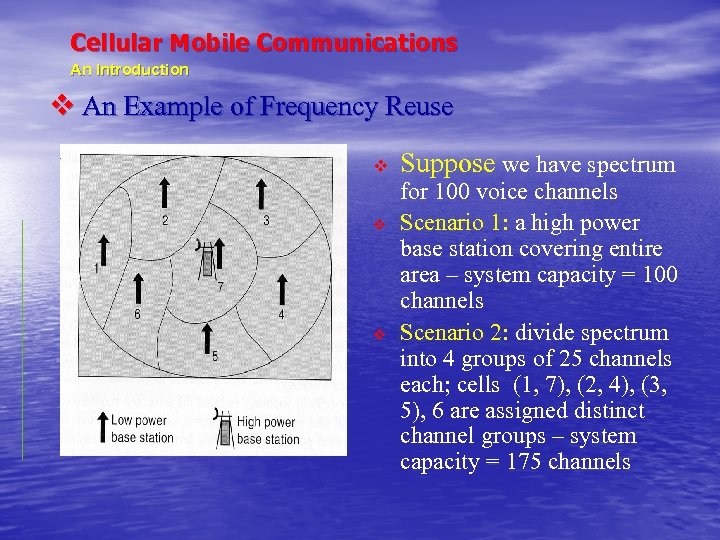
Cellular Mobile Communications An Introduction v An Example of Frequency Reuse v v v Suppose we have spectrum for 100 voice channels Scenario 1: a high power base station covering entire area – system capacity = 100 channels Scenario 2: divide spectrum into 4 groups of 25 channels each; cells (1, 7), (2, 4), (3, 5), 6 are assigned distinct channel groups – system capacity = 175 channels
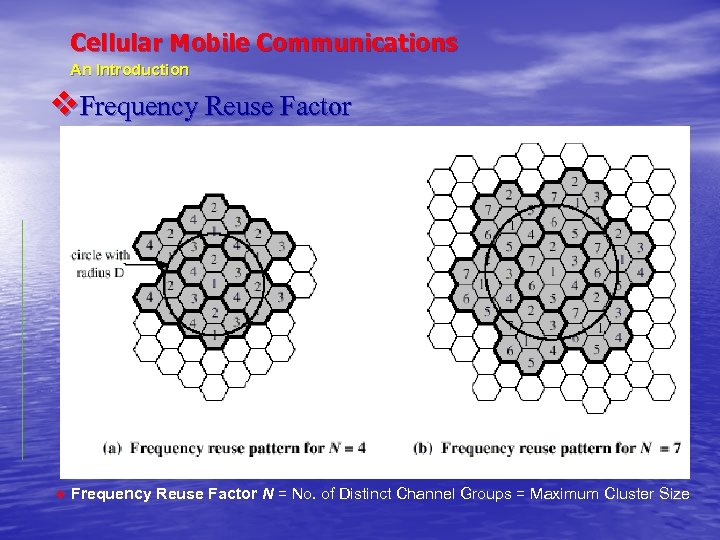
Cellular Mobile Communications An Introduction v. Frequency Reuse Factor v Frequency Reuse Factor N = No. of Distinct Channel Groups = Maximum Cluster Size
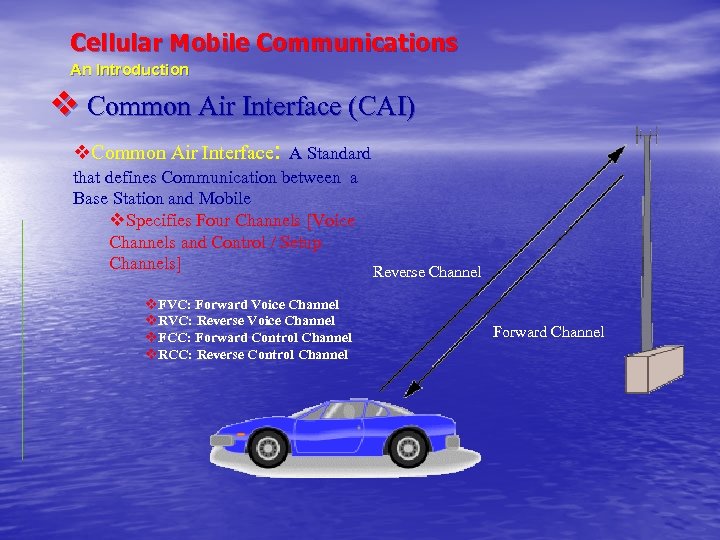
Cellular Mobile Communications An Introduction v Common Air Interface (CAI) v. Common Air Interface: A Standard that defines Communication between a Base Station and Mobile v. Specifies Four Channels [Voice Channels and Control / Setup Channels] Reverse Channel v. FVC: Forward Voice Channel v. RVC: Reverse Voice Channel v. FCC: Forward Control Channel v. RCC: Reverse Control Channel Forward Channel
Cellular Mobile Communications An Introduction v Call Setup Procedure v. Cellular Phone Codes: Special Codes are associated with each Cell Phone to identify the phone, its owner, and service provider: v. Electronic Serial Number(ESN) -A Unique 32 -bit Code v. Mobile Identification Number(MIN): A Subscriber’s Telephone Number v Station Class mark (SCM): Indicates the Max Tx Power for the User v. When a Cellular Phone is turned on and Initiates a Call: [see next slide] v. Monitors the Control Channels and gets hold on to the strongest one v. Makes a Call Initiation Request[Dials the Called part Number, MIN , ESN and SCM automatically transmitted] v. Validation Procedure at MSC & Voice-Frequency pair Allocation v. Base Station Pages the Information for the Mobile v. MSC Connects the Mobile with the Called Party[Another Mobile/Landline Phone] v. Call is Established and Communication Starts
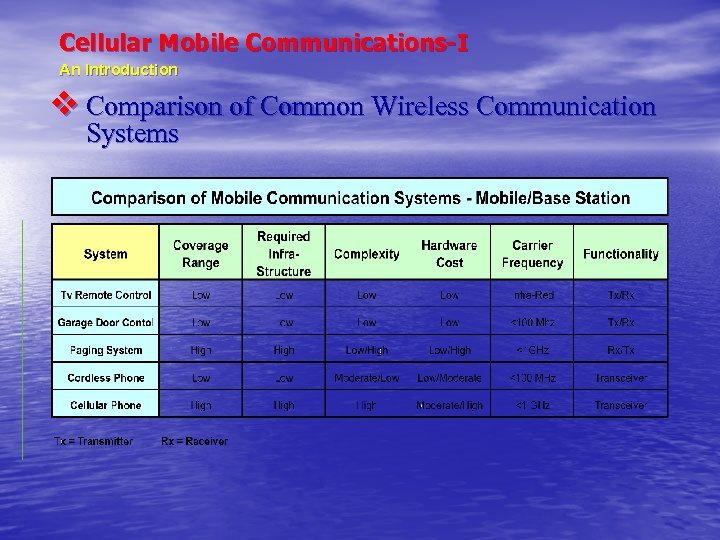
Cellular Mobile Communications-I An Introduction v Comparison of Common Wireless Communication Systems
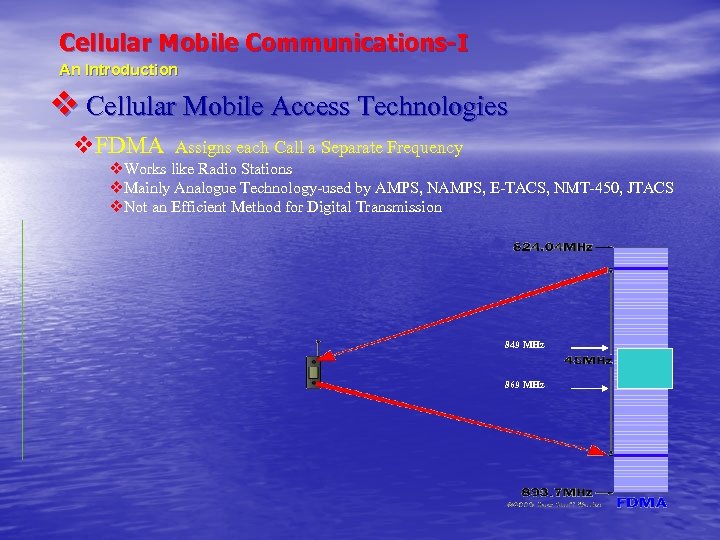
Cellular Mobile Communications-I An Introduction v Cellular Mobile Access Technologies v. FDMA Assigns each Call a Separate Frequency v. Works like Radio Stations v. Mainly Analogue Technology-used by AMPS, NAMPS, E-TACS, NMT-450, JTACS v. Not an Efficient Method for Digital Transmission 849 MHz 869 MHz
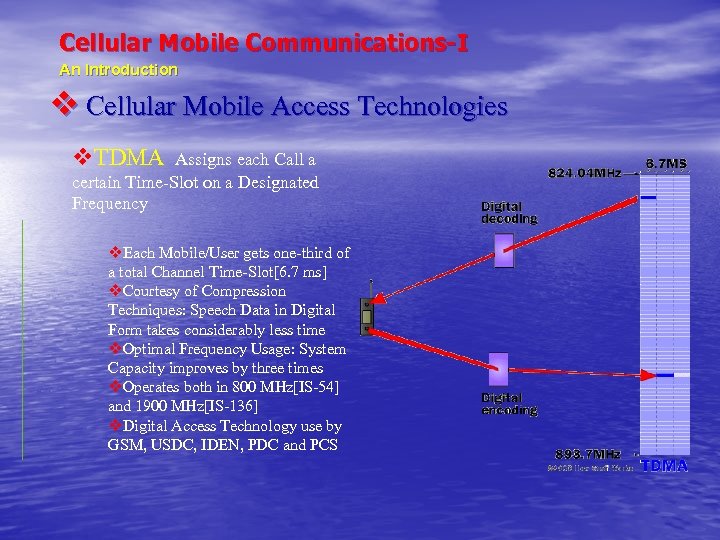
Cellular Mobile Communications-I An Introduction v Cellular Mobile Access Technologies v. TDMA Assigns each Call a certain Time-Slot on a Designated Frequency v. Each Mobile/User gets one-third of a total Channel Time-Slot[6. 7 ms] v. Courtesy of Compression Techniques: Speech Data in Digital Form takes considerably less time v. Optimal Frequency Usage: System Capacity improves by three times v. Operates both in 800 MHz[IS-54] and 1900 MHz[IS-136] v. Digital Access Technology use by GSM, USDC, IDEN, PDC and PCS
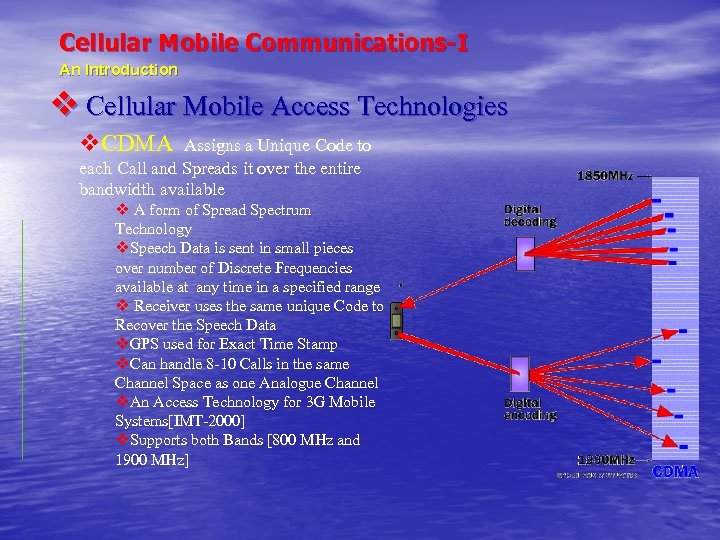
Cellular Mobile Communications-I An Introduction v Cellular Mobile Access Technologies v. CDMA Assigns a Unique Code to each Call and Spreads it over the entire bandwidth available v A form of Spread Spectrum Technology v. Speech Data is sent in small pieces over number of Discrete Frequencies available at any time in a specified range v Receiver uses the same unique Code to Recover the Speech Data v. GPS used for Exact Time Stamp v. Can handle 8 -10 Calls in the same Channel Space as one Analogue Channel v. An Access Technology for 3 G Mobile Systems[IMT-2000] v. Supports both Bands [800 MHz and 1900 MHz]
Cellular Mobile Communications An Introduction v Trends in Cellular radio and Personal Communications v PCS/PCN: PCS calls for more personalized services whereas PCN refers to Wireless Networking Concept-any person, anywhere, anytime can make a call using PC. PCS and PCN terms are sometime used interchangeably v IEEE 802. 11: A standard for computer communications using wireless links[inside building]. v ETSI’s 20 Mbps HIPER LAN: Standard for indoor Wireless Networks v IMT-2000 [International Mobile Telephone-2000 Standard]: A 3 G universal, multi-function, globally compatible Digital Mobile Radio Standard is in making v Satellite-based Cellular Phone Systems v A very good Chance for Developing Nations to Improve their Communication Networks
Скачать презентацию Cellular Mobile Communications An Introduction Cellular Mobile
c4551f5d6d1bce2ab95427c83e3a3348.ppt