 Скачать презентацию Cellular factors mediating the production of astaxanthin by
c21a0b7739db7156a75666064f8deb3b.ppt
- Количество слайдов: 14



Cellular factors mediating the production of astaxanthin by Haematococcus pluvialis Claude Aflalo & Sammy Boussiba Thanks to: Bing Wang, Yuval Meshulem, Aliza Zarka, Ben Friehoff Microalgal Biotechnology Laboratory Blaustein Institutes for Desert Research Ben Gurion University, Sde Boker, Israel CA Chlamy 06
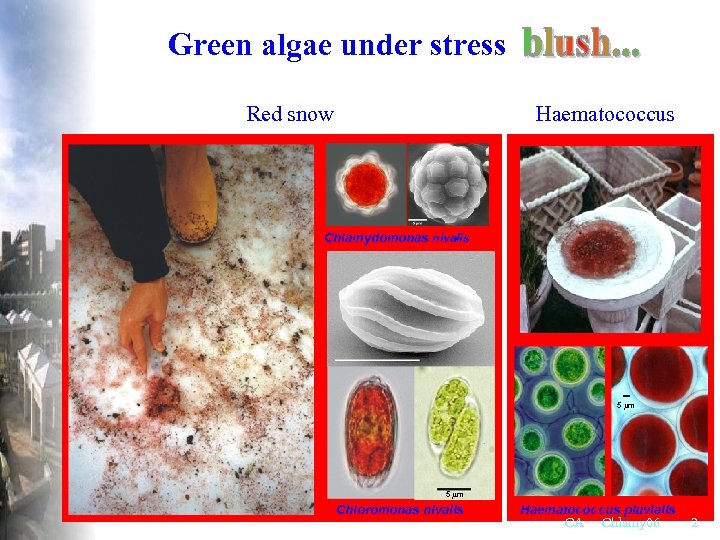
Green algae under stress Red snow Haematococcus Chlamydomonas nivalis 5 mm Chloromonas nivalis Haematococcus pluvialis CA Chlamy 06 2
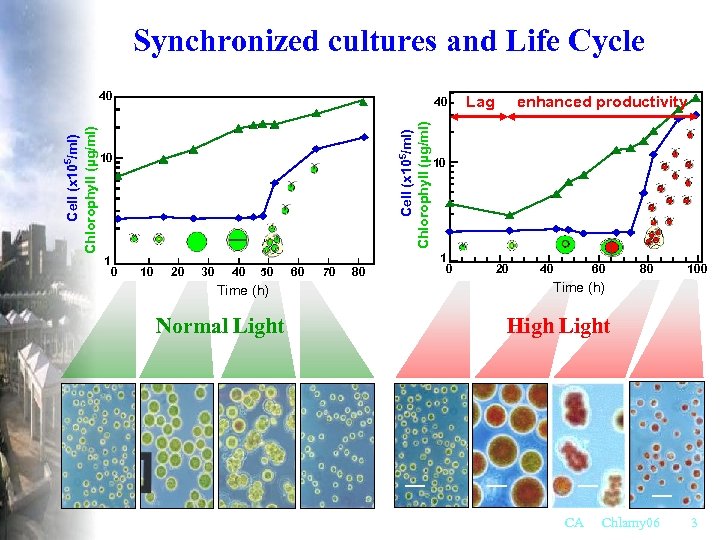
Synchronized cultures and Life Cycle 40 Cell (x 105/ml) Chlorophyll (µg/ml) 40 10 1 0 10 20 30 40 50 Time (h) Normal Light 60 70 80 Lag enhanced productivity 10 1 0 20 40 60 80 100 Time (h) High Light CA Chlamy 06 3
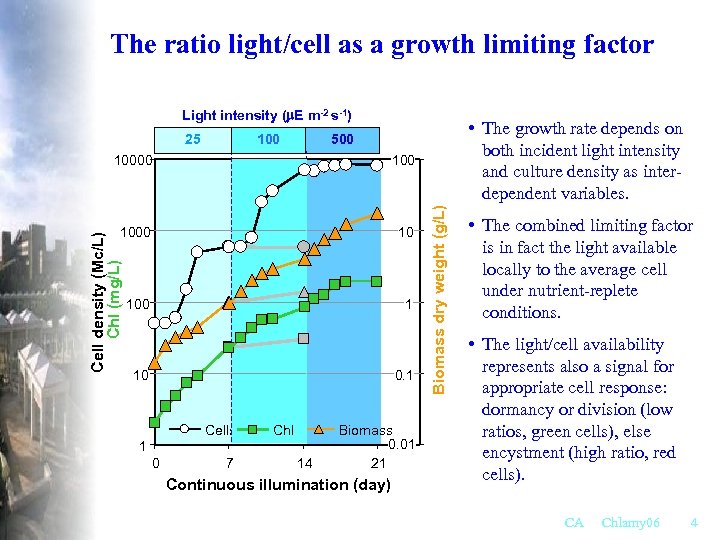
The ratio light/cell as a growth limiting factor Light intensity (m. E m-2 s-1) 25 • The growth rate depends on both incident light intensity and culture density as interdependent variables. 500 1000 10 100 1 10 0. 1 Cells Chl 1 0 7 14 Biomass 0. 01 21 Continuous illumination (day) Biomass dry weight (g/L) 100 Cell density (Mc/L) Chl (mg/L) 10000 • The combined limiting factor is in fact the light available locally to the average cell under nutrient-replete conditions. • The light/cell availability represents also a signal for appropriate cell response: dormancy or division (low ratios, green cells), else encystment (high ratio, red cells). CA Chlamy 06 4
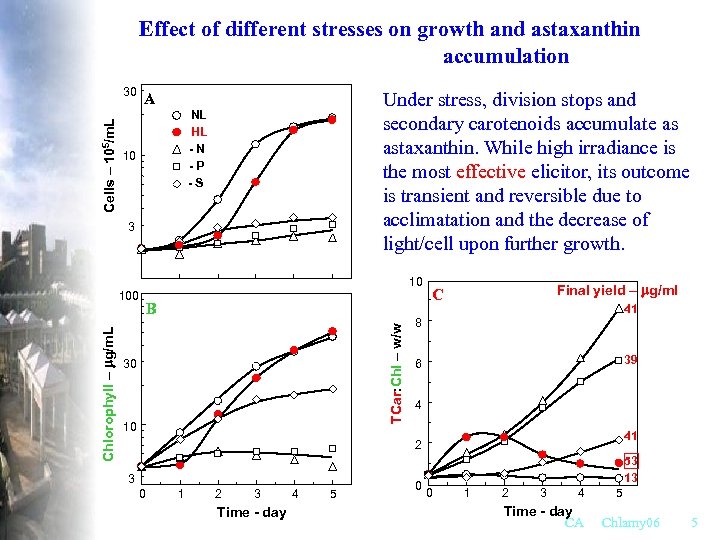
Effect of different stresses on growth and astaxanthin accumulation Cells – 105/m. L 30 Under stress, division stops and secondary carotenoids accumulate as astaxanthin. While high irradiance is the most effective elicitor, its outcome is transient and reversible due to acclimatation and the decrease of light/cell upon further growth. A NL HL -N -P -S 10 3 10 B TCar: Chl – w/w Chlorophyll – mg/m. L 100 30 10 Final yield – mg/ml C 41 8 39 6 4 41 2 3 0 1 2 3 Time - day 4 5 0 53 13 0 1 2 3 4 Time - day CA 5 Chlamy 06 5
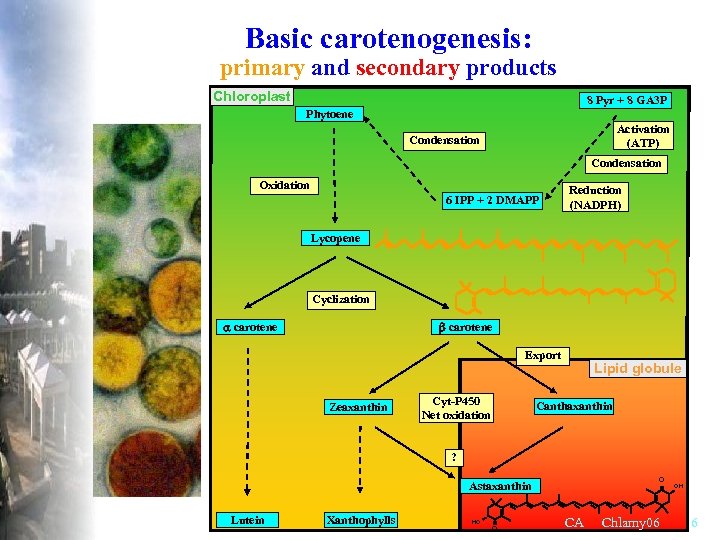
Basic carotenogenesis: primary and secondary products Chloroplast 8 Pyr + 8 GA 3 P Phytoene Activation (ATP) Condensation Oxidation 6 IPP + 2 DMAPP Reduction (NADPH) Lycopene Cyclization a carotene b carotene Export Zeaxanthin Cyt-P 450 Net oxidation Lipid globule Canthaxanthin ? O Astaxanthin Lutein Xanthophylls HO O CA Chlamy 06 OH 6
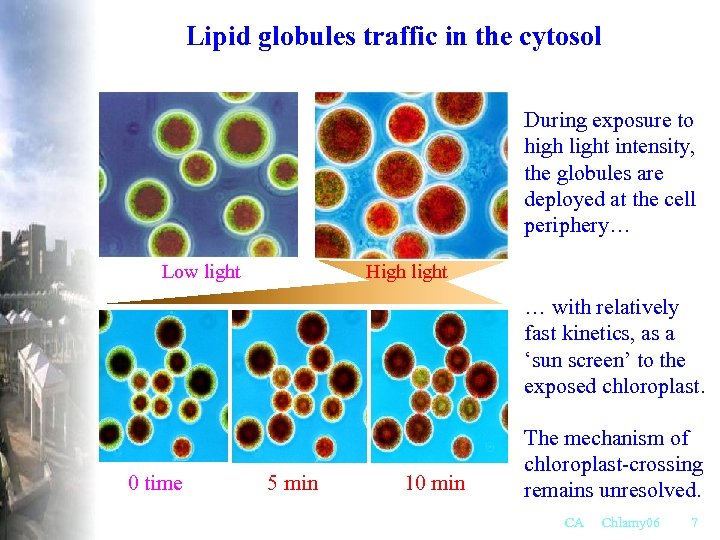
Lipid globules traffic in the cytosol During exposure to high light intensity, the globules are deployed at the cell periphery… Low light High light … with relatively fast kinetics, as a ‘sun screen’ to the exposed chloroplast. 0 time 5 min 10 min The mechanism of chloroplast-crossing remains unresolved. CA Chlamy 06 7
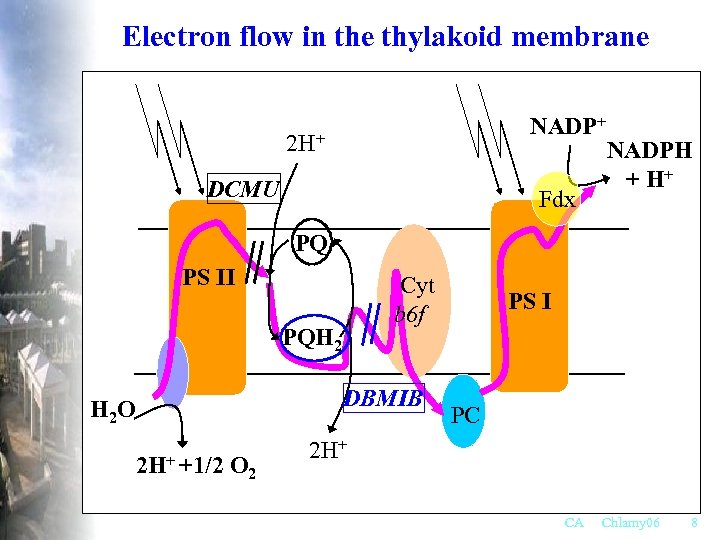
Electron flow in the thylakoid membrane NADP+ 2 H+ DCMU Fdx NADPH + H+ PQ PS II Cyt b 6 f PQH 2 DBMIB H 2 O 2 H+ +1/2 O 2 PS I PC 2 H+ CA Chlamy 06 8
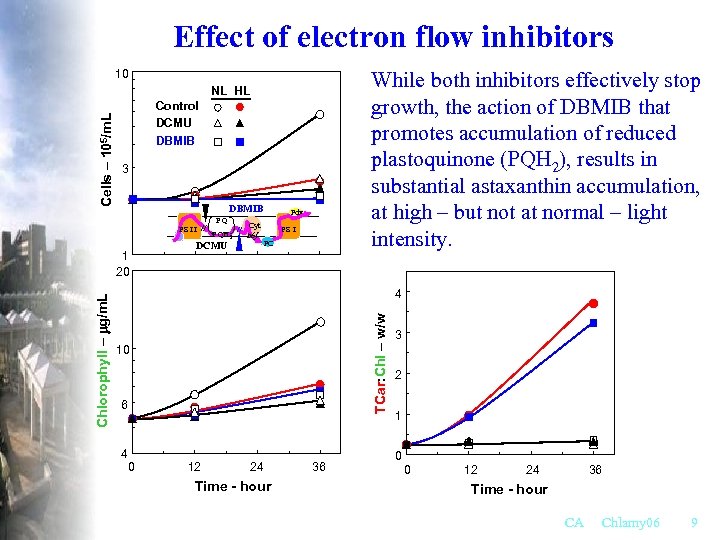
Effect of electron flow inhibitors 10 While both inhibitors effectively stop growth, the action of DBMIB that promotes accumulation of reduced plastoquinone (PQH 2), results in substantial astaxanthin accumulation, at high – but not at normal – light intensity. Cells – 105/m. L NL HL Control DCMU DBMIB 3 DBMIB PQ PS II DCMU Fdx PS I PC 4 TCar: Chl – w/w Chlorophyll – mg/m. L 1 20 PQH 2 Cyt b 6 f 10 6 4 0 12 24 Time - hour 36 3 2 1 0 0 12 24 36 Time - hour CA Chlamy 06 9
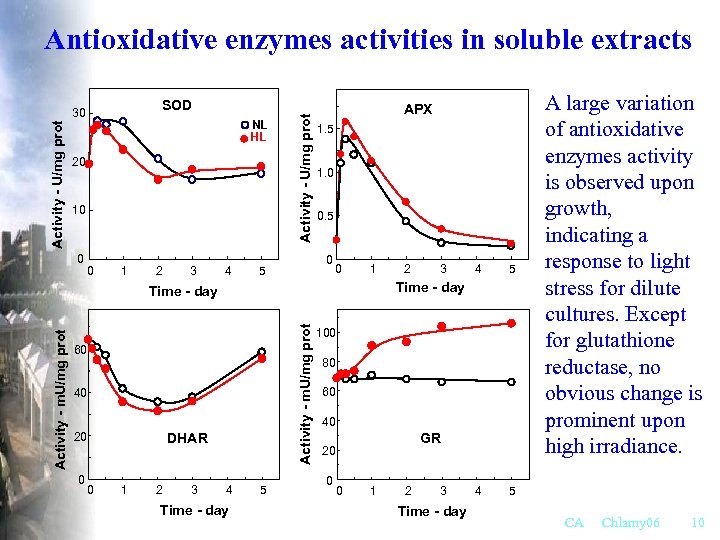
Antioxidative enzymes activities in soluble extracts Activity - U/mg prot NL HL 20 10 0 0 1 2 3 4 Activity - U/mg prot SOD 30 APX 1. 5 1. 0 0. 5 0 1 Activity - m. U/mg prot 60 40 0 0 DHAR 1 2 3 3 4 5 Time - day 20 2 4 Time - day 5 100 80 60 40 GR 20 0 0 1 2 3 Time - day A large variation of antioxidative enzymes activity is observed upon growth, indicating a response to light stress for dilute cultures. Except for glutathione reductase, no obvious change is prominent upon high irradiance. CA Chlamy 06 10
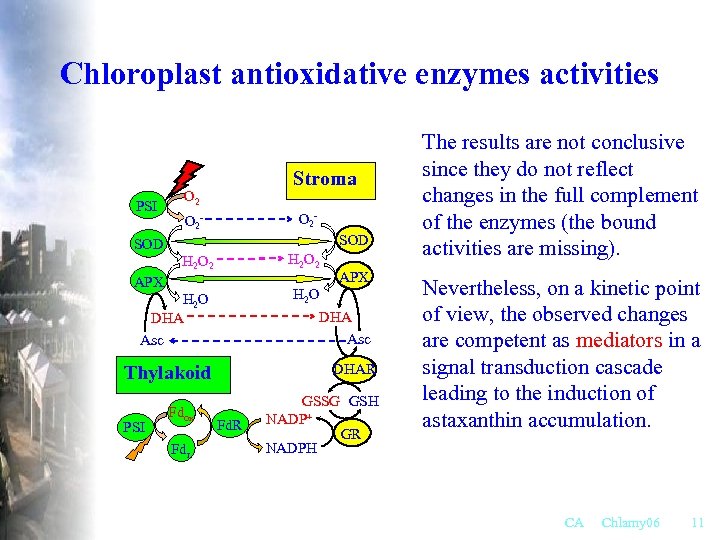
Chloroplast antioxidative enzymes activities PSI SOD Stroma O 2 - SOD H 2 O 2 H 2 O DHA Asc H 2 O APX DHA Asc DHAR Thylakoid PSI Fdox Fdr APX Fd. R GSSG GSH NADP+ GR NADPH The results are not conclusive since they do not reflect changes in the full complement of the enzymes (the bound activities are missing). Nevertheless, on a kinetic point of view, the observed changes are competent as mediators in a signal transduction cascade leading to the induction of astaxanthin accumulation. CA Chlamy 06 11
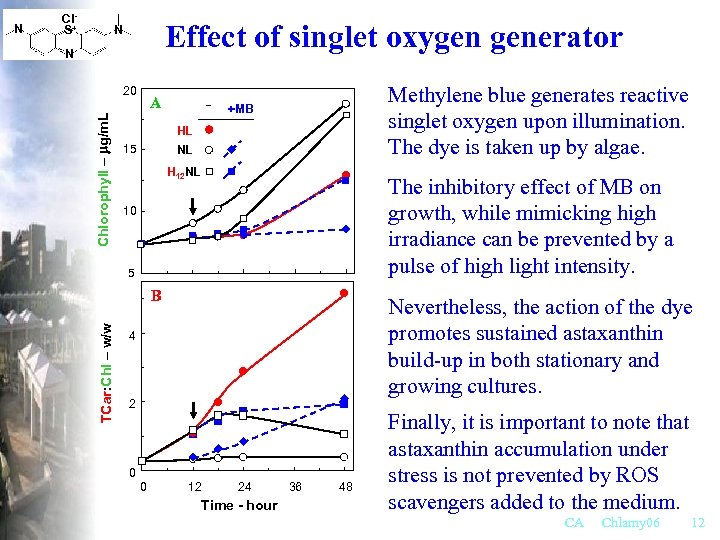
Effect of singlet oxygen generator N N Chlorophyll – mg/m. L 20 A – Methylene blue generates reactive singlet oxygen upon illumination. The dye is taken up by algae. +MB HL 15 NL H 12 NL The inhibitory effect of MB on growth, while mimicking high irradiance can be prevented by a pulse of high light intensity. 10 5 B TCar: Chl – w/w N Cl. S+ Nevertheless, the action of the dye promotes sustained astaxanthin build-up in both stationary and growing cultures. 4 2 0 0 12 24 Time - hour 36 48 Finally, it is important to note that astaxanthin accumulation under stress is not prevented by ROS scavengers added to the medium. CA Chlamy 06 12
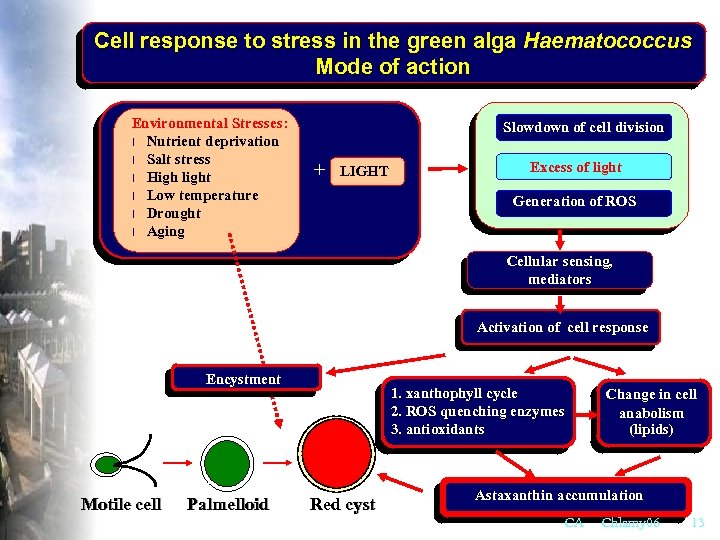
Cell response to stress in the green alga Haematococcus Mode of action Environmental Stresses: l Nutrient deprivation l Salt stress l High light l Low temperature l Drought l Aging Slowdown of cell division + LIGHT Excess of light Generation of ROS Cellular sensing, mediators Activation of cell response Encystment Motile cell Palmelloid 1. xanthophyll cycle 2. ROS quenching enzymes 3. antioxidants Red cyst Change in cell anabolism (lipids) Astaxanthin accumulation CA Chlamy 06 13
Thank you ☺ CA Chlamy 06 14
Скачать презентацию Cellular factors mediating the production of astaxanthin by
c21a0b7739db7156a75666064f8deb3b.ppt