


 Скачать презентацию Cellular Automata with Strong Anticipation Property of Elements
dfd125e68131c54b3d4f21ea4f74ee4d.ppt
- Количество слайдов: 39
 Cellular Automata with Strong Anticipation Property of Elements Alexander Makarenko, prof. , dr. NTUU “KPI”, Institute for of Applied System Analysis, Kyiv, Ukraine makalex@i. com. ua 1
 • Part I. Introduction. Strong and Weak Anticipation 2
 INTRODUCTION • The presentation is devoted to the description of rather new mathematical objects – namely the cellular automata with anticipation. • Mathematically such objects sometimes frequently have the form of advanced equations. • Since the introduction of strong anticipation by D. Dubois the numerous investigations of concrete systems had been proposed. 3
 Anticipation (0) • an • tic • i • pa • tion • 1. the act of anticipating or the state of being anticipated. • 2. realization in advance; foretaste. • 3. expectation or hope. • 4. intuition, foreknowledge, or prescience. • 5. a premature withdrawal or assignment of money from a trust estate. • 6. a musical tone introduced in advance of its harmony so that it sounds against the preceding chord. • [1540– 50; (< Middle French) < Latin] • Random House Kernerman Webster's College Dictionary, © 2010 K Dictionaries Ltd. Copyright 2005, 1997, 1991 by Random House, Inc. All rights reserved. 4
 • Models and Mathematics of Anticipation 5
 Examples of Problems with Anticipation • • • Optimal control problems Nerve conduction equations Economic dynamics Travelling waves in spatial lattice The slowing down of neutrons in nuclear reactor • Large social systems (A. Makarenko) • Sustainable development (A. Makarenko) 6
 Mathematical Objects • • Advanced differential equations Mixed type differential equations Advanced difference equations Mixed type difference equations Equations with deviated arguments Fixed points Periodic solutions Theorems of existence and uniqueness 7
 • So in proposed talk the new examples of models with anticipation had been considered – namely the cellular automat. 8
 STRONG ANTICIPATION • Since the beginning of 90 -th in the works by D. Dubois – the idea of strong anticipation had been introduced: “Definition of an incursive discrete strong anticipatory system …: an incursive discrete system is a system which computes its current state at time, as a function of its states at past times, present time, , and even its states at future times 9
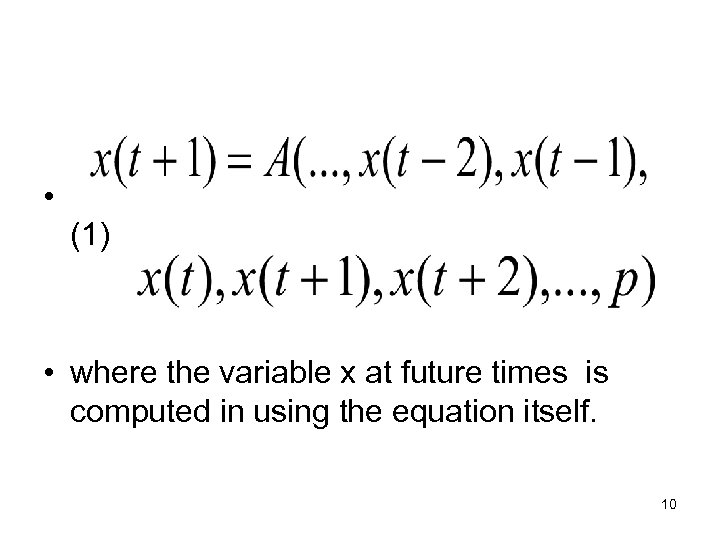 • (1) • where the variable x at future times is computed in using the equation itself. 10
 WEAK ANTICIPATION • Definition of an incursive discrete weak anticipatory system: an incursive discrete system is a system which computes its current state at time, as a function of its states at past times, present time, , and even its predicted states at future times 11
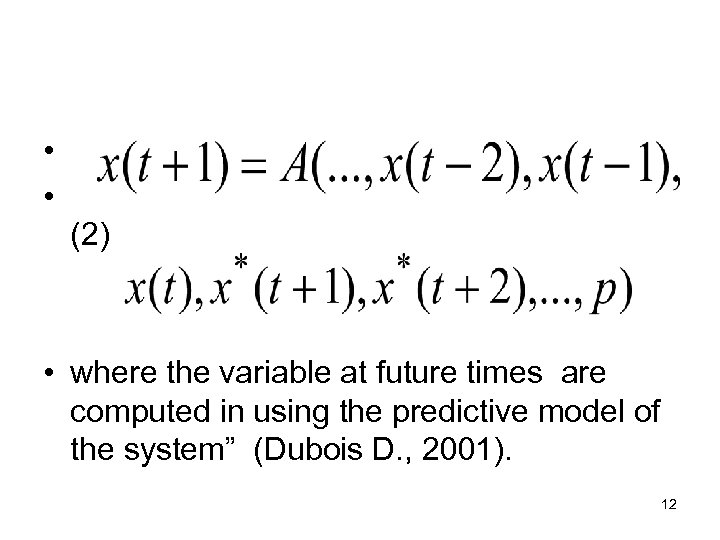 • • (2) • where the variable at future times are computed in using the predictive model of the system” (Dubois D. , 2001). 12
 Part II. Cellular Automata with Anticipation 13
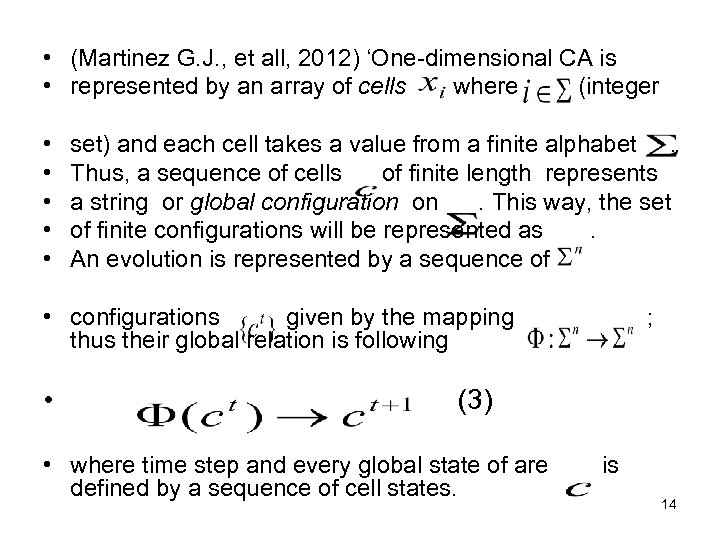 • (Martinez G. J. , et all, 2012) ‘One-dimensional CA is • represented by an array of cells where (integer • • • set) and each cell takes a value from a finite alphabet. Thus, a sequence of cells of finite length represents a string or global configuration on. This way, the set of finite configurations will be represented as. An evolution is represented by a sequence of • configurations given by the mapping thus their global relation is following • ; (3) • where time step and every global state of are defined by a sequence of cell states. is 14
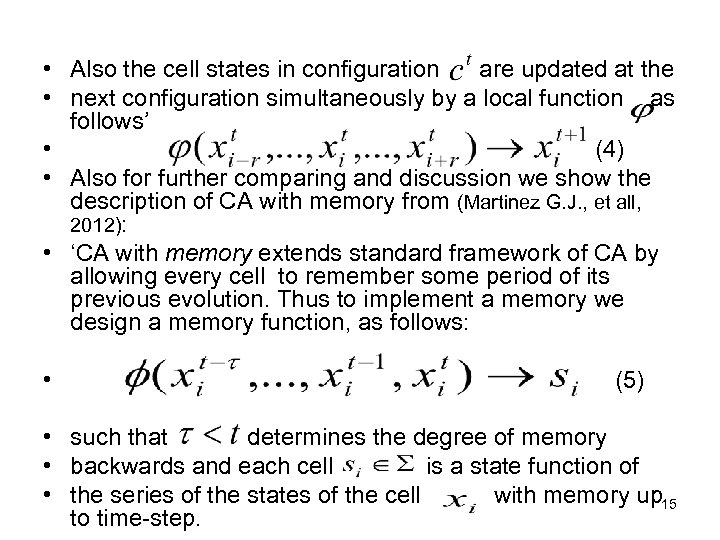 • Also the cell states in configuration are updated at the • next configuration simultaneously by a local function as follows’ • (4) • Also for further comparing and discussion we show the description of CA with memory from (Martinez G. J. , et all, 2012): • ‘CA with memory extends standard framework of CA by allowing every cell to remember some period of its previous evolution. Thus to implement a memory we design a memory function, as follows: • (5) • such that determines the degree of memory • backwards and each cell is a state function of • the series of the states of the cell with memory up 15 to time-step.
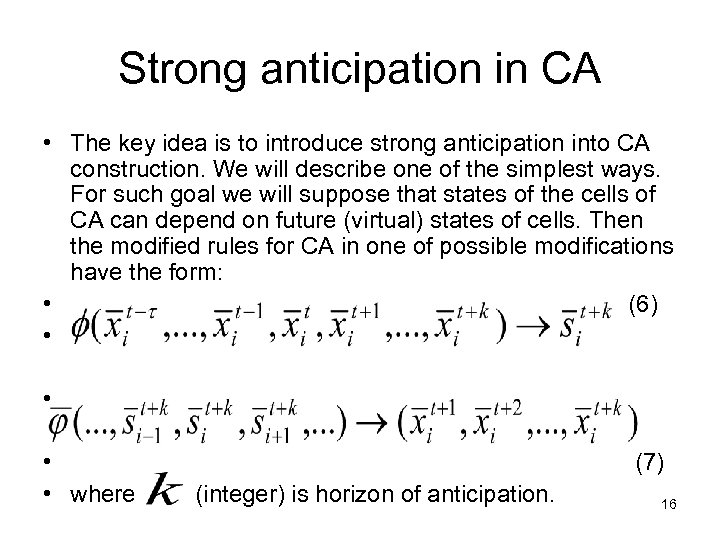 Strong anticipation in CA • The key idea is to introduce strong anticipation into CA construction. We will describe one of the simplest ways. For such goal we will suppose that states of the cells of CA can depend on future (virtual) states of cells. Then the modified rules for CA in one of possible modifications have the form: • (6) • • where (7) (integer) is horizon of anticipation. 16
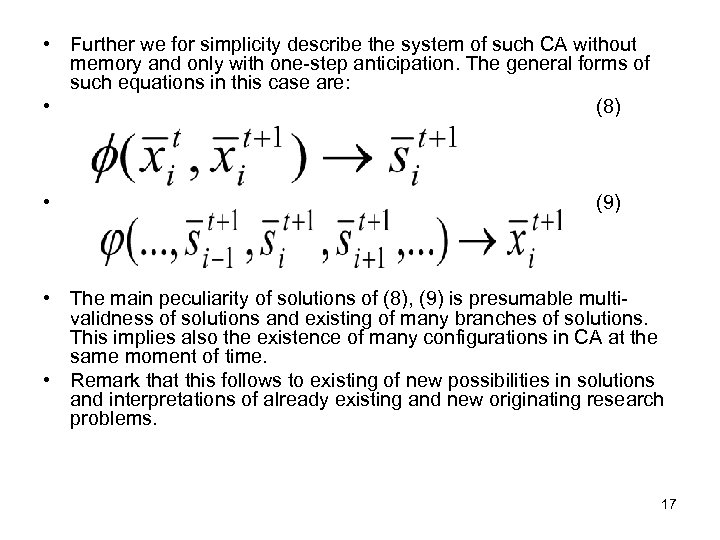 • Further we for simplicity describe the system of such CA without memory and only with one-step anticipation. The general forms of such equations in this case are: • (8) • (9) • The main peculiarity of solutions of (8), (9) is presumable multivalidness of solutions and existing of many branches of solutions. This implies also the existence of many configurations in CA at the same moment of time. • Remark that this follows to existing of new possibilities in solutions and interpretations of already existing and new originating research problems. 17
 ‘Anticipative’ modification may be introduced to the game ‘Life’. • The suggested generalizations open the way for investigations -- • of the anticipatory cellular automata (ACA). • But the investigation of ACA is the matter of future. • So, here we propose the description and first steps of simplest example investigations – the ‘Life’’ Game with anticipation in elements (rules for operating). • We name it as ‘Life. A’ Game. 18
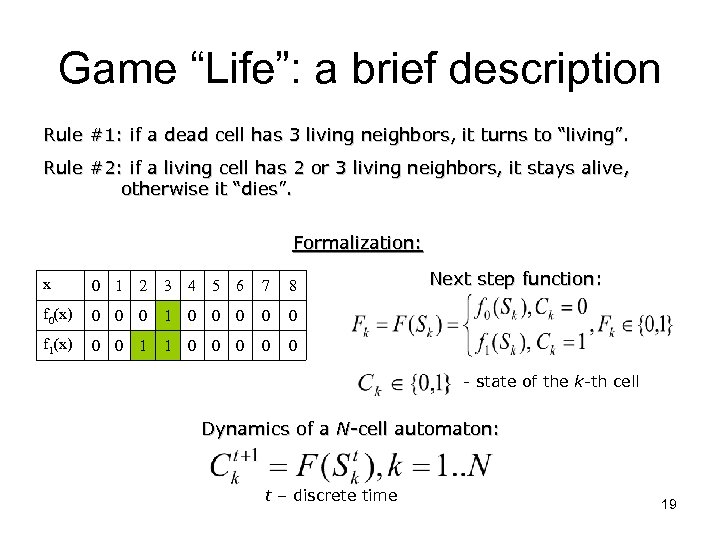 Game “Life”: a brief description Rule #1: if a dead cell has 3 living neighbors, it turns to “living”. Rule #2: if a living cell has 2 or 3 living neighbors, it stays alive, otherwise it “dies”. Formalization: x 0 1 2 3 4 5 6 7 8 f 0(x) 0 0 0 1 0 0 0 f 1(x) 0 0 1 1 0 0 Next step function: 0 - state of the k-th cell Dynamics of a N-cell automaton: t – discrete time 19
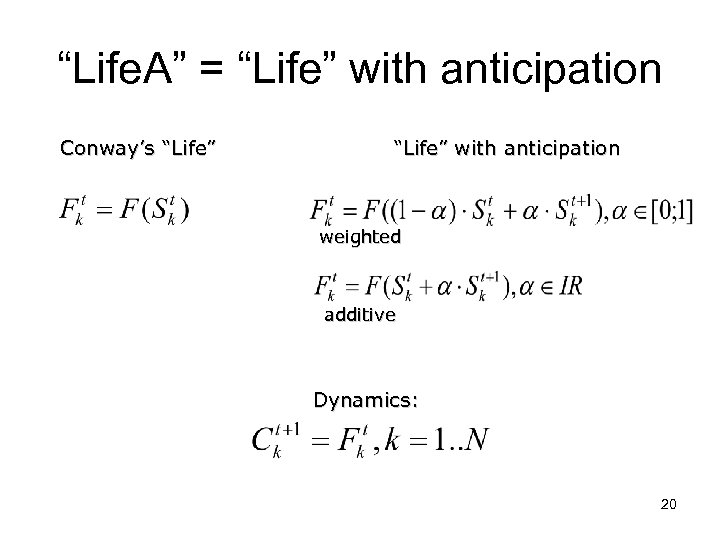 “Life. A” = “Life” with anticipation Conway’s “Life” with anticipation weighted additive Dynamics: 20
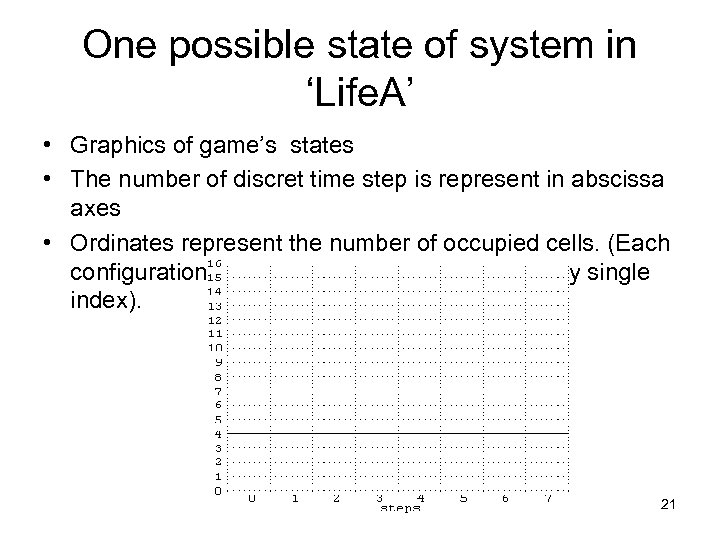 One possible state of system in ‘Life. A’ • Graphics of game’s states • The number of discret time step is represent in abscissa axes • Ordinates represent the number of occupied cells. (Each configurations of CA elements is represented by single index). 21
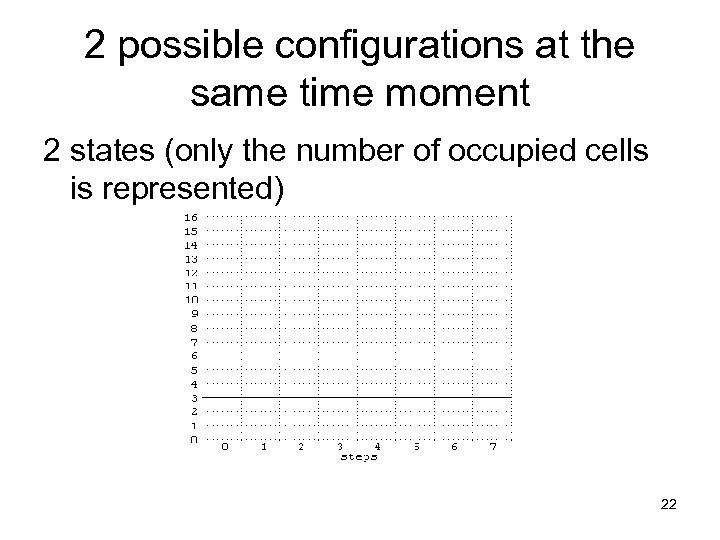 2 possible configurations at the same time moment 2 states (only the number of occupied cells is represented) 22
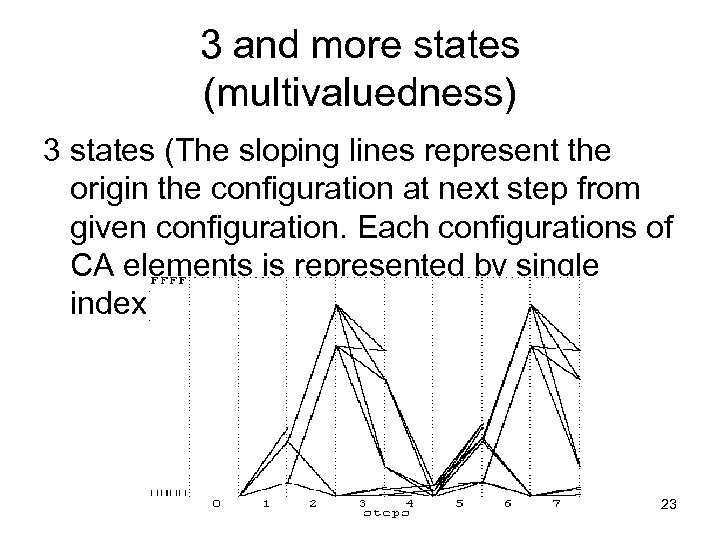 3 and more states (multivaluedness) 3 states (The sloping lines represent the origin the configuration at next step from given configuration. Each configurations of CA elements is represented by single index). 23
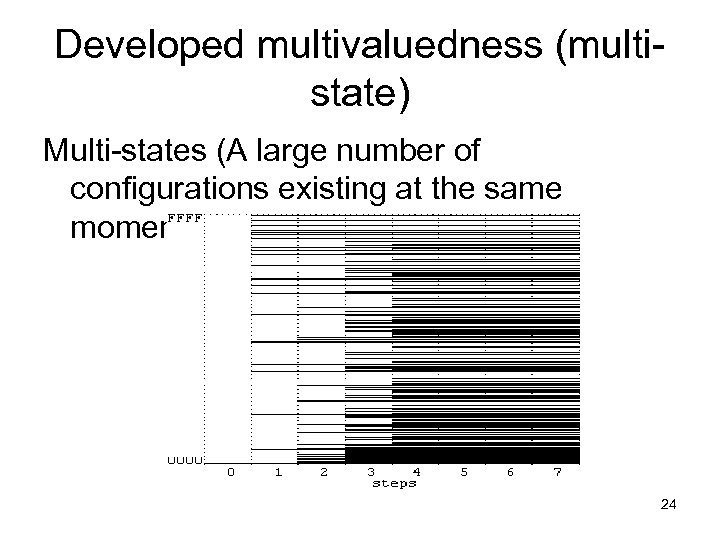 Developed multivaluedness (multistate) Multi-states (A large number of configurations existing at the same moment in model). 24
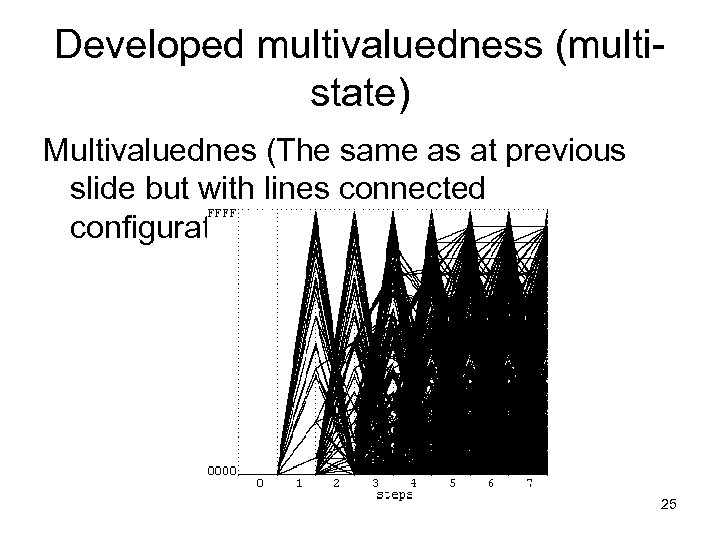 Developed multivaluedness (multistate) Multivaluednes (The same as at previous slide but with lines connected configurations). 25
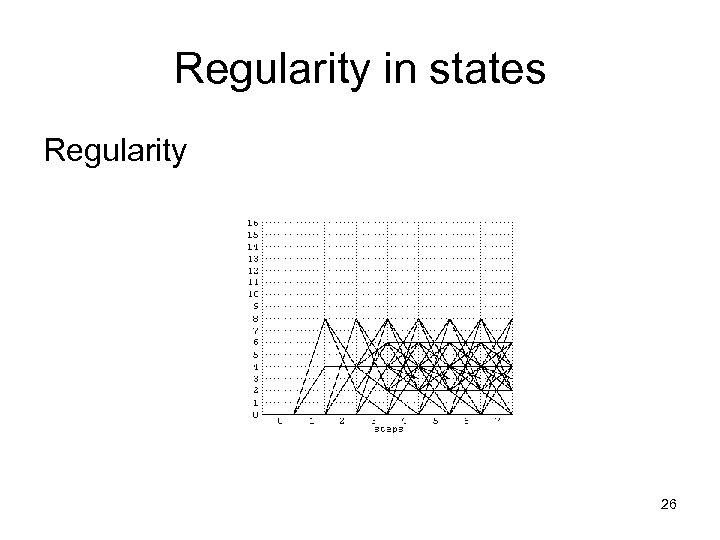 Regularity in states Regularity 26
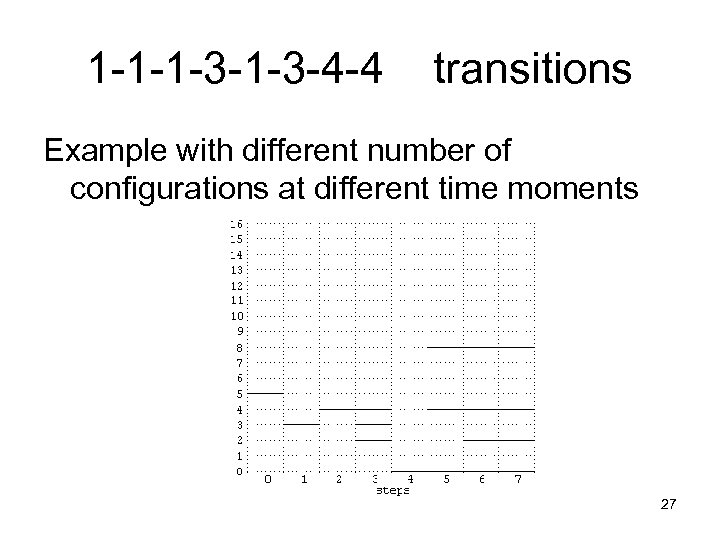 1 -1 -1 -3 -4 -4 transitions Example with different number of configurations at different time moments 27
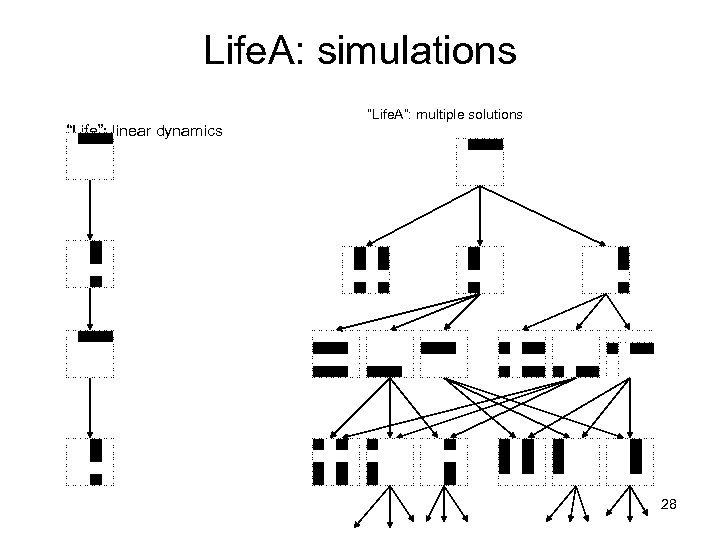 Life. A: simulations “Life”: linear dynamics “Life. A”: multiple solutions 28
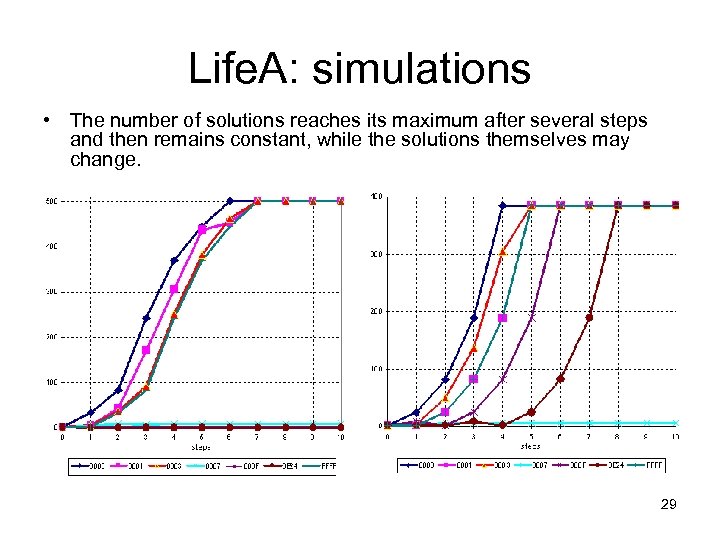 Life. A: simulations • The number of solutions reaches its maximum after several steps and then remains constant, while the solutions themselves may change. 29
 • III. Examples of Applications and Further • Research Problems 30
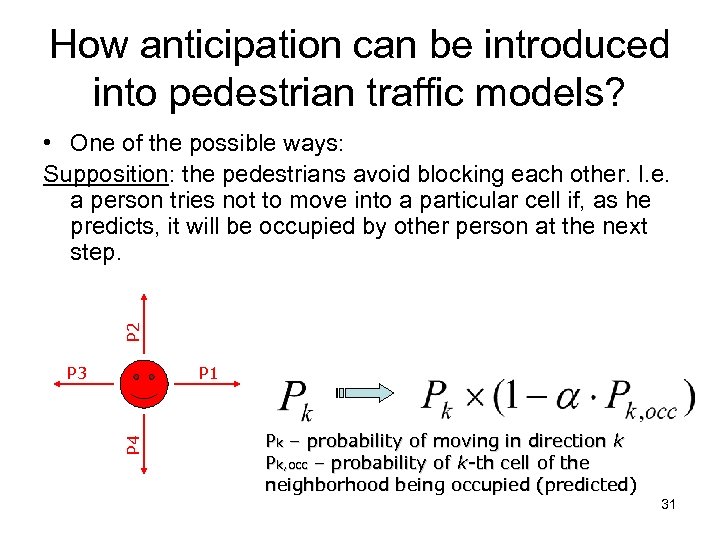 How anticipation can be introduced into pedestrian traffic models? P 2 • One of the possible ways: Supposition: the pedestrians avoid blocking each other. I. e. a person tries not to move into a particular cell if, as he predicts, it will be occupied by other person at the next step. P 1 P 4 P 3 Pk – probability of moving in direction k Pk, occ – probability of k-th cell of the neighborhood being occupied (predicted) 31
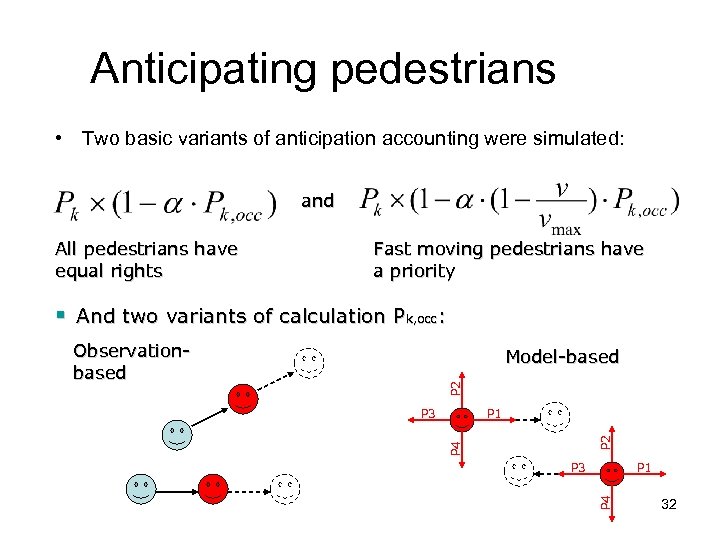 Anticipating pedestrians • Two basic variants of anticipation accounting were simulated: and All pedestrians have equal rights Fast moving pedestrians have a priority § And two variants of calculation Pk, occ: Observationbased P 2 Model-based P 2 P 1 P 4 P 3 32
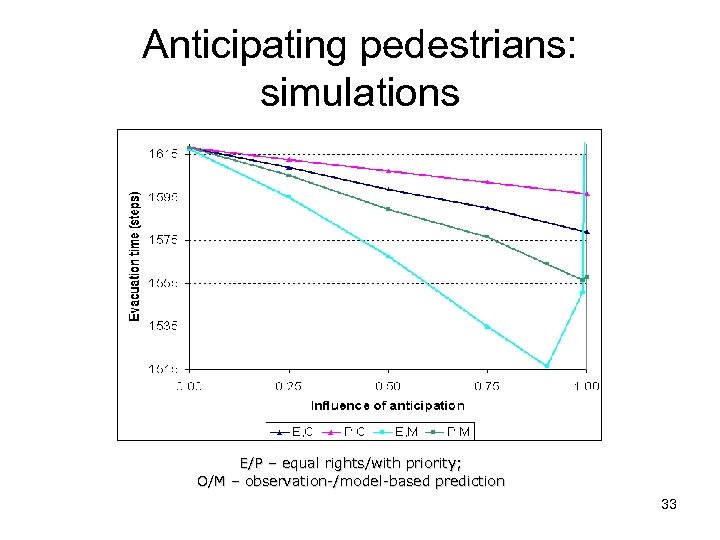 Anticipating pedestrians: simulations E/P – equal rights/with priority; O/M – observation-/model-based prediction 33
 Conclusions and further research problems • Anticipation property may be quite naturally introduced into CA models. 34
 • 1. At first we remember the new possibilities in considering of non-deterministic CA (and moreover usual automata). Non-deterministic automata allow few transition ways from one state to others. Usually it is supposed that such structure is only theoretical and in reality only one of the ways is used in each transition. • CA with anticipation opens the natural possibility for considering of the systems with many different ways in parallel. • Accepting possibilities of physical realization of strong anticipatory systems it may be accepted existence of CA with many branches. • Also such systems are interesting as multi-valued dynamical systems. 35
 • 2. In proposed paper we have considered only the case of finite alphabet for indexing the cell’s states. But previous investigations of dynamical systems with strong anticipation show the possibilities of existing the solutions with infinite numbers of solution branches. • This allows introducing CA with infinite number of cell’ states (or at least infinite alphabet for CA). 36
 • 3. The generalizations from point 1 and 2 and analysis of automata and CA theories origin follows to presumable considering of aspects of computation theory. • The short list of topics may be the next: – computability; – Turing and non-Turing machines; – automata and languages; – recursive functions theory; – models of computation; – new possibilities for computations with accounting possible branching. 37
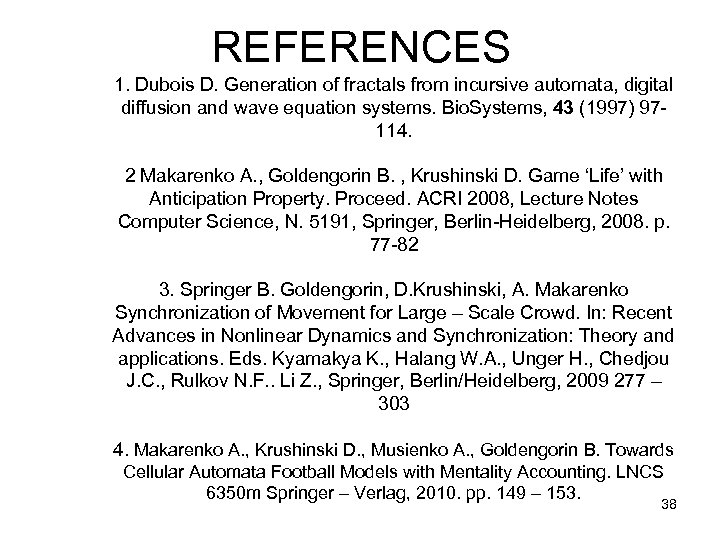 REFERENCES 1. Dubois D. Generation of fractals from incursive automata, digital diffusion and wave equation systems. Bio. Systems, 43 (1997) 97114. 2 Makarenko A. , Goldengorin B. , Krushinski D. Game ‘Life’ with Anticipation Property. Proceed. ACRI 2008, Lecture Notes Computer Science, N. 5191, Springer, Berlin-Heidelberg, 2008. p. 77 -82 3. Springer B. Goldengorin, D. Krushinski, A. Makarenko Synchronization of Movement for Large – Scale Crowd. In: Recent Advances in Nonlinear Dynamics and Synchronization: Theory and applications. Eds. Kyamakya K. , Halang W. A. , Unger H. , Chedjou J. C. , Rulkov N. F. . Li Z. , Springer, Berlin/Heidelberg, 2009 277 – 303 4. Makarenko A. , Krushinski D. , Musienko A. , Goldengorin B. Towards Cellular Automata Football Models with Mentality Accounting. LNCS 6350 m Springer – Verlag, 2010. pp. 149 – 153. 38
 Thanks for attention makalex@i. com. ua http: //ceeisd. org. ua http: //www. summerschool. ssa. org. ua 39