


 Скачать презентацию CE 203 Chapter 1 Economics in Engineering Decisions
49db2a096fb49281c103cf4010813883.ppt
- Количество слайдов: 31
 CE 203 Chapter 1 Economics in Engineering Decisions ISU CCEE
 ISU CCEE
 The Significance of Numbers l l l ISU CCEE 23 - 3 9/11 911
 Personal Finance l l ISU CCEE How much to save each month for an annual trip Is graduate school a good investment in my future? Will the loss in income be regained by additional earnings? Is a higher salary better than stock options? Can you believe an ad for a car of 15 y old and having done only 500 miles?
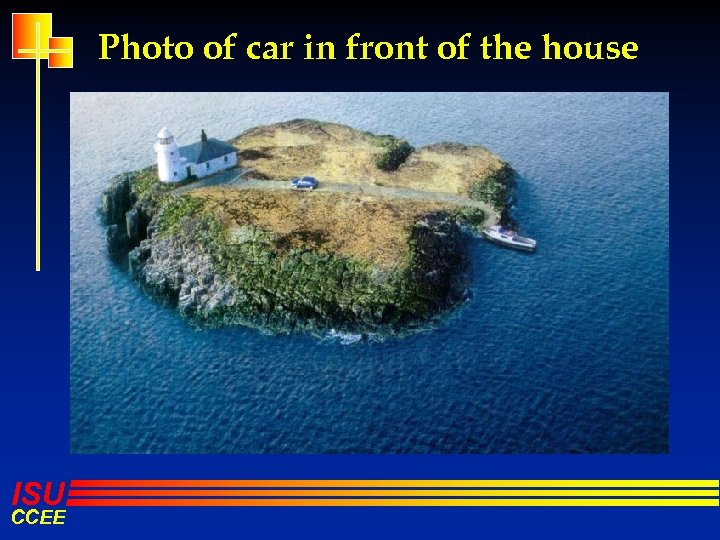 Photo of car in front of the house ISU CCEE
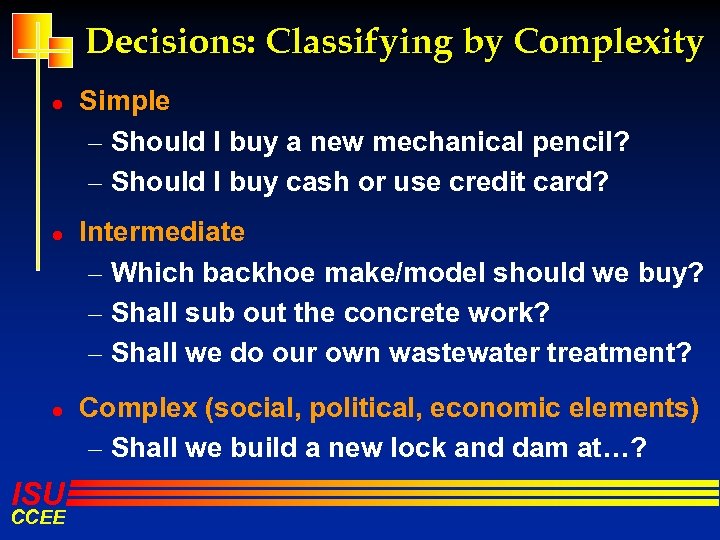 Decisions: Classifying by Complexity l l l ISU CCEE Simple – Should I buy a new mechanical pencil? – Should I buy cash or use credit card? Intermediate – Which backhoe make/model should we buy? – Shall sub out the concrete work? – Shall we do our own wastewater treatment? Complex (social, political, economic elements) – Shall we build a new lock and dam at…?
 Could the World Trade Center have withstood the 9/11 attacks? l l l ISU CCEE Towers did not collapse immediately Fires brought them down Better fire prevention measures? Sturdier fireproofing adds weight and cost How much should be spend on new high-rise buildings to prevent this?
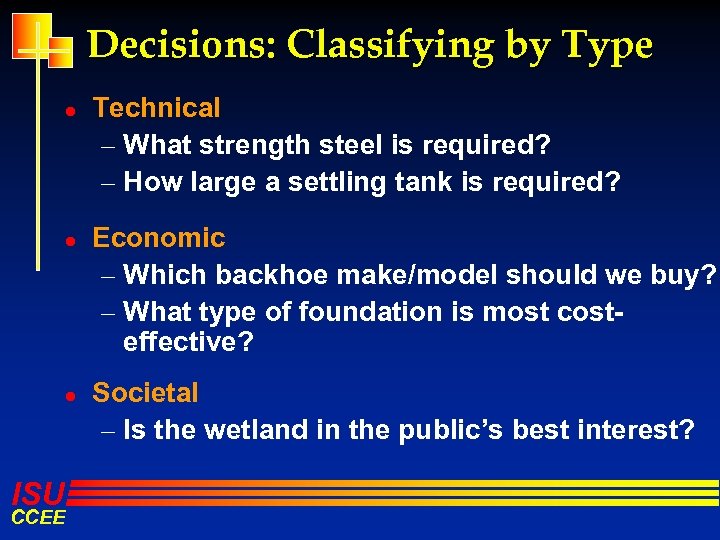 Decisions: Classifying by Type l l l ISU CCEE Technical – What strength steel is required? – How large a settling tank is required? Economic – Which backhoe make/model should we buy? – What type of foundation is most costeffective? Societal – Is the wetland in the public’s best interest?
 Problems emphasized in CE 203 Intermediate complexity, primarily economic – Important enough to require analysis – Difficult enough to require organized, rational approach – Decided largely or entirely on the basis of costs versus benefits (the single criterion of economics) ISU CCEE
 Problems beyond CE 203 Complex, a mixture of economic, social, and political elements – Economic aspects of such problems will be discussed in CE 203 – Classic economic theory assumes that the whole economy is in equilibrium (steady state) ISU CCEE
 Rational Decision Making (9 steps) (1) Recognize the problem (State A) – Is there a problem that is solvable? – How can the problem be defined? (2) Define the goal or objective (State B) – What do we want (or want to know)? – What change do we desire? ISU CCEE
 Rational Decision Making (9 steps) (3) Identify/develop alternatives – Use/modify existing solutions – Brainstorm (and other techniques) to expand solution space – Do nothing (does not imply no change) ISU CCEE
 Rational Decision Making (9 steps) (4) Assemble data – in 203, primarily economic – Costs » Materials and supplies » Direct labor » Overhead (facilities, support labor, utilities, etc. ) » Extra-market (e. g. , employee injuries) – Benefits » Sales (of products/services) » Extra-market (social, psychological, …) ISU CCEE
 Rational Decision Making (9 steps) (5) “Real life” definitions for costs and benefits may get complicated – Initial cost per unit? – “Life cycle cost” per unit? – Total cost of satisfying mission requirements? – “Spread the work around” cost (DOD work by congress)? – “Accomplish mission regardless” cost? ISU CCEE
 Rational Decision Making (9 steps) (6) Construct the model(s) – Physical (various kinds) – Virtual (3 -D computer model) – Mathematical (typical for economic and many other types of problems) (7) Analyze the alternatives – Data processed using model – Results stated in comparable way ISU CCEE
 Rational Decision Making (9 steps) (8) Select the best alternative – Select highest B: C alternative for economic problems – Include extra-market and “intangible” consequences at this point – Present at least two “well-engineered” solutions for complex problems – Be careful in eliminating alternatives ISU CCEE
 Rational Decision Making (9 steps) (9) Audit the process and the results – Were assumptions reasonable? – Were projections accurate? – Are changes in process called for? ISU CCEE
 CE 203 Chapter 2 EEA Engineering Costs ISU CCEE
 Costs: what to keep in mind l l ISU CCEE Actual costs may not be known – may mean they must be estimated Estimating may be difficult but is often critical – good analysis with bad data is worthless if not disastrous Costs tend to be underestimated (60% low to 30% high) Benefits tend to be overestimated (50% high to 20% low)
 Costs: some definitions l Fixed cost – Constant, unaffected by volume: rent, insurance, property taxes, interest on borrowed capital, variety of overhead costs l Variable cost – Changes as a function of output: direct utilities, direct labor, materials, sales commissions, shipping costs, etc. ISU CCEE
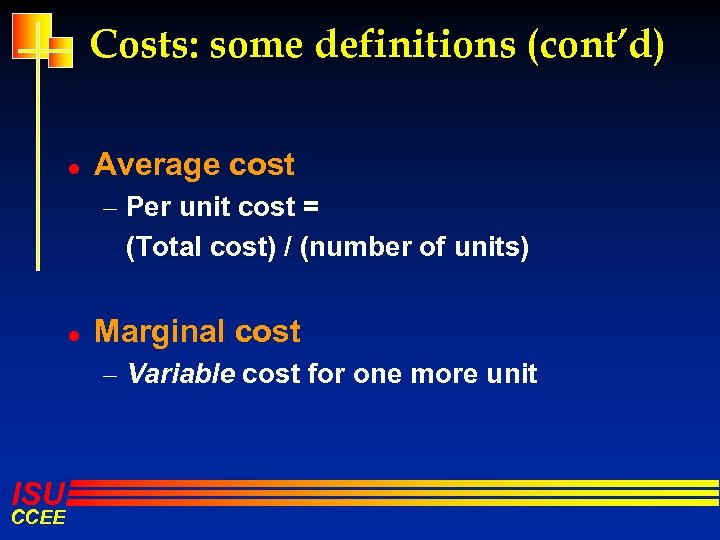 Costs: some definitions (cont’d) l Average cost – Per unit cost = (Total cost) / (number of units) l Marginal cost – Variable cost for one more unit ISU CCEE
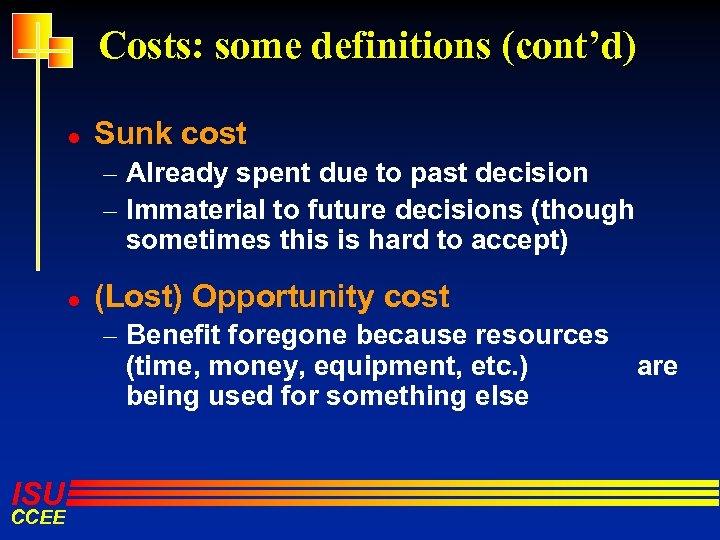 Costs: some definitions (cont’d) l Sunk cost – Already spent due to past decision – Immaterial to future decisions (though sometimes this is hard to accept) l (Lost) Opportunity cost – Benefit foregone because resources (time, money, equipment, etc. ) are being used for something else ISU CCEE
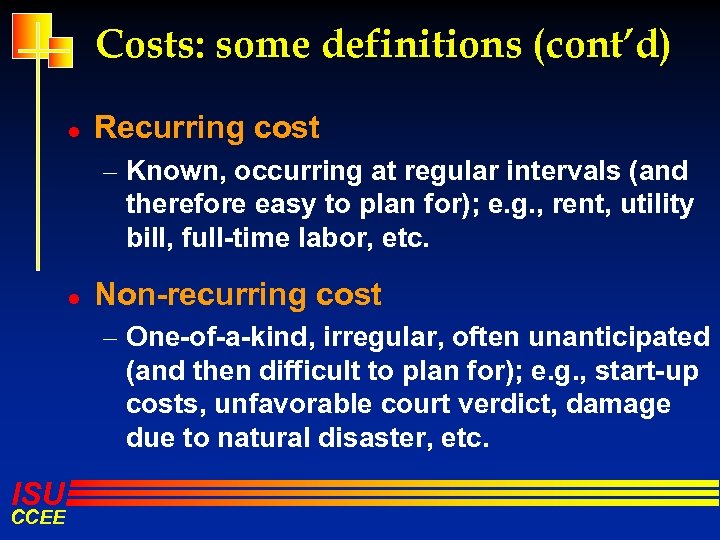 Costs: some definitions (cont’d) l Recurring cost – Known, occurring at regular intervals (and therefore easy to plan for); e. g. , rent, utility bill, full-time labor, etc. l Non-recurring cost – One-of-a-kind, irregular, often unanticipated (and then difficult to plan for); e. g. , start-up costs, unfavorable court verdict, damage due to natural disaster, etc. ISU CCEE
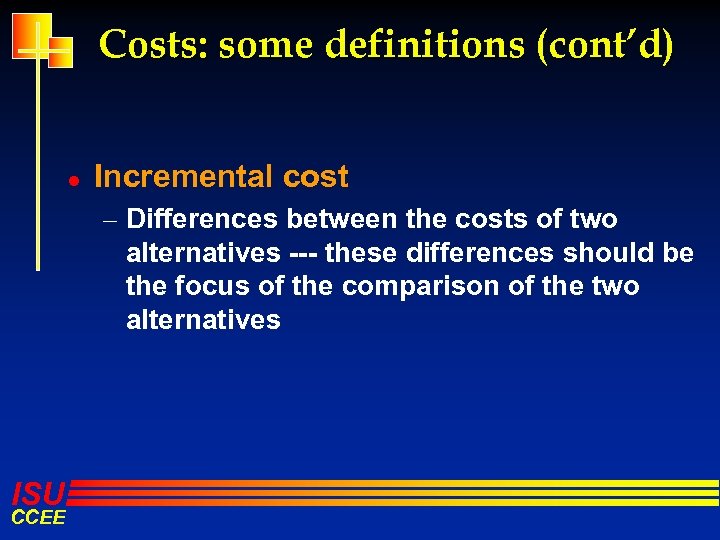 Costs: some definitions (cont’d) l Incremental cost – Differences between the costs of two alternatives --- these differences should be the focus of the comparison of the two alternatives ISU CCEE
 Costs: some definitions (cont’d) l Cash cost – Actual transfer of money (“out-of-pocket”) – Basis for engineering economic analysis l Book cost – No transfer of money (usually) – Common example is asset depreciation (“written off” by the accounting department) ISU CCEE
 Costs: some definitions (cont’d) l Life-cycle cost – Sum of all costs associated with the lifecycle of a product or service conception, design, production, testing and quality assurance, maintenance, effects on the environment, disposal, etc. ) – Two concepts: » The later the design change, the higher the cost » The earlier the design decision, the more later costs are “locked in. ” ISU CCEE
 Cash Flow Diagram (CFD) Graphic tool showing size, sign, and timing of cash flows – helpful for engineering economic analysis (very important initially) – Horizontal line indicating uniform units of time (days or months or years or …) – Each cash flow “in” (revenue or benefit) is shown as an arrow up (positive) from time line – Each cash flow “out” (cost) is shown as an arrow down (negative) from time line ISU CCEE
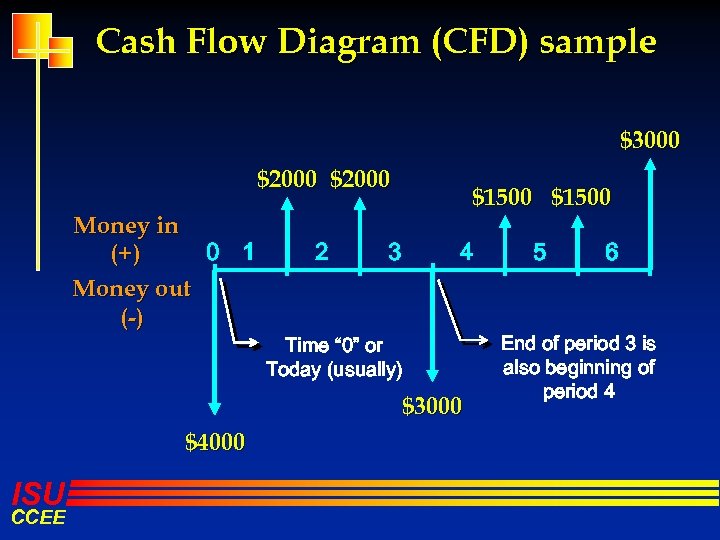 Cash Flow Diagram (CFD) sample $3000 $2000 Money in 0 1 (+) Money out (-) 2 $1500 3 4 Time “ 0” or Today (usually) $3000 $4000 ISU CCEE 5 6 End of period 3 is also beginning of period 4
 Some Cash Flow Categories l l l ISU CCEE First Cost – Costs of “getting started” Operations and Maintenance (O&M) – Annual expense (though not necessarily constant) for fuel, labor, minor repair, etc. ) Salvage value – Revenue received for sale or transfer of property at end of “project” or useful life
 Some Cash Flow Categories l l ISU CCEE Revenue – “Sale” price of goods/services Overhaul – Major repair or refurbishing during life of asset
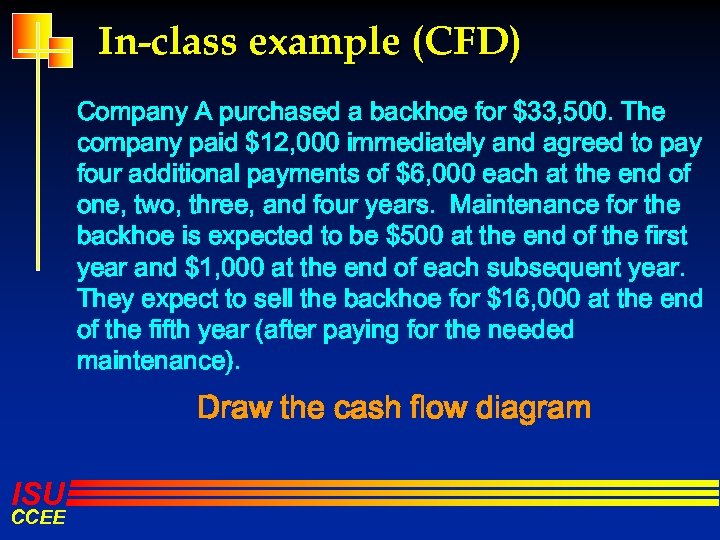 In-class example (CFD) Company A purchased a backhoe for $33, 500. The company paid $12, 000 immediately and agreed to pay four additional payments of $6, 000 each at the end of one, two, three, and four years. Maintenance for the backhoe is expected to be $500 at the end of the first year and $1, 000 at the end of each subsequent year. They expect to sell the backhoe for $16, 000 at the end of the fifth year (after paying for the needed maintenance). Draw the cash flow diagram ISU CCEE