


 Скачать презентацию CDF Run II Computing Workshop A user s perspective
bd21aa00913b30d396e0d980febfc4fb.ppt
- Количество слайдов: 20
 CDF Run II Computing Workshop. A user’s perspective Stefano Belforte INFN - Trieste Febryary 10, 1999 Stefano Belforte - INFN Trieste
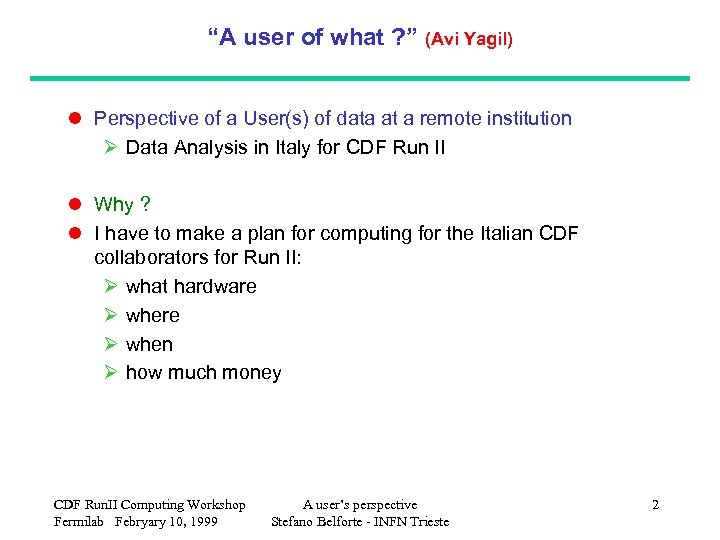 “A user of what ? ” (Avi Yagil) l Perspective of a User(s) of data at a remote institution Ø Data Analysis in Italy for CDF Run II l Why ? l I have to make a plan for computing for the Italian CDF collaborators for Run II: Ø what hardware Ø when Ø how much money CDF Run. II Computing Workshop Fermilab Febryary 10, 1999 A user’s perspective Stefano Belforte - INFN Trieste 2
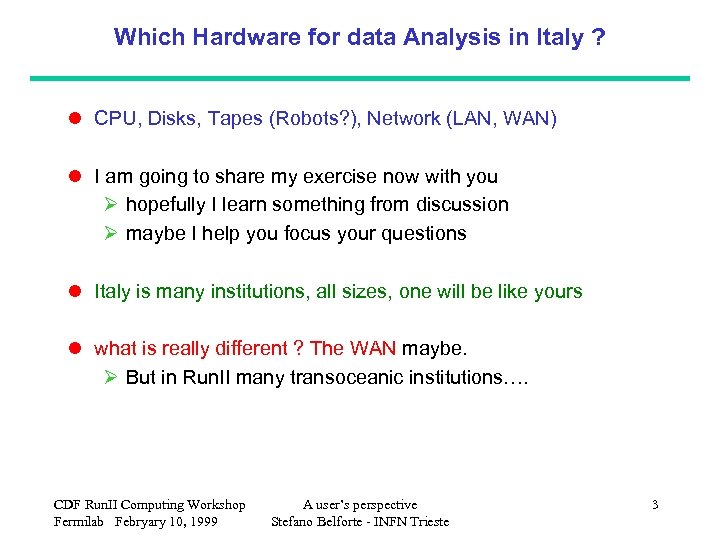 Which Hardware for data Analysis in Italy ? l CPU, Disks, Tapes (Robots? ), Network (LAN, WAN) l I am going to share my exercise now with you Ø hopefully I learn something from discussion Ø maybe I help you focus your questions l Italy is many institutions, all sizes, one will be like yours l what is really different ? The WAN maybe. Ø But in Run. II many transoceanic institutions…. CDF Run. II Computing Workshop Fermilab Febryary 10, 1999 A user’s perspective Stefano Belforte - INFN Trieste 3
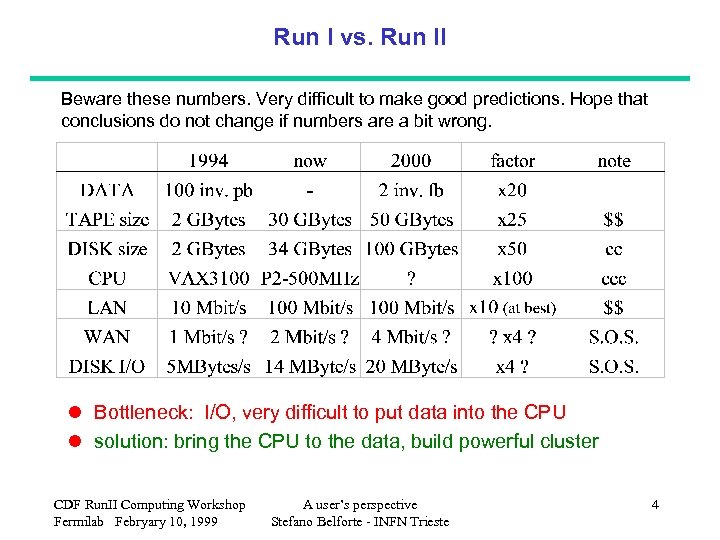 Run I vs. Run II Beware these numbers. Very difficult to make good predictions. Hope that conclusions do not change if numbers are a bit wrong. l Bottleneck: I/O, very difficult to put data into the CPU l solution: bring the CPU to the data, build powerful cluster CDF Run. II Computing Workshop Fermilab Febryary 10, 1999 A user’s perspective Stefano Belforte - INFN Trieste 4
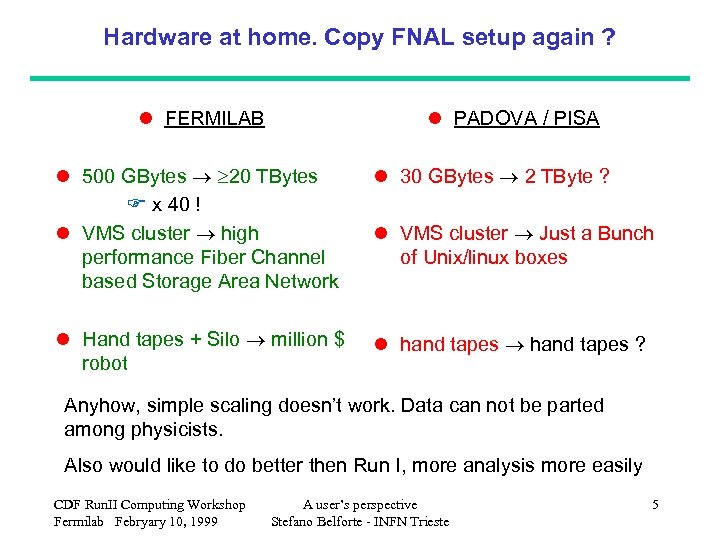 Hardware at home. Copy FNAL setup again ? l FERMILAB l PADOVA / PISA l 500 GBytes 20 TBytes F x 40 ! l VMS cluster high performance Fiber Channel based Storage Area Network l 30 GBytes 2 TByte ? l Hand tapes + Silo million $ robot l hand tapes ? l VMS cluster Just a Bunch of Unix/linux boxes Anyhow, simple scaling doesn’t work. Data can not be parted among physicists. Also would like to do better then Run I, more analysis more easily CDF Run. II Computing Workshop Fermilab Febryary 10, 1999 A user’s perspective Stefano Belforte - INFN Trieste 5
 How much data must I handle at home? l Liz’s Table, see : http: //www-cdf. fnal. gov/internal/upgrades/computing/ offline_minutes/buckley_vr_talk_jan_99. ps Page 5. CDF Run. II Computing Workshop Fermilab Febryary 10, 1999 A user’s perspective Stefano Belforte - INFN Trieste 6
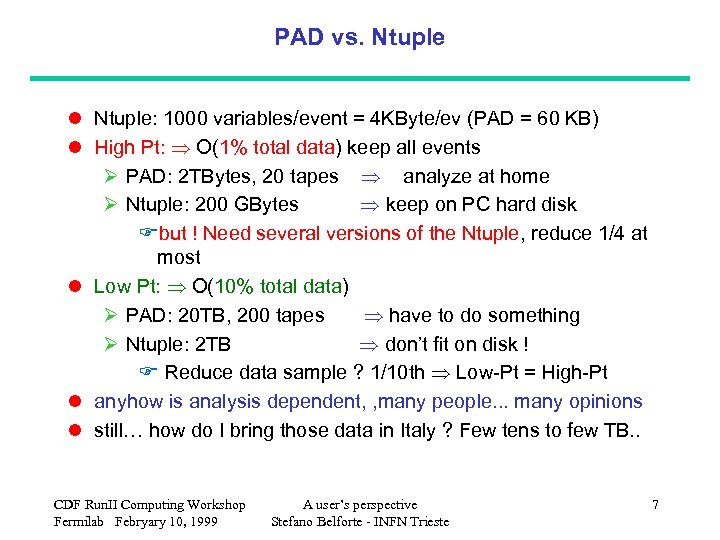 PAD vs. Ntuple l Ntuple: 1000 variables/event = 4 KByte/ev (PAD = 60 KB) l High Pt: O(1% total data) keep all events Ø PAD: 2 TBytes, 20 tapes analyze at home Ø Ntuple: 200 GBytes keep on PC hard disk Fbut ! Need several versions of the Ntuple, reduce 1/4 at most l Low Pt: O(10% total data) Ø PAD: 20 TB, 200 tapes have to do something Ø Ntuple: 2 TB don’t fit on disk ! F Reduce data sample ? 1/10 th Low-Pt = High-Pt l anyhow is analysis dependent, , many people. . . many opinions l still… how do I bring those data in Italy ? Few tens to few TB. . CDF Run. II Computing Workshop Fermilab Febryary 10, 1999 A user’s perspective Stefano Belforte - INFN Trieste 7
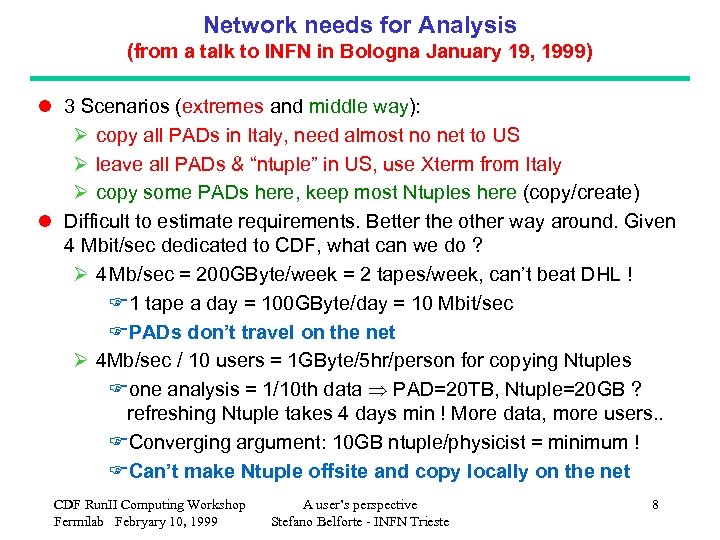 Network needs for Analysis (from a talk to INFN in Bologna January 19, 1999) l 3 Scenarios (extremes and middle way): Ø copy all PADs in Italy, need almost no net to US Ø leave all PADs & “ntuple” in US, use Xterm from Italy Ø copy some PADs here, keep most Ntuples here (copy/create) l Difficult to estimate requirements. Better the other way around. Given 4 Mbit/sec dedicated to CDF, what can we do ? Ø 4 Mb/sec = 200 GByte/week = 2 tapes/week, can’t beat DHL ! F 1 tape a day = 100 GByte/day = 10 Mbit/sec FPADs don’t travel on the net Ø 4 Mb/sec / 10 users = 1 GByte/5 hr/person for copying Ntuples Fone analysis = 1/10 th data PAD=20 TB, Ntuple=20 GB ? refreshing Ntuple takes 4 days min ! More data, more users. . FConverging argument: 10 GB ntuple/physicist = minimum ! FCan’t make Ntuple offsite and copy locally on the net CDF Run. II Computing Workshop Fermilab Febryary 10, 1999 A user’s perspective Stefano Belforte - INFN Trieste 8
 What goes out of FNAL ? l PADs don’t travel on the net l Ntuples don’t travel on the net l what do I do ? CDF Run. II Computing Workshop Fermilab Febryary 10, 1999 A user’s perspective Stefano Belforte - INFN Trieste 9
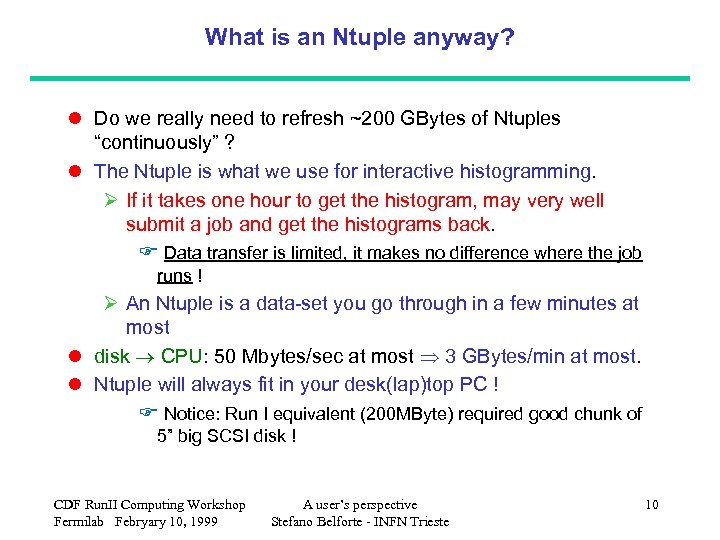 What is an Ntuple anyway? l Do we really need to refresh ~200 GBytes of Ntuples “continuously” ? l The Ntuple is what we use for interactive histogramming. Ø If it takes one hour to get the histogram, may very well submit a job and get the histograms back. F Data transfer is limited, it makes no difference where the job runs ! Ø An Ntuple is a data-set you go through in a few minutes at most l disk CPU: 50 Mbytes/sec at most 3 GBytes/min at most. l Ntuple will always fit in your desk(lap)top PC ! F Notice: Run I equivalent (200 MByte) required good chunk of 5” big SCSI disk ! CDF Run. II Computing Workshop Fermilab Febryary 10, 1999 A user’s perspective Stefano Belforte - INFN Trieste 10
 Disk to CPU l standard desktop PC vs. Powerserver CDF Run. II Computing Workshop Fermilab Febryary 10, 1999 A user’s perspective Stefano Belforte - INFN Trieste 11
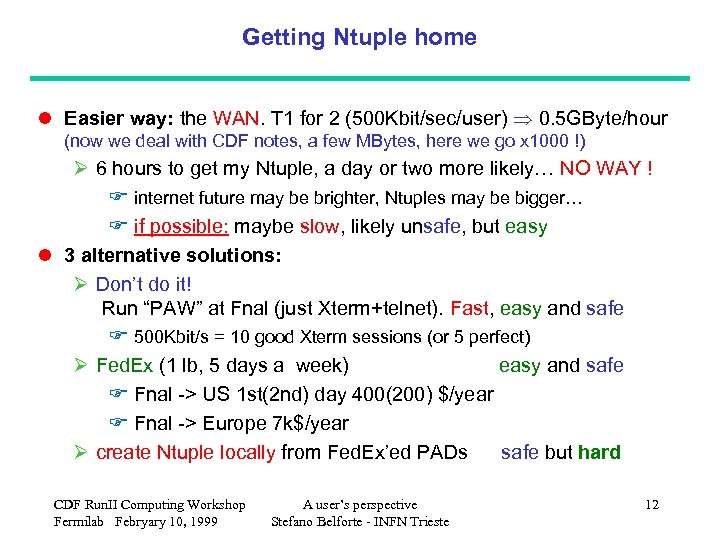 Getting Ntuple home l Easier way: the WAN. T 1 for 2 (500 Kbit/sec/user) 0. 5 GByte/hour (now we deal with CDF notes, a few MBytes, here we go x 1000 !) Ø 6 hours to get my Ntuple, a day or two more likely… NO WAY ! F internet future may be brighter, Ntuples may be bigger… F if possible: maybe slow, likely unsafe, but easy l 3 alternative solutions: Ø Don’t do it! Run “PAW” at Fnal (just Xterm+telnet). Fast, easy and safe F 500 Kbit/s = 10 good Xterm sessions (or 5 perfect) Ø Fed. Ex (1 lb, 5 days a week) easy and safe F Fnal -> US 1 st(2 nd) day 400(200) $/year F Fnal -> Europe 7 k$/year Ø create Ntuple locally from Fed. Ex’ed PADs safe but hard CDF Run. II Computing Workshop Fermilab Febryary 10, 1999 A user’s perspective Stefano Belforte - INFN Trieste 12
 Data Analysis in Pisa: The Final Answer (from a talk to INFN in Pisa May 12, 1998) l We will have to try, can’t pick the right approach before collaboration has finalized data handling and distribution tools, and analysis topics have been pinpointed l We will try everything, user pressure will drive l Needs will be dominated by physics output (maybe we find SUSY in 3 lepton samples and everybody looks at this small data set…) l We will exploit local computing as much as possible to reduce network load (likely bottleneck, as it always has been) l Still will need to access FNAL PADs to produce data sets to copy to Pisa. If network is no good will use tapes (expensive though!). But we desperately need guaranteed bandwidth for interactive work l If can not log in FNAL, no way to do most analysis here, only use “dead” data sets: no express data, no hot topics, just late sidelines… the good old way: take the plane and go to FNAL. CDF Run. II Computing Workshop Fermilab Febryary 10, 1999 A user’s perspective Stefano Belforte - INFN Trieste 13
 Dealing with PADs at home l Easily 1~5 TB, what to do ? Ø All on disk ? 20 to 100 disks… and no VMS cluster. . . Ø Multi CPU Server+RAID ? F Small SUN ? Or Big PC ? Ø PC farm (our small Level 3? ) ? LAN ! Ø Tape stacker ? 1~2 TB only? A couple of drive ? So slow ! Ø Taking shift at tape mounting ? 5 PCs, 10 drives, 50 tapes… but… will beat the robot ? Ø Power server at FCC ? l Up to 500 GB: all on disk. 2 ~ 3 PC’s working together. F LAN, LAN ! l Morale: the less you need it, the better it is. CDF Run. II Computing Workshop Fermilab Febryary 10, 1999 A user’s perspective Stefano Belforte - INFN Trieste 14
 Where to put a Power Unix Server with 5 TB disk ? l See e. g. : http: //www-cdf. fnal. gov/upgrades/cdfdh/ doc/hardware/hard_arch. ps a. k. a. cdfsga: /cdf/pub/cdf 4707_r 2 dh_hard_arch. ps Figure 3 CDF Run. II Computing Workshop Fermilab Febryary 10, 1999 A user’s perspective Stefano Belforte - INFN Trieste 15
 Tapes l Anyhow will need tapes for more then import to disk Ø PADs, simulation, Monte. Carlo, … l Will need to run analysis jobs from tape, just like at FNAL l But in Run II all tape data must be spooled to disk first l spool space: 100 GBytes each (one full tape) ? Ø Not likely Ø Better spool 10 GBytes a time Ø Better be a free parameter CDF Run. II Computing Workshop Fermilab Febryary 10, 1999 A user’s perspective Stefano Belforte - INFN Trieste 16
 Summary l l l need Fed. Ex need to run at FNAL: low latency WAN need flexible software at home need good LAN at home need flexible expandable hardware at home CDF Run. II Computing Workshop Fermilab Febryary 10, 1999 A user’s perspective Stefano Belforte - INFN Trieste 17
 Conclusions l recommendation to INFN l recommendations (requests) to managers CDF Run. II Computing Workshop Fermilab Febryary 10, 1999 A user’s perspective Stefano Belforte - INFN Trieste 18
 To my colleagues l buy “nothing” now l buy little (few PC’s, few tapes, little disk) next year, add disks as needed (JIT !) l get the best LAN and WAN you can l try to do the most at FNAL, ship tapes every day if need be, put CPU and or disks in FCC if needed l see how it goes, see where the market goes l be prepared to handle few TB in 2001/2 F get a computer room ready F don’t know which hardware will be best, but likely it will not fit on your desktops CDF Run. II Computing Workshop Fermilab Febryary 10, 1999 A user’s perspective Stefano Belforte - INFN Trieste 19
 To the Offline Managers l l tapes, disks & CPU for everybody (lot’s of) friendly, low latency batch i/f from home (www ? ) fast, easy-to-use i/f from Robot to Fed. Ex help for simple linux system at home: Ø suggested/supported hardware configuration Ø easy to use/install software, adaptable to limited hardware setup Ø one example on-site OFF the LAN CDF Run. II Computing Workshop Fermilab Febryary 10, 1999 A user’s perspective Stefano Belforte - INFN Trieste 20