


 Скачать презентацию CDF 1 UC has long History with CDF
f61fa645c4b6f4878ea21cd92200f93d.ppt
- Количество слайдов: 68
 CDF 1. UC has long History with CDF - since before the beginning (Cronin)- design, construction (innovative trigger system), management, leadership, postdoc and student education; 2. Unique physics opportunity- have entered the Higgs sensitivity region, less material near beam pipe, low-mass region is where EWK precision data say the SM Higgs is (if it is- my bet is no). 3. Unique leverage (it’s 50 miles by car away, not so political, and we are already invested); 4. Consequently lots of bang per buck (BPB*). We have a chance make a big contribution. High risk, but high, influential, and satisfying payoff. * Sheldon- can we mutually make a BPB table? 3/16/2018 NSF Site Visit 1
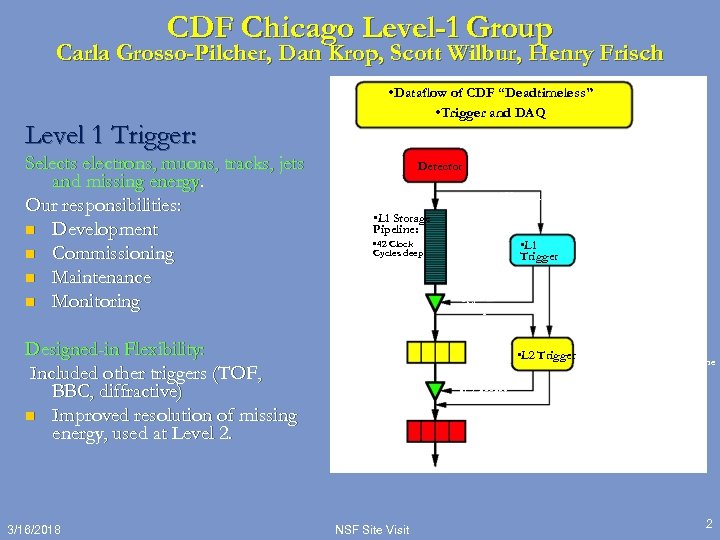 CDF Chicago Level-1 Group Carla Grosso-Pilcher, Dan Krop, Scott Wilbur, Henry Frisch • Dataflow of CDF “Deadtimeless” • Trigger and DAQ Level 1 Trigger: Selects electrons, muons, tracks, jets and missing energy. Our responsibilities: n Development n Commissioning n Maintenance n Monitoring Designed-in Flexibility: Included other triggers (TOF, BBC, diffractive) n Improved resolution of missing energy, used at Level 2. 3/16/2018 Detector • 7. 6 MHz Crossing Rate • 132 ns clock cycle • L 1 Storage Pipeline: • 42 Clock Cycles deep • L 1 Trigger • L 1 Accept • DAQ Buffers NSF Site Visit • 7. 6 MHz Synchronous pipeline • 5544 ns latency • <35 k. Hz Accept rate • Level 2: • L 2 Trigger • Asynchronous 2 stage pipeline • L 2 Buffers: • 4 Events • Level 1: • L 2 Accept • ~20µs latency • 800 Hz Accept rate • L 1 + L 2 Rejection: >2000: 1 2
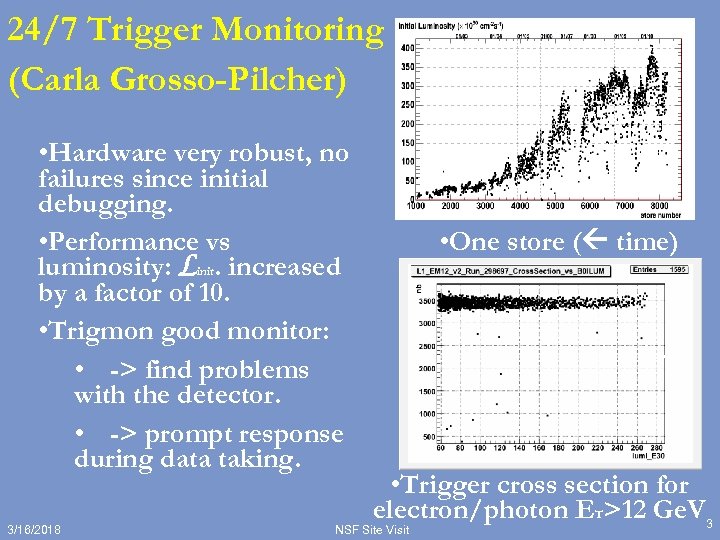 24/7 Trigger Monitoring (Carla Grosso-Pilcher) • Hardware very robust, no failures since initial debugging. • Performance vs luminosity: Linit. increased by a factor of 10. • Trigmon good monitor: • -> find problems with the detector. • -> prompt response during data taking. 3/16/2018 • One store ( time) • <- noise • Trigger cross section for electron/photon ET>12 Ge. V 3 NSF Site Visit
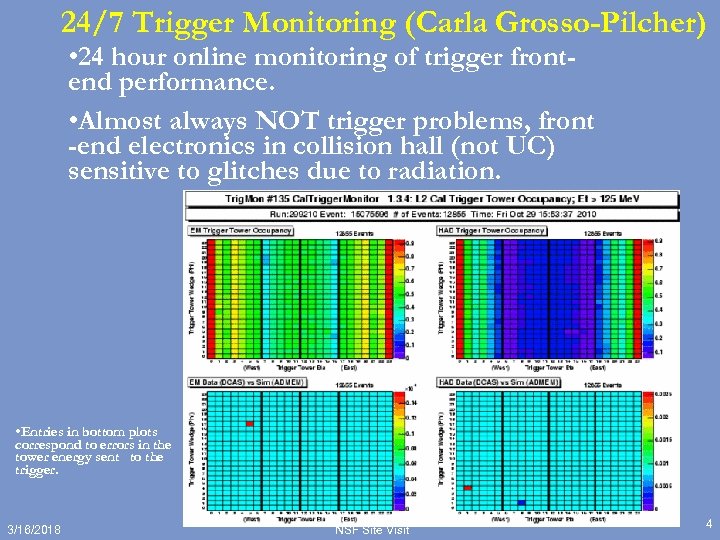 24/7 Trigger Monitoring (Carla Grosso-Pilcher) • 24 hour online monitoring of trigger frontend performance. • Almost always NOT trigger problems, front -end electronics in collision hall (not UC) sensitive to glitches due to radiation. • Entries in bottom plots correspond to errors in the tower energy sent to the trigger. 3/16/2018 NSF Site Visit 4
 n Trigger Upgrades (Dan and Carla) Commissioned new L 2 decision PC’s. Decreased algorithmic latency. n Expanded test-stand capabilities and improved checkout procedure. n Commissioned replacement boards. n Improved operator and expert documentation. n Identified and corrected system errors. n 3/16/2018 NSF Site Visit 5
 Analysis n Focus has been on three areas `surgical’ measurements of low mass states in EWK events (non-SM Higgs, e. g. ) n Events with gauge bosons and 3 rd generation fermions n Very h; gh-Pt W’s and Z’s (no longer competitive with LHC) n n Two on-going analyses and one just published: Same-sign and cross-generation multi-lepton signatures in W and Z events (`lepton-jets’)- Scott Wilbur’s thesis n 3 rd analysis of ttbar-gamma and lgmet n n Three Ph. D’s- all 3 superb, and very effective on CMS or ATLAS 3/16/2018 NSF Site Visit 6
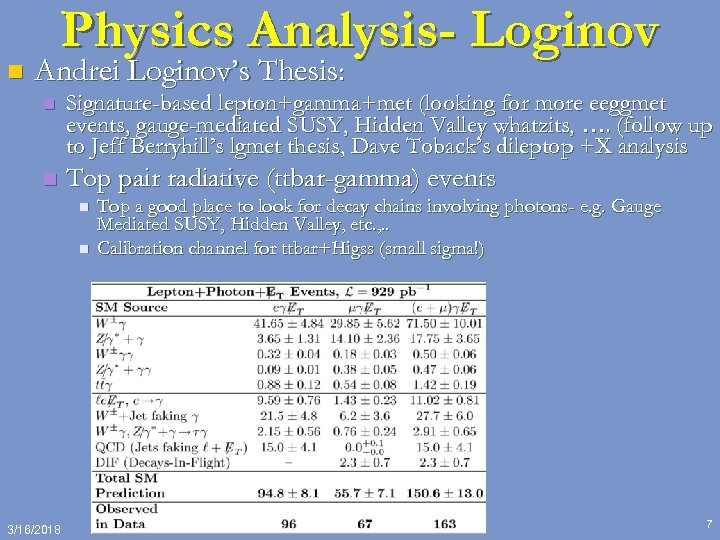 n Physics Analysis- Loginov Andrei Loginov’s Thesis: n Signature-based lepton+gamma+met (looking for more eeggmet events, gauge-mediated SUSY, Hidden Valley whatzits, …. (follow up to Jeff Berryhill’s lgmet thesis, Dave Toback’s dileptop +X analysis n Top pair radiative (ttbar-gamma) events n n 3/16/2018 Top a good place to look for decay chains involving photons- e. g. Gauge Mediated SUSY, Hidden Valley, etc. , . . Calibration channel for ttbar+Higss (small sigma!) NSF Site Visit 7
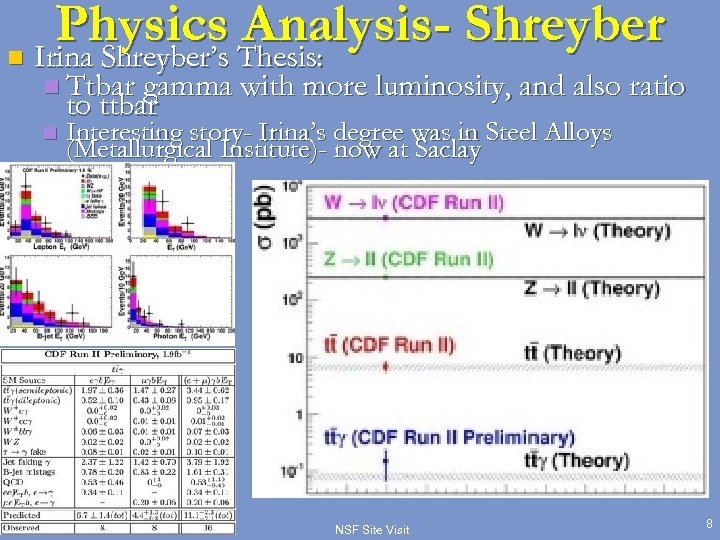 Physics Thesis: Analysis- Shreyber n Irina Shreyber’s n Ttbar gamma with more luminosity, and also ratio n 3/16/2018 to ttbar Interesting story- Irina’s degree was in Steel Alloys (Metallurgical Institute)- now at Saclay NSF Site Visit 8
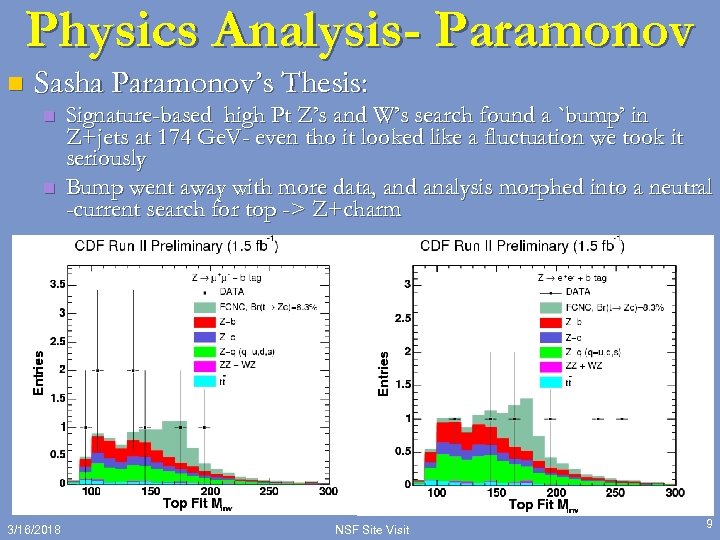 Physics Analysis- Paramonov n Sasha Paramonov’s Thesis: n n 3/16/2018 Signature-based high Pt Z’s and W’s search found a `bump’ in Z+jets at 174 Ge. V- even tho it looked like a fluctuation we took it seriously Bump went away with more data, and analysis morphed into a neutral -current search for top -> Z+charm NSF Site Visit 9
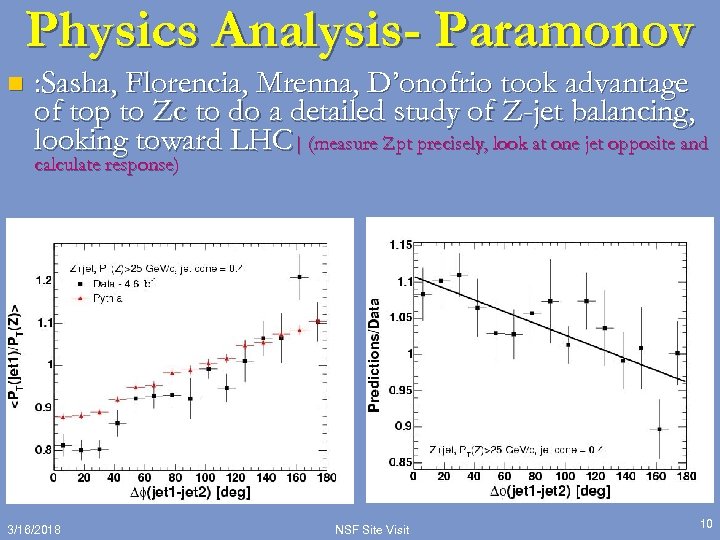 Physics Analysis- Paramonov n : Sasha, Florencia, Mrenna, D’onofrio took advantage of top to Zc to do a detailed study of Z-jet balancing, looking toward LHC| (measure Zpt precisely, look at one jet opposite and calculate response) 3/16/2018 NSF Site Visit 10
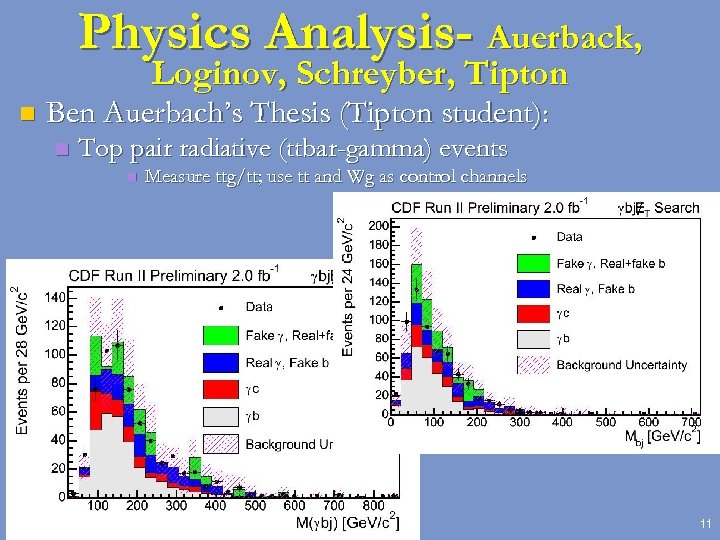 Physics Analysis- Auerback, Loginov, Schreyber, Tipton n Ben Auerbach’s Thesis (Tipton student): n Top pair radiative (ttbar-gamma) events n 3/16/2018 Measure ttg/tt; use tt and Wg as control channels NSF Site Visit 11
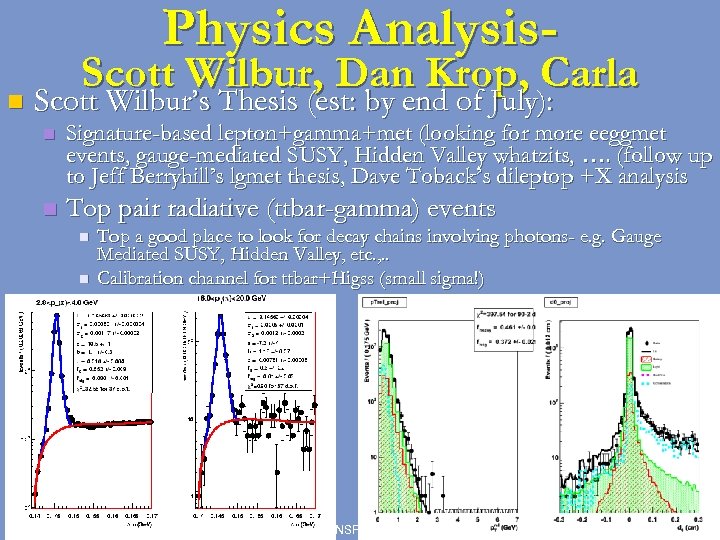 Physics Analysis- n Scott Wilbur, Dan Krop, Carla Scott Wilbur’s Thesis (est: by end of July): n Signature-based lepton+gamma+met (looking for more eeggmet events, gauge-mediated SUSY, Hidden Valley whatzits, …. (follow up to Jeff Berryhill’s lgmet thesis, Dave Toback’s dileptop +X analysis n Top pair radiative (ttbar-gamma) events n n 3/16/2018 Top a good place to look for decay chains involving photons- e. g. Gauge Mediated SUSY, Hidden Valley, etc. , . . Calibration channel for ttbar+Higss (small sigma!) NSF Site Visit 12
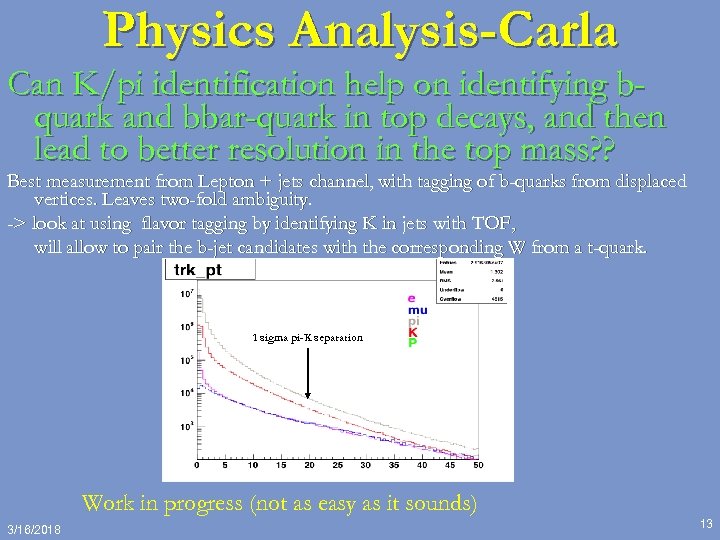 Physics Analysis-Carla Can K/pi identification help on identifying bquark and bbar-quark in top decays, and then lead to better resolution in the top mass? ? Best measurement from Lepton + jets channel, with tagging of b-quarks from displaced vertices. Leaves two-fold ambiguity. -> look at using flavor tagging by identifying K in jets with TOF, will allow to pair the b-jet candidates with the corresponding W from a t-quark. 1 sigma pi-K separation Work in progress (not as easy as it sounds) 3/16/2018 13
 EDUCATION Opportunity to Educate Hands-On: then move to LHC analysis Students: Redlinger (first reconstruction of masses from tracks in jets at Tevatron), Kopp (first precise W/Z ratio, W width), Saltzberg (first precise W mass and method), Romano (first top dileptons), Toback, Berryhill (first signature-based searches), Loginov, Shreyber (first measurement of ttbar-gamma), . . (also Tsai, Snider, Derwent, Wahl, Paramonov-plus Incandela and Somalwar (monpoles)- all handson types) n Postdocs- Myron Campbell, Tony Liss, Dan Amidei, Claudio Campagnari, Sarah Eno, Greg Sullivan, Peter Wilson, Ray Culbertson, Bruce Knutson, Un-Ki Yang, Maria Spiropoulu, n 3/16/2018 NSF Site Visit 14
 Bang For Buck- Group (Carla) plays a key role in 24 -7 monitoring of the trigger and detector (quote JJ) n 2 of last 3 students (Loginov, Shreyber) were not paid by NSF-Really good Russian student applying in fall (have had 3 in a row- this would be 4 th). n Quality of post-docs has been high- expect to continue to be attractive to the best (we got Wetstein: (unpaid by NSF) joint with ANL on Psec) n Adding Rosner (we hope)- like having 2 more gears (tell Z story of Run 0 over a beer) n 3/16/2018 NSF Site Visit 15
 Next 3 years – if no Run III Difficult time to knows the future of CDF right now- we would like to plan for both cases n Base Plan (assume at least one more year of datafollowed by 2 of analysis) (as orig. submitted): n Carla, Frisch, , 1 postdoc, 2 students, 1 undergrad n Finish present analyses, possibly one more if find something useful-publish (takes at least 1 year); n Continue detector monitoring, fixing as long as needed n n 3/16/2018 Plan would be to focus on the SM light Higgs and keep an (a priori) eye open for non-SM Higgs NSF Site Visit 16
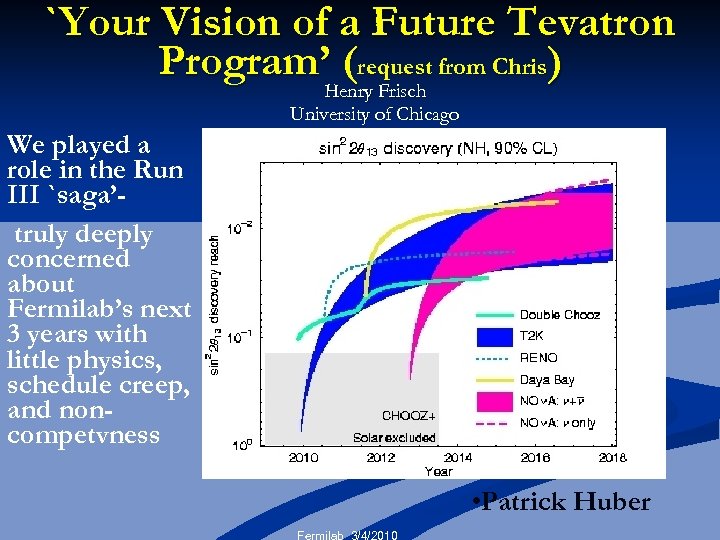 `Your Vision of a Future Tevatron Program’ (request from Chris) Henry Frisch University of Chicago We played a role in the Run III `saga’truly deeply concerned about Fermilab’s next 3 years with little physics, schedule creep, and noncompetvness • Patrick Huber Fermilab 3/4/2010
 CDF Group Budget as orig. proposed (pre Run III possibility) Senior Personnel (Carla + 2 mo of Henry) n Postdoc n Graduate Students n Secretarial n Local Business Center n Domestic Travel n Foreign Travel n Materials and Supplies n Permanent Equipment n Tuition n Total with all lunatic fringe etc n 105, 383 53, 000 92, 275 5, 799 1, 365 6, 000 0 15, 000 25, 000 46, 388 546, 971 18
 Next 3 years- Run 3 If Run III goes ahead will there be additional NSF support in addition to Do. E support? (HEPAP and P 5 represent both); n Run III Plan (assume 3 more years of datafollowed by 1 of analysis, addl. univ. support): n Carla, Frisch, Rosner, 2 postdocs, 2 students, 1 undergrad, 2 visitors n Work on energy-flow jet resolution for SM H->bbar exclusion across the whole mass range- need critical mass (Kuhlmann, others- many years of work so far); n Continue detector monitoring, fixing as long as needed n 3/16/2018 NSF Site Visit 19
 The Development of Large-Area Thin Planar Psec Photodetectors Henry Frisch 3/16/2018 NSF Site Visit 20
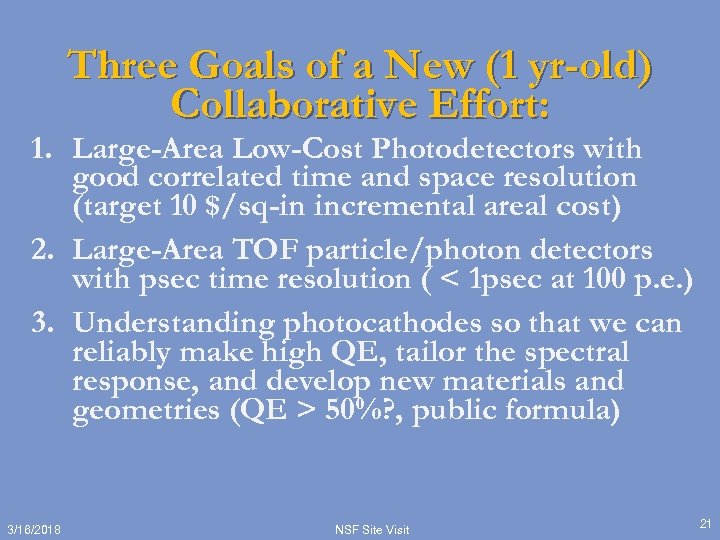 Three Goals of a New (1 yr-old) Collaborative Effort: 1. Large-Area Low-Cost Photodetectors with good correlated time and space resolution (target 10 $/sq-in incremental areal cost) 2. Large-Area TOF particle/photon detectors with psec time resolution ( < 1 psec at 100 p. e. ) 3. Understanding photocathodes so that we can reliably make high QE, tailor the spectral response, and develop new materials and geometries (QE > 50%? , public formula) 3/16/2018 NSF Site Visit 21
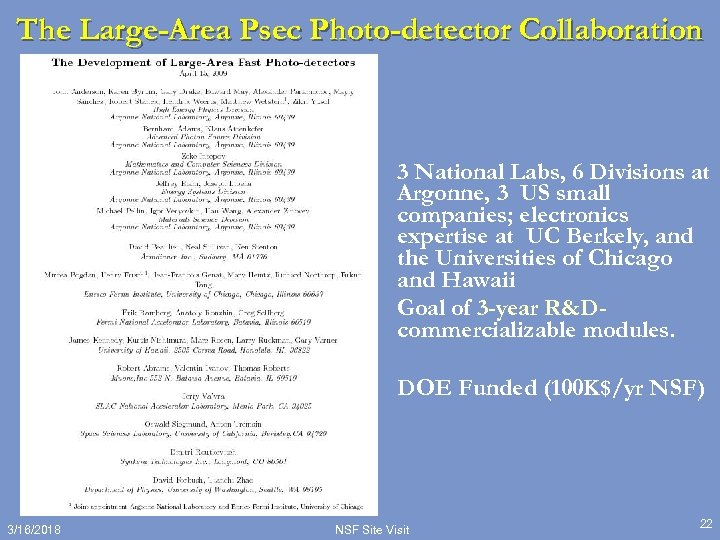 The Large-Area Psec Photo-detector Collaboration 3 National Labs, 6 Divisions at Argonne, 3 US small companies; electronics expertise at UC Berkely, and the Universities of Chicago and Hawaii Goal of 3 -year R&Dcommercializable modules. DOE Funded (100 K$/yr NSF) 3/16/2018 NSF Site Visit 22
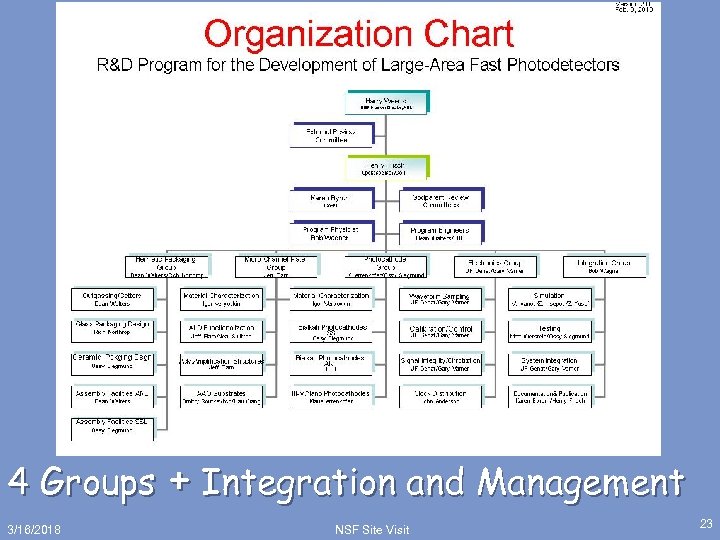 4 Groups 3/16/2018 + Integration and Management NSF Site Visit 23
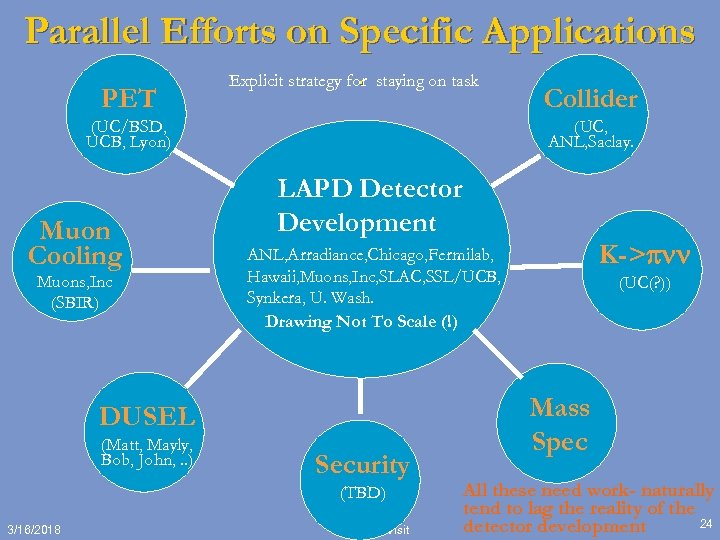 Parallel Efforts on Specific Applications PET . Explicit strategy for staying on task (UC/BSD, UCB, Lyon) Muon Cooling Muons, Inc (SBIR) (UC, ANL, Saclay. LAPD Detector Development Security (TBD) 3/16/2018 K->pnn ANL, Arradiance, Chicago, Fermilab, Hawaii, Muons, Inc, SLAC, SSL/UCB, Synkera, U. Wash. Drawing Not To Scale (!) DUSEL (Matt, Mayly, Bob, John, . . ) Collider NSF Site Visit (UC(? )) Mass Spec All these need work- naturally tend to lag the reality of the 24 detector development
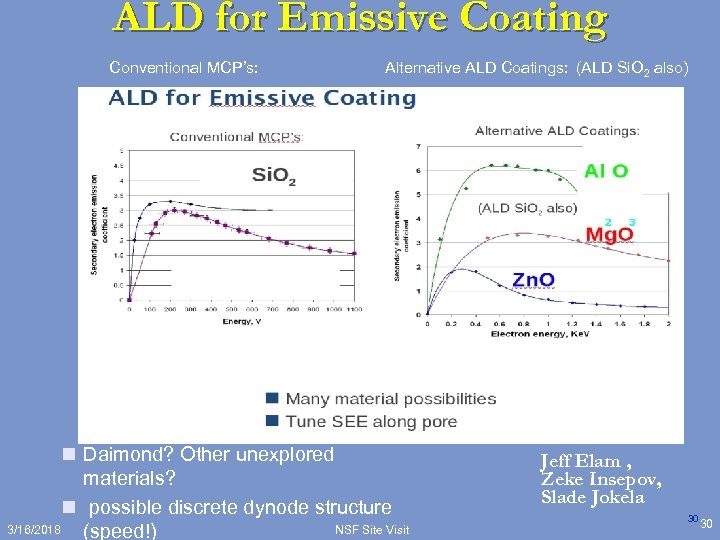
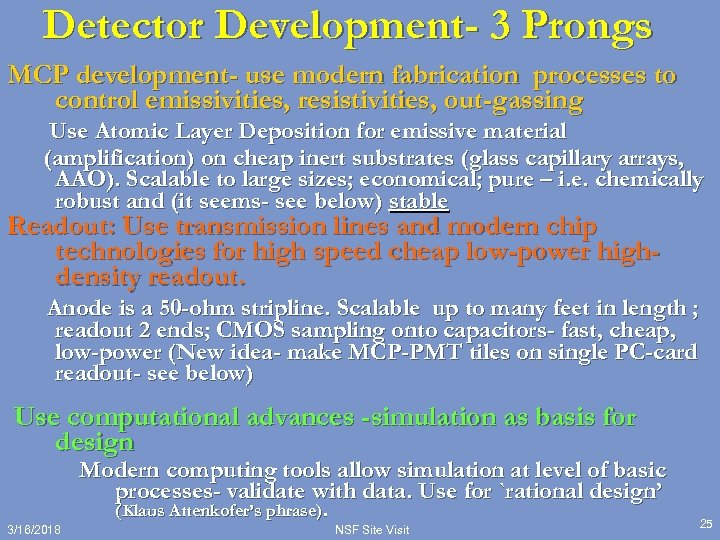 Detector Development- 3 Prongs MCP development- use modern fabrication processes to control emissivities, resistivities, out-gassing Use Atomic Layer Deposition for emissive material (amplification) on cheap inert substrates (glass capillary arrays, AAO). Scalable to large sizes; economical; pure – i. e. chemically robust and (it seems- see below) stable Readout: Use transmission lines and modern chip technologies for high speed cheap low-power highdensity readout. Anode is a 50 -ohm stripline. Scalable up to many feet in length ; readout 2 ends; CMOS sampling onto capacitors- fast, cheap, low-power (New idea- make MCP-PMT tiles on single PC-card readout- see below) Use computational advances -simulation as basis for design Modern computing tools allow simulation at level of basic processes- validate with data. Use for `rational design’ (Klaus Attenkofer’s phrase). 3/16/2018 NSF Site Visit 25
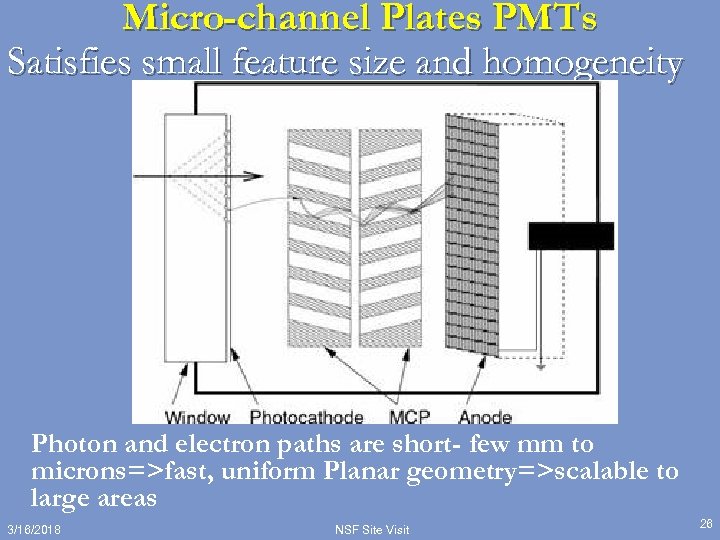 Micro-channel Plates PMTs Satisfies small feature size and homogeneity Photon and electron paths are short- few mm to microns=>fast, uniform Planar geometry=>scalable to large areas 3/16/2018 NSF Site Visit 26
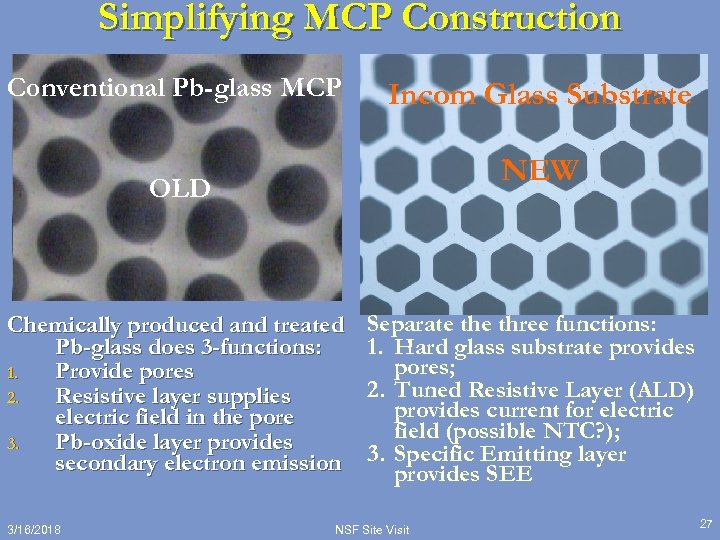 Simplifying MCP Construction Conventional Pb-glass MCP Incom Glass Substrate NEW OLD Chemically produced and treated Pb-glass does 3 -functions: 1. Provide pores 2. Resistive layer supplies electric field in the pore 3. Pb-oxide layer provides secondary electron emission 3/16/2018 Separate three functions: 1. Hard glass substrate provides pores; 2. Tuned Resistive Layer (ALD) provides current for electric field (possible NTC? ); 3. Specific Emitting layer provides SEE NSF Site Visit 27
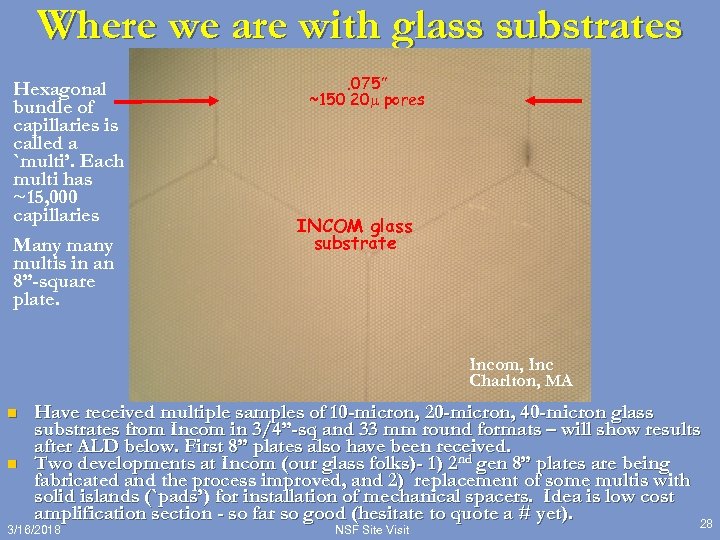 Where we are with glass substrates Hexagonal bundle of capillaries is called a `multi’. Each multi has ~15, 000 capillaries Many multis in an 8”-square plate. . 075” ~150 20 m pores INCOM glass substrate Incom, Inc Charlton, MA n n Have received multiple samples of 10 -micron, 20 -micron, 40 -micron glass substrates from Incom in 3/4”-sq and 33 mm round formats – will show results after ALD below. First 8” plates also have been received. Two developments at Incom (our glass folks)- 1) 2 nd gen 8” plates are being fabricated and the process improved, and 2) replacement of some multis with solid islands (`pads’) for installation of mechanical spacers. Idea is low cost amplification section - so far so good (hesitate to quote a # yet). 28 3/16/2018 NSF Site Visit
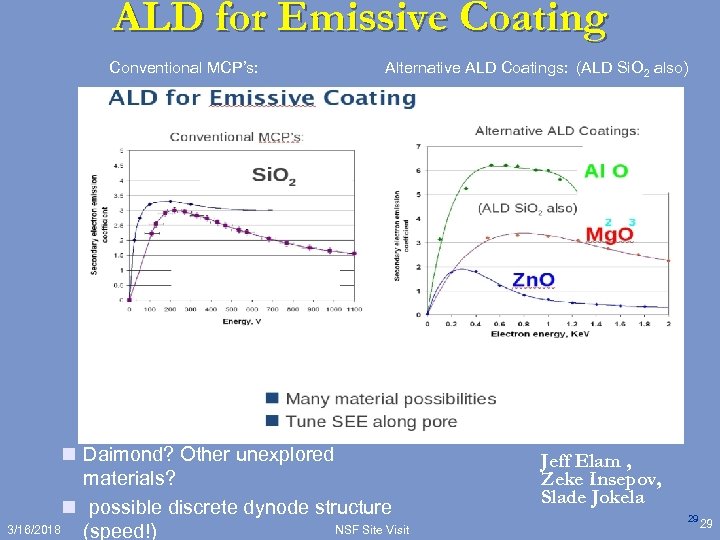 ALD for Emissive Coating Conventional MCP’s: Alternative ALD Coatings: (ALD Si. O 2 also) n Daimond? Other unexplored materials? n possible discrete dynode structure 3/16/2018 NSF Site Visit (speed!) Jeff Elam , Zeke Insepov, Slade Jokela 29 29
 ALD for Emissive Coating Conventional MCP’s: Alternative ALD Coatings: (ALD Si. O 2 also) n Daimond? Other unexplored materials? n possible discrete dynode structure 3/16/2018 NSF Site Visit (speed!) Jeff Elam , Zeke Insepov, Slade Jokela 30 30
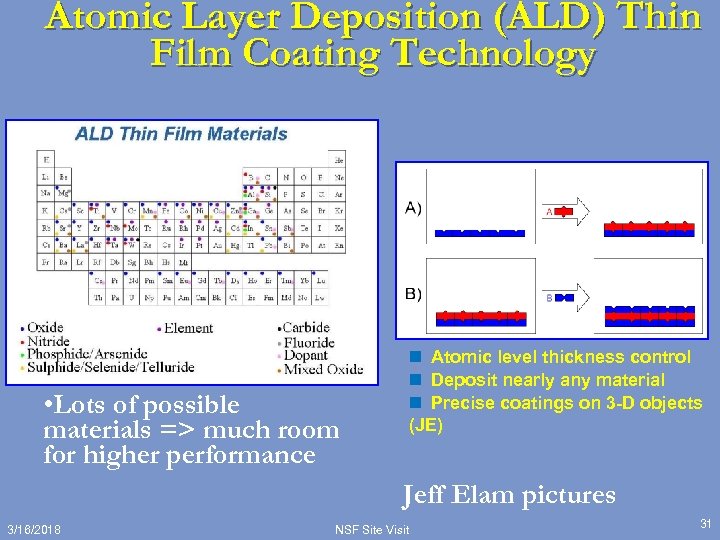 Atomic Layer Deposition (ALD) Thin Film Coating Technology n Atomic level thickness control n Deposit nearly any material n Precise coatings on 3 -D objects (JE) • Lots of possible materials => much room for higher performance Jeff Elam pictures 3/16/2018 NSF Site Visit 31
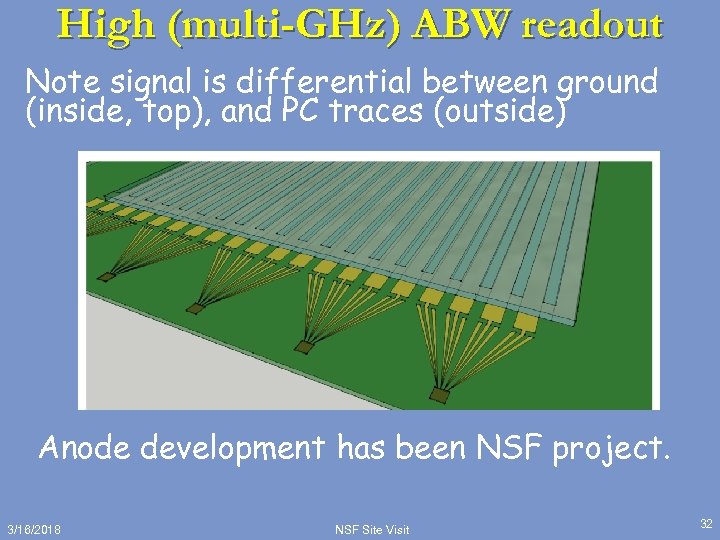 High (multi-GHz) ABW readout Note signal is differential between ground (inside, top), and PC traces (outside) Anode development has been NSF project. 3/16/2018 NSF Site Visit 32
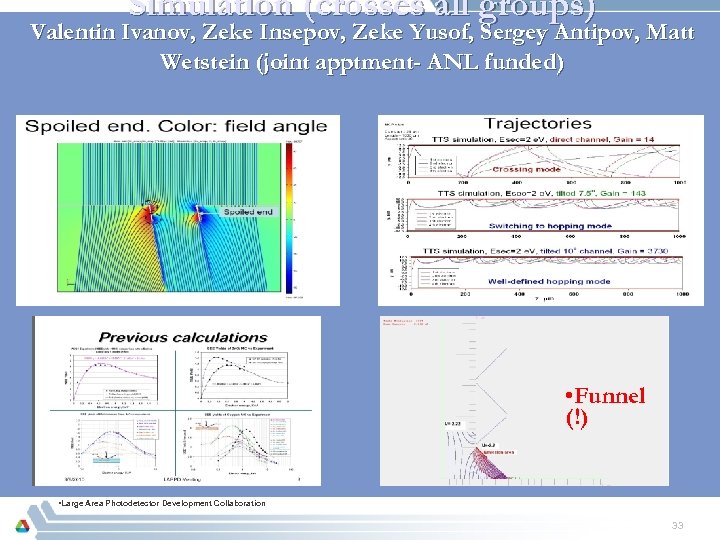 Simulation (crosses all groups) Valentin Ivanov, Zeke Insepov, Zeke Yusof, Sergey Antipov, Matt Wetstein (joint apptment- ANL funded) • 10μm pore • 40μm spacing • Funnel (!) • Large Area Photodetector Development Collaboration 3/16/2018 NSF Site Visit 33 33
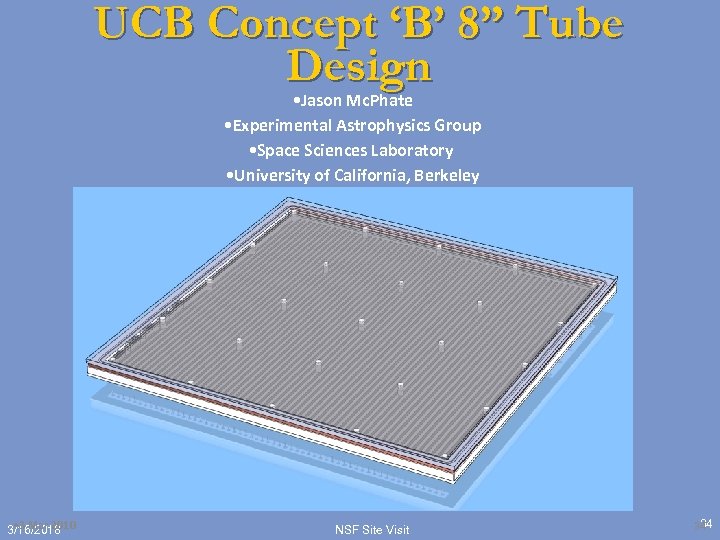 UCB Concept ‘B’ 8” Tube Design • Jason Mc. Phate • Experimental Astrophysics Group • Space Sciences Laboratory • University of California, Berkeley • 3 Mar 2010 3/16/2018 NSF Site Visit 34 34
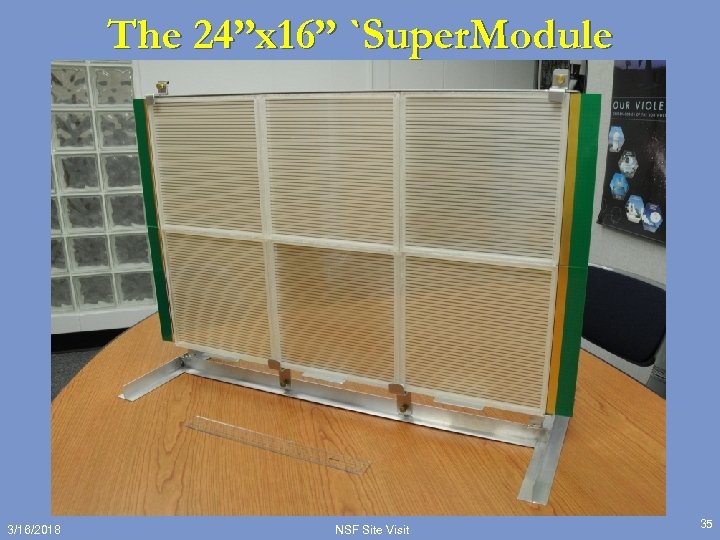 The 24”x 16” `Super. Module 3/16/2018 NSF Site Visit 35
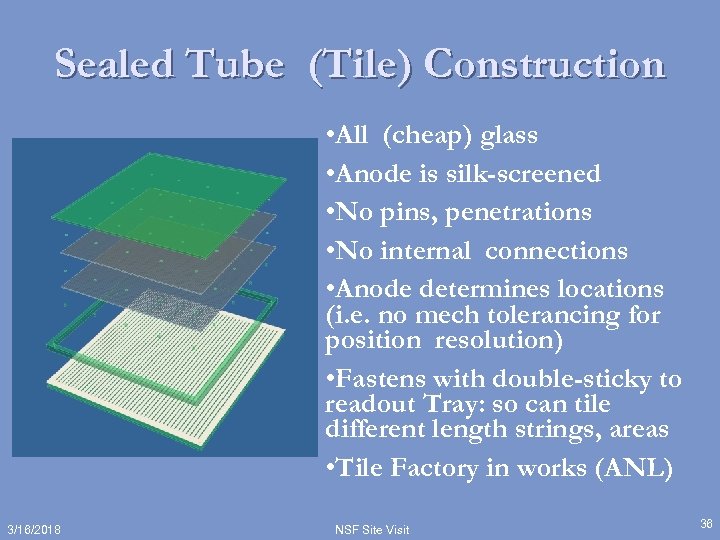 Sealed Tube (Tile) Construction • All (cheap) glass • Anode is silk-screened • No pins, penetrations • No internal connections • Anode determines locations (i. e. no mech tolerancing for position resolution) • Fastens with double-sticky to readout Tray: so can tile different length strings, areas • Tile Factory in works (ANL) 3/16/2018 NSF Site Visit 36
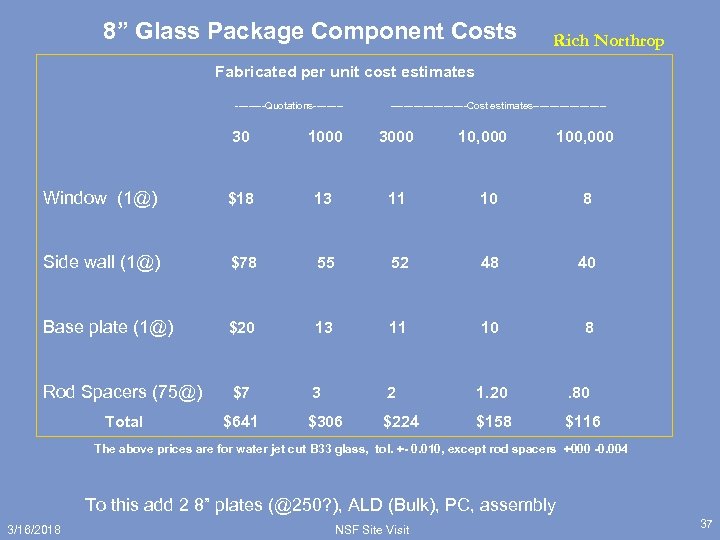 8” Glass Package Component Costs Rich Northrop Fabricated per unit cost estimates -----Quotations------------Cost estimates----------- 30 1000 3000 10, 000 100, 000 Window (1@) $18 13 11 10 8 Side wall (1@) $78 55 52 48 40 Base plate (1@) $20 13 11 10 8 Rod Spacers (75@) $7 3 2 1. 20 . 80 Total $641 $306 $224 $158 $116 The above prices are for water jet cut B 33 glass, tol. +- 0. 010, except rod spacers +000 -0. 004 To this add 2 8” plates (@250? ), ALD (Bulk), PC, assembly 3/16/2018 NSF Site Visit 37
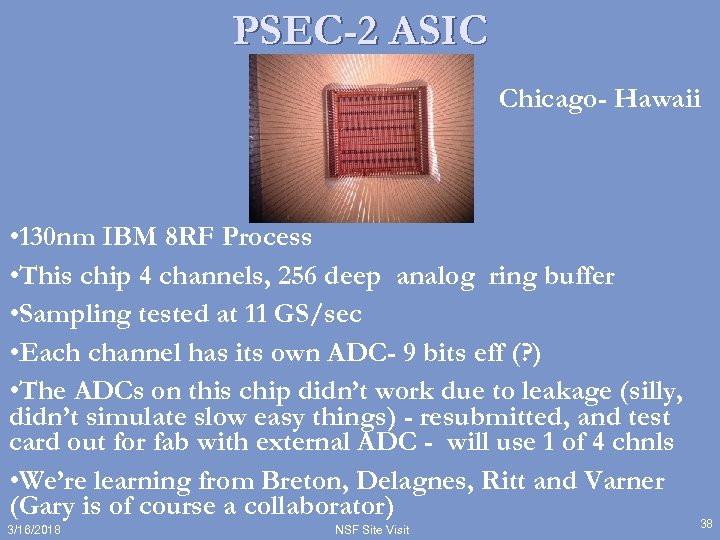 PSEC-2 ASIC Chicago- Hawaii • 130 nm IBM 8 RF Process • This chip 4 channels, 256 deep analog ring buffer • Sampling tested at 11 GS/sec • Each channel has its own ADC- 9 bits eff (? ) • The ADCs on this chip didn’t work due to leakage (silly, didn’t simulate slow easy things) - resubmitted, and test card out for fab with external ADC - will use 1 of 4 chnls • We’re learning from Breton, Delagnes, Ritt and Varner (Gary is of course a collaborator) 3/16/2018 NSF Site Visit 38
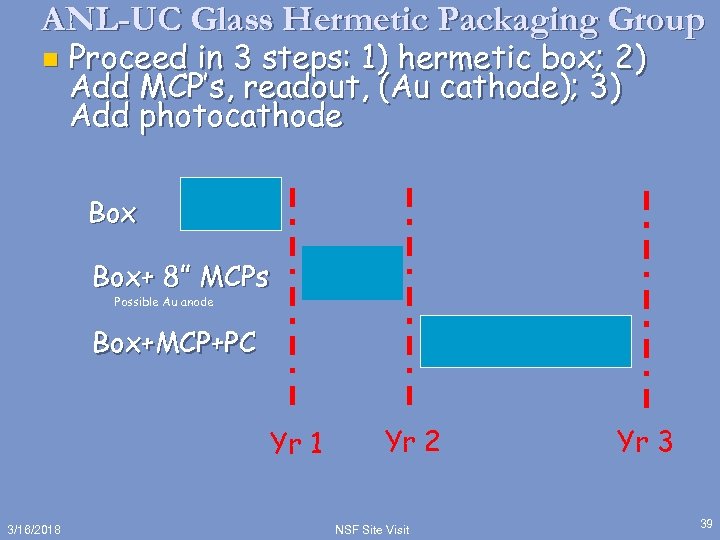 ANL-UC Glass Hermetic Packaging Group n Proceed in 3 steps: 1) hermetic box; 2) Add MCP’s, readout, (Au cathode); 3) Add photocathode Box+ 8” MCPs Possible Au anode Box+MCP+PC Yr 1 3/16/2018 Yr 2 NSF Site Visit Yr 3 39
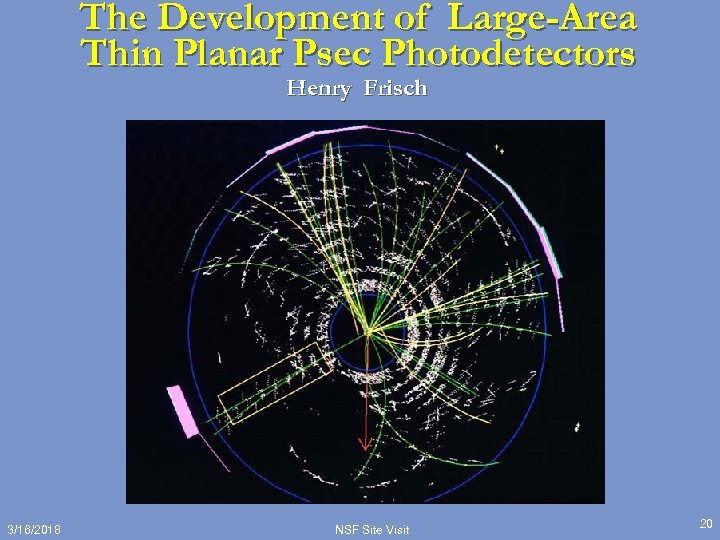
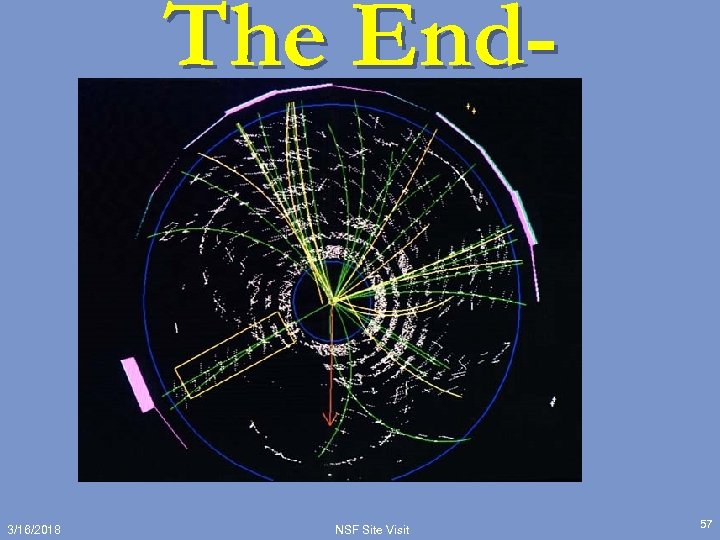
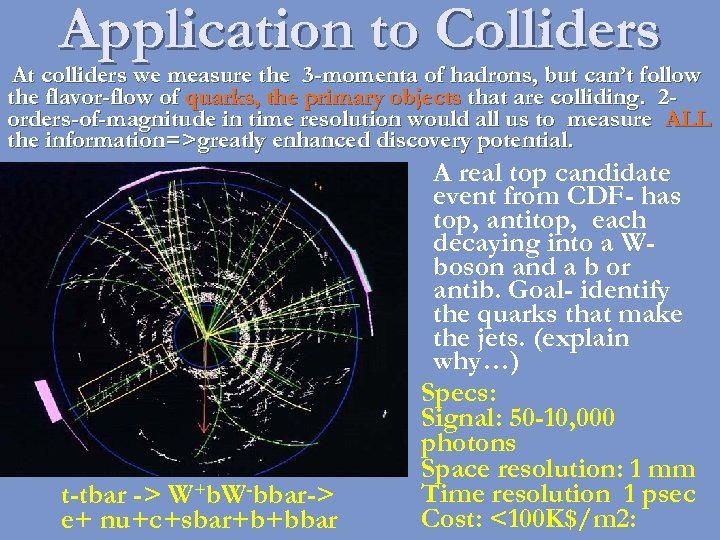 Application to Colliders At colliders we measure the 3 -momenta of hadrons, but can’t follow the flavor-flow of quarks, the primary objects that are colliding. 2 orders-of-magnitude in time resolution would all us to measure ALL the information=>greatly enhanced discovery potential. t-tbar -> W+b. W-bbar-> e+ nu+c+sbar+b+bbar A real top candidate event from CDF- has top, antitop, each decaying into a Wboson and a b or antib. Goal- identify the quarks that make the jets. (explain why…) Specs: Signal: 50 -10, 000 photons Space resolution: 1 mm Time resolution 1 psec Cost: <100 K$/m 2:
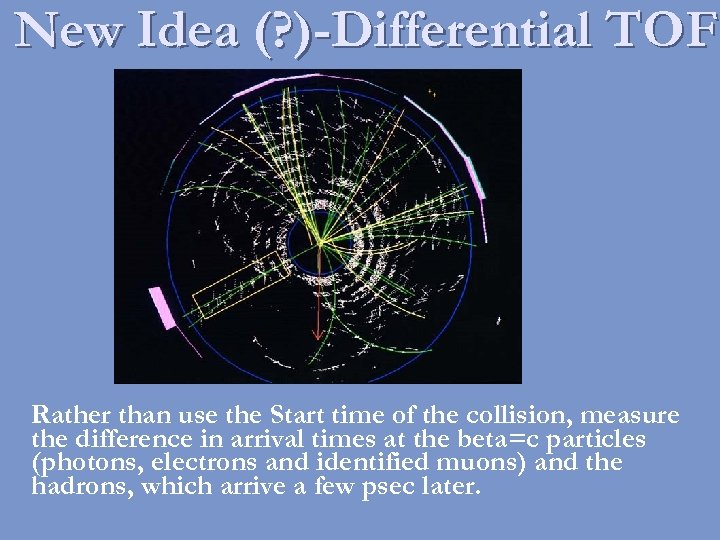 New Idea (? )-Differential TOF Rather than use the Start time of the collision, measure the difference in arrival times at the beta=c particles (photons, electrons and identified muons) and the hadrons, which arrive a few psec later.
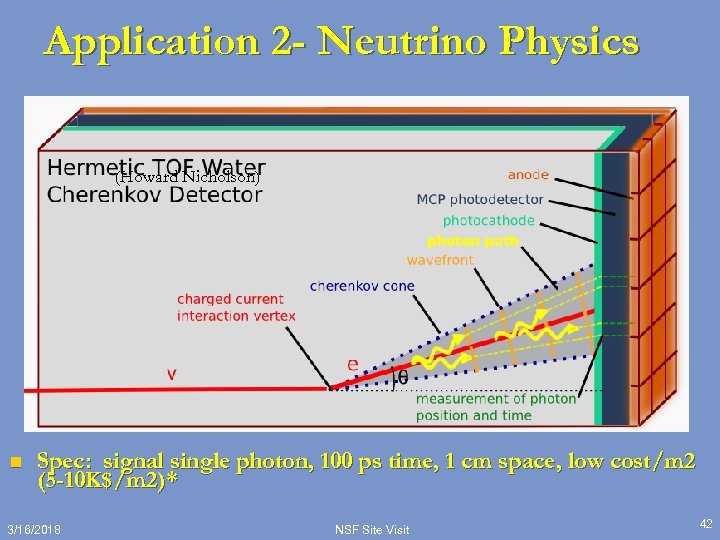 Application 2 - Neutrino Physics (Howard Nicholson) n Spec: signal single photon, 100 ps time, 1 cm space, low cost/m 2 (5 -10 K$/m 2)* 3/16/2018 NSF Site Visit 42
 New Idea: Hi-res H 2 O n Spatial Res of <1 cm plus >50% coverage would allow working close to the walls => greater Fid/Tot ratio; n Also would make curve of Fid/Tot flatter wrt to symmetry- could make a high, long, narrow (book-on-end) detector at smaller loss of F/T; n Cavern height cheaper than width; robust tubes can stand more pressure n Narrow may allow magnetic field (!) 3/16/2018 NSF Site Visit 43
 New idea: Hi-Res H 20 -continued n 100 psec time resolution is 3 cm space resolution ALONG photon direction; n Transverse resolution on each photon should be sub-cm; n Question- can one reconstruct tracks? n Question- can one reconstruct vertices? n Question- can one distinguish a pizero from an electron and 2 vertices from one? (4 tracks vs 1 too) 3/16/2018 NSF Site Visit 44
 New idea: Hi-Res H 20 -continued n Question: Can we reconstruct the first 3 radiation lengths of an event with resolution ~1/10 of a radiation length? n Handles on pizero-electron separation: 2 vs 1 vertices; no track vs 1 track between primary vertex and first photon conversion; 2 tracks (twice the photons) from the 2 conversion vertices; n Know photon angle, lots of photons-fit to counter dispersion, scattering; n Book-on-end aspect ratio helps against dispersion, scattering-have to look at whole picture. 3/16/2018 NSF Site Visit 45
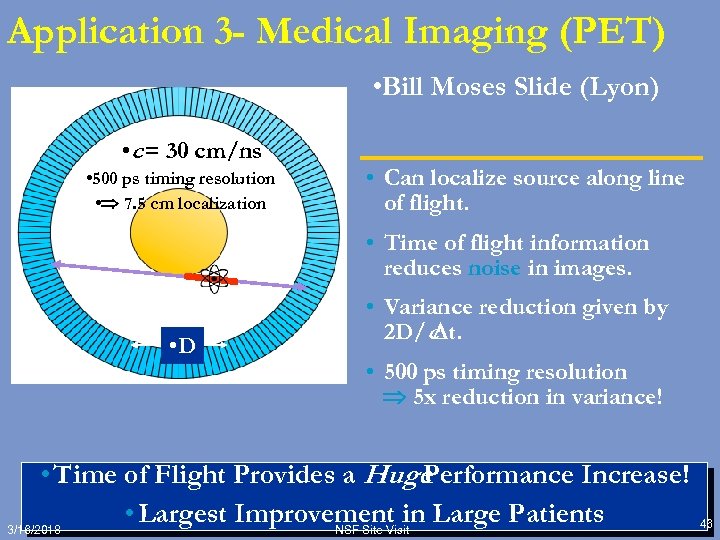 Application 3 - Medical Imaging (PET) • Bill Moses Slide (Lyon) • c = 30 cm/ns • 500 ps timing resolution • 7. 5 cm localization • Can localize source along line of flight. • Time of flight information reduces noise in images. • D • Variance reduction given by 2 D/c t. • 500 ps timing resolution 5 x reduction in variance! • Time of Flight Provides a Huge Performance Increase! • Largest Improvement in Large Patients 3/16/2018 NSF Site Visit 46
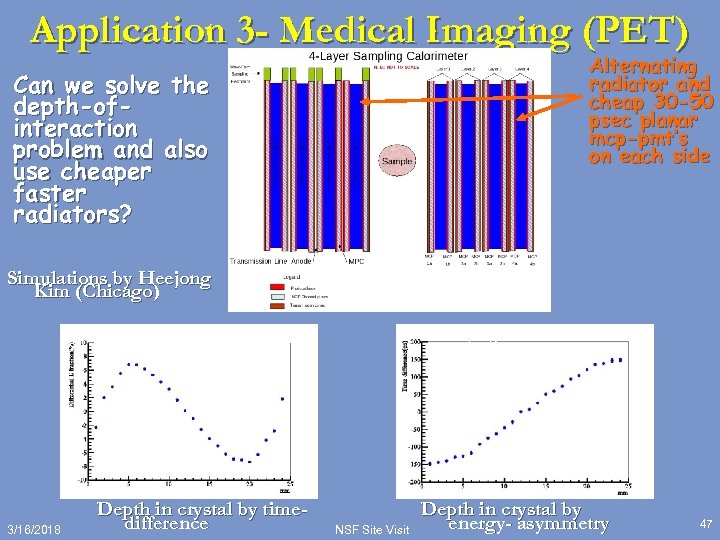 Application 3 - Medical Imaging (PET) Alternating radiator and cheap 30 -50 psec planar mcp-pmt’s on each side Can we solve the depth-ofinteraction problem and also use cheaper faster radiators? Simulations by Heejong Kim (Chicago) Heejong Kim 3/16/2018 Depth in crystal by timedifference NSF Site Visit Depth in crystal by energy- asymmetry 47
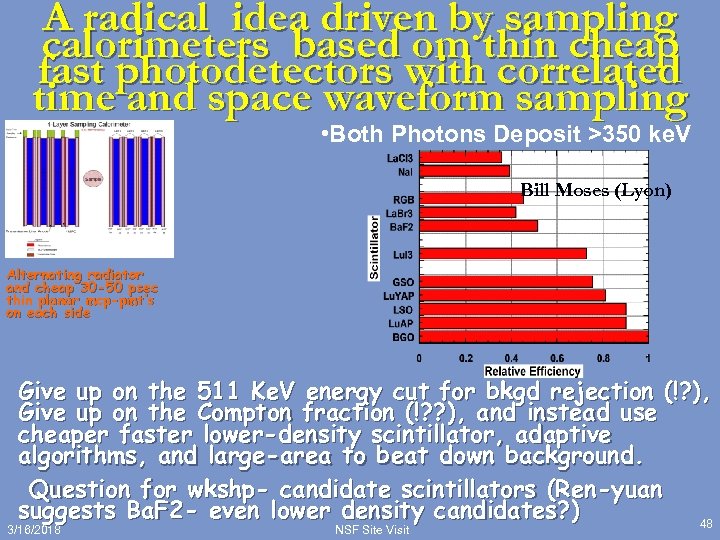 A radical idea driven by sampling calorimeters based om thin cheap fast photodetectors with correlated time and space waveform sampling • Both Photons Deposit >350 ke. V Bill Moses (Lyon) Alternating radiator and cheap 30 -50 psec thin planar mcp-pmt’s on each side Give up on the 511 Ke. V energy cut for bkgd rejection (!? ), Give up on the Compton fraction (!? ? ), and instead use cheaper faster lower-density scintillator, adaptive algorithms, and large-area to beat down background. Question for wkshp- candidate scintillators (Ren-yuan suggests Ba. F 2 - even lower density candidates? ) 48 3/16/2018 NSF Site Visit
 Medical Imaging (PET)-cont. Spec: signal 10, 000 photons, 30 ps time resolution , 1 mm space resolution, 30 K$/m 2, and commercializable for clinical use. SUMMARY However- truth in advertising- there is a long way to go (see Bill Moses’s talk at Clermont. ) It looks promising, as it may be possible to produce large panels with better spatial and time resolution than possible with photomultipliers, and our initial estimates are that MCP-PMT’s may be as much as a factor of 10 cheaper. However, the development will take a collaborative effort on measurements and simulation (see papers by Heejong Kim et al on web). Talks are also underway among Clermont, Strasbourg, Lyon, and Chicago. N. B. independent funding now. 3/16/2018 NSF Site Visit 49
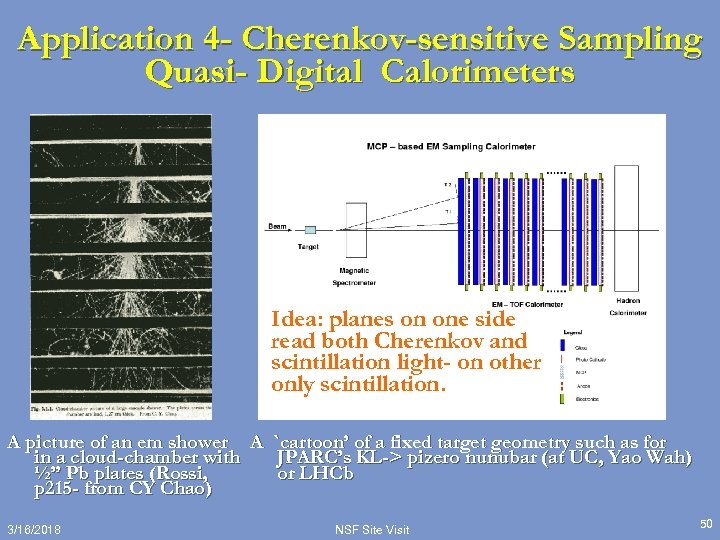 Application 4 - Cherenkov-sensitive Sampling Quasi- Digital Calorimeters Idea: planes on one side read both Cherenkov and • I scintillation light- on other only scintillation. A picture of an em shower A `cartoon’ of a fixed target geometry such as for in a cloud-chamber with JPARC’s KL-> pizero nunubar (at UC, Yao Wah) ½” Pb plates (Rossi, or LHCb p 215 - from CY Chao) 3/16/2018 NSF Site Visit 50
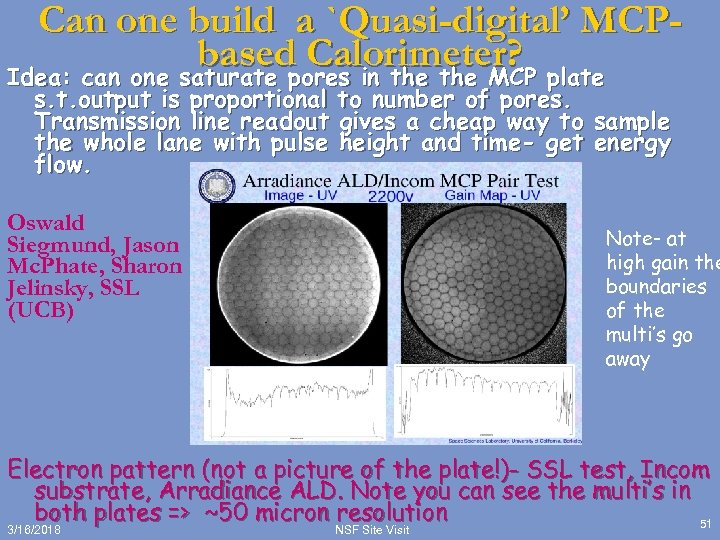 Can one build a `Quasi-digital’ MCPbased Calorimeter? Idea: can one saturate pores in the MCP plate s. t. output is proportional to number of pores. Transmission line readout gives a cheap way to sample the whole lane with pulse height and time- get energy flow. Oswald Siegmund, Jason Mc. Phate, Sharon Jelinsky, SSL (UCB) Note- at high gain the boundaries of the multi’s go away Electron pattern (not a picture of the plate!)- SSL test, Incom substrate, Arradiance ALD. Note you can see the multi’s in both plates => ~50 micron resolution 51 3/16/2018 NSF Site Visit
 More Information: • • 3/16/2018 Main Page: http: //psec. uchicago. edu Library: Collaboration Meetings, Godparent Reviews, Milestones, Image Library, Document Library, Year-1 Summary Report, Links to MCP, Photocathode, Materials Literature, etc. ; Blog: Our log-book- open to all (say yes to certificate Cerberus, etc. )- can keep track of us (many companies do, we have found); Wish us well- goal is in 3 years (2 from now) to have commercializable modules- too late for the 1 st round of LBNE, but maybe not too late for a 2 nd or 3 rd-generation detector. NSF Site Visit 52
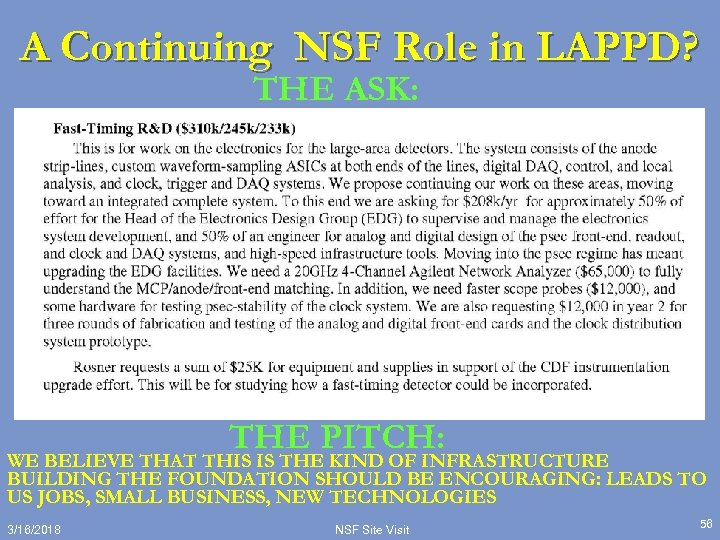
 NSF Funding Contributions to LAPPD • HJF Summer Salary (Spokesman- ( N. B. NSF -Leadership role)) (LAPPD+CDF) • 97 K$ Supplement this year for EDG and UCEC engineering work on anodes • No students (Eric Oberla is on a GANN) • No postdocs (Matt Wetstein is paid for by ANL Director’s funds) • Limited to one specific project- anodes- based on the (transformational) Chicago ideas (Tang, Genat, Grabas, Frisch, Sanders)- US Patent 2007/0187596 and US Provisional Application 61/339, 865 (one more through ANL). 3/16/2018 NSF Site Visit 53
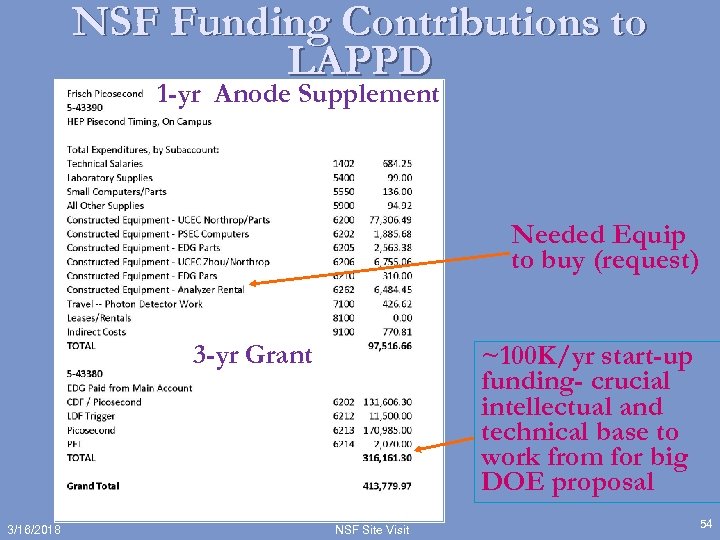 NSF Funding Contributions to LAPPD 1 -yr Anode Supplement Needed Equip to buy (request) 3 -yr Grant 3/16/2018 ~100 K/yr start-up funding- crucial intellectual and technical base to work from for big DOE proposal NSF Site Visit 54
 A Continuing NSF Role in LAPPD? • NSF support has played a crucial role in the intellectual and technical groundwork • LBNE needs 100, 000 PMT’s- list price in small quantities is > 3 K$ each/ hope is 1 -2 K$/each, so cost of PMT’s is somewhere between 100 M$ and 300 M$ • Big gains possible in QE for photocathodes (not discussed here, but one of the impetuses (impeti? ) for the beingproposed National Center for Advanced Detectors and Sensors. ) • Muon cooling application (measure mv by TOF)- future of US HEP? (SBIR with Muons. Inc) • Medical Imagining- PET, hadron therapy (with Clermont, Lyon, Saclay, BSD)- could have major societal impact (aka outreach). 3/16/2018 NSF Site Visit 55
 A Continuing NSF Role in LAPPD? THE ASK: THE PITCH: WE BELIEVE THAT THIS IS THE KIND OF INFRASTRUCTURE BUILDING THE FOUNDATION SHOULD BE ENCOURAGING: LEADS TO US JOBS, SMALL BUSINESS, NEW TECHNOLOGIES 3/16/2018 NSF Site Visit 56
 The End- 3/16/2018 NSF Site Visit 57
 Backup 3/16/2018 NSF Site Visit 58
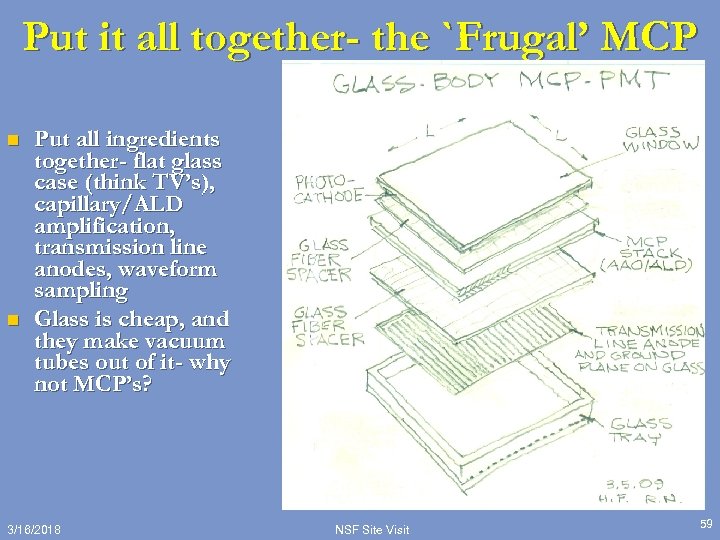 Put it all together- the `Frugal’ MCP n n Put all ingredients together- flat glass case (think TV’s), capillary/ALD amplification, transmission line anodes, waveform sampling Glass is cheap, and they make vacuum tubes out of it- why not MCP’s? 3/16/2018 NSF Site Visit 59
 God. Parent Review Panels • Packaging Group • Karen Byrum • K. Arisaka • J. Elam • D. Ferenc • J. F. Genat • P. Hink • A. Ronzhin 3/16/2018 • Photocathode Group • MCP Group • Bob Wagner • K. Attenkofer A. Bross • Z. Insepov A. Tremsin • J. Va’vra • A. Zinovev • Gary Varner • J. Buckley • K. Harkay • V. Ivanov A. Lyashenko • T. Prolier • M. Wetstein NSF Site Visit • Electronics Group • • Zikri Yusof B. Adams • M. Demarteau • G. Drake • T. Liu • I. Veryovkin • S. Ross 60
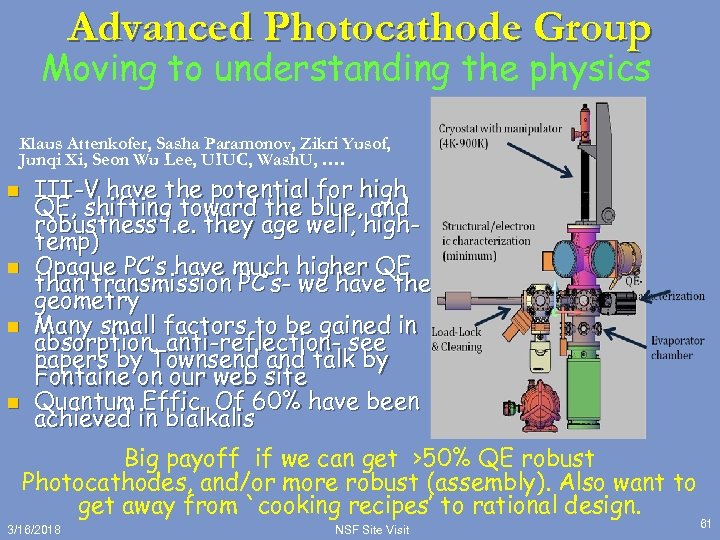 Advanced Photocathode Group Moving to understanding the physics Klaus Attenkofer, Sasha Paramonov, Zikri Yusof, Junqi Xi, Seon Wu Lee, UIUC, Wash. U, …. n n III-V have the potential for high QE, shifting toward the blue, and robustness i. e. they age well, hightemp) Opaque PC’s have much higher QE than transmission PC’s- we have the geometry Many small factors to be gained in absorption, anti-reflection- see papers by Townsend and talk by Fontaine on our web site Quantum Effic. Of 60% have been achieved in bialkalis Big payoff if we can get >50% QE robust Photocathodes, and/or more robust (assembly). Also want to get away from `cooking recipes’ to rational design. 3/16/2018 NSF Site Visit 61
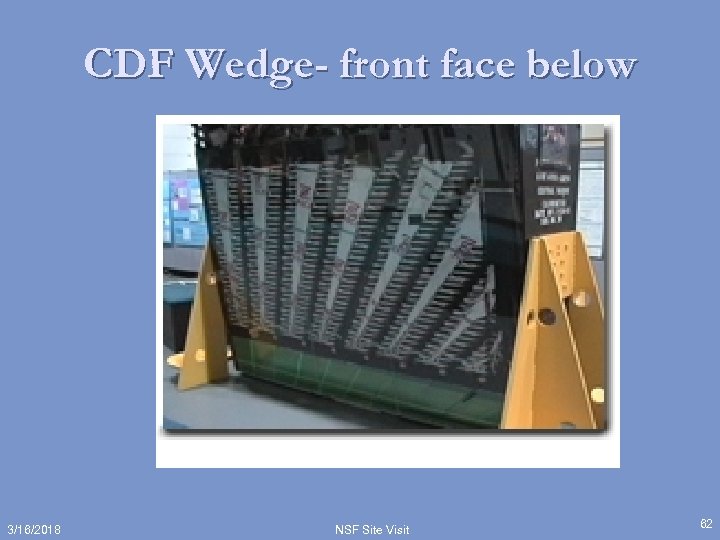 CDF Wedge- front face below 3/16/2018 NSF Site Visit 62
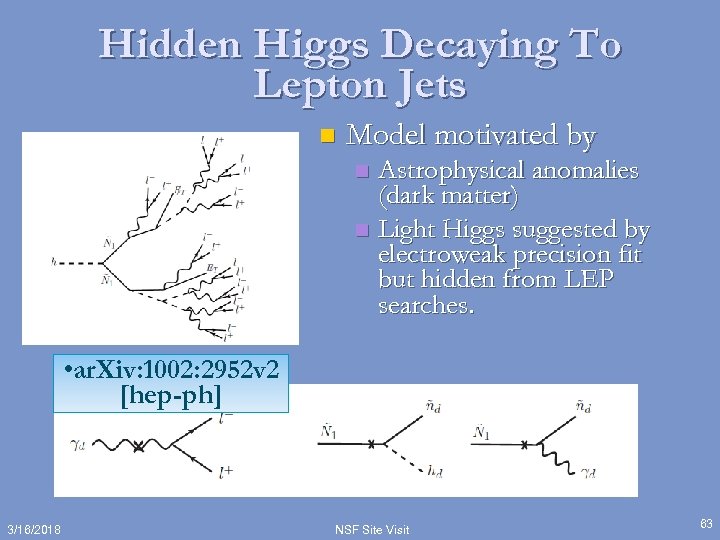 Hidden Higgs Decaying To Lepton Jets n Model motivated by Astrophysical anomalies (dark matter) n Light Higgs suggested by electroweak precision fit but hidden from LEP searches. n • ar. Xiv: 1002: 2952 v 2 [hep-ph] 3/16/2018 NSF Site Visit 63
 I. Run the Tevatron Until We Are Sure We Don’t Need It 1. There are key precision measurements that it will be a very long time, if ever, before they are done better at the LHC than at the Tevatron – e. g. the W mass and the top quark mass. 2. Even if the LHC is able to measure these more precisely, the systematics of the measurements at the LHC and the Tevatron will be quite different- there is a good chance that the tension between the EWK precision fits and the LEP limit on the Higgs mass will endure, and being sure that there is no problem in MW or Mtop is critical. 3. There are many models that have light new physics- the Tevatron is a better match to MET ~ MW/4 and light masses (few Ge. V to EWK scale) for track-based triggering and soft electron reconstruction, among other soft (low Pt) things. 4. We have finally entered the realm of diboson and Higgs crosssections- still many signatures to explore. The SM Higgs is only one of many possibilities, e. g. - and tools are still getting better. Why quit now? Fermilab 3/4/2010
 II. Make adiabatic improvements and necessary replacements/upgrades 1. Systematic program to get detector efficiencies to PRL (not to tape) up to 90% (`hammering down highest nails’) - many small nagging losses. 2. Make tests of luminosity leveling- opposition was from bphysics, but would help in quality of high-Pt data, analysis, and (I still believe, but could be wrong) efficiency. 3. I don’t know about silicon lifetime- need to ask experts. I think other sub-systems are ok (e. g. CEM goes down slowly but steadily, COT and magnet seem to be holding up) Fermilab 3/4/2010
 III. Assign technical staff to run the detectors instead of constant shuffling of responsibilities people to run the 1. Heard often that `there aren’t enough detectors’. • This is true in the present model, which is mind-blowingly inefficient. In the present model, institutions are still responsible for sub-systems built years (decades in some cases) earlier. Maintaining these systems is neither interesting nor easy to do well- yet we persist at it. Not surprisingly, it’s hard to find enough people to do it. The ones we do find are completely unskilled and are shortterm. • The lab needs to make a new model, the `John Roof’ model, in which permanent staff are assigned to run, maintain, and improve the operation of the detectors. This is possible- it would only take a management decision that this is a priority. Fermilab 3/4/2010
 IV. Make qualitative improvements in capability (i. e. non-adiabatic) • EXAMPLES (these need evaluation by collaboration godparent committees or equiv. - these are ones I know a little about, probably good others) 1. New silicon systems with better spatial resolution (cancelled by previous management) 2. New TDC’s for the COT for faster readout (cancelled by previous management), less deadtime (more b-physics data) 3. 3 -10 -psec TOF for K-pi separation for quark-flavor identification (e. g. ttbar -> e nu b bbar c sbar). 4. New SVT track-based trigger. • Build on ILC detector development advances- incorporate them into the Tevatron program. (takes careful evaluation) Fermilab 3/4/2010
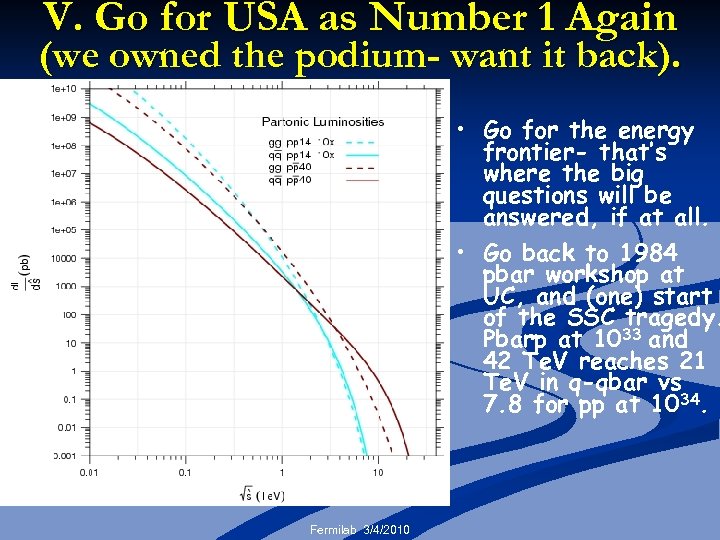 V. Go for USA as Number 1 Again (we owned the podium- want it back). • Go for the energy frontier- that’s where the big questions will be answered, if at all. • Go back to 1984 pbar workshop at UC, and (one) start of the SSC tragedy. Pbarp at 1033 and 42 Te. V reaches 21 Te. V in q-qbar vs 7. 8 for pp at 1034. Fermilab 3/4/2010