 Скачать презентацию CCT Report for CGPM Membership of CCT
a5915406ae0cb39c8510f6d5708f2d3b.ppt
- Количество слайдов: 25



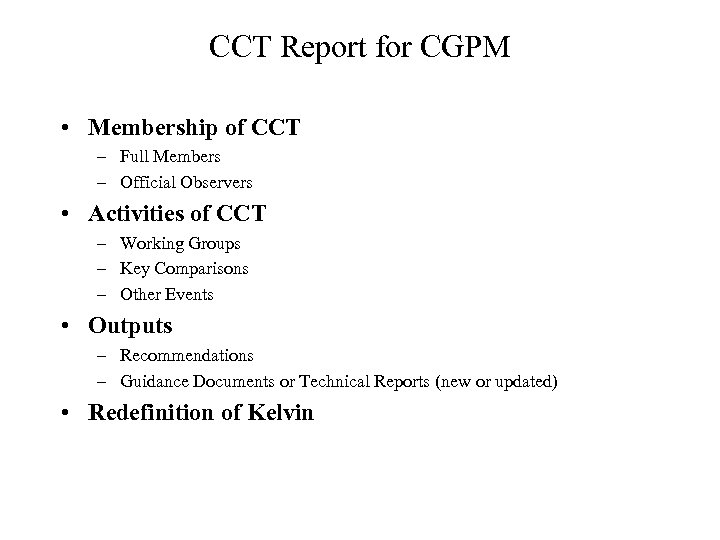
CCT Report for CGPM • Membership of CCT – Full Members – Official Observers • Activities of CCT – Working Groups – Key Comparisons – Other Events • Outputs – Recommendations – Guidance Documents or Technical Reports (new or updated) • Redefinition of Kelvin
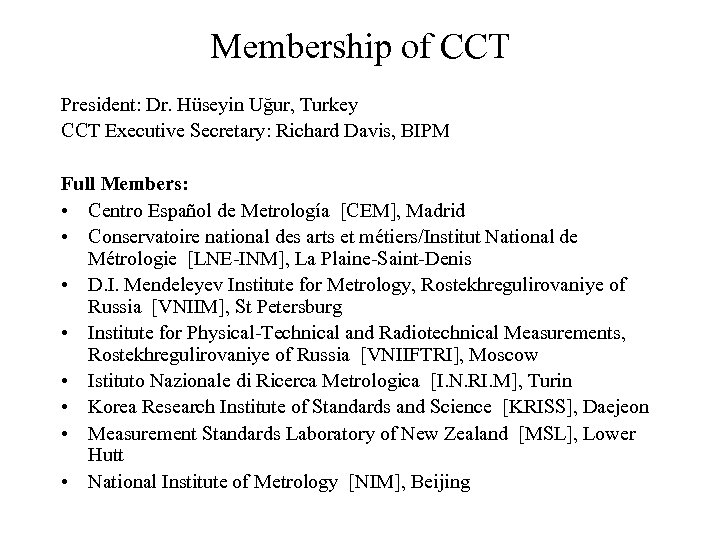
Membership of CCT President: Dr. Hüseyin Uğur, Turkey CCT Executive Secretary: Richard Davis, BIPM Full Members: • Centro Español de Metrología [CEM], Madrid • Conservatoire national des arts et métiers/Institut National de Métrologie [LNE-INM], La Plaine-Saint-Denis • D. I. Mendeleyev Institute for Metrology, Rostekhregulirovaniye of Russia [VNIIM], St Petersburg • Institute for Physical-Technical and Radiotechnical Measurements, Rostekhregulirovaniye of Russia [VNIIFTRI], Moscow • Istituto Nazionale di Ricerca Metrologica [I. N. RI. M], Turin • Korea Research Institute of Standards and Science [KRISS], Daejeon • Measurement Standards Laboratory of New Zealand [MSL], Lower Hutt • National Institute of Metrology [NIM], Beijing
![Membership of CCT Full Members: • National Institute of Standards and Technology [NIST], Gaithersburg](https://present5.com/presentation/a5915406ae0cb39c8510f6d5708f2d3b/image-3.jpg "Membership of CCT Full Members: • National Institute of Standards and Technology [NIST], Gaithersburg")
Membership of CCT Full Members: • National Institute of Standards and Technology [NIST], Gaithersburg • National Measurement Institute, Australia [NMIA], Lindfield • National Metrology Institute of Japan, AIST [NMIJ/AIST], Tsukuba • National Metrology Institute of South Africa [NMISA], Pretoria • National Metrology Institute of Turkey [UME], Gebze-Kocaeli • National Physical Laboratory [NPL], Teddington • National Research Council of Canada - Institute for National Measurement Standards [NRC-INMS], Ottawa, Ontario • Nederlands Meetinstituut/Van Swinden Laboratorium B. V. [NMi. VSL], Delft • Physikalisch-Technische Bundesanstalt [PTB], Braunschweig • Slovak Institute of Metrology/Slovenskı Metrologickı Ústav [SMU], Bratislava • Standards, Productivity and Innovation Board [SPRING], Singapore
![Membership of CCT Official Observers: • Centro Nacional de Metrología [CENAM], Querétaro, Qro •](https://present5.com/presentation/a5915406ae0cb39c8510f6d5708f2d3b/image-4.jpg "Membership of CCT Official Observers: • Centro Nacional de Metrología [CENAM], Querétaro, Qro •")
Membership of CCT Official Observers: • Centro Nacional de Metrología [CENAM], Querétaro, Qro • Instituto Nacional de Tecnología Industrial [INTI], San Martín, Prov. Buenos Aires • Instituto Português da Qualidade [IPQ], Caparica • National Institute of Metrology, Standardization and Industrial Quality [INMETRO], Rio de Janeiro
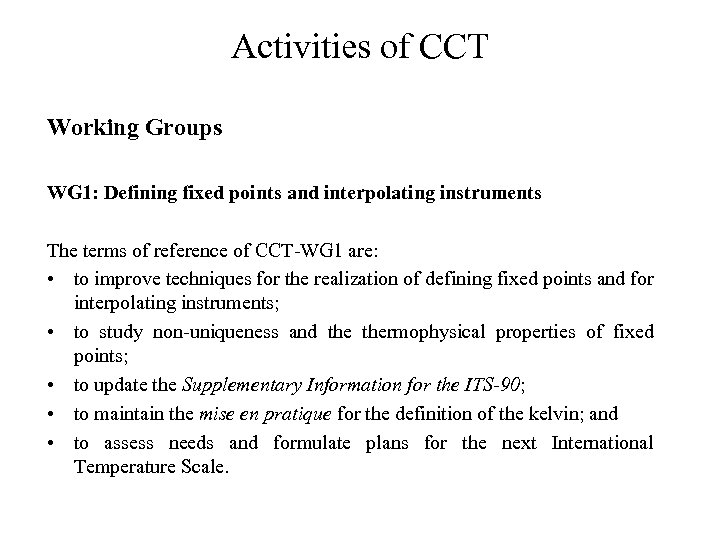
Activities of CCT Working Groups WG 1: Defining fixed points and interpolating instruments The terms of reference of CCT-WG 1 are: • to improve techniques for the realization of defining fixed points and for interpolating instruments; • to study non-uniqueness and thermophysical properties of fixed points; • to update the Supplementary Information for the ITS-90; • to maintain the mise en pratique for the definition of the kelvin; and • to assess needs and formulate plans for the next International Temperature Scale.
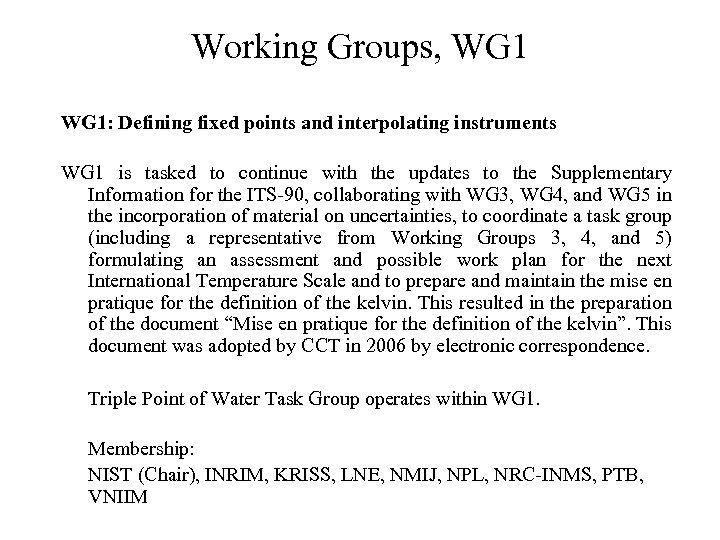
Working Groups, WG 1: Defining fixed points and interpolating instruments WG 1 is tasked to continue with the updates to the Supplementary Information for the ITS-90, collaborating with WG 3, WG 4, and WG 5 in the incorporation of material on uncertainties, to coordinate a task group (including a representative from Working Groups 3, 4, and 5) formulating an assessment and possible work plan for the next International Temperature Scale and to prepare and maintain the mise en pratique for the definition of the kelvin. This resulted in the preparation of the document “Mise en pratique for the definition of the kelvin”. This document was adopted by CCT in 2006 by electronic correspondence. Triple Point of Water Task Group operates within WG 1. Membership: NIST (Chair), INRIM, KRISS, LNE, NMIJ, NPL, NRC-INMS, PTB, VNIIM
Working Groups, WG 2: Secondary reference points and techniques of approximation to ITS-90 The terms of reference of CCT-WG 2 are: • to revise the Techniques for Approximating the ITS-90; and • to revise and update the list of secondary reference points. WG 2 is tasked to continue with the updates to the “Techniques for Approximating the ITS-90”, including advice on secondary fixed-point construction and operation. Membership: NRC-INMS (Chair), CENAM, INRIM, KRISS, LNE, MSL, NIM, NMIJ, NMISA, PTB
Working Groups, WG 3: Uncertainties The terms of reference of CCT-WG 3 are: • to establish and recommend methods for quoting uncertainties in realizing the ITS-90 using contact thermometry; and • to ensure notational consistency in methods for quoting uncertainties for other areas of interest to the CCT (including optical thermometry and humidity). WG 3 is tasked with continuing the production of a document on uncertainty budgets for contact thermometry, and to act in an oversight role for similar documents produced by other working groups. Membership: MSL (Chair), CEM, CENAM, INRIM, IPQ, LNE, NMIA, NMIJ, NMi-VSL, NIST, PTB, SMU, UME, VNIIM
Working Groups, WG 4: Thermodynamic temperature determination and extension of the ITS-90 to lower temperatures The terms of reference of CCT-WG 4 are: • to review and make recommendations concerning thermodynamic temperature determination and the definition of the kelvin WG 4 is tasked with continuing the production and dissemination of Supplementary Information for the PLTS-2000 and with monitoring progress on potential redefinition of the kelvin in terms of the Boltzmann constant. WG 4 has produced a document called “Supplementary information for the realization of the PLTS-2000”. This document was approved by the CCT in July 2007.
Working Groups, WG 4: Thermodynamic temperature determination and extension of the ITS-90 to lower temperatures The President of CCT has asked WG 4 to establish a Task Group for the redefinition of Kelvin (TG-SI). The activities of this task group are given later. Definition of Kelvin Task Group (TG-SI) operates within WG 4. Membership: PTB (Chair), INRIM, KRISS, LNE, MSL, NIM, NIST, NMIJ, NPL, NRC, CCT President, CCT Executive Secretary
Working Groups, WG 5: Radiation Thermometry The terms of reference of CCT-WG 5 are: • • • to study, develop and advise the CCT on issues related to optical methods for temperature measurement, including the reporting of uncertainty budgets; to maintain good links/interface with the radiometry community; and to provide formal liaison between the CCT and CCPR. WG 5 is tasked with producing a document on uncertainty in radiation thermometry at temperatures below the Ag freezing point, with the coordination of thermodynamic measurement results at higher temperatures, with continuing the examination and coordination of activities related to hightemperature fixed points, and with providing appropriate input into the mise en pratique for the realization of the kelvin. Membership: NPL (Chair), INRIM, KRISS, LNE, MSL, NIM, NIST, NMC/SPRING, NMIA, NMIJ, NMi-VSL, PTB, SMU, UME, VNIIM CCPR Liaison: NPL
Working Groups, WG 6: Humidity measurements The terms of reference of CCT-WG 6 are: • to advise the CCT on matters relating to humidity; • to produce a working document on principal uncertainty components in humidity measurements for input to Working Group 3; and • to harmonize the terms and definitions related to humidity measurements. WG 6 is tasked with continuing production of the document on uncertainty in humidity, with the operation of CCT-K 6, and with providing strategic planning information on future key and supplementary comparisons in the field. Membership: NIST (Chair), CENAM, IMGC, KRISS, LNE-CETIAT, MSL, NIM, NMIJ, NMi. VSL, NPL, NMC/SPRING, PTB, UME, VNIIM
Working Groups, WG 7: Key Comparisons The terms of reference of CCT-WG 7 are: • to examine all relevant documents for each key comparison, starting with the protocol and ending with the draft B report; • to advise the pilot laboratory in preparing the text of the entry to Appendix B of the MRA as required, and to prepare a recommendation on these subjects for approval by the CCT; • to prepare guidance documents on identifying significant deviations for use by the pilot laboratories; and • to advise the pilot laboratory in preparing a comparison status document, and to prepare a recommendation for this summary for the CCT.
Working Groups, WG 7 is tasked with continuing the oversight of ongoing key comparisons, and with the production of guidance documents on comparison deviations. Including pilot laboratories of ongoing and completed CCT key comparisons in the membership of this working group captures and preserves the experience and lessons learned during previous comparison exercises. Membership: Pilot CCT-K 2, (NRC, Chair), Pilot CCT-K 1 (NPL), Pilot CCT-K 3 (NIST), Pilot CCT-K 4 (PTB), Pilot CCT-K 5 (NMi-VSL), Pilot CCTK 6 (NPL), Pilot CCT-K 7 (BIPM), Chair CCT-WG 3, Manager BIPM KCDB (non-voting), NMIA, IMGC, KRISS
Working Groups, WG 8: Calibration and Measurement Capabilities The terms of reference are substantially those recommended by the JCRB in the document JCRB-10/6(3). The terms of reference of CCT-WG 8 are: • to establish and maintain lists of service categories and, where necessary, rules for the preparation of CMC entries; • to agree on detailed technical review criteria; • to coordinate and, where possible, conduct inter-regional reviews of CMCs submitted by RMOs for posting in Appendix C of the MRA; • to provide guidance on the range of CMCs supported by particular key comparisons; • to examine the sufficiency of existing comparisons for supporting CMC submissions and to recommend new comparisons where deemed necessary; and • to coordinate the review of existing CMCs in the context of new results of key and supplementary comparisons.
Working Groups, WG 8 is tasked to continue with the creation of CMC review protocols and the review of fast-track CMC submissions for inclusion in Appendix C, along with the identification of new comparisons needed to support CMC submissions. Membership: SIM(Chair), APMP, COOMET, EUROMET, SADCMET To facilitate communications among the RMOs, CMC Service categories and Review Protocols have recently been made available in Open Access on the WG 8 web space.
Working Groups, WG 9: Thermophysical Properties The terms of reference of CCT-WG 9 are: • to advise the CCT on matters related to thermophysical properties, and to assess the need in this field for a key comparison. WG 9 is tasked with continuing the production of a document on uncertainty, and with identifying and undertaking suitable pilot studies to establish the state of measurement and maturity of the field. Membership: NMIJ (Chair), INRIM, IPQ, KRISS, LNE, NIM, NIST, PTB, VNIIM
Activities of CCT, Key Comparisons Completed, results are published in KCDB • CCT-K 1: Realizations of the ITS-90 from 0, 65 K to 24. 6 K (19972001). • CCT-K 2: Realizations of the ITS-90 from 13. 8 K to 273. 16 K (19971999) • CCT-K 3: Comparison of realizations of the ITS‑ 90 over the range 83. 8058 K to 933. 473 K (1997 -2001) • CCT-K 4: Comparisons of local realizations of Aluminum and Silver fixed points (1998 -2000) • CCT-K 7: Comparisons of water triple point cells (2002 -2004)
Activities of CCT, Key Comparisons In Progress • CCT-K 5: Realizations of the ITS-90 between 962 °C and 1700 °C using vacuum strip lamps as transfer standards (1997 -1999). Report in Progress, Draft B. • CCT-K 6: Comparison of humidity standards: dew and frost point temperatures (2003 -). In progress
Activities of CCT, Other Events Various CCT Working Groups have organized the following international meetings: • Workshop on Uncertainty in Temperature Fixed Points (2004) • Workshop on Common Problems in Radiometry and Thermometry (2004) • Workshop on Uncertainty in Humidity Measurements (2004) • Workshop on Methods for New Determinations of the Boltzmann Constant (2005) • Workshop on Progress in Determining the Boltzmann Constant (2006)
Outputs (2004 -2007) Recommendations: CCT in its 2005 Meeting has adopted three recommendations to be submitted to CIPM. • T 1 (2005) on the clarification of the definition of the kelvin, unit of thermodynamic temperature (CCT/05 -T 1 and CIPM Recommendation 2, CI-2005) • T 2 (2005) on new determinations of thermodynamic temperature and the Boltzmann constant (CCT/05 -T 2) • T 3 (2005) on the creation of a mise en pratique of the definition of the kelvin (CCT/05 -T 3 and 8 th Edition of the SI brochure).
Outputs (2004 -2007) Guidance Documents or Technical Reports (new or updated) • Addendum to the Supplementary Information for the ITS-90. • Supplementary Information for the PLTS-2000 • Guidance Document on the Uncertainties in the realization of the SPRT subranges of ITS -90 • Techniques for Approximating the ITS-90 (Blue Book). • Isotopic Effects in the Hydrogen Fixed Points: Report to the CCT • Summary of Facts Relating to Isotopic Effects and the Triple Point of Water: Report of the ad hoc Task Group on the Triple Point of Water • Methodologies for the estimation of uncertainties and the correction of fixed-point temperatures attributable to the influence of chemical impurities • Uncertainty Budgets for SPRT Calibrations at the Defining Fixed Points • Working document cataloguing the uncertainty associated with a radiation thermometry approximation of the ITS-90 below the silver point • Uncertainty in the generation of humidity • Report to the CIPM on the implications of changing the definition of the base unit kelvin.
Redefinition of Kelvin A new task group (TG-SI) was created within WG 4 in response to the CIPM 2005 recommendation (CI-2005) and held its first meeting in October 2006. The Terms of Reference follow closely CIPM Recommendation 1 of 2005, (CI-2005), "Preparative steps towards new definitions of the kilogram, the ampere, the kelvin and the mole in terms of fundamental constants". • consider the implications of changing the definitions of the abovementioned base units of the SI, with particular emphasis on the kelvin, from the point of view of metrology in thermometry; • present this point of view to the CCT and to other concerned Consultative Committees or their appropriate Working Groups and to work with them to prepare a report to the CIPM not later than June 2007; • monitor closely the results of new experiments relevant to the possible new definition of the kelvin, and to identify necessary conditions to be met before proceeding with changing the definition; • solicit input from the wider scientific and technical community on this important matter.
Redefinition of Kelvin, Output First major output of TG-SI was the report to the CIPM on the implications of changing the definition of the base unit kelvin which was delivered to CCU in May 2007. Due to the importance of the subject, the executive summary of this report is presented in the written version of this report. Membership: J. Fischer (chairman), S. Gerasimov, K. D. Hill, G. Machin, M. Moldover, L. Pitre, P. Steur, M. Stock*, O. Tamura, H. Ugur, D. R. White, I. Yang, and J. Zhang. *Replaced by R. Davis, current Executive Secretary of CCT.
CCT Report for CGPM Thank You
Скачать презентацию CCT Report for CGPM Membership of CCT
a5915406ae0cb39c8510f6d5708f2d3b.ppt