 Скачать презентацию CCS and the Environment Plymouth Marine Laboratory UK
b03ebd318a3728eb764e28a2654af917.ppt
- Количество слайдов: 19



CCS and the Environment Plymouth Marine Laboratory, UK UKCCSC Workshop, Nottingham, 17 -18 April 2007
UKCCSC Meeting April 2007 Nottingham Theme 3 CCS and the Environment C. 1 Marine Ecosystem Models Blackford, (PML) Marine system models to quantify and predict ecosystem affects of acidification. C. 2 Laboratory Mesocosms Widdicombe, (PML) Investigate impact on biodiversity, animal health, bioavailability and speciation of contaminants C. 3 Natural Analogues Rees, (PML) and in collaboration with Theme B Investigate potential analogues to determine relevance of natural seepage and seek funding if appropriate C. 4 Scientific Literature Turley (PML), Colls (Nottingham) Access all appropriate scientific information C. 5 Field experiments Identify responses to terrestrial leaks Colls (Nottingham) C. 6 Socio-economics Austen (PML) and in collaboration with Theme D Environmental/society interaction and policy implications C. 7 Networking Turley (PML) and Colls (Nottingham) Facilitate internal and external information exchange including policy makers
UKCCSC Meeting April 2007 Nottingham Theme 3 CCS and the Marine Environment C. 7 Networking Turley (PML) Facilitate internal and external information exchange including policy makers C. 6 Socio-economics Austen (PML) Environmental/society interaction and policy implications
Informing UK Agencies, NGOs etc ……. Workshop on Ocean Acidification for UK Agencies, Government and NGOs, 28 January 2005 at EN HQ Presentation to EN (now Natural England) Council March 2006 Dan Laffoley Chair of IMCO 2 RUG 2005 -2007– major buy in Evidence to EA – on OA and CCS 2006 EA workshop via Andrew Wither on “Global and local impacts of Ocean Acidification” 2007 NGOs Conservation Societies WWF, Greenpeace, Friends of the Earth, E 3 G, Bellona Foundation Whale and Dolphin Conservation Society Marine Conservation Society Annual Conference International Whaling Commission
Engaging the Climate Change Policy Community ……. Presentation at the ADCC Symposium at the Met Office, Exeter 1 -2 February 2005 + Publication United Nations Framework Convention on Climate Change Presentation at UNFCCC Twenty-Second Sessions of the Subsidiary Bodies and seminar of governmental experts, Bonn May 2005 Presentation at Climate Change & Governance Conference, New Zealand, March 2006. Key note + Publication in CONFRONTING CLIMATE CHANGE 2006 Evidence to the Stern Report on Economic of Climate Change
Intergovernmental Panel on Climate Change 7 • Assesses scientific, technical 0 0 2 / • • • www. ipcc. ch and socio-economic information Relevant for the understanding of climate change Assesses its potential impacts Assesses options for adaptation and mitigation Last reported in 2001, new report in 2007 – will help drive new framework on climate change i. e. post Kyoto. Lead Author of marine section for WGII, Ch 4 “Ecosystems” Ocean acidification included in the new report – a first for IPCC!
Engaging the Energy Mitigation Community … • Towards a Sustainable Energy Economy (TSEC a UKRC funded programme) UK Carbon Capture and Storage Consortium (UKCCSC) PML TSEC project funded, PML leads the Environment Theme and is a member of the Senior Management Team • UK Energy Research Council (UKERC) keynote • EPSRC Energy Programme Science Advisory Group Future funding? • UKRC 2007 SR bid on Energy
IMCO 2 Evidence into Laws for Protection of Our Oceans. . . Evidence at OSPAR Workshop on the environmental impact of placement of carbon dioxide in geological structures in the maritime area, Trondheim, 26 -27 October 2004. UN International Maritime Organization OA used as a key driver for changes to The London Protocol considered CCS and highest legal barrier removed. CCS legal from February 2007. OSPAR predicted to follow suite. OSPAR Biodiversity Committee Intercessional corresponding group convened by Norway and the UK to review Effects of Ocean Acidification in OSPAR area. “OSPAR report on Ocean Acidification “ 2006 Seminar on CO 2 Sequestration in Geological Structures, for the London Convention, DTI Conference Centre, London, 20 May 2005 Evidence at IMO, London Convention Science Group and contribution to the Senior Team report on CCS 25 May 2005 Evidence at IMO, London Convention Science Group Intersessional Technical Working Group on CO 2 sequestration April 2006
Working with Government Departments…. Dti: request for information on CCS (via OSPAR & London Convention) Defra: requests for information on CCS and OA (Marine and Global Atmosphere Divisions) Annual Report Card December 2006: section on ocean acidification supplied by PML - www. mccip. org. uk/arc GECC (Global Environmental Change Committee): presentation, report, questionnaire on research needs 2006
Working and Informing UK Government…. . Government initiatives as part of the UK Presidency of the EU and G 8: • ADCC symposium and book launch • Climate Change Workshop “Tipping Points in the Earth System”, British Embassy, Berlin. • A shared Resource – Carbon capture and storage in the North Sea. British Embassy, Norway • Written evidence at request of defra for input into G 8 & Montreal Evidence to Government reviews: • e. g. Stern Review on Economics of Climate Change, Treasury Review of CCS, Marine Bill Presentations to Government Ministers and Civil Servants: • e. g. Elliot Morley, Linda Gilroy, Howard Dalton, David Warrilow, John Roberts
Informing Parliament …. • Poster on CCS at “Set for Britain” meeting, Houses of Parliament, March 2006 • Responding to Parliamentary Questions e. g. PQ 0765 05/06 by Normal Baker PML response by Mr Morley • Parliamentary & Scientific Committee, Westminster, presentation on SOA, 23 October 2006 + publication in Parliamentary Journal. • th 30 January 2007: PMSP breakfast reception in the House of Commons
Informing the EU…. Turley, Hawkins & Reid. Seminar on Impact of Climate Change and Ocean Acidification, Brussels 13 December 2004 to DG Environment Laffoley, Turley & Greenaway. Lunchtime seminar on Climate change, surface ocean acidification and their impacts on European seas 2006 to Heads of DGs EU presentation on OA: FP 7 Advisory Group of Experts, 30 July 2006 Plus much lobbying by others ………………… FP 7 Call on December 2006: • Specific consortium on Ocean Acidification • OA mentioned throughout the call = lots of funding opportunities
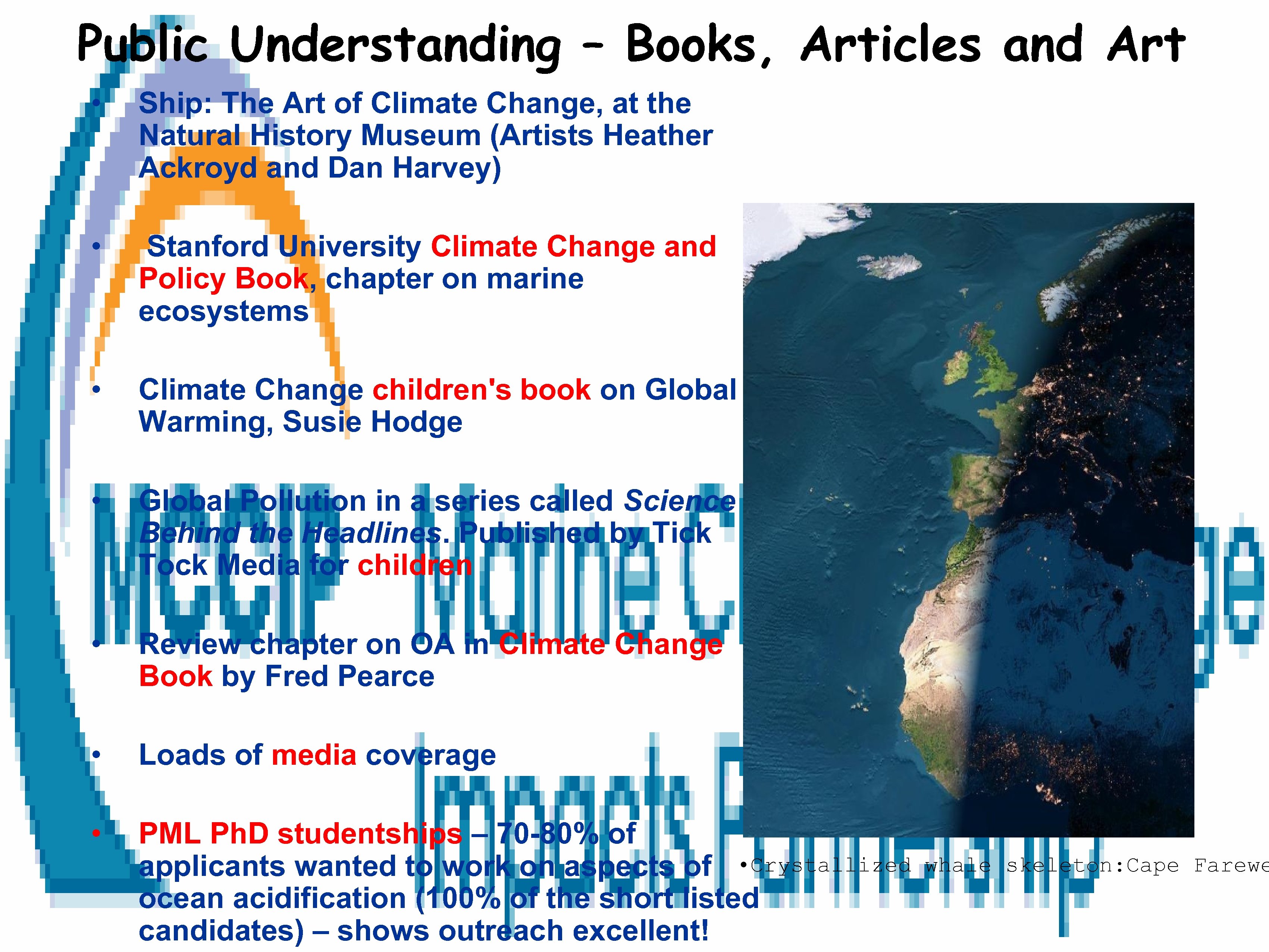
Public Understanding – Books, Articles and Art • Ship: The Art of Climate Change, at the Natural History Museum (Artists Heather Ackroyd and Dan Harvey) • Stanford University Climate Change and Policy Book, chapter on marine ecosystems • Climate Change children's book on Global Warming, Susie Hodge • Global Pollution in a series called Science Behind the Headlines. Published by Tick Tock Media for children • Review chapter on OA in Climate Change Book by Fred Pearce • Loads of media coverage • PML Ph. D studentships – 70 -80% of applicants wanted to work on aspects of • Crystallized ocean acidification (100% of the short listed candidates) – shows outreach excellent! whale skeleton: Cape Farewe
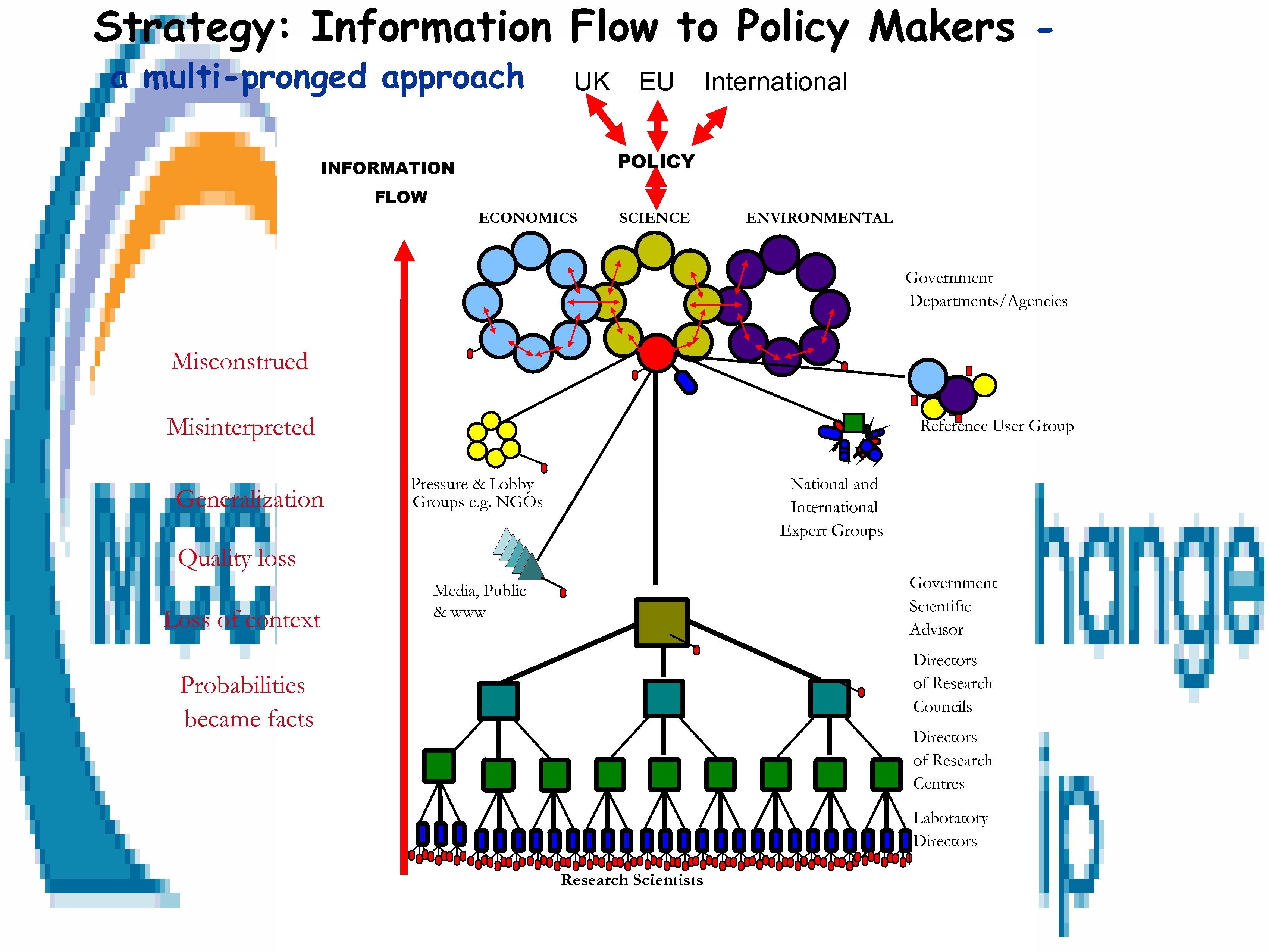
Strategy: Information Flow to Policy Makers a multi-pronged approach UK EU International POLICY INFORMATION FLOW ECONOMICS SCIENCE ENVIRONMENTAL Government Departments/Agencies Misconstrued Misinterpreted Generalization Reference User Group Pressure & Lobby Groups e. g. NGOs National and International Expert Groups Quality loss Loss of context Government Scientific Advisor Media, Public & www Directors of Research Councils Probabilities became facts Directors of Research Centres Laboratory Directors Research Scientists
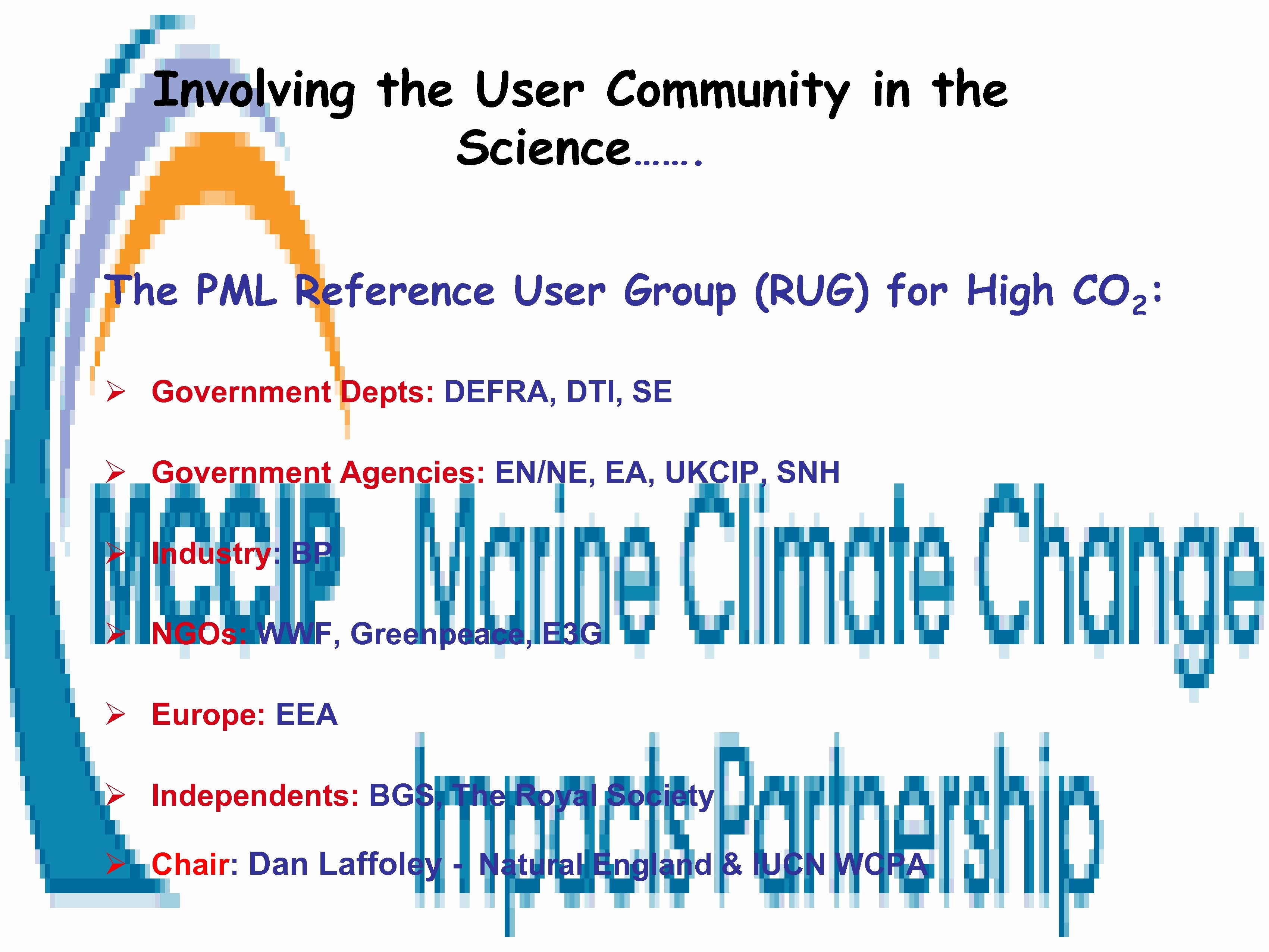
Involving the User Community in the Science……. The PML Reference User Group (RUG) for High CO 2: Ø Government Depts: DEFRA, DTI, SE Ø Government Agencies: EN/NE, EA, UKCIP, SNH Ø Industry: BP Ø NGOs: WWF, Greenpeace, E 3 G Ø Europe: EEA Ø Independents: BGS, The Royal Society Ø Chair: Dan Laffoley - Natural England & IUCN WCPA
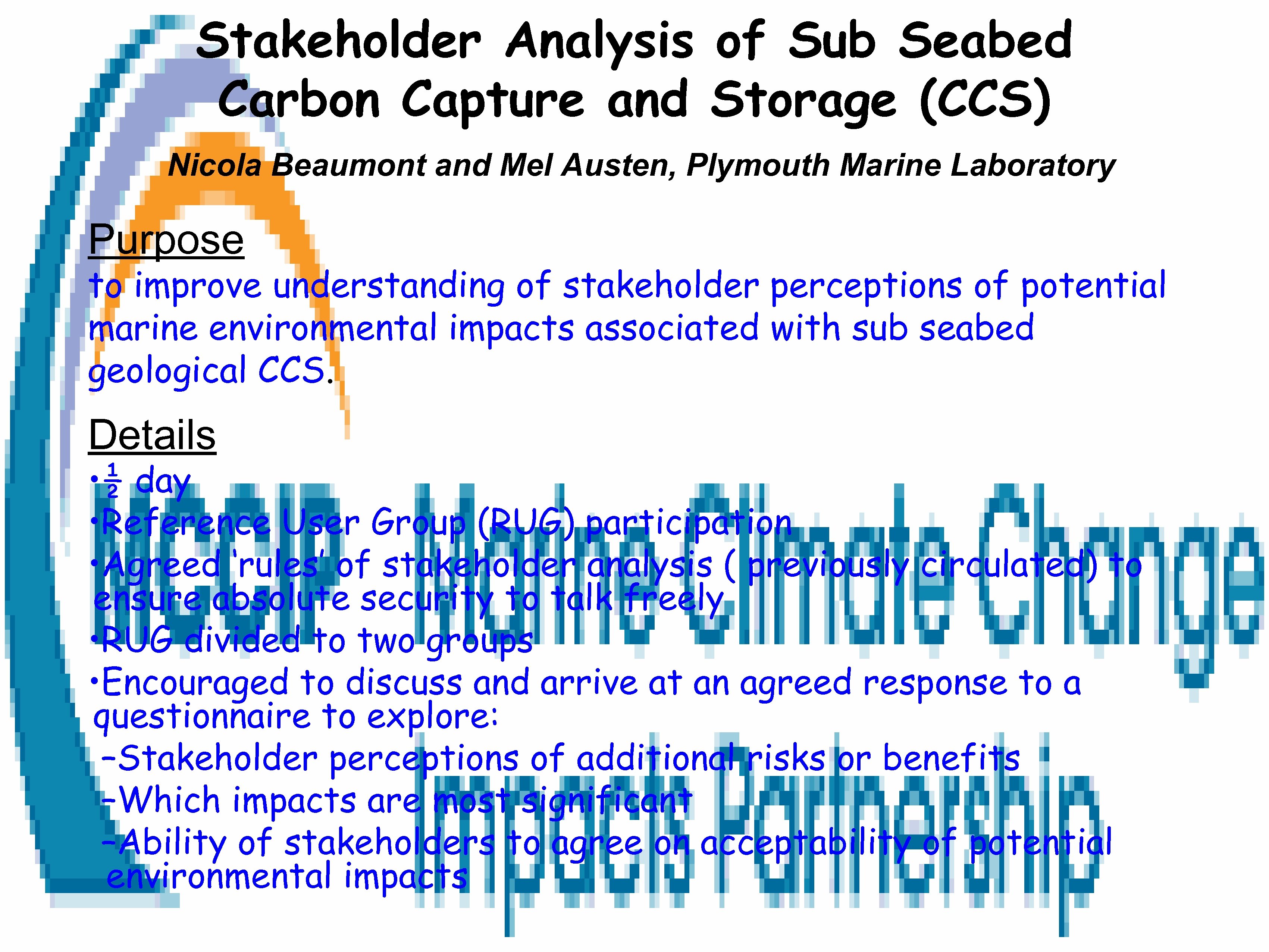
Stakeholder Analysis of Sub Seabed Carbon Capture and Storage (CCS) Nicola Beaumont and Mel Austen, Plymouth Marine Laboratory Purpose to improve understanding of stakeholder perceptions of potential marine environmental impacts associated with sub seabed geological CCS. Details • ½ day • Reference User Group (RUG) participation • Agreed ‘rules’ of stakeholder analysis ( previously circulated) to ensure absolute security to talk freely • RUG divided to two groups • Encouraged to discuss and arrive at an agreed response to a questionnaire to explore: –Stakeholder perceptions of additional risks or benefits –Which impacts are most significant –Ability of stakeholders to agree on acceptability of potential environmental impacts
Key Perceptions • CCS is part of the UK’s low carbon emission toolkit for the future 2), low-frequency environmental impacts are • Small-scale (10 m acceptable • CCS should be implemented straight away although parallel research into the impacts should continue • More research into potential impacts was required: likelihood of different physico-chemical scenarios i. e. probabilities of impact/leak temporal and spatial scale of impact (how much leakage, how often, dispersion) realism of physico-chemical models Under these scenarios need to know organism/ecosystem impacts and the scales at which they take place recovery potential cumulative effects of impact realism of ecosystem models • Regulation and monitoring could be safely undertaken by government and industry over short and long time scales
On-line Events and the WWW. Web article in climate change debate on www. opendemocracy. net • Live World Ocean Web Caste on SOA 13 November 2006 • 14 -18 yr olds from around the world • Presentations by experts • Q & A http: //www. thew 2 o-events. net/oa. php • Text dialogue search hits on “ocean acidification”: October 2003 = 17 June 2006 = 267, 000 January 2007 = 321, 000
Скачать презентацию CCS and the Environment Plymouth Marine Laboratory UK
b03ebd318a3728eb764e28a2654af917.ppt