


 Скачать презентацию CCIED Looking Forward 1 Context After
23649f0012b67d230ed22be6fbc029ca.ppt
- Количество слайдов: 76
 CCIED Looking Forward 1
 Context • After four years… u 50+ papers, multiple awards, significant advances on state of the art, two new workshops, lots of tech transfer, many students trained, etc • But… We didn’t stop Internet worms, let alone malware, let alone cybercrime… nor did anyone else. At best, moved it around a bit. By any meaningful metric things are worse than when we started… • Mistake: looking at this primarily as a technical problem
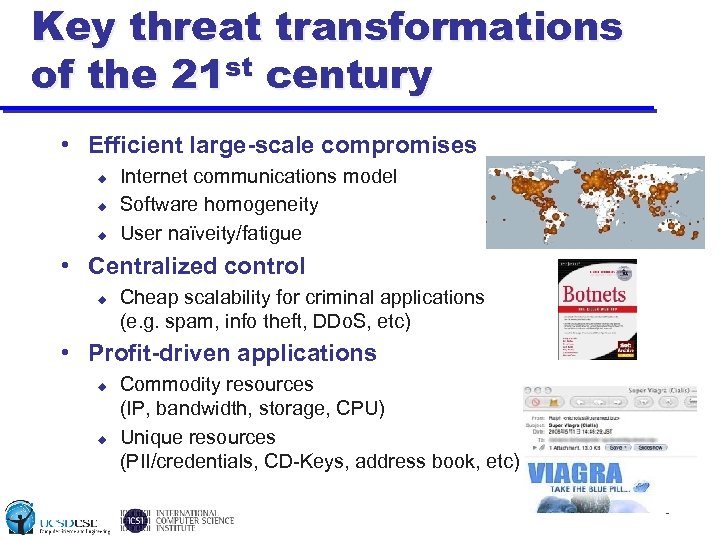 Key threat transformations of the 21 st century • Efficient large-scale compromises u u u Internet communications model Software homogeneity User naïveity/fatigue • Centralized control u Cheap scalability for criminal applications (e. g. spam, info theft, DDo. S, etc) • Profit-driven applications u u Commodity resources (IP, bandwidth, storage, CPU) Unique resources (PII/credentials, CD-Keys, address book, etc) 3
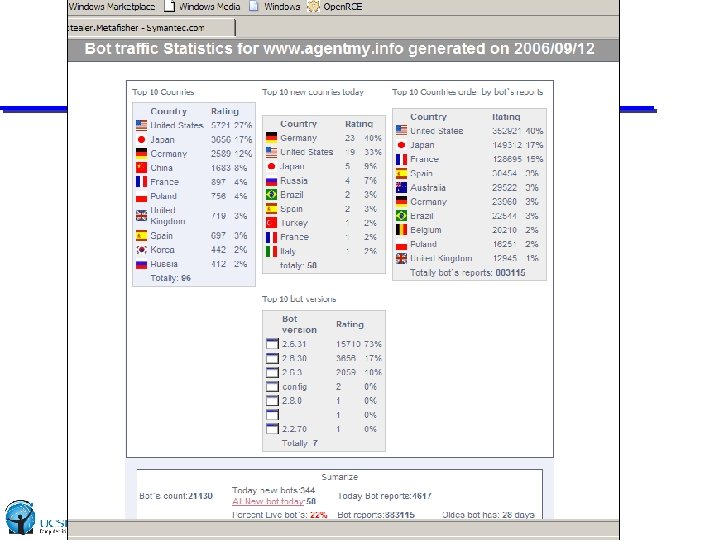
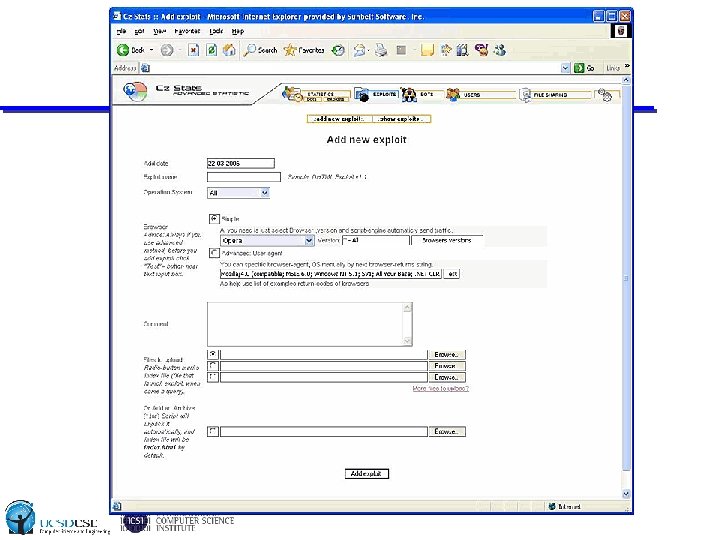
 Emergence of Economic Drivers • In last five years, emergence of profit-making malware u u Anti-spam efforts force spammers to launder e-mail through compromised machines (starts with My. Doom. A, So. Big) “Virtuous” economic cycle transforms nature of threat • Commoditization of compromised hosts u Fluid third-party exchange market (millions of hosts) » Raw bots (range from pennies to dollars) » Value added tier: SPAM proxying (more expensive) • Innovation in both host substrate and its uses u u Sophisticated infection and command/control networks: platform SPAM, piracy, phishing, identity theft, DDo. S are all applications
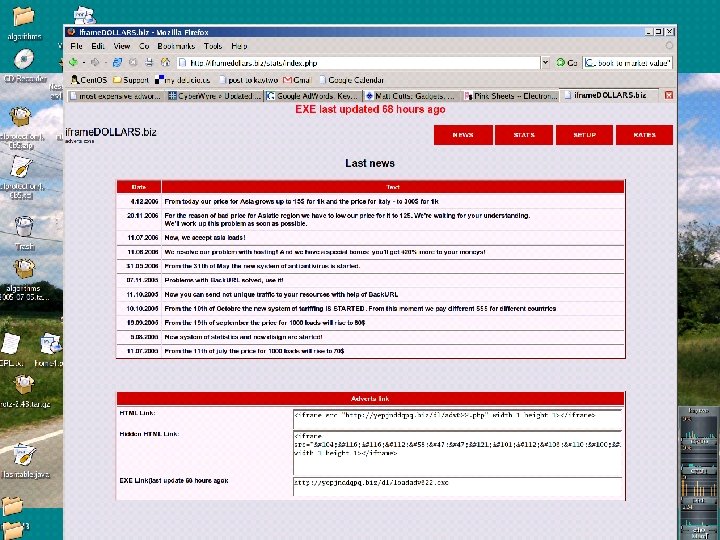
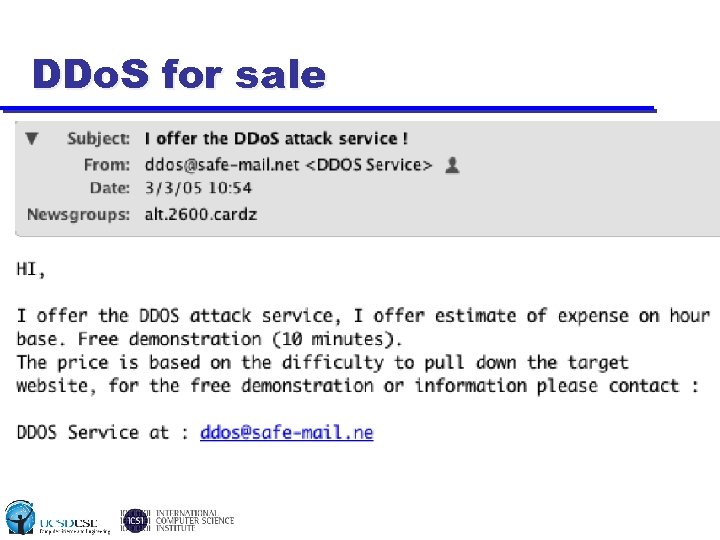 DDo. S for sale • Emergence of economic engine for Internet crime u SPAM, phishing, spyware, etc • Fluid third party markets for illicit digital goods/services u u Bots ~$0. 5/host, special orders, value added tiers Cards, malware, exploits, DDo. S, cashout, etc.
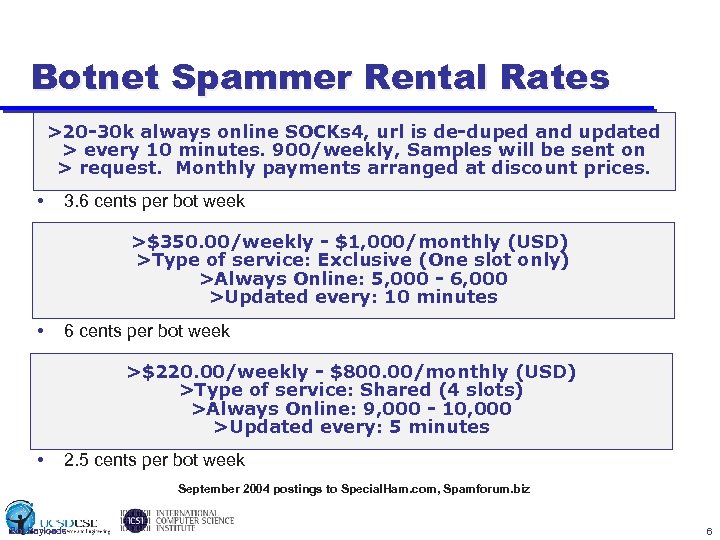 Botnet Spammer Rental Rates >20 -30 k always online SOCKs 4, url is de-duped and updated > every 10 minutes. 900/weekly, Samples will be sent on > request. Monthly payments arranged at discount prices. • 3. 6 cents per bot week >$350. 00/weekly - $1, 000/monthly (USD) >Type of service: Exclusive (One slot only) >Always Online: 5, 000 - 6, 000 >Updated every: 10 minutes • 6 cents per bot week >$220. 00/weekly - $800. 00/monthly (USD) >Type of service: Shared (4 slots) >Always Online: 9, 000 - 10, 000 >Updated every: 5 minutes • 2. 5 cents per bot week September 2004 postings to Special. Ham. com, Spamforum. biz Bot Payloads 6
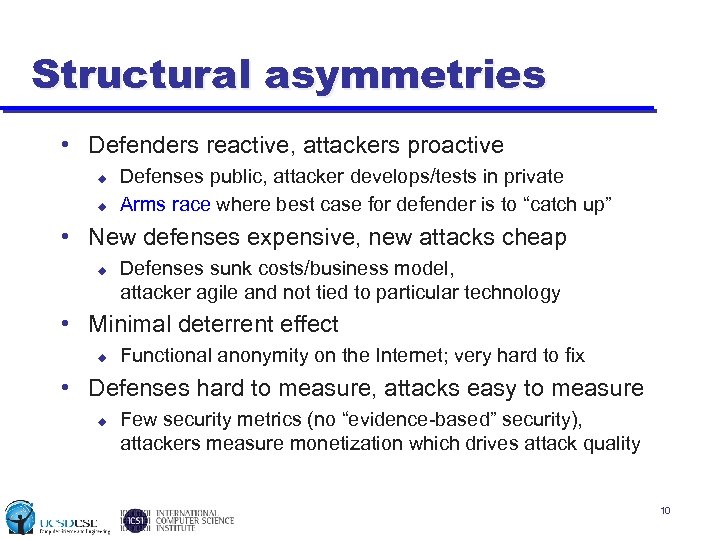 Structural asymmetries • Defenders reactive, attackers proactive u u Defenses public, attacker develops/tests in private Arms race where best case for defender is to “catch up” • New defenses expensive, new attacks cheap u Defenses sunk costs/business model, attacker agile and not tied to particular technology • Minimal deterrent effect u Functional anonymity on the Internet; very hard to fix • Defenses hard to measure, attacks easy to measure u Few security metrics (no “evidence-based” security), attackers measure monetization which drives attack quality 10
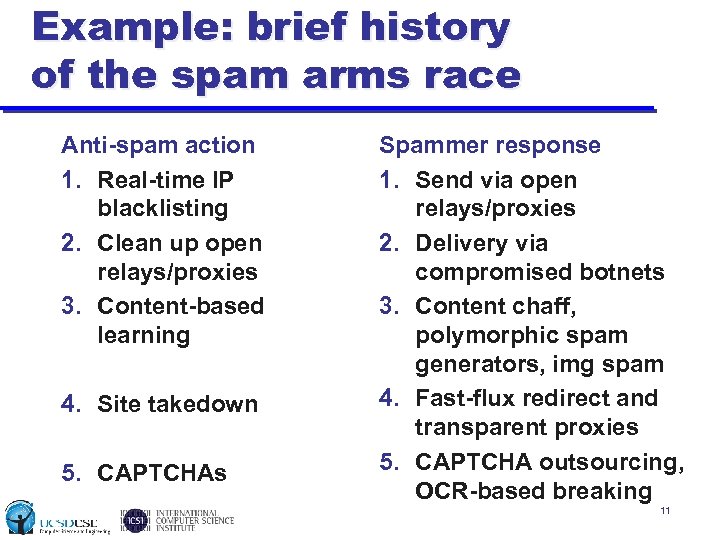 Example: brief history of the spam arms race Anti-spam action 1. Real-time IP blacklisting 2. Clean up open relays/proxies 3. Content-based learning 4. Site takedown 5. CAPTCHAs Spammer response 1. Send via open relays/proxies 2. Delivery via compromised botnets 3. Content chaff, polymorphic spam generators, img spam 4. Fast-flux redirect and transparent proxies 5. CAPTCHA outsourcing, OCR-based breaking 11
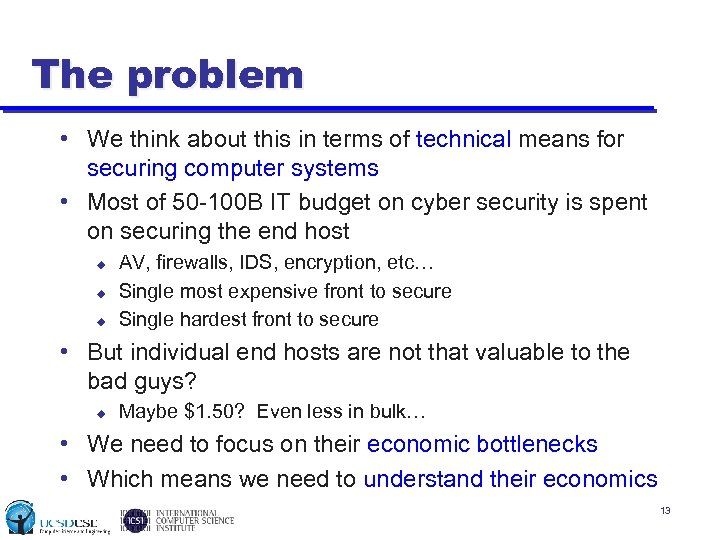 The problem • We think about this in terms of technical means for securing computer systems • Most of 50 -100 B IT budget on cyber security is spent on securing the end host u u u AV, firewalls, IDS, encryption, etc… Single most expensive front to secure Single hardest front to secure • But individual end hosts are not that valuable to the bad guys? u Maybe $1. 50? Even less in bulk… • We need to focus on their economic bottlenecks • Which means we need to understand their economics 13
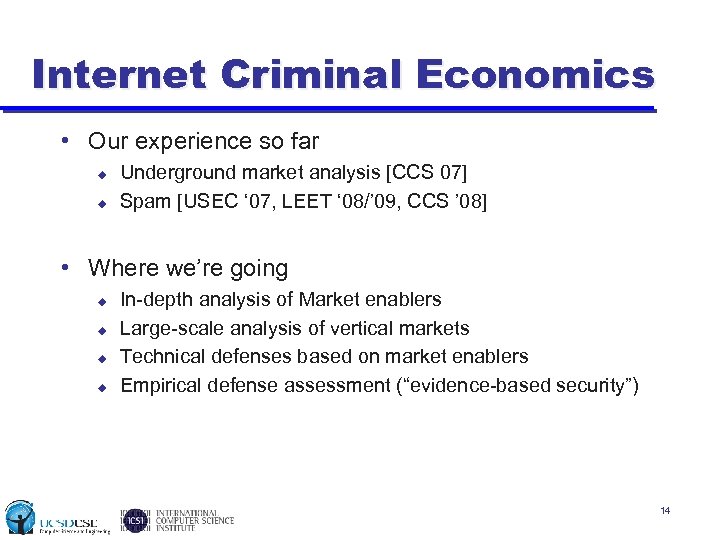 Internet Criminal Economics • Our experience so far u u Underground market analysis [CCS 07] Spam [USEC ‘ 07, LEET ‘ 08/’ 09, CCS ’ 08] • Where we’re going u u In-depth analysis of Market enablers Large-scale analysis of vertical markets Technical defenses based on market enablers Empirical defense assessment (“evidence-based security”) 14
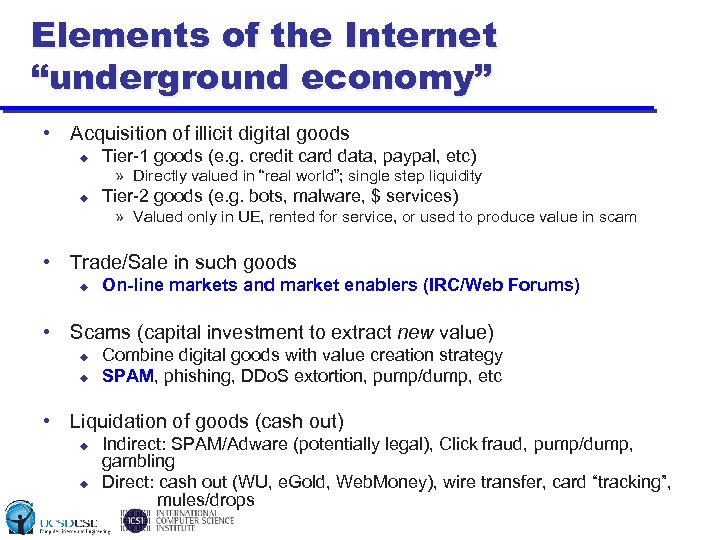 Elements of the Internet “underground economy” • Acquisition of illicit digital goods u Tier-1 goods (e. g. credit card data, paypal, etc) » Directly valued in “real world”; single step liquidity u Tier-2 goods (e. g. bots, malware, $ services) » Valued only in UE, rented for service, or used to produce value in scam • Trade/Sale in such goods u On-line markets and market enablers (IRC/Web Forums) • Scams (capital investment to extract new value) u u Combine digital goods with value creation strategy SPAM, phishing, DDo. S extortion, pump/dump, etc • Liquidation of goods (cash out) u u Indirect: SPAM/Adware (potentially legal), Click fraud, pump/dump, gambling Direct: cash out (WU, e. Gold, Web. Money), wire transfer, card “tracking”, mules/drops
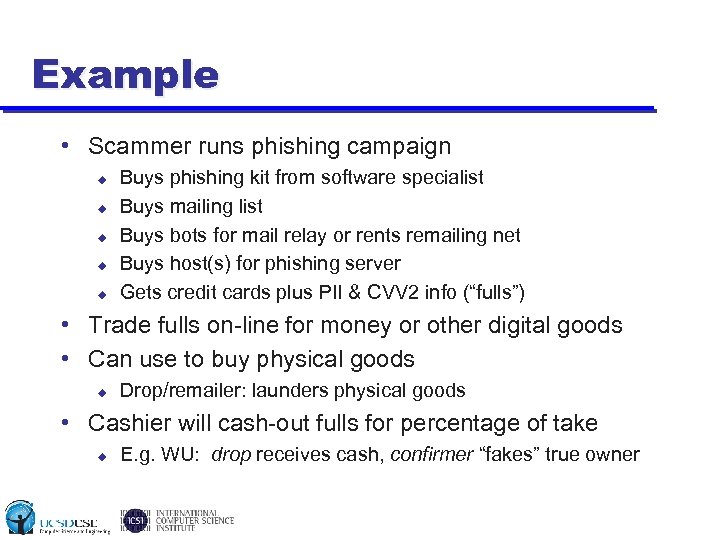 Example • Scammer runs phishing campaign u u u Buys phishing kit from software specialist Buys mailing list Buys bots for mail relay or rents remailing net Buys host(s) for phishing server Gets credit cards plus PII & CVV 2 info (“fulls”) • Trade fulls on-line for money or other digital goods • Can use to buy physical goods u Drop/remailer: launders physical goods • Cashier will cash-out fulls for percentage of take u E. g. WU: drop receives cash, confirmer “fakes” true owner
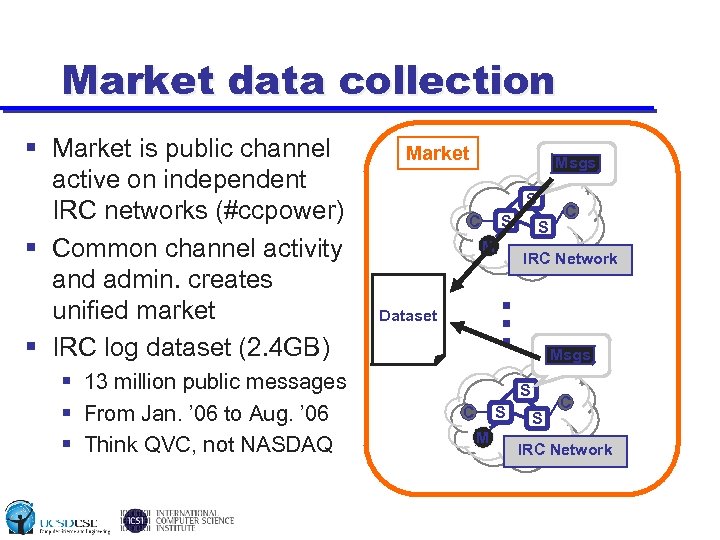 Market data collection § 13 million public messages § From Jan. ’ 06 to Aug. ’ 06 § Think QVC, not NASDAQ Market Msgs S S C M C S IRC Network … § Market is public channel active on independent IRC networks (#ccpower) § Common channel activity and admin. creates unified market § IRC log dataset (2. 4 GB) Dataset Msgs S S C M S C IRC Network
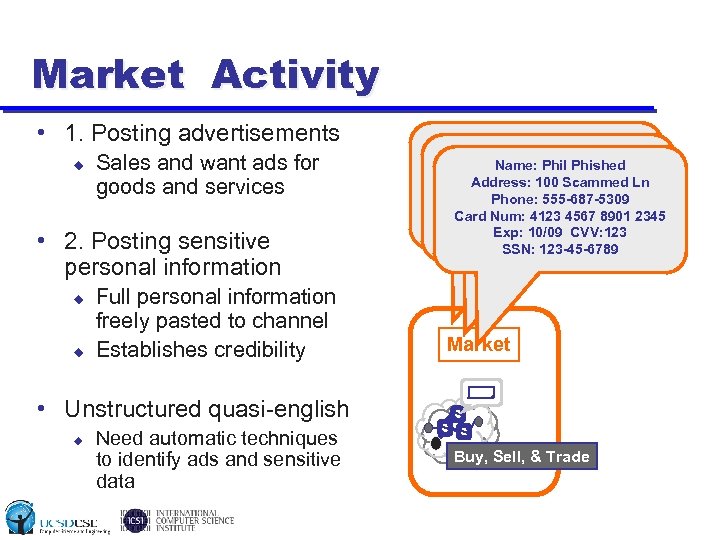 Market Activity • 1. Posting advertisements u Sales and want ads for goods and services • 2. Posting sensitive personal information u u Full personal information freely pasted to channel Establishes credibility • Unstructured quasi-english u Need automatic techniques to identify ads and sensitive data ”have hacked hosts, “i have verified paypal Name: Phil mailer mail lists, php. Phished Address: 100 Scammed Ln accounts with good send to all inbox” Phone: 555 -687 -5309 balance…and i 8901 2345 can Card Num: 4123 4567 cashout paypals” Exp: 10/09 CVV: 123 SSN: 123 -45 -6789 Market S S S Buy, Sell, & Trade
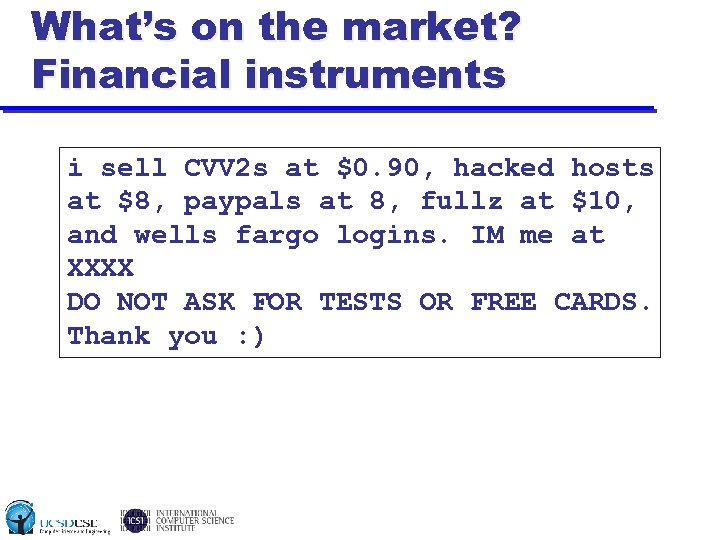 What’s on the market? Financial instruments i sell CVV 2 s at $0. 90, hacked hosts at $8, paypals at 8, fullz at $10, and wells fargo logins. IM me at XXXX DO NOT ASK FOR TESTS OR FREE CARDS. Thank you : )
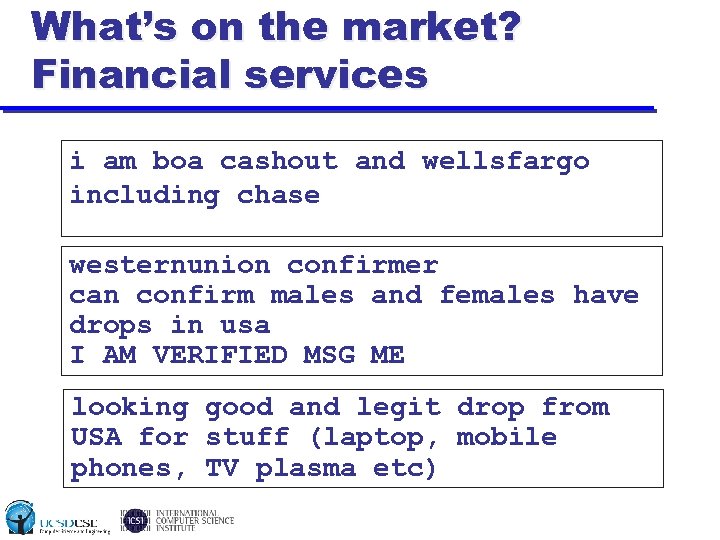 What’s on the market? Financial services i am boa cashout and wellsfargo including chase westernunion confirmer can confirm males and females have drops in usa I AM VERIFIED MSG ME looking good and legit drop from USA for stuff (laptop, mobile phones, TV plasma etc)
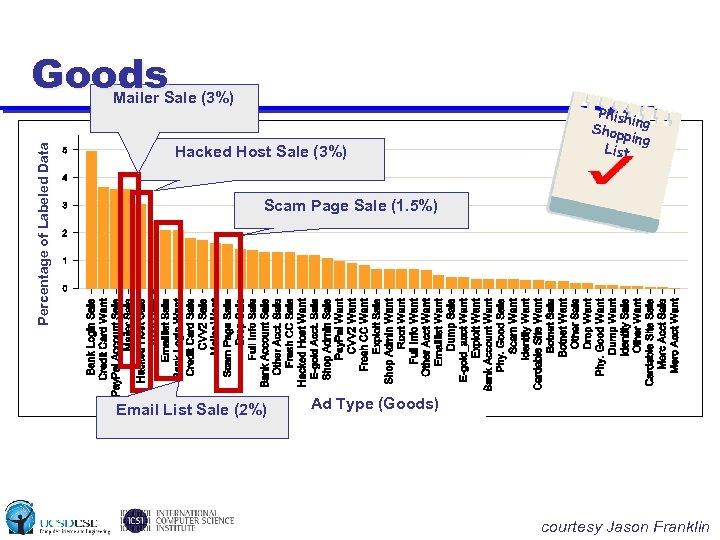 Goods Percentage of Labeled Data Mailer Sale (3%) Hacked Host Sale (3%) Phish in Shopp g ing List Scam Page Sale (1. 5%) Email List Sale (2%) Ad Type (Goods) courtesy Jason Franklin
 Some high bits • Value of “goodwill data” u u u 87 k unique credit cards (w/valid Luhn and BIN #) » Estimate $427. 50 exposure = $37 M Declared value of bank accounts = $54 M But these are only the public numbers, not trades • Reputation u u u Few miscreants will deal with unknown buyers/sellers New entrants establish reputation by providing free samples or services » Post raw credit card, bank account, etc Poor behavior is systematically reported » #rippers channel
 Leads to many questions… • Vertical integration vs open markets? u How much is each? How much transparency? • Who dominates market volume? u u A small number of bigger players? A large number of small players? • What dominates value creation in each segment? • Can we use market data to directly value threat risk? • Where are the bottlenecks? u u Cashout? Market friction (reputation issues) Which bottlenecks amenable to technical means vs economic means/state power. • All unknown… and fairly critical
![Vertical market segment: Spam-based marketing • 100 B+ spam e-mails sent per day [Ironport]](https://present5.com/presentation/23649f0012b67d230ed22be6fbc029ca/image-23.jpg "Vertical market segment: Spam-based marketing • 100 B+ spam e-mails sent per day [Ironport]") Vertical market segment: Spam-based marketing • 100 B+ spam e-mails sent per day [Ironport] u u u Most focused on product/service advertising Some as vector for malware, etc. >$1 B in direct costs [IDC], larger indirect costs 10 -100 x • Range of enablers u Botnet-based mail delivery, spaming software, address list, redirection infrastructure, hosting infrastructure, payment processing, fulfillment • Direct marketing business model u u Cost of delivery < marginal revenue * conversion rate Only works because someone is buying? • Very little empirical data on any of this… 24
Vertical market segment: Spam-based marketing • 100 B+ spam e-mails sent per day [Ironport] u u u Most focused on product/service advertising Some as vector for malware, etc. >$1 B in direct costs [IDC], larger indirect costs 10 -100 x • Range of enablers u Botnet-based mail delivery, spaming software, address list, redirection infrastructure, hosting infrastructure, payment processing, fulfillment • Direct marketing business model u u Cost of delivery < marginal revenue * conversion rate Only works because someone is buying? • Very little empirical data on any of this… 24
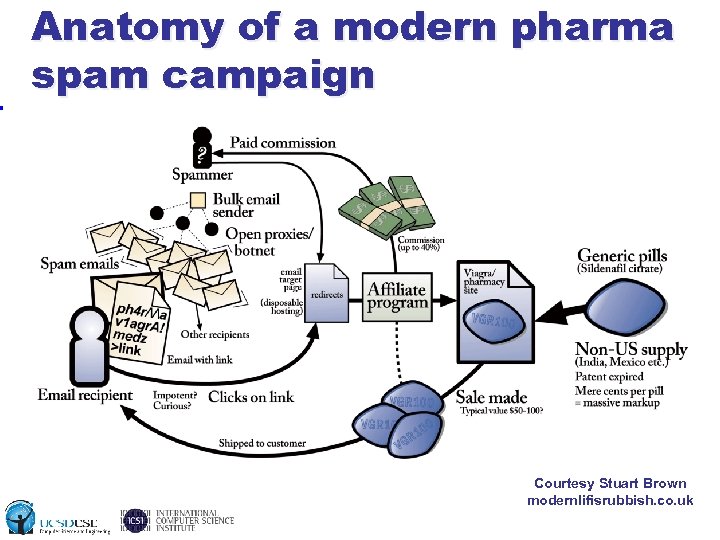 Anatomy of a modern pharma spam campaign Courtesy Stuart Brown modernlifisrubbish. co. uk
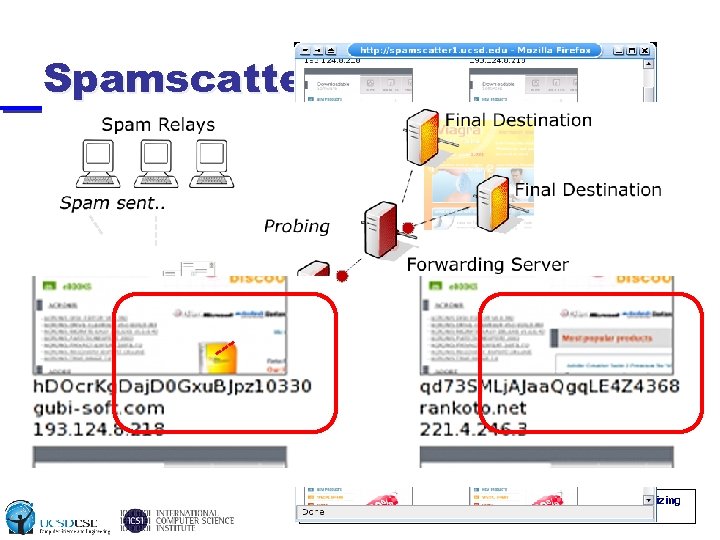 Spamscatter • Goal: Measure and analyze Internet scam hosting infrastructure • Mine spam for URLs to scam sites hosting ad u u u Probe machines hosting the scams over time Follow all redirections (separate redirection infrastructure from hosting infrastructure) Render pages and cluster sites based on image similarity (image shingling) Andreson, Fleizach, Savage and Voelker, Spamscatter: Characterizing Internet Scam hosting Infrastrcuture, USENIX Security 2007.
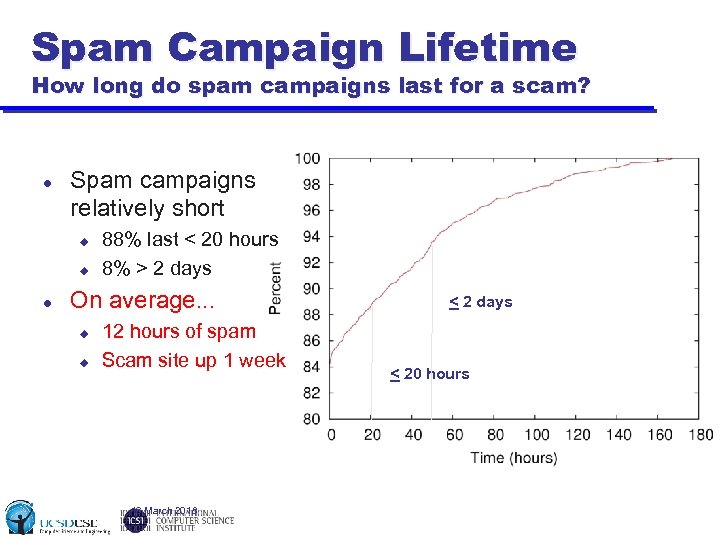 Spam Campaign Lifetime How long do spam campaigns last for a scam? Spam campaigns relatively short u u 88% last < 20 hours 8% > 2 days On average. . . u u 12 hours of spam Scam site up 1 week 16 March 2018 < 2 days < 20 hours
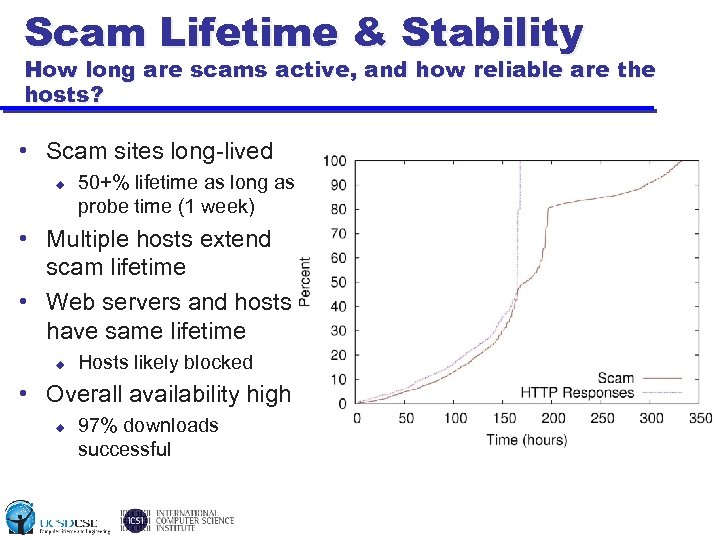 Scam Lifetime & Stability How long are scams active, and how reliable are the hosts? • Scam sites long-lived u 50+% lifetime as long as probe time (1 week) • Multiple hosts extend scam lifetime • Web servers and hosts have same lifetime u Hosts likely blocked • Overall availability high u 97% downloads successful
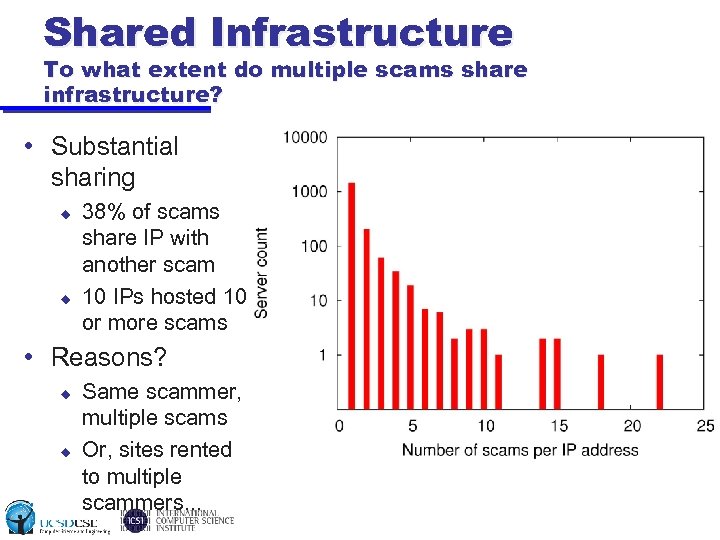 Shared Infrastructure To what extent do multiple scams share infrastructure? • Substantial sharing u u 38% of scams share IP with another scam 10 IPs hosted 10 or more scams • Reasons? u u Same scammer, multiple scams Or, sites rented to multiple scammers. . .
 Looking inside spam campaigns • Virtually all analysis of spam is from standpoint of recipient u How many received, from whom, content of msg, etc? • We really care much more about standpoint of spammer u u How many sent, how many delivered, to whom, for how long, sent how, what kind of countermeasures, how many site visits in response, how many conversions, how much cost, how much revenue? But generally not visible, except to spammer • Approach: botnet infiltration u u Spam sent via botnets, botnets have trust problem wrt compromised hosts Instrumented botnet host offers window into spam operations 30
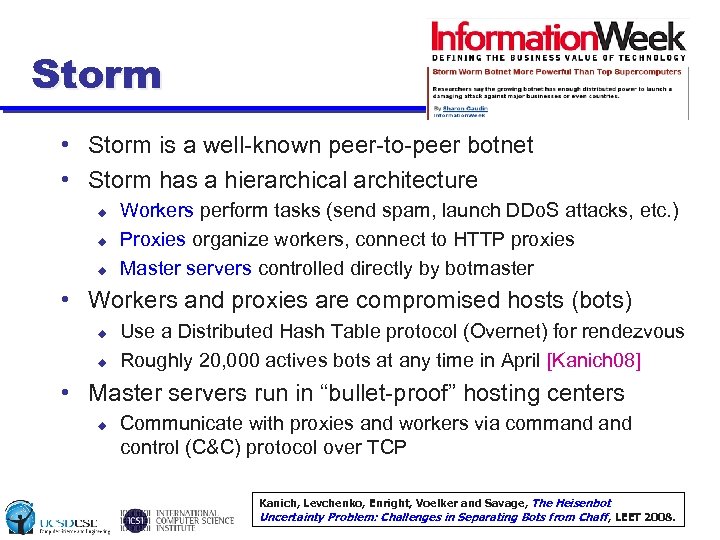 Storm • Storm is a well-known peer-to-peer botnet • Storm has a hierarchical architecture u u u Workers perform tasks (send spam, launch DDo. S attacks, etc. ) Proxies organize workers, connect to HTTP proxies Master servers controlled directly by botmaster • Workers and proxies are compromised hosts (bots) u u Use a Distributed Hash Table protocol (Overnet) for rendezvous Roughly 20, 000 actives bots at any time in April [Kanich 08] • Master servers run in “bullet-proof” hosting centers u Communicate with proxies and workers via command control (C&C) protocol over TCP Kanich, Levchenko, Enright, Voelker and Savage, The Heisenbot 31 Spamalytics Uncertainty Problem: Challenges in Separating Bots from Chaff, LEET 2008.
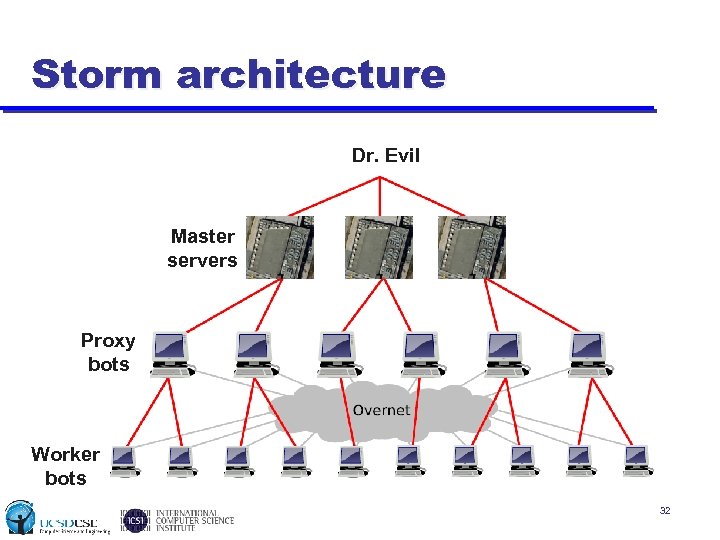 Storm architecture Dr. Evil Master servers Proxy bots Worker bots 32
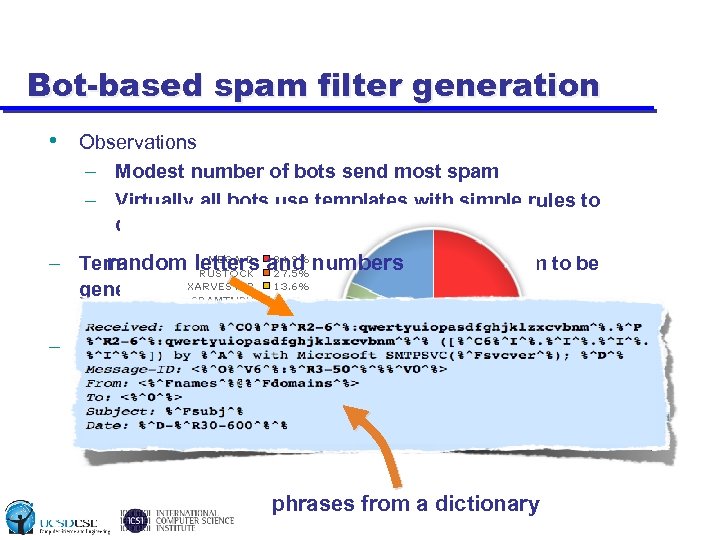
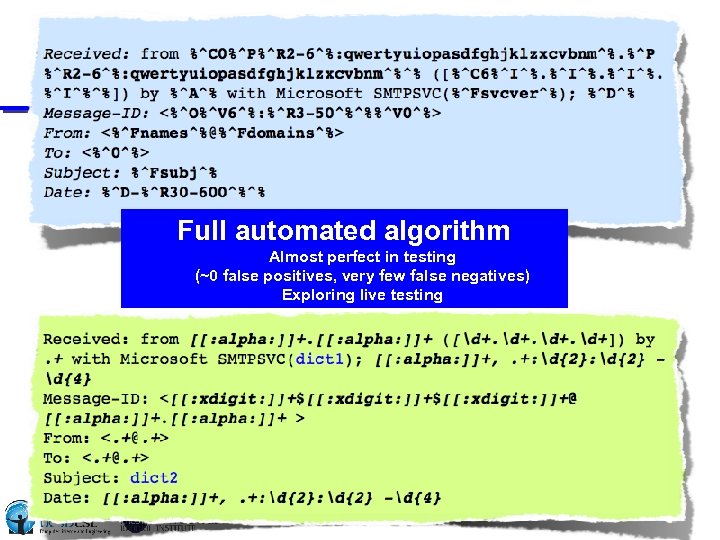
![Storm spam campaigns Workers request “updates” to send spam [Kreibich 08] u u Dictionaries:](https://present5.com/presentation/23649f0012b67d230ed22be6fbc029ca/image-32.jpg "Storm spam campaigns Workers request “updates” to send spam [Kreibich 08] u u Dictionaries:") Storm spam campaigns Workers request “updates” to send spam [Kreibich 08] u u Dictionaries: names, domains, URLs, etc. Email templates for producing polymorphic spam » Macros instantiate fields: %^Fdomains^% from domains dict u Lists of target email addresses (batches of 500 -1000 at a time) Workers immediately act on these updates u u Create a unique message for each email address Send the message to the target Report the results (success, failure) back to proxies Send harvested e-mail addresses Many campaign types u Self-propagation malware, pharmaceutical, stocks, phishing, … Kreibich, Kanich, Levchenko, Enright, Voelker, Paxson and Savage, 33 On the Spam Campaign Trail, LEET 2008.
Storm spam campaigns Workers request “updates” to send spam [Kreibich 08] u u Dictionaries: names, domains, URLs, etc. Email templates for producing polymorphic spam » Macros instantiate fields: %^Fdomains^% from domains dict u Lists of target email addresses (batches of 500 -1000 at a time) Workers immediately act on these updates u u Create a unique message for each email address Send the message to the target Report the results (success, failure) back to proxies Send harvested e-mail addresses Many campaign types u Self-propagation malware, pharmaceutical, stocks, phishing, … Kreibich, Kanich, Levchenko, Enright, Voelker, Paxson and Savage, 33 On the Spam Campaign Trail, LEET 2008.
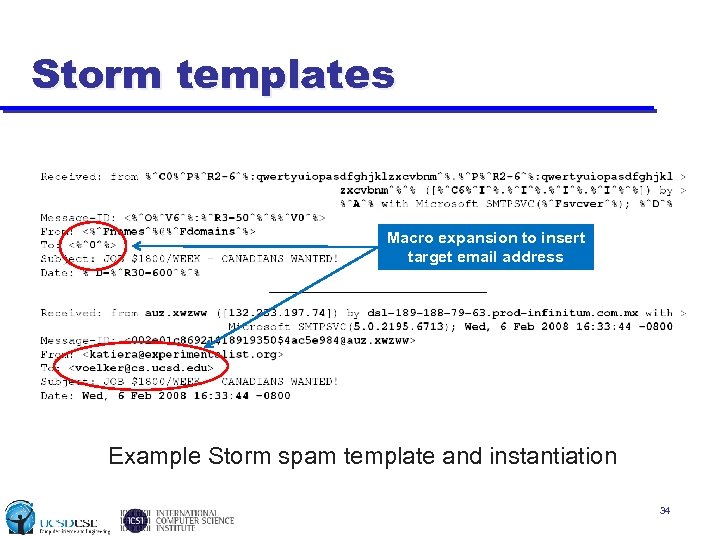 Storm templates Macro expansion to insert target email address Example Storm spam template and instantiation 34
![Storm in action Received: from dkjs. sgdsz ([132. 233. 197. 74]) by dsl-189 -188](https://present5.com/presentation/23649f0012b67d230ed22be6fbc029ca/image-34.jpg "Storm in action Received: from dkjs. sgdsz ([132. 233. 197. 74]) by dsl-189 -188") Storm in action Received: from dkjs. sgdsz ([132. 233. 197. 74]) by dsl-189 -188 -7963. prod-infinitum. com. mx with Microsoft SMTPSVC(5. 0. 2195. 6713); Received: from auz. xwzww Wed, 6 Feb 2008 16: 33: 44 -0800 ([132. 233. 197. 74]) Received: from auz. xwzww by dsl-189 -188 -79 From:
Storm in action Received: from dkjs. sgdsz ([132. 233. 197. 74]) by dsl-189 -188 -7963. prod-infinitum. com. mx with Microsoft SMTPSVC(5. 0. 2195. 6713); Received: from auz. xwzww Wed, 6 Feb 2008 16: 33: 44 -0800 ([132. 233. 197. 74]) Received: from auz. xwzww by dsl-189 -188 -79 From:
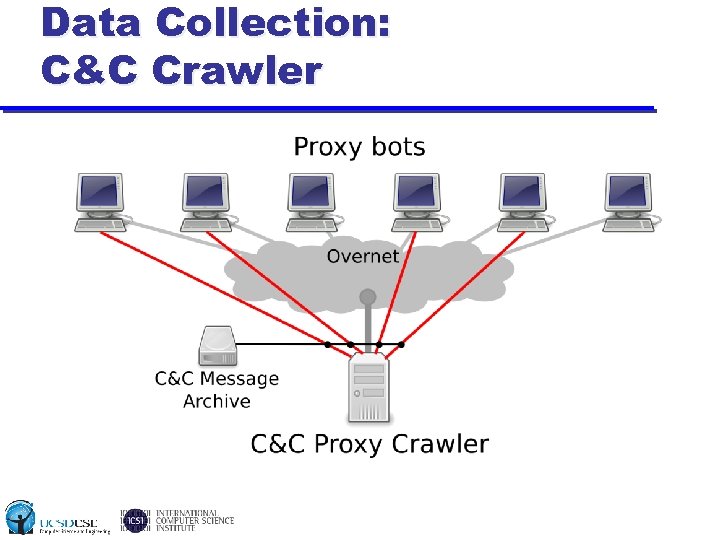 Data Collection: C&C Crawler
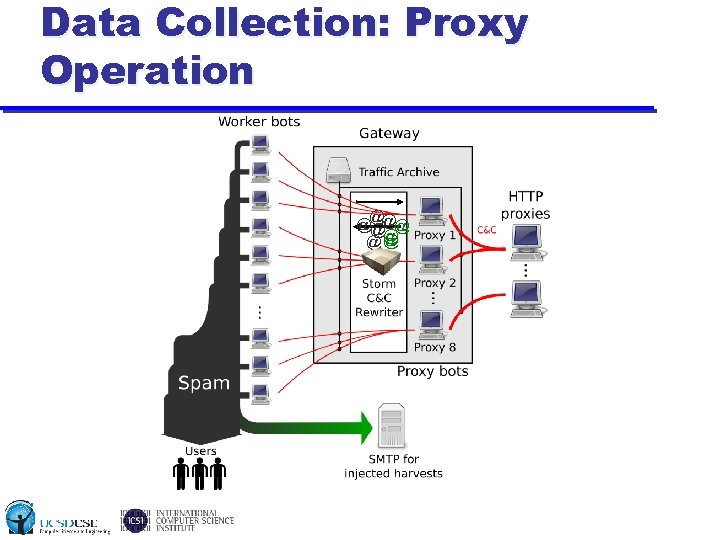 Data Collection: Proxy Operation @ @@ @@
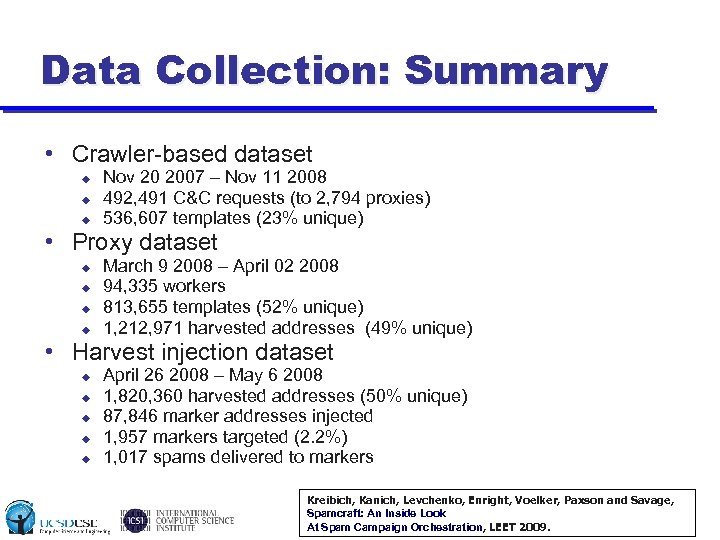 Data Collection: Summary • Crawler-based dataset u u u Nov 20 2007 – Nov 11 2008 492, 491 C&C requests (to 2, 794 proxies) 536, 607 templates (23% unique) • Proxy dataset u u March 9 2008 – April 02 2008 94, 335 workers 813, 655 templates (52% unique) 1, 212, 971 harvested addresses (49% unique) • Harvest injection dataset u u u April 26 2008 – May 6 2008 1, 820, 360 harvested addresses (50% unique) 87, 846 marker addresses injected 1, 957 markers targeted (2. 2%) 1, 017 spams delivered to markers Kreibich, Kanich, Levchenko, Enright, Voelker, Paxson and Savage, Spamcraft: An Inside Look At Spam Campaign Orchestration, LEET 2009.
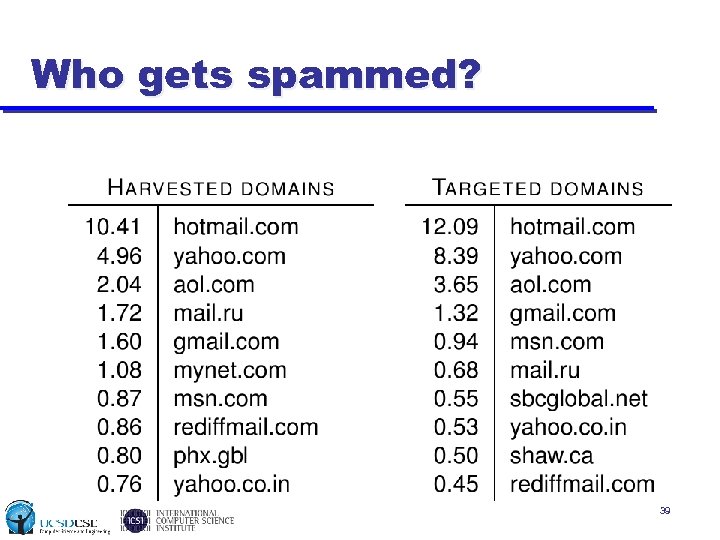 Who gets spammed? 39
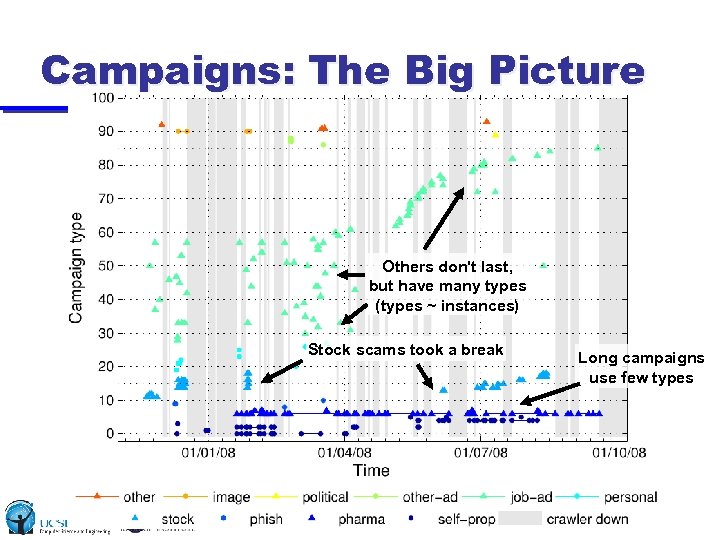 Campaigns: The Big Picture Others don't last, but have many types (types ~ instances) Stock scams took a break Long campaigns use few types
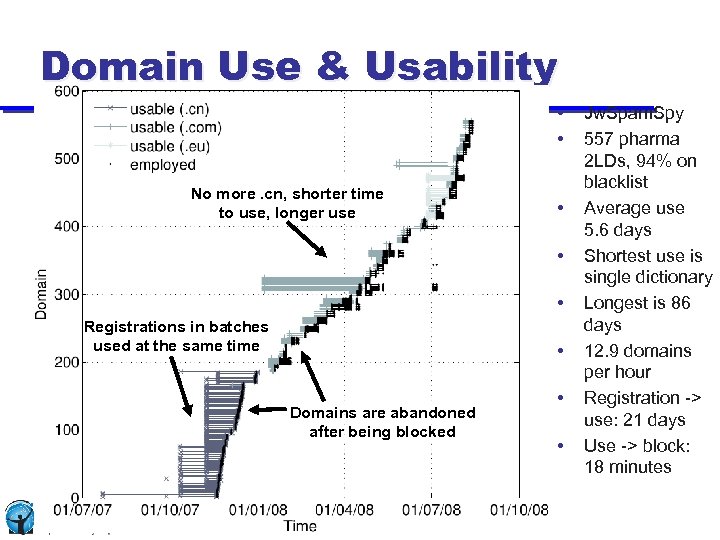 Domain Use & Usability • • No more. cn, shorter time to use, longer use • • • Registrations in batches used at the same time • Domains are abandoned after being blocked • • Jw. Spam. Spy 557 pharma 2 LDs, 94% on blacklist Average use 5. 6 days Shortest use is single dictionary Longest is 86 days 12. 9 domains per hour Registration -> use: 21 days Use -> block: 18 minutes
 Address Sourcing • 10, 000 addresses sampled from harvests and target lists • Web-searches on Google • Only available on infected machines: u u 76% of harvested addresses 87% of targeted addresses • Web crawling for addresses unlikely
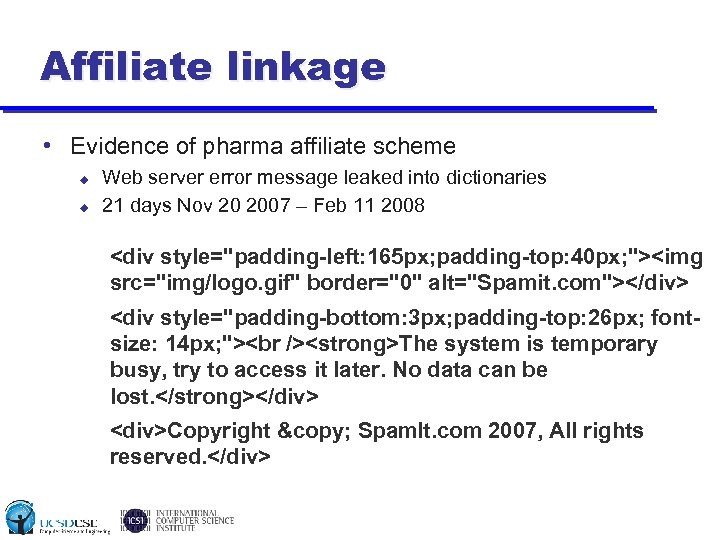 Affiliate linkage • Evidence of pharma affiliate scheme u u Web server error message leaked into dictionaries 21 days Nov 20 2007 – Feb 11 2008
 Estimating spam profits • Key basic inequality: (Delivery Cost) < (Conversion Rate) x (Marginal Revenue) • We have some handle on two of these u u • Delivery cost to send spam » Outsourced cost: retail purchase price < $70/M addrs » In-house cost: development/management labor Marginal revenue » Average pharma sale of $100, affiliate commissions ≈ 50% Conversion rate is hard to measure directly • • We provided first empirical measurement of conversion By rewriting requests sent through proxies under our control 44
![Modifying template links Received: from dkjs. sgdsz ([132. 233. 197. 74]) by dsl-189 -188](https://present5.com/presentation/23649f0012b67d230ed22be6fbc029ca/image-44.jpg "Modifying template links Received: from dkjs. sgdsz ([132. 233. 197. 74]) by dsl-189 -188") Modifying template links Received: from dkjs. sgdsz ([132. 233. 197. 74]) by dsl-189 -188 -7963. prod-infinitum. com. mx with spammerdomain. com Microsoft SMTPSVC(5. 0. 2195. 6713); Wed, 6 Feb 2008 16: 33: 44 -0800 spammerdomain 2. com From:
Modifying template links Received: from dkjs. sgdsz ([132. 233. 197. 74]) by dsl-189 -188 -7963. prod-infinitum. com. mx with spammerdomain. com Microsoft SMTPSVC(5. 0. 2195. 6713); Wed, 6 Feb 2008 16: 33: 44 -0800 spammerdomain 2. com From:
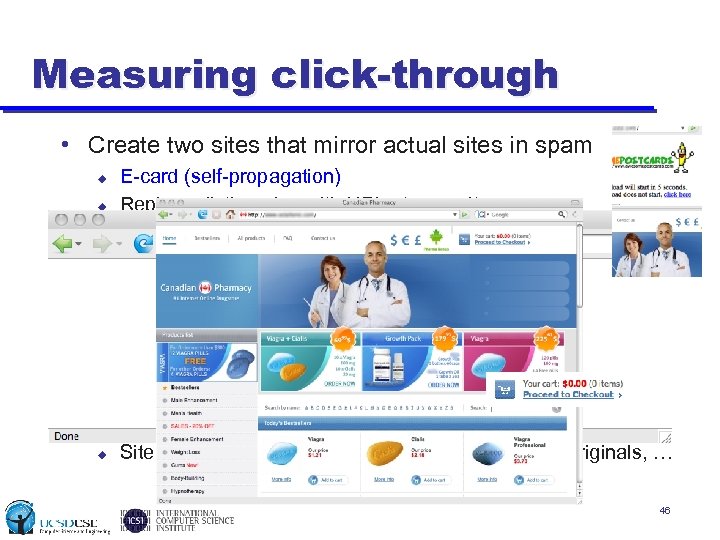 Measuring click-through • Create two sites that mirror actual sites in spam u u E-card (self-propagation) and pharmaceutical Replace dictionaries with URLs to our sites • E-card (self-prop) site u u Link to benign executable that POSTs to our server Log all POSTs to track downloads and executions • Pharma site u u Log all accesses up through clicks on “purchase” Track the contents of shopping carts • Strive for verisimilitude to remove bias (spam filtering) u Site content is similar, URLs have same format as originals, … 46
 Measuring Delivery • Create various test email accounts u u u At Web mail providers: Hotmail, Yahoo!, Gmail Behind a commercial spam filtering appliance As SMTP sinks: accept every message delivered • Put email addresses in Storm target delivery lists • Log all emails delivered to these addresses u Both labeled as spam (“Junk E-mail”) and in inbox 47
 Ethical context • Consequentialism • First, do no harm (users no worse off than before) u We do not send any spam » Proxies are relays, worker bots send spam u We do not enable additional spam to be sent » Workers would have connected to some other proxy u We do not enable spam to be sent to additional users » Users are already on target lists, only add control addresses • Second, reduce harm where possible u Our pharma sites don’t take credit card info u Our e-card sites don’t export malicious code 48
 Legal context • Warning: IANAL • CAN*SPAM • Subject to strong definition of “initiator”; we don’t fit it • ECPA • Our proxy is directly addressed by worker bots (“party to” communication carve out) • CFAA • We do not contact worker bots, they contact us (“unauthorized access”? ) • We do not cause any information to be extracted or any fundamentally new activity to take place • Hard to find a good theory of damages (functionally indistinguishable -- consequentialism) 49
 But… • In this kind of work there is little precedent • No agency to get permission; no way to get indemnity • Lawyers tend to say “I believe this activity has low risk of…” • We worked with two different lawyers to make sure • Thus, we communicate our activities to a lot of people • • Security researchers in industry, academia Affected network operators/registrars Law enforcement FTC 50
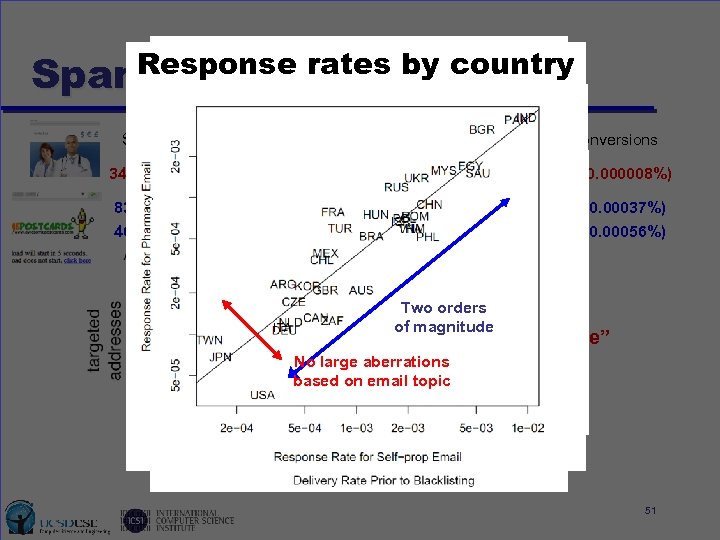 Effects rates by country Response of Blacklisting Spam pipeline Feed) (CBL Spam filtering software Sent MTA Inbox Visits Conversions Unused • 347. 5 MThe fraction (24%) 82. 7 M of spam delivered into user(0. 003%) 28 (0. 000008%) 10, 522 inboxes depends on the spam filtering software used 83. 6 M 40. 1 M • u 21. 1 M (25%) 3, 827 (0. 005%) Combination of site filtering (e. g. , blacklists) and 316 (0. 00037%) --content filtering (e. g. , spamassassin) (0. 005%) 225 (0. 00056%) 10. 1 M (25%) 2, 721 Difficult to generalize, but we can use our test accounts for specific services Other filtering Pharma: 12 Two orders of magnitude M spam emails for one “purchase” No large aberrations based on email topic E-card: 1 in 10 that was delivered to the binary Fraction of spam sent visitors execute inboxes Effective 51
 The spammer’s bottom line • Recall that we tracked the contents of shopping carts • Using the prices on the actual site, we can estimate the value of the purchases u 28 purchases for $2, 731 over 25 days, or $100/day ($140 active) • We only interposed on a fraction of the workers u u Connected to approx 1. 5% of workers Back-of-the-envelope (be very careful) $7 -10 k/day for all, or ~$3 M/year With a 50% affiliate commission, $1. 5 M/year revenue Not enough to be profitable unless spammer = botnet owner • For self-propagation u Roughly 3 -9 k new bots/day 52
 We’re on the cusp… • This is a wide open area with huge impact potential • We have tremendous momentum and experience here • Over several years we’ve brokered the commercial partnerships necessary to do this work (plus fed advice) Active Data Providers Active Research Partnerships • Key agreements in UC: active purchasing experiments 53
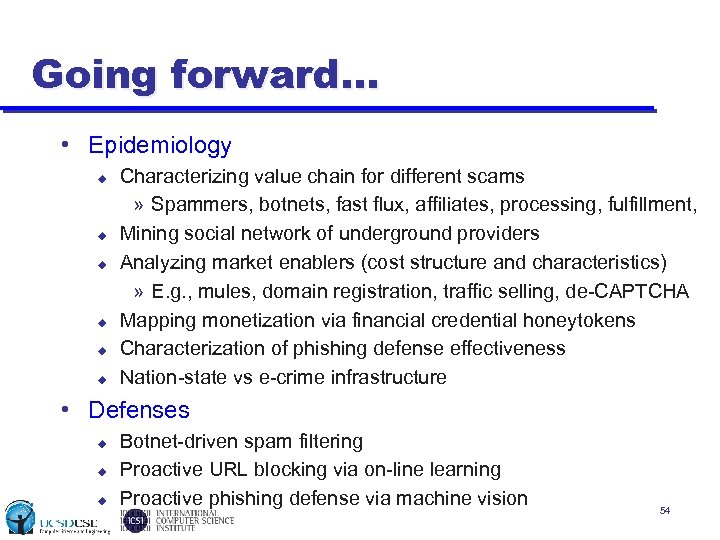 Going forward… • Epidemiology u u u Characterizing value chain for different scams » Spammers, botnets, fast flux, affiliates, processing, fulfillment, Mining social network of underground providers Analyzing market enablers (cost structure and characteristics) » E. g. , mules, domain registration, traffic selling, de-CAPTCHA Mapping monetization via financial credential honeytokens Characterization of phishing defense effectiveness Nation-state vs e-crime infrastructure • Defenses u u u Botnet-driven spam filtering Proactive URL blocking via on-line learning Proactive phishing defense via machine vision 54
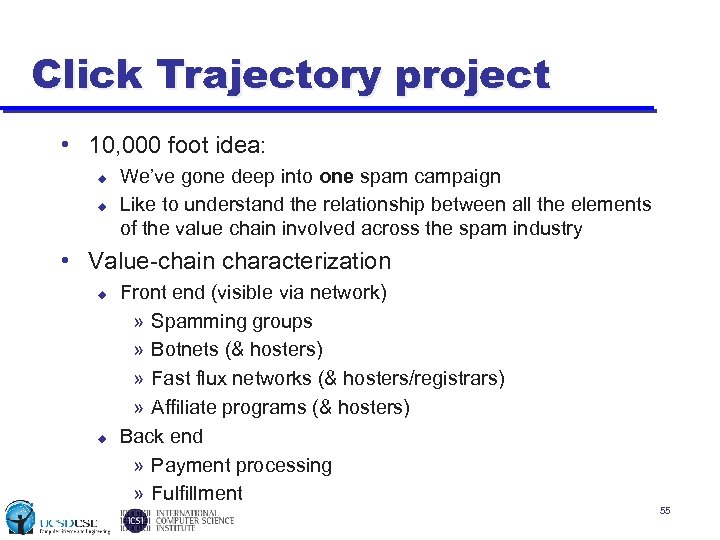 Click Trajectory project • 10, 000 foot idea: u u We’ve gone deep into one spam campaign Like to understand the relationship between all the elements of the value chain involved across the spam industry • Value-chain characterization u u Front end (visible via network) » Spamming groups » Botnets (& hosters) » Fast flux networks (& hosters/registrars) » Affiliate programs (& hosters) Back end » Payment processing » Fulfillment 55
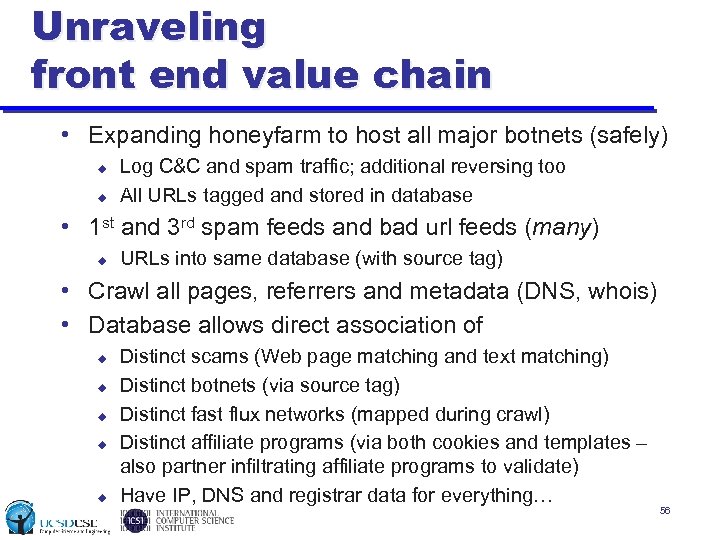 Unraveling front end value chain • Expanding honeyfarm to host all major botnets (safely) u u Log C&C and spam traffic; additional reversing too All URLs tagged and stored in database • 1 st and 3 rd spam feeds and bad url feeds (many) u URLs into same database (with source tag) • Crawl all pages, referrers and metadata (DNS, whois) • Database allows direct association of u u u Distinct scams (Web page matching and text matching) Distinct botnets (via source tag) Distinct fast flux networks (mapped during crawl) Distinct affiliate programs (via both cookies and templates – also partner infiltrating affiliate programs to validate) Have IP, DNS and registrar data for everything… 56
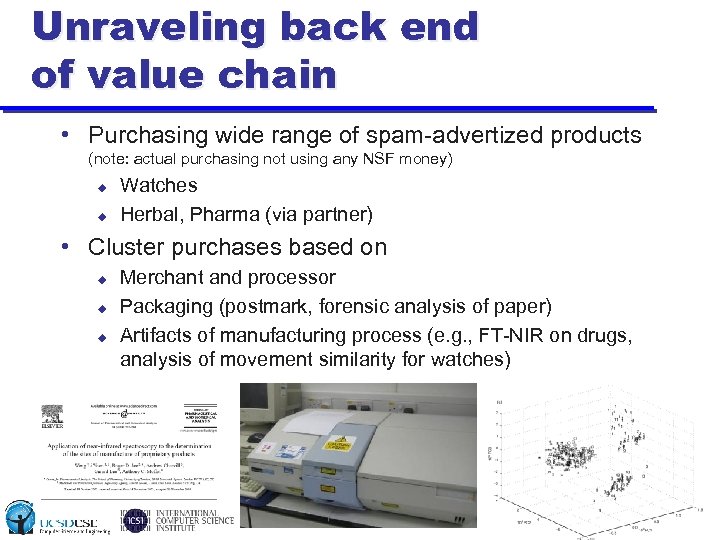 Unraveling back end of value chain • Purchasing wide range of spam-advertized products (note: actual purchasing not using any NSF money) u u Watches Herbal, Pharma (via partner) • Cluster purchases based on u u u Merchant and processor Packaging (postmark, forensic analysis of paper) Artifacts of manufacturing process (e. g. , FT-NIR on drugs, analysis of movement similarity for watches) 57
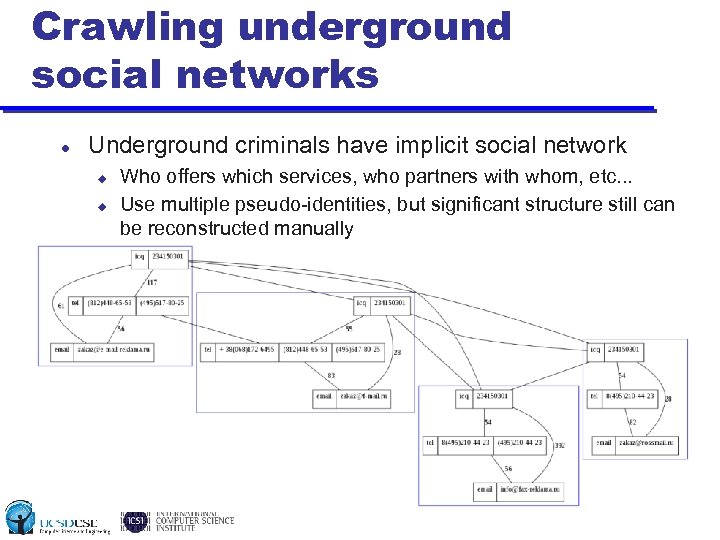 Crawling underground social networks Underground criminals have implicit social network u u Who offers which services, who partners with whom, etc. . . Use multiple pseudo-identities, but significant structure still can be reconstructed manually Goal: build social network via crawling/datamining u u Identifiers (ICQ, phone, etc) Web page content, linkage on forum sites (who referenced whom, etc)
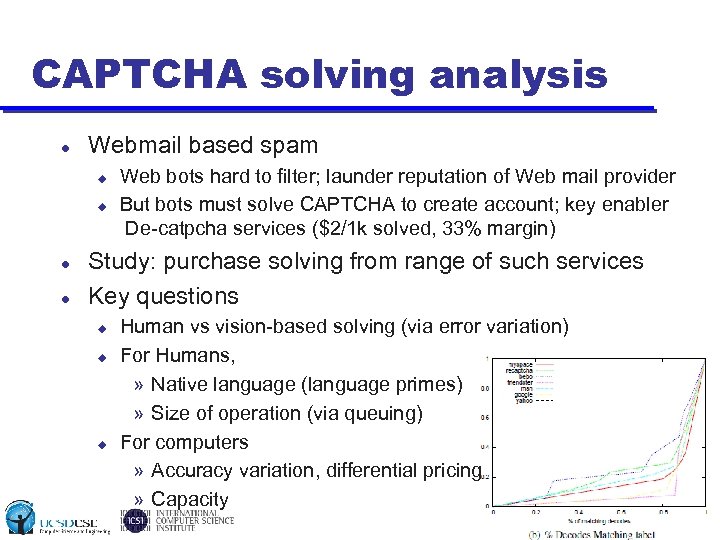 CAPTCHA solving analysis Webmail based spam u u Web bots hard to filter; launder reputation of Web mail provider But bots must solve CAPTCHA to create account; key enabler De-catpcha services ($2/1 k solved, 33% margin) Study: purchase solving from range of such services Key questions u u u Human vs vision-based solving (via error variation) For Humans, » Native language (language primes) » Size of operation (via queuing) For computers » Accuracy variation, differential pricing » Capacity
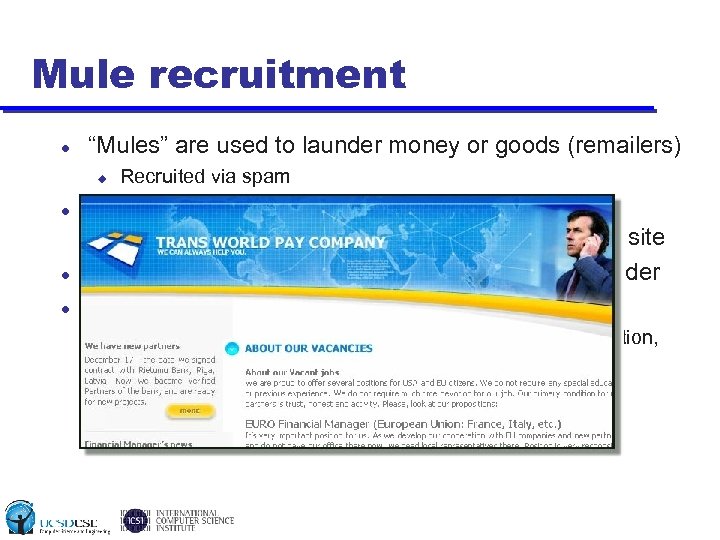 Mule recruitment “Mules” are used to launder money or goods (remailers) u Recruited via spam Building classifier that identifies mule spam automatically; cluster based on e-mail content and site Engage in automated conversation with e-mail sender Goal: u Infer size of mule operation, turn-over, level of sophistication, changes in demand, etc.
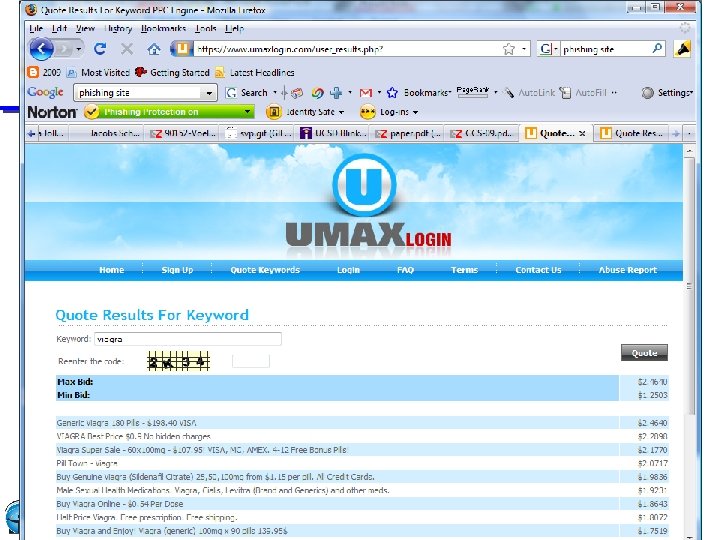 Traffic selling On-line underground market for click traffic (parallel to Google/Yahoo) u u For direction to particular scams (e. g. pharma, counterfeits, etc) For use in click fraud/PTC scams Active purchasing of traffic streams u u Characterize traffic streams themselves » Real people, country of origin, time on site, click through, etc » Survey of subset of people (why are you here) Differential pricing for different click streams
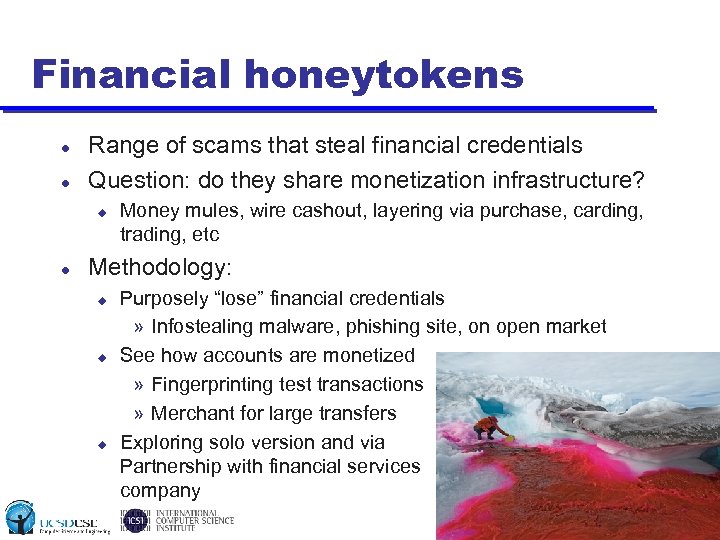 Financial honeytokens Range of scams that steal financial credentials Question: do they share monetization infrastructure? u Money mules, wire cashout, layering via purchase, carding, trading, etc Methodology: u u u Purposely “lose” financial credentials » Infostealing malware, phishing site, on open market See how accounts are monetized » Fingerprinting test transactions » Merchant for large transfers Exploring solo version and via Partnership with financial services company
 Scam domain registration Web-based crime is built on cheap and easy domain registration, but little understood We now have full feed for. com, . net and. org (others) Look at pattern of use for scam domains (ala w/Storm) u u Time to use, length of use, registrar agility, etc Different between FF domains and hosting domains Mining registrant records u Either identify template or tie into social network
 Phishing defense value • We have three kinds of phishing defenses u u u Spam filtering: stops subset from getting known e-mails lures Toolbars: stop subset from clicking on a known phishing site Takedown: stop everyone from reaching known phishing site • But… how much do they each matter (i. e. , to the phisher) and which is worth additional investment? • Dataset u u Categorize phish e-mail and send through current filters Track current toolbar blacklists Track site lifetime (i. e. takedown) Estimating click through (Taylor webalizer trick, DNS caching) 64
 Assessing Attacks By Nation-States • Air. Jaldi is the ISP for the Nation of Tibet u u 20, 000 users in wireless deployment in Dharamsala (nation-in-exile) Maintains Tibetan nation’s web presence (San Jose) • At both locations we’ve deployed Bro monitors • Goal: can we observe attacks originating for nation-state purposes rather than cybercrime? u u u San Jose location has “control”: Air. Jaldi has non-Tibetan customers too, can partition address space Control for Dharamsala deployment harder, but working on it … Initial data captured prior to Ghost. Net story indeed exhibits Ghost. Net infections = direct subversion from China • Meta-question: how much similarity between e-crime/nationstate methods/infrastructure?
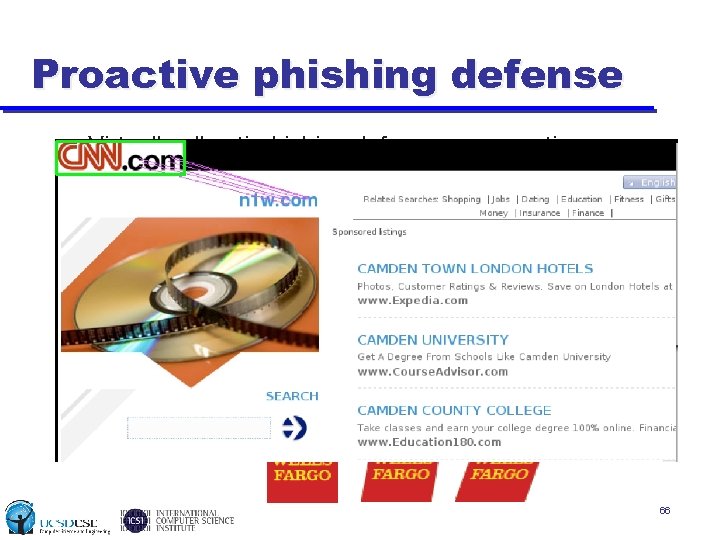 Proactive phishing defense • Virtually all anti-phishing defenses are reactive • Proactive defense via browser-based logo identification u Phishing campaigns all use logos or variations as trust cues • SIFT feature matching invariant (rotation, shearing, scale) 66
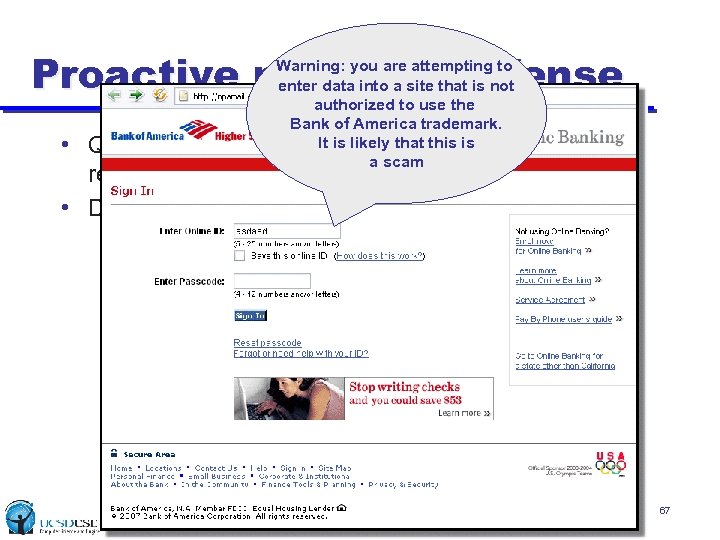 Proactive phishing defense Warning: you are attempting to enter data into a site that is not authorized to use the Bank of America trademark. provider It is likely thatfor domains) (ala SPF this is a scam • Query brand on recognized logo – is IP address authorized to display • Delay notification until user attempts to enter data 67
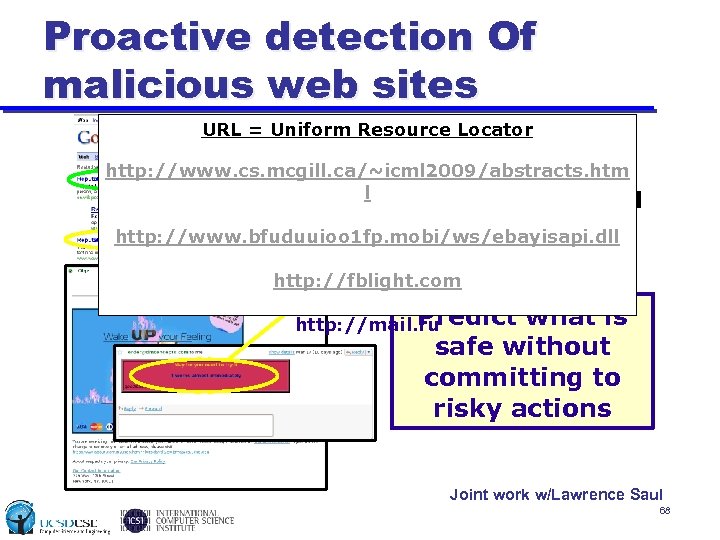 Proactive detection Of malicious web sites URL = Uniform Resource • Safe URL? Locator • Web exploit? http: //www. cs. mcgill. ca/~icml 2009/abstracts. htm l • Spam-advertised site? http: //www. bfuduuioo 1 fp. mobi/ws/ebayisapi. dll • Phishing site? http: //fblight. com Predict http: //mail. ru what is safe without committing to risky actions Joint work w/Lawrence Saul 68
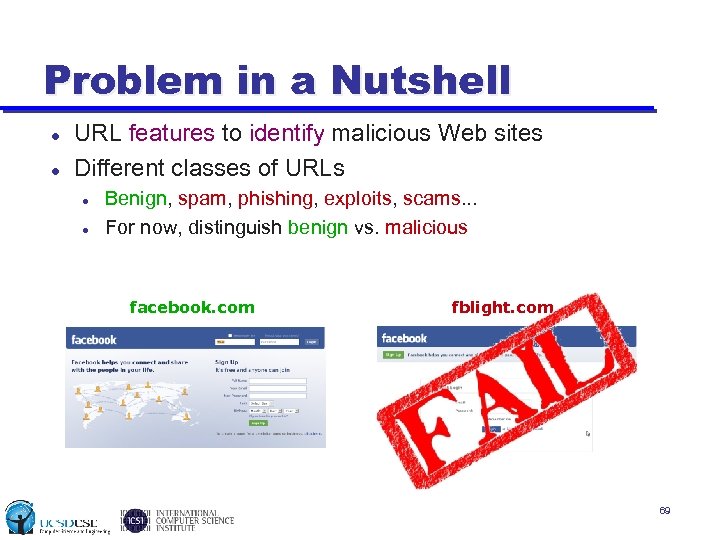 Problem in a Nutshell URL features to identify malicious Web sites Different classes of URLs Benign, spam, phishing, exploits, scams. . . For now, distinguish benign vs. malicious facebook. com fblight. com 69
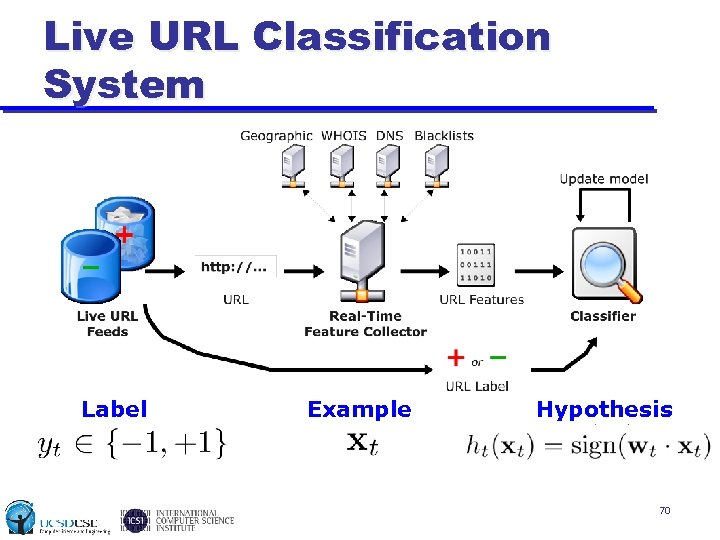 Live URL Classification System Label Example Hypothesis 70
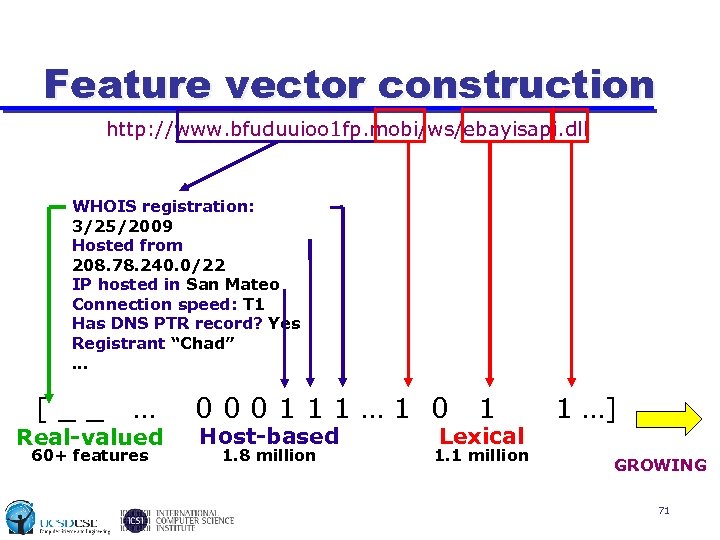 Feature vector construction http: //www. bfuduuioo 1 fp. mobi/ws/ebayisapi. dll WHOIS registration: 3/25/2009 Hosted from 208. 78. 240. 0/22 IP hosted in San Mateo Connection speed: T 1 Has DNS PTR record? Yes Registrant “Chad”. . . [__ … Real-valued 60+ features 000111… 1 0 Host-based 1. 8 million 1 Lexical 1. 1 million 1 …] GROWING 71
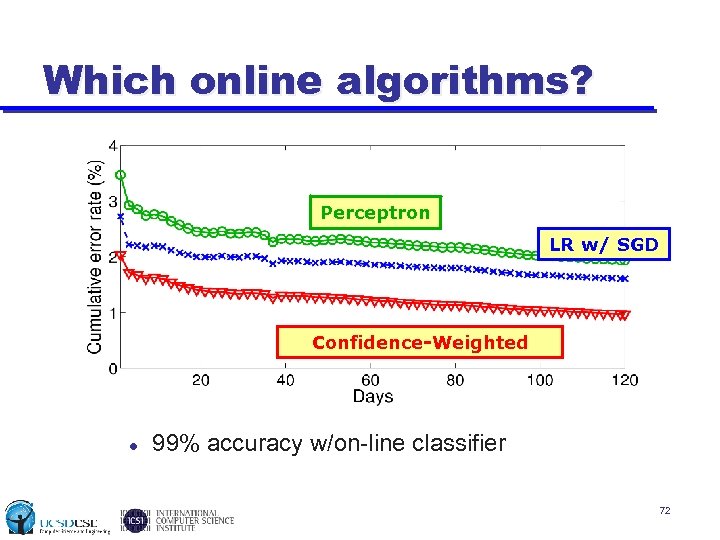 Which online algorithms? Perceptron LR w/ SGD Confidence-Weighted 99% accuracy w/on-line classifier 72
 Meta-points on URL classification • Two big practical issues for using machine learning u u Much work doesn’t scale to large-scale problems Batch SVM-type strategies adapt slowly and don’t work well in practice (adversary just changes from day-to-day) • We’ve been working closely with a large Web-mail provider on this project u u u Scales to their problem size Online update adapts quickly Performs better than their current strategy (they have reimplemented our scheme and tested w/live data) 73
 Bot-based spam filter generation • Observations – Modest number of bots send most spam – Virtually all bots use templates with simple rules to describe polymorphism – Templates+dictionaries ≈ regex describing spam to be random letters and numbers generated – If we can extract or infer these from the botnets, we have a perfect filter for all the spam generated by the botnet – Very specific filters, extremely low FP risk http: //www. marshal. com/trace/spam_statistics. asp phrases from a dictionary
 Full automated algorithm Almost perfect in testing (~0 false positives, very few false negatives) Exploring live testing
 Summary • We think that the economic structures underlying e-crime are far weaker than their technical vulnerabilities • Quantitative empirical data is key both for driving technical innovations and policy • We think we’re uniquely positioned to do this work 76
 Questions? Collaborative Center for Internet Epidemiology and Defenses http: //ccied. org Yahoo! 77