 Скачать презентацию CBTC Communication Based Train Control Rail Signalling
012c7ebde013a83b7f3b1291fce412a3.ppt
- Количество слайдов: 18



CBTC – Communication Based Train Control Rail Signalling Solutions Igor Silajev
Introduction n Communication Based Train Control is an automated control system that ensures safe operation of rail vehicles using data communication between control entities. n CBTC is based on basic principles from telecommunication and automation n There are different levels of automation: Automatic Train Protection (ATP) n Automatic Train Operation (ATO) n Automatic Train Supervision (ATS) n Rail Signalling Solutions Igor Silajev
THALES CBTC n Characteristic of THALES CBTC : n Standard network and radio based communication system based on the Internet Protocol (IP) Standard. n Remote train monitoring in real time n Constant high-speed connectivity between train and trackside n Centralized network management n A flexible network architecture Rail Signalling Solutions Igor Silajev
THALES CBTC Functional Components n Detection of train location, speed and direction n Transponder tags, tachometer, n Accelerometer, n Switch/route info n Route and switch interlocking n Safe train separation using Progressive Movement Authority n Work Zone protection n Train handover between neighboring Zone Controller n Emergency Stop Device response Rail Signalling Solutions Igor Silajev
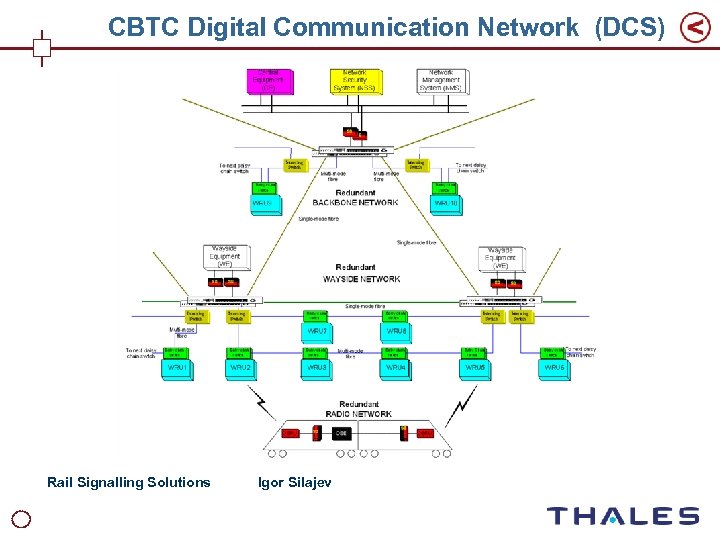
CBTC Digital Communication Network (DCS) Rail Signalling Solutions Igor Silajev
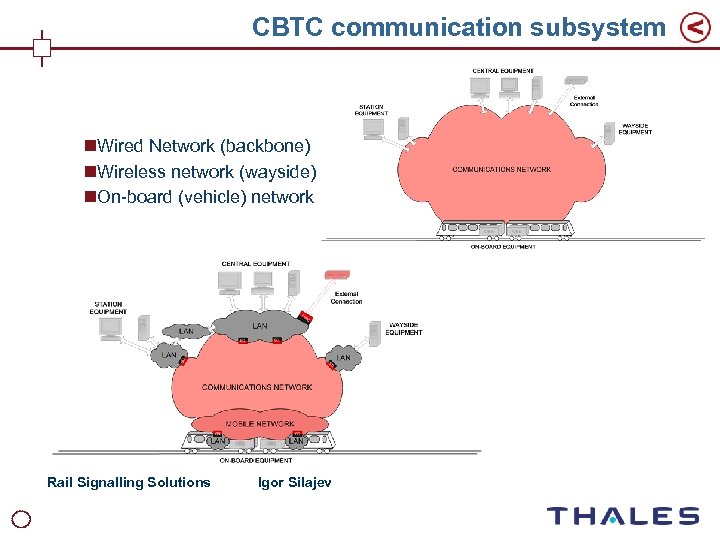
CBTC communication subsystem n. Wired Network (backbone) n. Wireless network (wayside) n. On-board (vehicle) network Rail Signalling Solutions Igor Silajev
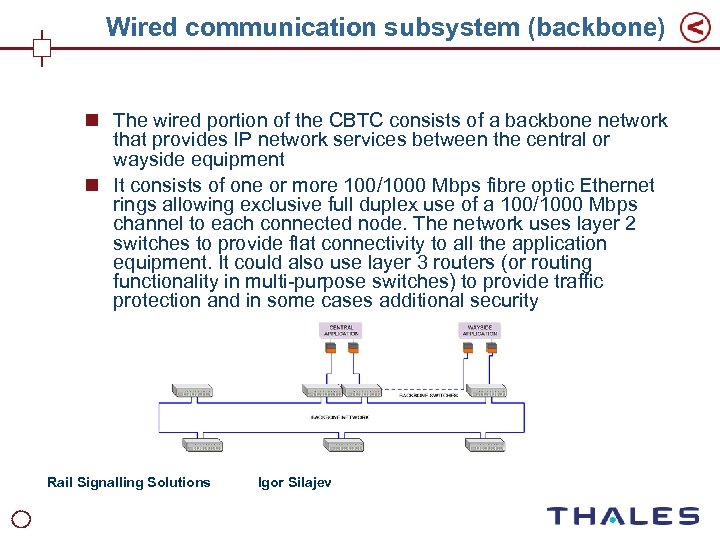
Wired communication subsystem (backbone) n The wired portion of the CBTC consists of a backbone network that provides IP network services between the central or wayside equipment n It consists of one or more 100/1000 Mbps fibre optic Ethernet rings allowing exclusive full duplex use of a 100/1000 Mbps channel to each connected node. The network uses layer 2 switches to provide flat connectivity to all the application equipment. It could also use layer 3 routers (or routing functionality in multi-purpose switches) to provide traffic protection and in some cases additional security Rail Signalling Solutions Igor Silajev
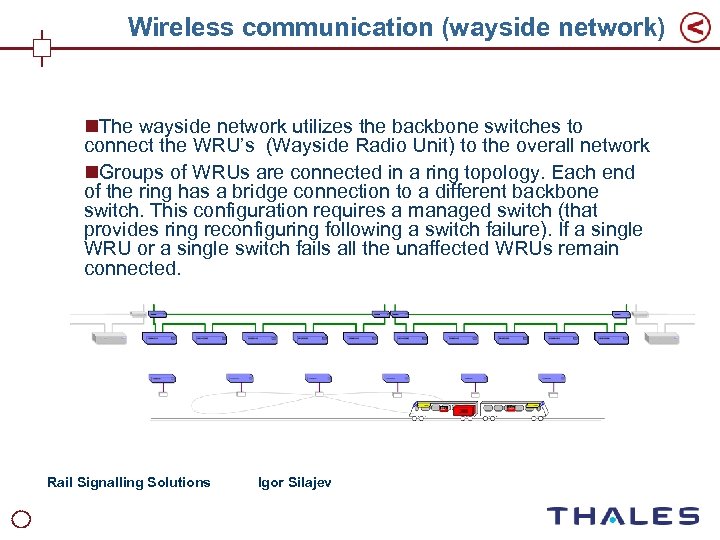
Wireless communication (wayside network) n. The wayside network utilizes the backbone switches to connect the WRU’s (Wayside Radio Unit) to the overall network n. Groups of WRUs are connected in a ring topology. Each end of the ring has a bridge connection to a different backbone switch. This configuration requires a managed switch (that provides ring reconfiguring following a switch failure). If a single WRU or a single switch fails all the unaffected WRUs remain connected. Rail Signalling Solutions Igor Silajev
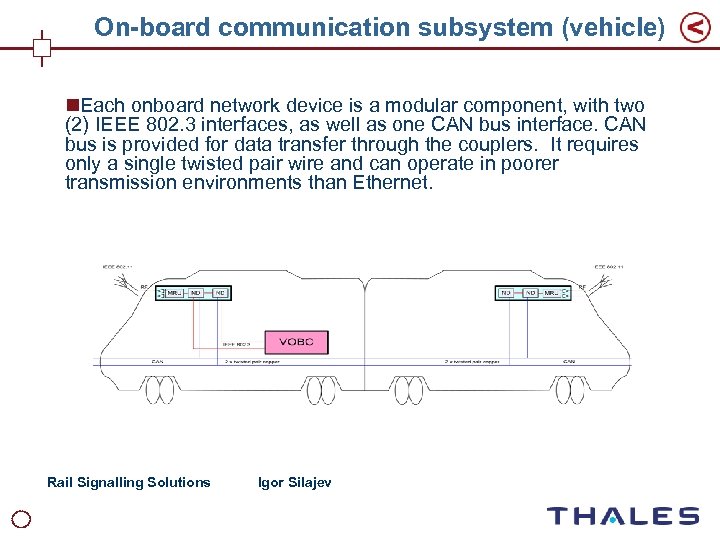
On-board communication subsystem (vehicle) n. Each onboard network device is a modular component, with two (2) IEEE 802. 3 interfaces, as well as one CAN bus interface. CAN bus is provided for data transfer through the couplers. It requires only a single twisted pair wire and can operate in poorer transmission environments than Ethernet. Rail Signalling Solutions Igor Silajev
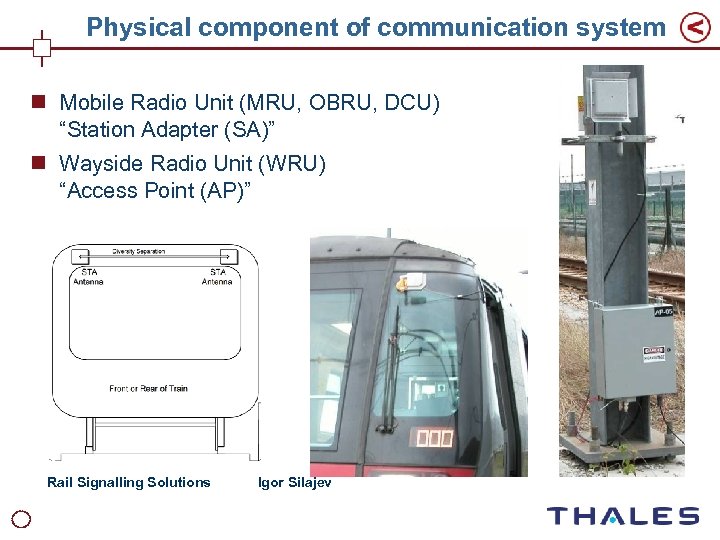
Physical component of communication system n Mobile Radio Unit (MRU, OBRU, DCU) “Station Adapter (SA)” n Wayside Radio Unit (WRU) “Access Point (AP)” Rail Signalling Solutions Igor Silajev
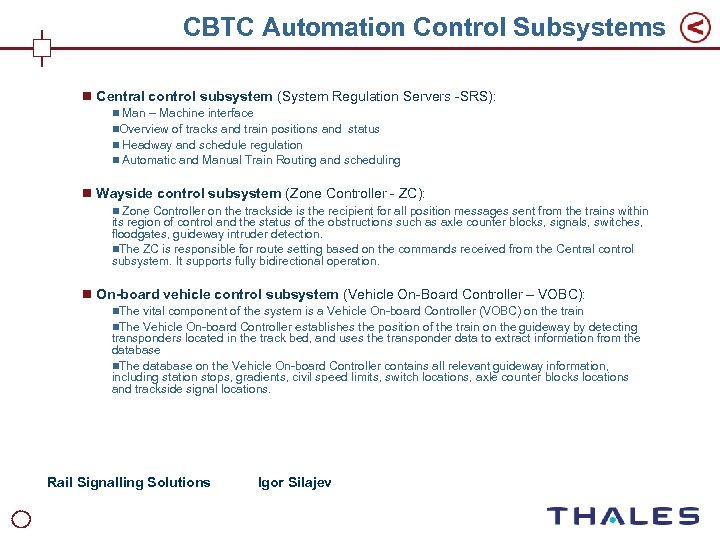
CBTC Automation Control Subsystems n Central control subsystem (System Regulation Servers -SRS): n Man – Machine interface n. Overview of tracks and train positions and status n Headway and schedule regulation n Automatic and Manual Train Routing and scheduling n Wayside control subsystem (Zone Controller - ZC): n Zone Controller on the trackside is the recipient for all position messages sent from the trains within its region of control and the status of the obstructions such as axle counter blocks, signals, switches, floodgates, guideway intruder detection. n. The ZC is responsible for route setting based on the commands received from the Central control subsystem. It supports fully bidirectional operation. n On-board vehicle control subsystem (Vehicle On-Board Controller – VOBC): n. The vital component of the system is a Vehicle On-board Controller (VOBC) on the train n. The Vehicle On-board Controller establishes the position of the train on the guideway by detecting transponders located in the track bed, and uses the transponder data to extract information from the database n. The database on the Vehicle On-board Controller contains all relevant guideway information, including station stops, gradients, civil speed limits, switch locations, axle counter blocks locations and trackside signal locations. Rail Signalling Solutions Igor Silajev
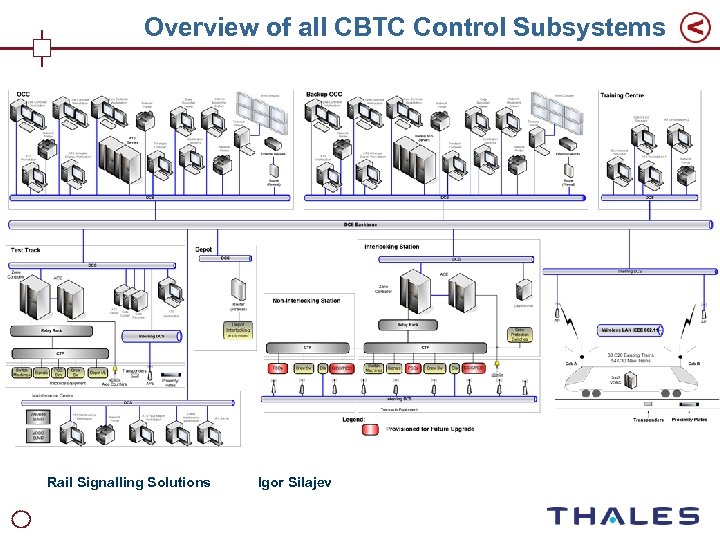
Overview of all CBTC Control Subsystems Rail Signalling Solutions Igor Silajev
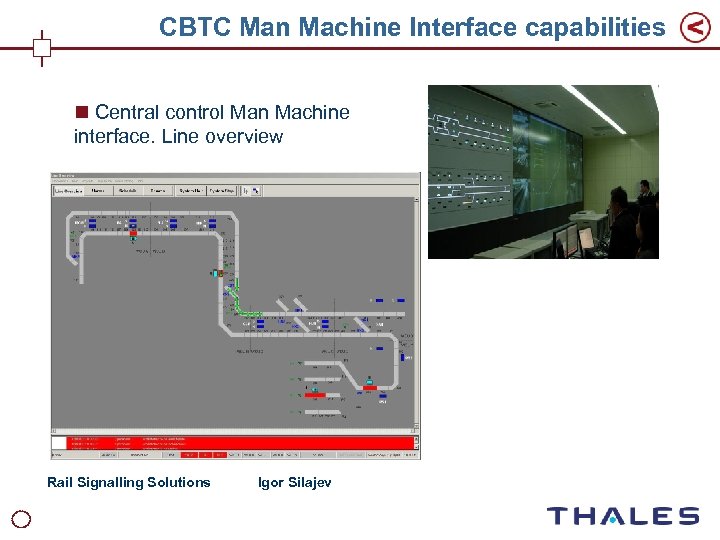
CBTC Man Machine Interface capabilities n Central control Man Machine interface. Line overview Rail Signalling Solutions Igor Silajev
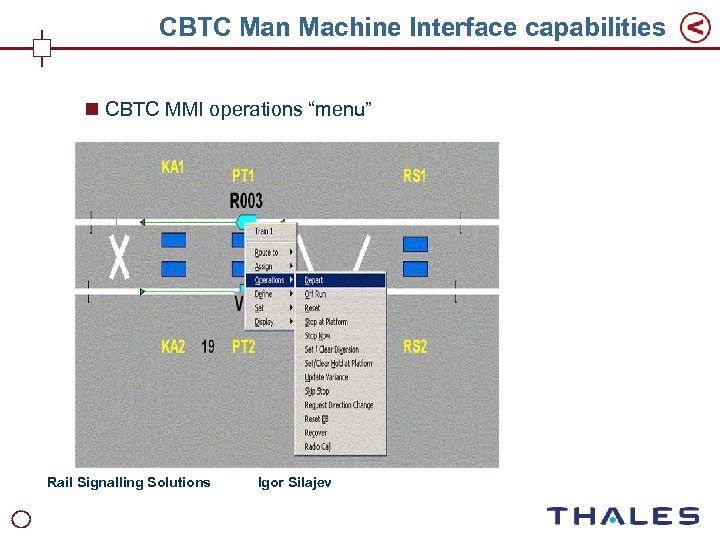
CBTC Man Machine Interface capabilities n CBTC MMI operations “menu” Rail Signalling Solutions Igor Silajev
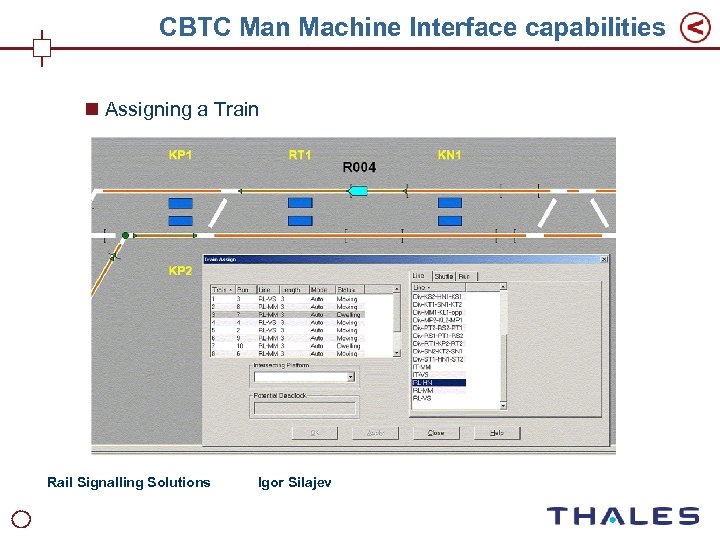
CBTC Man Machine Interface capabilities n Assigning a Train Rail Signalling Solutions Igor Silajev
CBTC Man Machine Interface capabilities n. Schedule definition, assignment and adjustment n. Predefine different schedule for weekday, weekend, holiday, etc. n. Predefine distribution of trains between buildups and reductions throughout the day n. Assign / clear predefined schedule for System Regulation Server to implement n. Apply automatic or manual global schedule slide Rail Signalling Solutions Igor Silajev
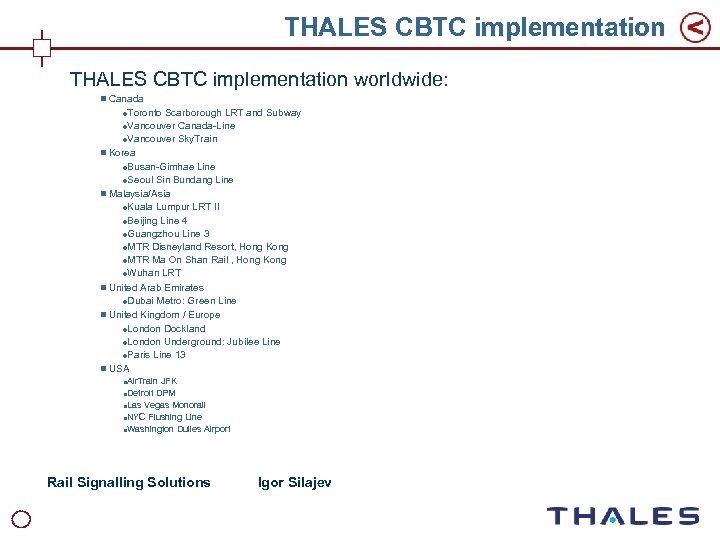
THALES CBTC implementation worldwide: n Canada l. Toronto Scarborough LRT and Subway l. Vancouver Canada-Line l. Vancouver Sky. Train n Korea l. Busan-Gimhae Line l. Seoul Sin Bundang Line n Malaysia/Asia l. Kuala Lumpur LRT II l. Beijing Line 4 l. Guangzhou Line 3 l. MTR Disneyland Resort, Hong Kong l. MTR Ma On Shan Rail , Hong Kong l. Wuhan LRT n United Arab Emirates l. Dubai Metro: Green Line n United Kingdom / Europe l. London Dockland l. London Underground: Jubilee Line l. Paris Line 13 n USA l. Air. Train JFK DPM l. Las Vegas Monorail l. NYC Flushing Line l. Washington Dulles Airport l. Detroit Rail Signalling Solutions Igor Silajev
Questions / Answers n. Q & A Rail Signalling Solutions Igor Silajev
Скачать презентацию CBTC Communication Based Train Control Rail Signalling
012c7ebde013a83b7f3b1291fce412a3.ppt