 Скачать презентацию CBS case study Crime survey Neuchatel 7 -8
3b61c47f4e4618c59f5221e664e30a90.ppt
- Количество слайдов: 24




CBS case study Crime survey Neuchatel, 7 -8 July 2011
Introduction • • • Crime and victimization survey Planned domains: police districts Sample size approx 750 / district 2005 -2008: NSM 2008 onwards: ISM SAE of crime statistics
From NSM to ISM • Local oversampling • Data collection: sequential mixed-mode • Different questionnaire Discontinuities expected SAE of crime statistics
Quantifying discontinuities • Survey transition from NSM to ISM • Small scale NSM in parallel to new ISM (full scale: approx 18, 000; small: 1/3 rd) • Discontinuities at national level • Now: police district level discontinuities required • But: NSM sample too small => SAE of crime statistics
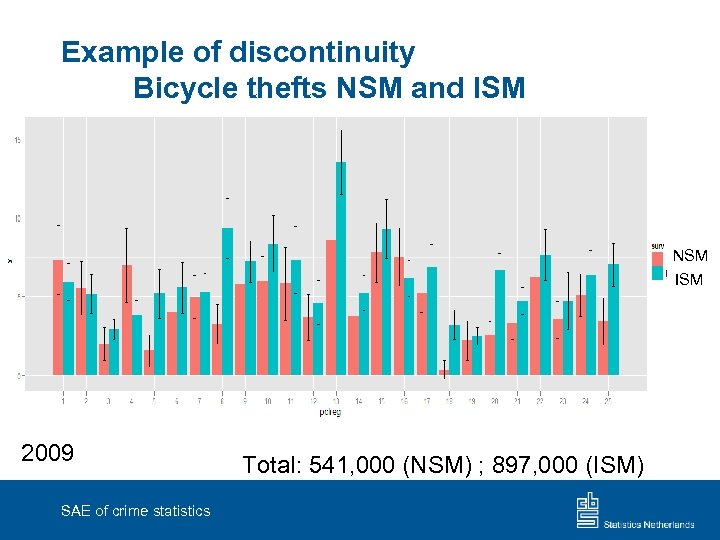
Example of discontinuity Bicycle thefts NSM and ISM NSM ISM 2009 SAE of crime statistics Total: 541, 000 (NSM) ; 897, 000 (ISM)
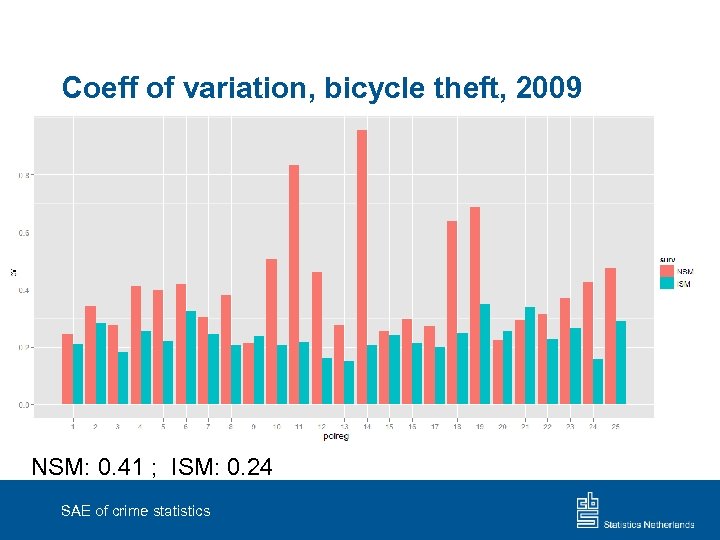
Coeff of variation, bicycle theft, 2009 NSM: 0. 41 ; ISM: 0. 24 SAE of crime statistics
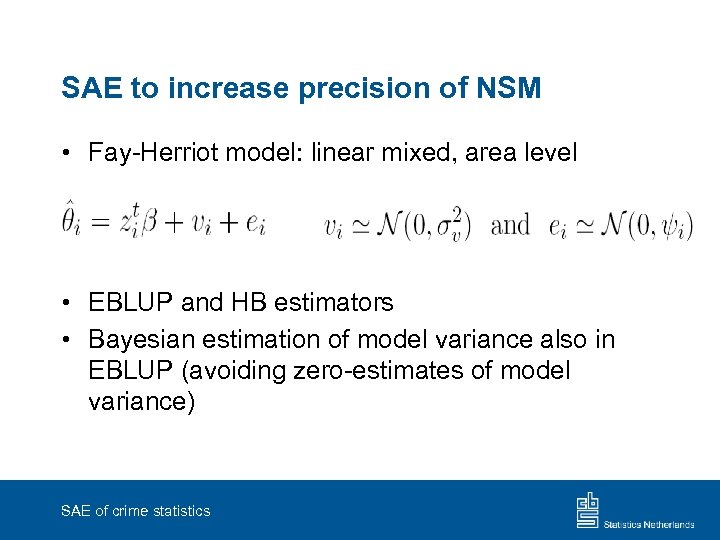
SAE to increase precision of NSM • Fay-Herriot model: linear mixed, area level • EBLUP and HB estimators • Bayesian estimation of model variance also in EBLUP (avoiding zero-estimates of model variance) SAE of crime statistics
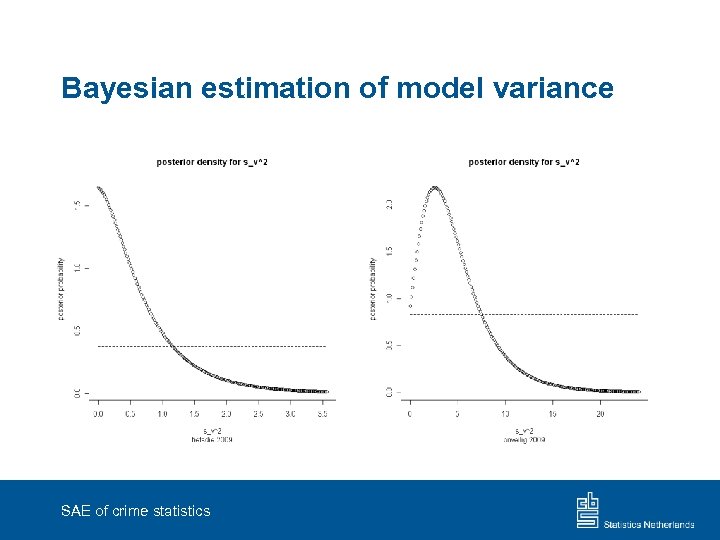
Bayesian estimation of model variance SAE of crime statistics
Covariates from registers • Police: Reported offences: property crimes, violence, assaults, threats, illicit drugs, weapons, vandalism, traffic offences • Administration: age, ethnicity, urbanisation, house prices, welfare claimants SAE of crime statistics
Covariates from ISM survey • Design based GREG estimates as auxiliary information (Ybarra & Lohr 2008) • Consequences for small area estimates • Model estimate weighted lower in BLUP due to error in covariate • Achieved through higher estimate of model variance in EBLUP (not Y & L adjustment) • Variance of GREGs approx. equal for all areas • (Other idea: multivariate FH model) SAE of crime statistics
Simulating errors in covariates • Bicycle thefts: NSM survey ~ police-reported • No error • post. mean model var = 1. 22 • Adding error, mean 0, sd 2, iterate 1, 000 x • post. mean model var = 1. 32 • To add detail, e. g. estimated beta SAE of crime statistics
Dimension reduction: PCA • Rather than using a small subset of covariates, use small dimension of PC subspace • Not guaranteed to work as correlation with survey variables not used in PCA • Use as a separate set of potential covariates in model selection pc 1 var. expl. . 39 SAE of crime statistics 2. 55 3 4 5 6 . 67. 75. 81. 87 … 12 … . 99
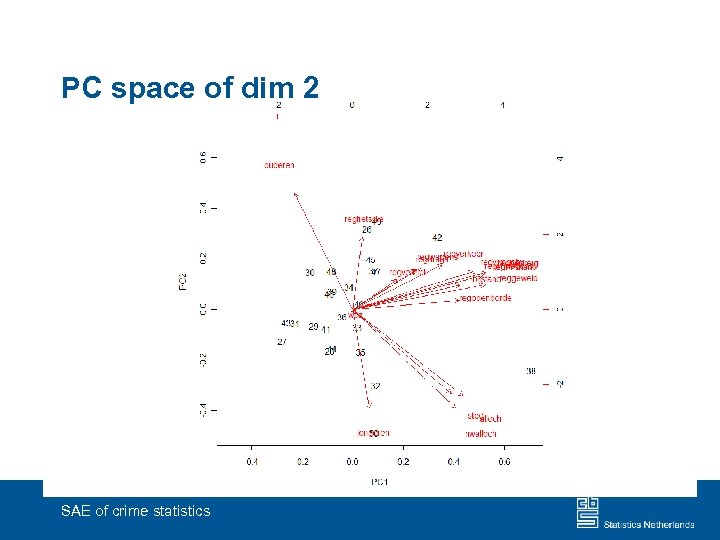
PC space of dim 2 SAE of crime statistics
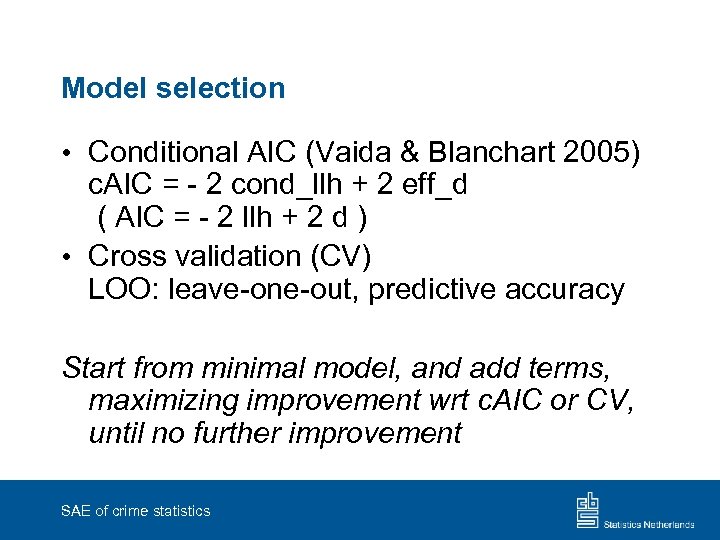
Model selection • Conditional AIC (Vaida & Blanchart 2005) c. AIC = - 2 cond_llh + 2 eff_d ( AIC = - 2 llh + 2 d ) • Cross validation (CV) LOO: leave-one-out, predictive accuracy Start from minimal model, and add terms, maximizing improvement wrt c. AIC or CV, until no further improvement SAE of crime statistics
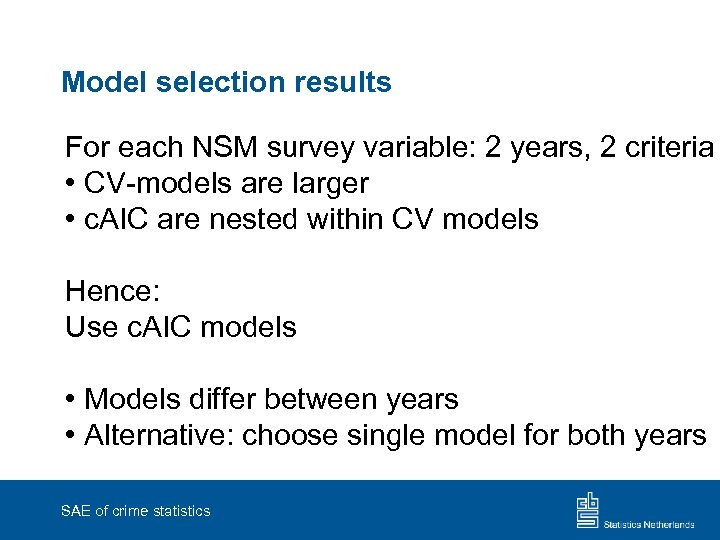
Model selection results For each NSM survey variable: 2 years, 2 criteria • CV-models are larger • c. AIC are nested within CV models Hence: Use c. AIC models • Models differ between years • Alternative: choose single model for both years SAE of crime statistics
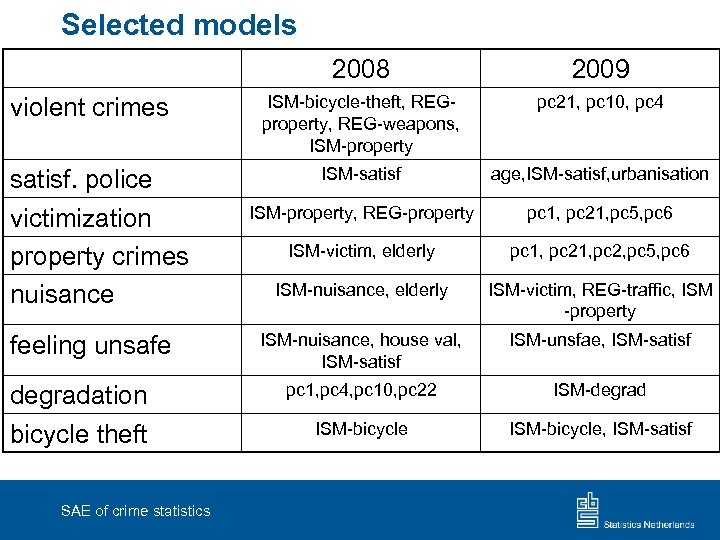
Selected models 2008 violent crimes satisf. police victimization property crimes nuisance feeling unsafe degradation bicycle theft SAE of crime statistics 2009 ISM-bicycle-theft, REGproperty, REG-weapons, ISM-property pc 21, pc 10, pc 4 ISM-satisf age, ISM-satisf, urbanisation ISM-property, REG-property pc 1, pc 21, pc 5, pc 6 ISM-victim, elderly pc 1, pc 2, pc 5, pc 6 ISM-nuisance, elderly ISM-victim, REG-traffic, ISM -property ISM-nuisance, house val, ISM-satisf ISM-unsfae, ISM-satisf pc 1, pc 4, pc 10, pc 22 ISM-degrad ISM-bicycle, ISM-satisf
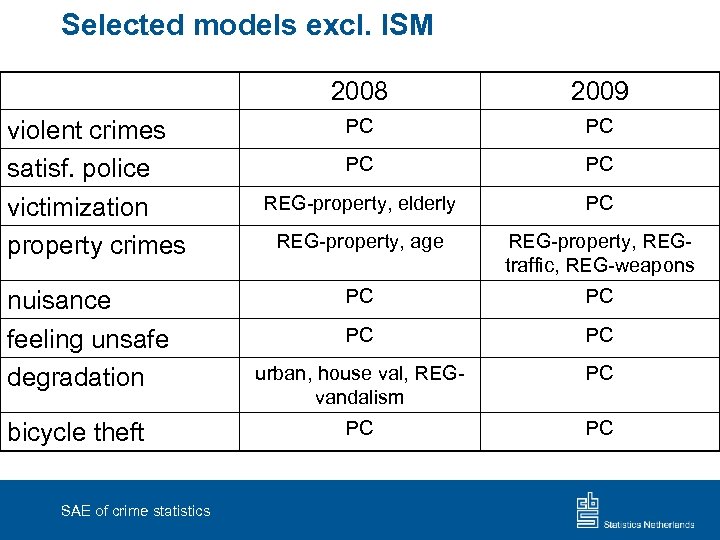
Selected models excl. ISM 2008 violent crimes satisf. police victimization property crimes nuisance feeling unsafe degradation bicycle theft SAE of crime statistics 2009 PC PC REG-property, elderly PC REG-property, age REG-property, REGtraffic, REG-weapons PC PC urban, house val, REGvandalism PC PC PC
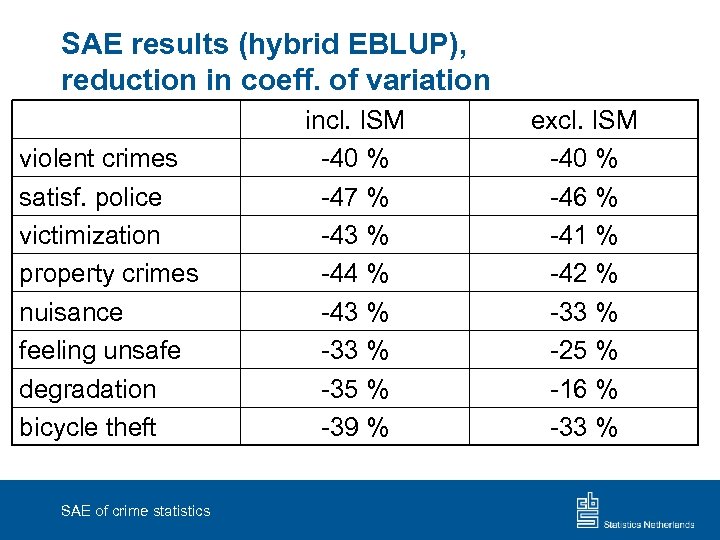
SAE results (hybrid EBLUP), reduction in coeff. of variation violent crimes satisf. police victimization property crimes nuisance feeling unsafe degradation bicycle theft SAE of crime statistics incl. ISM -40 % -47 % -43 % -44 % -43 % -35 % -39 % excl. ISM -40 % -46 % -41 % -42 % -33 % -25 % -16 % -33 %
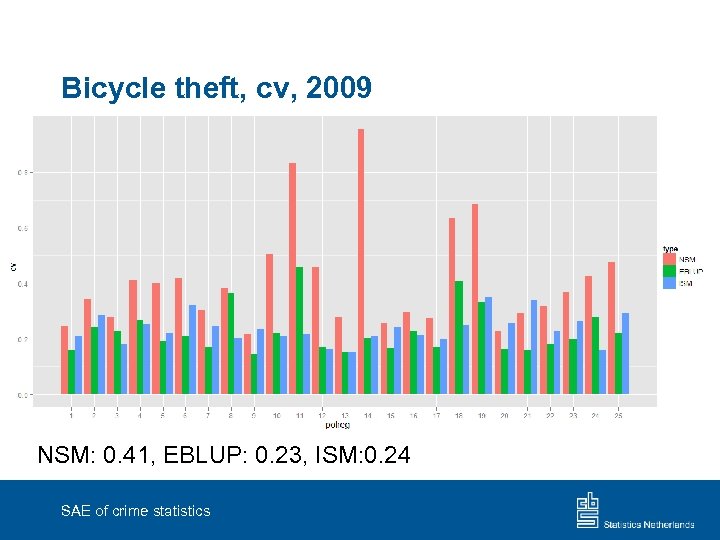
Bicycle theft, cv, 2009 NSM: 0. 41, EBLUP: 0. 23, ISM: 0. 24 SAE of crime statistics
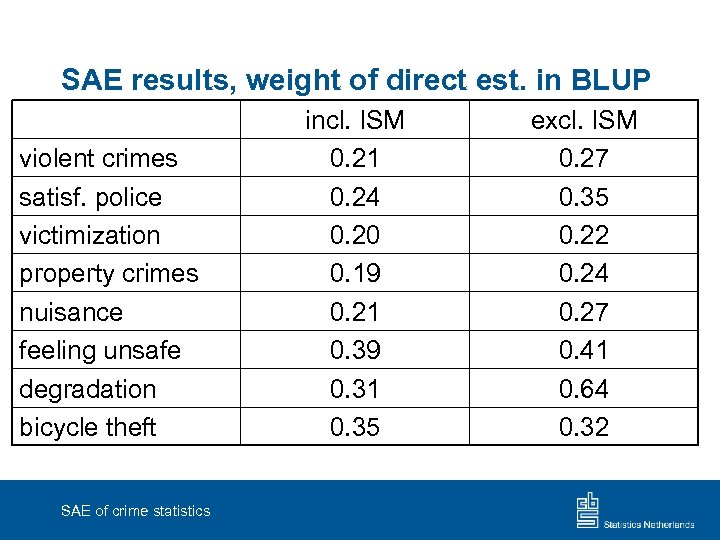
SAE results, weight of direct est. in BLUP violent crimes satisf. police victimization property crimes nuisance feeling unsafe degradation bicycle theft SAE of crime statistics incl. ISM 0. 21 0. 24 0. 20 0. 19 0. 21 0. 39 0. 31 0. 35 excl. ISM 0. 27 0. 35 0. 22 0. 24 0. 27 0. 41 0. 64 0. 32
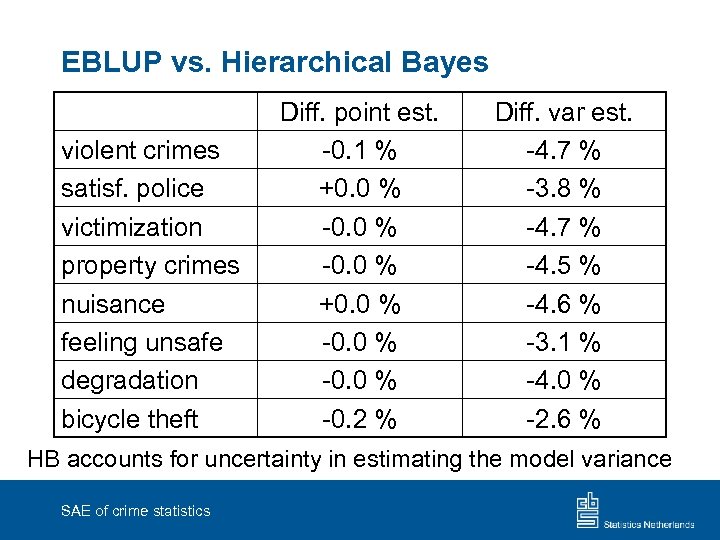
EBLUP vs. Hierarchical Bayes violent crimes satisf. police victimization property crimes nuisance feeling unsafe degradation bicycle theft Diff. point est. -0. 1 % +0. 0 % -0. 2 % Diff. var est. -4. 7 % -3. 8 % -4. 7 % -4. 5 % -4. 6 % -3. 1 % -4. 0 % -2. 6 % HB accounts for uncertainty in estimating the model variance SAE of crime statistics
Conclusions • • Considerable increase in precision with SAE Gain in precision depends on variable PCA is important for some variables Using ISM outcomes important for some variables • MSE estimates HB higher (preferable) SAE of crime statistics
To do (maybe) • Sort out errors in input data! And re-run everything. • Calibration to direct estimate of totals (is model diagnostic) • Study residuals • Elaborate on errors in covariates • Use past survey outcomes as covariates • More detailed comparison of HB-NSM estimates with ISM SAE of crime statistics
Future work (post-ESSnet) • Multivariate modelling of NSM and ISM variables • Consider model averaging • Using more detailed areas, with smaller sample sizes: beneficial? SAE of crime statistics
Скачать презентацию CBS case study Crime survey Neuchatel 7 -8
3b61c47f4e4618c59f5221e664e30a90.ppt