 Скачать презентацию CBRNE Resilience Strategy and Action Plan for Canada
dced74df3d5d74e837c48af274f129ce.ppt
- Количество слайдов: 19



CBRNE Resilience Strategy and Action Plan for Canada Pierre Trudel October 20, 2011
Contents ● International Safety and Security Landscape ● Overview of CBRNE policy and programs in Canada ● Scientific Support to CBRNE Resilience ● CBRNE Resilience Strategy and Action Plan for Canada ● Federal CBRNE Plan ● Federal Nuclear Emergency Plan (FNEP) ● All Hazards Risk Assessment Canada’s multi jurisdictional/multi disciplinary approach ● International CBRNE Cooperation 2
International Safety and Security Landscape ● Complex, interconnected global challenges Global Nuclear Safety CBRNE Resilience Critical Infrastructure Protection Pandemics Aviation Security Radicalization and counter violent extremism (CVE) … Domestic: ● Resilience of the economy ● Secure flow of people and goods ● Arctic and the North: sovereignty and border security 3
CBRNE Domestic Landscape 2005 Chemical, Biological, Radiological and Nuclear Strategy of the Government of Canada 4
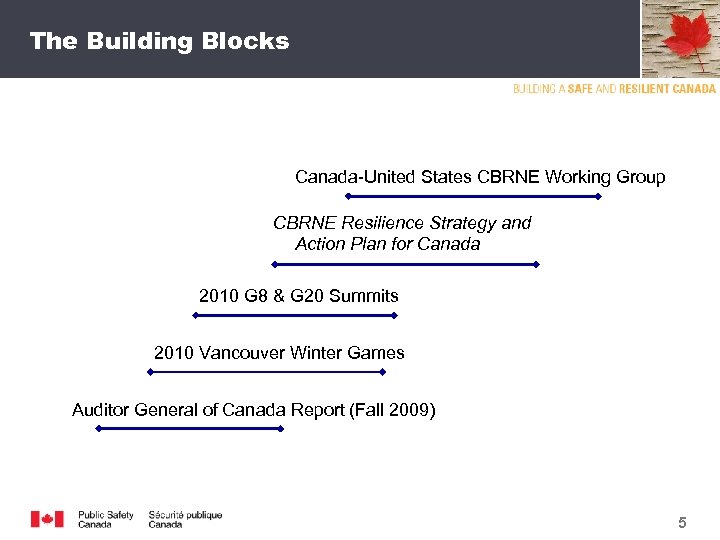
The Building Blocks Canada United States CBRNE Working Group CBRNE Resilience Strategy and Action Plan for Canada 2010 G 8 & G 20 Summits 2010 Vancouver Winter Games Auditor General of Canada Report (Fall 2009) 5
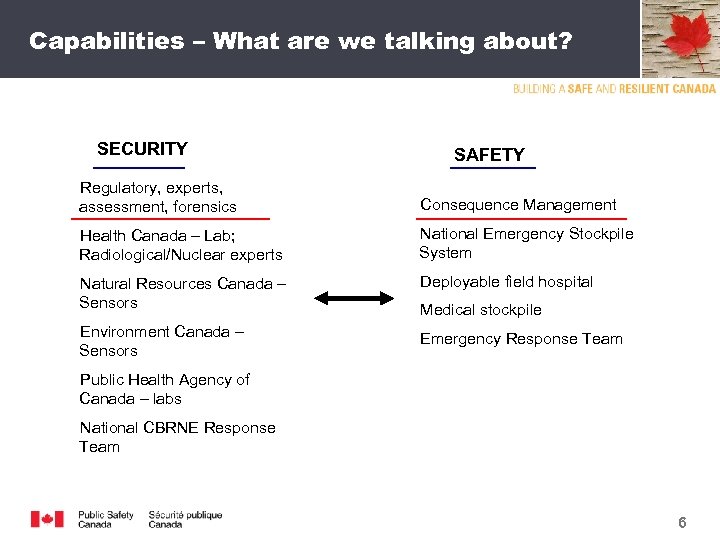
Capabilities – What are we talking about? SECURITY SAFETY Regulatory, experts, assessment, forensics Consequence Management Health Canada – Lab; Radiological/Nuclear experts National Emergency Stockpile System Natural Resources Canada – Sensors Deployable field hospital Environment Canada – Sensors Emergency Response Team Medical stockpile Public Health Agency of Canada – labs National CBRNE Response Team 6
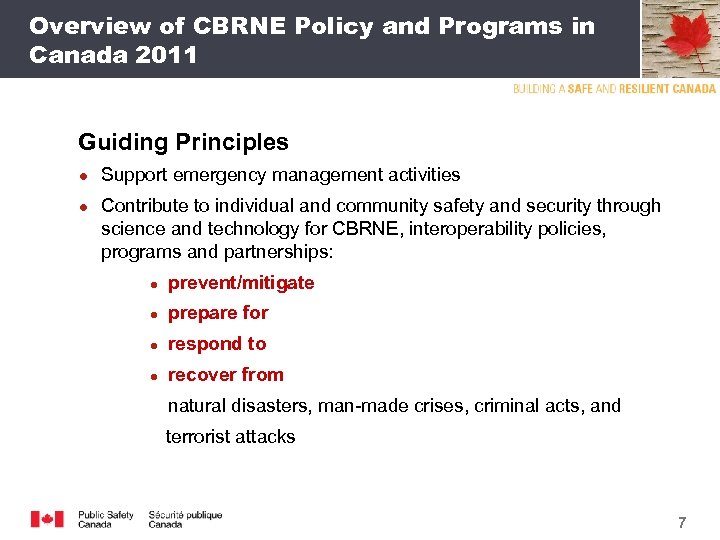
Overview of CBRNE Policy and Programs in Canada 2011 Guiding Principles ● Support emergency management activities ● Contribute to individual and community safety and security through science and technology for CBRNE, interoperability policies, programs and partnerships: ● prevent/mitigate ● prepare for ● respond to ● recover from natural disasters, man made crises, criminal acts, and terrorist attacks 7
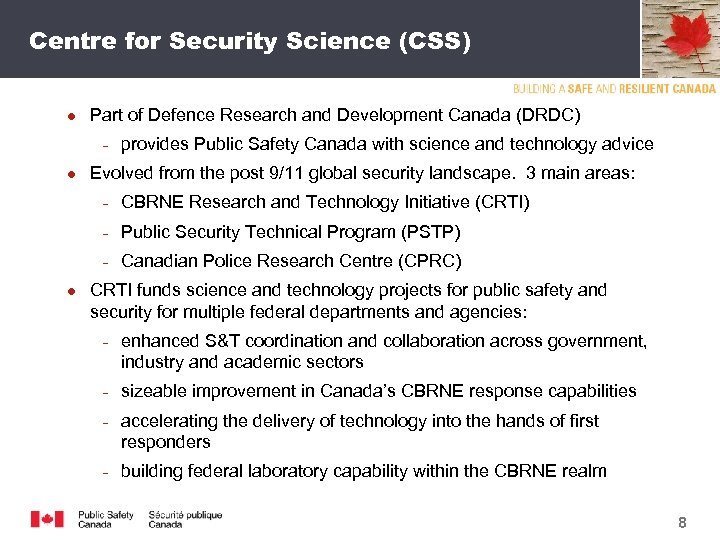
Centre for Security Science (CSS) ● Part of Defence Research and Development Canada (DRDC) provides Public Safety Canada with science and technology advice ● Evolved from the post 9/11 global security landscape. 3 main areas: CBRNE Research and Technology Initiative (CRTI) Public Security Technical Program (PSTP) Canadian Police Research Centre (CPRC) ● CRTI funds science and technology projects for public safety and security for multiple federal departments and agencies: enhanced S&T coordination and collaboration across government, industry and academic sectors sizeable improvement in Canada’s CBRNE response capabilities accelerating the delivery of technology into the hands of first responders building federal laboratory capability within the CBRNE realm 8
CBRNE Resilience Strategy for Canada ● Federal/Provincial/Territorial Ministers Responsible for Emergency Management approved (January 2011): The Chemical, Biological, Radiological, Nuclear and Explosives Resilience Strategy for Canada The Chemical, Biological, Radiological, Nuclear and Explosives Resilience Action Plan for Canada ● Purpose: To guide the creation and maintenance of sustainable Canadian CBRNE policies, programs, standards, training, plans and concepts at the international, federal, provincial and territorial levels 9
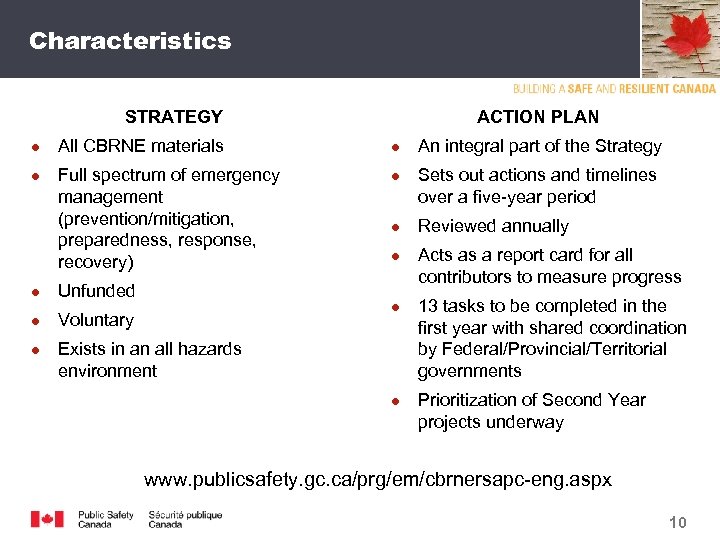
Characteristics STRATEGY ACTION PLAN ● All CBRNE materials ● An integral part of the Strategy ● Full spectrum of emergency management (prevention/mitigation, preparedness, response, recovery) ● Sets out actions and timelines over a five year period ● Reviewed annually ● Acts as a report card for all contributors to measure progress ● 13 tasks to be completed in the first year with shared coordination by Federal/Provincial/Territorial governments ● Prioritization of Second Year projects underway ● Unfunded ● Voluntary ● Exists in an all hazards environment www. publicsafety. gc. ca/prg/em/cbrnersapc eng. aspx 10
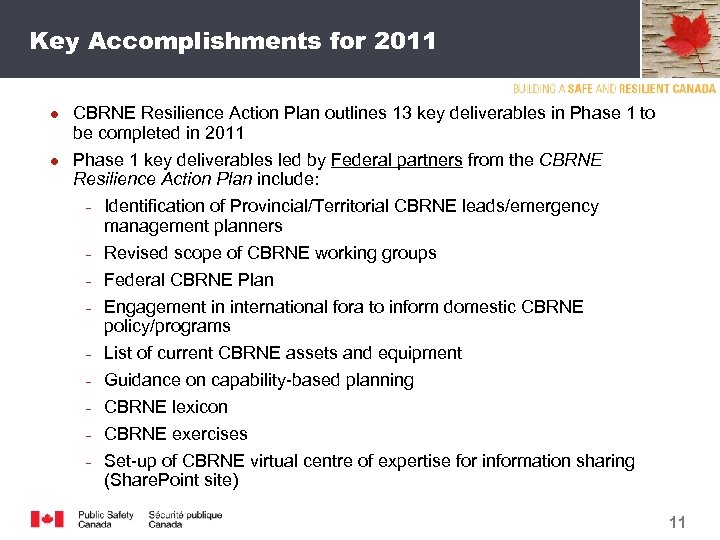
Key Accomplishments for 2011 ● CBRNE Resilience Action Plan outlines 13 key deliverables in Phase 1 to be completed in 2011 ● Phase 1 key deliverables led by Federal partners from the CBRNE Resilience Action Plan include: Identification of Provincial/Territorial CBRNE leads/emergency management planners Revised scope of CBRNE working groups Federal CBRNE Plan Engagement in international fora to inform domestic CBRNE policy/programs List of current CBRNE assets and equipment Guidance on capability based planning CBRNE lexicon CBRNE exercises Set up of CBRNE virtual centre of expertise for information sharing (Share. Point site) 11
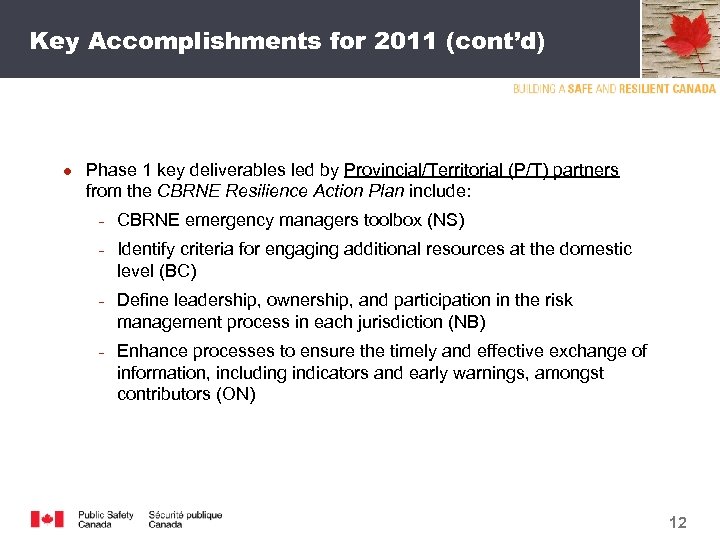
Key Accomplishments for 2011 (cont’d) ● Phase 1 key deliverables led by Provincial/Territorial (P/T) partners from the CBRNE Resilience Action Plan include: CBRNE emergency managers toolbox (NS) Identify criteria for engaging additional resources at the domestic level (BC) Define leadership, ownership, and participation in the risk management process in each jurisdiction (NB) Enhance processes to ensure the timely and effective exchange of information, including indicators and early warnings, amongst contributors (ON) 12
Focus for 2012 ● Work on the following Phase 2 action items will begin in 2012: Development of risk assessment methodologies specific to CBRNE Refine CBRNE training delivery (at individual level) Develop core requirements for a National CBRNE Plan 13
Federal CBRNE Plan ● Aim provide the necessary direction, coordination and support for integrated federal actions ● Scope all four components of emergency management coordinate with Federal Nuclear Emergency Plan (FNEP) revision builds on Federal Emergency Response Plan (FERP) and Emergency Support Function (ESF) responsibilities 14
Federal Nuclear Emergency Plan (FNEP) ● FNEP initially written in 1984 and last major update was in 2002 before Emergency Management Framework for Canada before Federal Emergency Response Plan ● Major revision underway led by Health Canada (HC) – Radiation Protection Bureau (RPB) multi departmental/multi jurisdictional in scope coordinated with Federal CBRNE Plan development 15
All-Hazards Risk Assessment ● Public Safety Canada is leading a federal process to develop a whole of government risk picture: Purpose: Support effective emergency management planning in federal institutions Scope: Support Ministers in meeting their legislative responsibility under the Emergency Management Act to identify risks within or related to their mandate and develop emergency management plans in respect of those risks All Hazards Approach: A mechanism for comparing and rating all hazards risks (malicious or non malicious) Integrated Approach: Provides a Government of Canada picture rather than an individual perspective from each department 16
International Engagement ● PS has recently commenced development with United States (U. S. ) partners of a Canada United States CBRNE Working Group ● PS is engaging with the North Atlantic Treaty Organization’s (NATO) Civil Emergency Planning centre to leverage ongoing CBRNE planning efforts and examine the potential for Canadian participation in NATO CBRNE related activities ● PS is working with the Global Initiative to Counter Nuclear Terrorism (GICNT) with an exercise to validate GICNT’s strategic plan 17
Canada – United States Cooperation ● Canada United States CBRNE Working Group to focus on preventing/ mitigating, preparing for, responding to, and recovering from CBRNE events. From a Canadian perspective, key deliverables are: CBRNE Mutual Assistance Plan: evaluate each country’s capabilities and the most efficient cross border deployment develop protocols to ensure rapid U. S. assistance to Canada and vice versa provide a greater alignment in the CBRNE domain between the two countries as each country learns more about: ● the other’s capabilities, roles and responsibilities the ability of each country to assist the other during critical periods of CBRNE events to be validated through exercises and adjusted to reflect lessons learned links science & technology, policy, and plans: ● operational communities will support and inform each other ● 18
Discussion 19
Скачать презентацию CBRNE Resilience Strategy and Action Plan for Canada
dced74df3d5d74e837c48af274f129ce.ppt